
Electric Mop Market Size, Growth & Demand by 2034
Coverage: By Mop Type (Flat Type, Spiral, Others); Connectivity (Wired, Cordless); Application (Residential, Commercial) , and Geography (North America, Europe, Asia Pacific, and South and Central America)
- Status : Data Released
- Report Code : TIPRE00006375
- Category : Electronics and Semiconductor
- No. of Pages : 150
- Available Report Formats :


- Last update date : August 10, 2026


2025 Market Size
US$ 6.95 Bn
Base year value
2034 Forecast
US$ 10.45 Bn
Projected by 2034
CAGR 2026-2034
4.64 %
Growth rate
Addressable Market
US$ 79.01 Bn
(2026-2034)
The Electric Mop Market was valued at US$ 6.95 Billion in 2025 and is projected to reach US$ 10.45 Billion by 2034, registering a CAGR of 4.64% from 2026 to 2034. The Market is increasing due to the fact that people are gradually shifting from traditional floor cleaning systems to advanced electric mops that offer efficient cleaning results.
North America is anticipated to witness a CAGR between 4.2-4.8% for the Electric Mop market size through 2034 due to high penetration of hard floors, higher pet adoption rate, and higher cycle life of small appliances in the region. The demand will be boosted by apartments, healthcare-associated cleaning practices, hospitality renovation, and retail marketing of wet/dry and steam electric mops.
Electric Mop Market Assessment and Insights
- North America held 26–30% share in 2025 and is growing at a CAGR range of 4.2–4.8% during 2026–2034, supported by cordless adoption, pet cleanup needs, and online appliance upgrades.
- US represented 79–83% of North America in 2025 and is growing at a CAGR range of 4.3–4.9%, led by premium residential and facility cleaning demand.
- Europe accounted for 22–26% share in 2025 and is advancing at a CAGR range of 3.9–4.5%, with Germany, the UK, France, Italy, and Spain leading adoption.
- Asia Pacific captured 34–38% share in 2025 and is expanding at a CAGR range of 5.0–5.6%, led by China, Japan, South Korea, India, and Australia.
- Largest Segment Flat Type held 58–62% market share in 2025 and is growing at a CAGR range of 4.1–4.7%, supported by broad residential usability and lower learning curve.
- High Growth Segment Cordless held 42–46% market share in 2025 and is growing at a CAGR range of 5.3–5.9%, driven by mobility, compact homes, and battery innovation.
- Key companies analyzed in detail: BISSELL Homecare, Inc., Stanley Black & Decker, Inc., Eureka Forbes Limited, Guangdong Kingbest Electric Co., Ltd., HAAN Corporation, Haier Group Corporation, Alfred Kärcher SE & Co. KG, Nilfisk A/S, TTK Prestige Limited, and SharkNinja Operating LLC.
Source: The Insight Partners' analysis based on proprietary research, government publications, company annual reports, investor presentations, industry databases, and expert interviews.
Technological migration is driving the market from single-function steam products into multi-function floor care systems featuring vacuuming, cleaning, mopping, washing, scrubbing, steaming, and self-cleaning. Technology development involves the availability of lithium-ion batteries, brushless motors, tank sealing technology, washable pads, rollers and electronic controls for moisture, suction and heating. Affordability while also ensuring product longevity has become an increasingly important consideration since floor care products are constantly exposed to water and subjected to mechanical stress.
Proactive demand will gain momentum in urban Asia, the North American replacement channels and environmentally-conscious European homes. Investments in the future will focus on cordless systems, dual tank systems, robotization and low chemical usage. The regulatory environment is supportive indirectly through safety, energy efficiency, indoor hygiene standards and workplace cleaning requirements forcing commercial purchasers to purchase hard floor care systems that deliver predictable results.
Electric Mop Market Report Scope
| Report Attribute | Details |
|---|---|
| Market size in 2025 | US$ 6.95 Billion |
| Market Size by 2034 | US$ 10.45 Billion |
| Global CAGR (2026 - 2034) | 4.64% |
| Historical Data | 2021-2024 |
| Forecast period | 2026-2034 |
Electric Mop Market Analysis
The market is growing due to the trend toward small families, the presence of more hard surfaces, pet ownership, and the need to reduce manual labor. The supply chain includes manufacturers of motor and battery units, plastic molders, suppliers of pads and rollers, water pump manufacturers, appliance manufacturers, e-commerce companies, distributors, facility services and customers who compare cleaning time, sanitation benefits, and maintenance cost.
The supply factors are the suppliers' ability to address the problem of battery endurance, leaks, steam safety, and replacement parts after sales. The consumer needs to have visible cleanliness without the use of buckets, squeezing, and repeated cleaning sweeps. The commercial demand includes hotels, hospitals, educational institutions, retailers, and office space that utilizes electric mops in areas where manual scrubbing is not feasible.
The competitive market in the Electric Mop Market Report consists of two divisions, which include Household care appliances and Commercial floor care products. These divisions comprise BISSELL Homecare, Inc. and SharkNinja Operating LLC, specializing in wet-dry and steam respectively, while Commercial floor care products division comprises Alfred Kärcher SE & Co. KG and Nilfisk A/S, gaining their credibility in hard floor systems. Companies like Stanley Black & Decker, Inc., Eureka Forbes Limited, Haier Group Corporation, TTK Prestige Limited, HAAN Corporation, and Guangdong Kingbest Electric Co., Ltd. focus on regional and price-sensitive markets.
Cordless ergonomics, self-cleaning rollers, quicker heating up, larger capacity tanks, and easy storage represent investment opportunities in the industry. Positioning requires credible hygiene features, replacement pads' availability, and channel coverage. The brands which are in line with apartment use, pet care, aging consumers, and route cleaning services may help with improving customer loyalty and minimizing return rates associated with heavy items, water leaking, and maintenance issues.
● REPORT CUSTOMIZATION
Tailor This Report To Align With Your Specific Business Requirements
This report can be customized to align precisely with your business objectives, scope, and target markets. Customization options include tailored segmentation, geography, competitive analysis, and strategic insights to support informed decision-making.
Customize This Report →WHAT YOU CAN ADJUST
- ● Segmentations
- ● Geography
- ● Competitive Analysis
- ● Language Preferences
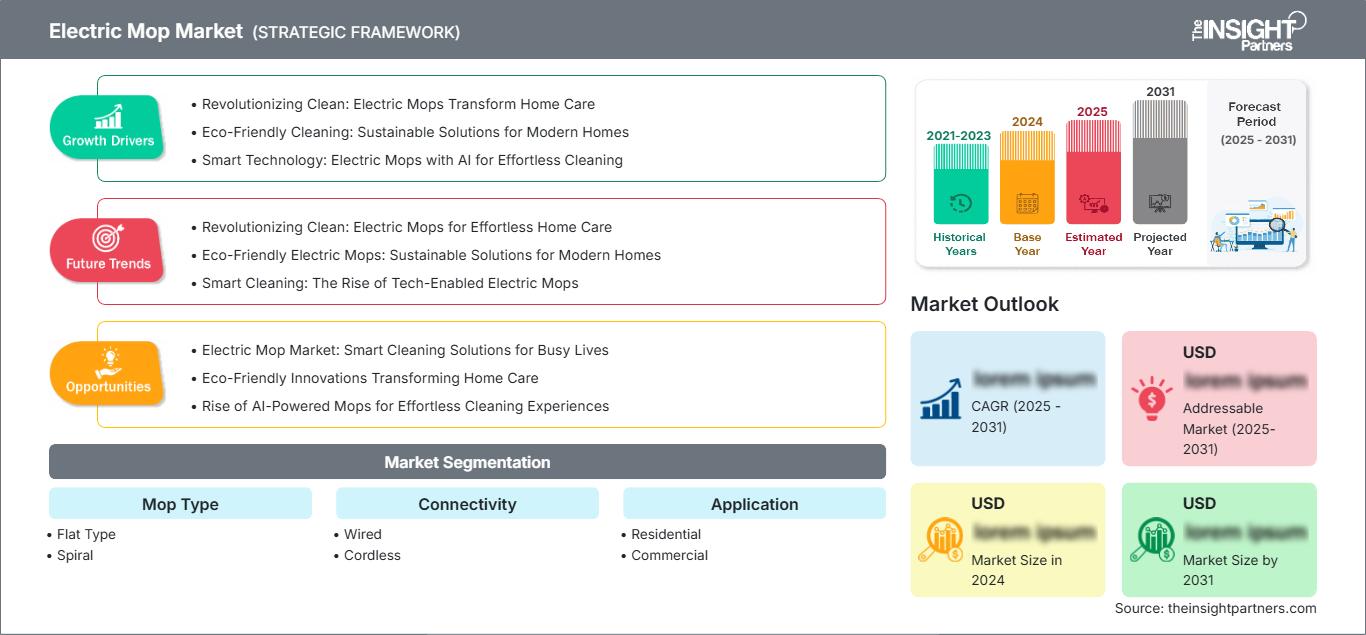
Electric Mop Market: Strategic Insights
Regional Insights
North America Electric Mop Market
North America held 26–30% share in 2025 and is expected to grow at a CAGR range of 4.2–4.8% through 2034. Electric Mop Market share is supported by high penetration of sealed hard floors, strong pet-care spending, and consumers willing to pay for products that combine vacuuming and mopping. Retailers also educate buyers through demonstrations, reviews, subscriptions for pads, and online replacement accessories.
The structural factors include aging households with preference for cleaning products that take less effort, multiple unit residences where small cordless vacuum cleaners become advantageous, and small commercial places that require touch-ups quickly. The United States is still the market leader, while Canada generates demand due to condominiums in the cities and cleaning of salt used in winters.
U.S. Electric Mop Market
The US accounted for 79-83% of North America in 2025 and is expected to witness a CAGR between 4.3-4.9%. The demand is supported by pet owners, rentals, retail offers, and the standard for healthcare related cleaning. BISSELL Homecare, Inc., Stanley Black & Decker, Inc., SharkNinja Operating LLC, Alfred Kärcher SE & Co. KG, and Nilfisk A/S have a high product visibility or commercial cleaning presence.
Cordless wet-dry mop in the kitchen, steam mop for hard floors, and compact scrubber mop for restaurants, clinics, salons, and office cleaning are some of the applications witnessed in the market. The commercial customers prefer products which reduce the downtime between shifts. The residential consumers are more inclined towards stain removal, hair removal, self-cleaning cycle, refilling facility, and chemical-free cleaning process.
Europe Electric Mop Market
Europe accounted for 22-26% market share in 2025 and has a projected CAGR between 3.9% and 4.5%. Germany accounts for high premium appliance penetration, hard-floor concentration, and knowledge of floor-care of engineered floors. The UK drives growth through e-commerce and small housing sizes; France has demand driven by urban apartment buildings and hygienic household practices.
In Italy and Spain, ceramic and stone floor use, hotel and travel-related accommodation cleaning, and value appliances influence growth. Buyers in Europe value factors such as energy efficiency, durability, serviceability, and fewer chemicals used. Some of the key players in this market include Alfred Kärcher SE & Co. KG, Nilfisk A/S, Stanley Black & Decker, Inc., SharkNinja Operating LLC, and BISSELL Homecare, Inc.
APAC Electric Mop Market
APAC accounted for 34–38% share in 2025 and would grow at a CAGR of 5.0–5.6%. In APAC, China dominates with its large-scale production of appliances, high e-commerce rate, and adoption of floor washers. Japan and South Korea provide innovation in terms of compact homes. Whereas, India and Australia provide an increasing middle class and urban population.
Drivers in this market involve appliance manufacturing, battery manufacturing, and hygiene awareness in dense metropolitan regions. The Electric Mop Market can be driven by appliance manufacturing, competitive pricing, and social commerce demonstration. Consumers look for compactness, no need for wires, auto-cleaning ability, and suitability for tiles, laminate, and sealed wooden floors.
Middle East & Africa Electric Mop Market
Middle East & Africa is projected to grow at a CAGR range of 3.8–4.4% as Saudi Arabia, the UAE, South Africa, and the rest of MEA invest in hospitality, retail, healthcare, residential compounds, and facility management. The UAE leads demand through premium retail, hotels, apartments, and high expectations for visible floor cleanliness.
The energy and infrastructure situations will help in adopting in malls, clinics, schools, and serviced residential facilities since there is a need for silent and small machines during the day to do the cleaning process. Hot temperatures and dusty conditions lead to more floor cleaning activities even though affordability poses challenges in terms of market penetration..
Segmentation Analysis
Mop Type
Mop Type is projected to grow at a CAGR range of 4.2–4.8% during 2026–2034 as consumers select designs based on floor area, maneuverability, and scrubbing intensity. Electric Mop Market scope includes flat pads for daily maintenance and spiral or rotating mechanisms for heavier soil removal. Manufacturers compete on pad durability, edge cleaning, weight distribution, refill economics, and compatibility with steam or spray functions.
- Flat Type leads demand because it is familiar, lightweight, easy to store, and suitable for kitchens, living rooms, apartments, and sealed hard floors requiring frequent surface cleaning.
- Spiral is strategically important where rotating or scrubbing action improves stain removal, making it attractive for pet messes, textured tiles, commercial spots, and higher-effort cleaning tasks.
Connectivity
Connectivity is forecast to grow at a CAGR range of 4.5–5.1% during 2026–2034 as buyers balance continuous power against convenience. Wired products remain cost-effective for steam performance and longer sessions, while cordless models gain share through portability, quick cleanup, and smaller living spaces. Battery life, charging time, motor efficiency, and safety circuitry are becoming central product differentiators.
- Wired remains relevant for steam mops and budget appliances because continuous power supports consistent heat, lower upfront pricing, and predictable performance during longer cleaning routines.
- Cordless is gaining strategic importance as consumers prioritize mobility, quick access, and compact storage, especially in urban homes, pet households, and light-commercial environments.
Application
Application is expected to grow at a CAGR range of 4.3–4.9% during 2026–2034 as residential demand scales and commercial adoption expands in small-format facilities. Households drive volume through convenience and hygiene needs, while commercial users evaluate productivity, repeatability, and downtime reduction. Product selection differs by floor traffic, cleaning frequency, operator training, and maintenance expectations.
- Residential dominates unit sales because families and renters want faster cleaning for sealed floors, kitchens, pet zones, and daily spills without managing buckets or disposable-heavy routines.
- Commercial offers higher-value opportunities in hospitality, healthcare support areas, retail, cafés, schools, and offices where compact powered mops improve spot cleaning and labor productivity.
Opportunity Snapshot
| Application | Revenue Contribution | Trend Tag | Adoption Stage |
| Residential | High | Pet Cleanup | Scaling |
| Commercial | Medium | Spot Cleaning | Emerging |
Electric Mop Market Growth Drivers and Impact Analysis
Hard-Floor Homes Accelerate Powered Cleaning Replacement
Hard flooring is increasingly preferred in apartments, kitchens, rental homes, and hospitality spaces because it is durable, easier to inspect, and compatible with quick cleaning routines. The market impact is a larger installed base of surfaces where powered mops show clear time savings over buckets and manual wringing. Consumers also want devices that handle pet hair, sticky spills, and everyday dust in one pass. Manufacturers can convert manual mop users by improving entry-level affordability while demonstrating visible soil pickup. Replacement demand strengthens when pads, rollers, tanks, and batteries are easy to maintain. This driver supports both flat-type electric mops and wet-dry cordless models that promise faster resets after meals, children’s activities, and high-traffic indoor movement.
Cordless Wet-Dry Platforms Improve Cleaning Convenience
Cordless wet-dry platforms are changing buyer expectations because they combine suction, washing, and sometimes self-cleaning in a compact appliance. The market impact is higher average selling prices and stronger differentiation versus basic steam mops. Runtime, tank separation, brush-roll cleaning, and ergonomic handling determine whether buyers treat a device as a daily tool or occasional appliance. Retail data and product pages show major brands highlighting up to 30–45 minutes of runtime, dual-tank hygiene, and simultaneous wet and dry pickup. That positioning encourages premium upgrades while reducing the friction of cleanup after cooking, pets, or small commercial foot traffic. Suppliers that improve battery durability and water management can gain repeat purchases and lower warranty pressure.
Commercial Micro-Cleaning Creates New Use Cases
Small commercial environments increasingly need cleaning devices between manual mops and large scrubber dryers. Cafés, clinics, salons, convenience stores, serviced apartments, and offices often require rapid floor refreshes during operating hours, where noise, storage, and setup time matter. The market impact is a light-commercial opportunity for compact electric mops, upright scrubber-style products, and cordless floor washers. Products must be rugged enough for frequent use while remaining simple for rotating staff. Nilfisk’s positioning of compact scrubbers as a successor to the mop reflects this shift toward productivity and safer floors. Manufacturers can unlock demand by offering commercial accessories, replaceable rollers, service spares, and training materials that help buyers quantify labor savings and cleanliness consistency.
Electric Mop Market Future Trends
Self-Cleaning and Sensor-Guided Maintenance Become Standard
Electric Mop Market trends will increasingly center on self-cleaning rollers, dirty-water separation, and sensors that notify users about tank status, brush maintenance, or dirt levels. These features address the main consumer pain point after cleaning, which is dealing with wet debris, hair, and odor. Over the forecast period, premium products will use simple displays, voice prompts, and docking routines to improve confidence and reduce misuse. This shift will make maintenance experience as important as stain removal. Brands that simplify post-cleaning care can raise adoption among older users, pet households, and commercial operators who need equipment ready for repeated use across the day.
Steam, Scrub, and Vacuum Functions Converge
Future products will increasingly converge steam, powered scrubbing, suction, and spray cleaning instead of treating electric mops as single-function appliances. Consumers want fewer devices in storage, while commercial users prefer tools that clean unexpected dry and wet messes without switching equipment. The trend will stimulate modular designs, improved pad materials, and better moisture control for sensitive sealed floors. Safety engineering will remain important because steam, electrical components, and water operate close together. Brands with strong testing, heat management, and user guidance can command premium positioning as buyers compare all-in-one performance against conventional steam-only or manual systems.
Electric Mop Market Opportunities
Premium Cordless Upgrades for Urban Homes
Urban households represent a clear investment opportunity because smaller living spaces, hard-floor finishes, and high cleaning frequency favor compact cordless appliances. Electric Mop Market Forecasts indicate that upgrade cycles will be strongest where consumers already own stick vacuums, robot vacuums, or premium steam mops and are ready to consolidate tasks. Brands can target this group with lightweight products, wall-friendly storage, quieter motors, and subscription bundles for pads and cleaning solution. Retail execution should emphasize real kitchens, pet accidents, and quick daily resets rather than occasional deep cleaning. The opportunity is strongest for companies that combine reliable batteries, low-maintenance tanks, and simple post-use cleaning routines.
Light-Commercial Kits for Facility Managers
Facility managers need compact equipment that improves productivity without the cost or training demands of large floor scrubbers. Suppliers can create opportunity by packaging electric mops with heavy-duty pads, spare rollers, charging docks, warranty coverage, and standardized operating instructions. The best targets are hotels, clinics, schools, retail chains, and restaurants with small hard-floor zones that need frequent touch-ups. Commercial kits can also support distributors because accessories and replacements generate recurring revenue. Success depends on proving lower water use, faster reset time, and safer floors compared with traditional mop buckets. Brands that document cleaning workflows can gain specification in outsourced cleaning contracts.
Recent Developments
- July 2026: iRobot Corp., the maker of Roomba, and a leader in consumer robotics and intelligent floor care, today announced its most significant portfolio expansion in years with the introduction of Roomba Electro Plus, its first non-robot floor cleaning solution, alongside a reimagined generation of Roomba® robots that now bring premium technologies & experiences throughout the portfolio. Together, the new products reflect iRobot's continued commitment to consumer-led innovation, expanding beyond robotic cleaning to deliver a more complete floor care ecosystem designed around the evolving needs of today's households.
- April 2026: BISSELL Homecare, Inc. introduced the CrossWave Edge Cordless Wet Dry Vacuum Cleaner, extending its wet-dry floor-care portfolio for families and pet owners. The launch emphasized simultaneous vacuuming and washing, edge cleaning, and simplified household maintenance, reinforcing the brand’s focus on cordless convenience and multi-surface hard-floor cleaning.
- April 2024: BISSELL Homecare, Inc. launched the CrossWave OmniForce cordless wet-dry vac, designed to vacuum and mop together or operate in dedicated power vacuum mode. The device highlighted 75% more suction in Power Vac mode, up to 30 minutes of cordless cleaning, two-tank technology, and self-cleaning functionality.
Frequently Asked Questions

- Comprehensive Market Sizing and Forecast Analysis
- Detailed Segmentation Analysis
- In-Depth Market Dynamics Assessment
- Regional and Country-Level Insights
- Competitive Landscape and Company Benchmarking
- Strategic Business Intelligence
Recent Reports
Testimonials

The Insight Partners provided valuable market intelligence that supported our global go-to-market strategy. Their team was professional, responsive, and attentive to our feedback, providing thoughtful analysis and helpful methodological clarifications throughout the project.
Junmo Kim Chief Financial Officer (CFO), Enertech Co., Ltd.
The Insight Partners' SCADA System Market report is comprehensive, with valuable insights on current trends and future forecasts. The team was highly professional, responsive, and supportive throughout. We are very satisfied and highly recommend their services.
RAN KEDEM Partner, Reali Technologies LTDs
I requested a report on a very specific software market and the team produced the report in a few days. The information was very relevant and well presented. I then requested some changes and additions to the report. The team was again very responsive and I got the final report in less than a week.
JEAN-HERVE JENN Chairman, Future Analytica
We worked with The Insight Partners for an important market study and forecast. They gave us clear insights into opportunities and risks, which helped shape our plans. Their research was easy to use and based on solid data. It helped us make smart, confident decisions. We highly recommend them.
PIYUSH NAGPAL Sr. Vice President, High Beam Global
The Insight Partners delivered insightful, well-structured market research with strong domain expertise. Their team was professional and responsive throughout. The user-friendly website made accessing industry reports seamless. We highly recommend them for reliable, high-quality research services
YUKIHIKO ADACHI CEO, Deep Blue, LLC.
This is the first time I have purchased a market report from The Insight Partners.While I was unsure at first, I visited their web site and felt more comfortable to take the risk and purchase a market report.I am completely satisfied with the quality of the report and customer service. I had several questions and comments with the initial report, but after a couple of dialogs over email with their analyst I believe I have a report that I can use as input to our strategic planning process.Thank you so much for taking the extra time and making this a positive experience.I will definitely recommend your service to others and you will be my first call when we need further market data.
JOHN SUZUKI President and Chief Executive Officer, Board Director, BK Technologies
I wish to appreciate your support and the professionalism you displayed in the course of attending to my request for information regarding to infectious disease IVD market in Nigeria. I appreciate your patience, your guidance, and the fact that you were willing to offer a discount, which eventually made it possible for us to close a deal. I look forward to engaging The Insight Partners in the future, all thanks to the impression you have created in me as a result of this first encounter.
DR CHIJIOKE ONYIA MANAGING DIRECTOR, PineCrest Healthcare Ltd.Reason to Buy
- Informed Decision-Making
- Understanding Market Dynamics
- Competitive Analysis
- Identifying Emerging Markets
- Customer Insights
- Market Forecasts
- Risk Mitigation
- Boosting Operational Efficiency
- Strategic Planning
- Investment Justification
- Tracking Industry Innovations
- Aligning with Regulatory Trends





 Get Free Sample for