
Electrically Conductive Tapes Market Growth, Trends & Forecast by 2034
Coverage: By Adhesive Type (Acrylic, Silicone); Material Type (Metal, Polymer); End Use (Electronics and Electricals, Building and Construction, Pharmaceuticals) , and Geography (North America, Europe, Asia Pacific, and South and Central America)
- Status : Data Released
- Report Code : TIPRE00010210
- Category : Chemicals and Materials
- No. of Pages : 150
- Available Report Formats :


- Last update date : October 26, 2026


2025 Market Size
US$ 1.71 Bn
Base year value
2034 Forecast
US$ 3.08 Bn
Projected by 2034
CAGR 2026-2034
6.78 %
Growth rate
Addressable Market
US$ 21.67 Bn
(2026-2034)
The Electrically Conductive Tapes market size was valued at US$ 1.71 Billion in 2025 and is projected to reach US$ 3.08 Billion by 2034, registering a CAGR of 6.78% during 2026-2034. The market covers adhesive tape solutions that combine bonding with electrical conductivity and includes acrylic and silicone adhesive types, metal and polymer material types, and applications across electronics and electricals, building and construction, and pharmaceuticals.
North America represents a substantial demand center because conductive tapes are integrated into electronics assembly, electromagnetic interference shielding, grounding, cable management, and specialized industrial equipment. The Electrically Conductive Tapes size in the region is supported by electronics manufacturing, semiconductor investment, data infrastructure, and demand for compact EMI control solutions. The region is estimated to account for ~28% of global demand in 2025 and expand at ~6.1% CAGR through 2034. Continued semiconductor manufacturing investment in the U.S. is creating additional requirements for materials used in electronic assembly and component protection.
Electrically Conductive Tapes Market Assessment and Insights
- North America: The region is estimated to represent ~28% of the global Electrically Conductive Tapes market share in 2025 and grow at ~6.1% CAGR through 2034. Semiconductor, data-center, telecommunications, automotive electronics, and industrial equipment manufacturing support demand for tapes that provide grounding and EMI shielding while simplifying assembly.
- U.S.: The U.S. is estimated to represent ~80% of North American demand and grow at ~6.0% CAGR. Semiconductor fabrication, AI infrastructure, electronics manufacturing, and defense electronics increase the need for thin conductive bonding and shielding materials that can be converted into application-specific formats.
- Europe: Europe is estimated to hold ~25% of global demand in 2025 and grow at ~6.3% CAGR. Germany, France, Italy, and the UK provide important demand through automotive electronics, industrial automation, telecommunications, medical equipment, and electronics manufacturing. Regulatory attention to product sustainability and repairability is an important differentiator.
- Asia Pacific: Asia Pacific is estimated to account for ~39% of global demand and expand at ~7.4% CAGR. China, Japan, South Korea, and India provide a strong industrial base through electronics assembly, semiconductor manufacturing, displays, consumer devices, automotive electronics, and battery-related applications.
- Largest Segment: Electronics and Electricals is estimated to be the largest main segment, with a ~7.3% CAGR. High usage in grounding, EMI shielding, flexible circuit assembly, component mounting, and electrical interconnection supports its position.
- High Growth Segment: Acrylic is estimated to record a ~7.1% CAGR because conductive acrylic systems provide a practical balance between adhesion, conductivity, converting performance, and compatibility with electronic assembly processes.
- Key companies analyzed in detail: 3M Company, Insul-Fab, tesa SE, Parafix Tapes & Conversions Ltd., PPI Adhesive Products Ltd., Avery Dennison Corporation, Advance Tapes International Limited, SK Direct Ltd., Laird Technologies, Inc., Nitto Denko Corporation, SEKISUI CHEMICAL CO., LTD., and TE Connectivity Ltd.
Source: The Insight Partners' analysis based on proprietary research, government publications, company annual reports, investor presentations, industry databases, and expert interviews.
Electrically conductive tapes have progressed from simple construction materials such as metal foils and conductive adhesives to advanced systems where conductivity, adhesion, flexibility, thickness, shielding capabilities, heat resistance, and converting are optimized for a specific end use. Conductive acrylic pressure sensitive adhesives have been used with various metals such as copper, aluminum, conductive fabric, non-wovens and polymer carriers. These tapes perform tasks such as grounding, electrical connection, EMI Shielding, static discharge and mechanical fastening in a single step process.
Product architecture is increasingly being made application-specific in nature. Isotropic tapes are those whose conductivity is provided through the adhesive material, while anisotropic tapes allow the direction of conduction to be chosen by the manufacturer. Die cutting and converting have become very significant activities in the value chain, since manufacturers have started purchasing tapes pre-shaped in order to fit around various components, connectors, display units, sensors, circuit boards and enclosures, and thereby save on assembly labor.
Examples of recent products show how the trend is increasingly toward thin, multi-functional tapes. Current offerings in conductive tapes include those based on copper backing and conductive fabrics, designed for small contact areas, flex substrates, grounding and EMI shielding purposes.
Market growth should be supported by continued electronics localization in North America and Europe along with production expansion in the Asia Pacific region. Semiconductors, advanced packages, displays, connected cars, industrial automation, and telecommunications equipment will need tapes capable of managing denser electronic structures. In effect, local production strategies will impact demand beyond consumer electronics industry.
Localization of the supply chain will prompt tape manufacturers and converters to develop better technical support and processing within the regions. Qualification processes will still be necessary since the customers normally ask for performance specifications regarding electrical, mechanical, environmental, and regulatory issues prior to qualifying the tape. It should also be noted that suppliers who can handle adhesive formulation, conductive material selection, die cutting, and application engineering will have an advantage.
Electrically Conductive Tapes Market Report Scope
| Report Attribute | Details |
|---|---|
| Market size in 2025 | US$ 1.71 Billion |
| Market Size by 2034 | US$ 3.08 Billion |
| Global CAGR (2026 - 2034) | 6.78% |
| Historical Data | 2021-2024 |
| Forecast period | 2026-2034 |
Electrically Conductive Tapes Market Analysis
The Electrically Conductive Tapes growth factor is directly related to growing density of electronic devices. With electronic components getting closer and closer to each other, it gets increasingly difficult to solve electromagnetic interference problems and provide the necessary level of grounding using only mechanical fastening. Conductive tape combines in one operation the bonding process and the creation of electrical properties. Thus, the material becomes highly beneficial for the applications where space and weight restrictions along with assembly time and geometry of electronic parts limit other types of solutions.
The value chain starts with conductive metal, conductive filler, polymeric film, fabric and adhesive system. The manufacturers create conductive tape formulation and laminate it to chosen carrier or foil. The converters slit, laminate, die cut, kiss cut or spool the tape according to client requirements. Original Equipment Manufacturers and contract manufacturers implement the product in electronics, electrical assemblies, automotive engineering, medical devices and other industries. Therefore, the quality factors of the product are formed by adhesive properties and electrical functionality of final construction.
Supply dynamics differ substantially by product architecture. Copper and aluminum constructions depend on metal cost and availability, while conductive fabric solutions introduce additional requirements for coating uniformity and mechanical durability. Polymer-based constructions can offer weight and flexibility benefits but require careful formulation to achieve stable electrical properties. Adhesive chemistry is equally important because fillers that increase conductivity can affect tack, cohesion, flexibility, and processability. Manufacturers, therefore, compete through formulation know-how rather than simply through backing material availability.
The competitive environment is shifting toward customized solutions rather than commodity tape supply. 3M Company offers electrically conductive adhesive transfer, single-sided, double-sided, and XYZ-axis products for electronics and EMI applications. tesa SE combines conductive acrylic adhesives with copper, aluminum, fabric, foam, woven, and nonwoven backings. Laird Technologies, Inc. emphasizes conductive fabric and transfer adhesive constructions for enclosure-level EMI shielding. PPI Adhesive Products Ltd. provides conductive transfer tapes and conductive foil-based shielding solutions. These portfolios illustrate how suppliers differentiate through conductivity direction, conformability, thickness, shielding, converting, and application support.
Investment is increasingly directed toward electronics-focused material development and production localization. Semiconductor and electronics manufacturing projects create demand for supporting materials that can be qualified near production sites. Suppliers can strengthen competitive positioning by developing regional technical centers, application laboratories, die-cutting capacity, and customized formulations. The ability to collaborate with OEMs during design and qualification can become more valuable than broad catalog breadth because conductive tapes often form part of a tightly engineered assembly.
● REPORT CUSTOMIZATION
Tailor This Report To Align With Your Specific Business Requirements
This report can be customized to align precisely with your business objectives, scope, and target markets. Customization options include tailored segmentation, geography, competitive analysis, and strategic insights to support informed decision-making.
Customize This Report →WHAT YOU CAN ADJUST
- ● Segmentations
- ● Geography
- ● Competitive Analysis
- ● Language Preferences
Electrically Conductive Tapes Market: Strategic Insights
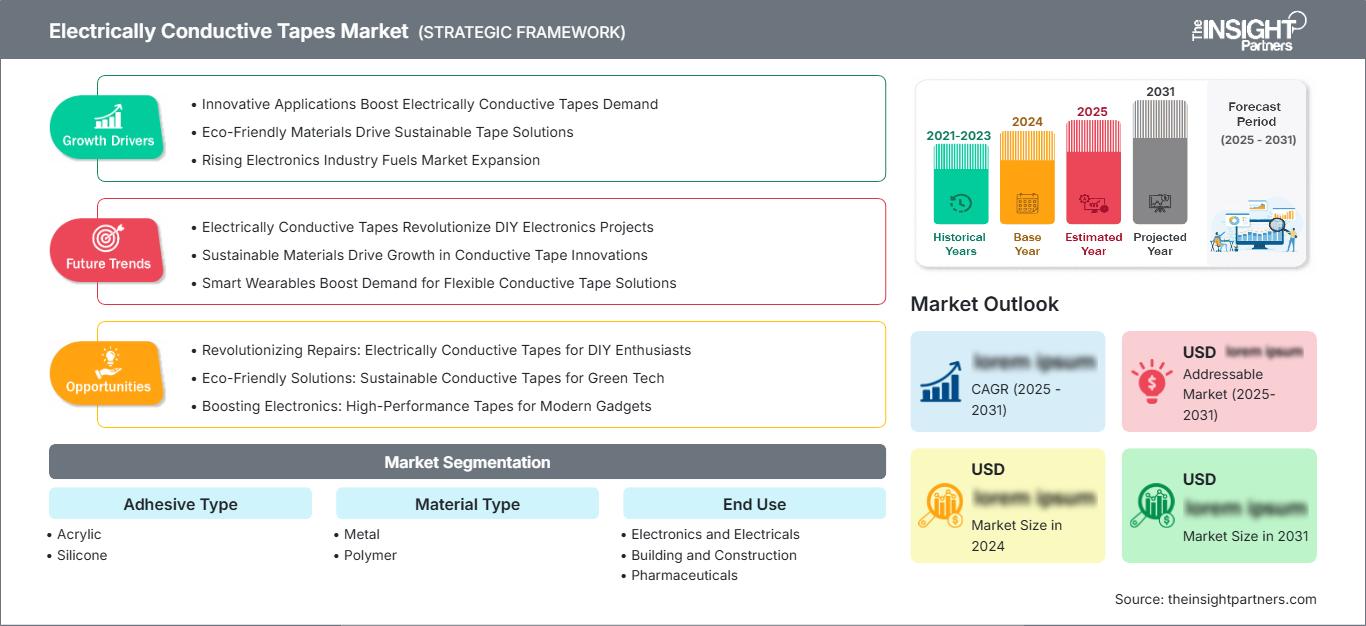
Regional Insights
North America Electrically Conductive Tapes Market
North America is estimated to represent ~28% of global demand in 2025 and grow at ~6.1% CAGR through 2034. The region benefits from electronics manufacturing, semiconductor investment, aerospace and defense systems, data infrastructure, telecommunications, and automotive electronics. Conductive tapes are used to connect conductive surfaces, manage electromagnetic interference, ground components, and provide flexible shielding where rigid metal assemblies would add complexity.
The U.S. is the principal regional demand center. Semiconductor manufacturing expansion, data-center construction, advanced computing, communications infrastructure, and automotive electronics increase the number of assemblies requiring EMI management. U.S. semiconductor policy has encouraged substantial domestic manufacturing investment, strengthening the downstream environment for specialized electronic materials.
Canada contributes through electronics, telecommunications, aerospace, medical equipment, and industrial manufacturing. Its proximity to U.S. production networks supports cross-border sourcing of engineered adhesive materials and converted components. Mexico provides another important manufacturing link through automotive and electronics assembly, creating demand for materials that can be integrated into high-volume production environments.
U.S. Electrically Conductive Tapes Market
The U.S. accounts for an estimated ~80% of North American demand and is projected to grow at ~6.0% CAGR. The country's market is characterized by high-value electronics applications rather than only volume-driven tape consumption. Semiconductor facilities, aerospace electronics, defense systems, communications infrastructure, automotive electronics, and data centers require shielding and grounding materials that can tolerate demanding assembly conditions.
The expanding domestic semiconductor ecosystem is particularly relevant because chip manufacturing and advanced electronics production require controlled material performance and dependable supply. Companies such as 3M Company, Laird Technologies, Inc., and Avery Dennison Corporation participate in broader technical adhesive and electronics material markets, while specialized converters support customer-specific formats.
Europe Electrically Conductive Tapes Market
Europe is estimated to represent ~25% of global demand in 2025 and expand at ~6.3% CAGR. Germany is an important demand center because of its automotive, industrial automation, electrical equipment, and machinery base. Conductive tapes are particularly relevant to electronic control units, sensors, displays, wiring assemblies, and industrial equipment where shielding and grounding must be integrated without adding substantial bulk.
France contributes through aerospace, defense, automotive, telecommunications, and medical equipment. The country's high-value engineering base supports demand for application-specific conductive materials requiring environmental and mechanical reliability. Italy has a strong machinery, appliance, automotive-component, and electrical equipment ecosystem that creates demand for flexible conductive and shielding materials.
The UK contributes through aerospace, medical technology, electronics, telecommunications, and specialized manufacturing. European regulation is increasingly influencing product design through sustainability, repairability, chemical restrictions, and resource-efficiency requirements. This favors tape constructions that can meet performance requirements while supporting thinner assemblies, easier component access, or reduced material intensity.
APAC Electrically Conductive Tapes Market
The Electrically Conductive Tapes market forecast shows that APAC is estimated to hold ~39% of global demand in 2025 and grow at ~7.4% CAGR. China is a major demand and manufacturing center because of its electronics, telecommunications, consumer devices, automotive, battery, and electrical equipment industries. Localized production of electronic components supports demand for both standard conductive tapes and highly customized converted formats.
Japan provides strong demand through automotive electronics, precision equipment, semiconductor-related manufacturing, consumer electronics, and industrial automation. Its market emphasizes reliability, dimensional control, heat resistance, and long-term electrical performance. South Korea is supported by displays, semiconductors, smartphones, batteries, and advanced electronics manufacturing, where compact conductive constructions can provide grounding and shielding without consuming significant device space.
India is an increasingly important demand center as electronics manufacturing, mobile-device assembly, automotive electronics, and domestic component production expand. The market remains more price-sensitive than Japan or South Korea, creating opportunities for suppliers that can combine localized converting with reliable conductive performance. Across APAC, proximity to electronics assembly plants remains a major competitive advantage because customers often require rapid prototyping and production support.
MEA Electrically Conductive Tapes Market
The MEA market remains smaller than the core electronics manufacturing regions but has opportunities in telecommunications, electrical equipment, infrastructure, automotive assembly, medical equipment, and industrial systems. Demand is concentrated around imported electronic assemblies and localized manufacturing hubs. Suppliers that provide technical support and application-specific converting can address the region's fragmented procurement structure. The regional market is expected to expand at ~5.1% CAGR as electronics infrastructure and industrial modernization progress.
Segmentation Analysis
Adhesive Type
The Electrically Conductive Tapes market report shows that Acrylic adhesive is estimated to record a ~7.1% CAGR and represents the fastest-growing adhesive type because it can balance conductivity, adhesion, environmental resistance, and converting requirements across electronics and electrical assemblies. Conductive acrylic formulations are widely suited to pressure-sensitive applications in which bonding and grounding must occur simultaneously.
Silicone is estimated to expand at a ~6.2% CAGR. Silicone systems remain relevant where temperature stability, flexibility, environmental resistance, or compatibility with demanding substrates is important. Their adoption is supported by specialized electronic, industrial, and medical applications in which long-term performance can justify higher material complexity.
Material Type
The Electrically Conductive Tapes market includes Metal and Polymer materials. Metal is estimated to grow at a ~6.9% CAGR because copper and aluminum provide established electrical conductivity and EMI shielding characteristics. Metal-backed tapes are widely used for grounding, shielding, cable management, electrical cabinets, and electronic components. Product differentiation increasingly centers on foil thickness, adhesive conductivity, conformability, corrosion resistance, and converting capability.
Polymer is estimated to expand at a ~6.3% CAGR. Conductive polymers and polymer-based carriers provide flexibility, low weight, conformability, and compatibility with compact electronic structures. Conductive fabrics and polymer films can be particularly useful when surfaces are curved or moving, and when rigid metal foil could reduce assembly flexibility.
End Use
The market includes Electronics and Electricals, Building and Construction, and Pharmaceuticals. Electronics and Electricals is estimated to grow at a ~7.3% CAGR and represents the largest segment. Its Electrically Conductive Tapes scope extends from PCB and FPC grounding to EMI shielding, display assemblies, sensors, connectors, consumer devices, data infrastructure, and industrial electronics.
Building and Construction is estimated to record a ~6.0% CAGR. Applications are associated with electrical systems, cable management, grounding, shielding, and specialized building components. Adoption depends on electrical performance, installation efficiency, substrate compatibility, durability, and applicable safety requirements.
Pharmaceuticals are estimated to expand at a ~5.7% CAGR. Demand is linked primarily to specialized electronic equipment, medical devices, monitoring systems, sensors, and controlled manufacturing environments rather than pharmaceutical formulations themselves. Product qualification emphasizes cleanliness, reliability, chemical compatibility, and controlled application.
Opportunity Snapshot
| End Use | Revenue Contribution | Trend Tag | Adoption Stage |
| Electronics and Electricals | High | EMI integration | Scaling |
| Building and Construction | Medium | System grounding | Scaling |
| Pharmaceuticals | Low | Device shielding | Emerging |
Electrically Conductive Tapes Market Growth Drivers and Impact Analysis
Increasing Electronic Component Density
The primary demand mechanism is the growing concentration of electronic functions within smaller assemblies. Smartphones, displays, computing equipment, sensors, automotive modules, and industrial controllers increasingly place conductive components close to one another. This increases the need for reliable grounding and EMI shielding. Conductive tape addresses the problem while simultaneously providing attachment, enabling manufacturers to replace separate fastening and shielding steps with one converted component.
Expansion of Semiconductor and Electronics Manufacturing
New semiconductor and electronics manufacturing capacity creates downstream demand for materials used in component assembly, shielding, grounding, and device integration. Domestic manufacturing initiatives in North America and Europe are strengthening regional electronics ecosystems, while APAC continues to provide extensive production capacity. Tape suppliers benefit when they can qualify products with manufacturers during the design stage and supply material close to production facilities.
Shift Toward Compact and Lightweight Assemblies
Device miniaturization favors conductive tapes because thin adhesive constructions can occupy less space than conventional mechanical shielding or grounding components. Flexible circuits, displays, sensors, wearable devices, automotive electronics, and compact medical equipment require materials that follow irregular surfaces while maintaining electrical continuity. This encourages development of thinner conductive layers, flexible carriers, and high-performance adhesives.
Electrically Conductive Tapes Market Future Trends
Electrically Conductive Tapes Trends Toward Multifunctional Constructions
The Electrically Conductive Tapes market trends indicate that conductive tapes are increasingly designed to perform more than one function. Grounding, EMI shielding, mechanical bonding, heat dissipation, flexibility, and cushioning can be combined within a multilayer construction. This approach reduces component count and assembly complexity. Suppliers are therefore moving toward engineered constructions in which the conductive backing, adhesive, carrier, and surface treatment are selected together rather than optimized independently.
Greater Use of Thin and Flexible Conductive Systems
Consumer electronics, automotive displays, wearable devices, and compact sensors are creating demand for thinner materials that can conform to curved or irregular geometries. Conductive fabrics, thin copper constructions, conductive films, and specialized adhesive systems allow shielding to follow product contours. This trend is increasing the importance of die-cutting precision and adhesive wet-out because small deviations can affect electrical contact and assembly reliability.
Integration of Sustainability Into Tape Design
Sustainability is increasingly affecting adhesive formulation, backing selection, manufacturing processes, and end-of-life considerations. Tape producers are investigating bio-based materials, lower-impact carriers, solvent reduction, and constructions that support easier component removal. European repairability requirements are reinforcing attention to how electronic products are assembled and serviced, creating a longer-term opportunity for functional tapes that balance strong attachment with controlled removability.
Electrically Conductive Tapes Market Opportunities
Application-Specific Conductive Tapes for Advanced Electronics
A major opportunity exists in customized conductive tapes for semiconductor equipment, data centers, displays, sensors, automotive electronics, and advanced computing systems. Buyers increasingly require specific combinations of conductivity direction, shielding, adhesion, thickness, flexibility, and environmental resistance. Suppliers can capture this opportunity by developing application laboratories, rapid prototyping, die-cutting, and co-development capabilities that shorten customer qualification cycles.
Localized Converting and Technical Support in Emerging Manufacturing Hubs
Electronics manufacturing expansion outside established production centers creates opportunities for regional tape converting and technical service. India, Southeast Asia, Mexico, and selected European locations can support localized slitting, die-cutting, lamination, and packaging while reducing logistics complexity. Suppliers that combine global material platforms with local engineering support can improve responsiveness and tailor conductive tapes to specific customer geometries and production equipment.
Recent Developments
- May 2026: NIPPON KINZOKU CO., LTD. strengthened promotion of its L-Core functional stainless steel as an Eco-Product. The material uses proprietary surface modification to create conductive pathways within the passive film, achieving low contact resistance while retaining stainless steel's corrosion resistance. The technology can eliminate nickel plating and conductive tapes in applications such as smartphone chassis, flexible printed circuits, display bezels, and electrical connectors, potentially influencing demand for conductive joining materials.
- September 2026: Researchers at Forschungszentrum Jülich evaluated commercially available conductive tapes for interconnecting heat-sensitive silicon heterojunction and perovskite-silicon solar cells without conventional high-temperature soldering. The study examined isotropic and anisotropic tapes containing silver and nickel conductive particles. The nickel-based anisotropic tape demonstrated strong electrical stability during damp-heat and thermal-cycle testing, highlighting conductive tapes as a potential low-temperature interconnection technology for next-generation photovoltaic modules.
Frequently Asked Questions

- Comprehensive Market Sizing and Forecast Analysis
- Detailed Segmentation Analysis
- In-Depth Market Dynamics Assessment
- Regional and Country-Level Insights
- Competitive Landscape and Company Benchmarking
- Strategic Business Intelligence
Recent Reports
Testimonials

The Insight Partners provided valuable market intelligence that supported our global go-to-market strategy. Their team was professional, responsive, and attentive to our feedback, providing thoughtful analysis and helpful methodological clarifications throughout the project.
Junmo Kim Chief Financial Officer (CFO), Enertech Co., Ltd.
The Insight Partners' SCADA System Market report is comprehensive, with valuable insights on current trends and future forecasts. The team was highly professional, responsive, and supportive throughout. We are very satisfied and highly recommend their services.
RAN KEDEM Partner, Reali Technologies LTDs
I requested a report on a very specific software market and the team produced the report in a few days. The information was very relevant and well presented. I then requested some changes and additions to the report. The team was again very responsive and I got the final report in less than a week.
JEAN-HERVE JENN Chairman, Future Analytica
We worked with The Insight Partners for an important market study and forecast. They gave us clear insights into opportunities and risks, which helped shape our plans. Their research was easy to use and based on solid data. It helped us make smart, confident decisions. We highly recommend them.
PIYUSH NAGPAL Sr. Vice President, High Beam Global
The Insight Partners delivered insightful, well-structured market research with strong domain expertise. Their team was professional and responsive throughout. The user-friendly website made accessing industry reports seamless. We highly recommend them for reliable, high-quality research services
YUKIHIKO ADACHI CEO, Deep Blue, LLC.
This is the first time I have purchased a market report from The Insight Partners.While I was unsure at first, I visited their web site and felt more comfortable to take the risk and purchase a market report.I am completely satisfied with the quality of the report and customer service. I had several questions and comments with the initial report, but after a couple of dialogs over email with their analyst I believe I have a report that I can use as input to our strategic planning process.Thank you so much for taking the extra time and making this a positive experience.I will definitely recommend your service to others and you will be my first call when we need further market data.
JOHN SUZUKI President and Chief Executive Officer, Board Director, BK Technologies
I wish to appreciate your support and the professionalism you displayed in the course of attending to my request for information regarding to infectious disease IVD market in Nigeria. I appreciate your patience, your guidance, and the fact that you were willing to offer a discount, which eventually made it possible for us to close a deal. I look forward to engaging The Insight Partners in the future, all thanks to the impression you have created in me as a result of this first encounter.
DR CHIJIOKE ONYIA MANAGING DIRECTOR, PineCrest Healthcare Ltd.Reason to Buy
- Informed Decision-Making
- Understanding Market Dynamics
- Competitive Analysis
- Identifying Emerging Markets
- Customer Insights
- Market Forecasts
- Risk Mitigation
- Boosting Operational Efficiency
- Strategic Planning
- Investment Justification
- Tracking Industry Innovations
- Aligning with Regulatory Trends





 Get Free Sample for