
Electron Microscope Market Trends, Demand & Growth by 2034
Coverage: by Type (Transmission Electron Microscope and Scanning Electron Microscope); and Verticals (Aeronautics, Automotive, Manufacturing, Textile, Construction, Pharmaceutical and Others); , and Geography (North America, Europe, Asia Pacific, and South and Central America)
- Status : Data Released
- Report Code : TIPTE100001021
- Category : Electronics and Semiconductor
- No. of Pages : 150
- Available Report Formats :


- Last update date : August 14, 2026


2025 Market Size
US$ 2.83 Bn
Base year value
2034 Forecast
US$ 5.54 Bn
Projected by 2034
CAGR 2026-2034
7.74 %
Growth rate
Addressable Market
US$ 37.66 Bn
(2026-2034)
The global Electron Microscope Market size was valued at US$ 2.83 Billion in 2025 and is projected to reach US$ 5.54 Billion by 2034, registering a compound annual growth rate (CAGR) of 7.74% from 2026 to 2034. This growth trajectory reflects increasing demand for high-resolution imaging across life sciences, materials science, and semiconductor manufacturing sectors. The rising adoption of advanced microscopy techniques including cryo-electron microscopy and automated imaging workflows continues to shape market expansion dynamics.
North America represents a significant revenue pocket within the global Electron Microscope Market, with estimates suggesting a CAGR of approximately 7.5-8.0% through the forecast period. The region's growth is anchored by robust R&D investments, well-established research institutions, and strong government funding for scientific research initiatives. Additionally, the presence of leading semiconductor manufacturers and biopharma clusters supporting structure-based drug discovery drives demand for advanced electron microscopy solutions across the United States and Canada.
Electron Microscope Market Assessment and Insights
- North America: Captured approximately 36-40% of the global Electron Microscope Market share in 2025, supported by strong R&D investments and a robust base of research institutions. The region is projected to grow at a CAGR of 7.5-8.0% during 2026-2034, driven by semiconductor R&D and biopharma discovery applications.
- US: Representing about 85-88% of the North American market in 2025, the U.S. continues to lead regional demand. The market is projected to expand at a CAGR of 7.0-7.5% through 2034, supported by NIH cryo-EM centers and semiconductor metrology programs.
- Europe: Held roughly 28-32% of the global market share in 2025, with Germany, the UK, and France as leading contributors. The region is expected to witness a CAGR of 7.0-7.5% from 2026 to 2034, driven by materials science research and automotive sector quality control requirements.
- Asia Pacific: Accounted for approximately 26-30% of the global market in 2025, with China, Japan, and India as major contributors. The region is projected to grow at a robust CAGR of 8.5-9.5% during 2026-2034, driven by semiconductor manufacturing expansion and government co-investment in domestic electron optics capabilities.
- Largest Segment: The Scanning Electron Microscope (SEM) segment dominated the market in 2025, accounting for an estimated 75-80% market share. This segment's prominence is attributed to its versatility, affordability, and widespread use in surface imaging and semiconductor inspections.
- High Growth Segment: The Transmission Electron Microscope (TEM) segment is projected to exhibit robust growth, with a CAGR of 8.0-8.5% from 2026 to 2034. This growth is driven by demand for atomic-resolution imaging in semiconductor failure analysis and cryo-EM applications in drug discovery.
- Key companies analyzed in detail: Thermo Fisher Scientific, Olympus Corporation, Jeol Ltd., Carl Zeiss AG, Hitachi High-Technologies Corporation, Sigma-Aldrich Corporation (Merck KGaA), Delong America Inc., Bruker Corporation, Keysight Technologies, Tescan Orsay Holding, A.S.
Source: The Insight Partners' analysis based on proprietary research, government publications, company annual reports, investor presentations, industry databases, and expert interviews.
The Electron Microscope Market forecast indicates an evolutionary change from traditional manual microscopes to automatic imaging solutions powered by artificial intelligence. The shift is due to the ongoing digitalization of the research process combined with the use of machine learning algorithms. The major players in the market are developing products with more automated capabilities such as automatic grid selection and optimized imaging that help to minimize the analysis time and increase its efficiency. Innovations in the sphere of electron optics and detectors provide better resolution as well as broaden the scope of potential applications in life sciences, nanotechnology, and material research.
In the near future, the market is set to experience continuous growth due to the emergence of new economies and increased investments in research facilities. Governmental programs aimed at the development of electron optics manufacturing and education programs for technicians in countries like China and India will become a driver for instrument sales. Moreover, the development of the cloud connectivity and digitalization features in microscopes will generate additional value due to the possibility of remote access and collaborative research.
Electron Microscope Market Report Scope
| Report Attribute | Details |
|---|---|
| Market size in 2025 | US$ 2.83 Billion |
| Market Size by 2034 | US$ 5.54 Billion |
| Global CAGR (2026 - 2034) | 7.74% |
| Historical Data | 2021-2024 |
| Forecast period | 2026-2034 |
Electron Microscope Market Analysis
The need for electron microscopes is fueled by the increasing requirement of imaging at the nano scale level in different fields of science and industries. The field of life sciences makes use of electron microscopes for visualizing cellular structures, pathogens and interactions among proteins at molecular levels in order to carry out the processes of drug discovery and disease research. Wafer inspection, failure analysis and process control at a technology node below 5 nm are some applications where semiconductor and electronics industry uses electron microscopes. For characterization of nanomaterials, surface morphology and structural properties, electron microscopes are used in material sciences.
Value chain in the Electron Microscope Market includes the supplier of components, producers of instruments, providers of application software and institutions utilizing the instrument for research purposes, with an increasing focus on solutions involving imaging systems. There are investments by manufacturers in research and development aimed at the provision of more efficient products with high resolution, analysis capabilities and ease of use. The availability of highly accurate components of electron optics and detectors continues to be vital in ensuring high performance of the instrument. Besides, there is an increase in the utilization of AI-driven software solutions for automated image processing and analysis.
The Electron Microscope Market has been analyzed based on the presence of well-established MNCs and specialty instrument manufacturers in the competitive landscape. Thermo Fisher Scientific leads in the market because of its wide range of products and applications support, whereas JEOL and Hitachi High-Technologies Corporation excel through technology innovation and regional strength. Carl Zeiss AG stands out through high-precision optics and materials science applications, whereas Bruker Corporation concentrates on the analytical capabilities of the product line. The trend analysis indicates that there is an emphasis on the automation of processes and AI integration, especially automated image acquisition and analysis capabilities.
Another strategy being employed by companies is the formation of partnerships and acquisition deals aimed at enhancing their product offerings and capabilities. As seen in the case of the acquisition of Nion Company by Bruker for their advanced STEM technology earlier in 2024, there is a trend in the consolidation process of companies so as to enhance their microscopy capabilities. Geographical expansion to the Asia Pacific region where growth is expected is another strategy that has attracted the interest of many players, especially due to the growth in semiconductor manufacturing activities and research facilities.
● REPORT CUSTOMIZATION
Tailor This Report To Align With Your Specific Business Requirements
This report can be customized to align precisely with your business objectives, scope, and target markets. Customization options include tailored segmentation, geography, competitive analysis, and strategic insights to support informed decision-making.
Customize This Report →WHAT YOU CAN ADJUST
- ● Segmentations
- ● Geography
- ● Competitive Analysis
- ● Language Preferences
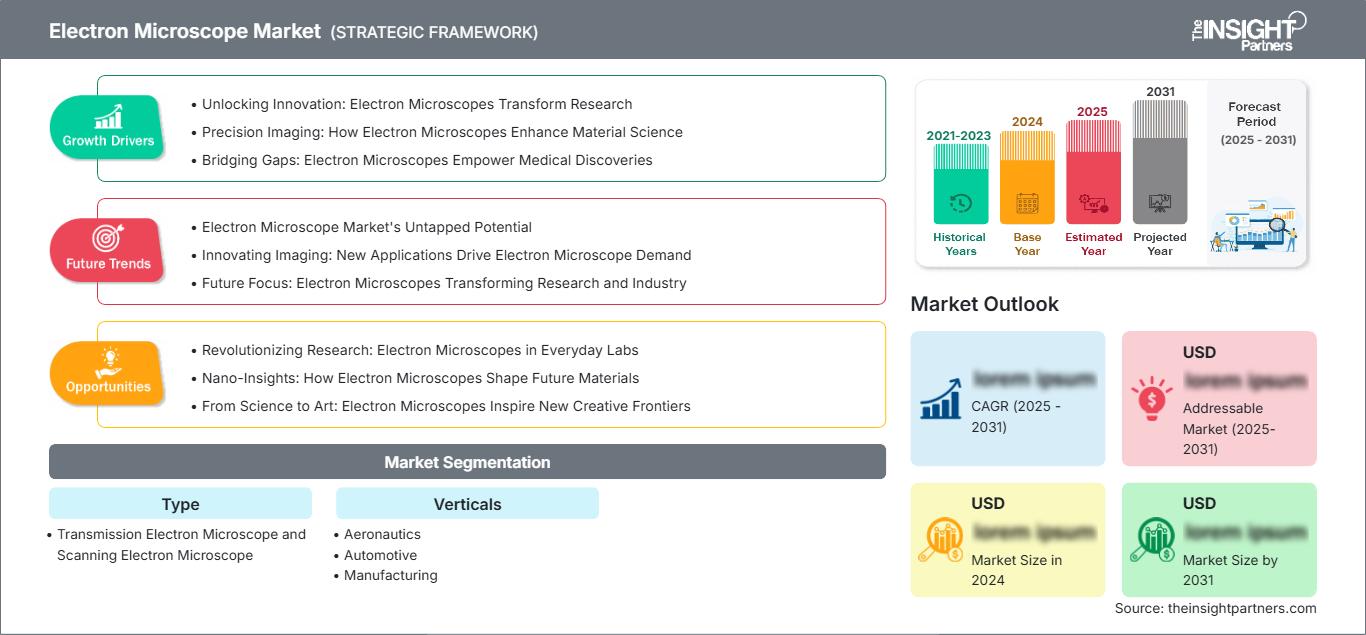
Electron Microscope Market: Strategic Insights
Regional Insights
North America Electron Microscope Market
The North American Electron Microscope Market accounted for approximately 36-40% of the global market share in 2025 and is projected to grow at a CAGR of 7.5-8.0% from 2026 to 2034. Market dominance of this region is supported by an existing research infrastructure, significant government spending such as that provided by the National Institutes of Health (NIH) as well as existence of significant semiconductor R&D centers. There are various initiatives in both U.S. and Canada involving NIH cryo-EM centers and semiconductor efforts that are leading to investment in advanced microscopy solutions. The pharmaceutical sector in particular makes use of electron microscopy for structure-based drug discovery and structural biology research. Also, the increase in the production of semiconductors in Oregon, Arizona and Ohio is leading to the need for on-site metrology and failure analysis equipment.
U.S. Electron Microscope Market
The U.S. Electron Microscope Market represented approximately 85-88% of the North American market in 2025 and is expected to grow at a CAGR of 7.0-7.5% during 2026-2034. The country's market dominance is driven by a combination of federal research funding, the presence of leading instrument manufacturers, and strong demand from semiconductor and biopharma sectors. Top players operating in the industry are Thermo Fisher Scientific, Bruker Corporation, and Keysight Technologies, which provide a wide range of products dedicated to various applications in life sciences, materials research, and semiconductor industries. Trends in applications show that automated solutions for TEM and SEM analysis with artificial intelligence-powered imaging and analysis capabilities become more popular. Growth in the number of core facilities in Boston and Bay Area is key to community-based initiatives and education in cryo-EM and FIB-SEM technologies.
Europe Electron Microscope Market
The European Electron Microscope Market captured approximately 28-32% of the global market share in 2025 and is projected to expand at a CAGR of 7.0-7.5% from 2026 to 2034. The growth of the region is aided by robust materials science research initiatives and quality assurance in the automotive industry. Germany forms the biggest market in the region because of its manufacturing background and research facilities provided by the Max Planck Society and Fraunhofer Institutes which promote EBSD and correlative methods. The UK ranks second due to its strength in academic research and life sciences. Countries such as France, Italy, and Spain have shown continuous growth through public funding for research and development and the consortia approach. The adoption of automated features in electron microscopes powered by artificial intelligence has gained popularity in the region.
APAC Electron Microscope Market
The Asia Pacific Electron Microscope Market accounted for approximately 26-30% of the global market share in 2025 and is projected to grow at the highest CAGR of 8.5-9.5% during 2026-2034. China and Japan are the leading contributors, driven by semiconductor manufacturing expansion and government co-investment in domestic electron-optics manufacturing. In the Chinese market, there are TEM manufacturing programs in the country and growing academic research capabilities. In the Indian market, there has been expansion due to government co-investment programs that are targeting domestic assembly and training of technicians. The Japanese and South Korean markets are important because of their advanced node roadmaps by TSMC and Samsung foundry, and the need for high throughput SEMs and atomic resolution TEMs in process debugging and yield improvements.
Middle East & Africa Electron Microscope Market
The Middle East & Africa Electron Microscope Market is projected to experience robust growth, with a CAGR of approximately 8.0-8.5% from 2026 to 2034. Saudi Arabia and the UAE are the leading markets, driven by investments in research capacity and scientific infrastructure under economic diversification plans. The market in South Africa is driven by academic research and needs for material characterization in the mining industry. The Rest of MEA market is experiencing a slow uptake that is driven by university acquisitions of cryo-TEM and FIB-SEM to establish scientific expertise outside the oil-dependent economies. There is increased awareness for cost-effective mid-tier systems and training courses, especially as there is the need for indigenous research capability development and STEM education.
Segmentation Analysis
Type
The Type segment of the Electron Microscope Market is categorized into Transmission Electron Microscope and Scanning Electron Microscope. This segment is projected to grow at a CAGR of 7.5-8.0% during 2026-2034, driven by the diverse requirements of nanoscale imaging applications. Scanning Electron Microscopes continue to dominate in terms of volume due to their versatility and suitability for surface imaging and semiconductor inspections, while Transmission Electron Microscopes are increasingly adopted for atomic-resolution imaging and cryo-EM applications requiring structural biology insights.
- Transmission Electron Microscope: Transmission electron microscopes provide atomic-resolution imaging for materials science, nanotechnology, and structural biology applications. These systems are essential for semiconductor failure analysis, nanoparticle characterization, and protein structure determination using cryo-EM techniques. The segment's growth is driven by advanced-node semiconductor requirements and drug discovery applications.
- Scanning Electron Microscope: Scanning electron microscopes dominate the market due to their versatility, speed, and suitability for surface imaging and composition analysis. These instruments are widely used in semiconductor inspection, materials research, industrial quality control, and biological applications. Their ease of use and robust automation features make them preferred for in-line process control.
Verticals
The Verticals segment of the Electron Microscope Market is categorized into Aeronautics, Automotive, Manufacturing, Textile, Construction, and Pharmaceutical. This segment is projected to grow at a CAGR of 7.5-8.0% from 2026 to 2034, reflecting the diverse industry applications of electron microscopy across quality control, failure analysis, and materials characterization. The Pharmaceutical sector leads in research intensity, driven by drug discovery and structural biology requirements, while Manufacturing and Automotive sectors expand their quality assurance capabilities.
- Aeronautics: Aerospace applications require electron microscopy for materials characterization, failure analysis, and quality assurance of advanced composites and alloys. These instruments support the development of lightweight, high-strength materials and ensure compliance with safety-critical standards.
- Automotive: Automotive applications use electron microscopy for materials research, failure analysis, and quality control of components. The growing adoption of electric vehicles and advanced driver assistance systems creates demand for battery materials characterization and electronic component inspection.
- Manufacturing: Manufacturing applications utilize electron microscopy for quality control, defect analysis, and process optimization across diverse industries. These instruments support continuous improvement initiatives and ensure product consistency in high-volume production environments.
- Textile: Textile applications employ electron microscopy for fiber characterization, surface morphology analysis, and development of advanced functional fabrics. These capabilities support innovation in performance textiles and quality assurance in manufacturing processes.
- Construction: Construction applications use electron microscopy for materials characterization, including cement hydration analysis, aggregate evaluation, and failure investigation. These instruments support durability assessment and quality assurance in building materials production.
- Pharmaceutical: Pharmaceutical applications represent a significant segment, driven by drug discovery, structural biology, and formulation development requirements. Cryo-electron microscopy enables visualization of protein structures and virus particles, supporting vaccine development and therapeutic design.
Opportunity Snapshot
| Application Segment | Revenue Contribution | Trend Tag | Adoption Stage |
|---|---|---|---|
| Aeronautics | Medium | Lightweight | Scaling |
| Automotive | Medium | EV Battery | Emerging |
| Manufacturing | High | Defect Analysis | Mature |
| Textile | Low | Fiber Design | Emerging |
| Construction | Low | Durability | Scaling |
| Pharmaceutical | High | Drug Discovery | Mature |
Electron Microscope Market Growth Drivers and Impact Analysis
Rising Demand for Nanoscale Imaging in Semiconductor and Electronics Manufacturing
The Electron Microscope Market trends indicate that development of semiconductor nodes to below 5nm is boosting the demand for electron microscopy, since optical metrology is failing to solve the challenges related to line edge roughness and interfacial oxide defects in advanced technology nodes. The semiconductor companies need atomic-level imaging for process diagnostics, defect analysis, and yield optimization, with multiple TEMs used in each clean room module for the channel uniformity check below 3nm. The growth of semiconductor research and development centers and metrology capabilities in regions like the United States, Taiwan, and South Korea is driving the demand for electron microscopes.
Increasing R&D Investments and Government Funding for Scientific Research
Government policies and initiatives to fund the development of scientific research and R&D have a key impact on the market. Financial support in the form of grants and subsidies helps create and develop research facilities, promote innovations and growth of the market. Government organizations allocate funds to areas where electron microscopes are a necessity, which include nanotechnology, life sciences and advanced manufacturing. Setting up research centers and partnering activities between instrument manufacturers and research facilities contribute to their adoption as well.
Growing Adoption of Cryo-Electron Microscopy in Drug Discovery and Structural Biology
The adoption of cryo-electron microscopy (cryo-EM) has revolutionized structural biology and drug discovery, enabling deeper insights into cellular structures and disease mechanisms at near-atomic resolution. Cryo-EM has become critical in structure-based drug design, with pharmaceutical and biotechnology companies increasingly investing in this technology for target characterization and lead optimization. The convergence of cryo-electron tomography with spatial multi-omics is expanding application possibilities, creating sustained demand for advanced cryo-EM systems and driving market growth.
Electron Microscope Market Future Trends
AI-Enabled Automation and Workflow Optimization in Electron Microscopy
Machine learning is being integrated across the electron microscopy acquisition stack, enabling autonomous grid selection, defocus control, and particle-orientation classification for cryo-EM applications. Thermo Fisher's SmartEM software and JEOL's AI-powered auto-tuning demonstrate the potential to increase throughput by up to 40% without hardware upgrades. This trend is making electron microscopes more user-friendly and accessible, reducing dependence on highly specialized operators and enabling broader adoption across research and industrial settings.
Expansion of In-Situ and Correlative Microscopy Techniques
The integration of multiple analytical techniques, including energy-dispersive X-ray spectroscopy (EDS) and scanning transmission electron microscopy (STEM), is expanding the functional possibilities of electron microscopes. In-situ experimentation capabilities allow observation of dynamic processes under varying environmental conditions, providing unprecedented insights into material behavior and biological mechanisms. The development of correlative workflows combining optical, electron, and X-ray microscopy is enabling multi-scale characterization across research disciplines.
Electron Microscope Market Opportunities
Expansion into Emerging Academic and Industrial Markets in Asia Pacific and Latin America
Emerging markets in Asia Pacific, particularly China, India, and Southeast Asian nations, present significant opportunities for electron microscope deployments. Government co-investment in domestic electron-optics manufacturing, technician training programs, and academic research infrastructure is expanding the installed base of advanced microscopy systems. Companies that offer cost-effective instrument solutions, comprehensive training programs, and localized service support are well-positioned to capitalize on these emerging market opportunities.
Development of AI-Integrated Imaging Platforms with Value-Added Software Solutions
Opportunities exist for electron microscope manufacturers to develop integrated platforms that combine hardware with AI-powered software for automated image acquisition, analysis, and interpretation. Advanced image processing algorithms, feature recognition, and quantitative analysis capabilities provide value-added services that address the challenges of data management and interpretation complexity. Subscription-based models offering cloud connectivity and collaborative analytics provide recurring revenue streams while addressing the evolving needs of research institutions seeking comprehensive imaging solutions.
Recent Developments
- June 2026: 3M introduced a new scanning transmission electron microscope (S/TEM), one of the most advanced instruments of its kind, to enable researchers to study materials at the atomic scale. The microscope provides unprecedented visibility into the structure and composition of materials, allowing 3M scientists to analyze how atoms influence the performance of products such as adhesives, abrasives, catalysts, and advanced materials. The new capability is expected to accelerate materials research, improve product development, enhance manufacturing innovation, and support the creation of next-generation solutions in areas including nanostructured films, electronics, and industrial technologies.
- July 2025: Thermo Fisher Scientific launched two advanced electron microscopy solutions — the Thermo Scientific Scios 3 Focused Ion Beam Scanning Electron Microscope (FIB-SEM) and the Thermo Scientific Talos 12 Transmission Electron Microscope (TEM) — to improve accessibility, automation, and productivity in scientific research. The Scios 3 FIB-SEM enhances site-specific quality control through improved ion beam performance, automated workflows, and faster sample preparation, supporting applications across materials science and industrial research. The Talos 12 TEM is designed for biological research, pathology, and drug development, offering a compact, user-friendly platform with advanced imaging capabilities.
- January 2025: CIQTEK entered into a strategic partnership with JH Technologies to appoint the company as a regional distributor for electron microscopes across parts of the United States. The collaboration focuses on expanding access to CIQTEK’s advanced scanning electron microscopes (SEM) and related microscopy solutions, while enabling JH Technologies to provide a broader range of high-resolution imaging systems, including SEM, transmission electron microscopes (TEM), and focused ion beam (FIB) systems. The partnership combines CIQTEK’s microscopy technology with JH Technologies’ distribution expertise, technical support capabilities, and established customer network across semiconductor, materials science, medical device, research, and industrial applications.
Frequently Asked Questions

- Comprehensive Market Sizing and Forecast Analysis
- Detailed Segmentation Analysis
- In-Depth Market Dynamics Assessment
- Regional and Country-Level Insights
- Competitive Landscape and Company Benchmarking
- Strategic Business Intelligence
Recent Reports
Testimonials

The Insight Partners' SCADA System Market report is comprehensive, with valuable insights on current trends and future forecasts. The team was highly professional, responsive, and supportive throughout. We are very satisfied and highly recommend their services.
RAN KEDEM Partner, Reali Technologies LTDs
I requested a report on a very specific software market and the team produced the report in a few days. The information was very relevant and well presented. I then requested some changes and additions to the report. The team was again very responsive and I got the final report in less than a week.
JEAN-HERVE JENN Chairman, Future Analytica
We worked with The Insight Partners for an important market study and forecast. They gave us clear insights into opportunities and risks, which helped shape our plans. Their research was easy to use and based on solid data. It helped us make smart, confident decisions. We highly recommend them.
PIYUSH NAGPAL Sr. Vice President, High Beam Global
The Insight Partners delivered insightful, well-structured market research with strong domain expertise. Their team was professional and responsive throughout. The user-friendly website made accessing industry reports seamless. We highly recommend them for reliable, high-quality research services
YUKIHIKO ADACHI CEO, Deep Blue, LLC.
This is the first time I have purchased a market report from The Insight Partners.While I was unsure at first, I visited their web site and felt more comfortable to take the risk and purchase a market report.I am completely satisfied with the quality of the report and customer service. I had several questions and comments with the initial report, but after a couple of dialogs over email with their analyst I believe I have a report that I can use as input to our strategic planning process.Thank you so much for taking the extra time and making this a positive experience.I will definitely recommend your service to others and you will be my first call when we need further market data.
JOHN SUZUKI President and Chief Executive Officer, Board Director, BK Technologies
I wish to appreciate your support and the professionalism you displayed in the course of attending to my request for information regarding to infectious disease IVD market in Nigeria. I appreciate your patience, your guidance, and the fact that you were willing to offer a discount, which eventually made it possible for us to close a deal. I look forward to engaging The Insight Partners in the future, all thanks to the impression you have created in me as a result of this first encounter.
DR CHIJIOKE ONYIA MANAGING DIRECTOR, PineCrest Healthcare Ltd.Reason to Buy
- Informed Decision-Making
- Understanding Market Dynamics
- Competitive Analysis
- Identifying Emerging Markets
- Customer Insights
- Market Forecasts
- Risk Mitigation
- Boosting Operational Efficiency
- Strategic Planning
- Investment Justification
- Tracking Industry Innovations
- Aligning with Regulatory Trends





 Get Free Sample for