
Electronic Access Control Systems Market Trends, Size & Forecast by 2034
Coverage: by Technology (Authentication System, Intruder Alarm System, and Perimeter Security System); End-Use (Homeland Security, Industrial, Residential, and Commercial), and Geography (North America, Europe, Asia Pacific, and South and Central America)
- Status : Data Released
- Report Code : TIPRE00002903
- Category : Electronics and Semiconductor
- No. of Pages : 150
- Available Report Formats :


- Last update date : August 25, 2026


2025 Market Size
US$ 45.66 Bn
Base year value
2034 Forecast
US$ 93.45 Bn
Projected by 2034
CAGR 2026-2034
8.28 %
Growth rate
Addressable Market
US$ 624.66 Bn
(2026-2034)
The Global Electronic Access Control Systems Market size stood at US$ 45.66 billion in 2025 and is estimated to reach US$ 93.45 billion by 2034, growing at a CAGR of 8.28% between 2026 and 2034. This is mainly due to the rising security concerns in the commercial, industrial, and residential industries, supported by advanced technologies like biometrics, cloud access control, and artificial intelligence integrated security management systems.
The largest regional market for Electronic Access Control Systems is North America, which is expected to grow at a CAGR of 7.5-8.5% over the forecast period. This is mainly due to the stringent regulations by the government for security measures, smart building technology adoption, and investments in homeland security facilities in the region.
Electronic Access Control Systems Market Assessment and Insights
- North America captured approximately 35–39% of the global Electronic Access Control Systems Market share in 2025, driven by strong government security mandates and early technology adoption. The region is expected to grow at a CAGR of 7.5–8.5% during 2026–2034, supported by smart city initiatives and commercial building modernization.
- US represented roughly 80–85% of the North American market in 2025. The country is forecast to expand at a CAGR of 7.8–8.8% through 2034, propelled by defense spending and commercial security investments.
- Europe accounted for approximately 25–29% of the global market in 2025, led by the UK, Germany, and France. The region is projected to grow at a CAGR of 7.0–8.0%, underpinned by GDPR compliance requirements and cybersecurity regulations.
- Asia Pacific represented approximately 22–26% of the global market in 2025, led by China, Japan, and India. The region is expected to register the fastest growth at a CAGR of 9.5–10.5%, driven by smart city development and rapid urbanization.
- Largest Segment: The Commercial end-use segment captured over 40–45% of the Electronic Access Control Systems market in 2025. This segment is projected to grow at a CAGR of 8.0–9.0% through 2034, driven by increasing demand for secure office premises and retail facilities.
- High Growth Segment: The Residential end-use segment is projected to achieve a CAGR of 10.0–11.0% during 2026–2034, driven by growing adoption of smart home security systems and consumer awareness regarding personal safety.
- Key companies analyzed in detail: Tyco International Ltd., Honeywell International Inc., Bio-Key International Inc., Bosch Security Systems, United Technologies Corporation, Boyce Manufacturing Company Ltd., Panasonic Corporation, Godrej Industries Ltd., Cognitec System GMBH.
Source: The Insight Partners' analysis based on proprietary research, government publications, company annual reports, investor presentations, industry databases, and expert interviews.
The Electronic Access Control Systems market report indicates that there have been notable transformations. From the conventional lock and key security systems, modern security systems include biometric security systems, card-based security systems, and advanced mobile access solutions. The successful implementation of the security system in government institutions and secure facilities proved its effectiveness, forming the basis for use in business and residential settings. The market has seen major technological advancements as there have been developments of cloud-based access control platforms, video surveillance, and AI-enabled threat detection system. There have been huge improvements in the production scale due to the maturity of manufacturing processes supported by investments from major security and technology firms.
In the future, the Electronic Access Control Systems market will experience an increase in adoption as there are numerous application areas such as managed security services and smart cities. Investments in the development of AI-powered authentication and mobile access systems will increase the level of competition in the market while favorable regulatory environment supporting data protection and security compliance will create more adoption channels.
Electronic Access Control Systems Market Report Scope
| Report Attribute | Details |
|---|---|
| Market size in 2025 | US$ 45.66 Billion |
| Market Size by 2034 | US$ 93.45 Billion |
| Global CAGR (2026 - 2034) | 8.28% |
| Historical Data | 2021-2024 |
| Forecast period | 2026-2034 |
Electronic Access Control Systems Market Analysis
The Electronic Access Control Systems Market forecast indicates that the demand stems from rising security risks and the need for improved perimeter security. The ability of the technology to integrate with CCTV cameras, intrusion detectors, and building automation systems makes it a preferred technology for security solutions.
The value chain includes the manufacturers of the components, system integrators, and solution providers for end users. North America and Europe have emerged as the primary innovation centers in this sector. The supply factors include a relatively concentrated supply base for biometric sensors, card readers, and control panels where the leading players own intellectual property rights and production capacity.
The competitive environment includes security companies along with access control system providers. Honeywell International and Tyco International make use of their security products to offer Electronic Access Control Systems through their wide security portfolios. Bosch Security Systems and Panasonic Corporation make use of their electronics expertise to provide full solutions. Bio-Key International and Cognitec System GMBH provide biometric authentication technology solutions. Alarm.com and Godrej Industries provide residential and commercial security solutions.
Electronic Access Control Systems market trends indicate significant R&D expenditure toward AI-driven authentication, cloud-based access management, and mobile access technologies. Strategic positioning increasingly revolves around partnerships with technology providers and integration with broader security ecosystems.
● REPORT CUSTOMIZATION
Tailor This Report To Align With Your Specific Business Requirements
This report can be customized to align precisely with your business objectives, scope, and target markets. Customization options include tailored segmentation, geography, competitive analysis, and strategic insights to support informed decision-making.
Customize This Report →WHAT YOU CAN ADJUST
- ● Segmentations
- ● Geography
- ● Competitive Analysis
- ● Language Preferences
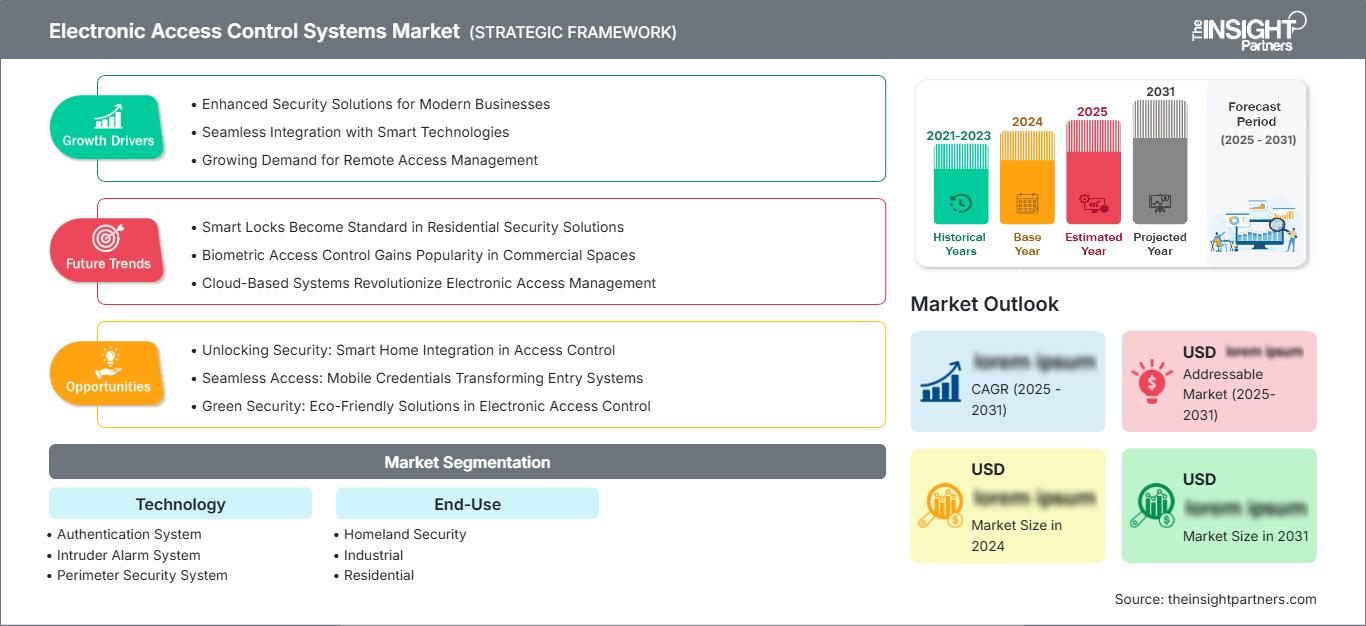
Electronic Access Control Systems Market: Strategic Insights
Regional Insights
North America Electronic Access Control Systems Market
North America electronic access control systems market will hold an estimated market share of 35-39% of the world revenue in 2025. The United States remains the major national market with an estimated market share of 80-85% owing to strong regulations on government security and large amount of defense expenditure. Early adaptation of biometrics and cloud access control systems has been a major benefit for the region, with business and government sector becoming major adopters of this technology. Healthcare and education are new growth segments for the market with patient safety and campus security becoming major driving factors.
The regional CAGR is estimated at 7.5-8.5% until 2034, backed by the development of the smart cities projects in the region that promote complete security solutions.
U.S. Electronic Access Control Systems Market
U.S. market for electronic access control systems is forecast to experience CAGR of 7.8% to 8.8% during 2026 to 2034, backed by strict government security regulations and spending in the commercial industry. United States has dominated the North American market in 2025 with more than 80%, as federal buildings, defense facilities, and banking institutions act as major end-users.
Healthcare and educational segments hold immense growth opportunity, owing to adoption of access control solutions by hospitals and educational institutes. Some of the emerging applications in the market include rising usage of mobile credentials and cloud-based platform solutions.
Europe Electronic Access Control Systems Market
Europe captured roughly 25–29% of the global Electronic Access Control Systems market in 2025, with the UK, Germany, and France as key regional markets. The UK leads European demand with approximately 7–9% of global market share, driven by government security regulations and commercial building standards. Germany accounts for about 6–8% of global demand, characterized by strong manufacturing sector security requirements.
France, Italy, and Spain show growing demand for integrated security solutions, supported by EU data protection and cybersecurity regulations. The region is projected to grow at a CAGR of 7.0–8.0% through 2034, supported by GDPR compliance and infrastructure security mandates.
APAC Electronic Access Control Systems Market
Asia Pacific Electronic Access Control Systems held around 22-26% of total worldwide market share in 2025 and is expected to exhibit the highest regional CAGR of 9.5-10.5% in 2026-2034. China is the largest country in the region with about 10-12% of total global consumption, powered by smart city projects and protection of vital infrastructure. Japan and South Korea exhibit high adoption rates due to the use of sophisticated biometric technology.
Emerging opportunities for India exist due to urbanization and development of smart cities. Australia will see demand from infrastructure security and defense verticals. The fast-paced digital evolution in tandem with government-sponsored projects for developing smart manufacturing and security infrastructure in the region are the driving factors for demand growth.
Middle East & Africa Electronic Access Control Systems Market
The Middle East & Africa Electronic Access Control Systems market is estimated to expand at a CAGR of 8.0–9.0% through 2034, driven by infrastructure development and security modernization. Saudi Arabia's Vision 2030 program is stimulating investments in smart city security infrastructure. The UAE shows strong adoption in commercial and government facilities, with Dubai's focus on smart city initiatives driving demand.
South Africa is emerging as a key market, with commercial and industrial security needs. The region is also witnessing increasing adoption in energy and critical infrastructure sectors, supported by government investments.
Segmentation Analysis
Technology
The technology segment of the Electronic Access Control Systems market is categorized into Authentication System, Intruder Alarm System, and Perimeter Security System. This segment is expected to exhibit a CAGR of 8.1–9.1% from 2026 to 2034.
- Authentication System: These systems verify user identity through credentials such as biometrics, cards, or mobile devices. This sub-segment dominates the market, capturing over 50–55% of revenue in 2025, driven by increasing adoption of biometric and cloud-based authentication solutions.
- Intruder Alarm System: These systems detect and alert unauthorized entry attempts. Demand is driven by growing security concerns and regulatory requirements for commercial and residential properties.
- Perimeter Security System: These systems protect facility boundaries using sensors, fences, and surveillance integration. This sub-segment shows significant growth potential in critical infrastructure and government applications.
End-Use
The end-use segment includes Homeland Security, Industrial, Residential, and Commercial. This segment is expected to witness a CAGR of 8.3–9.3% from 2026 to 2034.
- Homeland Security: This is a significant end-use segment, driven by government investments in border security and critical infrastructure protection. The segment benefits from consistent defense and homeland security funding.
- Industrial: This segment includes manufacturing, energy, and logistics facilities. Demand is driven by need for facility security and regulatory compliance in critical infrastructure sectors.
- Residential: This is the fastest-growing end-use segment, driven by smart home adoption and consumer awareness regarding personal and property security. Growth is supported by affordable access control solutions.
- Commercial: This is the largest end-use segment, capturing over 40–45% of the market in 2025. Offices, retail, and financial institutions represent major commercial adopters of access control systems.
Opportunity Snapshot
| End-Use | Revenue Contribution | Trend Tag | Adoption Stage |
|---|---|---|---|
| Homeland Security | High | Critical Infrastructure | Mature |
| Commercial | High | Smart Building | Mature |
| Industrial | Medium | Facility Security | Scaling |
| Residential | Medium | Smart Home | Emerging |
Electronic Access Control Systems Market Growth Drivers and Impact Analysis
Increasing Security Threats and Government Regulations
Security threats, such as terrorism, cybercrime, and workplace violence, around the world are the main impetus behind the growth of the Electronic Access Control Systems industry. Governments of countries have introduced strong security policies requiring improved access control systems in their government offices, infrastructure, and other public places. The need for these policies gives the industry a constant drive for developing advanced technologies for identity and perimeter security. It has been noted that the governments have significantly increased their budget for homeland and infrastructure security, thereby opening up many opportunities for this market.
Smart Building and Infrastructure Modernization
The global trend toward smart building and infrastructure modernization is driving significant demand for Electronic Access Control Systems. Commercial buildings, educational institutions, and healthcare facilities are integrating access control with building management systems for improved security and operational efficiency. The technology enables integration with HVAC, lighting, and energy management systems, reducing operational costs while enhancing security. Market data indicates that smart building investments are growing across geographies, creating substantial demand for integrated access control solutions. This trend extends to smart city initiatives, where Electronic Access Control Systems are integral to connected security infrastructure in transportation hubs, public facilities, and urban environments.
Technological Advancements in Biometric and Mobile Access
Continuous technological advancements in biometric authentication and mobile access are driving market growth and product innovation. Biometric technologies, including fingerprint, facial recognition, and iris scanning, offer enhanced security compared to traditional card-based systems. Mobile access solutions using smartphones as credentials are gaining popularity, offering convenience and reduced operational costs. These technological innovations stimulate replacement purchases as organizations upgrade from legacy systems. The integration of artificial intelligence and machine learning is enhancing threat detection and system efficiency. As technology costs decrease and performance improves, adoption across residential, commercial, and government sectors is expected to accelerate.
Electronic Access Control Systems Market Future Trends
Integration of AI and Cloud-Based Access Management
The Electronic Access Control Systems market is witnessing significant technological evolution toward AI-driven and cloud-based access management platforms. Artificial intelligence enables advanced threat detection, behavioral analytics, and predictive security management. Cloud-based solutions offer scalability, remote management, and reduced infrastructure costs, making them attractive for multi-site organizations. The integration of these technologies enables real-time security monitoring, automated threat response, and comprehensive access audit trails. This trend toward intelligent, connected security solutions is expected to open new market segments and challenge traditional on-premise system dominance in applications where scalability and remote management are critical factors.
Convergence with IoT and Physical Security Integration
Electronic Access Control Systems are increasingly converging with IoT devices and integrated physical security platforms. Access control integration with video surveillance, intrusion detection, and building automation provides comprehensive security solutions for commercial, industrial, and government facilities. The technology is also being integrated with IoT sensors for environmental monitoring and asset tracking applications. This trend is supported by the growing importance of comprehensive security management and the reduction of total cost of ownership through integrated solutions. As organizations seek unified security platforms, the market for integrated Electronic Access Control Systems continues to expand.
Electronic Access Control Systems Market Opportunities
Expansion in Smart City and Critical Infrastructure Projects
The integration of Electronic Access Control Systems into smart city infrastructure presents significant growth opportunities. Government investments in smart city projects, including transportation hubs, public facilities, and urban security infrastructure, create substantial demand for advanced access control solutions. Critical infrastructure protection, including energy, water, and telecommunications facilities, requires robust security systems. As urbanization continues and governments increase infrastructure spending, the smart city segment is expected to be a significant growth driver for the Electronic Access Control Systems market.
Emerging Residential and SMB Security Market
The residential and small-to-medium business (SMB) security market offers substantial growth opportunities for Electronic Access Control Systems. Consumer awareness regarding home security, coupled with decreasing technology costs, is driving adoption of smart door locks and wireless access control systems. The SMB sector represents significant untapped potential, as businesses increasingly recognize the value of professional security solutions. The trend toward do-it-yourself and professionally monitored security systems is creating new distribution channels and business models. With the global population growth and increasing urbanization, the residential and SMB security segment is poised for significant expansion.
Recent Developments
- March 2026: Johnson Controls (NYSE: JCI), a global technology leader in energy efficiency, decarbonization, thermal management and mission-critical performance, today announced a series of advancements across its access control and video security portfolio. Showcased at ISC West 2026 (March 23-27) in Las Vegas, these latest releases from Johnson Controls reinforce the company’s leadership in open, scalable, and future-ready security platforms.
- March 2026: Precise Biometrics, a global pioneer in biometrics and cybersecurity, today announced the launch of Palm Access Pro, its next-generation biometric solution for physical access control. The solution combines Precise’s touchless palm authentication and anti-spoofing software with a flexible orchestration platform for multi-factor authentication (MFA), enabling secure and seamless access combining biometrics with mobile credentials.
- April 2026: Mercury Security has announced the commercial launch of its embedded application environment, marking a shift in access control from static hardware systems to programmable, edge-native security platforms.
Frequently Asked Questions

- Comprehensive Market Sizing and Forecast Analysis
- Detailed Segmentation Analysis
- In-Depth Market Dynamics Assessment
- Regional and Country-Level Insights
- Competitive Landscape and Company Benchmarking
- Strategic Business Intelligence
Recent Reports
Testimonials

The Insight Partners' SCADA System Market report is comprehensive, with valuable insights on current trends and future forecasts. The team was highly professional, responsive, and supportive throughout. We are very satisfied and highly recommend their services.
RAN KEDEM Partner, Reali Technologies LTDs
I requested a report on a very specific software market and the team produced the report in a few days. The information was very relevant and well presented. I then requested some changes and additions to the report. The team was again very responsive and I got the final report in less than a week.
JEAN-HERVE JENN Chairman, Future Analytica
We worked with The Insight Partners for an important market study and forecast. They gave us clear insights into opportunities and risks, which helped shape our plans. Their research was easy to use and based on solid data. It helped us make smart, confident decisions. We highly recommend them.
PIYUSH NAGPAL Sr. Vice President, High Beam Global
The Insight Partners delivered insightful, well-structured market research with strong domain expertise. Their team was professional and responsive throughout. The user-friendly website made accessing industry reports seamless. We highly recommend them for reliable, high-quality research services
YUKIHIKO ADACHI CEO, Deep Blue, LLC.
This is the first time I have purchased a market report from The Insight Partners.While I was unsure at first, I visited their web site and felt more comfortable to take the risk and purchase a market report.I am completely satisfied with the quality of the report and customer service. I had several questions and comments with the initial report, but after a couple of dialogs over email with their analyst I believe I have a report that I can use as input to our strategic planning process.Thank you so much for taking the extra time and making this a positive experience.I will definitely recommend your service to others and you will be my first call when we need further market data.
JOHN SUZUKI President and Chief Executive Officer, Board Director, BK Technologies
I wish to appreciate your support and the professionalism you displayed in the course of attending to my request for information regarding to infectious disease IVD market in Nigeria. I appreciate your patience, your guidance, and the fact that you were willing to offer a discount, which eventually made it possible for us to close a deal. I look forward to engaging The Insight Partners in the future, all thanks to the impression you have created in me as a result of this first encounter.
DR CHIJIOKE ONYIA MANAGING DIRECTOR, PineCrest Healthcare Ltd.Reason to Buy
- Informed Decision-Making
- Understanding Market Dynamics
- Competitive Analysis
- Identifying Emerging Markets
- Customer Insights
- Market Forecasts
- Risk Mitigation
- Boosting Operational Efficiency
- Strategic Planning
- Investment Justification
- Tracking Industry Innovations
- Aligning with Regulatory Trends





 Get Free Sample for