
Electronic Display Market Share, Growth & Forecast by 2034
Coverage: By Technology (LCD, LED, OLED, Others); Application (Consumer Electronics, Digital Signage, Automotive Display, Others); End-Use (Retail, Entertainment, Corporate, Healthcare, Government, Others) , and Geography (North America, Europe, Asia Pacific, and South and Central America)
- Status : Data Released
- Report Code : TIPRE00016969
- Category : Electronics and Semiconductor
- No. of Pages : 150
- Available Report Formats :


- Last update date : August 10, 2026


2025 Market Size
US$ 166.27 Bn
Base year value
2034 Forecast
US$ 234.36 Bn
Projected by 2034
CAGR 2026-2034
3.89 %
Growth rate
Addressable Market
US$ 1,819.83 Bn
(2026-2034)
The Electronic Display Market size reached a valuation of US$ 166.27 Billion in 2025 and will grow up to US$ 234.36 Billion by 2034, marking a CAGR of 3.89% during the forecast period of 2026-2034. The market is growing due to LCD, LED, and OLED solutions that enhance the functionality of connected devices used for consumer, signage, intelligent cockpit, medical visualization, collaboration, and public information purposes.
In North America, the market is expected to grow at a CAGR rate between 3.4-4.1%. This growth is driven by premium television replacements, enterprise screens, intelligent automotive cockpits, and retail media networks. Other factors that drive the demand include healthcare visualization interfaces, government command centers, and high refresh rate and low power displays.
Electronic Display Market Assessment and Insights
- North America held 24–27% share in 2025 and is growing at a CAGR range of 3.4–4.1% during 2026–2034, driven by connected homes, automotive interfaces, retail media, healthcare visualization, and corporate workplace refresh cycles.
- US represented 82–86% of North America in 2025 and is growing at a CAGR range of 3.5–4.2%, led by consumer electronics, digital signage, and automotive display demand.
- Europe accounted for 20–23% share in 2025 and is advancing at a CAGR range of 3.1–3.8%, with Germany, the UK, France, Italy, and Spain leading adoption.
- Asia Pacific captured 43–47% share in 2025 and is expanding at a CAGR range of 4.2–4.9%, led by China, Japan, South Korea, India, and Taiwan manufacturing ecosystems.
- Largest Segment LCD technology held 55–59% market share in 2025 and is growing at a CAGR range of 2.7–3.4%, supported by televisions, monitors, signage, and cost-sensitive displays.
- High Growth Segment OLED technology held 17–21% market share in 2025 and is growing at a CAGR range of 8.5–10.2%, driven by premium smartphones, televisions, wearables, and automotive interiors.
- Key companies analyzed in detail: Acer Incorporated, ActiveLight Inc., AUO Corporation, Cambridge Display Technology Limited, Casio Computer Co., Ltd., LG Electronics Inc., Sharp Corporation, Sony Corporation, Toshiba Corporation, and Zenith Electronics LLC.
Source: The Insight Partners' analysis based on proprietary research, government publications, company annual reports, investor presentations, industry databases, and expert interviews.
From screen manufacture to panel production in tandem with drive electronics, software adjustment, and application-specific casing design, display manufacturing has advanced significantly. While LCDs still lead in volumes, LED backlights, miniaturized LED emitters, and OLED panels continue to redefine the product hierarchy. Glass capabilities, material availability, yield management, and region-specific customer initiatives become critical for manufacturers as devices require thinner designs, improved power efficiency, brighter displays, and extended lifetime.
Further development in display manufacturing will largely depend on intelligent mobility solutions, retail media revenue generation, work collaboration in hybrid environments, healthcare applications, and infrastructure upgrade. Support for electronics manufacturing in Asia and North America, coupled with energy-efficiency policies, ensures added resilience in capacity alongside increased pressure on power-efficient platforms. Future growth for emerging economies lies in increased units while for developed economies it is larger displays.
Electronic Display Market Report Scope
| Report Attribute | Details |
|---|---|
| Market size in 2025 | US$ 166.27 Billion |
| Market Size by 2034 | US$ 234.36 Billion |
| Global CAGR (2026 - 2034) | 3.89% |
| Historical Data | 2021-2024 |
| Forecast period | 2026-2034 |
Electronic Display Market Analysis
The Electronic Display Market growth is driven by increasing display resolution in day-to-day usage in smartphones, smart TVs, cockpit displays in cars, medical dashboards, digital signage, and control rooms. Displays are increasingly used as decision-making interfaces and not just information conveyors. Consumer electronics drive volume, whereas commercial and automotive markets drive value through longevity, brightness, touch, curvature, and processing.
Value chain components include glass substrates, organic materials, LED packs, polarizers, driver ICs, panel makers, module makers, display brands, signage integrators, and software platforms. Supply conditions favor firms that can influence yield, energy consumption, color accuracy, and longevity. Electronic Display Market supply is characterized by cycles in panel prices, and therefore differentiation must be based on premium characteristics and engineering.
Positioning for Competitive Analysis of Electronic Display Market relies on technology depth, scale of production, channel coverage, and strength of the product ecosystem. LG Electronics Inc. and Sony Corporation position themselves through high-end televisions and professional displays, whereas Sharp Corporation and AUO Corporation have strong positions in panels and commercial displays. Acer Incorporated positions itself using monitor and computing channels, and Casio Computer Co., Ltd. is associated with specialized display enabled products.
There is a shift towards OLED capacity, mini-LED designs, automotive cockpit systems, and signage systems integrating hardware with content management. Cambridge Display Technology Limited continues to be relevant due to its OLED materials technologies, and ActiveLight Inc. and Zenith Electronics LLC are helping in supporting specialized and legacy display ecosystems. It is now becoming more important to align display performance with economics of use cases.
● REPORT CUSTOMIZATION
Tailor This Report To Align With Your Specific Business Requirements
This report can be customized to align precisely with your business objectives, scope, and target markets. Customization options include tailored segmentation, geography, competitive analysis, and strategic insights to support informed decision-making.
Customize This Report →WHAT YOU CAN ADJUST
- ● Segmentations
- ● Geography
- ● Competitive Analysis
- ● Language Preferences
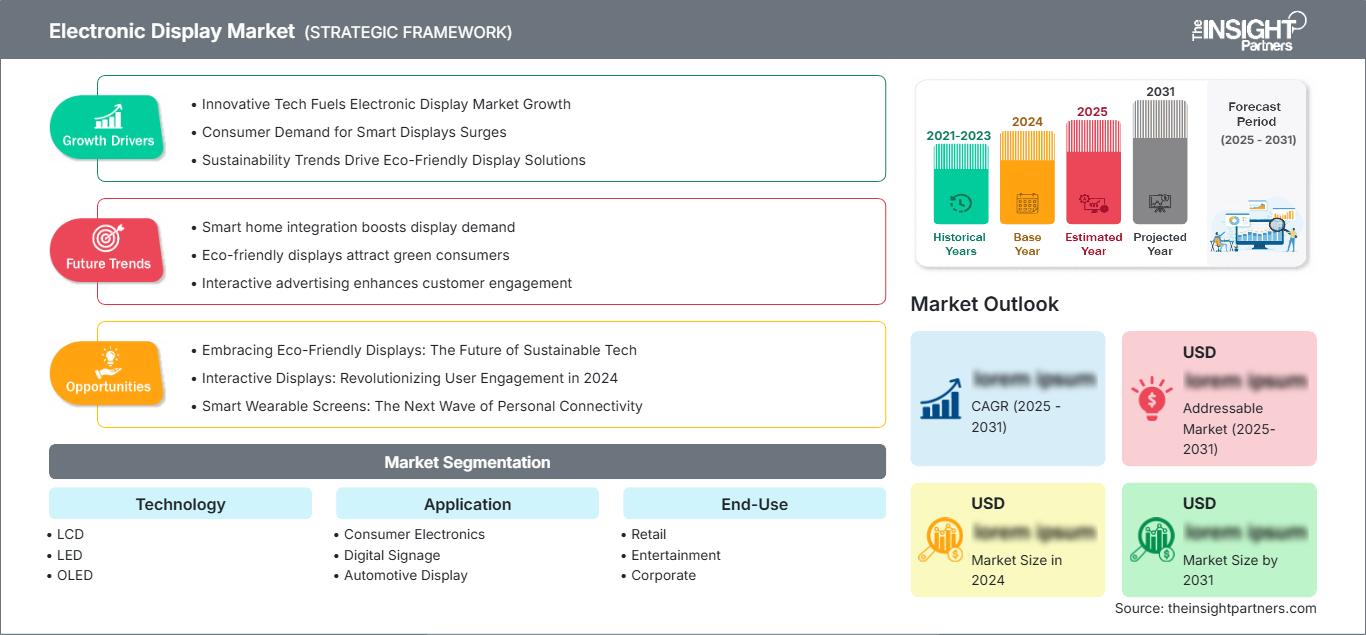
Electronic Display Market: Strategic Insights
Regional Insights
North America Electronic Display Market
North America held 24–27% share in 2025 and is projected to grow at a CAGR range of 3.4–4.1% through 2034. Electronic Display Market share is supported by premium television upgrades, large-format retail screens, workplace collaboration panels, smart vehicle cockpits, and healthcare visualization. The US Energy Information Administration focus on building electricity efficiency reinforces demand for lower power commercial displays.
Display purchases in the region are increasingly tied to content monetization and operational visibility. Retailers deploy dynamic signage for pricing and advertising, hospitals use high-resolution monitors for imaging review, and corporate campuses refresh meeting rooms for hybrid work. Buyers emphasize reliability, service networks, cybersecurity features, and integration with software platforms because downtime can disrupt customer engagement and workflows.
U.S. Electronic Display Market
In 2025, the US accounted for 82–86% of the North American market and is projected to achieve a CAGR of 3.5–4.2%. The key demand drivers in the US are consumer electronics, QSR signage, control rooms, infotainment for automobiles, gaming monitors, and displays for the health care sector. Some leading companies in this market include Sony Corporation, LG Electronics Inc., Sharp Corporation, Acer Incorporated, and AUO Corporation.
The applications that show positive trends include OLED televisions, high refresh rate gaming displays, interactive corporate boards, and rugged displays for public organizations. Automotive displays are transitioning from single infotainment displays to cockpit displays with multiple zones. The reason why US consumers look for energy efficiency ratings, warranties, and vendor support is that business display networks need reliable performance across numerous sites.
Europe Electronic Display Market
Share of Europe in 2025 was 20–23%, and CAGR of 3.1–3.8% is anticipated in the future. Germany takes the leading position owing to automotive interiors, industrial visualization, and premium consumer electronics. In turn, the UK is characterized by retail media, transport information systems, and business screens usage. France provides the demand for public infrastructure, healthcare, and production of broadcasts.
Italy and Spain are known for hospitality industry, retail upgrading, education, and signages for smart cities. Sustainable criteria become important for European buyers because they influence purchasing decisions. High-quality professional displays and vehicle cluster panels, as well as energy-efficient screens are preferred in the European market. Germany still takes the leading position due to electronics and industrial automation.
APAC Electronic Display Market
Asia Pacific held 43-47% market share in 2025 and is projected to achieve 4.2-4.9% CAGR growth. China will dominate through panel capacity, television production, smartphones, signage, and EV cockpit display demand. On the other hand, Japan and South Korea will bring in their premium OLED, gaming, and automotive capabilities. India and Australia will make contributions through consumer electronics, retail, and public infrastructure.
There are favorable industrial policies in the region and semiconductors manufacturing incentives. APAC will benefit from its urban retail network, mass transit systems, and mobile first consumers. While cost competition will remain fierce, premium OLED displays, mini-LED and automobile displays will help improve unit value. APAC will be the major producer and demand booster of the Electronic Display Market.
Middle East & Africa Electronic Display Market
Middle East & Africa is projected to grow at a CAGR range of 3.0–3.7% as Saudi Arabia, the UAE, South Africa, and rest of MEA invest in airports, retail, healthcare, education, hospitality, and public security displays. The UAE leads premium signage adoption through tourism, malls, events, and smart-city projects.
Demand favors bright, durable screens capable of operating in high-temperature and high-dust environments. Saudi Arabia adds volume through infrastructure programs and entertainment venues, while South Africa requires cost-effective displays for retail and public services. Growth remains project-led, but urban development and transport modernization create selective opportunities for professional-grade products.
Segmentation Analysis
Technology
Technology is expected to grow at a CAGR range of 3.6–4.3% during 2026–2034 as Electronic Display Market scope covers LCD, LED, and OLED platforms. LCD sustains mainstream affordability, LED improves brightness and energy performance, and OLED raises premium value through contrast, thinness, and flexible design. Selection depends on cost, viewing quality, power use, lifetime, and application environment.
- LCD remains the largest technology because televisions, monitors, laptops, public information screens, and value-oriented signage depend on proven manufacturing scale, stable supply, and attractive cost per display area.
- LED demand is supported by direct-view signage, backlighting, outdoor displays, retail walls, and commercial environments where brightness, modularity, and visibility under varied lighting conditions are strategic.
- OLED is positioned for premium visual experiences in smartphones, televisions, wearables, gaming monitors, and automotive interiors where contrast, thin form factors, low response time, and flexible design matter.
Application
Application is projected to grow at a CAGR range of 3.7–4.4% during 2026–2034 as consumer electronics, digital signage, and automotive display demand diversify revenue. Consumer devices create scale, signage monetizes attention in physical locations, and vehicles increasingly use multi-display cockpits. Application strategy is shaped by brightness, durability, interface design, refresh rate, and software integration.
- Consumer Electronics generates volume through televisions, smartphones, tablets, laptops, monitors, and wearables, with replacement cycles increasingly influenced by resolution, refresh rate, color quality, and energy performance.
- Digital Signage supports retail media, transportation information, corporate communication, hospitality, and public alerts, where remote content management and high brightness convert displays into revenue or operational assets.
- Automotive Display is gaining strategic value as instrument clusters, head-up displays, center stacks, passenger screens, and rear-seat entertainment expand screen area per vehicle and support software-defined interiors.
End-Use
End-Use is forecast to grow at a CAGR range of 3.5–4.2% during 2026–2034 as retail, entertainment, corporate, healthcare, and government buyers apply screens to decision-making, services, and engagement. Retail emphasizes monetization, entertainment prioritizes immersion, corporate buyers require collaboration, healthcare needs accuracy, and government agencies value resilient communication across facilities and public spaces.
- Retail uses displays for electronic shelf communication, in-store media, menu boards, and omnichannel campaigns, making uptime, brightness, centralized control, and analytics compatibility important purchase considerations.
- Entertainment demand comes from televisions, gaming monitors, venues, cinemas, museums, and event spaces where high contrast, large formats, fast response, and immersive visual quality support premium experiences.
- Corporate buyers deploy interactive boards, video walls, conferencing displays, and lobby screens to support hybrid work, executive communication, training, and real-time operational visibility.
- Healthcare applications require accurate visualization for diagnostics, monitoring, operating rooms, telemedicine, and patient engagement, with reliability, hygiene compatibility, and visual precision influencing procurement.
- Government demand includes command centers, transport information, public safety rooms, education, civic buildings, and digital service counters where durability, security, and lifecycle support are essential.
Opportunity Snapshot
| Application | Revenue Contribution | Trend Tag | Adoption Stage |
| Consumer Electronics | High | Premium Refresh | Mature |
| Digital Signage | Medium | Retail Media | Scaling |
| Automotive Display | Medium | Smart Cockpit | Scaling |
Electronic Display Market Growth Drivers and Impact Analysis
Premium Visual Interfaces Expand Across Connected Devices
Consumers and enterprises increasingly judge devices by screen quality, making display performance a core purchase factor rather than a secondary specification. Higher resolution, faster refresh rates, wider color coverage, and lower power use influence smartphones, televisions, notebooks, gaming monitors, wearables, and conferencing systems. The practical impact is stronger demand for OLED and high-end LED formats, while LCD remains essential for affordable scale. Device brands use better screens to extend replacement cycles and justify higher selling prices. This driver also supports panel innovation because suppliers must deliver thinner modules, improved brightness, and consistent color performance across multiple form factors.
Digital Signage Converts Physical Locations into Media Assets
Retailers, airports, restaurants, transit operators, stadiums, and corporate campuses are turning display networks into communication and revenue platforms. Screens enable dynamic pricing, localized advertising, operational alerts, wayfinding, and customer engagement without printed material replacement. As cloud content management becomes standard, buyers can update many locations quickly and measure campaign effectiveness. The market impact is rising demand for commercial-grade LED and LCD systems with high brightness, long duty cycles, narrow bezels, and remote monitoring. Vendors that combine displays with mounting, software integration, warranties, and energy-efficient operation can capture more project value than panel-only suppliers.
Software-Defined Vehicles Increase Display Area per Car
Automotive interiors are shifting from mechanical controls to software-centered interfaces, raising the number and size of displays in instrument clusters, center stacks, rear-seat systems, passenger screens, and head-up displays. Electric vehicles amplify this trend because cockpit experience supports brand differentiation and digital service delivery. Automotive displays require wide temperature tolerance, high brightness, low reflectivity, long lifetime, and functional safety alignment. The real-world impact is higher panel value per vehicle and stronger demand for OLED, LTPS LCD, and mini-LED options. Suppliers with automotive qualification, curved design capability, and stable long-term supply can secure platform-level programs.
Electronic Display Market Future Trends
OLED and Mini-LED Architectures Move Beyond Premium Niches
Electronic Display Market trends will increasingly feature OLED and mini-LED moving from flagship products into broader notebooks, monitors, televisions, signage, and vehicle interiors. Cost reduction, better yields, and wider supplier participation will make advanced panels accessible to more price points. OLED will benefit from contrast, thinness, and design flexibility, while mini-LED will serve bright, durable, and larger formats. Buyers will compare lifetime, burn-in mitigation, brightness, repairability, and power use before choosing technology. This trend will pressure LCD suppliers to improve backlighting, efficiency, and refresh performance while creating opportunities for hybrid product roadmaps.
Display Systems Become Software-Controlled Experience Platforms
Future displays will be evaluated by software integration as much as panel performance. Retail screens will connect with content scheduling, audience analytics, and inventory systems; corporate displays will link with conferencing platforms; automotive screens will receive over-the-air interface updates; and healthcare displays will integrate with digital records and imaging workflows. This shift creates demand for secure operating systems, device management, calibration tools, and remote diagnostics. Hardware vendors that partner with software ecosystems can strengthen recurring revenue and reduce commoditization. Buyers will increasingly prefer suppliers that support lifecycle management rather than one-time screen replacement.
Electronic Display Market Opportunities
Automotive Cockpit Platforms for Mid-Range Vehicles
Electronic Display Market Forecasts point to a strong opportunity in scalable cockpit platforms for mid-range vehicles, not only luxury models. Suppliers can develop modular screen families that share electronics, cover glass, software interfaces, and qualification evidence while allowing automakers to select different sizes and technologies. This reduces engineering cost and accelerates model rollout across trims. The opportunity is attractive because vehicle makers need digital differentiation without premium-only pricing. Panel manufacturers, module integrators, and automotive electronics suppliers can capture more value by offering validated display assemblies, thermal design support, and long-term supply commitments across multi-year vehicle platforms.
Managed Display Networks for Retail and Public Infrastructure
Retailers, transport authorities, hospitals, universities, and municipalities need display networks that operate reliably across many sites. Suppliers can create managed offerings covering hardware, installation, content software, monitoring, preventive maintenance, and energy-performance reporting. This approach turns display procurement into a service model and helps customers reduce downtime, coordinate messaging, and extend asset life. The opportunity is strongest where screens support revenue, safety, or public service delivery. Vendors with national support partners, rugged product lines, cybersecurity features, and analytics-ready platforms can move beyond commodity screen sales and build recurring commercial relationships.
Recent Developments
- May 2026: LG Electronics (LG) is bolstering its leadership in the commercial display market with the launch of its ultra-low-power “LG E-Paper Display.” The new product, which received a Red Dot Award: Product Design 2026 in recognition of its innovative, user-centric design, will be launched first in South Korea early next month, followed by Europe and U.S. in July.
- March 2026: DKE, a global leader in ePaper display technology and an E Ink partner, announced the launch of its new product platform, DKE FLEX. This new category of ePaper displays is the first to be built on organic thin-film transistors (OTFTs) on plastic substrates and is suitable for driving all monochrome and color E Ink front planes.
- July 2025: Omdia reported that LTPS TFT LCD and OLED display revenues would exceed 50% of the automotive display market in 2025, with automotive display panel revenue projected at US$ 13.6 billion. The finding highlights the migration toward higher-value cockpit panels and premium display technologies.
Frequently Asked Questions

- Comprehensive Market Sizing and Forecast Analysis
- Detailed Segmentation Analysis
- In-Depth Market Dynamics Assessment
- Regional and Country-Level Insights
- Competitive Landscape and Company Benchmarking
- Strategic Business Intelligence
Recent Reports
Testimonials

The Insight Partners' SCADA System Market report is comprehensive, with valuable insights on current trends and future forecasts. The team was highly professional, responsive, and supportive throughout. We are very satisfied and highly recommend their services.
RAN KEDEM Partner, Reali Technologies LTDs
I requested a report on a very specific software market and the team produced the report in a few days. The information was very relevant and well presented. I then requested some changes and additions to the report. The team was again very responsive and I got the final report in less than a week.
JEAN-HERVE JENN Chairman, Future Analytica
We worked with The Insight Partners for an important market study and forecast. They gave us clear insights into opportunities and risks, which helped shape our plans. Their research was easy to use and based on solid data. It helped us make smart, confident decisions. We highly recommend them.
PIYUSH NAGPAL Sr. Vice President, High Beam Global
The Insight Partners delivered insightful, well-structured market research with strong domain expertise. Their team was professional and responsive throughout. The user-friendly website made accessing industry reports seamless. We highly recommend them for reliable, high-quality research services
YUKIHIKO ADACHI CEO, Deep Blue, LLC.
This is the first time I have purchased a market report from The Insight Partners.While I was unsure at first, I visited their web site and felt more comfortable to take the risk and purchase a market report.I am completely satisfied with the quality of the report and customer service. I had several questions and comments with the initial report, but after a couple of dialogs over email with their analyst I believe I have a report that I can use as input to our strategic planning process.Thank you so much for taking the extra time and making this a positive experience.I will definitely recommend your service to others and you will be my first call when we need further market data.
JOHN SUZUKI President and Chief Executive Officer, Board Director, BK Technologies
I wish to appreciate your support and the professionalism you displayed in the course of attending to my request for information regarding to infectious disease IVD market in Nigeria. I appreciate your patience, your guidance, and the fact that you were willing to offer a discount, which eventually made it possible for us to close a deal. I look forward to engaging The Insight Partners in the future, all thanks to the impression you have created in me as a result of this first encounter.
DR CHIJIOKE ONYIA MANAGING DIRECTOR, PineCrest Healthcare Ltd.Reason to Buy
- Informed Decision-Making
- Understanding Market Dynamics
- Competitive Analysis
- Identifying Emerging Markets
- Customer Insights
- Market Forecasts
- Risk Mitigation
- Boosting Operational Efficiency
- Strategic Planning
- Investment Justification
- Tracking Industry Innovations
- Aligning with Regulatory Trends





 Get Free Sample for