
Electronic Security Market Trends, Size & Forecast by 2034
Coverage: By Product Type (Security Alarms, CCTV, Video Surveillance System, EACS, and Anti-theft system); and End-user (Manufacturing Industries, Government Institutions, Educational Institutions, Healthcare Institutions, Data Centers, Commercial Infrastructure, Residential, and Banking); , and Geography (North America, Europe, Asia Pacific, and South and Central America)
- Status : Data Released
- Report Code : TIPTE100001023
- Category : Electronics and Semiconductor
- No. of Pages : 150
- Available Report Formats :


- Last update date : August 12, 2026


2025 Market Size
US$ 78.33 Bn
Base year value
2034 Forecast
US$ 128.58 Bn
Projected by 2034
CAGR 2026-2034
5.66 %
Growth rate
Addressable Market
US$ 937.78 Bn
(2026-2034)
The Electronic Security Market size is estimated to reach US$ 78.33 Billion in 2025 and will further grow up to US$ 128.58 Billion in 2034, recording a CAGR of 5.66% throughout the forecasted period from 2026 to 2034. This indicates increasing demand for integrated surveillance, access control systems, and anti-theft devices.
According to the Electronic Security Market report, North America will hold its significance with the growth rate of CAGR being 5.2–5.8% during 2026–2034. The factors supporting this growth include the rising trend of building smart cities, critical infrastructural security measures, and technological upgrade needs of enterprises.
Electronic Security Market Assessment and Insights
- North America: The region commands approximately 32–36% share in 2025 and is growing at a CAGR range of 5.2–5.8% between 2026–2034, driven by stringent regulatory compliance requirements and advanced security infrastructure supporting widespread adoption across commercial and government sectors.
- US: The United States accounts for 75–80% share in 2025 and is growing at a CAGR range of 5.0–5.6% between 2026–2034, reflecting mature market conditions with continuous replacement cycles and cloud-based platform migration.
- Europe: The region holds approximately 24–28% share in 2025 and is growing at a CAGR range of 5.4–6.0% between 2026–2034, with the UK, Germany, and France leading adoption through GDPR compliance and critical infrastructure protection initiatives.
- Asia Pacific: The region represents approximately 22–26% share in 2025 and is growing at a CAGR range of 6.5–7.2% between 2026–2034, with China, India, Japan, and South Korea driving growth through urbanization and smart city deployments.
- Largest Segment: The CCTV segment holds approximately 38–42% market share in 2025 and is growing at a CAGR range of 5.4–5.9% between 2026–2034, reflecting dominant adoption for perimeter monitoring and facility surveillance applications.
- High Growth Segment: The EACS segment represents approximately 18–22% market share in 2025 and is growing at a CAGR range of 6.8–7.4% between 2026–2034, driven by biometric authentication demand and cloud-based access management solutions.
- Key companies analyzed in detail: Axis Communications AB, Robert Bosch LLC, Honeywell International Inc., Tyco Security Products, Checkpoint Systems, Inc., NICE Systems Ltd., Siemens AG, Johnson Controls International plc, ADT LLC dba ADT Security Services, and United Technologies Corporation.
Source: The Insight Partners' analysis based on proprietary research, government publications, company annual reports, investor presentations, industry databases, and expert interviews.
The Electronic Security Market forecast indicates that there has been growth to integrate various technologies such as video analytics, biometrics, and artificial intelligence threat monitoring, apart from being limited to conventional alarm systems. Innovations in hardware have now moved to IP-enabled camera systems using edge computing, whereas the software platform has been developing towards the use of cloud computing technologies with machine learning for optimized incident responses, minimized false alarms, and intelligence generation.
Dynamics on the forward side include increasing regulation adoption in the emerging markets of Asia Pacific and Middle East, and high investments in next-generation technologies which can address cybersecurity integration and IoT devices. The tailwinds from regulation requirements for the protection of critical infrastructures and data privacy continue to drive premium services adoption by enterprises.
Electronic Security Market Report Scope
| Report Attribute | Details |
|---|---|
| Market size in 2025 | US$ 78.33 Billion |
| Market Size by 2034 | US$ 128.58 Billion |
| Global CAGR (2026 - 2034) | 5.66% |
| Historical Data | 2021-2024 |
| Forecast period | 2026-2034 |
Electronic Security Market Analysis
Key demand determinants involve the increased incidence of crime and security threats throughout the world, the need for critical infrastructure protection in the energy and transportation industries, and incentive schemes from insurance companies to organizations that have proven security records. The value chain comprises suppliers of hardware products such as cameras, sensors, and access control systems, suppliers of software systems including video management and analysis systems, and system integrators. The supply chain involves better availability of semiconductors, 5G connectivity for transmission of video feeds, and price competition.
Channel distribution comprises OEM alliances with commercial building developers, official dealers for regional enterprise clients, and online market places for fast implementation for small and medium size enterprises. Compatibility with current building management system, enterprise resource planning software, and third-party monitoring centers has now become an important selling point, as the customer demands more unified view of the whole security network rather than individual components.
The Electronic Security Market trends indicate competition among well-known security firms such as Honeywell International Inc. and Johnson Controls International plc going head-to-head against specialty firms like Axis Communications AB and ADT LLC dba ADT Security Services, all vying for differentiation on the basis of platform capabilities, hardware performance, and quality of customer service. The trends reveal consolidation moves by bigger firms buying innovative startups to add AI analytical, cloud-based management, and cybersecurity capabilities, while venture capital investments continue targeting the development of new-age security products for smart cities and critical infrastructures.
Positioning is now more focused on Total Cost of Ownership, security certifications, and compliance guarantee instead of only price of the devices. Market leaders are adding more service offerings that are focused on managed security services, remote monitoring, and threat analytics, considering the fact that customers consider security platforms as strategic assets for operational excellence and risk management instead of just intrusion detection systems.
● REPORT CUSTOMIZATION
Tailor This Report To Align With Your Specific Business Requirements
This report can be customized to align precisely with your business objectives, scope, and target markets. Customization options include tailored segmentation, geography, competitive analysis, and strategic insights to support informed decision-making.
Customize This Report →WHAT YOU CAN ADJUST
- ● Segmentations
- ● Geography
- ● Competitive Analysis
- ● Language Preferences
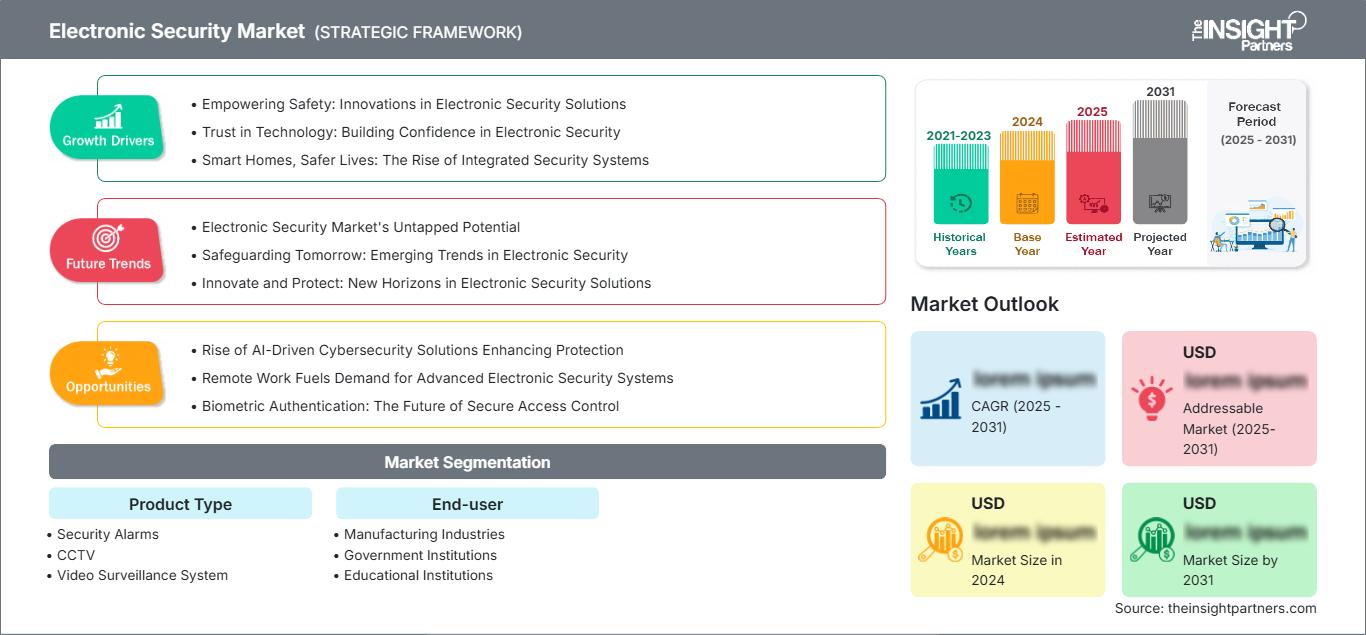
Electronic Security Market: Strategic Insights
Regional Insights
North America Electronic Security Market
The share of the North American market within the Global Market stands at 32-36% in 2025 and is estimated to witness a CAGR of 5.2-5.8% during 2026-2034. North America enjoys the benefit of well-developed regulatory frameworks with security system certification, presence of commercial security infrastructure, and enterprise-level consciousness towards security threats and efficient operation via integration platforms.
Factors responsible for sustained growth include frequent regulatory changes calling for certified security systems, replacement cycle of old analog systems, and integration of security platforms with building management systems. Large enterprises look towards security platforms that enable real-time threat detection, video analytics using AI, and management of facilities in real-time.
U.S. Electronic Security Market
The United States accounts for approximately 75–80% of North American share in 2025 and is growing at a CAGR range of 5.0–5.6% between 2026–2034. As the dominant market within the region, the US reflects mature adoption levels with continuous compliance-driven replacement demand and ongoing technology upgrades among commercial and government facility operators of all sizes.
Company presence includes all major security providers maintaining registered device lists with regulatory authorities, including Honeywell International Inc., Johnson Controls International plc, Axis Communications AB, and ADT LLC dba ADT Security Services, each competing through platform capabilities and customer support differentiation. Application trends indicate growing demand for IP-based systems among large enterprises, cloud-based solutions for small businesses, and high-end service tiers featuring AI-driven threat analytics and predictive maintenance tools.
Europe Electronic Security Market
Europe holds approximately 24–28% of global share in 2025 and is projected to grow at a CAGR range of 5.4–6.0% between 2026–2034. The region benefits from GDPR compliance requirements, critical infrastructure protection regulations, and progressive adoption of integrated security platforms across member states supporting cross-border facility management.
The UK accounts for roughly 22-26% of European demand because of post-Brexit regulatory compatibility and robust commercial security facilities that facilitate international business activities. Germany is a dominant national market accounting for 24-28%, which is owing to the installation of commercial facilities and compliance enforcement through data protection laws and occupational safety legislation.
France, Italy, and Spain collectively make up for 35-40% of the demand in the European market, with France making use of smart cities, Italy for its historic sites protection and tourism security, and Spain for trade corridor surveillance in the Mediterranean.
APAC Electronic Security Market
Asia Pacific represents approximately 22–26% of global Electronic Security Market share in 2025 and is growing at a CAGR range of 6.5–7.2% between 2026–2034, making it the fastest-growing regional market. China leads with 35–40% of APAC demand, followed by India, Japan, South Korea, and Australia, each pursuing urbanization and security modernization initiatives.
The industrial factors include logistics growth for e-commerce, security of facilities in the manufacturing sector, and intercity business development that needs better vision and threat surveillance for dispersed facility networks. The policy factors are the new regulatory regimes in India and Southeast Asia, investments in infrastructure for smart transportation corridors, and government incentives for integration of security.
Middle East & Africa Electronic Security Market
The Middle East and Africa region represents an emerging market with a projected CAGR range of 7.0–7.8% between 2026–2034. Saudi Arabia leads adoption through Vision 2030 infrastructure initiatives and security corridor development connecting to GCC markets and East African trade routes.
The UAE serves as a regional hub with advanced security infrastructure and regulatory frameworks supporting cross-border commercial facility compliance. South Africa represents the most mature African market, driven by mining facility security, commercial property protection, and interprovincial transportation monitoring requiring integrated surveillance and access control capabilities across diverse operating conditions.
Segmentation Analysis
Product Type
The Product Type segment is projected to grow at a CAGR range of 5.5–6.1% between 2026–2034. This segmentation reflects distinct technology requirements, deployment scenarios, and adoption patterns across different solution categories, with CCTV and video surveillance systems dominating demand due to comprehensive facility monitoring and threat detection applications.
- Security Alarms: Represents approximately 12–16% of product type demand, driven by residential properties, small commercial facilities, and perimeter protection applications requiring intrusion detection, glass break sensors, and integrated notification systems for rapid response coordination.
- CCTV: Commands approximately 38–42% market share, reflecting dominant adoption for facility surveillance, perimeter monitoring, and incident documentation where continuous video recording, remote viewing, and forensic analysis deliver substantial security value and liability protection.
- Video Surveillance System: Accounts for approximately 22–26% of demand and is growing at a CAGR range of 6.2–6.8%, driven by enterprise deployments, smart city initiatives, and critical infrastructure applications requiring advanced analytics, facial recognition, and automated threat detection capabilities.
- EACS: Represents approximately 18–22% market share and is growing at a CAGR range of 6.8–7.4%, driven by biometric authentication demand, cloud-based access management, and integration with building automation systems for comprehensive facility security and occupancy management.
- Anti-theft system: Accounts for approximately 8–12% of demand, including retail merchandise protection, asset tracking solutions, and electronic article surveillance systems deployed across commercial environments to prevent inventory losses and unauthorized removal of valuable equipment.
End-user
The End-user segment is projected to grow at a CAGR range of 5.4–6.0% between 2026–2034. This segmentation distinguishes between different facility types and operational environments that deploy Electronic Security Market solutions, each with distinct regulatory requirements, threat profiles, and technology adoption patterns.
- Manufacturing Industries: Represents approximately 14–18% of end-user demand, including production facilities, warehouses, and distribution centers requiring perimeter protection, access control, and video surveillance to safeguard intellectual property, prevent theft, and ensure workplace safety compliance.
- Government Institutions: Commands approximately 16–20% market share, encompassing federal, state, and municipal facilities requiring certified security systems, surveillance of public spaces, and integrated platforms supporting emergency response coordination and critical infrastructure protection mandates.
- Educational Institutions: Accounts for approximately 10–14% of demand, including K-12 schools, universities, and training centers deploying access control, video surveillance, and emergency notification systems to protect students, faculty, and campus facilities from unauthorized access and security incidents.
- Healthcare Institutions: Represents approximately 12–16% market share, driven by hospitals, clinics, and medical facilities requiring controlled access to sensitive areas, patient monitoring capabilities, and integrated security platforms supporting HIPAA compliance and asset protection requirements.
- Data Centers: Accounts for approximately 8–12% of demand and is growing at a CAGR range of 7.5–8.2%, reflecting hyperscale facility deployments, colocation providers, and enterprise data centers requiring biometric access control, continuous video surveillance, and integrated security management for critical IT infrastructure protection.
- Commercial Infrastructure: Represents approximately 14–18% market share, including office buildings, shopping centers, and mixed-use developments deploying integrated security platforms to protect tenants, visitors, and property assets while supporting building automation and energy management integration.
- Residential: Commands approximately 12–16% of demand, driven by single-family homes, apartment complexes, and gated communities seeking alarm systems, video doorbells, and smart home security integration for intrusion detection and remote monitoring capabilities.
- Banking: Accounts for approximately 6–10% market share, including bank branches, ATMs, and financial service facilities requiring certified surveillance systems, access control, and integrated alarm monitoring to protect cash handling operations and customer data from theft and fraud.
Opportunity Snapshot
| End-user | Revenue Contribution | Trend Tag | Adoption Stage |
|---|---|---|---|
| Manufacturing Industries | High | Industrial IoT | Mature |
| Government Institutions | High | Critical Infrastructure | Mature |
| Educational Institutions | Medium | Campus Safety | Scaling |
| Healthcare Institutions | High | HIPAA Compliance | Scaling |
| Data Centers | Medium | Hyperscale Security | Emerging |
| Commercial Infrastructure | High | Smart Building | Mature |
| Residential | Medium | Smart Home | Scaling |
| Banking | Medium | ATM Protection | Mature |
Electronic Security Market Growth Drivers and Impact Analysis
Critical Infrastructure Protection Mandates
The adoption of the systems will be mandatory due to government regulations for the certification of Electronic Security Market systems in the energy, transportation, and utility facilities sectors. Compliance with these regulations leads to an ongoing demand since there is always a deadline. The clarification about certified device lists, video storage periods, and audit trails for access control systems makes it easier to adopt the system.
There will be a financial benefit when insurance carriers give a discount of 10-20% to those facilities that have adopted certified security systems and shown reduction in incidents. The emerging market segments in Asia Pacific and the Middle East are adopting the same regulations, and the critical infrastructure protection regulations in India and the GCC security corridor initiative are expected to increase the addressable market.
Smart City and IoT Integration
Increasingly, local government officials are looking at the Electronic Security Market as a critical component of the smart city ecosystem, where video surveillance, access control, and emergency notification systems converge to form an integrated command center that allows for decisions based on data about resource allocation and emergency response. The result is clear ROI due to shortened incident resolution times and better outcomes in terms of citizen safety.
With advanced technology, such as AI-based video analytics, license plate readers, and threat detection systems, the raw video data becomes intelligent data that leads to informed decisions. When combined with traffic management systems and emergency response systems, the whole city infrastructure becomes visible, and electronic security providers are seen as partners, not commodity suppliers.
Cloud-Based Security Platform Migration
With the evolution of the Electronic Security Market towards cloud computing, there is a need for solutions that have the ability to offer remote monitoring, management, and video storage in addition to meeting the demands of on-premise installations. Enterprise installations by multinationals and government organizations necessitate security solutions that can integrate cloud with on-premise solutions to create a hybrid system.
Cloud computing features such as multi-tenancy, automatic software updates, and certifications for cybersecurity are being developed for security solutions to increase efficiency and minimize the cost of ownership for facility managers. With the rapid adoption of cloud technology through 2030, security solutions that are able to support hybrid installation of cloud and on-premise solutions will take a disproportionately high market share from those using a single architecture.
Electronic Security Market Future Trends
AI-Driven Threat Analytics
Machine learning algorithms analyzing video streams and sensor data will increasingly predict security incidents, identify suspicious behavior patterns, and recommend targeted interventions before threats materialize. Axis Communications AB and other leaders are already deploying facial recognition, behavioral analytics, and automated alert tagging that transform raw surveillance data into actionable security insights, enabling proactive risk management rather than reactive incident response.
Future platforms will integrate computer vision from multiple camera feeds with access control logs and alarm system data to create comprehensive facility security profiles, enabling personalized threat detection that improves security performance while reducing false alarms. Predictive maintenance capabilities will analyze device health, network performance, and environmental conditions to forecast equipment failures, minimizing unplanned downtime and extending system lifecycles across distributed security deployments.
Cybersecurity and Physical Security Convergence
As Electronic Security Market systems become increasingly connected to corporate networks and cloud platforms, security providers will evolve to offer integrated cybersecurity and physical security solutions that address hybrid threats. Johnson Controls International plc and other innovators are developing platforms that integrate network security monitoring, device authentication, and encrypted video transmission with traditional access control and surveillance capabilities.
This evolution will require new data standards, cybersecurity certifications, and liability frameworks as security platforms become critical components of enterprise cybersecurity architectures. Regulatory bodies are expected to mandate continuous monitoring of security device cybersecurity posture, creating opportunities for providers to develop specialized solutions serving this emerging market segment alongside traditional physical security deployments.
Electronic Security Market Opportunities
Emerging Market Infrastructure Development
Asia Pacific, Middle East, and Africa regions present substantial growth opportunities as governments implement critical infrastructure protection regulations and commercial facility operators modernize security capabilities. India's proposed security mandate for commercial facilities, GCC corridor development projects, and African mining facility security initiatives create multi-billion-dollar addressable markets for providers offering localized solutions, regional support infrastructure, and regulatory compliance expertise.
Market entry strategies should prioritize partnerships with local system integrators, integration with regional building management platforms, and device certification aligned with emerging regulatory frameworks. Early movers establishing brand recognition and customer relationships in these markets will benefit from switching costs and network effects as regulatory deadlines approach and facility operators seek proven, compliant solutions rather than evaluating new vendors under time pressure.
Managed Security Service Expansion
Facility operators increasingly recognize the strategic value of remote monitoring, predictive analytics, and managed security services beyond basic equipment deployment, creating opportunities for providers to migrate customers from product sales to recurring revenue service models. Margins on managed services substantially exceed hardware revenues, making service tier expansion a critical profitability driver for security providers seeking sustainable competitive advantages.
Value-added offerings including 24/7 monitoring, incident response coordination, cybersecurity management, and compliance reporting enable providers to differentiate on total value rather than device pricing alone. Successful migration strategies combine demonstrable ROI case studies, tiered pricing models that reward expanded adoption, and customer success programs ensuring clients realize maximum value from comprehensive security service capabilities.
Recent Developments
- March 2026: Johnson Controls International plc unveiled next-generation C- CURE IQ 3.2 access control platform and embedded video management capabilities at ISC West 2026, delivering open, scalable security for enterprise and commercial environments with mid-summer 2026 availability.
- April 2026: ADT LLC dba ADT Security Services launched Live Light illuminated wireless yard sign and My Safety personal safety service integrated into ADT+ platform, extending protection beyond the front door with intelligent real-time monitoring capabilities for residential and small business customers.
- March 2026: Axis Communications AB introduced next wave of unified security solutions at ISC West 2026, featuring private cellular connectivity, advanced edge intelligence, and integrated sensing technologies including AXIS TP3604-E and AXIS Q2802-E Bispectral Camera for US and EMEA markets.
Frequently Asked Questions

- Comprehensive Market Sizing and Forecast Analysis
- Detailed Segmentation Analysis
- In-Depth Market Dynamics Assessment
- Regional and Country-Level Insights
- Competitive Landscape and Company Benchmarking
- Strategic Business Intelligence
Recent Reports
Testimonials

The Insight Partners provided valuable market intelligence that supported our global go-to-market strategy. Their team was professional, responsive, and attentive to our feedback, providing thoughtful analysis and helpful methodological clarifications throughout the project.
Junmo Kim Chief Financial Officer (CFO), Enertech Co., Ltd.
The Insight Partners' SCADA System Market report is comprehensive, with valuable insights on current trends and future forecasts. The team was highly professional, responsive, and supportive throughout. We are very satisfied and highly recommend their services.
RAN KEDEM Partner, Reali Technologies LTDs
I requested a report on a very specific software market and the team produced the report in a few days. The information was very relevant and well presented. I then requested some changes and additions to the report. The team was again very responsive and I got the final report in less than a week.
JEAN-HERVE JENN Chairman, Future Analytica
We worked with The Insight Partners for an important market study and forecast. They gave us clear insights into opportunities and risks, which helped shape our plans. Their research was easy to use and based on solid data. It helped us make smart, confident decisions. We highly recommend them.
PIYUSH NAGPAL Sr. Vice President, High Beam Global
The Insight Partners delivered insightful, well-structured market research with strong domain expertise. Their team was professional and responsive throughout. The user-friendly website made accessing industry reports seamless. We highly recommend them for reliable, high-quality research services
YUKIHIKO ADACHI CEO, Deep Blue, LLC.
This is the first time I have purchased a market report from The Insight Partners.While I was unsure at first, I visited their web site and felt more comfortable to take the risk and purchase a market report.I am completely satisfied with the quality of the report and customer service. I had several questions and comments with the initial report, but after a couple of dialogs over email with their analyst I believe I have a report that I can use as input to our strategic planning process.Thank you so much for taking the extra time and making this a positive experience.I will definitely recommend your service to others and you will be my first call when we need further market data.
JOHN SUZUKI President and Chief Executive Officer, Board Director, BK Technologies
I wish to appreciate your support and the professionalism you displayed in the course of attending to my request for information regarding to infectious disease IVD market in Nigeria. I appreciate your patience, your guidance, and the fact that you were willing to offer a discount, which eventually made it possible for us to close a deal. I look forward to engaging The Insight Partners in the future, all thanks to the impression you have created in me as a result of this first encounter.
DR CHIJIOKE ONYIA MANAGING DIRECTOR, PineCrest Healthcare Ltd.Reason to Buy
- Informed Decision-Making
- Understanding Market Dynamics
- Competitive Analysis
- Identifying Emerging Markets
- Customer Insights
- Market Forecasts
- Risk Mitigation
- Boosting Operational Efficiency
- Strategic Planning
- Investment Justification
- Tracking Industry Innovations
- Aligning with Regulatory Trends





 Get Free Sample for