
Electronics Products Rentals Market Size, Demand & Growth by 2034
Coverage: By Type (Home Appliances, Refrigerator, Air Cooler, TV, Washing Machine, Others); Application (Personal, Business); Distribution Channel (Online, Offline) , and Geography (North America, Europe, Asia Pacific, and South and Central America)
- Status : Data Released
- Report Code : TIPRE00019100
- Category : Electronics and Semiconductor
- No. of Pages : 150
- Available Report Formats :


- Last update date : August 25, 2026


2025 Market Size
US$ 22.31 Bn
Base year value
2034 Forecast
US$ 36.59 Bn
Projected by 2034
CAGR 2026-2034
5.65 %
Growth rate
Addressable Market
US$ 266.96 Bn
(2026-2034)
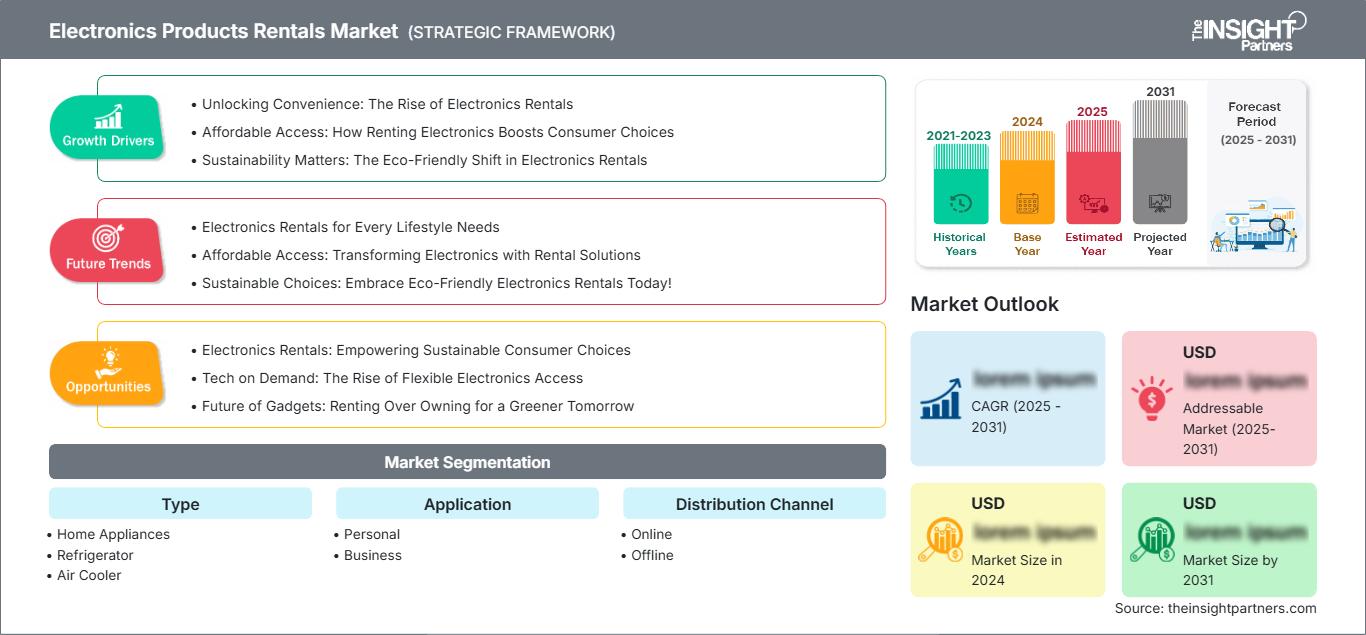
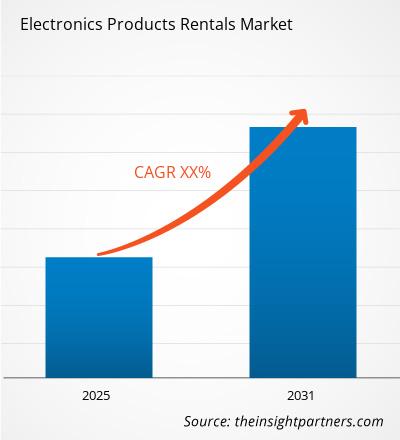
The global Electronics Products Rentals market was valued at US$ 22.31 billion in 2025 and is expected to reach US$ 36.59 billion by 2034; it is estimated to record a CAGR of 5.65% during 2026-2034.
Electronics Products Rentals Market Assessment and Insights
- North America represents a mature rental ecosystem, supported by established consumer financing, business technology requirements, and broad retail coverage, with a 2025 Electronic Products Rental Market share of 30–34% and a 2026–2034 CAGR of 5.8–6.3%.
- US remains the principal North American market, benefiting from dense provider networks and digital lease-to-own adoption, with a 2025 share of 70–74% of North America and a 2026–2034 CAGR of 5.7–6.2%.
- Europe combines established appliance rental practices with circular-economy adoption across the UK, Germany, France, Italy, and Spain, holding a 2025 share of 24–28% and expanding at a 2026–2034 CAGR of 6.0–6.5%.
- Asia Pacific is positioned for faster adoption as China, Japan, South Korea, India, and Australia combine expanding urban consumption with digital platforms, representing a 2025 share of 25–29% and a 2026–2034 CAGR of 7.1–7.7%.
- Largest Segment is Home Appliances, reflecting broad household applicability and replacement needs, with a 2025 market share of 44–48% and a 2026–2034 CAGR of 5.8–6.2%.
- High Growth Segment is Online, supported by digital discovery, delivery integration, and flexible contracting, with a 2025 market share of 34–38% and a 2026–2034 CAGR of 8.0–8.6%.
- Key companies analyzed in detail: A2 Computers; Abcom Technology Group Inc. dba ABCOMRENTS; FlexiRent Capital Pty Ltd; GSE Audiovisual, Inc.; Hamilton Rentals Limited; Meeting Tomorrow, LLC; Mr Rental NZ Pty Ltd; Radio Rentals Limited; Red Cherry Computer Rentals (Pty) Ltd; Upbound Group, Inc.
Source: The Insight Partners' analysis based on proprietary research, government publications, company annual reports, investor presentations, industry databases, and expert interviews.
Device economics changes affect how rental providers form their fleet, structure contract prices, and handle residual value. Traditional appliances continue playing a central role, and new products like computers, televisions, cooling devices, and equipment for events cause a faster turnover. Rental providers add more services such as delivery, installation, repairs, replacement, and refurbishing to become more efficient. IEA statistics indicate that cooling space is the fastest-growing end use of buildings since 2000, thus adding value to efficiency and flexibility solutions.
During the forecast period, providers should focus on urban expansion markets, digital sales, and inventory management. APAC will gain from increased appliance penetration and expanded formalized rentals, while European rental providers will concentrate on lifecycle management and efficiency solutions. North American rental providers will strengthen their omnichannel competencies. Economic conditions worldwide are still unequal, and according to the IMF, the global economy is set to grow by 3.0% in 2026 and 3.4% in 2027.
Electronics Products Rentals Market Report Scope
| Report Attribute | Details |
|---|---|
| Market size in 2025 | US$ 22.31 Billion |
| Market Size by 2034 | US$ 36.59 Billion |
| Global CAGR (2026 - 2034) | 5.65% |
| Historical Data | 2021-2024 |
| Forecast period | 2026-2034 |
Electronics Products Rentals Market Analysis
Demand is defined by consumers’ and businesses’ need for access without financial investment into ownership. Thus, the growth path of the Electronic Products Rental Market relies on price inflation of products, replacements pace, temporary use, and availability of financing. The market comprises manufacturers, distributors, rental companies, logistic services providers, repairmen, refurbishment services providers, insurance companies, and online marketplaces. Value is generated through matching assets and their usage period, at the same time minimizing depreciation costs.
The dynamics of supply are getting more and more dependent on quality of inventory, not only quantity of assets. Precious electronics imply secure tracking of each unit, standard inspections, wiping of data, maintenance service and careful redeployment process. Appliances make assets more likely to be used longer; TV, computing equipment and event rental equipment implies higher turnover rate. Companies that provide logistic and refurbishment services can increase residual value of assets, minimize downtime and develop different contract structures.
Competitive intensity is fragmented through category depth, geographic reach, responsiveness, and flexibility of contracts. The Upbound Group, Inc. offers a combination of store-based and digital platforms while GSE Audiovisual, Inc., Hamilton Rentals Limited, Meeting Tomorrow, LLC, and Red Cherry Computer Rentals (Pty) Ltd focus on professional technology and events needs. On the other hand, A2 Computers and ABCOMRENTS are providers of business technology solutions, and regional companies like Mr Rental NZ Pty Ltd and Radio Rentals Limited still serve households.
New investments will be made in digital order management, asset tracking, refurbishment capabilities, and automation of operations. Upbound Group, Inc. reported that e-commerce accounted for about 27% of Rent-A-Center lease-to-own sales in 2025. This demonstrates how strategically important the digital platforms have become. Competitive differentiation will be more and more focused on the integration of online ordering with physical delivery and finance management, service, and asset recovery as opposed to pure rental pricing.
● REPORT CUSTOMIZATION
Tailor This Report To Align With Your Specific Business Requirements
This report can be customized to align precisely with your business objectives, scope, and target markets. Customization options include tailored segmentation, geography, competitive analysis, and strategic insights to support informed decision-making.
Customize This Report →WHAT YOU CAN ADJUST
- ● Segmentations
- ● Geography
- ● Competitive Analysis
- ● Language Preferences
Electronics Products Rentals Market: Strategic Insights
Regional Insights
North America Electronic Products Rental Market
The share of North America is pegged at around 30-34% in 2025 due to existing rental infrastructure, strong presence of retail outlets, mature financing solutions for consumers, and substantial business demand for temporary technology use. The market is projected to have a CAGR growth of 5.8-6.3% during 2026-2034, wherein most of the regional activities occur in the United States.
The drivers include company events, education, relocations, home appliances replacement, and refresh cycles for technologies. Rental companies are making digital purchase links between products and local delivery systems. In addition, the regional framework supports refurbished solutions since the returned equipment can be used, repurposed or sold via alternative distribution channels.
U.S. Electronic Products Rental Market
It is estimated that the US constituted about 70-74% of the 2025 market in North America, recording a CAGR of 5.7-6.2% between 2025 and 2034. The market is driven by the strong presence of stores, digital rent to own, and already existing demand for appliances, computers, television, and temporary event equipment.
The applications of the business sector are still very significant as the companies do not have to incur any costs for ownership for temporary projects, meetings, trainings, and technology changeovers. The Upbound Group, Inc. is still active in both online and physical store-based markets, while A2 Computers, ABCOMRENTS, Meeting Tomorrow, LLC, and GSE Audiovisual, Inc. serve the specialists.
Europe Electronic Products Rental Market
Europe had an estimated share of 24–28% in 2025, and it is forecasted to grow at a CAGR of 6.0–6.5% during the period from 2025 to 2034. The major players in the region include the UK and Germany because of their mature equipment-hire practices, costly appliances, and need for technologies in companies.
The advantage of the UK is due to its mature practices and wide services network. The German market is driven by strong demands of industries and businesses in addition to increased interest in lifetime efficiency. Opportunities in France, Italy, and Spain arise from urban household appliances, tourism, events, and temporary accommodation.
APAC Electronic Products Rental Market
APAC represented an estimated 25–29% share in 2025 and is expected to record a 7.1–7.7% CAGR through 2034, making it the fastest-growing major region. China leads regional scale, followed by Japan, South Korea, India, and Australia.
Urbanization, rising appliance penetration, digital payments, and business technology adoption support demand. India is particularly relevant for cooling equipment, with IEA data showing air-conditioner sales reached 14 million units in 2024, while cooling contributed an estimated 60 GW to peak load. Efficiency policies and infrastructure expansion therefore create demand for modern, energy-efficient rental fleets.
Middle East & Africa Electronic Products Rental Market
Middle East and Africa is expected to expand at a 6.2–6.8% CAGR through 2034, supported by urban development, tourism, events, commercial construction, and increasing cooling requirements. Saudi Arabia and the UAE lead regional demand, while South Africa anchors the southern market.
High temperatures and infrastructure investment create sustained requirements for cooling and temporary electronics. IEA data indicates Middle Eastern electricity demand increased by nearly 4% in 2025, with air-conditioner adoption supporting consumption. Rental models can reduce upfront costs for households, hospitality operators, offices, and event organizers, particularly where utilization is seasonal.
Segmentation Analysis
Type
Type is led by Home Appliances, reflecting broad household utility and recurring replacement requirements. The segment is projected to expand at a 5.8–6.2% CAGR from 2026–2034. Refrigerators, air coolers, televisions, and washing machines complement the core category, enabling providers to build bundled household packages and improve delivery economics.
- Home Appliances: Broad household applicability supports recurring rental demand, particularly among temporary residents and cost-sensitive customers. Strategic importance stems from bundle potential, predictable maintenance cycles, and opportunities for refurbishment.
- Refrigerator: Refrigerators address essential household requirements and relocation-related demand. Their relatively long useful life supports structured rental periods, while maintenance and replacement services remain important differentiators.
- Air Cooler: Air coolers benefit from seasonal heat exposure and affordability considerations. Rental providers can respond to temporary cooling needs while rotating equipment between customers and maintaining utilization.
- TV: Television rentals serve temporary residences, hospitality, events, and entertainment requirements. Product upgrades and screen-size preferences create opportunities for flexible contracts and rapid redeployment of returned units.
- Washing Machine: Washing machines provide essential household utility where purchase costs, relocation, or temporary accommodation discourage ownership. Service reliability and installation capability strongly influence customer retention.
Application
Application divides demand between personal and business use, with the segment expected to grow at a 6.2–6.7% CAGR from 2026–2034. Personal rentals emphasize affordability and convenience, while business demand is shaped by temporary projects, workforce mobility, events, and technology refresh requirements.
- Personal: Personal rentals address affordability, relocation, temporary accommodation, and access to higher-value appliances without immediate ownership. Providers can strengthen adoption through bundled contracts, flexible durations, maintenance, and home delivery.
- Business: Business users prioritize predictable costs, rapid deployment, service continuity, and equipment availability. Rental agreements can support conferences, training, temporary offices, project teams, and technology transitions while limiting idle capital.
Distribution Channel
Distribution Channel is shifting toward digital acquisition, with the segment forecast to expand at a 7.0–7.6% CAGR from 2026–2034. Online channels improve product comparison and transaction speed, while offline networks remain valuable for installation, service, inspection, and high-touch contracts.
- Online: Online rental channels improve discovery, quotation, identity verification, payment, and contract management. Their strategic importance increases as providers integrate real-time inventory, delivery scheduling, digital documentation, and automated customer support.
- Offline: Offline channels remain important for appliance demonstrations, installation, service, local fulfillment, and customers requiring assisted transactions. Physical networks also support inspection, returns, repairs, and secondary-market recovery.
Opportunity Snapshot
| Application | Revenue Contribution | Trend Tag | Adoption Stage |
| Personal | High | Flexible Bundles | Scaling |
| Business | High | Temporary Access | Mature |
Electronics Products Rentals Market Growth Drivers and Impact Analysis
Flexible access reduces the capital burden of technology ownership
By converting significant capital expenses for equipment to regular payments, renting becomes an affordable process for individuals and helps in maintaining the working capital of the business organization. This effect will be felt strongly by those products that have high costs, short life cycles or unclear usage patterns. A business can tie up rental periods according to the periods in which the project will take place, the time of conducting conferences, renting temporary offices, training programs or even in the case of increasing the number of personnel. Individuals can enjoy the services of refrigerators, television sets, washing machines and air conditioners in case of moving house or transitional housing. For the provider of service, there is continuous flow of income while products can be evaluated and reallocated or resold.
Shorter technology cycles increase the value of rental and refurbishment
Rapid product upgrades create a mismatch between customer expectations and the economic life of many devices. Rental providers can absorb this mismatch by rotating inventory across customers and channels rather than requiring each user to purchase new equipment. Computing, TV, displays, and events technology in particular are more appropriate for this strategy since their performance requirements can evolve more quickly than any physical degradation. Refurbishing makes it possible to add extra value to returned items via testing, repair, cleansing, and redeployment. From the side of manufacturers and distributors, the introduction of rental pathways becomes an opportunity for handling excess stock or used items. This effect covers logistics and post-sale services in general since the increased turn of items requires standard procedures of inspection and repair. Companies that are able to control the item lifecycle and forecast demand can minimize idle stock.
Climate variability strengthens demand for flexible cooling equipment
Cooling is becoming a more operationally significant category as hotter conditions raise demand for air conditioners and air coolers. IEA analysis shows that space cooling has recorded the fastest growth among building end uses since 2000, while India’s air-conditioner sales reached a record 14 million units in 2024. Rental can address seasonal demand by allowing households, offices, hospitality venues, and events to access equipment without permanent ownership. The model also supports technology substitution as efficiency standards evolve, enabling operators to replace older units across the fleet rather than leaving customers with inefficient equipment. Energy efficiency is therefore becoming a commercial consideration alongside price. Providers can differentiate through efficient models, maintenance, installation, and transparent electricity-use information, while governments and utilities can benefit from faster diffusion of higher-performing equipment.
Electronics Products Rentals Market Future Trends
Lifecycle intelligence will reshape fleet economics
The next phase of Electronic Products Rental Market trends will center on lifecycle intelligence rather than simple inventory availability. Providers are likely to connect rental platforms with predictive maintenance, device telemetry, automated inspection records, and residual-value forecasting. Such systems can determine when an appliance should be repaired, redeployed, upgraded, or transferred to secondary sales. Machine-learning models may increasingly combine utilization history, product age, service records, customer behavior, and resale conditions to optimize contract duration. The result should be more precise pricing and fewer assets sitting idle between rentals. Operators with strong data infrastructure can also standardize refurbishment quality across locations, creating consistent customer experiences. This trend will favor companies capable of integrating operational data across procurement, logistics, finance, servicing, and resale rather than relying on isolated rental-management systems.
Rental ecosystems will converge with circular commerce
Circular commerce is expected to become more integrated with rental operations as manufacturers, retailers, and service providers seek additional value from products after their first use cycle. Future contracts may increasingly incorporate certified refurbishment, manufacturer warranties, component recovery, and resale pathways. This can make rental fleets more resilient to product depreciation because returned assets retain identifiable secondary-market value. Retailers may use rental as an alternative route for customers who want to experience a product before purchasing, while manufacturers can gain visibility into actual usage patterns. Regulatory emphasis on repairability and resource efficiency could reinforce these arrangements in Europe and other markets. Over time, the distinction between renting, refurbishing, resale, and trade-in services may narrow, creating integrated product-lifecycle ecosystems that reward high utilization and transparent asset histories.
Electronics Products Rentals Market Opportunities
Embedded financing can expand access to higher-value appliance bundles
Providers have an opportunity to move beyond individual-product rentals toward structured household packages combining refrigerators, washing machines, televisions, and cooling equipment. Bundling can increase average contract value while simplifying procurement for customers entering temporary housing, relocating, or establishing new residences. Embedded financing and digital identity verification can shorten approval cycles and make higher-value packages accessible without requiring a conventional purchase transaction. Providers can also introduce differentiated terms based on duration, maintenance coverage, replacement options, and early-return conditions. The strongest opportunity lies in markets where urban mobility is high and household formation is increasing, because customers may value convenience more than permanent ownership. Operators should prioritize transparent total-cost communication, reliable delivery, and standardized servicing to avoid margin erosion from bundled maintenance obligations.
Enterprise technology pools can unlock recurring temporary-use demand
Businesses increasingly require technology for projects whose duration does not justify permanent ownership. Rental operators can create managed technology pools covering laptops, displays, televisions, networking equipment, and presentation systems, with inventory reserved for recurring corporate requirements. Contracts can combine equipment, delivery, installation, technical support, replacement, and return logistics under a single commercial framework. This approach can reduce procurement friction for companies managing conferences, training programs, seasonal workforces, office moves, or temporary project teams. Providers should target customers with predictable but intermittent requirements, where utilization can be forecast across multiple projects. Integration with corporate procurement systems and asset-management software can further improve retention by making rentals easier to request, approve, track, and reconcile. Electronic Products Rental Market Forecasts therefore increasingly depend on enterprise service design as well as consumer affordability.
Recent Developments
- July 2026: Cloud of Goods announced the global launch of its equipment rental marketplace, enabling rental companies, local businesses, entrepreneurs and individuals worldwide to join the platform and provide mobility, accessibility, medical, baby and other equipment rentals in their communities.
- July 2026: Hexaware Technologies partnered with SmartRent to modernize customer and revenue operations using AI-led support and Salesforce Revenue Cloud Advanced, targeting more than 911,000 smart rental units globally and aiming to streamline customer service, quoting, billing and bill-to-cash processes.
- May 2026: Sinoboom signed a strategic partnership agreement with Southeast Asian equipment rental company Ban Ngai, including an order for more than 500 Sinoboom units, primarily medium- to high-reach boom lifts, significantly expanding Ban Ngai’s rental fleet and supporting its plans to enter new markets and build a globally leading rental business.
Frequently Asked Questions

- Comprehensive Market Sizing and Forecast Analysis
- Detailed Segmentation Analysis
- In-Depth Market Dynamics Assessment
- Regional and Country-Level Insights
- Competitive Landscape and Company Benchmarking
- Strategic Business Intelligence
Recent Reports
Testimonials

The Insight Partners provided valuable market intelligence that supported our global go-to-market strategy. Their team was professional, responsive, and attentive to our feedback, providing thoughtful analysis and helpful methodological clarifications throughout the project.
Junmo Kim Chief Financial Officer (CFO), Enertech Co., Ltd.
The Insight Partners' SCADA System Market report is comprehensive, with valuable insights on current trends and future forecasts. The team was highly professional, responsive, and supportive throughout. We are very satisfied and highly recommend their services.
RAN KEDEM Partner, Reali Technologies LTDs
I requested a report on a very specific software market and the team produced the report in a few days. The information was very relevant and well presented. I then requested some changes and additions to the report. The team was again very responsive and I got the final report in less than a week.
JEAN-HERVE JENN Chairman, Future Analytica
We worked with The Insight Partners for an important market study and forecast. They gave us clear insights into opportunities and risks, which helped shape our plans. Their research was easy to use and based on solid data. It helped us make smart, confident decisions. We highly recommend them.
PIYUSH NAGPAL Sr. Vice President, High Beam Global
The Insight Partners delivered insightful, well-structured market research with strong domain expertise. Their team was professional and responsive throughout. The user-friendly website made accessing industry reports seamless. We highly recommend them for reliable, high-quality research services
YUKIHIKO ADACHI CEO, Deep Blue, LLC.
This is the first time I have purchased a market report from The Insight Partners.While I was unsure at first, I visited their web site and felt more comfortable to take the risk and purchase a market report.I am completely satisfied with the quality of the report and customer service. I had several questions and comments with the initial report, but after a couple of dialogs over email with their analyst I believe I have a report that I can use as input to our strategic planning process.Thank you so much for taking the extra time and making this a positive experience.I will definitely recommend your service to others and you will be my first call when we need further market data.
JOHN SUZUKI President and Chief Executive Officer, Board Director, BK Technologies
I wish to appreciate your support and the professionalism you displayed in the course of attending to my request for information regarding to infectious disease IVD market in Nigeria. I appreciate your patience, your guidance, and the fact that you were willing to offer a discount, which eventually made it possible for us to close a deal. I look forward to engaging The Insight Partners in the future, all thanks to the impression you have created in me as a result of this first encounter.
DR CHIJIOKE ONYIA MANAGING DIRECTOR, PineCrest Healthcare Ltd.Reason to Buy
- Informed Decision-Making
- Understanding Market Dynamics
- Competitive Analysis
- Identifying Emerging Markets
- Customer Insights
- Market Forecasts
- Risk Mitigation
- Boosting Operational Efficiency
- Strategic Planning
- Investment Justification
- Tracking Industry Innovations
- Aligning with Regulatory Trends





 Get Free Sample for