
Emergency Exit Sign Market Size, Trends & Demand by 2034
Coverage: By Product Type (Electrical Exit Sign, Non-electrical Exit Sign); Application (Residential, Commercial, Industrial, Public Facility), and Geography (North America, Europe, Asia Pacific, and South and Central America)
- Status : Data Released
- Report Code : TIPRE00014691
- Category : Electronics and Semiconductor
- No. of Pages : 150
- Available Report Formats :


- Last update date : September 01, 2026


2025 Market Size
US$ 940.00 Mn
Base year value
2034 Forecast
US$ 1,410.00 Mn
Projected by 2034
CAGR 2026-2034
4.61 %
Growth rate
Addressable Market
US$ 10,670.21 Mn
(2026-2034)
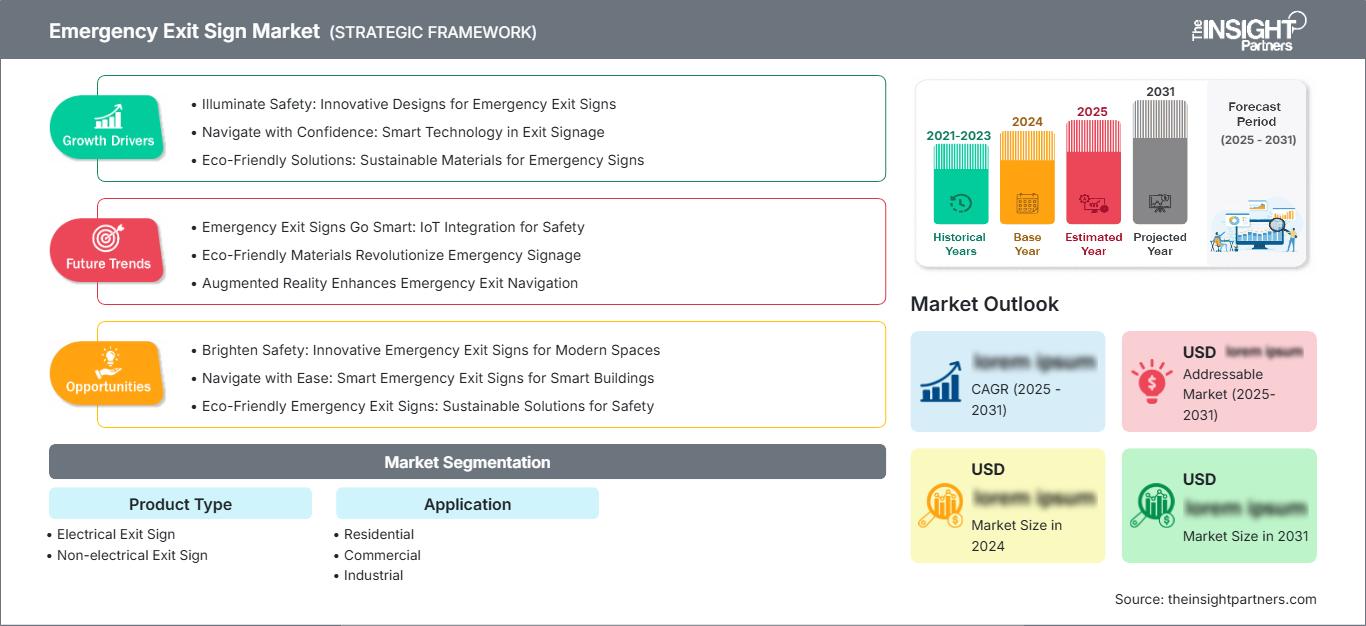
The Emergency Exit Sign Market size was estimated to be US$ 940.00 Million in 2025 and forecasted to reach US$ 1,410.00 Million by 2034, registering a compound annual growth rate of 4.61% for the duration of 2026-2034. The scope of this report includes the sale and installation of both illuminated and non-illuminated safety signs that help identify the emergency exit routes for evacuations and compliance with building safety standards.
As far as geography is concerned, North America is likely to continue to be one of the most prominent regions in the Emergency Exit Sign Market owing to the presence of fire safety codes and renovation of commercial buildings. Additionally, the market in North America is expected to gain traction as a result of a forecast CAGR of 4.3–4.8% in 2034.
Emergency Exit Sign Market Assessment and Insights
- North America remains a mature demand center supported by established building codes, commercial construction, institutional facilities, and replacement programs, holding a 2025 share of 31–35% and expanding at a 4.3–4.8% CAGR between 2026–2034.
- US accounts for most North American demand, supported by stringent workplace and life-safety requirements, with a 2025 share of 72–76% of North America and a 4.2–4.7% CAGR between 2026–2034.
- Europe maintains substantial demand across the UK, Germany, France, Italy, and Spain, where fire-safety compliance and efficient lighting support adoption, representing a 2025 share of 27–31% and a 4.1–4.6% CAGR between 2026–2034.
- Asia Pacific is positioned for comparatively faster expansion as China, Japan, South Korea, India, and Australia increase commercial and public infrastructure investment, representing a 2025 share of 23–27% and a 5.0–5.6% CAGR between 2026–2034.
- Largest Segment is Electrical Exit Sign, reflecting its suitability for regulated commercial and public environments, with a 2025 market share of 68–72% and a 4.4–4.9% CAGR between 2026–2034.
- High Growth Segment is Public Facility, supported by safety modernization and infrastructure programs, with a 2025 market share of 24–28% and a 5.1–5.7% CAGR between 2026–2034.
- Key companies analyzed in detail: Acuity Brands Lighting, Inc.; ABB Installation Products Inc.; Eaton; Hubbell Incorporated; Isolite Corporation; Legrand; LINERGY; Mackwell; Schneider Electric; Signify N.V.
Source: The Insight Partners' analysis based on proprietary research, government publications, company annual reports, investor presentations, industry databases, and expert interviews.
Technological progress is making exit signs move beyond simple lighting devices to more effective LED designs, self-testing capabilities, better batteries, and networking. Manufacturers' preferences tend to move towards smaller cases, reduced power usage, standardization, and increased maintenance periods. NFPA standards identify internally and externally illuminated signs and set up emergency lighting standards, and UL 924 continues to be crucial for compliance in the United States.
The Emergency Exit Sign Market forecast indicates that future deployment will be most successful when new construction meets modern regulations and energy-efficiency programs. Countries like India, Southeast Asia, the Middle East, and certain European retrofit markets will provide the greatest opportunity as commercial structures and public infrastructure update their safety devices. Funding will be directed towards testing connectivity, remote diagnostics, lithium-based batteries, and integration of emergency signage into building management software.
Emergency Exit Sign Market Report Scope
| Report Attribute | Details |
|---|---|
| Market size in 2025 | US$ 940.00 Million |
| Market Size by 2034 | US$ 1,410.00 Million |
| Global CAGR (2026 - 2034) | 4.61% |
| Historical Data | 2021-2024 |
| Forecast period | 2026-2034 |
Emergency Exit Sign Market Analysis
The Emergency Exit Sign Market report indicates that demand is driven by regulatory compliance since exit signage is still considered as a life safety issue rather than an architectural option. Suppliers in the value chain include LED and battery producers, electronics producers, sign makers, electrical wholesalers, installers, facilities managers and testing facilities. In terms of procurement considerations include certification, visibility, length of operation time, installation complexity and maintenance requirements.
Supply drivers in the Emergency Exit Sign Market include the availability of semiconductors, batteries, plastics, aluminum, optical components and localized certification requirements. LED modules have made emergency lights more efficient and less dependent on maintenance while self-testing electronics help in minimizing inspection costs. Manufacturers today are increasingly producing modular systems which can be installed wall mounted, ceiling mounted, recessed and even suspended thus helping the distributor cater to different applications without having to maintain a fragmented inventory.
From the Emergency Exit Sign Market analysis, the existence of a competitive structure of diversified electrical equipment manufacturers along with manufacturers of specialized emergency lighting is apparent. The key players in the former category include Acuity Brands Lighting, Inc., Eaton, Hubbell Incorporated, Legrand, and Schneider Electric, who compete in diverse electrical product lines and specification opportunities.
ABB Installation Products Inc., Isolite Corporation, LINERGY, and Mackwell represent the latter group by providing emergency lighting expertise and, therefore, compete in reliable products and certifications along with flexible installation and longevity. Strategic investments will shift towards connected testing and maintenance rather than just the signage equipment itself. Signify N.V. showed the way to go through cloud-based emergency lighting management while other leading players are implementing diagnostics and energy efficiency systems.
● REPORT CUSTOMIZATION
Tailor This Report To Align With Your Specific Business Requirements
This report can be customized to align precisely with your business objectives, scope, and target markets. Customization options include tailored segmentation, geography, competitive analysis, and strategic insights to support informed decision-making.
Customize This Report →WHAT YOU CAN ADJUST
- ● Segmentations
- ● Geography
- ● Competitive Analysis
- ● Language Preferences
Emergency Exit Sign Market: Strategic Insights
Regional Insights
North America Emergency Exit Sign Market
North America had a share of 31-35% in 2025 and is estimated to grow at a CAGR of 4.3-4.8% during 2026-2034. USA is the major country-level market due to demand arising from regulation of workplaces, buildings, institutions, and retrofit activities in the commercial segment. Demand from Canada arises due to the need for compliant systems in commercial, healthcare, education, and infrastructure projects.
It is essential to consider the replacement cycle in this region since even though the systems installed have to be replaced due to wear and tear, battery degradation, failures, damage, and code compliance. Switching to LEDs would help reduce the cost of operation while providing visibility. Self-testing of systems helps manufacturers meet the needs of facility inspection by manufacturers.
U.S. Emergency Exit Sign Market
In the year 2025, the US will be contributing 72-76% to the total North American market, and is forecast to record a 4.2–4.7% CAGR up till 2034. Requirements set forth by OSHA dictate that the exit routes have appropriate lighting and the exits need to be well-marked, thereby driving recurring demand for compliance. NFPA 101 also impacts the specification and installation of products.
Some of the leading players in the market are Acuity Brands Lighting, Inc., Eaton, Hubbell Incorporated, and Schneider Electric. Commercial buildings continue to lead in terms of applications, while healthcare, education, warehouse, hospitality, and public buildings contribute towards the replacement demand. The adoption of self-test features, efficient LEDs, and remote monitoring has increased maintenance efficiency without altering the basic safety function of exit signs.
Europe Emergency Exit Sign Market
The European region accounted for a market share of 27–31% in 2025 and is anticipated to register growth at a 4.1–4.6% CAGR over 2034. United Kingdom and Germany are major regions that include demand from developed fire safety systems, building renovations, and energy-efficient emergency systems. Regulatory emphasis on evacuation signage and emergency lighting increases the number of replacements.
The United Kingdom enjoys advantages from existing fire safety management and inspections at workplaces, hotels, schools, and public places. In Germany, there is industrial facilities along with commercial construction and high technical standards. France, Italy, and Spain contribute demand through public infrastructure, tourist facilities, health care buildings, offices, and residential complexes. European customers look for LEDs' energy-saving characteristics, slim design, self-diagnosing options, and capability to operate in centralized monitoring systems.
APAC Emergency Exit Sign Market
The share of APAC was estimated to be 23–27% in 2025, and growth is expected at a CAGR of 5.0–5.6% through 2034, driven by China. In APAC, Japan and South Korea focus on building infrastructure, while India and Australia make contributions via commercial and infrastructure constructions and buildings.
Expansion of industries, urbanization, construction of transportation networks, and renovation of public buildings drive adoption. India, in particular, provides attractive opportunities due to commercial construction, hospitals, airports, and public transport system development. Australia relies on existing requirements for emergency lighting, and China is characterized by strong production and construction capacity. The region's future depends on efficient LED lighting, compliance, and monitoring.
Middle East & Africa Emergency Exit Sign Market
This region is expected to grow at a 4.5-5.1% CAGR until 2034, with Saudi Arabia and UAE driving the demand within the region. South Africa continues to be the main southern region, whereas other regions in MEA offer selective opportunities via hospitality, healthcare, retail, and development of public infrastructures.
Buildings requiring substantial energy use and infrastructure projects drive the need for reliable emergency lighting systems that are low-maintenance. Both Saudi Arabia and UAE have the advantages of large hospitality, airport, commercial, and mixed-use developments, whereas South Africa is a combination of commercial refurbishment projects with industrial needs. The adoption of the product outside the main markets is project-based.
Segmentation Analysis
Product Type
Product Type is led by Electrical Exit Sign, which is projected to expand at a 4.4–4.9% CAGR from 2026–2034. Electrical products dominate applications requiring continuous visibility and emergency operation, particularly in commercial, industrial, and public environments. LED sources, battery backup, self-testing, and compact electronics strengthen their replacement appeal.
- Electrical Exit Sign: Electrical signs remain the principal solution where continuous illumination and emergency backup are required. Demand centers on regulated buildings, retrofit projects, and applications requiring dependable visibility during power interruptions.
- Non-electrical Exit Sign: Non-electrical signs serve applications where passive visibility, reduced wiring, or specialized installation conditions are advantageous. Their value is strongest where photoluminescent performance can complement broader emergency-egress systems.
Application
Application is forecast to grow at a 4.8–5.3% CAGR from 2026–2034, reflecting varied requirements across residential, commercial, industrial, and public facilities. Commercial and public properties generate substantial demand because occupancy levels, evacuation complexity, and regulatory scrutiny increase the need for dependable signage.
- Residential: Residential demand is concentrated in multifamily housing, high-rise buildings, student accommodation, and developments with multiple escape routes. Developers prioritize compact, compliant systems that integrate with broader fire-safety infrastructure.
- Commercial: Commercial buildings represent a major demand base because offices, retail centers, hospitality venues, and healthcare properties require clearly identified evacuation routes and dependable emergency illumination.
- Industrial: Industrial facilities require robust signage capable of operating in demanding environments. Warehouses, manufacturing plants, and processing sites emphasize durability, visibility, serviceability, and compliance with workplace safety requirements.
- Public Facility: Public facilities include schools, airports, transit buildings, government premises, and civic venues. Their strategic importance comes from high occupancy, complex evacuation paths, and strong regulatory oversight.
Opportunity Snapshot
| Application | Revenue Contribution | Trend Tag | Adoption Stage |
| Residential | Medium | Compact LED | Scaling |
| Commercial | High | Smart Testing | Mature |
| Industrial | High | Rugged Housing | Mature |
| Public Facility | High | Code Modernization | Scaling |
Emergency Exit Sign Market Growth Drivers and Impact Analysis
Mandatory life-safety requirements sustain replacement-led demand
Regulatory demands in the Emergency Exit Sign Market help in generating resilience in demand because building owners have to keep on purchasing safety equipment at regular intervals of time. OSHA has specified that all exit routes should be illuminated and exit signs should be installed by following NFPA 101 regulations. There are similar demands in Europe and Australia that encourage recurring installations and replacements of these products. The commercial demand of these products is not just about new constructions but also about aging batteries, housing, LEDs and outdated products, which help manufacturers in generating recurring revenue through distributors and contractors. Regulatory demands have increased the significance of testing and documentation of these products, which makes it hard for manufacturers to use untested products and creates demand stability even during recessions.
LED efficiency improves lifecycle economics for building operators
LED technology is improving the financial case for replacing older fluorescent and incandescent emergency signage. Lower power requirements, longer source life, compact form factors, and reduced maintenance can lower lifecycle costs for facilities with large numbers of installed units. The benefit is especially relevant to hospitals, universities, warehouses, retail chains, airports, and office portfolios where maintenance teams must manage equipment across multiple buildings. Manufacturers can use this transition to introduce self-testing capabilities, improved battery management, and standardized modular components. Facility owners gain an opportunity to combine energy-saving retrofits with compliance upgrades rather than treating each activity separately. The commercial impact is strongest when procurement teams evaluate total cost of ownership instead of purchase price alone. As LED penetration increases, suppliers with efficient optics, durable batteries, diagnostic functions, and simplified installation can capture replacement demand while supporting broader building-efficiency programs.
Infrastructure expansion increases safety-equipment requirements
Expansion of airports, hospitals, schools, logistics centers, data facilities, shopping complexes, and public transportation infrastructure creates direct requirements for clearly identified escape routes. Large projects often involve complex floor plans, multiple occupancy zones, and strict handover documentation, increasing the value of standardized emergency signage. Emerging economies add further opportunity because urbanization and new construction can establish installed bases that generate future replacement demand. Contractors and electrical distributors play an important role because product selection is frequently embedded in project specifications before construction begins. Manufacturers that provide photometric information, certifications, installation guidance, and multiple mounting configurations can improve specification success. The impact is also visible in renovation projects where older buildings are upgraded to contemporary safety standards. Infrastructure investment therefore expands both first-installation demand and the future maintenance base for manufacturers and service providers.
Emergency Exit Sign Market Future Trends
Connected compliance management will become a core product capability
Future Emergency Exit Sign Market trends are likely to move from standalone illumination toward connected compliance management. Wireless communication, cloud dashboards, automated testing, and condition alerts can allow facility managers to monitor large portfolios without relying exclusively on manual inspections. Exit signs may increasingly report battery condition, test results, fault events, and service requirements to centralized platforms. This architecture can reduce maintenance uncertainty while creating opportunities for recurring software and service revenue. Manufacturers are likely to integrate open communication protocols and cybersecurity controls so emergency systems can operate alongside broader building-management infrastructure. The strongest adoption should occur in hospitals, airports, universities, hotels, and corporate campuses where the cost of manual inspection is significant. Over time, connected diagnostics could become a differentiating requirement during procurement rather than an optional technology feature.
Lithium batteries and modular designs will gain specification preference
Battery chemistry is likely to become a more important specification criterion in the Emergency Exit Sign Market as building owners prioritize reliability, service life, temperature performance, and environmental considerations. Lithium iron phosphate and related lithium technologies can offer advantages in cycle behavior, compactness, and maintenance compared with older battery chemistries when properly engineered and certified. Manufacturers are also likely to develop modular exit-sign architectures in which batteries, LED modules, electronics, and legends can be serviced or replaced independently. Such designs can reduce maintenance waste and simplify inventory management for facility operators. Product development will increasingly balance battery performance with safety certification, thermal management, and recyclability. Procurement teams may therefore evaluate emergency signs using lifecycle criteria rather than focusing only on initial equipment price. This shift can favor suppliers able to document battery reliability, serviceability, and environmental performance.
Emergency Exit Sign Market Opportunities
Portfolio localization can unlock emerging-market construction programs
Providers can pursue targeted expansion in India, Southeast Asia, the Middle East, and selected African markets by adapting products to local codes, voltage conditions, installation practices, and procurement structures. Rather than using a single global configuration, suppliers can create region-specific portfolios supported by local certification and distributor training. Airport, hospital, hotel, transit, education, and mixed-use developments offer particularly relevant opportunities because project specifications typically address emergency egress during design. Partnerships with electrical contractors and engineering consultants can improve specification visibility before purchasing decisions are finalized. Companies should also develop service and replacement networks early because the installed base created by new construction will generate recurring maintenance requirements. The opportunity is strongest for manufacturers that combine competitive pricing with documentation, installation simplicity, reliable batteries, and local technical support, allowing them to address both initial project awards and subsequent replacement demand.
Digital maintenance services can create recurring revenue streams
The Emergency Exit Sign Market Forecasts increasingly point toward opportunities beyond hardware sales as building owners seek measurable compliance and lower maintenance workloads. Suppliers can package connected emergency signs with monitoring software, scheduled testing, fault alerts, reporting, and service contracts. Subscription-based maintenance can be particularly attractive for organizations operating large portfolios because facility teams can prioritize failures remotely instead of conducting identical inspections at every site. Manufacturers can also use aggregated failure data to improve product design and predict replacement requirements. For investors, the opportunity lies in companies that combine hardware margins with recurring digital and service revenue. Commercial adoption will depend on cybersecurity, interoperability, clear reporting, and demonstrable reductions in inspection effort. Vendors should initially target complex facilities where manual testing costs are high and compliance documentation must be retained across multiple buildings.
Recent Developments
- February 2025: New Star Lighting introduced its Exit & Emergency Series, a range of durable exit and emergency lighting solutions designed for challenging environments including healthcare, hazardous locations, cleanrooms, food processing facilities and high-traffic public areas, with products engineered for reliability, safety and regulatory compliance.
- September 2025: Flood Risk America launched its Emergency Exit Flood Door, an integrated solution built into its flood panels that keeps floodwaters out while providing occupants with a safe escape route during flood emergencies, addressing the challenge of evacuating buildings protected by full-entryway flood barriers.
- June 2025: Signify launched its Interact emergency lighting system, combining a wireless emergency lighting portfolio with a secure cloud-based dashboard that enables building managers to monitor, automate testing, generate compliance reports and manage both general and emergency lighting from a single platform, helping reduce maintenance complexity and costs.
Frequently Asked Questions

- Comprehensive Market Sizing and Forecast Analysis
- Detailed Segmentation Analysis
- In-Depth Market Dynamics Assessment
- Regional and Country-Level Insights
- Competitive Landscape and Company Benchmarking
- Strategic Business Intelligence
Recent Reports
Testimonials

The Insight Partners' SCADA System Market report is comprehensive, with valuable insights on current trends and future forecasts. The team was highly professional, responsive, and supportive throughout. We are very satisfied and highly recommend their services.
RAN KEDEM Partner, Reali Technologies LTDs
I requested a report on a very specific software market and the team produced the report in a few days. The information was very relevant and well presented. I then requested some changes and additions to the report. The team was again very responsive and I got the final report in less than a week.
JEAN-HERVE JENN Chairman, Future Analytica
We worked with The Insight Partners for an important market study and forecast. They gave us clear insights into opportunities and risks, which helped shape our plans. Their research was easy to use and based on solid data. It helped us make smart, confident decisions. We highly recommend them.
PIYUSH NAGPAL Sr. Vice President, High Beam Global
The Insight Partners delivered insightful, well-structured market research with strong domain expertise. Their team was professional and responsive throughout. The user-friendly website made accessing industry reports seamless. We highly recommend them for reliable, high-quality research services
YUKIHIKO ADACHI CEO, Deep Blue, LLC.
This is the first time I have purchased a market report from The Insight Partners.While I was unsure at first, I visited their web site and felt more comfortable to take the risk and purchase a market report.I am completely satisfied with the quality of the report and customer service. I had several questions and comments with the initial report, but after a couple of dialogs over email with their analyst I believe I have a report that I can use as input to our strategic planning process.Thank you so much for taking the extra time and making this a positive experience.I will definitely recommend your service to others and you will be my first call when we need further market data.
JOHN SUZUKI President and Chief Executive Officer, Board Director, BK Technologies
I wish to appreciate your support and the professionalism you displayed in the course of attending to my request for information regarding to infectious disease IVD market in Nigeria. I appreciate your patience, your guidance, and the fact that you were willing to offer a discount, which eventually made it possible for us to close a deal. I look forward to engaging The Insight Partners in the future, all thanks to the impression you have created in me as a result of this first encounter.
DR CHIJIOKE ONYIA MANAGING DIRECTOR, PineCrest Healthcare Ltd.Reason to Buy
- Informed Decision-Making
- Understanding Market Dynamics
- Competitive Analysis
- Identifying Emerging Markets
- Customer Insights
- Market Forecasts
- Risk Mitigation
- Boosting Operational Efficiency
- Strategic Planning
- Investment Justification
- Tracking Industry Innovations
- Aligning with Regulatory Trends





 Get Free Sample for