
Emergency Stop Switches Market Trends, Share & Demand by 2034
Coverage: By Type (Null Line and Live Line, Single Live Line, Others); Application (Machinery and Equipment, Elevators, Conveyor Belts, Others); Industry (Metalworking, Packaging, Textile, Food, Printing, Woodworking, Others), and Geography (North America, Europe, Asia Pacific, and South and Central America)
- Status : Data Released
- Report Code : TIPRE00014692
- Category : Electronics and Semiconductor
- No. of Pages : 150
- Available Report Formats :


- Last update date : August 13, 2026


2025 Market Size
US$ 12.69 Bn
Base year value
2034 Forecast
US$ 38.24 Bn
Projected by 2034
CAGR 2026-2034
13.04 %
Growth rate
Addressable Market
US$ 221.51 Bn
(2026-2034)
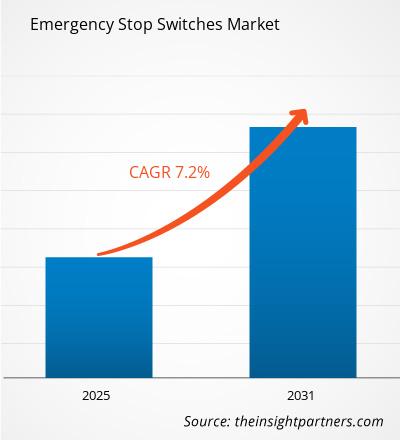
The global Emergency Stop Switches Market size is estimated to grow from US$ 12.69 billion in 2025 to reach US$ 38.24 billion by 2034, growing at a CAGR of 13.04% from 2026 to 2034. The market is expanding owing to the need for emergency stops that have mechanical latching capabilities in automated manufacturing, material handling, vertical transportation and medical devices.
In North America, the market is anticipated to experience an estimated 11.8% – 12.6% CAGR growth through 2034. Reshoring and factory modernization efforts are driving up the number of machines that require readily accessible stop points, and elevator modernization and machine risk assessment requirements help fuel replacement opportunities. Providers with comprehensive distribution and certified assemblies are well-poised to address machine builders and end-users in search of quicker commissioning periods.
Emergency Stop Switches Market Assessment and Insights
- North America: Representing 27–30% share in 2025, the region is projected to expand at an 11.8–12.6% CAGR between 2026–2034, supported by automation retrofits, machinery compliance, and elevator modernization.
- US: Accounting for 76–79% of North American demand in 2025, the country is expected to register an 11.9–12.7% CAGR between 2026–2034.
- Europe: Holding 24–27% share in 2025, Europe is forecast to grow at 11.2–12.0% between 2026–2034, led by Germany, the UK, France, Italy, and Spain.
- Asia Pacific: Capturing 33–36% share in 2025, the region is anticipated to post a 14.2–15.0% CAGR between 2026–2034, with China, Japan, India, and South Korea leading.
- Largest Segment: Machinery and Equipment accounted for an estimated 45–49% market share in 2025 and is projected to register a CAGR between 12.5–13.5% during 2026–2034, reflecting extensive machine-level safety requirements.
- High Growth Segment: Conveyor Belts represented an estimated 22–26% market share in 2025 and is projected to register a CAGR between 14.0–15.0% during 2026–2034, supported by automated material handling
- Key companies analyzed in detail: ABB Ltd.; EAO AG; Eaton Corporation plc; KK SWITCHES Co., Ltd.; OMRON Corporation; Rees, Inc.; REMA Lipprandt GmbH & Co. KG; SICK AG; Honeywell International Inc.; E. Dold & Söhne GmbH & Co. KG.
Source: The Insight Partners' analysis based on proprietary research, government publications, company annual reports, investor presentations, industry databases, and expert interviews.
The emergency stop system architecture has changed from being comprised of standalone mushroom buttons to modular units, diagnosable elements and relaying and controller connections. Positive opening contacts, lighting up indication, M12 connectivity and reduced depths of the panels are changing market requirements. Manufacturing continues to be scattered across diverse electrical component makers and human-machine interface vendors, while quality plastics, contacts, springs and enclosures make a basis for robust products. The market will increasingly reward players able to deliver mechanically reliable devices with easy wiring, wide configurability and documented functional safety.
During the forecast period, investments into factories in India, Southeast Asia, Mexico and Eastern Europe will increase the installed base available to address. Application of the Machinery Regulation by the EU starting 2027 and the 2026 edition of IEC 60947-5-5 are expected to stimulate product development and certification cycles. Buyers will prefer devices which require less effort for installation and audit purposes.
Emergency Stop Switches Market Report Scope
| Report Attribute | Details |
|---|---|
| Market size in 2025 | US$ 12.69 Billion |
| Market Size by 2034 | US$ 38.24 Billion |
| Global CAGR (2026 - 2034) | 13.04% |
| Historical Data | 2021-2024 |
| Forecast period | 2026-2034 |
Emergency Stop Switches Market Analysis
The Emergency Stop Switches Market growth is driven by the increased density of robots, CNC machines, conveyor systems, lifts, and test automation systems. Every additional cell or hazard zone requires numerous points to be able to stop them, which boosts demand for units faster than shipment of machinery itself. Supply chain includes suppliers of contact materials and enclosures, switch manufacturers, panel makers, safety system integrators, distributors, OEMs, and maintenance teams.
Supply differences arise from the need for reliable positive opening, ingress protection, actuation cycles, mounting depth, terminals, and certifications. Standard products are still cost competitive, but tough environment pull cord switches and self-monitoring and illuminated units have more value. The need for dual sources and local stock becomes procurement requirement because inexpensive component can prevent installation due to unavailability of documentation or connector configuration.
The Emergency Stop Switches market analysis suggests a somewhat fragmented competition landscape. Automation product lines and sales network scale make ABB Ltd., OMRON Corporation, SICK AG, Eaton Corporation plc, and Honeywell International Inc. differentiate from competitors. Application expertise makes EAO AG, Rees, Inc., REMA Lipprandt GmbH & Co. KG, KK SWITCHES Co., Ltd., and E. Dold & Söhne GmbH & Co. KG differentiate from their competitors.
Investment will focus on push-in wiring, state indication, small footprint, and integration with safety controllers. Competitive differentiation will involve combining standard global product lines with custom contact, release mechanism, legend, connector, and enclosure options. Vendors can preserve profit margins through reducing the time required for selection, providing conformity documents, and offering retrofit equivalents without competing solely on the price of switches.
● REPORT CUSTOMIZATION
Tailor This Report To Align With Your Specific Business Requirements
This report can be customized to align precisely with your business objectives, scope, and target markets. Customization options include tailored segmentation, geography, competitive analysis, and strategic insights to support informed decision-making.
Customize This Report →WHAT YOU CAN ADJUST
- ● Segmentations
- ● Geography
- ● Competitive Analysis
- ● Language Preferences
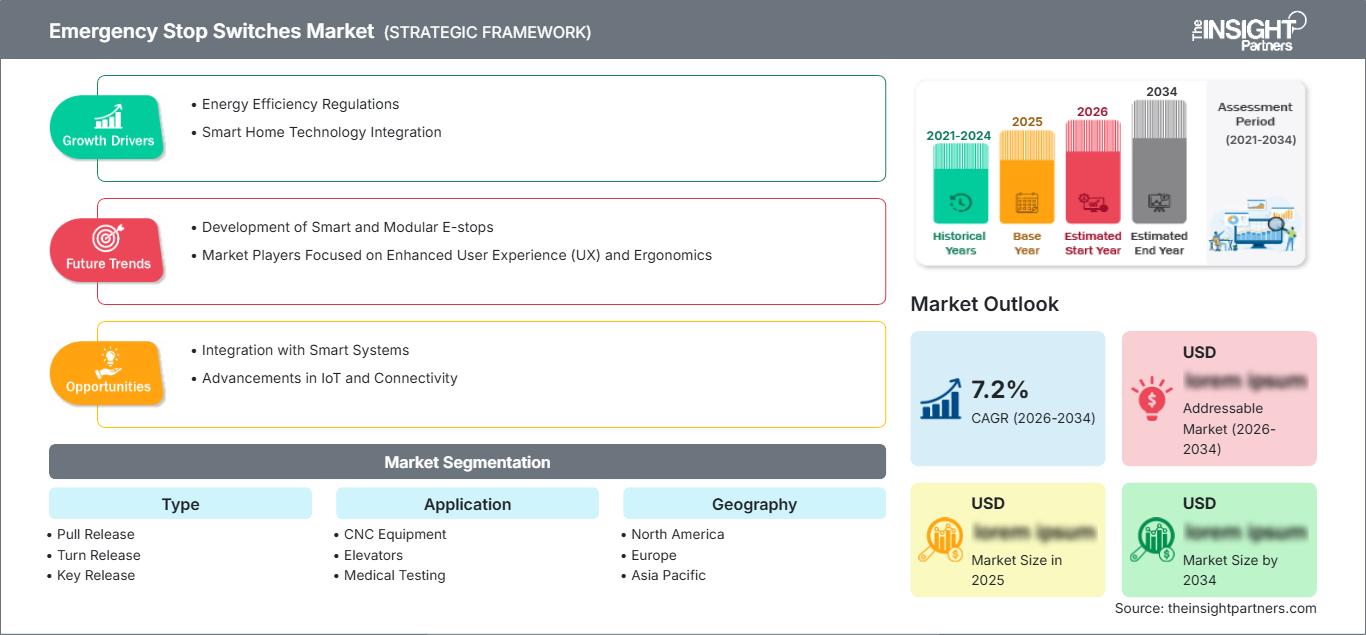
Emergency Stop Switches Market: Strategic Insights
Regional Insights
North America Emergency Stop Switches Market
North America held around 27–30% Emergency Stop Switches Market share in 2025 and is anticipated to grow at a CAGR of 11.8–12.6% until 2034. The demand will come from reshoring, warehouse automation, semiconductor spending, and updating of legacy lines, resulting in a repeatable need for panel mount and rope pull versions. Increasingly, machine manufacturers look for certified components with enclosed construction and proven safety relay compatibility.
Canada derives its growth potential from food processing, mining, energy, and material handling applications, while Mexico relies on automotive and electronics nearshoring. In-region sourcing prefers widely available 22 mm and miniature switches, yet application engineering becomes a crucial factor for long conveyor belts, wash-down zones, and vibration-prone environments. Audit findings, control panel upgrades, and operator accessibility analysis support replacement cycles and make the distributors of safety integrators capable of shaping brands' preferences among diverse end users and OEM projects.
U.S. Emergency Stop Switches Market
The United States contributed about 76–79% of North America’s market share in 2025 and is expected to grow at a CAGR of 11.9-12.7% in 2026-2034. The automotive, aerospace, packaging, logistics, machine tool, and food processing industries have high investments which lead to high device demand. Safe practices consistent with OSHA guidelines and tailored risk assessments by the customers contribute to the demand regardless of the discretionality of equipment upgrade.
ABB Ltd., Eaton Corporation plc, OMRON Corporation, SICK AG, Honeywell International Inc., and Rees, Inc. are the companies with product or distribution coverage in the market. The CNC equipment makes use of small turn-release switch devices near operators while conveyors use rope-pull devices due to constant access. Elevator modernization projects need durable and maintenance friendly control systems for the pits, machine rooms, and inspection areas. The medical test equipment uses shallow mounted and easy-to-clean control systems.
Europe Emergency Stop Switches Market
Europe held an approximate share of 24-27% in 2025 and is projected to witness growth at a CAGR of 11.2-12.0% during the forecast period. Germany has been leading through machine tools, automotive automation, packaging machines, and export-oriented OEMs. The UK has been contributing through logistics, food processing, lifts, and specialist machinery, where the demand for retrofit products will be driven by risk assessment and maintenance needs.
France has a combination of aerospace, rail transport, processing, and lift machinery applications, whereas Italy's machinery clusters contribute through packaging, ceramic, and factory machinery applications. Spain will contribute through automotive, renewable energy, and warehouse applications. The EU Machinery Regulation will come into force from January 2027 and will extend the focus to connected and autonomous machinery as well as improve the planning for conformity. In this market, the vendors providing compliant designs as per ISO 13850, IEC 60947-5-5 testing certificates, multilingual capability, and configurability will have an edge. Cross border distributors continue to play a key role since the production volumes are spread among several specialized OEMs.
APAC Emergency Stop Switches Market
Asia Pacific had an approximated market share of 33-36% in 2025 and is forecasted to register the fastest growth regionally at CAGRs of 14.2-15.0% through 2034. China is at the fore because of machine building, electronics, batteries, and logistics automation; Japan and South Korea have their focus on high-end safety and small machine integration in their factories.
Indian incentives and industrial corridors increase the greenfield market opportunity, and Australia focuses on mining, material handling, and process applications. Within the market, local manufacturers put pressure on standard products' prices; however, multinational certification and quality continue to be key.
Middle East & Africa Emergency Stop Switches Market
Middle East & Africa is estimated to grow at a CAGR of 10.6%-11.4% till 2034. Demand in the region is dominated by Saudi Arabia because of industrial diversification, mining, logistics, and large infrastructure projects requiring automation. The UAE needs solutions for airports, warehouses, elevators, and manufacturing processes, whereas South Africa is supported through mining and processing.
Demand in RoMEA continues to be driven by projects, where durable models, distributor stock, and environmental protection come first. Reliable local shutdown is important in energy facilities, yet procurement may not always be timely. Supplier-provided certification, installation support, documentation, and replacement help the ESS Market.
Segmentation Analysis
Type
Type segmentation encompasses Null Line and Live Line, Single Live Line, and Others, with the main segment projected to register a CAGR of 12.5–13.5% during 2026–2034. Selection depends on electrical architecture, equipment design, isolation requirements, switching configuration, and machinery safety strategy. The Emergency Stop Switches Market scope across different electrical configurations reflects the need to accommodate both standardized machinery platforms and application-specific control circuits.
- Null Line and Live Line: This configuration addresses equipment requiring interruption arrangements across neutral and live electrical paths, supporting dependable isolation strategies where machinery design, circuit architecture, and operating conditions require broader switching coverage.
- Single Live Line: Single live line configurations serve machinery where emergency interruption can be implemented through the energized conductor, supporting relatively straightforward circuit designs, compact equipment architectures, and standardized industrial control applications.
Application
Application segmentation includes Machinery and Equipment, Elevators, Conveyor Belts, and Others and is projected to record a CAGR of 13.0–14.0% during 2026–2034. Machinery and Equipment remains the largest application because emergency intervention is fundamental across machine tools, production cells, processing systems, and automated equipment. Conveyor Belts represent the high-growth application as logistics, warehousing, packaging, mining, and continuous material-handling operations expand.
- Machinery and Equipment: This application accounted for an estimated 45–49% market share in 2025 and is projected to register a CAGR of 12.5–13.5% during 2026–2034, reflecting widespread machine-level safety requirements across industrial production.
- Elevators: Emergency-stop components support maintenance, inspection, commissioning, and selected control functions within elevator systems, with demand influenced by urban infrastructure, modernization of installed systems, and continued construction of commercial and residential buildings.
- Conveyor Belts: This application represented an estimated 22–26% market share in 2025 and is projected to register a CAGR of 14.0–15.0% during 2026–2034, driven by expanding automated material-handling infrastructure.
Industry
Industry segmentation covers Metalworking, Packaging, Textile, Food, Printing, Woodworking, and Others and is projected to expand at a CAGR of 12.8–13.8% during 2026–2034. Demand varies according to machinery density, automation intensity, equipment operating speeds, production-line complexity, and worker proximity to moving components. Metalworking and packaging remain particularly important because their operations commonly combine automated machinery with cutting, forming, conveying, filling, and handling processes.
- Metalworking: Machine tools, presses, cutting systems, forming equipment, robotic welding cells, and automated machining lines create substantial safety-switch requirements because operators frequently work near high-force, high-speed, or mechanically hazardous equipment.
- Packaging: Automated filling, sealing, labeling, palletizing, wrapping, and conveying systems support broad emergency-stop adoption, particularly as packaging lines become faster, more integrated, and increasingly dependent on robotics and synchronized motion control.
- Textile: Spinning, weaving, knitting, dyeing, finishing, and material-handling equipment require accessible shutdown mechanisms, creating replacement and OEM opportunities as textile producers modernize machinery and increase production-line automation.
- Food: Processing, mixing, cutting, filling, packaging, and conveying equipment creates recurring requirements for robust emergency controls, particularly where frequent cleaning, moisture exposure, hygienic operating conditions, and continuous production influence equipment selection.
- Printing: Commercial and industrial printing machinery incorporates multiple moving rollers, feeders, cutting mechanisms, and finishing systems, supporting emergency-stop requirements across presses and increasingly automated post-print production environments.
- Woodworking: Saws, milling machines, planers, routers, sanding systems, panel-processing equipment, and automated woodworking lines require rapidly accessible emergency controls because operators may work close to cutting and material-feeding mechanisms.
Opportunity Snapshot
| Application | Revenue Contribution | Trend Tag | Adoption Stage |
| Machinery and Equipment | High | Machine Safety | Mature |
| Elevators | Medium | Vertical Mobility | Mature |
| Conveyor Belts | High | Smart Conveying | Scaling |
| Others | Low | Specialized Safety | Emerging |
Emergency Stop Switches Market Growth Drivers and Impact Analysis
Higher Automation Density Multiplies Certified Stop Points
The automated manufacturing plants will have greater use of robots, transfer systems, tooling modules, and operator interfaces than regular production lines. Hence, the need for emergency stop will be higher depending on the hazardous areas and cell complexity rather than just the plant count. In CNC cells, the control can be placed on the main panel, loader panel, teach pendant, and the cell perimeter entry points. In the warehouses, there will be rope pull protection for conveyors and local controls for the sortation module. This factor amplifies the quantity of the unit and requires families of devices which facilitate validation for the machine platform. It is also relevant to replacements as the end-users would like similar parts to reduce downtime.
Standards Revisions Accelerate Engineering Refresh Cycles
ISO 13850 defines functional requirements and design principles for machinery emergency-stop functions, while IEC 60947-5-5 addresses mechanically latching electrical devices. The 2026 IEC revision creates a practical trigger for manufacturers to review latch testing, illuminated-state behavior, approval files, and product labeling. Separately, the EU Machinery Regulation applies from January 2027 and brings connected and autonomous equipment more firmly into conformity planning. These changes encourage OEMs to reassess legacy bills of materials before platform renewals. Suppliers benefit through recertification-driven substitutions, but they must fund testing, documentation, and customer change support. Products with complete technical files and stable form-fit-function equivalence can shorten redesign effort and win approved-vendor positions.
Modernization Converts Compliance Gaps into Retrofit Demand
Large installed bases of elevators, machine tools, packaging lines, and laboratory equipment create demand independent of greenfield capital expenditure. During control-panel upgrades, operators often replace worn devices, add stop points, improve visibility, or standardize connectors. Retrofit economics are attractive because switch cost is small relative to avoided downtime, incident exposure, and full machine replacement. Pull-cord systems can extend protection across conveyors without installing numerous fixed stations, while compact turn-release units fit constrained panels. The Emergency Stop Switches Market also benefits when insurers, customers, or internal audits identify access or documentation gaps. Vendors offering retrofit kits, dimensional cross-references, and dependable regional stock can convert fragmented maintenance events into repeat business.
Emergency Stop Switches Market Future Trends
Diagnosable Devices Become Standard System Nodes
Emergency Stop Switches Market trends increasingly favor devices that communicate condition and actuation status to safety controllers without weakening the independent stop function. LED rings, coded connectors, self-monitoring contacts, and safe series-connection architectures will reduce fault-finding time and wiring errors. Future designs are likely to expose richer diagnostics through adjacent control infrastructure rather than turn the actuator into a general-purpose connected endpoint. This distinction preserves fail-safe mechanical behavior while helping maintenance teams locate an activated or damaged device rapidly. Suppliers that document diagnostic coverage and controller interoperability can secure specification advantages in modular production and logistics systems.
Configurable Platforms Replace Excessive SKU Proliferation
Manufacturers will consolidate around platform designs that combine interchangeable actuators, contact blocks, illumination, connectors, shrouds, and enclosures. Configuration software and digital product data can help engineers select compliant combinations while avoiding incompatible components. The approach lowers supplier inventory, supports regional certification variants, and enables OEMs to standardize panel cutouts across machinery families. Modular platforms also simplify sustainability objectives because damaged contact or operator assemblies may be replaced without discarding a complete station. Competitive advantage will depend on controlling configuration complexity, maintaining approvals across combinations, and supplying machine-readable engineering data suitable for electrical design and lifecycle systems.
Emergency Stop Switches Market Opportunities
Build Retrofit Programs Around Installed-Base Intelligence
Emergency Stop Switches Market Forecasts support targeted retrofit programs rather than undifferentiated component selling. Vendors can map aging elevator fleets, machine-tool populations, conveyor installations, and legacy panel platforms, then offer verified dimensional replacements, wiring adapters, and documentation packs. Channel partners should prioritize facilities where downtime costs justify stocked conversion kits and scheduled replacement. A structured program can combine site surveys, access-point reviews, spare-part rationalization, and technician training. The commercial objective is to reduce customer engineering effort while securing recurring demand. Partnerships with panel builders, authorized service firms, and safety integrators provide scalable access to fragmented installed bases.
Localize Certified Portfolios for High-Growth Manufacturing Hubs
Asia Pacific and selected nearshoring locations offer opportunities for localized assembly, application engineering, and distributor inventory. Global suppliers should preserve core approvals while adapting cable lengths, connector preferences, legends, enclosure materials, and price architecture to regional machine-builder requirements. Local testing partnerships can shorten certification response, and dual-language technical files can improve adoption among export-oriented OEMs. Specialists may enter through high-value niches such as washdown equipment, mining conveyors, compact medical systems, or authorized-reset applications. Investment decisions should balance volume potential against approval maintenance and channel capability, with pilot programs focused on clusters where multiple machine builders share common panel and safety architectures.
Recent Developments
- October 2025: IDEC Corporation has expanded its emergency stop switch portfolio with new illuminated low-voltage e-stop switches designed specifically for battery-powered and low-power equipment. The new models provide machine operators with a clear visual indication of emergency stop status while maintaining energy efficiency in compact systems.
- August 2025: ONPOW has introduced the ONPOW63 Metal Emergency Stop Switch, a compact and durable safety control solution designed to provide rapid shutdown capabilities for industrial machinery and automated equipment. The emergency stop button is developed to help protect operators and equipment by enabling immediate interruption of hazardous operations during critical situations.
- January 2024: EAO AG introduced flat-ribbon cable versions of Series 84 emergency-stop and stop switches. The compact monoblock devices combine low back-panel depth, visible illumination, and IP65, IP66, and IP67 front protection, targeting space-constrained industrial controls and simplified harness integration.
Frequently Asked Questions

- Comprehensive Market Sizing and Forecast Analysis
- Detailed Segmentation Analysis
- In-Depth Market Dynamics Assessment
- Regional and Country-Level Insights
- Competitive Landscape and Company Benchmarking
- Strategic Business Intelligence
Recent Reports
Testimonials

The Insight Partners' SCADA System Market report is comprehensive, with valuable insights on current trends and future forecasts. The team was highly professional, responsive, and supportive throughout. We are very satisfied and highly recommend their services.
RAN KEDEM Partner, Reali Technologies LTDs
I requested a report on a very specific software market and the team produced the report in a few days. The information was very relevant and well presented. I then requested some changes and additions to the report. The team was again very responsive and I got the final report in less than a week.
JEAN-HERVE JENN Chairman, Future Analytica
We worked with The Insight Partners for an important market study and forecast. They gave us clear insights into opportunities and risks, which helped shape our plans. Their research was easy to use and based on solid data. It helped us make smart, confident decisions. We highly recommend them.
PIYUSH NAGPAL Sr. Vice President, High Beam Global
The Insight Partners delivered insightful, well-structured market research with strong domain expertise. Their team was professional and responsive throughout. The user-friendly website made accessing industry reports seamless. We highly recommend them for reliable, high-quality research services
YUKIHIKO ADACHI CEO, Deep Blue, LLC.
This is the first time I have purchased a market report from The Insight Partners.While I was unsure at first, I visited their web site and felt more comfortable to take the risk and purchase a market report.I am completely satisfied with the quality of the report and customer service. I had several questions and comments with the initial report, but after a couple of dialogs over email with their analyst I believe I have a report that I can use as input to our strategic planning process.Thank you so much for taking the extra time and making this a positive experience.I will definitely recommend your service to others and you will be my first call when we need further market data.
JOHN SUZUKI President and Chief Executive Officer, Board Director, BK Technologies
I wish to appreciate your support and the professionalism you displayed in the course of attending to my request for information regarding to infectious disease IVD market in Nigeria. I appreciate your patience, your guidance, and the fact that you were willing to offer a discount, which eventually made it possible for us to close a deal. I look forward to engaging The Insight Partners in the future, all thanks to the impression you have created in me as a result of this first encounter.
DR CHIJIOKE ONYIA MANAGING DIRECTOR, PineCrest Healthcare Ltd.Reason to Buy
- Informed Decision-Making
- Understanding Market Dynamics
- Competitive Analysis
- Identifying Emerging Markets
- Customer Insights
- Market Forecasts
- Risk Mitigation
- Boosting Operational Efficiency
- Strategic Planning
- Investment Justification
- Tracking Industry Innovations
- Aligning with Regulatory Trends





 Get Free Sample for