
Energy Efficient Glass Market Size, Trends & Demand by 2034
Coverage: by Coating (Hard Coat, Soft Coat); Glazing (Triple Glazing, Double Glazing, Single Glazing); End-Use Industry (Building and Construction, Automotive, Solar Panel, Others) , and Geography (North America, Europe, Asia Pacific, and South and Central America)
- Status : Data Released
- Report Code : TIPRE00004855
- Category : Chemicals and Materials
- No. of Pages : 150
- Available Report Formats :


- Last update date : August 19, 2026


2025 Market Size
US$ 32.51 Bn
Base year value
2034 Forecast
US$ 47.3 Bn
Projected by 2034
CAGR 2026-2034
4.25 %
Growth rate
Addressable Market
US$ 362.36 Bn
(2026-2034)
The global Energy Efficient Glass market was valued at US$ 32.51 billion in 2025 and is expected to reach US$ 47.3 billion by 2034; it is estimated to record a CAGR of 4.25% during 2026-2034.
Energy Efficient Glass Market Assessment and Insights
- North America: North America held a 27–31% share in 2025 and is expected to grow at a CAGR of 4.2–4.7% between 2026–2034, supported by retrofit demand, energy codes, commercial construction, and high-performance residential windows.
- US: The US represented 78–82% of North America's 2025 demand and is projected to grow at a CAGR of 4.0–4.5% through 2034, led by replacement glazing and energy-efficiency standards.
- Europe: Europe held a 26–30% share in 2025 and is expected to expand at 4.6–5.1% CAGR, with Germany, the UK, France, Italy, and Spain supported by renovation programs and stringent building-performance requirements.
- Asia Pacific: Asia Pacific represented 32–36% share in 2025 and is forecast to grow at 5.3–5.8% CAGR, led by China, Japan, South Korea, and India, where urban construction and energy-performance policies support high-performance glazing.
- Largest Segment: End-Use Industry held a 70–74% market share in 2025 and is projected to grow at a CAGR of 4.6–5.0%, reflecting the dominant role of building and construction applications.
- High Growth Segment: Glazing represented 43–47% share in 2025 and is expected to grow at 5.2–5.6% CAGR, supported by the shift from single to insulating configurations.
- Key companies analyzed in detail: AGC Inc.; Guardian Industries, LLC; Morley Glass & Glazing Limited; Nippon Sheet Glass Co., Ltd.; Compagnie de Saint-Gobain S.A.; SCHOTT AG; sedak GmbH & Co. KG; Türkiye Şişe ve Cam Fabrikaları A.Ş.; Vitro, S.A.B. de C.V.; Central Glass Co., Ltd.
Source: The Insight Partners' analysis based on proprietary research, government publications, company annual reports, investor presentations, industry databases, and expert interviews.
In Energy Efficient Glass Market, there has been a shift from traditional clear glazing to systems featuring coating, multiple panels, filled gases, selective transmission, and framing compatibility. Soft coat low emissive glass improves thermal and solar properties of glass while hard coats have their uses where durability and processability of the glass is considered. In addition, there is a need for larger coated pane production and glazed facade manufacturing for the building industry while for the automotive sector the glass needs to be light weight and offer optical, acoustic, and thermal performance.
Increased demand will move from being solely construction-related to renovation, especially in Europe and developed North America market. Demand will also pick up in emerging Asian market due to increasing urbanization and rising energy needs. Performance of windows in total is under evaluation by the developers.
Energy Efficient Glass Market Report Scope
| Report Attribute | Details |
|---|---|
| Market size in 2025 | US$ 32.51 Billion |
| Market Size by 2034 | US$ 47.3 Billion |
| Global CAGR (2026 - 2034) | 4.25% |
| Historical Data | 2021-2024 |
| Forecast period | 2026-2034 |
Energy Efficient Glass Market Analysis
The Energy Efficient Glass Market is driven by the necessity of regulating heat transfer, solar heat gain, daylighting, and occupant comfort. Low-emittance coatings block radiant heat loss, whereas double and triple glazed insulating glass units are more efficient in terms of heat transfer than single pane glass. Guardian Glass suggests that U-value, solar heat gain coefficient, visible light transmittance, and light-to-solar gain are the essential parameters. The system consists of float-glass makers, coating providers, processors, fabricators, framers, façade installers, architects, developers, and owners of buildings.
The supply chain depends on the utilization rate of float-glass furnaces, coating capacity, energy prices, coating materials, and regional fabrication infrastructure. Big players profit from integration of production processes and specification relations, whereas specialists can compete in terms of customization, oversize, complicated facades, and short lead times. Demand is dependent on the total performance of the façade system, thus technical assistance and simulations play an important role.
The Energy Efficient Glass Market competitive positioning analysis indicates a move towards performance differentiation rather than commodity volumes. AGC Inc., Guardian Industries, LLC, Nippon Sheet Glass Co., Ltd., and Compagnie de Saint-Gobain S.A. continue to offer wide portfolios for solar control and thermal insulation applications. SCHOTT AG and sedak GmbH & Co. KG cater to specialized and large-size needs, whereas Türkiye Şişe ve Cam Fabrikaları A.Ş. serves the regional dimension. Vitro, S.A.B. de C.V. has expanded its architectural high-performance offering portfolio, and Morley Glass & Glazing Limited has concentrated on its insulating glass and fenestration competence.
Funding is increasingly oriented towards lower-carbon production, innovative coatings, automation, and retrofit solutions. Saint-Gobain and AGC have proven joint venture on lower-carbon melting technologies for flat glass, whereas Vitro has been developing its digital specification solution and innovations in insulating glass technology. Increasingly, competitive advantage will come from product performance, manufacturing efficiency, carbon reductions, technical services, and digital solutions. Regional processors can compete on retrofit, specialized façades, complex forms, and certified performance projects.
● REPORT CUSTOMIZATION
Tailor This Report To Align With Your Specific Business Requirements
This report can be customized to align precisely with your business objectives, scope, and target markets. Customization options include tailored segmentation, geography, competitive analysis, and strategic insights to support informed decision-making.
Customize This Report →WHAT YOU CAN ADJUST
- ● Segmentations
- ● Geography
- ● Competitive Analysis
- ● Language Preferences
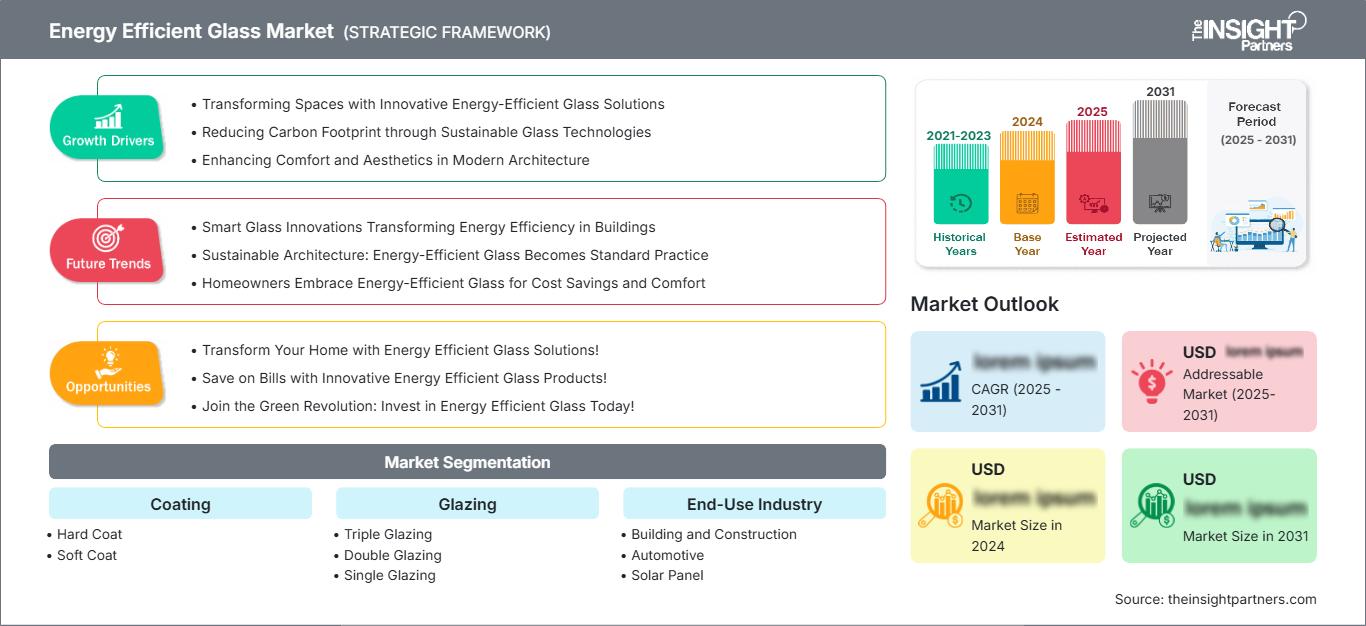
Energy Efficient Glass Market: Strategic Insights
Regional Insights
North America Energy Efficient Glass Market
In North America, the Energy Efficient Glass market share was 27-31% in 2025 and will continue growing at CAGR of 4.2-4.7% during 2034. There is demand from window replacements, commercial retrofitting projects, energy-efficient constructions, and solar protection & thermal insulation façades. The ENERGY STAR program considers low-e glass as one of the tools to improve the energy efficiency of windows.
There are also demands in Canada from cold climate insulation needs and renovations. In the United States, there is the main demand center due to the construction market and certification infrastructure.
U.S. Energy Efficient Glass Market
The US represented 78–82% of North America's 2025 demand and is expected to grow at 4.0–4.5% CAGR through 2034. Demand is concentrated in residential replacement, commercial renovation, institutional buildings, and façades designed around energy codes. ENERGY STAR indicates that certified low-E products can improve heating and cooling performance over single-pane clear glazing.
Major suppliers include Guardian Industries, LLC, Vitro, S.A.B. de C.V., AGC Inc., and Nippon Sheet Glass Co., Ltd. Application trends favor solar-control products in warmer regions and stronger thermal insulation in colder climates. Advanced products combine appearance, daylight, bird safety, acoustics, and energy performance. Digital tools support earlier comparison.
Europe Energy Efficient Glass Market
Europe accounted for 26–30% share in 2025 and is expected to grow at 4.6–5.1% CAGR through 2034. Roughly 75% of EU buildings are considered to have poor energy performance, while annual renovation remains around 1%, creating a large opportunity for better windows and glazing. Germany remains a leading market due to its building stock and established high-performance window industry.
The UK prioritizes energy performance in refurbishment, while Germany, France, Italy, and Spain provide demand shaped by climate and renovation intensity. Saint-Gobain, AGC, NSG Group, and regional processors have strong presence. Embodied-carbon considerations increasingly encourage recycled content and lower-carbon glass alongside operational performance.
APAC Energy Efficient Glass Market
APAC represented 32–36% share in 2025 and is forecast to grow at 5.3–5.8% CAGR through 2034, making it the fastest-growing major region. China leads, supported by construction and strengthening green-building standards. Japan and South Korea emphasize high-performance envelopes, while India and Australia offer growth through urban development and efficiency initiatives.
China's GB/T 35604-2025 standard for green product assessment of building glass took effect in November 2025, reinforcing the policy direction toward greener products. Japan has a mature insulating-glass ecosystem, while India is developing from a lower penetration base. Producers are expanding coated-glass capabilities.
Middle East & Africa Energy Efficient Glass Market
Middle East and Africa is projected to grow at 4.0–4.5% CAGR through 2034. Saudi Arabia and the UAE lead demand because of commercial developments, high cooling loads, and extensive glazed façades. Solar-control coatings are relevant where limiting solar heat gain can reduce cooling requirements while retaining daylight.
South Africa contributes through commercial construction, refurbishment, and green-building specifications, while the rest of MEA remains project-driven. Opportunities are strongest for solar-control glass, insulated units, and high-temperature products. Suppliers with local processing and façade-engineering capabilities are positioned to benefit as infrastructure programs expand.
Segmentation Analysis
Coating
Coating is expected to expand at a 4.8–5.3% CAGR during 2026–2034. Coatings determine radiant heat, solar gain, reflectivity, and daylight, defining the Energy Efficient Glass Market scope. Low-E technology is central to high-performance architectural glass, with soft- and hard-coat systems serving different durability and fabrication requirements. Guardian Glass notes that low-E coatings support thermal insulation and solar control while preserving natural light transmission.
- Hard Coat: Hard-coat products offer durable surface performance and processing flexibility, making them suitable for applications where coating robustness and fabrication considerations are important.
- Soft Coat: Soft-coat low-E glass provides advanced thermal insulation and solar-control performance, supporting premium windows, façades, and projects targeting stringent building-performance requirements.
Glazing
Glazing is projected to grow at a 5.2–5.6% CAGR during 2026–2034. Growth benefits from replacing single glazing with insulating configurations and wider use of high-performance façades. Double and triple glazing use multiple panes and cavities, while vacuum configurations offer high insulation with slimmer profiles.
- Triple Glazing: Triple glazing provides multiple insulating cavities and is strategically important for cold climates, premium residential construction, passive-building designs, and projects requiring stronger thermal performance.
- Double Glazing: Double glazing remains the mainstream insulating configuration, balancing performance, material use, fabrication complexity, and installed cost.
- Single Glazing: Single glazing retains a role in basic, replacement-constrained, and low-performance applications, but its position is pressured by energy-efficiency requirements and the transition toward insulated assemblies.
End-Use Industry
End-Use Industry is expected to grow at a 4.6–5.0% CAGR during 2026–2034 and remains the largest main segment because building applications generate substantial high-performance glazing demand. Automotive and solar applications add diversification through optical, thermal, durability, and manufacturing requirements.
- Building and Construction: Building and construction is the core demand base, encompassing residential windows, commercial façades, curtain walls, skylights, doors, and renovation projects where thermal and solar performance directly affect building operation.
- Automotive: Automotive applications use energy-efficient glass to manage cabin temperature, solar load, comfort, and efficiency while meeting optical, safety, acoustic, and weight requirements.
- Solar Panel: Solar-panel applications use specialized glass where high transmission, durability, surface performance, and optical characteristics affect module efficiency, lifetime, and resistance to environmental exposure.
Opportunity Snapshot
| Segment Name | Revenue Contribution | Trend Tag | Adoption Stage |
| Building and Construction | High | Deep Retrofit | Scaling |
| Automotive | Medium | Cabin Efficiency | Scaling |
| Solar Panel | Medium | High Transmission | Scaling |
Energy Efficient Glass Market Growth Drivers and Impact Analysis
Building renovation and stricter envelope-performance requirements
The largest structural opportunity comes from renovation of inefficient building stock. In the European Union, roughly three-quarters of buildings have poor energy performance, while annual renovation is only about 1%, creating a substantial base for window and façade upgrades. Energy-efficient glazing can be integrated into replacement windows, curtain walls, and retrofit systems without changing the entire energy architecture. Replacement demand also supports coated and insulating glass in North America because owners can justify upgrades through operating-cost reduction, comfort, and compliance. Impact is strongest where glazing represents a meaningful envelope share and heating or cooling loads are high. Suppliers with retrofit-compatible products and local fabrication are advantaged.
Rising cooling loads and demand for solar-control performance
Rising cooling requirements are increasing the importance of glass that manages solar heat without sacrificing daylight. Low-E solar-control coatings can reflect incoming solar energy while maintaining visible transmission, balancing daylight, comfort, and air-conditioning requirements. Guardian Glass identifies solar heat gain, visible light transmission, and selectivity as key measures. The impact extends into curtain walls, skylights, atriums, and large façades. Middle Eastern, Asian, and southern US projects are particularly relevant because cooling demand influences operating costs. Suppliers able to tailor coating performance to orientation, climate, and façade design can capture higher-value specifications.
Integration of glazing into broader low-carbon building strategies
Energy-efficient glass is increasingly evaluated within broader envelope strategies covering insulation, frames, shading, renewable energy, and low-carbon materials. The IEA reports that efficiency measures in IEA economies generated more than 27 EJ of energy savings over two decades. For glass producers, this expands competition toward carbon intensity, recycled content, manufacturing efficiency, and whole-assembly performance. Greater attention to embodied carbon creates opportunities for lower-carbon float glass and recycled-content products. Suppliers able to document operational and environmental performance while meeting transparency, aesthetics, safety, acoustic, and durability requirements can gain specification advantages.
Energy Efficient Glass Market Future Trends
Performance optimization through advanced coatings and insulating configurations
The Energy Efficient Glass Market trends are moving toward lower heat transfer, high daylight transmission, controlled solar gain, neutral aesthetics, and thinner assemblies. Multi-silver low-E coatings, improved edge technologies, vacuum insulating glass, and hybrid configurations can extend performance beyond conventional double glazing. Guardian Glass highlights vacuum insulating glass as a thinner alternative to more complex insulated configurations. Manufacturers are also developing climate-specific products. Simulation, digital selection, and project-specific coating combinations should become more important, with premium glazing differentiated by thermal, optical, acoustic, structural, aesthetic, and environmental performance.
Convergence of energy efficiency with smart and sustainable façades
Energy-efficient glazing is moving toward multifunctional façades combining solar management, daylight, environmental performance, and occupant comfort. Saint-Gobain illustrates this direction through solar-control, thermal-insulation, low-carbon, and smart-glass solutions. Producers are also improving digital tools for earlier glazing and framing evaluation. Vitro's FramingFactor tool evaluates total assembly performance using glazing and framing parameters. This should shift specifications toward whole-window and whole-façade performance, increasing demand for integrated products, digital design support, environmental documentation, and multifunctional glazing.
Energy Efficient Glass Market Opportunities
Retrofit solutions for existing commercial and residential windows
Retrofitting existing buildings offers a significant opportunity because replacement of complete windows can be disruptive, expensive, and difficult in occupied properties. Retrofit-oriented glazing can improve thermal performance while preserving frames or reducing construction time. AGC's on-site retrofit Low-E approach demonstrates how an additional Low-E layer can be installed over existing windows to approximate the performance benefits of double glazing while reducing the need for extensive exterior work. Such approaches are particularly relevant to offices, retail buildings, hotels, schools, and older residential properties where façade replacement is constrained. Suppliers can capture value through products, installation, assessment, and verification. Regional opportunities are strongest where building stock is old, energy prices are material, renovation policies are supportive, and owners face pressure to improve energy ratings without vacating occupied premises.
Premium large-format and high-performance façade applications
Energy Efficient Glass Market Forecasts increasingly favor high-performance façade projects that specify glass according to orientation, solar exposure, daylight, thermal insulation, aesthetics, and sustainability targets. Saint-Gobain's 2025 façade references demonstrate the use of different high-performance glass configurations across a single large development to respond to directional solar exposure and daylight requirements. Similar project-specific specifications create opportunities for premium processors and manufacturers with advanced coating, tempering, laminating, digital modeling, and logistics capabilities. Growth should be particularly visible in major urban centers, high-rise commercial developments, airports, cultural buildings, and premium hospitality projects where façade transparency is important but operating efficiency must also be demonstrated.
Recent Developments
- May 2026: Pilkington United Kingdom Limited, part of NSG Group, has launched a thermal insulation glass called Pilkington Optitherm™ S3 Plus, designed to enhance energy efficiency in new homes and retrofits. This low-emissivity (low-e) glass, manufactured in the UK, integrates into triple glazing units (TGU) achieving Ug-values as low as 0.6 W/m²K while maintaining lower reflectance compared to other low-e products. This reduces the mirror effect common in triple glazing, and the glass is compatible with standard processing techniques, including toughening without compromising its performance.
- September 2025: Saint-Gobain Glass and LuxWall have formed a strategic partnership to introduce INSIO® next-generation vacuum glazing in Europe. This collaboration will incorporate LuxWall's transparent insulation technology into INSIO®, marking a significant advancement in energy-efficient building envelopes. LuxWall's technology aims to convert glass from a major source of energy loss into an effective solution for energy conservation, ultimately leading to reduced energy costs and capital expenditure.
Frequently Asked Questions

- Comprehensive Market Sizing and Forecast Analysis
- Detailed Segmentation Analysis
- In-Depth Market Dynamics Assessment
- Regional and Country-Level Insights
- Competitive Landscape and Company Benchmarking
- Strategic Business Intelligence
Recent Reports
Testimonials

The Insight Partners' SCADA System Market report is comprehensive, with valuable insights on current trends and future forecasts. The team was highly professional, responsive, and supportive throughout. We are very satisfied and highly recommend their services.
RAN KEDEM Partner, Reali Technologies LTDs
I requested a report on a very specific software market and the team produced the report in a few days. The information was very relevant and well presented. I then requested some changes and additions to the report. The team was again very responsive and I got the final report in less than a week.
JEAN-HERVE JENN Chairman, Future Analytica
We worked with The Insight Partners for an important market study and forecast. They gave us clear insights into opportunities and risks, which helped shape our plans. Their research was easy to use and based on solid data. It helped us make smart, confident decisions. We highly recommend them.
PIYUSH NAGPAL Sr. Vice President, High Beam Global
The Insight Partners delivered insightful, well-structured market research with strong domain expertise. Their team was professional and responsive throughout. The user-friendly website made accessing industry reports seamless. We highly recommend them for reliable, high-quality research services
YUKIHIKO ADACHI CEO, Deep Blue, LLC.
This is the first time I have purchased a market report from The Insight Partners.While I was unsure at first, I visited their web site and felt more comfortable to take the risk and purchase a market report.I am completely satisfied with the quality of the report and customer service. I had several questions and comments with the initial report, but after a couple of dialogs over email with their analyst I believe I have a report that I can use as input to our strategic planning process.Thank you so much for taking the extra time and making this a positive experience.I will definitely recommend your service to others and you will be my first call when we need further market data.
JOHN SUZUKI President and Chief Executive Officer, Board Director, BK Technologies
I wish to appreciate your support and the professionalism you displayed in the course of attending to my request for information regarding to infectious disease IVD market in Nigeria. I appreciate your patience, your guidance, and the fact that you were willing to offer a discount, which eventually made it possible for us to close a deal. I look forward to engaging The Insight Partners in the future, all thanks to the impression you have created in me as a result of this first encounter.
DR CHIJIOKE ONYIA MANAGING DIRECTOR, PineCrest Healthcare Ltd.Reason to Buy
- Informed Decision-Making
- Understanding Market Dynamics
- Competitive Analysis
- Identifying Emerging Markets
- Customer Insights
- Market Forecasts
- Risk Mitigation
- Boosting Operational Efficiency
- Strategic Planning
- Investment Justification
- Tracking Industry Innovations
- Aligning with Regulatory Trends





 Get Free Sample for