
Energy Efficient Lighting Market Size, Share & Forecast by 2034
Coverage: by Source (High-Intensity Discharge Lamps (HID), Linear Fluorescent Lamps (LFL), And Light Emitting Diodes (LED), Others); Application (Home Use, Commercial Use, Industrial Use) , and Geography (North America, Europe, Asia Pacific, and South and Central America)
- Status : Data Released
- Report Code : TIPRE00010964
- Category : Electronics and Semiconductor
- No. of Pages : 150
- Available Report Formats :


- Last update date : August 17, 2026


2025 Market Size
US$ 45.87 Bn
Base year value
2034 Forecast
US$ 74.26 Bn
Projected by 2034
CAGR 2026-2034
5.50 %
Growth rate
Addressable Market
US$ 544.72 Bn
(2026-2034)
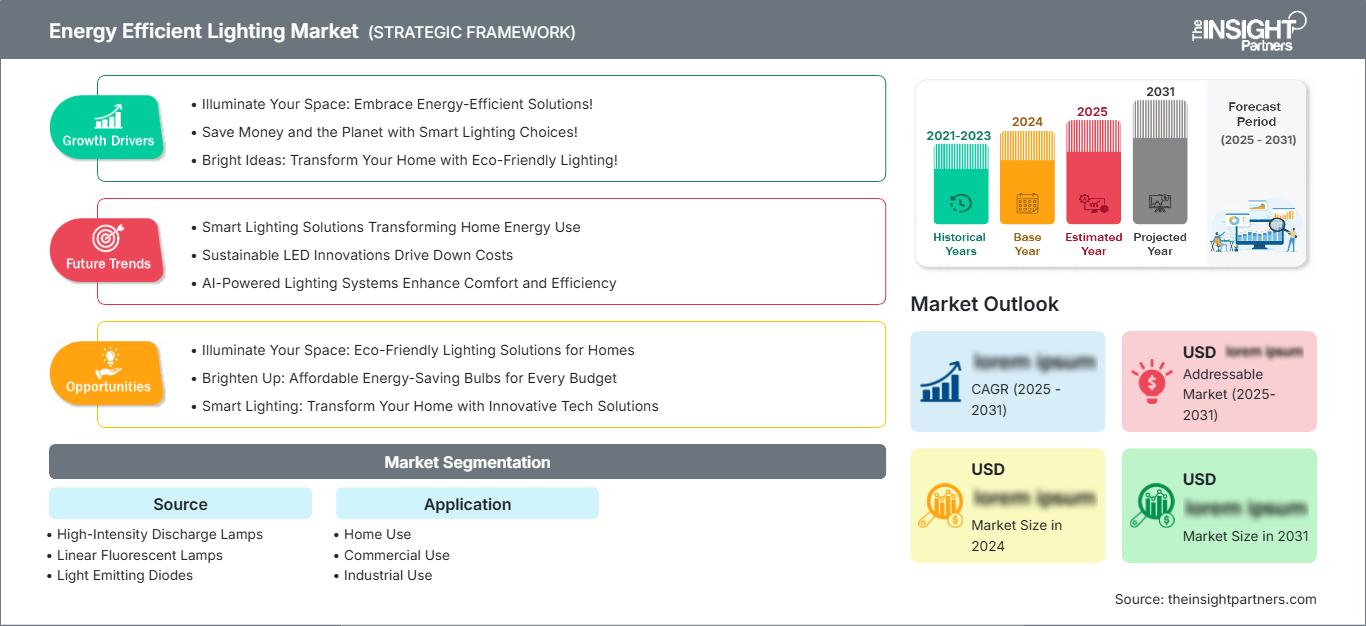
The Energy Efficient Lighting Market was valued at US$ 45.87 Billion in 2025 and is projected to reach US$ 74.26 Billion by 2034, expanding at a CAGR of 5.50% from 2026 to 2034. This growth trajectory reflects accelerating LED adoption, stringent energy performance standards, and rising infrastructure investments across residential, commercial, and industrial sectors worldwide.
North America maintains dominance in the Energy Efficient Lighting Market size landscape, with the region expected to grow at a CAGR range of 4.5–5.5% through 2034. Structural growth drivers include IEA Net Zero 2050 alignment mandates, EU Ecodesign regulations phasing out fluorescent technologies, and widespread smart building certifications driving retrofit activity across developed economies.
Energy Efficient Lighting Market Assessment and Insights
- North America: The region held 32–34% of global share in 2025, growing at a CAGR range of 4.5–5.5% between 2026–2034, driven by smart building adoption and commercial retrofit initiatives.
- US: The United States accounted for 28–30% of North American share in 2025, expanding at a CAGR range of 4.5–5.5% between 2026–2034, supported by DOE efficiency standards.
- Europe: Europe captured 26–28% of global share in 2025, growing at a CAGR range of 5.0–6.0% between 2026–2034, with Germany, UK, and France leading through Ecodesign compliance.
- Asia Pacific: The region held 24–26% of global share in 2025, expanding at the fastest CAGR range of 6.5–7.5% between 2026–2034, propelled by China, India, Japan, and urbanization programs.
- Largest Segment: The Light Emitting Diodes source segment dominated with 58–60% market share in 2025, growing at a CAGR range of 5.5–6.5% between 2026–2034, driven by superior efficacy and declining costs.
- High Growth Segment: The Commercial Use application segment demonstrated highest growth potential with 42–44% market share in 2025, expanding at a CAGR range of 6.0–7.0% between 2026–2034, owing to large-scale retrofit projects.
- Key companies analyzed in detail: Acuity Brands Lighting Inc., Cooper Lighting Solutions (Hubbell Incorporated), Cree LED (Ideal Industries Inc.), GE Lighting (Current Lighting Solutions LLC), Hubbell Lighting Inc., Nichia Corporation, OSRAM GmbH (ams OSRAM AG), Philips Lighting Holding B.V. (Signify N.V.), Soraa Inc. (part of TKX Capital portfolio), and The Lighting Quotient Ltd.
Source: The Insight Partners' analysis based on proprietary research, government publications, company annual reports, investor presentations, industry databases, and expert interviews.
The Energy Efficient Lighting Market has developed from basic fluorescent alternatives to smart connected LED lights with state-of-the-art controls. The efficiency of LEDs surpasses 200 lumens per watt in high-end products, whereas conventional fluorescent lamps that contain mercury need to meet phase-out requirements in the EU RoHS regulations and MEPS schemes around the globe. Technologies such as Zigbee, Bluetooth Mesh, and DALI-2 have facilitated easy installation of connected lights in historical buildings and occupied office buildings in terms of savings of up to 40% on re-wiring costs.
Cloud-enabled lighting networks allow for energy consumption optimization from thousands of lighting points from remote dashboards along with HVAC and building management systems. The APAC and MEA regions represent high-growth markets owing to initiatives such as the Indian UJALA initiative and the Saudi Vision 2030 scheme to invest in their infrastructure. Positive regulatory trends include the 2026 Ecodesign regulation of the European Commission for 140 lm/W minimum efficacy by 2027.
Energy Efficient Lighting Market Report Scope
| Report Attribute | Details |
|---|---|
| Market size in 2025 | US$ 45.87 Billion |
| Market Size by 2034 | US$ 74.26 Billion |
| Global CAGR (2026 - 2034) | 5.50% |
| Historical Data | 2021-2024 |
| Forecast period | 2026-2034 |
Energy Efficient Lighting Market Analysis
Steady demand is driven by mandatory minimum energy performance standards in 90 countries that account for close to 80% of lighting energy consumption in the world. The value chain comprises LED chips suppliers, including Nichia and OSRAM; LED lighting fixtures assembly units; control system providers; and utility programs administrators. The LED chip market is expected to expand because of its high efficiency compared to incandescent lamps with up to 80–90% energy saving. Supply conditions are rather stable despite some variations in rare earth phosphor and gallium nitride substrate prices related to semiconductor cycles. The market supply base diversifies in Asia and Europe.
According to market review, the commercial sector is generating 42–44% of the revenue in 2025, while office buildings and retail premises are leading segments with 6.0–7.0% CAGR till 2034. Competitive environment includes large global electrical manufacturers such as Signify, Acuity Brands, and ams OSRAM as well as LED lighting manufacturers such as Cree LED and Soraa. Competitive advantages are based on IoT-enabled smart lighting systems, with Atrius cloud management solution introduced by Acuity Brands and Interact IoT portfolio offered by Signify.
Investment trends favor networked lighting infrastructure that shares occupancy, daylight, and energy data with building automation systems via open protocols like BACnet/IP and LonWorks. This interoperability transforms lighting from a fixed utility expense into an active energy management and operational optimization asset within intelligent building ecosystems, delivering 30–40% additional savings beyond LED efficacy gains alone.
● REPORT CUSTOMIZATION
Tailor This Report To Align With Your Specific Business Requirements
This report can be customized to align precisely with your business objectives, scope, and target markets. Customization options include tailored segmentation, geography, competitive analysis, and strategic insights to support informed decision-making.
Customize This Report →WHAT YOU CAN ADJUST
- ● Segmentations
- ● Geography
- ● Competitive Analysis
- ● Language Preferences
Energy Efficient Lighting Market: Strategic Insights
Regional Insights
North America Energy Efficient Lighting Market
North America maintained its position as the largest market region in 2025, accounting for 32–34% of global revenue. The region is projected to expand at a CAGR range of 4.5–5.5% between 2026 and 2034, supported by sustained commercial construction activity, healthcare facility modernization, and data center expansion. Regulatory enforcement remains a primary catalyst, with DOE energy conservation standards mandating 120 lm/W minimum efficacy for general service lamps and Title 24 building codes in California requiring advanced lighting controls in all new commercial construction exceeding 10,000 square feet.
Utility rebates programs will keep encouraging retrofitting projects in public buildings and industrial applications, whereas ASHRAE 90.1-2022 standards have tightened lighting power density limits for offices, educational institutions, and healthcare premises. Networked lighting control systems captured 35-37% of the North American market share by 2025 and will be growing the fastest with CAGR of 10-11% up to 2031 because building owners will try to optimize energy consumption and incorporate networked lighting controls into larger smart building systems.
U.S. Energy Efficient Lighting Market
The United States represented 28–30% of the North American share in 2025, with domestic valuations reaching approximately US$ 14.5 billion. The U.S. market is forecast to grow at a CAGR range of 4.5–5.5% through 2034, driven by updated DOE efficiency standards, ongoing LED price declines, and stricter state-level building codes accelerating replacement cycles. Commercial facilities contributed 42–44% of U.S. energy efficient lighting revenue in 2025, while industrial warehouses and data centers emerged as the fastest-growing application segments at 7.0–8.0% CAGR.
According to the Energy Efficient Lighting Market report, major players like Acuity Brands, Signify, GE Lighting, Hubbell, and Cree LED have well-established distribution channels covering all 50 states, especially in offices, retailing, healthcare, and education segments. Now, residential use constitutes substantial volumes owing to the ENERGY STAR labeling requirement and consumer realization of savings of lifetime costs greater than 75% compared to incandescent lamps. The latest LED fixtures have achieved an efficiency of more than 200 lm/W in their premium versions whereas the connected controls help achieve extra savings of 30-40%.
Europe Energy Efficient Lighting Market
Europe captured 26–28% of global Energy Efficient Lighting Market share in 2025, valued at approximately US$ 12.8 billion, and is projected to grow at a CAGR range of 5.0–6.0% through 2034. The United Kingdom commands 16–18% of European regional revenue, with updated Ecodesign regulations mandating 120 lm/W minimum efficacy from September 2023 and 140 lm/W from September 2027, accelerating LED migration across commercial and industrial facilities. Germany follows closely with 20–22% share, driven by EN 12464-1 workplace lighting standards and KfW energy efficiency grant programs supporting SME retrofit investments.
France, Italy, and Spain, combined, account for 30-32% of the European market, where France is at the forefront of smart city programs in Paris and Lyon, while Italy is working on industrial manufacturing plants. In Europe, the market is mature and stable, with growth driven by regulatory compliance, Ecodesign Fluorescent phase out, and migration to IoT enabled luminaries that facilitate automatic energy monitoring with 40-50% reduction in maintenance costs than traditional technologies. Germany is the market leader in the region, followed by UK and France in terms of volume.
APAC Energy Efficient Lighting Market
According to the Energy Efficient Lighting Market forecast, Asia Pacific held 24–26% of global share in 2025, valued at approximately US$ 11.2 billion, and is projected to expand at the fastest CAGR range of 6.5–7.5% through 2034. China takes the lead with a regional adoption rate of 38-40% of APAC revenues, due to large-scale infrastructure projects, energy intensity goals under the 14th Five Year Plan, and stringent GB building codes for high-efficacy lighting requirements in all public gathering places and businesses.
Japan is next with a regional adoption rate of 16-18%, with an emphasis on compliance with the Top Runner program, and safety measures for the aging population in healthcare and residential buildings, utilizing circadian-tuned LEDs.
Together, India, South Korea, and Australia make up 28-30% of APAC Energy Efficient Lighting Market revenues, with India’s UJALA program responsible for distribution of more than 370 million LED bulbs and lamps since 2015. South Korea focuses on IoT implementation in commercial towers, whereas Australia imposes stringent MEPS requirements in mining, education, and healthcare segments. Key industrial drivers include government support for LEDs via subsidies, rapid urbanization at a rate of 3.5%, and awareness of energy saving costs after regional electricity price increases.
Middle East & Africa Energy Efficient Lighting Market
The Middle East & Africa Energy Efficient Lighting Market is projected to grow at a CAGR range of 8.0–9.0% through 2034, representing strong regional growth potential globally. Saudi Arabia leads with Vision 2030 giga-projects including NEOM, Red Sea developments, and Qiddiya entertainment city, all requiring comprehensive energy-efficient lighting solutions meeting international LEED and Estidama standards. The UAE follows with Dubai's Green Building Regulations and updated Al Sa'fat code mandating high-efficacy LED luminaires with smart controls in all new commercial and residential developments exceeding specific thresholds.
South Africa constitutes the largest mature market for sub-Saharan Africa because of mining efficiency requirements as well as commercial offices in Johannesburg and Cape Town under conditions of constant power shortages. RoMEA consists of Egypt's New Administrative Capital, Kenya's Konza Technopolis, and Lagos smart city in Nigeria and illustrates how vision at national level gets translated into reality in terms of multi-use urban environment that requires efficient lighting infrastructure. The energy and infrastructure situation encompasses availability of solar power which enables the use of hybrid solar-LED lighting systems.
Segmentation Analysis
Source
The Source segment of the Energy Efficient Lighting Market is projected to grow at a CAGR range of 5.5–6.5% between 2026 and 2034. LED technology dominates with superior efficacy exceeding 200 lm/W in premium products, 50,000–100,000 hour rated life, and instant-on capability critical for commercial and industrial applications. Fluorescent systems face phase-out timelines under EU Ecodesign and RoHS regulations due to mercury content, while HID sources remain prevalent in outdoor and industrial applications requiring high-intensity output despite lower efficiency compared to LED alternatives.
- High-Intensity Discharge Lamps: HID lamps maintain 8–10% market presence in 2025, valued for high-intensity output in stadiums, airports, and industrial facilities, though declining efficiency and warm-up times drive gradual LED replacement in non-critical applications.
- Linear Fluorescent Lamps: Linear fluorescent systems hold 18–20% share in 2025, primarily in legacy commercial installations and regions with slower regulatory enforcement, though T5/T8 tube bans by 2023–2027 accelerate migration toward LED retrofit tubes and replacement fixtures.
- Light Emitting Diodes: LED light sources commanded 58–60% market share in 2025 with dominant position, driven by energy efficiency mandates, superior lifespan reducing replacement frequency, and seamless integration with smart controls and occupancy sensors in connected building ecosystems.
Application
The Application segment of the Energy Efficient Lighting Market is forecast to grow at a CAGR range of 5.0–6.0% between 2026 and 2034. Commercial buildings lead in absolute revenue contribution, while industrial applications emerge as high-growth categories as energy-intensive manufacturing and warehouse facilities prioritize operational cost reductions. Residential applications benefit from consumer awareness and utility rebate programs, though lower average unit prices limit revenue share compared to large-scale commercial and industrial deployments requiring sophisticated control systems.
- Home Use: Residential applications held 24–26% market share in 2025 with steady growth outlook, propelled by ENERGY STAR certification, smart home integration, and consumer awareness of lifetime cost savings exceeding 75% versus incandescent alternatives in general illumination.
- Commercial Use: Commercial buildings command 42–44% of 2025 Energy Efficient Lighting Market revenue, encompassing offices, retail centers, hotels, and shopping malls where brand reputation and operational cost concerns drive premium system investments with remote monitoring capabilities.
- Industrial Use: Industrial facilities represent 30–32% share in 2025, characterized by demanding environments requiring IP65+ rated fixtures, extended operational hours justifying rapid ROI calculations, and integration with process control systems in manufacturing and warehousing operations.
Opportunity Snapshot
| Application | Revenue Contribution | Trend Tag | Adoption Stage |
|---|---|---|---|
| Home Use | Medium | Smart Bulb Integration | Scaling |
| Commercial Use | High | IoT Networked Controls | Mature |
| Industrial Use | High | High-Bay LED Retrofit | Mature |
Energy Efficient Lighting Market Growth Drivers and Impact Analysis
Stringent Global Energy Performance Standards
Minimum energy performance standards necessitate the installation of high-efficiency lighting in residential, commercial, and industrial buildings in more than 90 nations, ensuring continued demand for purchases. The EU Ecodesign requires efficacy of at least 120 lm/W starting 2023 and then 140 lm/W from 2027, whereas U.S. DOE regulations stipulate similar requirements for general service lamps. IEC 62776 covers LED tube replacements on an international basis, and the ENERGY STAR rating ensures performance certification of equipment in North America. Non-compliance is heavily penalized, with consequences such as prohibition from sale, fines, and legal liability.
LED Technology Cost-Performance Advancement
LED lighting fixtures achieve greater than 200 lumens per watt efficiencies in premium models having ratings between 50,000 hours and 100,000 hours of operation, making them significantly more efficient in terms of energy use and lower maintenance costs when compared to their fluorescent and incandescent counterparts. In total cost of ownership calculations, the LED fixture continues to become more economical over time even with a higher initial cost, due to lower maintenance requirements, including reduced labor costs, ballast changes, and electricity bills throughout its 10-15 years of operation period.
Smart Building Integration and IoT Connectivity
Lighting solutions are transforming from simple passive solutions into active tools for building management through IoT platforms using wireless components. Technologies like DALI-2, Zigbee 3.0, and Bluetooth Mesh not only cut down installation costs by 40-50%, but also make remote monitoring, automatic fault detection, and maintenance planning possible. Connectivity to cloud-based dashboards helps building managers to manage hundreds or thousands of units in different facilities automatically collecting energy consumption statistics and saving up to 50-60% on inspection efforts. Standardized communication systems, such as BACnet/IP, can integrate lighting solutions with HVAC, access control, and fire panels for optimized building ecosystem.
Energy Efficient Lighting Market Future Trends
Wireless Networked Lighting Controls Dominance
Energy Efficient Lighting Market trends indicate that wireless, networked lighting controls will capture 55–60% of new commercial installations by 2030 as energy codes mandate advanced controls in all new construction and major renovations. Manually operated systems will become obsolete because the ASHRAE 90.1-2022 and IECC 2021 standards mandate occupancy sensing, daylight harvesting, and personal control of lighting for office buildings, schools, and retail stores. Companies such as Acuity Brands and Signify have come up with radio mesh system networks that can be operated using mobile apps, thus providing the opportunity to remotely operate zoning, scheduling, and energy consumption without making changes to the wiring of the facility.
AI-Powered Predictive Maintenance Integration
Through the analysis of luminaire performance, driver conditions, and occupancy patterns, artificial intelligence and machine learning algorithms will play a critical role in predicting system failures before they happen and moving the maintenance process from reactive to proactive. The AI lighting management software will help to match the historical performance metrics with sensor data to create a dimming schedule that highlights potential failures in components and creates automated energy reports for LEED certification purposes. This will ensure that all the processes are compliant with regulations, extend the lifespan of the assets, and minimize the risk of unexpected downtime.
Energy Efficient Lighting Market Opportunities
Emerging Markets Infrastructure Expansion
Middle East & Africa and Asia Pacific regions present substantial growth opportunities as national development visions materialize into physical infrastructure. Saudi Vision 2030 encompasses US$ 1+ trillion in giga-projects including NEOM, Red Sea resorts, and Qiddiya entertainment destinations, all requiring comprehensive energy-efficient lighting systems meeting international LEED and Estidama standards. India's Smart Cities Mission targets 100 cities with integrated infrastructure upgrades, while Africa's urbanization rate of 3.5% annually drives commercial and residential construction across Lagos, Nairobi, and Cairo. Manufacturers establishing local distribution networks, technical support capabilities, and regulatory compliance expertise in these regions will capture disproportionate market share as first-mover advantages compound over the forecast period.
Hybrid Solar-LED Lighting Systems
Hybrid lighting systems combining solar photovoltaic charging with LED luminaires and lithium battery storage address grid instability challenges in emerging markets while supporting sustainability objectives in developed regions. These systems reduce operational electricity costs by 70–80% compared to grid-powered alternatives, enhance resilience during regional power disruptions, and align with corporate net-zero commitments increasingly mandated by investors and regulators. Manufacturers offering modular, scalable hybrid solutions with remote monitoring capabilities will differentiate themselves in both off-grid rural applications and urban commercial installations seeking to reduce carbon footprints while maintaining uninterrupted illumination during extended outages and peak demand periods.
Recent Developments
- May 2026: Orion Energy Systems introduced the MPHL2, an energy-efficient LED lighting solution designed for the rapidly growing AI-driven data center market. This product addresses the high power demands of AI workloads by offering superior energy savings, configurability, and ease of integration, helping data centers reduce operating costs. With thousands of new data centers planned in the U.S. to support AI and cloud computing growth, Orion aims to become a key provider in this expanding infrastructure sector. The MPHL2 is made in Wisconsin, ensuring availability and customization for large-scale deployments.
- March 2025: Atlas Copco has launched the second generation of solar powered light towers, the HiLight MS 4 and MS 5, a groundbreaking development in their commitment to providing the market with efficient, safe, and dependable lighting solutions for operators in a wide range of applications from events to oil and gas, construction, and mining.
- November 2025: Signify inaugurated a new Philips Smart Light Hub (SLH) in Ahmedabad, Gujarat, expanding its retail footprint in India.
Frequently Asked Questions

- Comprehensive Market Sizing and Forecast Analysis
- Detailed Segmentation Analysis
- In-Depth Market Dynamics Assessment
- Regional and Country-Level Insights
- Competitive Landscape and Company Benchmarking
- Strategic Business Intelligence
Recent Reports
Testimonials

The Insight Partners' SCADA System Market report is comprehensive, with valuable insights on current trends and future forecasts. The team was highly professional, responsive, and supportive throughout. We are very satisfied and highly recommend their services.
RAN KEDEM Partner, Reali Technologies LTDs
I requested a report on a very specific software market and the team produced the report in a few days. The information was very relevant and well presented. I then requested some changes and additions to the report. The team was again very responsive and I got the final report in less than a week.
JEAN-HERVE JENN Chairman, Future Analytica
We worked with The Insight Partners for an important market study and forecast. They gave us clear insights into opportunities and risks, which helped shape our plans. Their research was easy to use and based on solid data. It helped us make smart, confident decisions. We highly recommend them.
PIYUSH NAGPAL Sr. Vice President, High Beam Global
The Insight Partners delivered insightful, well-structured market research with strong domain expertise. Their team was professional and responsive throughout. The user-friendly website made accessing industry reports seamless. We highly recommend them for reliable, high-quality research services
YUKIHIKO ADACHI CEO, Deep Blue, LLC.
This is the first time I have purchased a market report from The Insight Partners.While I was unsure at first, I visited their web site and felt more comfortable to take the risk and purchase a market report.I am completely satisfied with the quality of the report and customer service. I had several questions and comments with the initial report, but after a couple of dialogs over email with their analyst I believe I have a report that I can use as input to our strategic planning process.Thank you so much for taking the extra time and making this a positive experience.I will definitely recommend your service to others and you will be my first call when we need further market data.
JOHN SUZUKI President and Chief Executive Officer, Board Director, BK Technologies
I wish to appreciate your support and the professionalism you displayed in the course of attending to my request for information regarding to infectious disease IVD market in Nigeria. I appreciate your patience, your guidance, and the fact that you were willing to offer a discount, which eventually made it possible for us to close a deal. I look forward to engaging The Insight Partners in the future, all thanks to the impression you have created in me as a result of this first encounter.
DR CHIJIOKE ONYIA MANAGING DIRECTOR, PineCrest Healthcare Ltd.Reason to Buy
- Informed Decision-Making
- Understanding Market Dynamics
- Competitive Analysis
- Identifying Emerging Markets
- Customer Insights
- Market Forecasts
- Risk Mitigation
- Boosting Operational Efficiency
- Strategic Planning
- Investment Justification
- Tracking Industry Innovations
- Aligning with Regulatory Trends





 Get Free Sample for