
Enterprise Network Equipment Market Growth, Share & Trends by 2034
Coverage: by Type (WLAN equipment, Ethernet switch, Enterprise routers, and Network security equipment); End-Use (BFSI, Retail, IT & Telecommunications, Automotive, and Governemnt & Utilities), and Geography (North America, Europe, Asia Pacific, and South and Central America)
- Status : Data Released
- Report Code : TIPRE00003049
- Category : Electronics and Semiconductor
- No. of Pages : 150
- Available Report Formats :


- Last update date : August 17, 2026


2025 Market Size
US$ 76.17 Bn
Base year value
2034 Forecast
US$ 108.05 Bn
Projected by 2034
CAGR 2026-2034
3.96 %
Growth rate
Addressable Market
US$ 836.64 Bn
(2026-2034)
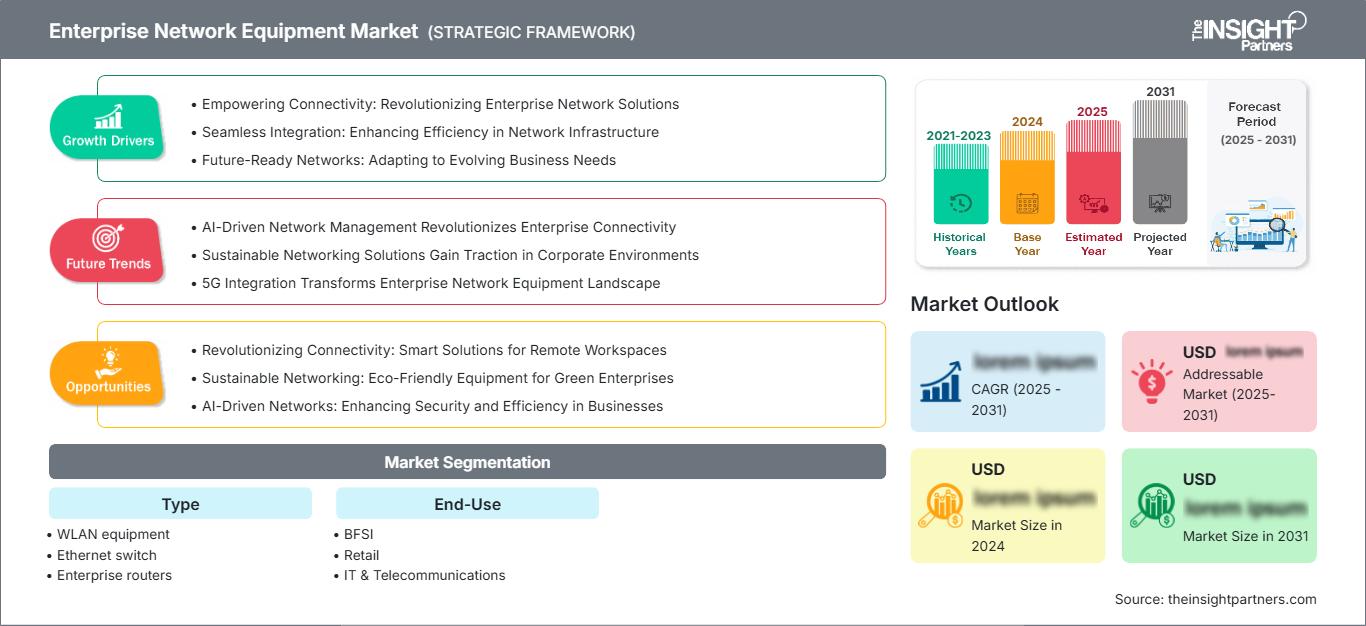
The Enterprise Network Equipment Market was valued at US$ 76.17 Billion in 2025 and is projected to reach US$ 108.05 Billion by 2034, expanding at a CAGR of 3.96% from 2026 to 2034. This growth trajectory reflects accelerating cloud adoption, hybrid work infrastructure investments, and rising cybersecurity mandates across BFSI, retail, IT, and government sectors worldwide.
North America maintains dominance in the Enterprise Network Equipment Market size landscape, with the region expected to grow at a CAGR range of 3.5–4.5% through 2034. Structural growth drivers include Fortune 500 campus network refreshes, federal zero-trust architecture mandates, and hyperscale data center expansions supporting AI workload deployments across enterprise customers.
Enterprise Network Equipment Market Assessment and Insights
- North America: The region held 36–38% of global share in 2025, growing at a CAGR range of 3.5–4.5% between 2026–2034, driven by enterprise IT spending and cloud infrastructure investments.
- US: The United States accounted for 30–32% of North American share in 2025, expanding at a CAGR range of 3.5–4.5% between 2026–2034, supported by federal modernization initiatives.
- Europe: Europe captured 24–26% of global share in 2025, growing at a CAGR range of 3.5–4.5% between 2026–2034, with Germany, UK, and France leading through GDPR compliance.
- Asia Pacific: The region held 22–24% of global share in 2025, expanding at the fastest CAGR range of 5.0–6.0% between 2026–2034, propelled by China, India, Japan, and digital transformation programs.
- Largest Segment: The Ethernet switch type segment dominated with 42–44% market share in 2025, growing at a CAGR range of 3.5–4.5% between 2026–2034, driven by data center expansion and campus network upgrades.
- High Growth Segment: The Network security equipment type segment demonstrated highest growth potential with 20–22% market share in 2025, expanding at a CAGR range of 5.5–6.5% between 2026–2034, owing to zero-trust adoption.
- Key companies analyzed in detail: Arista Networks Inc., Aruba Networks (Hewlett Packard Enterprise), Cisco Systems Inc., Dell EMC (Dell Technologies Inc.), Extreme Networks Inc., Huawei Technologies Co. Ltd., Juniper Networks (Hewlett Packard Enterprise), Palo Alto Networks Inc., Riverbed Technology Inc., and VMware Corporation (Broadcom Inc.).
Source: The Insight Partners' analysis based on proprietary research, government publications, company annual reports, investor presentations, industry databases, and expert interviews.
The market has shifted towards cloud-managed, AI-enabled networking systems with security built into them. The Ethernet switch now offers 400G/800G speed in data centers, whereas the SD-WAN and SASE system decrease branch office complexity by 40-50%. Such technology is witnessing greater adoption in distributed enterprises because large-scale manual configuration is difficult and expensive for them.
With cloud-managed networking solutions, an organization's IT staff can manage thousands of devices via dashboards, as well as integrate the solution with identity management and security orchestration solutions. Asia Pacific and MEA become high-growth markets, with government schemes such as Digital India in India and Saudi Vision 2030 in Saudi Arabia leading to record infrastructure investments. Positive regulatory trends like NIS2 cybersecurity directive in Europe and Zero Trust policies in the United States fuel adoption of network security equipment.
Enterprise Network Equipment Market Report Scope
| Report Attribute | Details |
|---|---|
| Market size in 2025 | US$ 76.17 Billion |
| Market Size by 2034 | US$ 108.05 Billion |
| Global CAGR (2026 - 2034) | 3.96% |
| Historical Data | 2021-2024 |
| Forecast period | 2026-2034 |
Enterprise Network Equipment Market Analysis
Strong demand for Enterprise Network Equipment Market growth solutions comes from compulsory digital transformation strategies in 85 countries worldwide accounting for almost 75% of global enterprise IT spend. The value chain involves semiconductor makers such as Broadcom and Marvell, equipment OEMs, system integrators, and managed service providers. Adoption of cloud-managed solutions increases owing to 50-60% decrease in operational complexity compared to CLI-based management. The supply side stays stable but changes of advanced ASIC and merchant silicon prices that depend on semiconductor cycles result in diversification of sources in Asia and North America by manufacturers.
The Enterprise Network Equipment Market research shows that the contribution of the IT and telecom verticals accounted for 28-30% of the total revenue in 2025. The fastest growing customer segments are BFSI and government with 5.0-6.0% CAGR till 2034. Key competitors include global networking players such as Cisco, HPE Aruba, and Juniper as well as security vendors like Palo Alto Networks and Arista. Current market trends in the segment are characterized by increasing importance of AI automation solutions with the emergence of Catalyst AI switching portfolio in the product range of Cisco and Juniper Mist AI for HPE.
Investment trends favor intent-based networking infrastructure that shares telemetry, performance, and security data with cloud management platforms via open APIs like REST and NETCONF. This interoperability transforms networking from a static connectivity utility into an active business enabler and operational optimization asset within intelligent enterprise ecosystems, delivering 30–40% additional efficiency gains beyond hardware performance improvements alone.
● REPORT CUSTOMIZATION
Tailor This Report To Align With Your Specific Business Requirements
This report can be customized to align precisely with your business objectives, scope, and target markets. Customization options include tailored segmentation, geography, competitive analysis, and strategic insights to support informed decision-making.
Customize This Report →WHAT YOU CAN ADJUST
- ● Segmentations
- ● Geography
- ● Competitive Analysis
- ● Language Preferences
Enterprise Network Equipment Market: Strategic Insights
Regional Insights
North America Enterprise Network Equipment Market
North America maintained its position as the largest Enterprise Network Equipment Market region in 2025, accounting for 36–38% of global revenue. The region is projected to expand at a CAGR range of 3.5–4.5% between 2026 and 2034, supported by sustained enterprise IT spending, federal agency modernization, and hyperscale data center expansions. The regulatory compliance push continues to be a key trigger, with zero-trust architectures mandated by OMB for all federal agencies to comply with cybersecurity requirements by 2025 and continuous diagnostics requirements by CISA for critical infrastructure companies in the energy, finance, and healthcare sectors.
The enterprise refresh cycle drives continued deployments among Fortune 500 corporate campuses and public sector campuses, while NIST 800-207 zero-trust principles include stricter network segmentation rules for agencies that handle sensitive information. Cloud-managed networking has been estimated to have taken 52–54% market share in North America in 2025 and will grow at the fastest rate of 8–9% CAGR till 2031 as IT teams favor simplicity and integration with cloud platforms.
U.S. Enterprise Network Equipment Market
The United States represented 30–32% of the North American share in 2025, with domestic valuations reaching approximately US$ 27.4 billion. The U.S. market is forecast to grow at a CAGR range of 3.5–4.5% through 2034, driven by updated federal acquisition regulations, ongoing AI data center investments, and stricter state-level cybersecurity mandates accelerating replacement cycles. IT and telecom verticals contributed 28–30% of U.S. enterprise network equipment revenue in 2025, while BFSI and government agencies emerged as the fastest-growing application segments at 5.0–6.0% CAGR.
According to the Enterprise Network Equipment Market report, Cisco, Arista, Juniper, Palo Alto Networks, and Dell have well-established distribution channels in all fifty states, especially in the financial sector, healthcare, education, and defense industries. The cloud-managed systems account for substantial volumes due to their subscription-based pricing strategy and the knowledge of the IT staff that their operating costs throughout the entire lifecycle would be reduced by more than 50% compared to legacy on-premise management. Currently, Ethernet switches provide 400G/800G capabilities in data centers and SD-WAN allows cutting down complexity by 40–50%.
Europe Enterprise Network Equipment Market
Europe captured 24–26% of global market share in 2025, valued at approximately US$ 19.8 billion, and is projected to grow at a CAGR range of 3.5–4.5% through 2034. The United Kingdom commands 18–20% of European regional revenue, with updated NIS2 cybersecurity directives mandating network segmentation and zero-trust principles for essential service operators across energy, transport, and healthcare sectors. Germany follows closely with 22–24% share, driven by GDPR data residency requirements and BSI IT-Grundschutz standards requiring certified network security appliances in all federal and critical infrastructure deployments.
The French, Italian, and Spanish countries together contribute 32-34% of the revenue generated in the European Enterprise Network Equipment Market. France excels in launching smart cities projects in Paris and Lyon. Italy concentrates on manufacturing Industry 4.0 solutions, and Spain gains from the hospitality industry due to the country's tourism. Despite maturity, the European market is consistent and growth is driven by regulation compliance, GDPR implementation, and migration to cloud-controlled platforms where automation of policy enforcement helps to save 40-50% operating expenses against CLI-based platforms. Germany dominates regional adoption, seconded by UK and France in terms of volume.
APAC Enterprise Network Equipment Market
Asia Pacific held 22–24% of global Enterprise Network Equipment Market share in 2025, valued at approximately US$ 18.3 billion, and is projected to expand at the fastest CAGR range of 5.0–6.0% through 2034. China leads regional adoption with 38–40% of APAC revenue, driven by massive smart city development, 14th Five-Year Plan digital infrastructure targets, and stringent MLPS 2.0 cybersecurity standards requiring certified network equipment in all government and critical sector deployments. Japan follows with 16–18% share, focusing on Society 5.0 initiatives and aging population telemedicine requiring high-bandwidth, low-latency campus networks.
India, South Korea, and Australia together constitute 28-30% of the APAC share, with India having implemented the Digital India plan for over 250,000 government establishments and encouraging manufacturing through Make in India policy. While South Korea is focused on 5G-enabled smart factories, Australia implements essential eight cyber security measures in industries such as mining, education, and healthcare. The industrial and policy drivers in the region are government incentives to promote digitalization, urbanization at an annual rate of 3.5%, and increased efficiency due to higher labor costs.
Middle East & Africa Enterprise Network Equipment Market
The market in Middle East & Africa is projected to grow at a CAGR range of 7.0–8.0% through 2034, representing strong regional growth potential globally. Saudi Arabia leads with Vision 2030 giga-projects including NEOM, Red Sea developments, and Qiddiya entertainment city, all requiring comprehensive enterprise networking solutions meeting international ISO 27001 and NCA cybersecurity standards. The UAE follows with Dubai's Smart City program and updated NESA information assurance standards mandating certified network security appliances in all government and critical infrastructure deployments exceeding specific thresholds.
South Africa is an example of the biggest mature market in Sub-Saharan Africa thanks to the development of the country's financial sector along with commercial office buildings in Johannesburg and Cape Town, despite the lack of advanced telecommunication infrastructures. The other regions of the Middle East and Africa region include the New Administrative Capital in Egypt, the Konza Technopolis in Kenya, and the smart cities of Lagos in Nigeria. These are the examples of how national dreams are transformed into sophisticated mixed-use urban eco-systems requiring efficient and secure network infrastructures.
Segmentation Analysis
Type
The Type segment of the Enterprise Network Equipment Market is projected to grow at a CAGR range of 3.5–4.5% between 2026 and 2034. Ethernet switches dominate with superior port density and throughput in data centers, 400G/800G capabilities for AI workloads, and cloud-managed orchestration critical for enterprise and campus deployments. WLAN equipment faces competition from 5G private networks in some industrial applications, while routers remain prevalent in WAN edge and branch office deployments requiring SD-WAN capabilities despite lower growth rates compared to security appliances.
- WLAN equipment: WLAN systems maintain 14–16% market presence in 2025, valued for wireless mobility in offices, retail, and hospitality, though 5G private networks and Wi-Fi 6E/7 adoption drive incremental upgrades in high-density environments.
- Ethernet switch: Ethernet switches commanded 42–44% share in 2025 with dominant position, driven by data center expansion, campus network refreshes, and seamless integration with cloud management platforms and intent-based networking controllers in modern enterprise ecosystems.
- Enterprise routers: Enterprise routers hold 18–20% share in 2025, primarily in WAN edge and branch deployments, with SD-WAN capabilities and zero-touch provisioning accelerating replacement cycles in distributed enterprises seeking operational simplicity.
- Network security equipment: Network security appliances represent 20–22% of 2025 volume with highest growth trajectory, characterized by zero-trust architecture mandates, next-generation firewall deployments, and integration with identity management and SIEM platforms in security operations centers.
End-Use
The End-Use segment of the Enterprise Network Equipment Market is forecast to grow at a CAGR range of 3.5–4.5% between 2026 and 2034. IT and telecom verticals lead in absolute revenue contribution, while BFSI and government applications emerge as high-growth categories as financial institutions and public agencies prioritize cybersecurity and digital service delivery. Retail benefits from omnichannel transformation initiatives, though lower average deal sizes limit revenue share compared to large-scale enterprise and government deployments requiring comprehensive security architectures.
- BFSI: Banking and financial services held 22–24% market share in 2025 with steady growth outlook, propelled by PCI-DSS compliance, digital banking platforms, and consumer awareness of cybersecurity requirements in online transactions and mobile banking applications.
- Retail: Retail enterprises command 14–16% of 2025 Enterprise Network Equipment Market revenue, encompassing omnichannel operations, inventory management, and customer analytics where brand reputation and operational cost concerns drive investments in cloud-managed networking.
- IT & Telecommunications: IT and telecom verticals represent 28–30% share in 2025, characterized by hyperscale data center expansions, 5G infrastructure deployments, and integration with cloud service platforms in carrier and enterprise service provider operations.
- Automotive: Automotive manufacturers hold 8–10% share in 2025, driven by Industry 4.0 smart factory initiatives, connected vehicle development requiring high-bandwidth test environments, and supply chain visibility platforms across global production networks.
- Government & Utilities: Government and utilities represent 18–20% share in 2025, characterized by zero-trust architecture mandates, critical infrastructure protection requirements, and integration with national cybersecurity frameworks in public sector and essential service deployments.
Opportunity Snapshot
| End-Use | Revenue Contribution | Trend Tag | Adoption Stage |
|---|---|---|---|
| BFSI | High | Zero-Trust Architecture | Mature |
| Retail | Medium | Omnichannel Wi-Fi | Scaling |
| IT & Telecommunications | High | Hyperscale AI Networking | Mature |
| Automotive | Low | Industry 4.0 Smart Factory | Emerging |
| Government & Utilities | High | Federal Zero-Trust Mandate | Mature |
Enterprise Network Equipment Market Growth Drivers and Impact Analysis
Mandatory Zero-Trust Architecture Adoption
Zero-trust security requirements necessitate network segmentation and continuous verification among federal agencies and critical infrastructure providers in more than 40 countries, ensuring ongoing demand. U.S. zero-trust architecture requirements under the OMB mandate all federal agencies adhere to cybersecurity requirements by 2025, while Europe’s NIS2 directive demands the same from essential service providers in the energy, transport, and healthcare sectors. The NIST 800-207 standards dictate how U.S. implementations proceed, while the ISO 27001 certifications ensure that enterprise security programs are compliant in foreign markets. Violation comes with hefty fines and penalties including funding cuts, operational closures, and liability risks, pushing CISOs and network architects to ensure certification and compliance through enterprise-proven solutions from reputable manufacturers.
AI Data Center Infrastructure Expansion
The Enterprise Network Equipment Market trends indicate that AI-based workloads now need 400G/800G Ethernet switches with a density of 50,000+ ports, which is quite different from the old 10G/25G generation in terms of bandwidth requirements and refresh rate. The total cost of ownership analysis now tends to show that dedicated AI networking is worth investing in, despite the increased initial costs, thanks to reduced performance limitations, power consumption, and complexity during seven to ten years of operation. State-of-the-art merchant silicon solutions from Broadcom and NVIDIA can also be leveraged to maximize the benefits from the use of such hardware, by improving performance and reducing footprint of AI-powered network infrastructure.
Cloud-Managed Networking Platform Adoption
Cloud-managed systems are now moving from being convenience add-ons to essential requirements for enterprise networks through subscription delivery systems with built-in AI analytics capabilities. REST APIs, NETCONF, and streaming telemetry protocols make it easy to reduce the operation burden by 50–60 percent, and they also support remote monitoring and automated enforcement of policies and maintenance scheduling. The cloud dashboard enables IT staff to manage thousands of devices at multiple locations while making it possible to detect configuration drift automatically and cut back on the work done with CLI by 60–70 percent. Integrations with open identity management, SIEM, and ITSM systems enable sharing of information between security operations and service desks.
Enterprise Network Equipment Market Future Trends
Intent-Based Networking with AI Automation
The intent-based networking platform would account for 65% to 70% of all new enterprise deployment by 2030 since IT departments demand business outcome-based automation in terms of campus, data center, and WAN networks. The use of traditional configuration through CLI is becoming obsolete because the emerging AIOps solutions such as Juniper Mist and Cisco Catalyst Center are demanding natural language policies along with self-healing and verification of configurations in distributed enterprises. HPE and Arista have started launching cognitive networking systems which can be controlled via mobile applications and would allow troubleshooting, capacity planning, and changes to security policies from anywhere and without the need to access physical devices.
SASE and SD-WAN Convergence
By 2030, Secure Access Service Edge (SASE) and SD-WAN technologies will converge into a common platform responsible for 70 to 80 percent of branch office connectivity as security and network teams consolidate their vendor portfolio. Firewall technology, WAN optimization solutions, and secure web gateways need to be integrated as part of the SASE architecture, which calls for single vendor platforms to provide network and security services from cloud edges. Vendors such as Palo Alto Networks and Cisco have already introduced Prisma Access and Umbrella SASE platforms that integrate SD-WAN, CASB, and ZTNA solutions to allow users to access branch connectivity from anywhere with the same security policies.
Enterprise Network Equipment Market Opportunities
Emerging Markets Digital Infrastructure Programs
The Middle East & Africa and Asia Pacific geographies hold ample scope for growth with development plans coming to fruition with the building of actual infrastructure. Saudi Arabia's vision is to invest over US$ 1 trillion dollars in giga-projects like NEOM, Red Sea, and Qiddiya, each of which will require comprehensive enterprise network solutions conforming to international standards of ISO 27001 and NCA cyber security. Digital India aims at upgrading the connectivity of around 250,000 government institutions, whereas Africa's annual urbanization of 3.5% will lead to deployment of commercial and public sector network solutions in Lagos, Nairobi, and Cairo. The companies which establish themselves through the setting up of distribution networks and technical support in these geographies will have the market edge.
Hybrid Cloud Networking Architectures
The Enterprise Network Equipment Market forecast indicates that networking architectures that leverage a combination of public cloud networking services and private data centers to overcome multi-cloud deployment difficulties within organizations, while ensuring that the organization meets any compliance guidelines for their industry, will solve many of the issues facing the multi-cloud landscape in terms of regulatory compliance. By combining private and public networking services, it will simplify the management process of these services by 40%–50% compared to separating cloud services from on-premises, increase performance through cloud interconnects, and align itself with the cloud-first approach to digital transformation. Providers of flexible, scalable hybrid networking architectures that enforce policies consistently will be more competitive within the regulated verticals and cloud-native organizations.
Recent Developments
- May 2026: Cisco Systems Inc. introduced Catalyst AI switching platforms with integrated AI analytics and intent-based policy enforcement, targeting enterprise data center and campus customers seeking automated network operations. The platform supports 400G/800G speeds and integrates with Cisco's full-stack security portfolio for zero-trust architecture deployments.
- July 2025: Arista Networks Inc. acquired Broadcom's VeloCloud SD-WAN business for an undisclosed sum, expanding its campus and branch networking portfolio with modern SD-WAN capabilities. The acquisition completes Arista's campus offering with wireless, switching, routing, NAC, and SD-WAN, enabling end-to-end enterprise networking solutions for distributed organizations.
- July 2025: Hewlett Packard Enterprise finalized its US$ 13.4 billion acquisition of Juniper Networks, combining HPE Aruba Networking and Juniper's Mist AI platforms. The transaction doubles HPE's networking business while bolstering AI-driven cognitive networking capabilities across enterprise campus, data center, and service provider segments.
Frequently Asked Questions

- Comprehensive Market Sizing and Forecast Analysis
- Detailed Segmentation Analysis
- In-Depth Market Dynamics Assessment
- Regional and Country-Level Insights
- Competitive Landscape and Company Benchmarking
- Strategic Business Intelligence
Recent Reports
Testimonials

The Insight Partners provided valuable market intelligence that supported our global go-to-market strategy. Their team was professional, responsive, and attentive to our feedback, providing thoughtful analysis and helpful methodological clarifications throughout the project.
Junmo Kim Chief Financial Officer (CFO), Enertech Co., Ltd.
The Insight Partners' SCADA System Market report is comprehensive, with valuable insights on current trends and future forecasts. The team was highly professional, responsive, and supportive throughout. We are very satisfied and highly recommend their services.
RAN KEDEM Partner, Reali Technologies LTDs
I requested a report on a very specific software market and the team produced the report in a few days. The information was very relevant and well presented. I then requested some changes and additions to the report. The team was again very responsive and I got the final report in less than a week.
JEAN-HERVE JENN Chairman, Future Analytica
We worked with The Insight Partners for an important market study and forecast. They gave us clear insights into opportunities and risks, which helped shape our plans. Their research was easy to use and based on solid data. It helped us make smart, confident decisions. We highly recommend them.
PIYUSH NAGPAL Sr. Vice President, High Beam Global
The Insight Partners delivered insightful, well-structured market research with strong domain expertise. Their team was professional and responsive throughout. The user-friendly website made accessing industry reports seamless. We highly recommend them for reliable, high-quality research services
YUKIHIKO ADACHI CEO, Deep Blue, LLC.
This is the first time I have purchased a market report from The Insight Partners.While I was unsure at first, I visited their web site and felt more comfortable to take the risk and purchase a market report.I am completely satisfied with the quality of the report and customer service. I had several questions and comments with the initial report, but after a couple of dialogs over email with their analyst I believe I have a report that I can use as input to our strategic planning process.Thank you so much for taking the extra time and making this a positive experience.I will definitely recommend your service to others and you will be my first call when we need further market data.
JOHN SUZUKI President and Chief Executive Officer, Board Director, BK Technologies
I wish to appreciate your support and the professionalism you displayed in the course of attending to my request for information regarding to infectious disease IVD market in Nigeria. I appreciate your patience, your guidance, and the fact that you were willing to offer a discount, which eventually made it possible for us to close a deal. I look forward to engaging The Insight Partners in the future, all thanks to the impression you have created in me as a result of this first encounter.
DR CHIJIOKE ONYIA MANAGING DIRECTOR, PineCrest Healthcare Ltd.Reason to Buy
- Informed Decision-Making
- Understanding Market Dynamics
- Competitive Analysis
- Identifying Emerging Markets
- Customer Insights
- Market Forecasts
- Risk Mitigation
- Boosting Operational Efficiency
- Strategic Planning
- Investment Justification
- Tracking Industry Innovations
- Aligning with Regulatory Trends





 Get Free Sample for