
Environmental Catalysts Market Share, Growth & Forecast by 2034
Coverage: by Type (Voc Oxidation Catalysts, Co Oxidation Catalysts, Selective Catalytic Reduction Catalysts, Others); Application (Manufacturing industries, Automotive), and Geography (North America, Europe, Asia Pacific, and South and Central America)
- Status : Data Released
- Report Code : TIPRE00013044
- Category : Chemicals and Materials
- No. of Pages : 150
- Available Report Formats :


- Last update date : August 27, 2026


2025 Market Size
US$ 3.35 Bn
Base year value
2034 Forecast
US$ 5.13 Bn
Projected by 2034
CAGR 2026-2034
4.85 %
Growth rate
Addressable Market
US$ 38.49 Bn
(2026-2034)
The Environmental Catalysts Market was valued at US$ 3.35 Billion in 2025 and is projected to reach US$ 5.13 Billion by 2034, registering a CAGR of 4.85% during 2026–2034. The market encompasses catalytic technologies used to reduce harmful emissions from automotive exhaust systems and industrial processes. Demand is shaped by tightening emission standards, expansion of pollution-control infrastructure, and continued investment in cleaner combustion and industrial production technologies.
North America is expected to remain a technologically advanced market, supported by stringent federal and state emission requirements, replacement demand for mature vehicle fleets, and industrial air-quality compliance. The Environmental Catalysts Market size in the region is expected to expand at approximately 4.4–4.9% CAGR during 2026–2034, with automotive after-treatment and stationary emission-control installations providing the principal demand base.
Environmental Catalysts Market Assessment and Insights
- North America: North America is estimated to account for 23–25% share in 2025 and expand at a 4.4–4.9% CAGR between 2026–2034, supported by mature emission-control infrastructure, vehicle replacement cycles, and industrial compliance requirements.
- US: The US represents approximately 74–78% of North America share in 2025 and is projected to grow at 4.5–5.0% CAGR between 2026–2034, led by heavy-duty vehicle and industrial applications.
- Europe: Europe is estimated at 25–28% share in 2025, growing at 4.2–4.7% CAGR between 2026–2034. Germany, the UK, France, Italy, and Spain remain important markets because of stringent vehicle and industrial emission requirements.
- Asia Pacific: Asia Pacific holds approximately 39–42% share in 2025 and is expected to register 5.1–5.7% CAGR between 2026–2034, with China, Japan, South Korea, and India driving automotive and industrial deployment.
- Largest Segment: Selective Catalytic Reduction Catalysts represent an estimated 45–49% market share in 2025, expanding at 5.0–5.4% CAGR during 2026–2034 as NOx control requirements intensify.
- High Growth Segment: Automotive applications account for approximately 55–59% market share in 2025 and are projected to grow at 5.1–5.5% CAGR during 2026–2034, supported by increasingly stringent exhaust standards.
- Key companies analyzed in detail: BASF SE, Applied Catalysts, Inc., Clariant AG, Dorf Ketal Chemicals LLC, Dow Inc., EmeraChem LLC, Environmental Catalyst Technology, Inc., Evonik Industries AG, Johnson Matthey Plc, Treibacher Industrie AG.
Source: The Insight Partners' analysis based on proprietary research, government publications, company annual reports, investor presentations, industry databases, and expert interviews.
The Environmental Catalysts Market has evolved from conventional oxidation and reduction systems toward higher-efficiency catalyst formulations capable of operating across wider temperature windows. Progress made in zeolite science, precious metal usage, washcoat technology, substrate technology, and durability of the catalyst has increased the conversion efficiency of the catalytic converters. The production of the catalytic converter is now more focused and based on applications, with the suppliers providing a catalytic converter for gasoline, diesel, stationary combustion, industrial process gas, and maritime applications.
The future development of the catalytic converter will focus more on low precious metal content, extended life intervals, recycled catalyst material, and digitally optimized performance of the catalyst. The investment is also shifting towards developing industrial economies, which are setting up the emission control system along with their growing manufacturing capability.
Environmental Catalysts Market Report Scope
| Report Attribute | Details |
|---|---|
| Market size in 2025 | US$ 3.35 Billion |
| Market Size by 2034 | US$ 5.13 Billion |
| Global CAGR (2026 - 2034) | 4.85% |
| Historical Data | 2021-2024 |
| Forecast period | 2026-2034 |
Environmental Catalysts Market Analysis
Demand within the Environmental Catalysts Market is principally generated by regulations requiring lower concentrations of nitrogen oxides, carbon monoxide, hydrocarbons, and other pollutants. Vehicle manufacturers, fleet operators, refineries, chemical plants, power generators, and manufacturing facilities form the core ecosystem. Catalyst suppliers provide formulations and substrates, while system integrators combine catalytic units with sensors, filters, dosing systems, and exhaust-treatment equipment. The Environmental Catalysts Market growth therefore, depends on both new equipment installations and replacement requirements.
The value chain is sensitive to platinum-group metal availability, ceramic and metallic substrate supply, catalyst manufacturing capacity, and precious-metal recycling. Automotive catalysts require consistent performance across transient temperature conditions, whereas industrial systems prioritize durability and resistance to sulfur, particulates, and process contaminants. Suppliers increasingly integrate recycling and metal-management capabilities to reduce exposure to raw-material price volatility while improving lifecycle economics.
Competition in the Environmental Catalysts Market is characterized by technology differentiation, application expertise, manufacturing scale, and access to precious metals. BASF SE and Johnson Matthey Plc maintain broad emission-control capabilities, while Clariant AG emphasizes catalyst technologies supporting industrial decarbonization and emission reduction. Treibacher Industrie AG offers custom environmental catalysts, which include vanadium, tungsten, zirconium, and rare earth catalysts for DeNOx and oxidation processes.
Strategic positioning is becoming more about regulatory readiness than just volume of catalysts being produced. There is investment in sophisticated catalyst design, local manufacture, recycling, and customization programs. The acquisition of CORMETECH by Johnson Matthey has improved the company's position for stationary emission control, while BASF is enhancing its catalyst production technology and Clariant shows environmental benefits from its catalyst portfolio.
● REPORT CUSTOMIZATION
Tailor This Report To Align With Your Specific Business Requirements
This report can be customized to align precisely with your business objectives, scope, and target markets. Customization options include tailored segmentation, geography, competitive analysis, and strategic insights to support informed decision-making.
Customize This Report →WHAT YOU CAN ADJUST
- ● Segmentations
- ● Geography
- ● Competitive Analysis
- ● Language Preferences
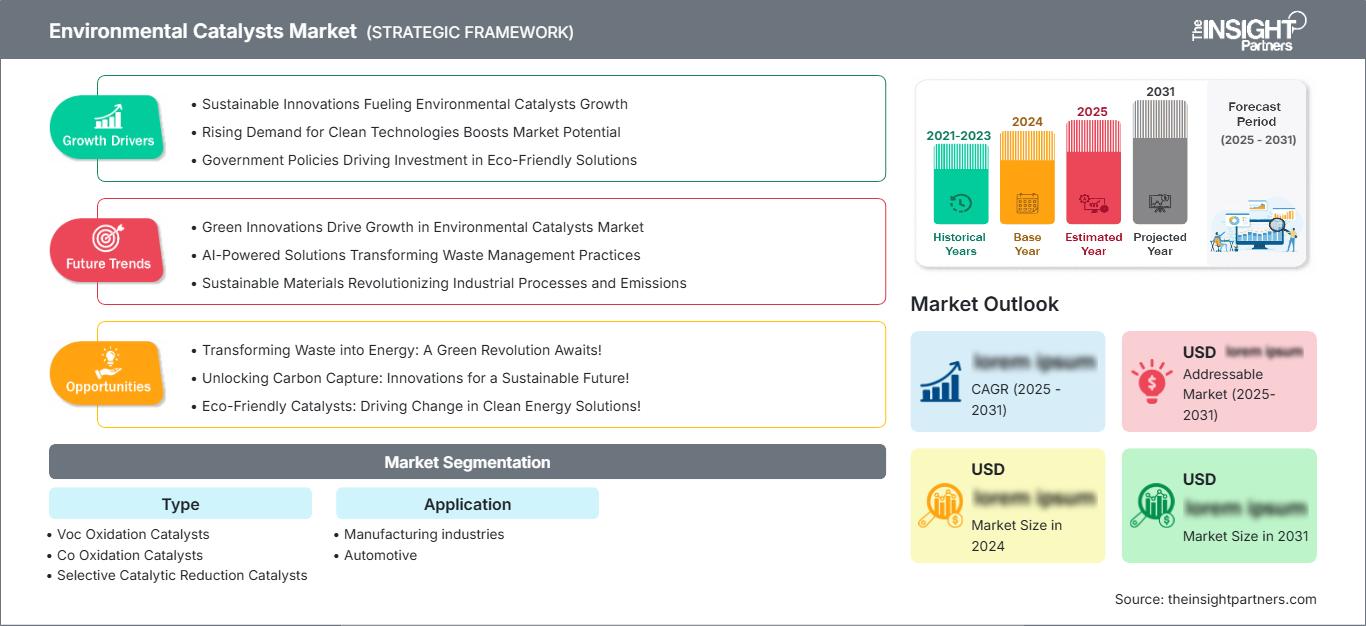
Environmental Catalysts Market: Strategic Insights
Regional Insights
North America Environmental Catalysts Market
North America represents 23–25% share of the Environmental Catalysts Market in 2025 and is projected to grow at 4.4–4.9% CAGR through 2034. Demand in the region is led by the US due to national and state standards concerning vehicle and industry emissions. Canada makes its contribution through mining, energy, transport, and industrial applications, whereas Mexico gains due to the growing presence of automobile manufacturing and regulations on emissions. The regional market is rather mature, which means that demand for replacement and retrofits needs to be considered together with the demand for new applications. Heavy-duty transport, power generation, chemical processing, refineries, and industries will keep on creating the need for catalysts for oxidation and NOx control. Growing investments in stationary applications, such as distributed power and data centers, are also expected.
U.S. Environmental Catalysts Market
The US accounts for approximately 74–78% of North America Environmental Catalysts Market share in 2025 and is expected to grow at 4.5–5.0% CAGR through 2034. The market benefits from established emissions legislation, large commercial vehicle fleets, extensive industrial infrastructure, and strong demand for stationary emission-control equipment. BASF SE, Johnson Matthey Plc, and EmeraChem LLC have relevant technology or market exposure.
The automotive sector focuses on applications in heavy trucks, buses, non-road machinery, and catalyst replacements. The industrial applications cover power generation, refining, chemical and manufacturing industries. The growing use of natural gas and backup generator sets provides another avenue for oxidation catalyst sales. The United States market is equally significant for stationary SCR applications, especially after investments and consolidations involving leading catalyst manufacturers. Compliance with regulations continues to be an important consideration along with durability, pressure drop, and total cost of ownership.
Europe Environmental Catalysts Market
Europe represents 25–28% share of the Environmental Catalysts Market in 2025 and is expected to expand at 4.2–4.7% CAGR through 2034, with Germany remaining a leading market. The region's mature automotive industry and stringent environmental policies support sustained catalyst replacement and technology upgrades.
The UK sustains demand from transportation, energy, waste management, and industrial plants that have to control pollutants more effectively. Germany has a large car-manufacturing base and heavy chemical and industrial activities, which allow the implementation of SCR and oxidation catalysts. France, Italy, and Spain have demand from automotive manufacturing, industrial processing, refining, and power generation. European producers also focus on high-efficiency catalysts, precious metal recovery, and low-carbon production, thus becoming an important technology development hub despite slower vehicle volume growth compared to Asia Pacific.
APAC Environmental Catalysts Market
APAC holds 39–42% of the Environmental Catalysts Market share in 2025 and is expected to register 5.1–5.7% CAGR, making it the leading regional market. China is the largest contributor, followed by Japan, South Korea, India, and Australia. Expanding vehicle fleets and industrial capacity sustain catalyst requirements.
China benefits from stringent vehicle emission standards and large manufacturing capacity, while Japan and South Korea emphasize advanced automotive technologies. India is increasing its deployment as vehicle and industrial emission requirements tighten. Australia contributes through mining, energy, and industrial applications. Policy-driven air-quality improvement, urbanization, and investment in manufacturing infrastructure should maintain regional demand, with China remaining the leading country by market scale.
Middle East & Africa Environmental Catalysts Market
The Middle East & Africa Environmental Catalysts Market is expected to record approximately 5.0–5.6% CAGR through 2034. Saudi Arabia and the UAE lead regional investment through refining, petrochemicals, power generation, and industrial diversification, while South Africa provides demand from mining, chemicals, transportation, and energy assets.
The region offers long-term opportunities because significant combustion-based infrastructure remains operational. Refinery modernization and industrial expansion can increase requirements for NOx and VOC control, while new power projects create demand for stationary catalysts. Saudi Arabia is positioned as the leading market within MEA, supported by energy-intensive industries and diversification programs. Catalyst suppliers with strong resistance to high temperatures, sulfur exposure, and demanding operating conditions are likely to have an advantage.
Segmentation Analysis
Type
The Type segment is expected to expand at different rates according to pollutant-control requirements and application maturity. Selective Catalytic Reduction Catalysts are projected to grow at 5.0–5.4% CAGR during 2026–2034, supported by NOx regulations, while VOC and CO oxidation technologies retain stable replacement demand. The Environmental Catalysts Market report evaluates these technology trends and their implications for future demand across emissions-control applications.
- Voc Oxidation Catalysts: These catalysts address volatile organic compound emissions from industrial exhaust streams, coatings, chemical processes, and manufacturing operations. Demand centers on facilities requiring continuous air-quality compliance and reliable destruction efficiency.
- Co Oxidation Catalysts: CO oxidation catalysts remain important for combustion systems, industrial equipment, and automotive exhaust treatment. Their strategic value stems from compact system integration, thermal durability, and compatibility with broader emission-control architectures.
- Selective Catalytic Reduction Catalysts: SCR catalysts provide a critical route for NOx reduction in diesel vehicles, power generation, marine equipment, and industrial processes. Their adoption is strengthened by increasingly demanding NOx limits and retrofit requirements.
- Polycarbonate: Polycarbonate-related catalyst requirements are associated with specialized industrial processes and high-performance applications where controlled chemical conversion and thermal stability are important to process efficiency and product consistency.
- Acrylic: Acrylic applications can require catalytic control technologies across manufacturing environments where volatile organic compounds and combustion-related pollutants must be managed alongside production efficiency.
- Nylon: Nylon production and processing involve chemical and thermal operations that can generate controlled emissions. Catalyst technologies support cleaner processing environments and compliance with industrial air-quality requirements.
- Polyethylene: Polyethylene manufacturing facilities use emission-control systems to manage process gases and combustion emissions. Catalyst demand is linked to plant scale, operating conditions, and environmental permitting requirements.
- Polypropylene: Polypropylene facilities increasingly incorporate emission-control equipment as environmental standards tighten. Catalyst selection emphasizes durability, process compatibility, and stable performance across continuous industrial operating cycles.
- Polyvinylchloride: PVC manufacturing requires careful management of process emissions. Catalyst-based systems can support treatment of combustion and organic pollutants, particularly where integrated environmental-control systems are deployed.
- Teflon: Teflon-related manufacturing processes can involve high-temperature operations and challenging fluorinated compounds. Environmental control systems require specialized materials and robust treatment configurations capable of maintaining performance under demanding conditions.
Application
The Application segment is projected to grow at 4.7–5.1% CAGR for Manufacturing industries and 5.1–5.5% for Automotive during 2026–2034. Automotive remains strategically significant because increasingly stringent exhaust standards require integrated catalyst systems.
- Manufacturing industries: Manufacturing industries represent a diversified demand base spanning chemicals, refining, power, metals, and process manufacturing. Catalyst adoption depends on emission permits, plant modernization, combustion technology, and the pollutant profile of individual facilities.
- Automotive: Automotive applications require oxidation and reduction catalysts across gasoline, diesel, hybrid, commercial, and off-road vehicles. Demand is supported by stricter emissions regulations, replacement cycles, durability requirements, and continued production of combustion-powered vehicles.
Opportunity Snapshot
| Application | Revenue Contribution | Trend Tag | Adoption Stage |
|---|---|---|---|
| Manufacturing Industries | Medium | Plant Retrofit | Scaling |
| Automotive | High | NOx Control | Mature |
Environmental Catalysts Market Growth Drivers and Impact Analysis
Stricter NOx and VOC emission standards
Tougher restrictions on emissions of nitrogen oxides, carbon monoxide, hydrocarbons, and VOC are resulting in higher technical demands placed on catalyst systems. Legislation applicable to the use of heavy-duty vehicles, combustion systems for industries, refineries, chemical plants, and electricity production systems is motivating users to improve catalyst formulations and to retire systems that cannot deliver the mandated levels of conversion. The effect does not remain limited to the original equipment because retrofits may be necessary in existing installations in order to comply with regulations. Companies that can show high levels of conversion at wider ranges of temperatures will have an opportunity to capitalize on this by winning mandates to supply these catalysts to compliance-conscious customers.
Expansion of stationary emission-control infrastructure
Demand from stationary applications is growing increasingly significant as the generation of power, industrial manufacturing, refining, and distributed generation capacity grows. Requirements for catalysts are especially applicable to combustion equipment that operates for extended periods of time and needs to remain compliant with emissions standards under varying load conditions. Expansion of data centers, backup generators, industrial boilers, and distributed energy sources provides new opportunities for oxidation and SCR applications. Furthermore, stationary catalyst systems also feature longer life cycles compared to those used in the automotive industry, thus providing demand on account of activity deterioration and poisoning of catalysts. Suppliers who possess experience in working with high temperatures and contaminated gases can meet special needs that cannot be met by standardized solutions.
Advances in catalyst efficiency and precious-metal management
Advancements in technology are resulting in improved catalyst performance, as well as reducing concerns related to cost and availability of critical materials. Metal efficiency, advanced washcoats, geometrical advancements in substrates and recycling processes can allow a reduction in the amount of precious metals needed for a certain conversion rate. This is significant due to the fact that there is exposure to metal prices, supply issues and technological advancements in the automotive industry on the side of catalyst suppliers. Closed-loop recycling can provide partial alleviation to these challenges by feeding metals back into the production process. Geometrical advancement in catalyst design allows for lower pressure drops and improved gas contact, which results in improved fuel economy. That is why the evaluation of catalysts is increasingly done on the basis of life-cycle economics rather than price.
Environmental Catalysts Market Future Trends
AI-assisted catalyst design and advanced manufacturing
Catalysts of the future would likely be developed with the help of artificial intelligence, machine learning, computational chemistry, and 3D printing to minimize trial and error experimentation and achieve a highly accurate structure of the catalyst. The catalyst design would be based on the analysis of pore structure, distribution of active centers, thermal gradient, pressure drop, and deactivation mechanisms, all at once. It would be possible to manufacture certain geometries that cannot be achieved through traditional extrusion and pressing. Digital simulation could also be employed to tailor the catalyst to particular fuel types, temperature regimes, and pollutants before the actual production of the catalyst. The Environmental Catalysts Market trends are therefore likely to move toward digitally optimized products rather than standardized catalyst geometries.
Growth of circular catalyst supply chains
Recycling of catalysts is anticipated to become an increasingly integral part of procurement strategies as companies look to hedge against fluctuations in the prices of precious metals and increase the circularity of materials. This means that future agreements could involve supplying catalysts, their monitoring, collecting, processing, and replacing them in a circular service model. In doing so, customers will get increased visibility on costs, while suppliers will be able to obtain recovered precious metals for their future manufacturing activities. At the same time, circularity will play a more significant role because of increased emphasis on material sourcing and disposal in environmental reporting. Thus, suppliers will be able to differentiate themselves through the efficiency of the process, traceability of their products, and the percentage of recycled metals in them, rather than only the performance of their catalysts.
Environmental Catalysts Market Opportunities
Stationary catalyst systems for distributed generation
The expansion of distributed generation creates an opportunity for catalyst suppliers to develop compact, durable systems optimized for natural-gas engines, diesel generators, and other decentralized combustion equipment. Data centers, industrial facilities, hospitals, telecommunications infrastructure, and commercial buildings increasingly require reliable backup power, creating a parallel requirement for emissions management. Suppliers can target this opportunity through modular oxidation and SCR packages that accommodate variable loads and limited installation space. Product strategies should emphasize low maintenance, rapid startup performance, catalyst durability, and remote monitoring. Partnerships with generator manufacturers and engineering contractors could accelerate adoption by integrating environmental controls into equipment at the design stage. The Environmental Catalysts Market Forecasts therefore include opportunities linked to decentralized power infrastructure, particularly where local air-quality rules impose tighter limits on backup-generation emissions.
Localized manufacturing and recycling networks in Asia Pacific
Asia Pacific offers an opportunity to establish localized catalyst manufacturing, precious-metal recovery, and technical-service networks close to major automotive and industrial customers. China, India, Japan, and South Korea combine large industrial bases with increasingly stringent environmental requirements, creating a favorable environment for regional production. Local manufacturing can shorten delivery times, reduce logistics exposure, and enable formulations tailored to regional fuels, operating conditions, and regulatory standards. Recycling facilities located near catalyst users can further improve metal recovery economics and reduce dependence on imported primary materials. Investors and suppliers can prioritize partnerships with vehicle manufacturers, industrial equipment producers, and refinery operators to secure long-term demand. Such regional ecosystems can also support technology transfer while reducing the cost of servicing geographically dispersed customers.
Recent Developments
- August 2026: Lummus Technology acquired Shell’s Environmental Catalysts and Systems assets as part of a strategic portfolio move. The transaction expands Lummus Technology’s environmental solutions capabilities and strengthens its portfolio of technologies addressing emissions control and cleaner industrial operations. The acquisition also broadens the company’s position across catalyst and environmental technology applications.
- October 2025: Clariant unveiled titanium-based catalyst solutions designed to provide a more sustainable alternative to conventional antimony-based catalysts used in polyester production. Scheduled for launch in 2026, the technology is intended to support lower processing temperatures, improved polymerization performance, reduced environmental impact, and easier PET recycling while addressing supply-chain concerns associated with antimony.
Frequently Asked Questions

- Comprehensive Market Sizing and Forecast Analysis
- Detailed Segmentation Analysis
- In-Depth Market Dynamics Assessment
- Regional and Country-Level Insights
- Competitive Landscape and Company Benchmarking
- Strategic Business Intelligence
Recent Reports
Testimonials

The Insight Partners' SCADA System Market report is comprehensive, with valuable insights on current trends and future forecasts. The team was highly professional, responsive, and supportive throughout. We are very satisfied and highly recommend their services.
RAN KEDEM Partner, Reali Technologies LTDs
I requested a report on a very specific software market and the team produced the report in a few days. The information was very relevant and well presented. I then requested some changes and additions to the report. The team was again very responsive and I got the final report in less than a week.
JEAN-HERVE JENN Chairman, Future Analytica
We worked with The Insight Partners for an important market study and forecast. They gave us clear insights into opportunities and risks, which helped shape our plans. Their research was easy to use and based on solid data. It helped us make smart, confident decisions. We highly recommend them.
PIYUSH NAGPAL Sr. Vice President, High Beam Global
The Insight Partners delivered insightful, well-structured market research with strong domain expertise. Their team was professional and responsive throughout. The user-friendly website made accessing industry reports seamless. We highly recommend them for reliable, high-quality research services
YUKIHIKO ADACHI CEO, Deep Blue, LLC.
This is the first time I have purchased a market report from The Insight Partners.While I was unsure at first, I visited their web site and felt more comfortable to take the risk and purchase a market report.I am completely satisfied with the quality of the report and customer service. I had several questions and comments with the initial report, but after a couple of dialogs over email with their analyst I believe I have a report that I can use as input to our strategic planning process.Thank you so much for taking the extra time and making this a positive experience.I will definitely recommend your service to others and you will be my first call when we need further market data.
JOHN SUZUKI President and Chief Executive Officer, Board Director, BK Technologies
I wish to appreciate your support and the professionalism you displayed in the course of attending to my request for information regarding to infectious disease IVD market in Nigeria. I appreciate your patience, your guidance, and the fact that you were willing to offer a discount, which eventually made it possible for us to close a deal. I look forward to engaging The Insight Partners in the future, all thanks to the impression you have created in me as a result of this first encounter.
DR CHIJIOKE ONYIA MANAGING DIRECTOR, PineCrest Healthcare Ltd.Reason to Buy
- Informed Decision-Making
- Understanding Market Dynamics
- Competitive Analysis
- Identifying Emerging Markets
- Customer Insights
- Market Forecasts
- Risk Mitigation
- Boosting Operational Efficiency
- Strategic Planning
- Investment Justification
- Tracking Industry Innovations
- Aligning with Regulatory Trends





 Get Free Sample for