
Environmental Sensor Market Size, Share & Forecast by 2034
Coverage: by Type (Temperature, Humidity, Air Quality, UV, Soil Moisture, Water Quality); Location (Indoor, Outdoor, Portable); Vertical (Government and Public Utilities, Commercial, Enterprise, Consumer Electronics, Residential, Healthcare and Pharmaceutical, Industrial, Others) , and Geography (North America, Europe, Asia Pacific, and South and Central America)
- Status : Data Released
- Report Code : TIPRE00012044
- Category : Electronics and Semiconductor
- No. of Pages : 380
- Available Report Formats :


- Last update date : August 17, 2026


2025 Market Size
US$ 2.46 Bn
Base year value
2034 Forecast
US$ 6.12 Bn
Projected by 2034
CAGR 2026-2034
10.66 %
Growth rate
Addressable Market
US$ 38.01 Bn
(2026-2034)
The Environmental Sensor Market was valued at US$ 2.46 Billion in 2025 and is projected to reach US$ 6.12 Billion by 2034, expanding at a CAGR of 10.66% from 2026 to 2034. This growth trajectory reflects accelerating smart city deployments, stringent air quality regulations, and rising IoT integration across government, industrial, and consumer electronics sectors worldwide.
North America maintains dominance in the Environmental Sensor Market size landscape, with the region expected to grow at a CAGR range of 9.5–10.5% through 2034. Structural growth drivers include EPA Clean Air Act amendments, EU Ambient Air Quality Directive alignment, and smart building certification mandates driving sophisticated sensor network deployments across municipal and commercial facilities.
Environmental Sensor Market Assessment and Insights
- North America: The region held 32–34% of global share in 2025, growing at a CAGR range of 9.5–10.5% between 2026–2034, driven by smart city initiatives and regulatory compliance investments.
- US: The United States accounted for 27–29% of North American share in 2025, expanding at a CAGR range of 9.5–10.5% between 2026–2034, supported by federal air quality monitoring mandates.
- Europe: Europe captured 26–28% of global share in 2025, growing at a CAGR range of 10.0–11.0% between 2026–2034, with Germany, UK, and France leading through Ambient Air Quality Directive compliance.
- Asia Pacific: The region held 24–26% of global share in 2025, expanding at the fastest CAGR range of 11.5–12.5% between 2026–2034, propelled by China, India, Japan, and urbanization programs.
- Largest Segment: The Temperature sensor type segment dominated with 28–30% market share in 2025, growing at a CAGR range of 9.5–10.5% between 2026–2034, driven by HVAC integration and industrial process monitoring.
- High Growth Segment: The Air Quality sensor type segment demonstrated highest growth potential with 22–24% market share in 2025, expanding at a CAGR range of 12.5–13.5% between 2026–2034, owing to pollution monitoring mandates.
- Key companies analyzed in detail: Sensirion AG, Honeywell International Inc., Siemens AG, ams OSRAM AG, Robert Bosch GmbH, Schneider Electric SE, Amphenol Corporation, Texas Instruments Incorporated, AVTECH Software Inc., and Apogee Instruments Inc.
Source: The Insight Partners' analysis based on proprietary research, government publications, company annual reports, investor presentations, industry databases, and expert interviews.
Environmental Sensor Market report indicates that the market has moved from single parameter measuring devices to IoT enabled devices with cloud connectivity and Artificial Intelligence capabilities. The current sensors come with the capability for multi-parameter analysis involving PM2.5, CO2, Volatile Organic Compounds (VOCs), and ultrafine particles, along with wireless technology like LoRaWAN and Narrowband Internet of Things (NB-IoT) which has resulted in the reduction in installation cost up to 50% - 60%. This has led to an increase in the installation of such sensors in smart cities and industries where installing cables is both difficult and costly.
With the cloud connectivity of sensor networks, the environmental authorities can monitor thousands of sensors at one time on dashboard integration with public health alerts and automated response system. Asia Pacific and Middle East and Africa appear as the emerging geographies, with the national initiatives like Smart Cities Mission of India and Saudi Arabia’s Vision 2030, resulting in significant investments in infrastructure. Tailwinds from regulation include the revised Ambient Air Quality Directive of the European Commission that comes into effect March 2025 and sets PM2.5 standards of 10 µg/m3.
Environmental Sensor Market Report Scope
| Report Attribute | Details |
|---|---|
| Market size in 2025 | US$ 2.46 Billion |
| Market Size by 2034 | US$ 6.12 Billion |
| Global CAGR (2026 - 2034) | 10.66% |
| Historical Data | 2021-2024 |
| Forecast period | 2026-2034 |
Environmental Sensor Market Analysis
The demand for Environmental Sensor Market solutions is robust due to the mandatory environmental monitoring schemes of 90 nations, covering almost 85% of the total world urban population. The supply chain includes semiconductor companies including Bosch Sensortec and Sensirion, sensor OEMs, system integrators, cloud platforms providers, while adoption of the IoT-connected sensors is driven by 60–70% operational simplicity compared to manual monitoring. The supply chain dynamics are steady, but the prices for advanced MEMS and semiconductors are subject to fluctuation due to production cycles and forcing manufacturers to source the components from Asia and Europe.
The Environmental Sensor Market forecast indicates that government and public utilities verticals accounted for 26–28% of the market revenue in 2025, with the fastest growing consumer verticals being industrial and healthcare sectors with 11.5–12.5% CAGR till 2034. The competitive environment of the segment includes diversified technology players including Honeywell, Siemens, Schneider Electric and specialized sensor providers, such as Sensirion and ams OSRAM. The strategic focus of companies is on the multi-parameter sensing platforms, as Sensirion introduced SEN62 environmental sensing platforms and Bosch added functionality of BME688 gas sensor.
The Environmental Sensor Market trends indicate that the investment point towards the use of networking infrastructure for sensors, enabling sharing of air quality, temperature, and humidity levels through open API protocols such as MQTT and HTTP. It enables environmental monitoring to move away from being merely a compliance activity at added costs to becoming a public health resource within the ecosystem of smart cities and industry.
● REPORT CUSTOMIZATION
Tailor This Report To Align With Your Specific Business Requirements
This report can be customized to align precisely with your business objectives, scope, and target markets. Customization options include tailored segmentation, geography, competitive analysis, and strategic insights to support informed decision-making.
Customize This Report →WHAT YOU CAN ADJUST
- ● Segmentations
- ● Geography
- ● Competitive Analysis
- ● Language Preferences
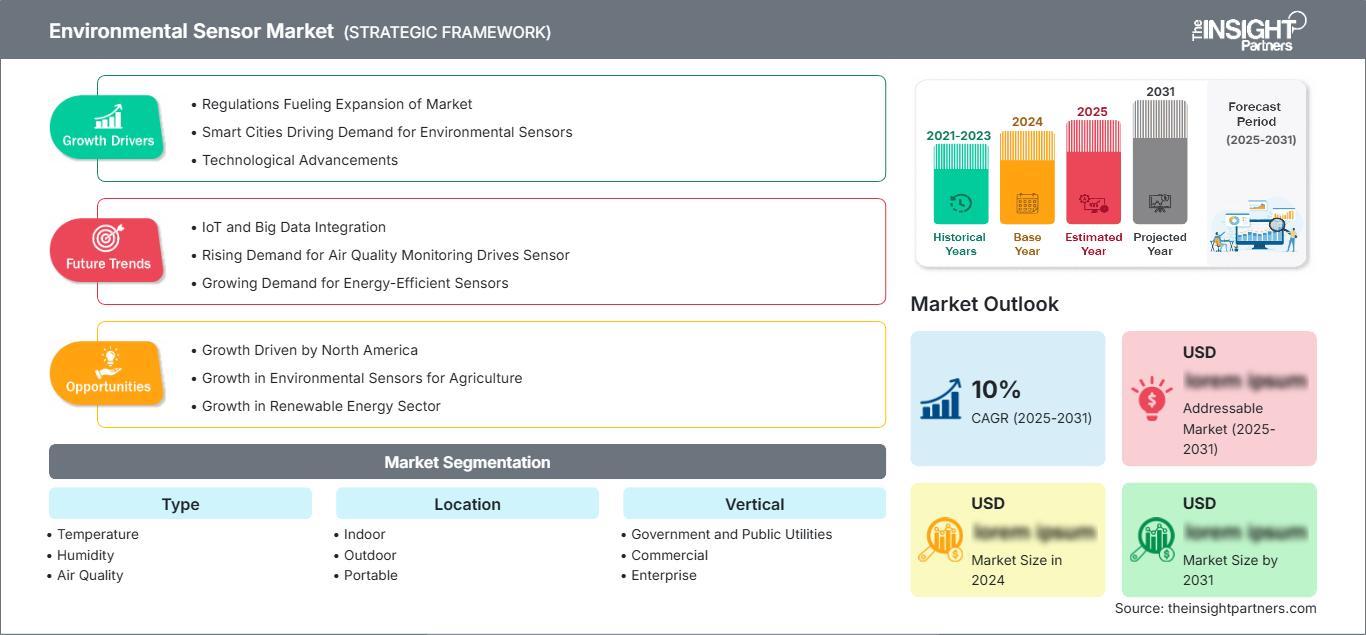
Environmental Sensor Market: Strategic Insights
Regional Insights
North America Environmental Sensor Market
North America maintained its position as the largest Environmental Sensor Market region in 2025, accounting for 32–34% of global revenue. The region is projected to expand at a CAGR range of 9.5–10.5% between 2026 and 2034, supported by sustained smart city investments, federal air quality monitoring programs, and industrial emissions compliance mandates. Regulatory enforcement continues to be an important driver, with EPA’s amendments to the Clean Air Act regulations demanding real-time monitoring of pollutants and Canadian Environmental Protection Act’s amendment regulations enforcing continuous emissions monitoring for industries in both United States and Canada urban centers.
Smart city initiatives have continued to drive deployment in major urban centers and public utility installations, alongside increased stringent accuracy standards from ASTM and ISO standards for manufacturers of sensors. The share of IoT-enabled sensors accounted for 48-50% of the North America market in 2025, growing fastest at 14-15% CAGR during 2026-2031 due to increasing demand for real-time monitoring and need to integrate with smart city systems.
U.S. Environmental Sensor Market
The United States represented 27–29% of the North American Environmental Sensor Market share in 2025, with domestic valuations reaching approximately US$ 0.78 billion. The U.S. market is forecast to grow at a CAGR range of 9.5–10.5% through 2034, driven by updated federal air quality regulations, ongoing smart building certifications, and stricter state-level environmental mandates accelerating replacement cycles. Government and public utilities verticals contributed 26–28% of U.S. environmental sensor revenue in 2025, while industrial and healthcare emerged as the fastest-growing application segments at 11.5–12.5% CAGR.
Leading firms such as Honeywell, Sensirion, Bosch, Texas Instruments, and Amphenol have well-established distributions channels all over the 50 states, particularly in California, New York, Texas, and industrial belts. Applications in the smart home have become very big owing to the health effects that consumers know are brought about by indoor air pollution and incorporation of smart thermostats. The multi-parameter sensors now allow for PM2.5, CO2, and VOC readings whereas cloud computing allows for savings of up to 50-60%.
Europe Environmental Sensor Market
Europe captured 26–28% of global Environmental Sensor Market share in 2025, valued at approximately US$ 0.69 billion, and is projected to grow at a CAGR range of 10.0–11.0% through 2034. The United Kingdom commands 18–20% of European regional revenue, with updated Air Quality Strategy mandates requiring ultrafine particle monitoring in major cities and public buildings across London, Manchester, and Birmingham metropolitan areas. Germany follows closely with 22–24% share, driven by Federal Environment Agency guidelines, EU Ambient Air Quality Directive compliance, and industrial emissions monitoring mandates in manufacturing sectors.
Together, France, Italy, and Spain contribute to 32–34% of European Environmental Sensor Market revenues, with France spearheading smart city programs in cities like Paris and Lyon, Italy concentrating on complying with regulations regarding emissions in the industrial zones, and Spain deriving strength from the development of air quality sensors in tourist areas. Europe still shows strong market presence, with its growth being driven by compliance with regulations, enforcement of EU directives, and the migration towards IoT-enabled data reporting solutions that can report data automatically and reduce monitoring costs by 50–60% compared to traditional manual sampling.
APAC Environmental Sensor Market
Asia Pacific held 24–26% of global Environmental Sensor Market share in 2025, valued at approximately US$ 0.64 billion, and is projected to expand at the fastest CAGR range of 11.5–12.5% through 2034. China leads regional adoption with 38–40% of APAC revenue, driven by massive smart city development, 14th Five-Year Plan environmental targets, and stringent Air Pollution Prevention Law requiring certified sensors in all industrial and municipal monitoring deployments. Japan follows with 18–20% share, focusing on Society 5.0 initiatives and aging population health monitoring requiring high-accuracy indoor air quality sensors.
India, South Korea, and Australia together account for 26–28% of the revenue in the APAC Environmental Sensor Market, with the Indian government's Smart City Mission having a vision to incorporate environmental monitoring in 100 cities and make their devices in India through Make in India campaigns. South Korea focuses on smart factories for emission monitoring, and Australia implements stringent National Environment Protection Measures in mining, educational institutions, and healthcare centers. The industrial and policy trends include governmental subsidies for environmental monitoring, fast-growing urbanization at 3.5%, and health implications due to pollution incidents in the region.
Middle East & Africa Environmental Sensor Market
The Middle East & Africa Environmental Sensor Market is projected to grow at a CAGR range of 13.0–14.0% through 2034, representing strongest regional growth potential globally. The biggest giga-projects in Saudi Arabia include NEOM, Red Sea projects, and Qiddiya entertainment city, all of which require a complete solution for environmental monitoring to comply with international ISO 14001 and NCA environmental standards. In UAE, there is Dubai's Smart City initiative and revised environmental quality standards that require environmental monitoring sensors in all commercial constructions and factories whose emissions exceed certain limits.
The biggest mature market in sub-Saharan Africa is South Africa due to mining industry environmental monitoring needs and commercial office constructions in Johannesburg and Cape Town despite air quality issues. Rest of MEA consists of Egypt's New Administrative Capital environmental monitoring, Kenya's Konza Technopolis smart city sensors, and Lagos air quality initiatives in Nigeria, all showing how country vision translates into a complex ecosystem of mixed use city development with environmental monitoring systems. Energy & infrastructure context involves numerous solar sources in the area allowing solar powered sensor deployment to minimize grid connection requirements and increase monitoring in remote areas.
Segmentation Analysis
Type
The Type segment of the Environmental Sensor Market is projected to grow at a CAGR range of 9.5–10.5% between 2026 and 2034. Temperature sensors dominate with widespread HVAC integration, industrial process monitoring, and climate control applications, while air quality sensors demonstrate highest growth due to pollution monitoring mandates. Humidity and soil moisture sensors remain prevalent in agricultural and building automation applications despite lower growth rates compared to air quality and water quality sensor deployments in smart city and industrial settings.
- Temperature: Temperature sensors maintain 28–30% market presence in 2025, valued for universal applicability in HVAC, industrial processes, and weather monitoring, with IoT integration driving incremental upgrades in smart building and factory automation deployments.
- Humidity: Humidity sensors hold 18–20% share in 2025, primarily in HVAC, pharmaceutical cleanrooms, and agricultural applications, with precision agriculture and smart home adoption accelerating replacement cycles in moisture-sensitive environments.
- Air Quality: Air quality sensors commanded 22–24% share in 2025 with highest growth trajectory, driven by urban pollution monitoring mandates, indoor air quality regulations, and seamless integration with public health alert systems and smart city platforms.
- UV: UV sensors represent 8–10% of 2025 volume, characterized by weather monitoring, agricultural applications, and personal health devices requiring solar radiation measurement in outdoor and wearable deployments.
- Soil Moisture: Soil moisture sensors hold 12–14% share in 2025, driven by precision agriculture adoption, irrigation optimization initiatives, and integration with farm management platforms in commercial and government agricultural operations.
- Water Quality: Water quality sensors represent 10–12% share in 2025, characterized by municipal water utility monitoring, industrial effluent compliance, and integration with environmental protection agency reporting systems in water treatment facilities.
Location
The Location segment of the Environmental Sensor Market is forecast to grow at a CAGR range of 9.5–10.5% between 2026 and 2034. Indoor deployments lead in absolute revenue contribution due to smart building and HVAC integration dominance, while outdoor applications emerge as high-growth categories as municipal air quality networks expand. Portable sensors benefit from consumer health awareness, though lower average unit prices limit revenue share compared to large-scale municipal and industrial deployments requiring comprehensive multi-sensor networks.
- Indoor: Indoor sensors held 48–50% market share in 2025 with steady growth outlook, propelled by smart building certifications, HVAC optimization, and professional awareness of indoor air quality health impacts in commercial and residential environments.
- Outdoor: Outdoor sensors command 38–40% of 2025 Environmental Sensor Market revenue, encompassing municipal air quality networks, industrial emissions monitoring, and weather stations where regulatory compliance and public health concerns drive investments in networked sensor arrays.
- Portable: Portable sensors represent 12–14% share in 2025, characterized by personal air quality monitors, wearable health devices, and integration with smartphone platforms in consumer electronics and occupational safety deployments.
Vertical
The Vertical segment of the Environmental Sensor Market is forecast to grow at a CAGR range of 9.5–10.5% between 2026 and 2034. Government and public utilities verticals lead in absolute revenue contribution, while industrial and healthcare applications emerge as high-growth categories as manufacturing facilities and pharmaceutical companies prioritize environmental compliance. Consumer electronics benefits from smart home integration, though lower average deal sizes limit revenue share compared to large-scale municipal and industrial deployments requiring certified monitoring systems.
- Government and Public Utilities: Government and public utilities held 26–28% market share in 2025 with steady growth outlook, propelled by municipal air quality networks, water utility monitoring, and professional awareness of public health requirements in urban environmental management.
- Commercial: Commercial buildings command 14–16% of 2025 Environmental Sensor Market revenue, encompassing office buildings, retail centers, and hotels where brand reputation and operational cost concerns drive investments in indoor air quality and HVAC optimization sensors.
- Enterprise: Enterprise applications represent 10–12% share in 2025, characterized by corporate campus environmental monitoring, workplace safety compliance, and integration with facility management platforms in large organization deployments.
- Consumer Electronics: Consumer electronics hold 12–14% share in 2025, driven by smart home devices, wearable health monitors, and smartphone integration enabling personal environmental awareness and automated home control systems.
- Residential: Residential applications represent 14–16% share in 2025, characterized by smart thermostat integration, indoor air quality monitors, and automation platforms in single-family and multi-unit residential building deployments.
- Healthcare and Pharmaceutical: Healthcare and pharmaceutical verticals hold 10–12% share in 2025, driven by hospital cleanroom monitoring, pharmaceutical manufacturing compliance, and integration with patient safety systems in critical care environments.
- Industrial: Industrial facilities represent 14–16% share in 2025, characterized by emissions monitoring mandates, workplace safety requirements, and integration with process control systems in manufacturing, energy, and chemical processing operations.
Opportunity Snapshot
| Vertical | Revenue Contribution | Trend Tag | Adoption Stage |
|---|---|---|---|
| Government and Public Utilities | High | Municipal Air Quality Networks | Mature |
| Commercial | Medium | Indoor Air Quality Compliance | Scaling |
| Enterprise | Low | Workplace Safety Monitoring | Emerging |
| Consumer Electronics | Medium | Smart Home Integration | Scaling |
| Residential | Medium | Smart Thermostat Integration | Scaling |
| Healthcare and Pharmaceutical | High | Cleanroom Monitoring | Mature |
| Industrial | High | Emissions Compliance Mandate | Mature |
Environmental Sensor Market Growth Drivers and Impact Analysis
Stringent Air Quality and Emissions Regulations
Requirements on air quality and emission regulations lead to environmental monitoring requirements in municipalities, industrial sites, and commercial locations in over 90 countries worldwide. The EU Directive on Ambient Air Quality effective March 2025 will require monitoring of 10 µg/m3 PM2.5 levels and ultra-fine particulates while Clean Air Act amendments by the EPA in the U.S. will ensure monitoring of pollutants in real time. ISO 14001 certification proves environmental management systems for use internationally. There is a heavy penalty for non-compliance, including fines, operational stoppages, and legal liabilities after health cases, forcing environmental managers and operators of facilities to prefer reliable systems from reputable manufacturers.
Smart City and IoT Platform Integration
Today’s smart cities use thousands of environmental sensors to provide a denser and richer amount of information than the conventional reference stations network used in the past. The total cost of ownership is starting to be calculated in such a way that IoT-connected sensors will have more advantages than the reference stations, despite their higher initial cost, because the cost of installation, maintenance, and data management will decrease over a period of five to seven years in the life of the device. Moreover, improvements in MEMS and wireless technologies add to the cost-benefit ratio by reducing the size of the device and extending its battery life.
Indoor Air Quality Health Awareness
Indoor air quality awareness is evolving from niche concern into mandatory building requirement via wellness certifications and tenant expectations. The standards include requirements for continuous monitoring of CO2, PM2.5, and VOCs in office buildings. This can help to reduce health productivity loss by 40-50 percent, in addition to helping automate the HVAC system. The cloud dashboard can help facility managers to manage many sensors in many buildings. This means reduced manual sampling work by 60-70 percent. Integration with building management, HR, and occupancy platforms is easy for data sharing with operations managers. Thus, we get holistic building ecosystems optimizing occupants' health and energy use while minimizing operational costs.
Environmental Sensor Market Future Trends
Multi-Parameter Sensor Platform Convergence
Multi-parameter sensors integrating temperature, humidity, air quality, and gas detection will capture 65–70% of new deployments by 2030 as organizations mandate consolidated monitoring across facilities. Sensors with only one parameter will have to consolidate due to the high cost of real estate, installation, and maintenance of multi-sensor systems, which makes it more efficient to use sensors that provide a broad range of environmental data with one sensor alone. Companies such as Sensirion and Bosch are developing environmental sensors that can detect more than 6 parameters with one device at once, allowing facility managers to measure full environmental data with only one sensor rather than many individual sensors.
AI-Powered Predictive Environmental Analytics
Artificial intelligence and machine learning algorithms will increasingly analyze sensor data patterns, pollution trends, and environmental conditions to predict air quality events before they occur, shifting monitoring from reactive to proactive models. AI-based environmental management software will correlate historical sensor data with weather forecasts, traffic patterns, and industrial activity to optimize alert timing, identify anomalous pollution sources, and automatically generate compliance reports for regulatory agencies. This capability reduces health impacts, extends sensor lifespans through predictive maintenance, and ensures continuous compliance without manual intervention, aligning environmental monitoring with broader public health and sustainability strategies across municipal, industrial, and commercial portfolios.
Environmental Sensor Market Opportunities
Emerging Markets Urban Environmental Programs
Middle East & Africa and Asia Pacific regions present substantial growth opportunities as national development visions materialize into physical infrastructure. Saudi Vision 2030 encompasses US$ 1+ trillion in giga-projects including NEOM, Red Sea resorts, and Qiddiya entertainment destinations, all requiring comprehensive environmental monitoring solutions meeting international ISO 14001 and NCA standards. India's Smart Cities Mission targets 100 cities with integrated environmental monitoring, while Africa's urbanization rate of 3.5% annually drives municipal sensor deployments across Lagos, Nairobi, and Cairo. Manufacturers establishing local distribution networks, technical support capabilities, and regulatory compliance expertise in these regions will capture disproportionate market share as first-mover advantages compound over the forecast period.
Hybrid Solar-Powered Sensor Networks
Hybrid sensor architectures integrating solar photovoltaic charging with low-power environmental sensors and wireless connectivity address grid instability challenges in emerging markets while supporting sustainability objectives in developed regions. These systems reduce operational electricity costs by 70–80% compared to grid-powered alternatives, enhance monitoring coverage in remote and off-grid locations, and align with corporate net-zero commitments increasingly mandated by investors and regulators. Manufacturers offering modular, scalable hybrid solutions with remote monitoring capabilities will differentiate themselves in both rural environmental monitoring and urban smart city applications seeking to reduce carbon footprints while maintaining continuous monitoring coverage during extended periods without grid access.
Recent Developments
- April 2026: Sensirion AG announced global availability of the SEN62 environmental sensing platform, integrating PM1, PM2.5, PM4, PM10, temperature, humidity, and VOC measurements in a single compact module. The platform targets smart building, industrial, and outdoor air quality applications requiring multi-parameter environmental monitoring with IoT connectivity.
- March 2026: Robert Bosch GmbH introduced the BME688 multi-parameter environmental sensor with AI-capable gas detection, supporting VOC, CO2, temperature, humidity, and pressure measurements in consumer electronics and smart home applications. The sensor features integrated machine learning for personalized air quality insights and automated HVAC control integration.
- April 2025: Axis Communications announced AXIS D6210 Air Quality Sensor and AXIS D6310 Air Quality Sensor, the company’s first environmental sensors. The new sensors seamlessly integrate with existing Axis solutions to monitor multiple indoor air quality parameters, enabling efficient and appropriate response to indoor air quality issues, including vaping and smoking, and the proactive management and optimization of air quality in almost any indoor environment. Both of the new sensors have been developed in-house by Axis.
Frequently Asked Questions

- Comprehensive Market Sizing and Forecast Analysis
- Detailed Segmentation Analysis
- In-Depth Market Dynamics Assessment
- Regional and Country-Level Insights
- Competitive Landscape and Company Benchmarking
- Strategic Business Intelligence
Recent Reports
Testimonials

The Insight Partners' SCADA System Market report is comprehensive, with valuable insights on current trends and future forecasts. The team was highly professional, responsive, and supportive throughout. We are very satisfied and highly recommend their services.
RAN KEDEM Partner, Reali Technologies LTDs
I requested a report on a very specific software market and the team produced the report in a few days. The information was very relevant and well presented. I then requested some changes and additions to the report. The team was again very responsive and I got the final report in less than a week.
JEAN-HERVE JENN Chairman, Future Analytica
We worked with The Insight Partners for an important market study and forecast. They gave us clear insights into opportunities and risks, which helped shape our plans. Their research was easy to use and based on solid data. It helped us make smart, confident decisions. We highly recommend them.
PIYUSH NAGPAL Sr. Vice President, High Beam Global
The Insight Partners delivered insightful, well-structured market research with strong domain expertise. Their team was professional and responsive throughout. The user-friendly website made accessing industry reports seamless. We highly recommend them for reliable, high-quality research services
YUKIHIKO ADACHI CEO, Deep Blue, LLC.
This is the first time I have purchased a market report from The Insight Partners.While I was unsure at first, I visited their web site and felt more comfortable to take the risk and purchase a market report.I am completely satisfied with the quality of the report and customer service. I had several questions and comments with the initial report, but after a couple of dialogs over email with their analyst I believe I have a report that I can use as input to our strategic planning process.Thank you so much for taking the extra time and making this a positive experience.I will definitely recommend your service to others and you will be my first call when we need further market data.
JOHN SUZUKI President and Chief Executive Officer, Board Director, BK Technologies
I wish to appreciate your support and the professionalism you displayed in the course of attending to my request for information regarding to infectious disease IVD market in Nigeria. I appreciate your patience, your guidance, and the fact that you were willing to offer a discount, which eventually made it possible for us to close a deal. I look forward to engaging The Insight Partners in the future, all thanks to the impression you have created in me as a result of this first encounter.
DR CHIJIOKE ONYIA MANAGING DIRECTOR, PineCrest Healthcare Ltd.Reason to Buy
- Informed Decision-Making
- Understanding Market Dynamics
- Competitive Analysis
- Identifying Emerging Markets
- Customer Insights
- Market Forecasts
- Risk Mitigation
- Boosting Operational Efficiency
- Strategic Planning
- Investment Justification
- Tracking Industry Innovations
- Aligning with Regulatory Trends





 Get Free Sample for