
Epithelial Cell Culture Media Market Analysis & Forecast 2034
Coverage: By Product Type (Human Mammary Epithelial Cells, Bronchia/Trachea Epithelial Cells, Renal Epithelial Cells, and Others) and End User (Biopharmaceutical Companies, Academic and Research Laboratories, and Others)
- Status : Data Released
- Report Code : TIPRE00022539
- Category : Life Sciences
- No. of Pages : 150
- Available Report Formats :


- Last update date : December 15, 2025


2025 Market Size
US$ 219.45 Mn
Base year value
2034 Forecast
US$ 581.62 Mn
Projected by 2034
CAGR 2026-2034
11.45 %
Growth rate
Addressable Market
US$ 3,530.66 Mn
(2026-2034)
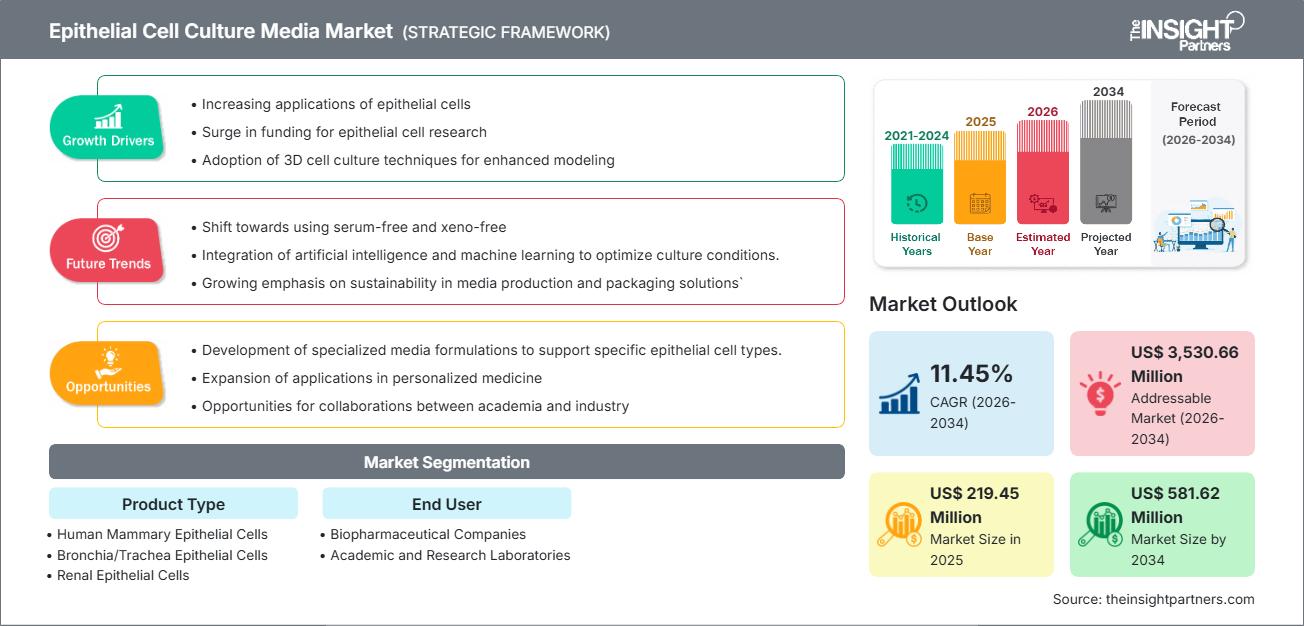
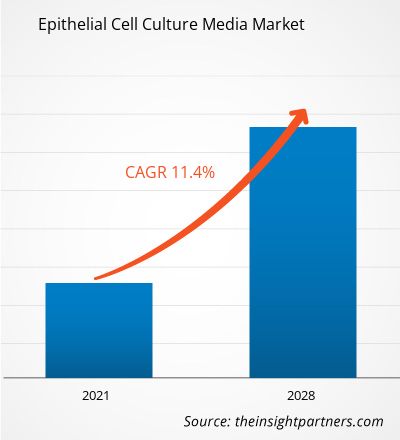
The Epithelial Cell Culture Media Market size is projected for vigorous growth, expected to reach US$ 581.62 million by 2034, soaring from US$ 219.45 million in 2025. The market is anticipated to register a Compound Annual Growth Rate (CAGR) of 11.45% during the forecast period of 2026–2034.
Epithelial Cell Culture Media Market Analysis
The global epithelial cell culture media market forecast indicates robust expansion, primarily fueled by the sustained and increasing demand for advanced in vitro models in core life science disciplines, including drug discovery, toxicology testing, and the burgeoning field of regenerative medicine. This growth is synergistically amplified by significant and continuous investments in biopharmaceutical R&D globally. Growing sophistication in culture techniques, such as the adoption of 3D cell culture systems including organoids and spheroids, is fundamentally reshaping the market. Besides, technology advances in media composition-a movement toward serum-free and chemically defined media-play a substantial role in improving experimental reproducibility, reducing batch-to-batch variability, and meeting high regulatory standards for clinical applications.
Epithelial Cell Culture Media Market Overview
Epithelial cell culture media represent specialized, complex biochemical solutions explicitly formulated to ensure the optimal survival, proliferation, and differentiation of epithelial cells. These cells, derived from critical tissues like the human mammary gland, bronchi, trachea, and renal systems, are essential research tools as they closely imitate the in vivo environment, particularly barriers and transport functions. The media must supply a precise balance of essential nutrients, growth factors, hormones, and trace elements to maintain cellular functionality and phenotype. The competitive landscape is dynamic, characterized by intense efforts from established life science providers to innovate media formulations and supported by increasing intellectual and commercial collaborations between leading academic institutions and industry players focusing on advanced applications like personalized medicine and high-throughput screening.
Market Research Highlights
- Global market for Epithelial Cell Culture Media was valued at US$ 219.45 Million in 2025
- Annual market size is expected to reach US$ 581.62 Million by 2034
- Total addressable market (TAM) during 2026-2034 is projected to reach approximately US$ 3,530.66 Million
- Market is anticipated to register a CAGR of 11.45% during the forecast period
- The United States represents a key market, supported by Increasing applications of epithelial cells, Surge in funding for epithelial cell research, Adoption of 3D cell culture techniques for enhanced modeling, as well as evolving industry dynamics
- Market analysis covers North America, Europe, Asia-Pacific, South and Central America, Middle East and Africa, with growth evaluated across the forecast period
- Market opportunities such as Development of specialized media formulations to support specific epithelial cell types., Expansion of applications in personalized medicine, Opportunities for collaborations between academia and industry are expected to influence market dynamics and addressable market
- Report profiles industry participants, including PromoCell GmbH, Merck KGaA, ATCC, AXOL Bioscience Ltd., Thermo Fisher Scientific Inc., Bio-Techne Corporation, Celprogen Inc., Lonza Group AG, HiMedia Laboratories, Cell Biologics Inc, while analyzing competitive strategies and innovation developments
-
Source: The Insight Partners' analysis based on proprietary research, government publications, company annual reports, investor presentations, industry databases, and expert interviews.
● REPORT CUSTOMIZATION
Tailor This Report To Align With Your Specific Business Requirements
This report can be customized to align precisely with your business objectives, scope, and target markets. Customization options include tailored segmentation, geography, competitive analysis, and strategic insights to support informed decision-making.
Customize This Report →WHAT YOU CAN ADJUST
- ● Segmentations
- ● Geography
- ● Competitive Analysis
- ● Language Preferences
Epithelial Cell Culture Media Market: Strategic Insights
-
Get Top Key Market Trends of this report.This FREE sample will include data analysis, ranging from market trends to estimates and forecasts.
Epithelial Cell Culture Media Market Drivers and Opportunities
Market Drivers:
- Increasing demand for cell-based assays: Epithelial cell models in assessing drug efficacy, drug absorption, and early-stage toxicity have continuously increased the demand for high-performance culture media with the expansion of drug pipelines at a global level.
- Increasing Prevalence of Chronic Diseases: Research aimed at tissue engineering, wound healing, and organ repair for conditions like diabetes, kidney failure, and lung disease relies heavily on cultivating primary epithelial cells, fueling media consumption.
- Technological Advancements in Media Formulations: The continuous introduction of next-generation media, including chemically defined, xeno-free, and custom formulations, enables researchers to achieve greater cell viability, higher passage numbers, and more physiologically relevant results.
Market Opportunities:
- Development of Serum-Free and Chemically Defined Media: The industry shift away from animal serum (fetal bovine serum) towards fully defined media presents a significant commercial opportunity, as these solutions offer superior consistency, safety, and regulatory compliance for clinical-grade manufacturing.
- Expansion in Emerging Markets: Rapid expansion of the biopharmaceutical and biosimilar manufacturing sectors across Asia-Pacific and Latin America is creating new, high-volume markets for standardized and specialized cell culture media required for process development.
- Strategic Partnerships for Innovation: Collaborations focused on developing patient-specific organoids and 3D tumor models, which predominantly utilize epithelial cells, will require proprietary, customized media solutions, unlocking premium market segments.
Epithelial Cell Culture Media Market Report Segmentation Analysis
The Epithelial Cell Culture Media Market share is analyzed across various segments to illustrate the specific types of cells being cultured and the primary end-users driving product consumption. Below is the standard segmentation approach used in most industry reports:
By Product Type
- Human Mammary Epithelial Cells (HMEC)
- Bronchia/Trachea Epithelial Cells
- Renal Epithelial Cells
By End User
- Biopharmaceutical Companies
- Academic and Research Laboratories
By Geography
- North America
- Europe
- Asia Pacific
- South & Central America
- Middle East & Africa
Epithelial Cell Culture Media Market Report Scope
| Report Attribute | Details |
|---|---|
| Market size in 2025 | US$ 219.45 Million |
| Market Size by 2034 | US$ 581.62 Million |
| Global CAGR (2026 - 2034) | 11.45% |
| Historical Data | 2021-2024 |
| Forecast period | 2026-2034 |
| Segments Covered |
By Product Type
|
| Regions and Countries Covered |
North America
|
| Market leaders and key company profiles |
|
Epithelial Cell Culture Media Market Players Density: Understanding Its Impact on Business Dynamics
The Epithelial Cell Culture Media Market is growing rapidly, driven by increasing end-user demand due to factors such as evolving consumer preferences, technological advancements, and greater awareness of the product's benefits. As demand rises, businesses are expanding their offerings, innovating to meet consumer needs, and capitalizing on emerging trends, which further fuels market growth.
Epithelial Cell Culture Media Market Share Analysis by Geography
North America holds the largest market share, with the Asia-Pacific region exhibiting the highest CAGR during the forecast period.
The market's trajectory is highly sensitive to regional R&D expenditure, regulatory environments, and the concentration of biotech industries. Below is a summary of market share and trends by region:
North America
- Market Share: Dominates the global market, underpinned by a highly advanced biomedical research infrastructure, favorable government funding mechanisms (e.g., NIH grants), and the commanding presence of global biopharmaceutical giants.
- Key Drivers: High demand for specialized media to support automated, high-throughput screening assays.
- Trends: Strong move toward establishing Good Manufacturing Practice (GMP)-grade media production for cell and gene therapy applications.
Europe
- Market Share: Holds a significant share, driven by supportive government-funded research initiatives (such as Horizon Europe), stringent quality control standards, and a robust network of academic research clusters and biotech start-ups.
- Key Drivers: Emphasis on ethical and reproducible research, increasing demand for defined media.
- Trends: Increased regulatory focus on reducing animal components in research, accelerating the adoption of xeno-free media alternatives.
Asia-Pacific
- Market Share: Fastest-growing region globally, fueled by vast opportunities arising from aggressive governmental investment in biotechnology, the rapid expansion of domestic pharmaceutical manufacturing, and the establishment of new, world-class research hubs across countries like China, Japan, and South Korea.
- Key Drivers: Increasing patient populations are driving clinical research and disease modeling efforts.
- Trends: High potential for market penetration for cost-effective, high-volume standardized media to support scaling bioproduction.
South and Central America
- Market Share: Emerging market characterized by increasing foreign direct investment in clinical trials and a growing focus on building local expertise in life sciences and biotechnology.
- Key Drivers: Increasing availability of regional distribution networks for high-quality imported media.
- Trends: Concentration of demand for standard, reliable basal media necessary for foundational cell biology research.
Middle East and Africa
- Market Share: Developing market exhibiting strong potential, supported by major national strategies focused on economic diversification and significant capital deployment into research cities and advanced medical centers (e.g., in the UAE and Saudi Arabia).
- Key Drivers: Partnerships with global leaders to ensure access to cutting-edge media and consumables.
- Trends: Initial demand focused on high-quality, specialized media required for advanced personalized medicine pilot programs.
Epithelial Cell Culture Media Market Players Density: Understanding Its Impact on Business Dynamics
The competitive environment is characterized by large, diversified life science conglomerates offering vast portfolios and highly focused companies specializing solely in cell culture media innovation. Key vendors prioritize media performance, supply chain reliability, and customer technical support.
This competitive environment pushes vendors to differentiate through:
- Customization and Formulation Expertise: Offering services to rapidly design and manufacture custom media formulations tailored to specific cell types, patient samples, or proprietary cell lines.
- Regulatory Compliance and Quality: Providing GMP-grade media and extensive documentation to support biopharma clients seeking regulatory approval for their cell culture-based products.
- Integration with Automation: Developing media optimized for use in high-throughput screening and automated cell culture platforms to meet the efficiency needs of large research organizations.
Major Companies operating in the Epithelial Cell Culture Media Market are:
- Thermo Fisher Scientific Inc.
- Merck KGaA
- Bio-Techne Corporation
- Lonza Group AG
- PromoCell GmbH
- ATCC
- AXOL Bioscience Ltd.
- Celprogen Inc.
- HiMedia Laboratories
Disclaimer: The companies listed above are not ranked in any particular order.
Epithelial Cell Culture Media Market News and Recent Developments
- ATCC published a detailed resource outlining protocols for culturing primary human epithelial and keratinocyte cells. The guide includes optimized media formulations and best practices to ensure reproducibility and high-quality results, supporting researchers in epithelial biology and regenerative medicine.
- Celprogen introduced human kidney normal epithelial cell products in multiple formats, including frozen vials and pre-plated flasks (T25–T225), along with specialized extracellular matrix and media. These cells support up to 120 population doublings over 12 passages, enabling long-term studies. The company also launched corneal epithelial cell culture media (M36045‑16S), available with serum, to facilitate ophthalmic research and drug development.
Epithelial Cell Culture Media Market Report Coverage and Deliverables
The "Epithelial Cell Culture Media Market Size and Forecast (2021–2034)" report provides a detailed analysis of the market covering below areas:
- Epithelial Cell Culture Media Market size and forecast at global, regional, and country levels for all the key market segments covered under the scope.
- Epithelial Cell Culture Media Market trends, as well as market dynamics such as drivers, restraints, and key opportunities.
- Detailed PEST and SWOT analysis.
- Epithelial Cell Culture Media Market analysis covering key market trends, global and regional framework, major players, regulations, and recent market developments.
- Industry landscape and competition analysis covering market concentration, heat map analysis, prominent players, and recent developments in the Epithelial Cell Culture Media Market.
- Detailed company profiles.
Frequently Asked Questions

- Comprehensive Market Sizing and Forecast Analysis
- Detailed Segmentation Analysis
- In-Depth Market Dynamics Assessment
- Regional and Country-Level Insights
- Competitive Landscape and Company Benchmarking
- Strategic Business Intelligence
Recent Reports
Testimonials

The Insight Partners provided valuable market intelligence that supported our global go-to-market strategy. Their team was professional, responsive, and attentive to our feedback, providing thoughtful analysis and helpful methodological clarifications throughout the project.
Junmo Kim Chief Financial Officer (CFO), Enertech Co., Ltd.
The Insight Partners' SCADA System Market report is comprehensive, with valuable insights on current trends and future forecasts. The team was highly professional, responsive, and supportive throughout. We are very satisfied and highly recommend their services.
RAN KEDEM Partner, Reali Technologies LTDs
I requested a report on a very specific software market and the team produced the report in a few days. The information was very relevant and well presented. I then requested some changes and additions to the report. The team was again very responsive and I got the final report in less than a week.
JEAN-HERVE JENN Chairman, Future Analytica
We worked with The Insight Partners for an important market study and forecast. They gave us clear insights into opportunities and risks, which helped shape our plans. Their research was easy to use and based on solid data. It helped us make smart, confident decisions. We highly recommend them.
PIYUSH NAGPAL Sr. Vice President, High Beam Global
The Insight Partners delivered insightful, well-structured market research with strong domain expertise. Their team was professional and responsive throughout. The user-friendly website made accessing industry reports seamless. We highly recommend them for reliable, high-quality research services
YUKIHIKO ADACHI CEO, Deep Blue, LLC.
This is the first time I have purchased a market report from The Insight Partners.While I was unsure at first, I visited their web site and felt more comfortable to take the risk and purchase a market report.I am completely satisfied with the quality of the report and customer service. I had several questions and comments with the initial report, but after a couple of dialogs over email with their analyst I believe I have a report that I can use as input to our strategic planning process.Thank you so much for taking the extra time and making this a positive experience.I will definitely recommend your service to others and you will be my first call when we need further market data.
JOHN SUZUKI President and Chief Executive Officer, Board Director, BK Technologies
I wish to appreciate your support and the professionalism you displayed in the course of attending to my request for information regarding to infectious disease IVD market in Nigeria. I appreciate your patience, your guidance, and the fact that you were willing to offer a discount, which eventually made it possible for us to close a deal. I look forward to engaging The Insight Partners in the future, all thanks to the impression you have created in me as a result of this first encounter.
DR CHIJIOKE ONYIA MANAGING DIRECTOR, PineCrest Healthcare Ltd.Reason to Buy
- Informed Decision-Making
- Understanding Market Dynamics
- Competitive Analysis
- Identifying Emerging Markets
- Customer Insights
- Market Forecasts
- Risk Mitigation
- Boosting Operational Efficiency
- Strategic Planning
- Investment Justification
- Tracking Industry Innovations
- Aligning with Regulatory Trends






 Get Free Sample for