
Epoxy Primer Market Demand, Trends & Forecast by 2034
Coverage: by Substrate (Metal, Concrete and Masonry, Fiberglass, Others); Application (Building and Construction, Automotive, Marine, Machinery and Equipment, Others); Technology (Solvent-Borne Technology, Waterborne Technology) , and Geography (North America, Europe, Asia Pacific, and South and Central America)
- Status : Data Released
- Report Code : TIPRE00005085
- Category : Chemicals and Materials
- No. of Pages : 150
- Available Report Formats :


- Last update date : September 01, 2026


2025 Market Size
US$ 11.01 Bn
Base year value
2034 Forecast
US$ 15.5 Bn
Projected by 2034
CAGR 2026-2034
3.87 %
Growth rate
Addressable Market
US$ 120.38 Bn
(2026-2034)
The global Epoxy Primer market was valued at US$ 11.01 billion in 2025 and is expected to reach US$ 15.5 billion by 2034; it is estimated to record a CAGR of 3.87% during 2026-2034.
Epoxy Primer Market Assessment and Insights
- North America: North America is estimated to account for a 26–30% share in 2025, growing at a CAGR of 3.8–4.4% between 2026–2034. Industrial maintenance and automotive refinishing support consistent consumption.
- US: The US represents approximately 21–24% of the global market and 79–82% of North American demand in 2025, with a CAGR of 3.7–4.3% during 2026–2034.
- Europe: Europe is estimated at a 22–26% share in 2025, advancing at a CAGR of 3.5–4.1% between 2026–2034. Germany, Italy, France, the UK, and Spain remain important markets.
- Asia Pacific: Asia Pacific holds an estimated 31–35% share in 2025 and is projected to expand at a CAGR of 4.8–5.5% during 2026–2034, led by China, India, Japan, and South Korea.
- Largest Segment: Metal represents the largest substrate segment, with a 58–62% market share in 2025 and a CAGR of 4.0–4.5% during 2026–2034, supported by corrosion-control requirements.
- High Growth Segment: Waterborne Technology represents a 30–34% share in 2025 and is estimated to record a CAGR of 5.0–5.7% during 2026–2034 as lower-emission formulations gain adoption.
- Key companies analyzed in detail: Akzo Nobel N.V., Asian Paints Limited, Axalta Coating Systems, LLC, BASF SE, Hempel A/S, Jotun A/S, Kansai Paint Co., Ltd., Nippon Paint Holdings Co., Ltd., PPG Industries, Inc., RPM International Inc.
Source: The Insight Partners' analysis based on proprietary research, government publications, company annual reports, investor presentations, industry databases, and expert interviews.
Coating technology has progressed from solvent-rich systems to more modern coatings based on high solids, water-based, chrome-free, and special-purpose epoxies. Manufacturing processes tend to focus on controlled cure, fast recoatability, surface acceptance, and application via automation. Metals are vital in this respect as the use of primers offers adhesion and corrosion protection prior to topcoats. In addition, there is greater emphasis on developing products that can work well with concrete, masonry, fiberglass, and composite substrates.
Further growth is anticipated to be driven by refurbishment needs, car manufacturing, marine repair, and industrial machinery purchase in Asia Pacific and some developing economies. Regulation concerning VOCs will promote development of water-based and high solid content products, while regulations on corrosion prevention will maintain demand for high-performance solvent-borne products. Consequently, product development will tend to focus on formulating environmentally friendly products which are also durable and fast to apply.
Epoxy Primer Market Report Scope
| Report Attribute | Details |
|---|---|
| Market size in 2025 | US$ 11.01 Billion |
| Market Size by 2034 | US$ 15.5 Billion |
| Global CAGR (2026 - 2034) | 3.87% |
| Historical Data | 2021-2024 |
| Forecast period | 2026-2034 |
Epoxy Primer Market Analysis
The growth of the Epoxy Primer market is highly dependent on the necessity to prepare the surface efficiently before applying topcoats. Corrosion resistance for steel structures, equipment, machinery, marine machinery, and industrial facilities is a major factor that drives the growth of the Market. The supply chain consists of epoxy resin producers, curing agent suppliers, pigment suppliers, additive suppliers, formulators, coating manufacturers, distributors, applicators, and asset owners in the industrial segment.
Metals are the leading substrates because steel, aluminum, and galvanized substrates require adhesion and corrosion resistance properties in aggressive operating conditions. The construction industry participates with structural steel and concrete protection, while marine and machinery sectors have requirements for water, chemical, wear, and immersion resistance. There is a trend toward the development of water-based systems where emission requirements are restrictive; however, solvent-based products offer some benefits due to application techniques, versatility, and predictability of curing.
Competition is defined by multinational coating vendors with extensive protective-coatings offerings as well as regional vendors focusing on automotive, marine, industrial, and architectural coatings. The Epoxy Primer Market report shows that competition among the vendors is now based more on formulation performance, application efficiency, technical assistance, and regulatory compliance than on prices only. Akzo Nobel N.V., BASF SE, Hempel A/S, Jotun A/S, and PPG Industries, Inc. have comprehensive product lines; Asian Paints Limited and Nippon Paint Holdings Co., Ltd. reinforce their positions geographically.
Axalta Coating Systems, LLC concentrates on automotive and industrial coating applications, while Kansai Paint Co., Ltd. has strong position in automotive and industrial markets. RPM International Inc. participates through its specialized coating operations offering products for infrastructure and industrial markets. Investment efforts will be increasingly made in waterborne technology, high-solids coatings, corrosion-resistant pigments, fast curing systems, and application-specific primers. Extensive product line enables the large vendors to target both construction and maintenance markets and adjust their formulations to environmental requirements.
● REPORT CUSTOMIZATION
Tailor This Report To Align With Your Specific Business Requirements
This report can be customized to align precisely with your business objectives, scope, and target markets. Customization options include tailored segmentation, geography, competitive analysis, and strategic insights to support informed decision-making.
Customize This Report →WHAT YOU CAN ADJUST
- ● Segmentations
- ● Geography
- ● Competitive Analysis
- ● Language Preferences
Epoxy Primer Market: Strategic Insights
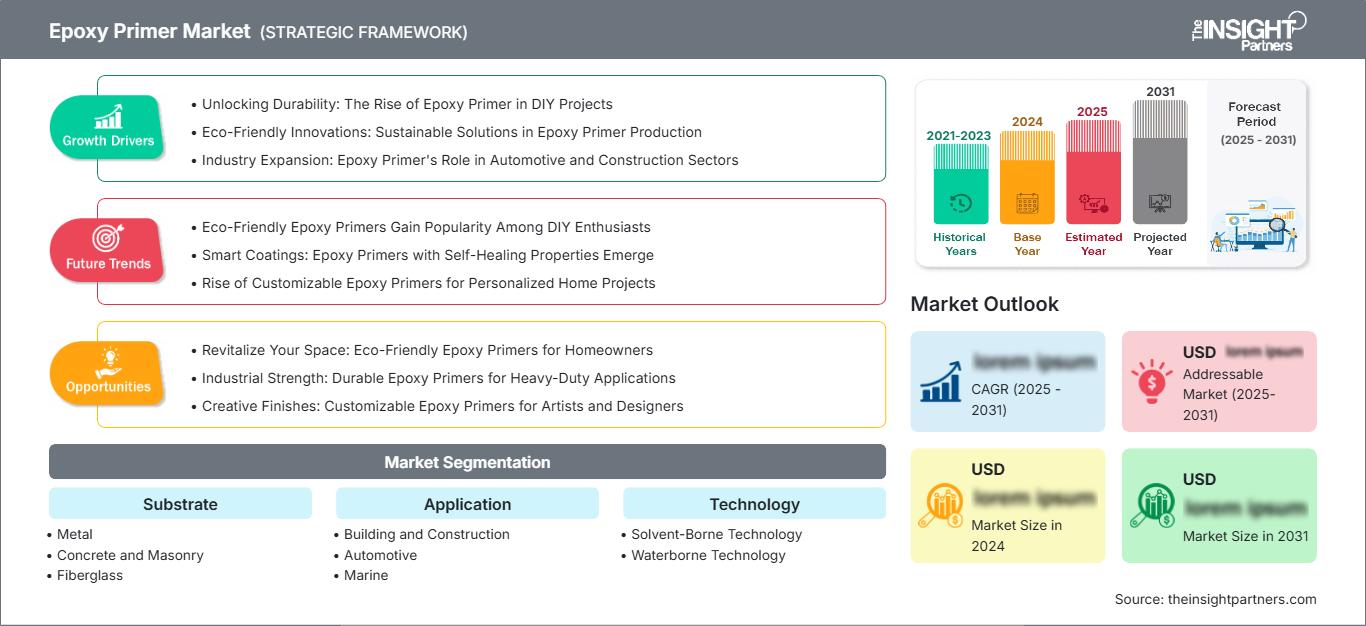
Regional Insights
North America Epoxy Primer Market
North America is estimated to account for 26-30% of the Epoxy Primer Market Share in 2025, with a CAGR of 3.8-4.4% to 2034. The region takes advantage of well-developed technologies in industrial coating, maintenance of infrastructure, auto body refinish, and preservation of marine assets. Corrosion resistance is still an important purchase criteria when buying structural steel, machinery, transportation equipment and infrastructure related to energy production. High-performance primers are often specified when extended life cycles and substrate protection justify additional costs for coatings.
US dominates the regional demand and makes up 79-82%, while Canada contributes a smaller, but nevertheless, technically relevant share through infrastructure, energy, transportation, and industrial applications. Renovation of obsolete assets stimulates repeat purchases, and automobile repair networks offer a reliable channel for sales of epoxy primers. Waterborne products are getting recognized in applications where there is an impact of emissions regulations, but solvent-based products are well-established in harsh industrial and repair markets.
U.S. Epoxy Primer Market
US constitutes around 79–82% of North American demand by 2025 and is projected to grow at a CAGR of 3.7–4.3% during 2025–34. The application areas are varied with demand from infrastructure rehabilitation, automotive refinishing, industrial equipment maintenance, and marine repair. PPG Industries, Inc., Axalta Coating Systems, LLC, and RPM International Inc. hold established positions in protective, industrial, and automotive coatings application segments.
Automotive refinishing is one of the important applications since the epoxy primers offer adhesion and protection against corrosion for prepared metal substrates. Industrial customers choose primers based on the state of substrate, exposure, curing time, and compatibility with topcoats. Waterborne and less polluting variants are being increasingly used in the market, wherever possible, while solvent-based versions are suitable for tough environments. The factors to consider include applicability of primers in terms of overall application performance.
Europe Epoxy Primer Market
Europe is expected to account for 22–26% of the global demand share in 2025 and is anticipated to exhibit a CAGR of 3.5–4.1%. Germany leads the region in terms of market position, followed by the UK, France, Italy, and Spain. There are high demands for formulating innovations due to environmental constraints and mature maintenance practices in industries.
UK and Germany exhibit good demand for industrial equipment, automobile manufacture, infrastructure and marine operations. Germany is driven by manufacturing industries and machinery whereas UK continues to have marine and infrastructure use. The contribution of France, Italy and Spain comes from transportation, construction, industrial machines and shipbuilding applications. Europeans consider emissions, durability, applicability and life-cycle together that helps in gradually moving towards water-based and higher solids technologies while retaining solvent-based products.
APAC Epoxy Primer Market
The APAC region is responsible for 31-35% of worldwide demand in 2025 and is anticipated to witness growth at a CAGR of 4.8-5.5%. The top countries include China, Japan, South Korea, India, and Australia. Demand is generated by manufacturing growth, infrastructure development, automotive production, and industrialization.
The major contributor to demand is China, and Japan and South Korea add value through high-level manufacturing of automotive, electronics, marine, and industrial parts. Infrastructure development, machinery manufacturing, and vehicle manufacturing drive demand in India. Mining, marine, and infrastructure maintenance generate demand in Australia. The growth of industries along with environmental movements drives demand for high solids and water-based products, but solvent-based products continue to be significant in cases of severe corrosion.
Middle East & Africa Epoxy Primer Market
MEA and Africa demand is relatively low in comparison but backed by oil and gas, construction, desalination, transportation and industrial machinery infrastructure. The regional market is projected to experience a CAGR of 3.6–4.2% and Saudi Arabia as one of the largest consumers. UAE and South Africa are two other sources of industrial and infrastructure demand.
Demand from Saudi Arabia and UAE comes from energy infrastructure, structural steel, infrastructure and marine infrastructure, whereas demand from South Africa is created by mining, transportation, industrial machinery and maintenance of infrastructure. Rest of MEA demand depends on project activity and capital expenditure. Extreme temperatures, humidity, saltiness and corrosiveness make durable primer solutions very important, especially in case of steel infrastructure and equipment with long maintenance period.
Segmentation Analysis
Substrate
The substrate segment in the Epoxy Primer Market is projected to expand at a CAGR of 4.0–4.5% during 2026–2034. Metal remains the principal demand base because epoxy primers improve adhesion and corrosion resistance on steel, aluminum, and galvanized surfaces. Concrete and masonry applications benefit from moisture and chemical resistance, while fiberglass applications are relevant to marine and specialized industrial equipment. Substrate-specific formulations increasingly balance surface preparation tolerance, curing conditions, and compatibility with finishing coats.
- Metal: Metal substrates remain the dominant consumption area because primers provide corrosion resistance and adhesion before topcoats. Demand is concentrated in structural steel, vehicles, machinery, marine equipment, and industrial assets requiring durable protection.
- Concrete and Masonry: Concrete and masonry applications use epoxy primers to improve coating adhesion and reduce substrate-related defects. Demand is associated with industrial floors, infrastructure, commercial structures, and chemically exposed surfaces.
- Fiberglass: Fiberglass applications are concentrated in marine, transportation, and specialized equipment. Primers support adhesion and surface uniformity while preparing composite substrates for compatible finishing systems under demanding environmental conditions.
Application
The application segment in the Epoxy Primer Market is estimated to grow at a CAGR of 4.1–4.7% from 2026 to 2034. Building and construction provide broad structural demand, while automotive applications benefit from refinishing and corrosion protection. Marine users require moisture and immersion resistance, whereas machinery and equipment applications prioritize abrasion, chemicals, and mechanical durability. Application-specific formulation enables manufacturers to optimize curing speed, film thickness, sanding properties, and exposure resistance.
- Building and Construction: Structural steel, concrete facilities, industrial flooring, and infrastructure projects use epoxy primers to improve adhesion and protect surfaces before finishing. Maintenance projects create recurring consumption alongside new construction.
- Automotive: Automotive applications require reliable adhesion, corrosion protection, sanding characteristics, and compatibility with subsequent coating layers. Body repair and commercial vehicle maintenance create demand for specialized two-component epoxy systems.
- Marine: Marine users require primers capable of resisting moisture, salt exposure, immersion, abrasion, and corrosion. Shipbuilding, vessel repair, offshore structures, and recreational craft provide differentiated demand for high-performance systems.
- Machinery and Equipment: Machinery and equipment applications prioritize chemical resistance, mechanical durability, rapid handling, and corrosion protection. Agricultural, construction, industrial, and processing equipment manufacturers use primers to improve coating-system longevity.
Technology
The technology segment in the Epoxy Primer Market is projected to register a CAGR of 4.3–5.0% during 2026–2034. Solvent-borne technology remains established because of application familiarity, strong penetration, and performance in demanding environments. Waterborne technology is expanding as formulators improve film formation, corrosion resistance, curing, and application consistency. Regulatory requirements and customer preferences are encouraging suppliers to reduce solvent content while maintaining performance comparable with conventional systems.
- Solvent-Borne Technology: Solvent-borne systems remain important for industrial, marine, automotive, and machinery applications requiring strong adhesion, predictable curing, and robust performance under variable environmental conditions.
- Waterborne Technology: Waterborne systems are gaining adoption where VOC reduction, workplace considerations, and regulatory compliance influence procurement. Improved resin dispersion and curing technologies are broadening their suitability for industrial applications.
Opportunity Snapshot
| Application | Revenue Contribution | Trend Tag | Adoption Stage |
| Building and Construction | High | Structural Steel | Mature |
| Automotive | High | Body Refinishing | Mature |
| Marine | Medium | Saltwater Protection | Scaling |
| Machinery and Equipment | Medium | Asset Protection | Scaling |
Epoxy Primer Market Growth Drivers and Impact Analysis
Industrial corrosion-control requirements extend coating demand
Corrosion protection is a fundamental purchasing criterion for steel structures, vehicles, machinery, marine assets, and industrial equipment. Epoxy primers create an adhesion layer and barrier that supports longer coating-system performance, particularly when assets face moisture, chemicals, salts, abrasion, or temperature variation. The economic impact extends beyond primer consumption because asset owners evaluate repainting frequency, downtime, maintenance labor, and replacement costs. As infrastructure ages, maintenance programs create recurring demand independent of new construction cycles. This favors suppliers capable of offering surface-tolerant, high-build, fast-curing, and chemically resistant products. Demand is also becoming more specification-driven, with users increasingly selecting systems according to exposure category, substrate preparation, film thickness, and topcoat compatibility rather than relying solely on generic primer classifications.
Automotive refinishing expands demand for application-specific primers
Automotive production and repair generate consistent demand for primers that provide corrosion protection and a stable foundation for subsequent coatings. Vehicle body repairs increasingly require products compatible with steel, galvanized steel, aluminum, and mixed-material assemblies, increasing the importance of substrate versatility. Repair shops also prioritize sanding behavior, curing time, recoat windows, and productivity because these characteristics affect workshop throughput. Two-component epoxy formulations can therefore command preference where corrosion resistance and adhesion are critical. Commercial vehicles and machinery add further demand because operators frequently repair exposed panels and structural components. The market impact is particularly relevant in regions with large vehicle fleets, where aftermarket repair represents recurring consumption even when new-vehicle production fluctuates. Manufacturers that simplify application steps can strengthen adoption among professional refinishing users.
Infrastructure investment supports durable protective coating systems
Investment in bridges, buildings, industrial facilities, transport infrastructure, ports, utilities, and energy assets creates opportunities for protective primer systems. New structures require coating systems during fabrication, while existing assets require periodic maintenance to control corrosion and preserve structural integrity. Epoxy primers are positioned within these systems because they provide strong adhesion and resistance before intermediate and finishing layers are applied. Infrastructure owners increasingly consider lifecycle performance when evaluating coatings, particularly where access is difficult or shutdowns are expensive. This encourages demand for high-build and surface-tolerant products capable of reducing preparation or recoating requirements. Construction contractors and asset operators also seek predictable curing and application characteristics to maintain project schedules. Consequently, infrastructure spending can generate both initial and recurring primer consumption across multiple end-use categories.
Epoxy Primer Market Future Trends
Waterborne formulations will gain technical parity
Waterborne epoxy primers are likely to advance through improvements in resin dispersion, amine chemistry, corrosion inhibition, and film formation. Future formulations will increasingly target applications previously dominated by solvent-borne products, particularly where environmental requirements restrict solvent emissions. Manufacturers are expected to develop systems offering faster drying, improved low-temperature performance, stronger adhesion, and greater resistance to moisture during early curing. Digital formulation tools and more sophisticated additive packages may help optimize performance without substantially increasing application complexity. Adoption will not be uniform because demanding marine, industrial, and maintenance environments can require specific solvent-borne characteristics. Nevertheless, technology convergence should broaden the addressable application base for waterborne primers. Suppliers that combine lower emissions with familiar application behavior are likely to gain specification opportunities among contractors, fleet operators, and industrial coating users.
Primer systems will become more application-integrated
Future product development in the Epoxy Primer Market Trends is likely to focus on multifunctional primer systems that reduce the number of coating stages and improve application productivity. Products combining primer and intermediate-coat functionality, faster-curing chemistries, improved surface tolerance, and enhanced topcoat compatibility can reduce labor requirements. Digital color and formulation systems may also support faster product selection and more consistent application across distributed repair networks. In industrial markets, manufacturers are expected to design primers around specific exposure categories rather than generic substrate classifications, resulting in specialized solutions for marine splash zones, machinery, structural steel, and transportation equipment. This shift can increase product differentiation while allowing suppliers to defend margins through performance specifications. Greater emphasis on lifecycle assessment may further encourage systems that require fewer recoating cycles and lower maintenance intervention over an asset's operating period.
Epoxy Primer Market Opportunities
Expansion of high-performance primers in emerging industrial economies
Manufacturers can pursue opportunities in India, Southeast Asia, the Middle East, and selected Latin American markets where industrialization and infrastructure development are increasing the installed base of metal structures and equipment. Local production, distribution partnerships, and technical service capabilities can improve access to smaller contractors and regional manufacturers. Opportunity is strongest where corrosion exposure is high and maintenance practices are becoming more specification-driven. Suppliers can differentiate through primers designed for local climatic conditions, including high humidity, heat, salt exposure, and variable surface preparation. Establishing regional technical centers can also shorten formulation adaptation cycles and support applicator training. The Epoxy Primer Market Forecasts indicate that suppliers combining localized commercial strategies with globally consistent quality controls can improve penetration without relying exclusively on large multinational procurement contracts.
Specialized waterborne solutions create premium product opportunities
The shift toward lower-emission coatings creates an opportunity for suppliers to develop premium waterborne epoxy primers for industrial applications where solvent reduction is increasingly important. Commercial success will depend on overcoming historical limitations involving drying, humidity sensitivity, corrosion protection, and application consistency. Formulators can target specific niches such as machinery, building interiors, industrial floors, transportation components, and controlled-environment manufacturing. Product developers should also evaluate complete coating systems rather than primer performance in isolation, because compatibility with intermediate and finishing coats influences specification decisions. Certification, technical documentation, and application training can strengthen customer confidence during conversion from established solvent-borne products. Strategic investment in waterborne resin technology and corrosion-inhibitive additives may therefore create differentiated positions while aligning product portfolios with tightening environmental expectations and changing procurement criteria.
Recent Developments
- March 2026: PPG Industries, Inc. introduced the PPG AQUACRON Waterborne Shop Primers (WSP) series for structural steel. The waterborne primers provide rapid curing, a smooth finish, and low VOC emissions, while a water-resistant layer reduces sandblasting and surface-preparation requirements before topcoat application. The formulation cures in approximately two minutes under standard heat, supporting faster fabrication throughput and reduced drying requirements.
- March 2026: Akzo Nobel N.V. launched Intergard 6788, an aluminum-pigmented universal primer developed for the global newbuilding market. The product is designed to support shipbuilding productivity and vessel efficiency, strengthening the company's marine coatings portfolio with a primer solution intended for newbuild applications and streamlined coating processes.
Frequently Asked Questions

- Comprehensive Market Sizing and Forecast Analysis
- Detailed Segmentation Analysis
- In-Depth Market Dynamics Assessment
- Regional and Country-Level Insights
- Competitive Landscape and Company Benchmarking
- Strategic Business Intelligence
Recent Reports
Testimonials

The Insight Partners' SCADA System Market report is comprehensive, with valuable insights on current trends and future forecasts. The team was highly professional, responsive, and supportive throughout. We are very satisfied and highly recommend their services.
RAN KEDEM Partner, Reali Technologies LTDs
I requested a report on a very specific software market and the team produced the report in a few days. The information was very relevant and well presented. I then requested some changes and additions to the report. The team was again very responsive and I got the final report in less than a week.
JEAN-HERVE JENN Chairman, Future Analytica
We worked with The Insight Partners for an important market study and forecast. They gave us clear insights into opportunities and risks, which helped shape our plans. Their research was easy to use and based on solid data. It helped us make smart, confident decisions. We highly recommend them.
PIYUSH NAGPAL Sr. Vice President, High Beam Global
The Insight Partners delivered insightful, well-structured market research with strong domain expertise. Their team was professional and responsive throughout. The user-friendly website made accessing industry reports seamless. We highly recommend them for reliable, high-quality research services
YUKIHIKO ADACHI CEO, Deep Blue, LLC.
This is the first time I have purchased a market report from The Insight Partners.While I was unsure at first, I visited their web site and felt more comfortable to take the risk and purchase a market report.I am completely satisfied with the quality of the report and customer service. I had several questions and comments with the initial report, but after a couple of dialogs over email with their analyst I believe I have a report that I can use as input to our strategic planning process.Thank you so much for taking the extra time and making this a positive experience.I will definitely recommend your service to others and you will be my first call when we need further market data.
JOHN SUZUKI President and Chief Executive Officer, Board Director, BK Technologies
I wish to appreciate your support and the professionalism you displayed in the course of attending to my request for information regarding to infectious disease IVD market in Nigeria. I appreciate your patience, your guidance, and the fact that you were willing to offer a discount, which eventually made it possible for us to close a deal. I look forward to engaging The Insight Partners in the future, all thanks to the impression you have created in me as a result of this first encounter.
DR CHIJIOKE ONYIA MANAGING DIRECTOR, PineCrest Healthcare Ltd.Reason to Buy
- Informed Decision-Making
- Understanding Market Dynamics
- Competitive Analysis
- Identifying Emerging Markets
- Customer Insights
- Market Forecasts
- Risk Mitigation
- Boosting Operational Efficiency
- Strategic Planning
- Investment Justification
- Tracking Industry Innovations
- Aligning with Regulatory Trends





 Get Free Sample for