
Expandable Polypropylene (EPP) Foam Market Growth, Size & Forecast by 2034
Coverage: By Type (Low Density, High Density, Porous PP); Application (Automotive, Packaging, Consumer Products, Others) , and Geography (North America, Europe, Asia Pacific, and South and Central America)
- Status : Data Released
- Report Code : TIPRE00005981
- Category : Chemicals and Materials
- No. of Pages : 150
- Available Report Formats :


- Last update date : September 15, 2026


2025 Market Size
US$ 1.43 Bn
Base year value
2034 Forecast
US$ 2.46 Bn
Projected by 2034
CAGR 2026-2034
6.97 %
Growth rate
Addressable Market
US$ 18.30 Bn
(2026-2034)
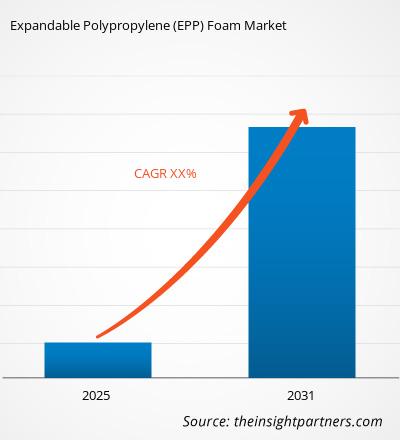
The Expandable polypropylene foam market is increasingly positioned as a lightweight engineering material for automotive, packaging, and consumer applications. The Market was valued at US$ 1.43 Billion in 2025 and is projected to reach US$ 2.46 Billion by 2034, expanding at a 6.97% CAGR from 2026 to 2034. Demand is supported by weight reduction, impact management, recyclability, thermal insulation, and growing requirements for durable reusable components.
North American adoption is supported by automotive localization, electric vehicle component development, and reusable industrial packaging. The regional Expandable polypropylene foam market size is estimated to advance at approximately 5.8–6.5% CAGR between 2026 and 2034. Stronger demand for lightweight vehicle structures and protective packaging is encouraging converters to expand molding capabilities and qualify higher-performance foam grades for demanding applications.
Expandable Polypropylene (EPP) Foam Market Assessment and Insights
- North America: North America represented approximately 27–31% Expandable polypropylene foam market share in 2025 and is projected to expand at a 5.8–6.5% CAGR between 2026–2034, supported by automotive manufacturing, EV component localization, and reusable packaging demand.
- US: The US accounted for approximately 78–82% of North American demand in 2025, with growth expected at a 5.9–6.5% CAGR between 2026–2034, supported by vehicle lightweighting and industrial packaging.
- Europe: Europe held approximately 23–27% share in 2025 and is projected to grow at a 5.4–6.1% CAGR between 2026–2034, with Germany, France, Italy, Spain, and the UK supporting automotive and reusable packaging applications.
- Asia Pacific: Asia Pacific captured approximately 38–42% share in 2025 and is expected to grow at a 7.1–7.8% CAGR between 2026–2034, led by China, Japan, India, South Korea, and Southeast Asian automotive manufacturing.
- Largest Segment: Automotive represented approximately 42–46% market share in 2025, with a 6.7–7.3% CAGR between 2026–2034, reflecting lightweighting, impact protection, and EV component requirements.
- High Growth Segment: Porous PP is estimated at approximately 16–20% market share in 2025, with a 7.3–8.0% CAGR between 2026–2034, supported by specialized cushioning and airflow requirements.
- Key companies analyzed in detail: AkzoNobel N.V., Bublon GmbH, Chase Corporation, Kureha Corporation, Mark Impex, Matsumoto Yushi-Seiyaku Co., Ltd., Nanjing Chemical Material Corp., Nouryon Chemicals B.V., Sekisui Chemical Co., Ltd., The Kish Company, Inc.
Source: The Insight Partners' analysis based on proprietary research, government publications, company annual reports, investor presentations, industry databases, and expert interviews.
The Expandable Polypropylene Foam Market has moved from traditional cushioning applications to engineered components where control of density, energy absorption, dimensional stability, and recyclability is necessary. Design flexibility through steam-chest molding, better bead fusion, density optimization, and product formulation by applications is on the rise. The automotive applications are crucial since EPP is a low-density material with impact-resistance. The packaging applications prefer reusable and recoverable material. The global number of vehicles manufactured was 96.4 million in 2025.
Future growth in the Expandable polypropylene foam market will be driven towards manufacturers with strong automotive supply chain and foam converting capabilities in close proximity to vehicle manufacture plants. India, Mexico, China, and South East Asia have seen increased capacities since the proximity to the vehicle assembly plants limits risks due to logistics and provides better technical support. Increased regulatory focus on recycling content and vehicle circularity also helps in development of recycle content products. The recent investments of JSP in India and Mexico exemplify this localization trend.
Expandable Polypropylene (EPP) Foam Market Report Scope
| Report Attribute | Details |
|---|---|
| Market size in 2025 | US$ 1.43 Billion |
| Market Size by 2034 | US$ 2.46 Billion |
| Global CAGR (2026 - 2034) | 6.97% |
| Historical Data | 2021-2024 |
| Forecast period | 2026-2034 |
Expandable Polypropylene (EPP) Foam Market Analysis
Market growth in Expandable Polypropylene Foam depends upon the lightweighting trend in the automotive sector, protective packaging, and repeated impact resistance requirement. Resin makers provide bead manufacturers with the polymer resin to be formulated and expanded to mold the material into parts by the converters. This market's supply chain relies on resin availability, bead expansion technique, mold efficiency, energy expenses, tooling skill, and qualification cycle of customers. Automotive projects typically involve a longer validation time than packaging projects; however, it could lead to stable demand at high volume when components are being produced.
The supply chain in the Expandable polypropylene foam market is increasingly dependent on the availability of polypropylene in a particular region and proximity of converters. Asia Pacific enjoys its strong ecosystem of polymer, automotive, and molding industries whereas North America and Europe concentrate on local production for supply reliability. Materials based on recycled content become strategically valuable since companies aim to reduce environmental footprint without compromising mechanical characteristics. The capacity of bead fusion consistency and density becomes crucial among manufacturers.
In the Expandable Polypropylene Foam market analysis, it is found that there is a competitive environment that consists of international materials suppliers, foam manufacturers and component suppliers. AkzoNobel N.V., Kureha Corporation, Nouryon Chemicals B.V. and Sekisui Chemical Co., Ltd. are involved by their specialized materials capabilities, whereas JSP Corporation has a very extensive global manufacturing network for EPP foams. Hanwha Corporation combines lightweight materials capability with automotive components capability.
The Expandable polypropylene foam market report shows that competitive positioning is becoming more and more dependent upon local manufacturing capabilities, application engineering capabilities, recycled content capability and OEM qualification support capability. New plants have been opened by JSP in Pune, India and Ramos Arizpe, Mexico bringing the total ARPRO manufacturing facilities to 22 worldwide.
● REPORT CUSTOMIZATION
Tailor This Report To Align With Your Specific Business Requirements
This report can be customized to align precisely with your business objectives, scope, and target markets. Customization options include tailored segmentation, geography, competitive analysis, and strategic insights to support informed decision-making.
Customize This Report →WHAT YOU CAN ADJUST
- ● Segmentations
- ● Geography
- ● Competitive Analysis
- ● Language Preferences
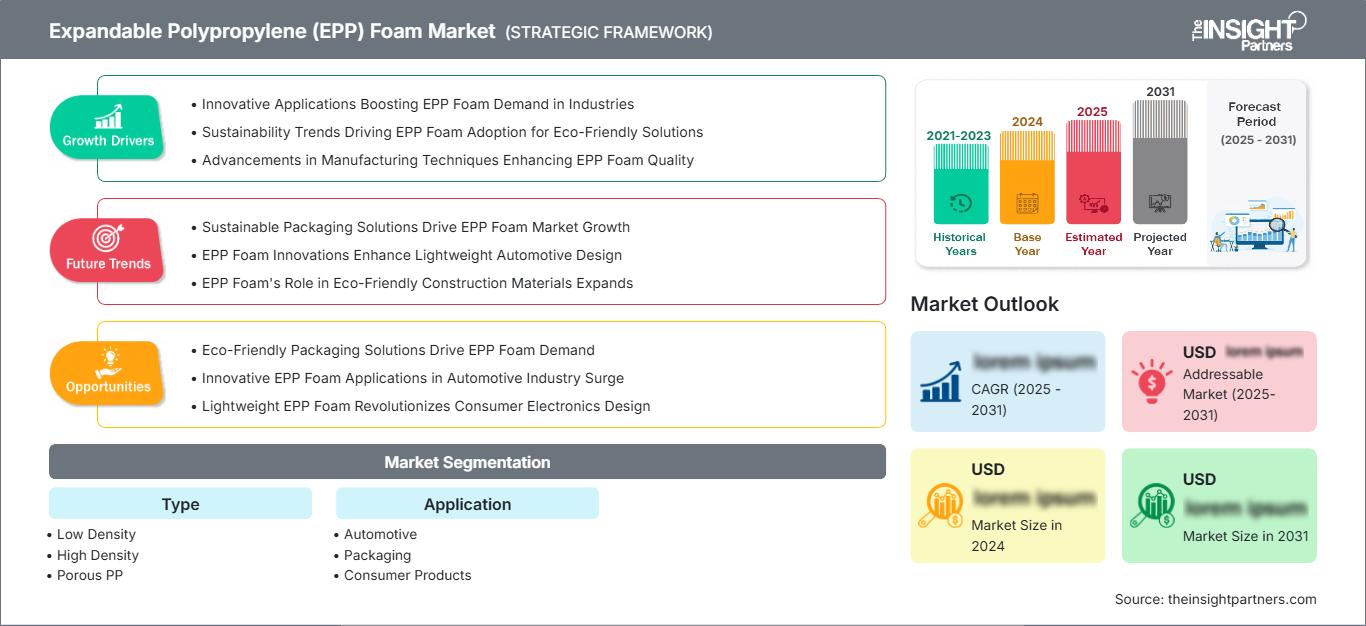
Expandable Polypropylene (EPP) Foam Market: Strategic Insights
Regional Insights
North America Expandable Polypropylene Foam Market
North America accounted for approximately 27–31% share in 2025 and is projected to grow at a 5.8–6.5% CAGR through 2034. These factors include existing automotive manufacturing capability, strong demand from the industrial packaging sector, and an increased need for lighter protective structures. There is still substantial automotive manufacturing taking place, even though there was a reduction in vehicle production in the Americas by 2025. The United States and Mexico still offer important manufacturing centers for these materials, making foam molding and components locally available.
Applications in the automotive industry continue to represent the largest share of demand, particularly bumper cores, energy absorbers, seats, and other interior parts. There may also be some demand in electric vehicles that depend on light weight, impact protection, and thermal management. Mexico continues to position itself as a nearshoring destination, while US converters have advantages in proximity to the OEM and Tier 1 networks.
U.S. Expandable Polypropylene Foam Market
The US represented approximately 78–82% of North American demand in 2025 and is expected to expand at a 5.9–6.5% CAGR. The manufacture of automotive products, investment in EVs, transport packaging, and industrial machinery protection offer diversified demand. US automobile production stood at about 10.24 million vehicles in 2025, underscoring the significance of the region in the components ecosystem.
The largest suppliers and converters offer solutions for a wide range of applications including vehicle interiors, impact protection, packaging inserts, sporting goods, and consumer goods. There is an increasing focus on demand because of the need for lighter weights and reusable packaging. The US manufacturers have been focused on supply security, leading to the adoption of regional manufacturing as opposed to depending on bead or molded component suppliers far away.
Europe Expandable Polypropylene Foam Market
Europe held approximately 23–27% share in 2025 and is forecast to expand at a 5.4–6.1% CAGR, with Germany remaining the leading country. The local automotive industry forms the basis of continuous demand, despite a slight decrease in vehicle manufacturing in Europe in 2025. There is extensive battery and vehicle manufacturing equipment in EU and UK facilities, which increases the demand for lightweight and high-impact-resistant materials.
The UK has a diversified automotive and packaging industry, whereas Germany serves as the region's major vehicle manufacturing and engineering center. The French and Spanish industries form a significant vehicle assembly base, thus driving the demand for molded components. The Italian industry is still relevant owing to its suppliers' automotive industry and industrial applications. The vehicle circularity regulations, recycled content goals, and material reduction initiatives are shaping European demand.
APAC Expandable Polypropylene Foam Market
APAC represented approximately 38–42% share in 2025 and is projected to grow at a 7.1–7.8% CAGR, led by China. China produced approximately 34.53 million vehicles in 2025, while India produced about 6.49 million, demonstrating the region's scale.
Japan, South Korea, India, and Australia complement regional demand through automotive, electronics, packaging, and consumer manufacturing. Policy support for advanced manufacturing and EV production further encourages lightweight materials. China remains the leading market because of its large vehicle base, expanding EV industry, and extensive polymer-processing ecosystem.
Middle East & Africa Expandable Polypropylene Foam Market
Middle East and Africa represent a smaller portion of global demand but are projected to expand at approximately 5.0–5.7% CAGR. There is industrial/logistical infrastructure development taking place in the two states, as opposed to South Africa, which continues to be an automotive manufacturing center. Africa is projected to produce 1.23 million units of vehicle in the year 2025, thus having a substantial industrial presence in the region.
The needs in this regard are met through vehicle localization, packaging and logistic services, cold chain logistics and construction needs. Saudi Arabia/UAE are offering potential investment opportunities due to their industrial and logistic infrastructural development, while South Africa offers vehicle manufacturing facilities. RoMEA demand is more fragmented and will depend on infrastructure development, consumer goods manufacturing, and vehicle components.
Segmentation Analysis
Type
The Type segment is expected to expand at a 6.8–7.2% CAGR between 2026–2034. Product selection depends on density, mechanical strength, resilience, thermal insulation, and molding requirements. Low-density grades address weight-sensitive applications, while high-density grades provide greater structural performance. Porous PP offers opportunities where controlled airflow, cushioning, and specialized functional properties are required. The Expandable Polypropylene Foam Market scope increasingly emphasizes material efficiency and application-specific performance.
- Low Density: Low-density foam supports weight reduction in automotive interiors, packaging inserts, and consumer products. Its lower material consumption makes it attractive where cushioning, buoyancy, and mass reduction outweigh requirements for high structural rigidity.
- High Density: High-density grades serve components requiring stronger load management, improved dimensional stability, and repeated impact resistance. Automotive structural parts and demanding protective packaging remain important applications where durability justifies higher material utilization.
- Porous PP: Porous PP provides controlled cellular structures suited to applications requiring airflow, cushioning, sound absorption, or specialized thermal behavior. Its performance profile supports differentiated product development beyond conventional closed-cell foam components.
Application
The Application segment is projected to grow at a 6.7–7.3% CAGR between 2026–2034. Automotive remains the dominant application because EPP combines low weight, resilience, energy absorption, and recyclability. Packaging provides a second major demand pool through reusable transport systems and protective inserts. Consumer products offer diversification across sports, household, and recreational goods where durability and low weight influence purchasing decisions.
- Automotive: Automotive applications include bumper cores, door and interior components, energy absorbers, toolboxes, seating elements, and other lightweight structures. EV production strengthens demand where weight optimization and impact performance support vehicle efficiency and safety.
- Packaging: Packaging demand centers on reusable containers, protective inserts, industrial dunnage, and temperature-sensitive transport systems. Reusability and resistance to repeated impacts make EPP attractive for closed-loop logistics and high-value product protection.
- Consumer Products: Consumer products use EPP where low weight, resilience, insulation, and comfort are important. Sports equipment, household products, toys, and recreational goods provide opportunities for customized shapes and durable designs.
Opportunity Snapshot
| Application | Revenue Contribution | Trend Tag | Adoption Stage |
|---|---|---|---|
| Automotive | High | EV Lightweighting | Scaling |
| Packaging | Medium | Reusable Dunnage | Scaling |
| Consumer Products | Low | Durable Design | Mature |
Expandable Polypropylene (EPP) Foam Market Growth Drivers and Impact Analysis
Automotive Lightweighting and EV Component Integration
The need for automotive lightweighting will continue to be a key structural driver due to the balancing act that carmakers face between vehicle efficiency, safety, comfort, and cost of the materials used in the construction of the vehicles. EPP can lower the weight of the parts but at the same time provides impact resistance and dimensional stability, making it applicable in interior structures, bumpers, seat parts, and energy management parts. The shift towards electric vehicles has made it even more important since the lowering of the weight of the vehicle can increase efficiency and compensate for the weight caused by batteries. Vehicle production reached 96.4 million units in 2025.
Growth of Reusable and Protective Packaging Systems
Another new demand generation opportunity is the development of reusable packaging systems since manufacturers will require systems that can withstand multiple reuse and transit. EPP is a resilient material and is low in weight, water-resistant, and impact absorbing. It is used in automobile dunnage, electronic packing, industrial containers, and temperature-sensitive logistics packaging. While disposable cushioning systems cannot withstand multiple logistical cycles, molded polypropylene systems can withstand multiple cycles and will retain their dimensionality. This is especially relevant in the automotive industry, in which the components are constantly being sent from one facility to another. Globalization of manufacturing processes has further increased the need for protective packaging to minimize damage and cost of handling.
Recycled Content and Circular Material Requirements
Circularity requirements are increasing the strategic importance of recycled polypropylene within foam production. Automotive manufacturers, packaging users, and consumer brands are evaluating recycled-content solutions to reduce virgin polymer consumption while maintaining functional performance. Recycled EPP can be particularly attractive where mechanical requirements are well understood and component designs permit controlled material specifications. JSP reports ARPRO grades containing recycled content and has developed material using recycled marine waste, demonstrating how recycled feedstocks can enter higher-value foam applications. As vehicle recycling policies develop, suppliers able to provide traceability, consistent recycled feedstock, and validated mechanical properties should gain stronger access to OEM qualification programs. This shift also encourages partnerships between material suppliers, converters, recyclers, and vehicle manufacturers.
Expandable Polypropylene (EPP) Foam Market Future Trends
Higher Recycled Content in Engineered Foam Grades
The Expandable Polypropylene Foam Market trends are moving toward higher recycled content without sacrificing density control, energy absorption, or processing consistency. Future grades are likely to use more carefully sorted post-industrial and post-consumer polypropylene streams, supported by improved compounding and quality-control systems. Automotive applications will be particularly influential because OEM sustainability targets increasingly extend into material selection and supplier qualification. Closed-loop programs may become more common for reusable dunnage and production scrap, enabling converters to recover material from controlled industrial streams. Product developers are also expected to differentiate grades according to recycled-content level, mechanical performance, and application requirements. This creates opportunities for suppliers to offer multiple sustainability tiers rather than a single recycled formulation. Traceability and consistent certification will become increasingly important purchasing criteria for major customers.
Localized Production for Regional Automotive Platforms
A second trend is the expansion of localized foam manufacturing around automotive assembly clusters. Regional production reduces freight requirements, improves responsiveness to engineering changes, and supports just-in-time component delivery. JSP's Pune and Ramos Arizpe investments demonstrate this model, with both facilities established partly to serve expanding automotive demand. Similar strategies are likely across India, Mexico, Southeast Asia, and China as automakers diversify production footprints. Suppliers will increasingly combine regional manufacturing with centralized material development, allowing global customers to receive consistent grades while local plants provide shorter lead times. This model should also encourage investment in regional tooling, testing, and technical support, making foam suppliers more integrated into OEM and Tier 1 development programs.
Expandable Polypropylene (EPP) Foam Market Opportunities
Developing Localized Foam Platforms in Emerging Automotive Hubs
The Expandable Polypropylene Foam Market Forecasts indicate attractive opportunities in emerging automotive manufacturing hubs where vehicle production, localization, and component sourcing are expanding simultaneously. India and Mexico are particularly relevant because they connect growing domestic demand with export-oriented manufacturing networks. Investors and material suppliers can prioritize local bead production, molding capacity, tooling support, and technical laboratories rather than relying entirely on imported components. Such platforms can serve automotive customers while also supplying packaging and consumer applications, improving asset utilization. The opportunity is strongest where polymer availability, skilled processing labor, and established Tier 1 ecosystems already exist. Companies that enter early can build qualification relationships before new vehicle platforms reach high-volume production. Localization can therefore provide both supply-chain resilience and a pathway toward broader regional application development.
Premium Recycled and High-Performance Foam Solutions
A further opportunity lies in premium grades combining recycled content with higher mechanical performance, thermal insulation, acoustic behavior, or controlled porosity. Customers increasingly require materials that satisfy multiple design objectives simultaneously, creating room for differentiated formulations rather than commodity foam products. Suppliers can prioritize recycled-content grades for reusable packaging, low-density materials for vehicle lightweighting, and high-performance structures for EV components. Partnerships with recyclers can secure consistent feedstock, while collaborations with converters can accelerate mold and processing optimization. The opportunity is especially relevant in Europe and advanced Asian markets, where circularity expectations are strengthening. Companies with proprietary bead technology, application engineering, and testing capabilities can defend margins more effectively than suppliers competing primarily on resin or material price.
Recent Developments
- December 2025: JSP Corporation — JSP announced that its new Pune plant in India and Ramos Arizpe plant in Mexico had commenced operations. Both facilities manufacture ARPRO expanded polypropylene foam, with automotive applications identified as an important demand driver. The two plants increased JSP Group's ARPRO production footprint to 22 locations worldwide and strengthened localized supply capabilities in growing automotive markets.
- May 2025: Borealis invested over EUR 100 million in new High Melt Strength polypropylene (HMS PP) line at its Burghausen, Germany, facility. The start-up is planned for the second half of 2026. Borealis Innovation Headquarters in Linz, Austria, spearheaded breakthrough innovation in design for recycling with Daploy High Melt Strength polypropylene (HMS PP). The new line will triple Borealis’ supply capability for fully recyclable HMS PP that enables high-performance and light weight foam solutions.
Frequently Asked Questions

- Comprehensive Market Sizing and Forecast Analysis
- Detailed Segmentation Analysis
- In-Depth Market Dynamics Assessment
- Regional and Country-Level Insights
- Competitive Landscape and Company Benchmarking
- Strategic Business Intelligence
Recent Reports
Testimonials

The Insight Partners' SCADA System Market report is comprehensive, with valuable insights on current trends and future forecasts. The team was highly professional, responsive, and supportive throughout. We are very satisfied and highly recommend their services.
RAN KEDEM Partner, Reali Technologies LTDs
I requested a report on a very specific software market and the team produced the report in a few days. The information was very relevant and well presented. I then requested some changes and additions to the report. The team was again very responsive and I got the final report in less than a week.
JEAN-HERVE JENN Chairman, Future Analytica
We worked with The Insight Partners for an important market study and forecast. They gave us clear insights into opportunities and risks, which helped shape our plans. Their research was easy to use and based on solid data. It helped us make smart, confident decisions. We highly recommend them.
PIYUSH NAGPAL Sr. Vice President, High Beam Global
The Insight Partners delivered insightful, well-structured market research with strong domain expertise. Their team was professional and responsive throughout. The user-friendly website made accessing industry reports seamless. We highly recommend them for reliable, high-quality research services
YUKIHIKO ADACHI CEO, Deep Blue, LLC.
This is the first time I have purchased a market report from The Insight Partners.While I was unsure at first, I visited their web site and felt more comfortable to take the risk and purchase a market report.I am completely satisfied with the quality of the report and customer service. I had several questions and comments with the initial report, but after a couple of dialogs over email with their analyst I believe I have a report that I can use as input to our strategic planning process.Thank you so much for taking the extra time and making this a positive experience.I will definitely recommend your service to others and you will be my first call when we need further market data.
JOHN SUZUKI President and Chief Executive Officer, Board Director, BK Technologies
I wish to appreciate your support and the professionalism you displayed in the course of attending to my request for information regarding to infectious disease IVD market in Nigeria. I appreciate your patience, your guidance, and the fact that you were willing to offer a discount, which eventually made it possible for us to close a deal. I look forward to engaging The Insight Partners in the future, all thanks to the impression you have created in me as a result of this first encounter.
DR CHIJIOKE ONYIA MANAGING DIRECTOR, PineCrest Healthcare Ltd.Reason to Buy
- Informed Decision-Making
- Understanding Market Dynamics
- Competitive Analysis
- Identifying Emerging Markets
- Customer Insights
- Market Forecasts
- Risk Mitigation
- Boosting Operational Efficiency
- Strategic Planning
- Investment Justification
- Tracking Industry Innovations
- Aligning with Regulatory Trends





 Get Free Sample for