
Expanded PTFE Market Size, Demand & Growth by 2034
Coverage: by Form (Sheets, Tapes, Membranes, Fibers, Others); End-Use Industry (Oil and Gas, Chemical, Transportation, Medical, Others); Application (Gaskets, Filtration and Separation, Dielectric Materials, Others) , and Geography (North America, Europe, Asia Pacific, and South and Central America)
- Status : Data Released
- Report Code : TIPRE00007818
- Category : Chemicals and Materials
- No. of Pages : 150
- Available Report Formats :


- Last update date : September 15, 2026


2025 Market Size
US$ 1.37 Bn
Base year value
2034 Forecast
US$ 2.66 Bn
Projected by 2034
CAGR 2026-2034
7.61 %
Growth rate
Addressable Market
US$ 18.11 Bn
(2026-2034)
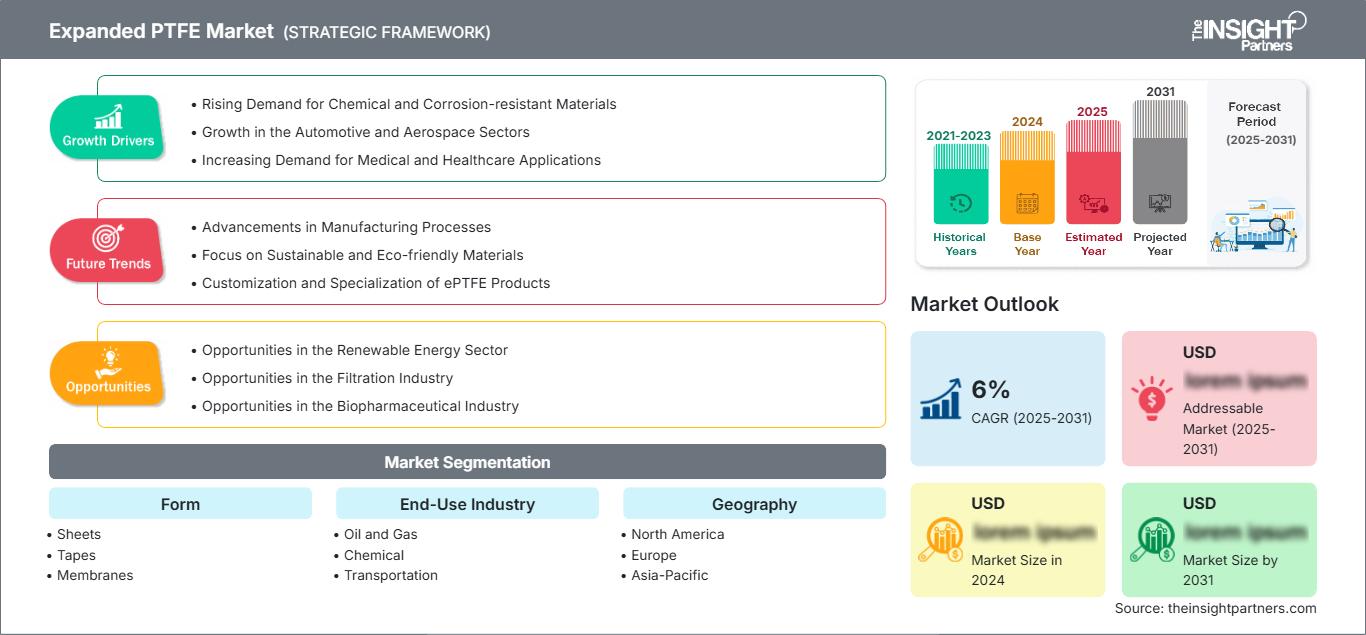
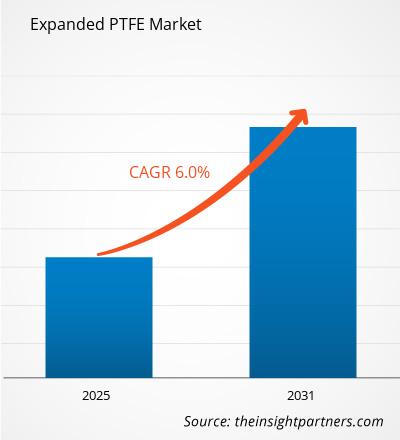
The Expanded PTFE Market size was valued at US$ 1.37 Billion in 2025 and is projected to reach US$ 2.66 Billion by 2034, expanding at a 7.61% CAGR from 2026 to 2034. Growth is linked to chemical resistance, low friction, thermal stability, controlled porosity, and conformability across demanding sealing, filtration, insulation, and medical applications.
North America is expected to remain an important technology and application center, with an estimated 6.9–7.5% CAGR from 2026–2034. Demand is supported by process-industry maintenance, pharmaceutical and medical-device production, advanced filtration, and replacement of conventional sealing materials in applications requiring reliable performance under aggressive operating conditions.
Expanded PTFE Market Assessment and Insights
- North America: North America is estimated to hold 21–25% Expanded PTFE Market share in 2025 and expand at a 6.9–7.5% CAGR between 2026–2034, supported by chemical processing, medical devices, industrial filtration, and high-performance sealing requirements.
- US: The US is estimated to represent 58–63% of North America's 2025 demand and grow at a 6.8–7.4% CAGR from 2026–2034, supported by advanced manufacturing and healthcare applications.
- Europe: Europe is estimated to account for 24–28% share in 2025, growing at a 7.0–7.6% CAGR from 2026–2034, with Germany, France, Italy, and the UK providing strong demand through chemical processing, industrial sealing, and medical applications.
- Asia Pacific: Asia Pacific is estimated at 34–38% share in 2025 and is expected to grow at a 8.0–8.7% CAGR from 2026–2034, led by China, Japan, South Korea, and India through expanding industrial, electronics, chemical, and healthcare manufacturing.
- Largest Segment: Membranes are estimated to hold 34–38% market share in 2025, with a 7.9–8.3% CAGR from 2026–2034, supported by filtration, venting, medical, and industrial applications.
- High Growth Segment: Medical is estimated at 14–18% market share in 2025, with an 8.3–8.9% CAGR during 2026–2034, driven by implantable devices, catheters, grafts, and minimally invasive technologies.
- Key companies analyzed in detail: Dexmet Corporation; Donaldson Company, Inc.; Markel Corporation; Phillips Scientific Inc.; Poly Fluoro Ltd.; Rogers Corporation; Shanghai Lanle Plastics Co., Ltd.; Teadit; W. L. Gore & Associates, Inc.; Zeus Industrial Products, Inc.
Source: The Insight Partners' analysis based on proprietary research, government publications, company annual reports, investor presentations, industry databases, and expert interviews.
The Expanded PTFE Market report shows that the market is moving from traditional sealing materials to engineered microstructures that are designed for their ability to be permeable, compressible, dimensionally stable, and controllable for transportation. The expanded technology may lead to the creation of fibrillated structures with specific properties related to their pore structure for various applications, whereas the multidirectional expansion leads to improved dimensional stability of sealing products. Suppliers are working on creating membranes, fibers, tapes, and sheets suitable for aggressive chemicals, changing pressures, medical tools, filtration, and electrical applications.
During the forecast period, investments in the Expanded PTFE Market are expected to move into higher-end applications in Asia Pacific, medical applications, industrial filtration, hydrogen applications, and advanced sealing solutions. The growing attention to the environmental impact of fluoropolymer production will motivate the need for stricter process management, material efficiency, recovery systems, and alternative products.
Expanded PTFE Market Report Scope
| Report Attribute | Details |
|---|---|
| Market size in 2025 | US$ 1.37 Billion |
| Market Size by 2034 | US$ 2.66 Billion |
| Global CAGR (2026 - 2034) | 7.61% |
| Historical Data | 2021-2024 |
| Forecast period | 2026-2034 |
Expanded PTFE Market Analysis
The demand in the Expanded PTFE Market is driven by the characteristics of the material, such as its inertness, thermal stability, low friction, flexibility, and microporous structure. They make PTFE a good solution for use in seals in chemical and oil & gas plants, filters in industrial and medical applications, and protective membranes for electronics and transportation industries. The value chain covers the processes of producing PTFE resins, extruding pastes, expansion, sintering or stretching, laminating, cutting, and converting. The economic performance is influenced by resin quality, expansion ratios, yield, precision needs, and certification processes.
The supply is determined by the presence of expertise in manufacturing PTFE-based materials and membranes. In fact, membrane manufacturers need strict controls on pore sizes, thicknesses, tensile strength, and permeability, while gasket converters have to focus on compressibility, elasticity, creep resistance, and conformance to the irregular shape of flanges. The growth of the Expanded PTFE Market will be driven by the growth of the market volume and higher technical contents per application. The availability of fluoropolymer processing equipment and converters in regions might significantly influence the lead time.
The Expanded PTFE Market forecast shows that competitors span specialized producers of materials, membrane producers, sealers, and medical device producers. W. L. Gore & Associates, Inc. enjoys broad capabilities in the areas of ePTFE membranes, fibers, medical devices, and sealing systems, whereas Donaldson Company, Inc. uses Tetratex membrane technology in filtration and venting processes. Teadit specializes in engineered sealing technologies, whereas Zeus Industrial Products, Inc. focuses on polymers' advanced engineering for industrial and medical applications.
Further competitors target special niches. Rogers Corporation offers engineered PTFE films and other materials, whereas Dexmet Corporation produces expanded metals and other engineered polymers. Markel Corporation and Phillips Scientific Inc. specialize in fluoropolymer needs, whereas Poly Fluoro Ltd. produces PTFE-based engineered products. Shanghai Lanle Plastics Co., Ltd. offers regional manufacturing capacity. Competitive strategies rely more on the process of qualification, customization, application engineering, and specification capabilities rather than just on the price of material.
● REPORT CUSTOMIZATION
Tailor This Report To Align With Your Specific Business Requirements
This report can be customized to align precisely with your business objectives, scope, and target markets. Customization options include tailored segmentation, geography, competitive analysis, and strategic insights to support informed decision-making.
Customize This Report →WHAT YOU CAN ADJUST
- ● Segmentations
- ● Geography
- ● Competitive Analysis
- ● Language Preferences
Expanded PTFE Market: Strategic Insights
Regional Insights
North America Expanded PTFE Market
North America is estimated to represent 21–25% of global demand in 2025 and is projected to expand at a 6.9–7.5% CAGR through 2034. The region benefits from established chemical-processing infrastructure, pharmaceutical manufacturing, aerospace activity, and advanced filtration demand. Replacement of conventional sealing materials is also supporting applications where low leakage, chemical resistance, and conformability are critical.
The US accounts for approximately 58–63% of North American demand, while Canada and Mexico contribute through energy, chemicals, manufacturing, and medical applications. Industrial maintenance remains a major demand source because ePTFE products can accommodate damaged or uneven sealing surfaces. Medical and filtration applications provide additional value growth. Regulatory attention to process emissions and containment is encouraging more reliable sealing systems, while infrastructure modernization supports recurring replacement demand across processing facilities.
U.S. Expanded PTFE Market
The US represents approximately 58–63% of North American demand in 2025 and is expected to grow at a 6.8–7.4% CAGR from 2026–2034. The economy is characterized by a robust chemical processing industry, medical devices, aerospace products, electronics, and filtration technologies. The material needs of these industries involve materials that can function effectively at various temperatures and under chemical exposure.
W. L. Gore & Associates, Inc., Donaldson Company, Inc., Rogers Corporation, and Zeus Industrial Products, Inc. have created a position for themselves within the technology/application segment that is related to the domestic value chain. Applications in the medical area have become important because of the use of minimally invasive methods, and there is a need for material functionality. Industrial applications will continue to be diverse in valves, pumps, flanges, filtration systems, and process vessels.
Europe Expanded PTFE Market
Europe is estimated to hold 24–28% share in 2025 and is projected to grow at a 7.0–7.6% CAGR through 2034. Germany continues to be a key market due to its chemical, automotive, pharmaceutical, and machinery industries. The UK and France contribute due to industrial processing and healthcare, while Italy and Spain help with demand from manufacturing, energy, food processing, and industrial maintenance.
Germany is a heavily industrialized country, requiring chemically-resistant sealing, filtration, and processing components. France benefits from chemical, pharmaceutical, aerospace, and energy-related applications, while Italy has a lot of machinery and industrial processing activity. The UK helps with demand from energy, life sciences, and advanced manufacturing industries, where reliability and leakage avoidance are becoming increasingly important factors.
Italy and Spain contribute through industrial equipment, chemical processing, food manufacturing, and infrastructure maintenance. The purchasing decision in Europe becomes more dependent on emissions control, equipment reliability, and material qualification. Therefore, an engineered ePTFE product that has been proven to perform can become a preferred choice for applications where total operational costs matter more than material cost.
APAC Expanded PTFE Market
APAC represents approximately 34–38% share in 2025 and is expected to expand at a 8.0–8.7% CAGR through 2034. China remains at the forefront of the region, with chemicals, electronics, industrial machinery, and manufacturing. Japan and South Korea focus on precision applications, whereas India offers rising demands in the areas of pharmaceuticals, chemicals, energy, and industrial facilities.
Expansion in the region is also driven by manufacturing investments and health care development. China includes extensive capabilities of chemical processes and electronics manufacturing, whereas Japan and South Korea keep the demand for high-quality materials. India and Australia create new opportunities in industrial processing, mining, energy, and health care sectors. There are more regional manufacturers who are investing in their conversion and applications engineering.
Middle East & Africa Expanded PTFE Market
Middle East and Africa is expected to represent approximately 5–7% of global demand in 2025, expanding at a 7.0–7.8% CAGR through 2034. Saudi Arabia leads regional demand through oil and gas, petrochemicals, and infrastructure, while the UAE supports industrial, energy, and logistics applications. South Africa contributes through mining, chemicals, and manufacturing.
Energy infrastructure is the principal demand foundation, with sealing systems required across pipelines, processing equipment, pumps, valves, and storage facilities. Expansion of chemical and hydrogen-related projects can create additional requirements for chemically resistant materials. Rest of MEA demand remains smaller but can increase as industrial capacity, water infrastructure, and energy investments expand.
Segmentation Analysis
Form
Form is projected to expand at a 7.5–8.0% CAGR from 2026–2034. Demand is shifting toward application-specific formats that provide controlled permeability, sealing conformity, flexibility, or mechanical stability. Membranes command significant value because filtration and venting applications require precise microstructures and consistent performance.
- Sheets: Sheets serve sealing, lining, gasketing, and industrial fabrication requirements where conformability and chemical resistance are important. Their broad dimensional availability makes them relevant to process equipment maintenance and customized industrial components.
- Tapes: Tapes are widely used for irregular or damaged flange surfaces because their conformability can simplify installation. Multidirectional and monoaxial formats allow suppliers to tailor strength, compression, and dimensional behavior to specific sealing requirements.
- Membranes: Membranes provide controlled microporosity for filtration, venting, medical, and protective applications. Their performance depends on pore structure, thickness, permeability, and surface treatment, making manufacturing precision a central competitive factor.
- Fibres: Fibres combine chemical resistance, thermal stability, flexibility, and low friction with engineered density and surface characteristics. They support specialized industrial structures, filtration media, reinforcement systems, and demanding textile-related applications.
End-Use Industry
End-Use Industry is expected to register a 7.7–8.2% CAGR during 2026–2034. Growth will be supported by process-industry reliability requirements, medical-device innovation, transportation electrification, and demand for materials that retain performance under aggressive chemical, thermal, and mechanical conditions. The Expanded PTFE Market scope therefore extends from established sealing applications toward increasingly specialized engineered systems.
- Oil and Gas: Oil and Gas applications use ePTFE in gaskets, seals, valve systems, piping, filtration, and equipment exposed to aggressive media. Reliability and leakage prevention remain central purchasing criteria across upstream, midstream, and downstream facilities.
- Chemical: Chemical processing requires highly resistant sealing and filtration materials because equipment encounters corrosive fluids, solvents, pressure fluctuations, and elevated temperatures. ePTFE supports reliable operation where conventional elastomers may have compatibility limitations.
- Transportation: Transportation applications include automotive, aerospace, and mobility systems requiring lightweight, chemically resistant, electrically stable, and thermally durable materials. Demand is increasingly connected to batteries, sensors, fluid systems, and advanced filtration components.
- Medical: Medical applications use ePTFE in vascular grafts, catheter components, membranes, and specialized device structures. Biocompatibility, controlled microstructure, long-term stability, and manufacturing consistency make material qualification especially important.
Opportunity Snapshot
| End-Use Industry | Revenue Contribution | Trend Tag | Adoption Stage |
| Oil and Gas | High | Leak Control | Mature |
| Chemical | High | Process Sealing | Mature |
| Transportation | Medium | Battery Vents | Scaling |
| Medical | Medium | Vascular Devices | Scaling |
Expanded PTFE Market Growth Drivers and Impact Analysis
Increasing requirements for reliable chemical and process sealing
Chemical processing, refining, energy, and industrial manufacturing facilities are placing greater emphasis on leak prevention, equipment uptime, and maintenance efficiency. The compressibility and flexibility of ePTFE makes it a good choice for applications that involve irregular flange faces since the seal can be installed with relatively low installation forces and still provide effective sealing. In addition, the excellent chemical resistance of ePTFE makes it useful for sealing in process environments that would cause degradation of other polymers. This leads to the generation of repeat business based on maintenance, replacement, and upgrade activities instead of focusing solely on new construction projects. Today's industrial facilities are increasingly looking at sealing materials based on lifecycle risks associated with leakage, downtime, and maintenance.
Expansion of advanced filtration and venting applications
The microporous ePTFE membranes are becoming more applicable for filtration, pressure equalization, moisture control, and contaminant protection. Industries may require controlled transmission of gases but at the same time prevent water, oil, or particle entry into industrial equipment, electronics, batteries, sensors, and health devices. The trend towards small-sized electronic devices and enclosed industrial designs increases the requirement for venting systems. The filtration process requires high permeability coupled with controlled retention. The manufacturers will be able to compete through the differences in the pore sizes, membrane thickness, surface finishing, laminates, and mechanical reinforcement. This leads to higher importance of knowledge and qualifications in this field. The increasing compactness and sensitivity to the pressure and moisture of the equipment creates opportunities for membrane solutions.
Rising demand for high-performance materials in medical devices
Medical-device manufacturers require materials that combine stable physical properties with predictable performance, biocompatibility, and manufacturing consistency. ePTFE has established relevance in vascular grafts, covered stents, catheter components, and specialized membranes because its microporous structure can be engineered for specific clinical functions. Growth in minimally invasive procedures is creating opportunities for smaller, more sophisticated device architectures where material precision becomes increasingly important. Suppliers must meet demanding qualification, traceability, and quality requirements, creating barriers to entry that favor experienced producers. Medical applications can also support higher-value products because development cycles, validation requirements, and regulatory documentation increase the importance of reliable material supply. Continued innovation in cardiovascular devices, interventional systems, and catheter technologies should therefore provide an important source of premium demand.
Expanded PTFE Market Future Trends
Application-specific microstructure engineering will accelerate
The Expanded PTFE Market trends show that future product development will increasingly focus on tailoring fibril size, pore distribution, density, thickness, surface chemistry, and directional expansion to individual applications. Rather than supplying standardized materials, producers are likely to offer engineered structures optimized for filtration, venting, sealing, medical implants, or electrical protection. Advanced characterization methods can improve consistency between production batches and allow customers to specify performance parameters more precisely. Multilayer constructions may also combine ePTFE with supporting substrates, coatings, or complementary polymers to create multifunctional components. This approach can increase material value while reducing dependence on commodity pricing. As end users demand narrower performance tolerances, suppliers with proprietary expansion technology and application-development capabilities should gain an advantage in technically demanding sectors.
Fluoropolymer compliance will reshape material development strategies
Environmental scrutiny of fluoropolymers is likely to influence product design, manufacturing processes, procurement policies, and customer qualification over the coming years. Producers will face greater pressure to document raw-material characteristics, emissions controls, processing practices, and end-of-life pathways. At the same time, complete substitution will remain challenging in applications where chemical resistance, temperature stability, low friction, or biocompatibility are difficult to replicate. This tension will encourage suppliers to improve process efficiency, minimize material losses, develop recovery approaches, and evaluate alternative architectures selectively. Customers are likely to distinguish between applications where fluoropolymer performance is essential and those where technically adequate substitutes exist. Competitive differentiation will increasingly depend on documented environmental management alongside conventional technical performance.
Expanded PTFE Market Opportunities
Localized production for Asian industrial and medical applications
Asia Pacific offers opportunities for manufacturers to establish localized ePTFE conversion and technical-support capabilities close to expanding chemical, pharmaceutical, electronics, and medical-device clusters. China, India, Japan, and South Korea provide different combinations of industrial scale, engineering expertise, healthcare investment, and export-oriented manufacturing. Local production can reduce lead times and simplify customization for customers requiring application-specific thicknesses, pore structures, tapes, or gasket dimensions. Partnerships with regional converters and medical-device manufacturers can also accelerate qualification and create recurring demand. Investors should prioritize locations offering reliable fluoropolymer feedstock access, skilled processing labor, established industrial ecosystems, and efficient logistics. A regional manufacturing strategy can improve responsiveness while reducing dependence on long-distance shipments of specialized, relatively high-value components.
Advanced medical and battery-related component development
Medical devices and battery systems offer attractive opportunities for high-value ePTFE applications because both require materials with carefully controlled permeability, chemical resistance, and durability. Medical manufacturers can pursue specialized membranes, graft structures, and catheter components, while transportation suppliers can explore venting and protective applications for battery packs and electronic systems. Product development should focus on qualification requirements, dimensional consistency, and integration with adjacent components rather than selling raw membrane material alone. Partnerships with device manufacturers can shorten development cycles by aligning material specifications with final-system requirements. Suppliers that build application engineering into their commercial model can create stronger customer relationships and capture value across design, qualification, and production stages.
Recent Developments
- January 2026: Zeus Industrial Products, Inc. - Zeus launched its PFX platform and introduced PFX Flex Sub-Lite-Wall, a next-generation catheter liner positioned as an alternative to film-cast PTFE. The development targets catheter designs requiring greater flexibility, scalability, and performance while supporting the company's expansion into advanced medical polymer solutions.
- October 2025: W. L. Gore & Associates, Inc. - Gore announced FDA approval for a new 6–10 mm diameter range for the GORE VIATORR TIPS Endoprosthesis with Controlled Expansion. The device uses Gore's proprietary ePTFE graft lining and expands the available sizing options for physicians treating portal hypertension.
Frequently Asked Questions

- Comprehensive Market Sizing and Forecast Analysis
- Detailed Segmentation Analysis
- In-Depth Market Dynamics Assessment
- Regional and Country-Level Insights
- Competitive Landscape and Company Benchmarking
- Strategic Business Intelligence
Recent Reports
Testimonials

The Insight Partners' SCADA System Market report is comprehensive, with valuable insights on current trends and future forecasts. The team was highly professional, responsive, and supportive throughout. We are very satisfied and highly recommend their services.
RAN KEDEM Partner, Reali Technologies LTDs
I requested a report on a very specific software market and the team produced the report in a few days. The information was very relevant and well presented. I then requested some changes and additions to the report. The team was again very responsive and I got the final report in less than a week.
JEAN-HERVE JENN Chairman, Future Analytica
We worked with The Insight Partners for an important market study and forecast. They gave us clear insights into opportunities and risks, which helped shape our plans. Their research was easy to use and based on solid data. It helped us make smart, confident decisions. We highly recommend them.
PIYUSH NAGPAL Sr. Vice President, High Beam Global
The Insight Partners delivered insightful, well-structured market research with strong domain expertise. Their team was professional and responsive throughout. The user-friendly website made accessing industry reports seamless. We highly recommend them for reliable, high-quality research services
YUKIHIKO ADACHI CEO, Deep Blue, LLC.
This is the first time I have purchased a market report from The Insight Partners.While I was unsure at first, I visited their web site and felt more comfortable to take the risk and purchase a market report.I am completely satisfied with the quality of the report and customer service. I had several questions and comments with the initial report, but after a couple of dialogs over email with their analyst I believe I have a report that I can use as input to our strategic planning process.Thank you so much for taking the extra time and making this a positive experience.I will definitely recommend your service to others and you will be my first call when we need further market data.
JOHN SUZUKI President and Chief Executive Officer, Board Director, BK Technologies
I wish to appreciate your support and the professionalism you displayed in the course of attending to my request for information regarding to infectious disease IVD market in Nigeria. I appreciate your patience, your guidance, and the fact that you were willing to offer a discount, which eventually made it possible for us to close a deal. I look forward to engaging The Insight Partners in the future, all thanks to the impression you have created in me as a result of this first encounter.
DR CHIJIOKE ONYIA MANAGING DIRECTOR, PineCrest Healthcare Ltd.Reason to Buy
- Informed Decision-Making
- Understanding Market Dynamics
- Competitive Analysis
- Identifying Emerging Markets
- Customer Insights
- Market Forecasts
- Risk Mitigation
- Boosting Operational Efficiency
- Strategic Planning
- Investment Justification
- Tracking Industry Innovations
- Aligning with Regulatory Trends





 Get Free Sample for