
Fiber Optics Testing Market Growth, Demand & Size by 2034
Coverage: by Service Type (Testing, Inspection, Certification, Others); Offering (In-House Services, Outsourced Services); End-Use Industry (IT and Telecommunications, Military and Aerospace, Manufacturing, Oil and Gas, Railways, Others) , and Geography (North America, Europe, Asia Pacific, and South and Central America)
- Status : Data Released
- Report Code : TIPRE00012724
- Category : Electronics and Semiconductor
- No. of Pages : 150
- Available Report Formats :


- Last update date : August 17, 2026


2025 Market Size
US$ 5.47 Bn
Base year value
2034 Forecast
US$ 10.68 Bn
Projected by 2034
CAGR 2026-2034
7.72 %
Growth rate
Addressable Market
US$ 72.73 Bn
(2026-2034)
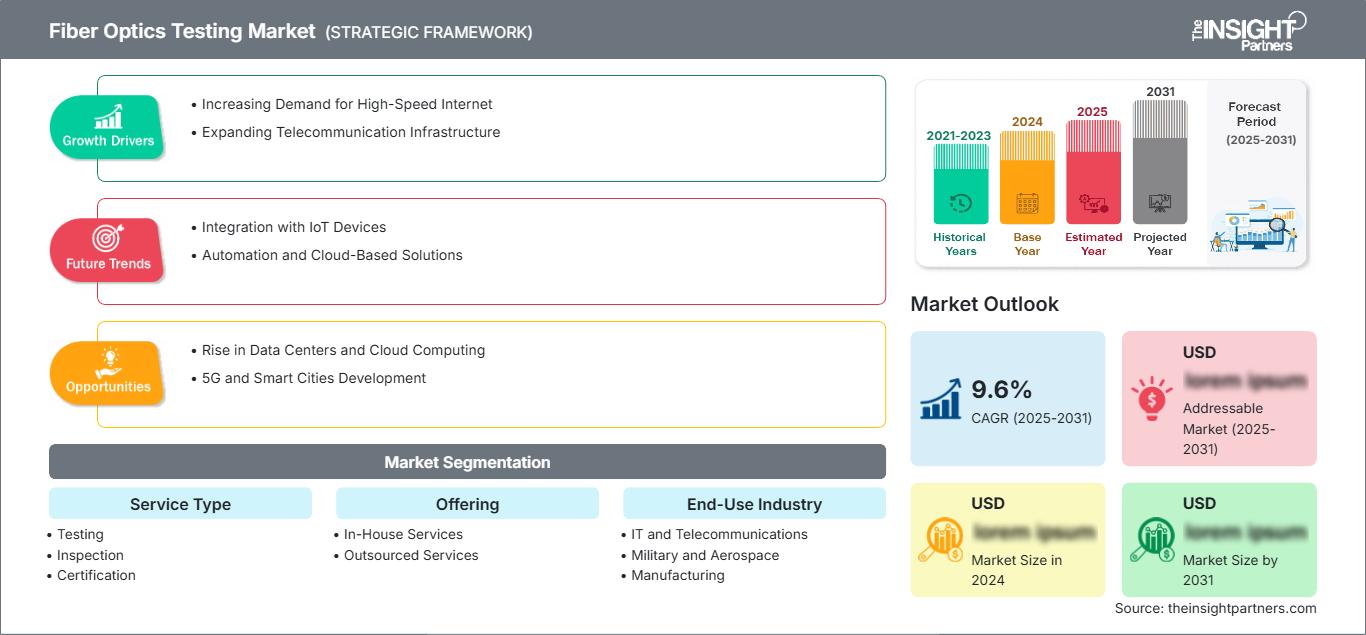
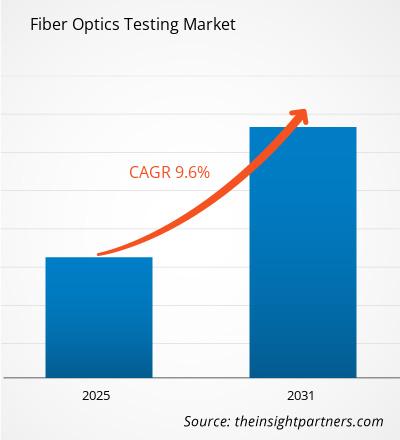
The Fiber Optics Testing Market size is valued at US$ 5.47 Billion in 2025 and is projected to reach US$ 10.68 Billion by 2034, expanding at a CAGR of 7.72% during the forecast period from 2026 to 2034. This growth trajectory reflects increasing adoption across IT and telecommunications, military and aerospace, manufacturing, and oil and gas sectors where fiber-optic network reliability is critical.
North America maintains a commanding position in the Fiber Optics Testing Market, with the region expected to grow at a CAGR range of 7–9% through 2034. Structural drivers include widespread deployment of 5G networks, hyperscale data center expansion, and military-grade optical network modernization programs across the United States and Canada.
Fiber Optics Testing Market Assessment and Insights
- North America – The region holds approximately 36–39% Fiber Optics Testing Market share in 2025 and is growing at a CAGR range of 7–9% between 2026–2034, driven by strong telecommunications infrastructure investments and data center construction.
- US – Accounts for nearly 77–80% of North America share in 2025, advancing at a CAGR range of 6–8% between 2026–2034, supported by leading testing equipment manufacturers and 5G network deployments.
- Europe – Represents approximately 22–25% share in 2025 and is expanding at a CAGR range of 7–9% between 2026–2034, with Germany, the UK, and France leading adoption in telecommunications and automotive fiber networks.
- Asia Pacific – Holds roughly 30–33% share in 2025 and is projected to grow at the fastest CAGR range of 8–10% between 2026–2034, propelled by China, Japan, South Korea, and India's telecommunications and manufacturing sectors.
- Largest Segment – IT and Telecommunications commands the largest end-use industry share at 42–45% in 2025, growing at a CAGR range of 7–9% between 2026–2034, as 5G and fiber-to-the-home deployments accelerate globally.
- High Growth Segment – Railways represents the fastest-growing segment with a CAGR range of 9–11% between 2026–2034, holding 8–11% share in 2025, fueled by high-speed rail network expansion and signaling system modernization.
- Key companies analyzed in detail: Element Materials Technology, EXFO Inc., Experior Laboratories, FiberTechs, Intertek Group plc, L3Harris Technologies, Inc., MET Laboratories, Inc., NTS Technical Systems, UL LLC, and VIAVI Solutions Inc.
Source: The Insight Partners' analysis based on proprietary research, government publications, company annual reports, investor presentations, industry databases, and expert interviews.
The development of the Fiber Optics Testing market has been influenced by progress in the field of optical time domain reflectometer technology, high-fiber count testing systems, and automated certification tools. The move from manual single-fiber testing to native 24-fiber testing has greatly increased the efficiency of data center builds and lowered cost in terms of labor force. Production trends have been moving towards combined test platforms integrating tier 1 optical loss testing with tier 2 OTDR troubleshooting.
According to the Fiber Optics Testing market forecast, the market is expected to gain traction due to its increasing use in new geographic regions such as Southeast Asia, Latin America, and Eastern Europe. Research and development investments in hollow-core fiber testing, artificial intelligence in network analysis, and legislative requirements for fiber certification standards will contribute to this process. Standards in testing techniques and cloud-based reporting will increase the market size internationally.
Fiber Optics Testing Market Report Scope
| Report Attribute | Details |
|---|---|
| Market size in 2025 | US$ 5.47 Billion |
| Market Size by 2034 | US$ 10.68 Billion |
| Global CAGR (2026 - 2034) | 7.72% |
| Historical Data | 2021-2024 |
| Forecast period | 2026-2034 |
Fiber Optics Testing Market Analysis
The Fiber Optics Testing Market report indicates that growth is driven by increased need for high-speed connectivity in telecommunications, data centers, and industrial networks. The supply chain includes manufacturers of optical components, providers of test equipment, certification service providers, and system integrators offering turnkey network testing services. Manufacturers of testing equipment such as EXFO Inc. and VIAVI Solutions Inc. have increased production capacity for their high-fiber-count test equipment, which supports 12, 16, and 24 fibers.
The supply chain structure is characterized by trend towards vertical integration of test platforms including optical loss testing, OTDR troubleshooting and cloud-based analytics within one single interface. Certification services providers like Intertek Group plc and UL LLC provide full range of certification services including test, inspection, and compliance documentation in telecommunications and industrial fiber networks. Such an integration simplifies network testing process for network operators and helps ensure regulatory compliance in applications where safety is critical.
Supply chain dynamics include the increasing integration of optical loss testing, OTDR troubleshooting, and cloud analysis into one single interface platform. Companies like Intertek Group plc and UL LLC provide certification services along with integrated testing and inspection of telecommunications networks and fiber networks used in industrial facilities. Such integration simplifies network validation processes for telecommunication network providers and enhances traceability and regulatory compliance in safety-sensitive applications. An increasing trend is the automation of testing processes, along with artificial intelligence-assisted analytical tools to minimize technician training needs.
The Fiber Optics Testing market trends indicate that investments indicate positioning related to network analysis through artificial intelligence and hollow-core fiber testing. Element Materials Technology made the announcement about fiber testing lab expansion in 2025 for increased demands from the manufacturers of telecom equipment and aerospace companies. The company L3Harris Technologies, Inc. has formed partnerships with defense contractors in order to develop military-grade fiber testing and certification for tactical communication networks. This shows industry realization that fiber testing will be essential as network speeds move to 1.6T and further.
● REPORT CUSTOMIZATION
Tailor This Report To Align With Your Specific Business Requirements
This report can be customized to align precisely with your business objectives, scope, and target markets. Customization options include tailored segmentation, geography, competitive analysis, and strategic insights to support informed decision-making.
Customize This Report →WHAT YOU CAN ADJUST
- ● Segmentations
- ● Geography
- ● Competitive Analysis
- ● Language Preferences
Fiber Optics Testing Market: Strategic Insights
Regional Insights
North America Fiber Optics Testing Market
North America holds a market share of around 36-39% of the Global Fiber Optics Testing in 2025 and is estimated to grow at a CAGR between 7-9% till 2034. The United States drives the regional market with the support of advanced test equipment manufacturers, large investment in telecommunication infrastructure, and large scale hyperscale data centers constructions. Contributions from Canada arise through telecommunication infrastructure build-up and fiber deployments in the oil & gas, mining, and transportation industries.
Structural factors include extensive use of 5G telecommunication networks which necessitate high deployments of fiber backhaul, more than USD 40 billion worth data center interconnections annually, and military grade optical network upgrade programs with allocated budgets through the Department of Defense. Major optical testing providers in California, Arizona, and Quebec contribute towards the development of advanced high fiber count testing tools and automation certifications systems.
U.S. Fiber Optics Testing Market
The United States constitutes around 77-80% of the total North America Fiber Optics Testing Market share in 2025, growing at a CAGR of 6-8% until 2034. The demand in the country is driven by investments in telecommunications infrastructure in excess of USD 50 billion per annum, construction of hyper-scale data centers that number above 5,000 across the nation, and certification of fiber networks for defense platforms under military aerospace.
Firms operating in this industry include VIAVI Solutions Inc., which operates out of Arizona, EXFO Inc., having substantial U.S. presence, and Intertek Group plc with operations in various states. Growth application trends are evident in IT and telecoms convergence, where there is adoption of fiber optic testing across 5G network and fiber-to-the-home installation by major service providers. Manufacturing and oil and gas are secondary areas of growth in terms of automation, process control, and remote monitoring systems.
Europe Fiber Optics Testing Market
Europe accounts for around 22–25% of the world Fiber Optics Testing market share in 2025, growing at a CAGR between 7–9% up to 2034. Germany is the leading region adopter of Fiber Optics Testing, accounting for 33–36% of Europe share due to automotive industry fiber-optics adoption in their cars and telecoms companies' adoption of 5G infrastructure deployment.
The United Kingdom accounts for 20–23% of Europe share due to infrastructure improvements in the telecoms sector and development of data centers in London, Manchester, and Edinburgh. France, Italy, and Spain account together for 22–25% of Europe share due to demand growth in telecoms backhaul infrastructure, signaling in railways and industrial automation applications. Multi-country automotive supply chain and digital connectivity projects of the European Union are the main drivers of Fiber Optics Testing adoption in Europe.
APAC Fiber Optics Testing Market
Asia Pacific is estimated to contribute about 30–33% in the share of the global Fiber Optics Testing market in 2025, experiencing the highest CAGR of 8–10% between 2026 and 2034. China is responsible for holding 42–45% of APAC's share, backed by the establishment of telecommunications infrastructure, deployment of 5G networks, and government policies for developing fiber optics broadband facilities in rural and urban areas.
The rest of the APAC market consists of Japan, South Korea, India, and Australia. The participation of Japan and South Korea stems from their advanced telecommunications network and fiber optics integration in manufacturing. On the other hand, India is growing in 5G deployment and Fiber to the home technology. Various factors driving the Indian market include Digital India campaigns, auctions of 5G spectrums, and data center construction.
Middle East & Africa Fiber Optics Testing Market
The Middle East & Africa accounts for around 5-7% of the global Fiber Optics Testing market share in 2025, growing at a CAGR of 8-10% until 2034. Saudi Arabia and UAE dominate regional adoption, holding 54-57% share of the MEA market on account of development of smart cities, upgrading of telecommunication infrastructure and fiber-optic network installation in oil & gas industry for exploration and production operations.
South Africa accounts for 19-22% share of the MEA market, growing due to the expansion of telecommunication infrastructure and installation of fiber-optic instrumentation in mining sector. The Rest of MEA region shows nascent opportunities in terms of fiber deployment in the energy and telecommunications sectors. Context in terms of energy and infrastructure includes fiber-optic networks and 5G infrastructure deployments and growing industrialization, which leads to adoption of fiber testing in telecommunications, oil & gas and mining applications.
Segmentation Analysis
Service Type
The Service Type segment is projected to grow at a CAGR range of 7–9% between 2026–2034. This segment encompasses testing, inspection, and certification services that ensure fiber-optic network performance, reliability, and compliance with industry standards across telecommunications and industrial applications.
- Testing – Testing commands 44–47% share in 2025, serving as the primary service for optical loss measurement, OTDR troubleshooting, and network performance validation in telecommunications and data center deployments.
- Inspection – Inspection represents 32–35% share in 2025, providing visual examination, connector end-face analysis, and contamination detection to prevent signal degradation and ensure long-term network reliability.
- Certification – Certification accounts for 21–24% share in 2025, delivering compliance documentation and performance guarantees for telecommunications carriers, industrial networks, and safety-critical applications requiring regulatory approval.
Offering
The Offering segment is expected to expand at a CAGR range of 7–9% between 2026–2034. This segment includes in-house services and outsourced services that determine organizational approach to fiber-optic testing based on expertise, equipment investment, and operational requirements.
- In-House Services – In-House Services hold 56–59% share in 2025, with telecommunications operators and large industrial enterprises maintaining dedicated testing teams and equipment for ongoing network maintenance and expansion projects.
- Outsourced Services – Outsourced Services represent 41–44% share in 2025, serving small and medium enterprises, construction contractors, and project-based deployments requiring specialized testing expertise and certification documentation from third-party providers.
End-Use Industry
The End-Use Industry segment will advance at a CAGR range of 7–9% between 2026–2034. This segment categorizes end-use scenarios including IT and telecommunications, military and aerospace, manufacturing, oil and gas, and railways where fiber-optic testing ensures network reliability and performance across diverse operational environments.
- IT and Telecommunications – IT and Telecommunications hold 42–45% share in 2025, with 5G deployment and hyperscale data center interconnects driving adoption in network construction, maintenance, and troubleshooting for telecommunications carriers and cloud service providers.
- Military and Aerospace – Military and Aerospace represent 14–17% share in 2025, integrating fiber testing in tactical communication networks, aircraft avionics, and satellite systems requiring ruggedized testing equipment and MIL-STD compliance certification.
- Manufacturing – Manufacturing account for 12–15% share in 2025, utilizing fiber testing in industrial automation, process control systems, and machine vision applications requiring reliable high-speed data communication in factory environments.
- Oil and Gas – Oil and Gas comprise 16–19% share in 2025, deploying fiber testing in downhole sensing, pipeline monitoring, and offshore communication systems for harsh environment operations with corrosion-resistant and pressure-tolerant fiber installations.
- Railways – Railways represents 8–11% share in 2025, serving high-speed rail networks, signaling systems, and train communication platforms with fiber testing ensuring reliable data transmission for passenger safety and operational efficiency.
Opportunity Snapshot
| End-Use Industry | Revenue Contribution | Trend Tag | Adoption Stage |
|---|---|---|---|
| IT and Telecommunications | High | 5G Backhaul | Mature |
| Military and Aerospace | Medium | Tactical Networks | Scaling |
| Manufacturing | Medium | Industrial Automation | Scaling |
| Oil and Gas | Medium | Downhole Sensing | Mature |
| Railways | Low | High-Speed Rail | Emerging |
Fiber Optics Testing Market Growth Drivers and Impact Analysis
5G Network Deployment and Fiber Backhaul Expansion
Global deployment of 5G networks creates substantial demand for Fiber Optics Testing technology in fiber backhaul construction, maintenance, and troubleshooting applications. Telecommunications operators require comprehensive testing for optical loss, OTDR characterization, and certification to ensure network performance meets service level agreements and regulatory requirements. Industry estimates suggest over USD 50 billion invested annually in global 5G infrastructure as of 2025, with fiber testing specified in every cell site backhaul connection, metro aggregation network, and core transport link. This infrastructure expansion generates recurring revenue opportunities for test equipment suppliers and certification service providers throughout the network build-out and ongoing maintenance cycles.
Hyperscale Data Center Construction and Interconnect Growth
Rapid expansion of hyperscale data centers and cloud computing infrastructure accelerates fiber testing adoption in high-density fiber environments requiring native 24-fiber simultaneous certification. Data center operators prioritize testing solutions that reduce construction timelines and improve certification throughput for thousands of fiber connections per facility. High-fiber-count testers from VIAVI Solutions Inc. and EXFO Inc. enable tier 1 certification of up to 24 fibers simultaneously, eliminating Y-cable complexity and reducing training requirements for technicians. This trend creates opportunities for companies offering automated testing platforms with cloud-based result management and integration into data center construction workflows.
Military and Aerospace Fiber Network Modernization
Growing investment in military-grade optical networks for tactical communications, aircraft avionics, and satellite systems drives fiber testing demand in applications requiring ruggedized equipment and MIL-STD compliance certification. Defense contractors and aerospace manufacturers prioritize testing solutions that validate fiber performance under extreme temperature, shock, vibration, and electromagnetic interference conditions. L3Harris Technologies, Inc. and Element Materials Technology have expanded military fiber testing capabilities with portable OTDR platforms and certification services meeting defense specification requirements. This trend generates multi-year contracts for testing equipment suppliers and service providers supporting defense modernization programs across ground, air, and sea platforms.
Fiber Optics Testing Market Future Trends
Hollow-Core Fiber Testing and Certification
Future Fiber Optics Testing systems will increasingly leverage hollow-core fiber technology requiring specialized testing methodologies distinct from conventional solid-core fiber validation. Hollow-core fibers offer lower latency and reduced nonlinearity for high-speed transmission but demand bidirectional testing approaches and modified loss measurement techniques. VIAVI Solutions Inc. introduced the industry's first all-in-one medium- and long-range hollow-core fiber testing and certification solution in January 2026, demonstrating technology readiness for commercial deployment. This trend will reshape testing equipment specifications and service provider capabilities as hollow-core fibers transition from research demonstrations to commercial telecommunications and data center interconnect applications requiring validated performance.
AI-Driven Network Analytics and Predictive Maintenance
As telecommunications and industrial fiber networks proliferate, integrating AI-driven analytics with testing platforms becomes critical for predictive maintenance and automated fault detection. AI-enhanced testing solutions analyze historical OTDR traces, loss measurements, and environmental data to predict fiber degradation before service-impacting failures occur. EXFO Inc. and VIAVI Solutions Inc. have expanded AI-powered analytics platforms that correlate testing results with network performance metrics to optimize maintenance schedules and reduce unplanned outages. This integration will accelerate fiber testing adoption in cost-sensitive segments where manual testing approaches face competition from automated monitoring and predictive maintenance technologies.
Fiber Optics Testing Market Opportunities
Telecommunications Infrastructure in Emerging Markets
Telecommunications infrastructure deployment in Southeast Asia, Latin America, and Africa presents significant opportunities for Fiber Optics Testing adoption in fiber-to-the-home, 5G backhaul, and rural broadband initiatives. Emerging market operators require cost-effective testing solutions that balance performance with affordability for large-scale network construction programs. Government initiatives including Digital India, Brazil's National Broadband Plan, and African Union's broadband connectivity targets drive fiber deployment requiring comprehensive testing and certification. Companies offering portable, battery-operated testing platforms with simplified user interfaces and local language support can capture value in this high-growth segment as telecommunications operators expand network coverage to underserved populations.
Industrial Fiber-Optic Sensing and IoT Integration
Industrial applications for fiber-optic sensing in oil and gas, mining, and infrastructure monitoring offer compelling opportunities for fiber testing integration in distributed acoustic sensing and temperature monitoring systems. Industrial operators benefit from fiber testing that validates sensor performance and ensures reliable data transmission from remote sensing locations to control systems. Intertek Group plc and NTS Technical Systems have demonstrated fiber testing integration in industrial IoT platforms with remote monitoring capabilities and automated alert systems for performance degradation. Regulatory pathways for industrial safety certification and ROI models for predictive maintenance will shape commercialization timelines, but long-term market potential remains substantial as industrial operators adopt fiber-optic sensing for structural health monitoring and process optimization.
Recent Developments
- February 2026: VIAVI Solutions Inc. announced the DCX 700 tier 1 optical loss test set for testing up to 24 fibers simultaneously, designed to meet fast-evolving data center needs by simplifying and accelerating multifiber certification for high-density fiber environments with native support for 12-, 16-, and 24-fiber configurations.
- February 2026: EXFO Inc. introduced its high fiber count data center test solution augmented with two new test instruments, the industry's first native 24-fiber capable testers purpose-built to support hyperscale and AI data center builds with FTB-Lite 975 and PXM/LXM OLTS platforms.
- January 2026: VIAVI Solutions Inc. launched an AR-based RF Viewer for its OneAdvisor 800 Wireless platform and introduced the industry's first all-in-one medium- and long-range hollow core fiber testing and certification solution aimed at improving network deployment and validation.
Frequently Asked Questions

- Comprehensive Market Sizing and Forecast Analysis
- Detailed Segmentation Analysis
- In-Depth Market Dynamics Assessment
- Regional and Country-Level Insights
- Competitive Landscape and Company Benchmarking
- Strategic Business Intelligence
Recent Reports
Testimonials

The Insight Partners' SCADA System Market report is comprehensive, with valuable insights on current trends and future forecasts. The team was highly professional, responsive, and supportive throughout. We are very satisfied and highly recommend their services.
RAN KEDEM Partner, Reali Technologies LTDs
I requested a report on a very specific software market and the team produced the report in a few days. The information was very relevant and well presented. I then requested some changes and additions to the report. The team was again very responsive and I got the final report in less than a week.
JEAN-HERVE JENN Chairman, Future Analytica
We worked with The Insight Partners for an important market study and forecast. They gave us clear insights into opportunities and risks, which helped shape our plans. Their research was easy to use and based on solid data. It helped us make smart, confident decisions. We highly recommend them.
PIYUSH NAGPAL Sr. Vice President, High Beam Global
The Insight Partners delivered insightful, well-structured market research with strong domain expertise. Their team was professional and responsive throughout. The user-friendly website made accessing industry reports seamless. We highly recommend them for reliable, high-quality research services
YUKIHIKO ADACHI CEO, Deep Blue, LLC.
This is the first time I have purchased a market report from The Insight Partners.While I was unsure at first, I visited their web site and felt more comfortable to take the risk and purchase a market report.I am completely satisfied with the quality of the report and customer service. I had several questions and comments with the initial report, but after a couple of dialogs over email with their analyst I believe I have a report that I can use as input to our strategic planning process.Thank you so much for taking the extra time and making this a positive experience.I will definitely recommend your service to others and you will be my first call when we need further market data.
JOHN SUZUKI President and Chief Executive Officer, Board Director, BK Technologies
I wish to appreciate your support and the professionalism you displayed in the course of attending to my request for information regarding to infectious disease IVD market in Nigeria. I appreciate your patience, your guidance, and the fact that you were willing to offer a discount, which eventually made it possible for us to close a deal. I look forward to engaging The Insight Partners in the future, all thanks to the impression you have created in me as a result of this first encounter.
DR CHIJIOKE ONYIA MANAGING DIRECTOR, PineCrest Healthcare Ltd.Reason to Buy
- Informed Decision-Making
- Understanding Market Dynamics
- Competitive Analysis
- Identifying Emerging Markets
- Customer Insights
- Market Forecasts
- Risk Mitigation
- Boosting Operational Efficiency
- Strategic Planning
- Investment Justification
- Tracking Industry Innovations
- Aligning with Regulatory Trends





 Get Free Sample for