
Fingerprint Sensor Market Size, Share & Demand by 2034
Fingerprint Sensor Market Size and Forecasts (2021-2034), Global and Regional Share, Trends, and Growth Opportunity Analysis by Technology (Optical Sensors, Thermal Sensors, Ultrasonic Sensors, Capacitive Sensors, and Pressure Sensors); Type (Swipe Sensors, Area Sensors, and Touch Sensors); End-User Industry (Military and Defense, Consumer Electronics, Banking and Finance, Healthcare, Commercial Security, and Government); and Geography
- Status : Data Released
- Report Code : TIPTE100001338
- Category : Electronics and Semiconductor
- No. of Pages : 150
- Available Report Formats :


- Last update date : September 09, 2026


2025 Market Size
US$ 8.77 Bn
Base year value
2034 Forecast
US$ 26.12 Bn
Projected by 2034
CAGR 2026-2034
12.89 %
Growth rate
Addressable Market
US$ 151.91 Bn
(2026-2034)
The Fingerprint Sensor Market size was valued at US$ 8.77 Billion in 2025 and is projected to reach US$ 26.12 Billion by 2034, registering a CAGR of 12.89% during 2026–2034. Expansion reflects broader deployment of biometric authentication across connected devices, secure access environments, financial services, healthcare systems, and government identity programs. Technology migration toward thinner, faster, and more secure sensing architectures is also widening addressable applications beyond conventional mobile-device authentication.
North America is expected to advance at an estimated 10.5–12.0% CAGR through 2034, supported by enterprise identity modernization and federal security requirements. Increasing deployment across banking, government, defense, healthcare, and commercial access systems should sustain demand, while established semiconductor and software ecosystems support integration of fingerprint sensing with secure authentication platforms and edge processing architectures.
Fingerprint Sensor Market Assessment and Insights
- North America: The region is projected to hold a 34–38% Fingerprint Sensor Market share in 2025 and expand at a 10.5–12.0% CAGR between 2026–2034, supported by enterprise security, government identity systems, and established technology infrastructure.
- US: The US is expected to represent 82–87% of North American revenue in 2025 and grow at a 10.0–11.5% CAGR through 2034, led by government, banking, and enterprise applications.
- Europe: Europe is estimated at a 21–25% share in 2025 and a 9.5–11.0% CAGR during 2026–2034, with Germany, the UK, France, Italy, and Spain supporting adoption through secure digital identity and regulated authentication programs.
- Asia Pacific: Asia Pacific is estimated to command a 42–46% share in 2025 and grow at an 13.5–15.0% CAGR, led by China, Japan, South Korea, and India, where electronics manufacturing and digital identity programs reinforce demand.
- Largest Segment: Area Sensors are estimated to hold a 52–58% market share in 2025 and expand at a 12.0–13.5% CAGR during 2026–2034, reflecting broad device integration.
- High Growth Segment: Ultrasonic Sensors are estimated at a 7–11% market share in 2025 and are projected to grow at a 15.0–17.0% CAGR during 2026–2034.
- Key companies analyzed in detail: Vaporsens, ISENSE, LLC, Stratio, Inc., Vkansee Technology, Inc., FlexEnable Ltd., Egis Technology Inc., Bio Recognition Systems, Inc., AuthenTec, Inc., NEC Corporation, and Touch Biometrix Limited.
Source: The Insight Partners' analysis based on proprietary research, government publications, company annual reports, investor presentations, industry databases, and expert interviews.
Fingerprint Sensor Market has moved from individual capacitive readers to optical sensors, ultrasonic sensors, flexible sensors, and under-display sensors. The economics of production rely more and more on wafer-scale processes, display integration, small packaging, and algorithmic improvements, not on hardware alone. Capacitive sensor technology still holds much relevance as an installed base, but optical and ultrasonic sensors become important when a manufacturer needs greater sensor area, thinner sensor modules, greater placement flexibility, or biometric authentication using current display stacks.
The Fingerprint Sensor Market report shows that going forward, investments must be focused on secure processing, liveness detection, flexible substrates, and biometric payment technologies. Regulatory pressure on identity assurance and interoperability will play into hands of suppliers who can enable standardized data transfer and quantifiable authentication performance. The NIST ANSI/NIST-ITL 1-2025 standard underscores the importance of interoperable fingerprint information, and the expansion of digital health policies offers further scope for controlled biometric access.
Fingerprint Sensor Market Report Scope
| Report Attribute | Details |
|---|---|
| Market size in 2025 | US$ 8.77 Billion |
| Market Size by 2034 | US$ 26.12 Billion |
| Global CAGR (2026 - 2034) | 12.89% |
| Historical Data | 2021-2024 |
| Forecast period | 2026-2034 |
Fingerprint Sensor Market Analysis
Growth of the fingerprint sensor market is being driven by the convergence of device authentication, physical access control, digital identity, and transaction security. Demand starts from requirements of OEMs for tiny sensing modules and continues through semiconductor manufacturing, sensor packaging, biometric algorithms, secure elements, device integration, and authentication software. Ecosystem thus favors companies capable of combining sensor hardware with low-power processing and matching performance.
Supply situation in the Fingerprint Sensor Market is increasingly affected by semiconductor manufacturing, display manufacturing, specialized piezoelectric components, and optical integration. Under-display solutions imply cooperation among sensor suppliers, display providers, chipsets providers, and mobile phone producers. This increases qualification requirements but also fosters long-term supply relationships. Development trends revealed by public information demonstrate ongoing miniaturization efforts, including ultrasonic solutions designed to reduce electrical path length and size of sensor modules.
Competition within Fingerprint Sensor Market is defined by sensor performance, module size, power efficiency, ability to integrate, intellectual property rights, and customer qualification. Egis Technology Inc. integrates fingerprint capabilities for both mobile phones and PC applications. Touch Biometrix Limited focuses on large area TFT capacitive sensors. Vkansee Technology, Inc. stays focused on optical in-display sensing, while FlexEnable Ltd. adds its expertise in flexible electronics technologies to unusual biometric form factors.
Positioning strategy in the Fingerprint Sensor Market increasingly requires going beyond supplying components into providing application-specific authentication platform solutions. NEC Corporation combines biometric algorithms and deployments in the governmental sector and in infrastructure projects, while other specialists such as Vaporsens, ISENSE, LLC, Stratio, Inc., Bio Recognition Systems, Inc., and AuthenTec, Inc. offer differentiated technology or history of intellectual property. Recent licensing and technology transfer transactions among Egis Technology Inc. demonstrate ongoing relevance of biometric IP and production relationships.
● REPORT CUSTOMIZATION
Tailor This Report To Align With Your Specific Business Requirements
This report can be customized to align precisely with your business objectives, scope, and target markets. Customization options include tailored segmentation, geography, competitive analysis, and strategic insights to support informed decision-making.
Customize This Report →WHAT YOU CAN ADJUST
- ● Segmentations
- ● Geography
- ● Competitive Analysis
- ● Language Preferences
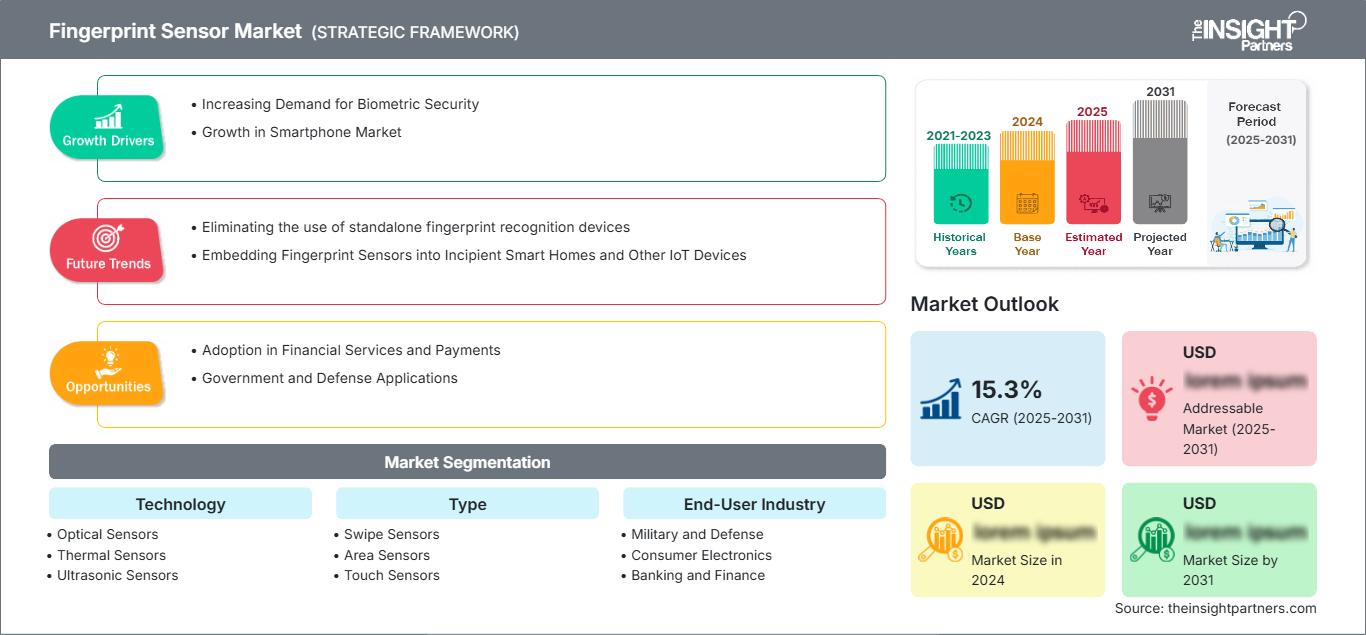
Fingerprint Sensor Market: Strategic Insights
Regional Insights
North America Fingerprint Sensor Market
North America is estimated to account for 34–38% of global Fingerprint Sensor Market revenue in 2025 and is expected to grow at a 10.5–12.0% CAGR through 2034. The regional base capitalizes on the sophistication of its semiconductor technology, mature enterprise security procurement, and the use of identity management systems. Organizations such as government departments, defense departments, financial entities, healthcare entities, and commercial centers constitute key demand segments.
The regional Fingerprint Sensor Market is also characterized by rigorous standards and cybersecurity policies. NIST continues assessing the efficacy of fingerprint matching, identification, image quality, and interoperability in support of procurement environments that emphasize biometric performance. The United States is the key player, with opportunities for Canada and Mexico in the area of enterprise access control, border management, and financial authentication.
U.S. Fingerprint Sensor Market
The U.S. is estimated to represent 82–87% of North American Fingerprint Sensor Market revenue in 2025 and is projected to expand at a 10.0–11.5% CAGR through 2034. Programs for identity management at the federal level, enterprise authentication, financial security, and defense applications offer diverse markets. Solutions based on fingerprinting are now considered in comparison to other types of biometrics such as facial recognition.
Corporate participation is broad, covering component manufacturers, algorithms, systems integrators, and major technology companies. The current focus of biometric research being done by NIST is on accuracy, presentation attack detection, interoperability, and performance among demographic groups. There is increasing emphasis on commercial products that use touch and area approaches compared to government applications.
Europe Fingerprint Sensor Market
Europe is estimated to hold a 21–25% share in 2025 and grow at a 9.5–11.0% CAGR through 2034. Germany holds the top spot for the regional opportunity, trailed by the UK, France, Italy, and Spain. The drivers include enterprise security, digital identity, financial services regulation, and increased use of biometric verification in secure physical spaces.
The UK sits at the sweet spot for financial-service security, government identity programs, border management, and enterprise access systems. Germany enjoys the advantages of industrial automation, automotive engineering, and enterprise security needs. There are solid government and transport security applications in France. In Italy and Spain, opportunities exist in banking, healthcare, commercial access, and tourism-based identity management.
APAC Fingerprint Sensor Market
APAC is estimated at a 42–46% share in 2025 and is projected to grow at a 13.5–15.0% CAGR through 2034. China leads the region, supported by electronics manufacturing and biometric-device integration. Japan and South Korea contribute through advanced semiconductor and display ecosystems, while India provides substantial demand from digital identity and financial inclusion programs.
China, Japan, South Korea, India, and Australia collectively create a diverse demand structure spanning smartphones, payment authentication, government identity, healthcare, and enterprise security. The region's manufacturing concentration supports rapid commercialization of new architectures, while national digitalization policies encourage secure identity infrastructure. WHO's continuing digital-health strategy also supports broader deployment of interoperable digital systems, although biometric adoption remains application-specific.
Middle East & Africa Fingerprint Sensor Market
Middle East & Africa is projected to expand at a 10.0–12.5% CAGR through 2034, with Saudi Arabia leading regional momentum, followed by the UAE and South Africa. Smart-government programs, airport modernization, financial digitization, and secure workforce access are strengthening demand for biometric authentication.
Saudi Arabia and the UAE benefit from investment in digital infrastructure and high-security facilities, while South Africa provides opportunities across banking, government, and commercial security. Rest of MEA demand is more fragmented but can expand as connectivity, identity infrastructure, and digital public services improve. Energy-sector investment also supports authentication requirements at industrial sites where controlled access and workforce accountability are operational priorities.
Segmentation Analysis
Technology
Technology segmentation includes Optical Sensors, Thermal Sensors, Ultrasonic Sensors, Capacitive Sensors, and Pressure Sensors. The technology segment is projected to expand at a 12.0–13.5% CAGR during 2026–2034. Adoption increasingly depends on accuracy, module thickness, power consumption, environmental tolerance, anti-spoofing capability, and compatibility with display or embedded hardware architectures.
- Optical Sensors: Optical Sensors remain important for in-display authentication because imaging principles can support compact integration and broad device compatibility. Demand is strongest where manufacturers prioritize display-area utilization and established optical component ecosystems.
- Thermal Sensors: Thermal Sensors identify ridge-related temperature differences and remain relevant where compact sensing and specialized authentication requirements outweigh the larger installed base of capacitive architectures.
- Ultrasonic Sensors: Ultrasonic Sensors are gaining strategic importance for under-display applications because acoustic sensing can operate through cover materials and support advanced placement flexibility in premium electronic devices.
- Capacitive Sensors: Capacitive Sensors remain widely deployed because electrical ridge detection offers mature manufacturing, low power consumption, rapid authentication, and strong compatibility with established mobile and access-control hardware.
- Pressure Sensors: Pressure Sensors provide opportunities for embedded authentication concepts where force, contact characteristics, or multifunctional sensing can complement fingerprint recognition in specialized devices.
Type
Type covers Swipe Sensors, Area Sensors, and Touch Sensors. The segment is forecast to grow at an 11.5–13.0% CAGR during 2026–2034. Market preference increasingly favors architectures that capture sufficient fingerprint information through a single interaction, reducing authentication time and simplifying user experience across consumer and enterprise applications.
- Swipe Sensors: Swipe Sensors retain relevance in constrained applications where a narrow sensing footprint can reduce hardware requirements. Their use remains concentrated in specialized devices and environments where controlled finger movement is acceptable.
- Area Sensors: Area Sensors provide broad fingerprint capture and support rapid authentication, making them particularly relevant for smartphones, laptops, access systems, and government identity equipment requiring dependable whole-fingerprint acquisition.
- Touch Sensors: Touch Sensors support simple single-contact authentication and align closely with consumer expectations for fast device access. Their integration flexibility also supports payment cards, access control, and embedded authentication designs.
End-User Industry
End-User Industry includes Military and Defense, Consumer Electronics, Banking and Finance, Healthcare, Commercial Security, and Government. The segment is expected to expand at a 13.0–14.5% CAGR through 2034 as authentication requirements diversify beyond personal devices and into identity-intensive institutional environments.
- Military and Defense: Military and Defense applications prioritize identity assurance, controlled facility access, personnel accountability, and resistance to unauthorized entry. Procurement emphasizes ruggedness, secure processing, interoperability, and reliable performance in demanding operating environments.
- Consumer Electronics: Consumer Electronics remains a high-volume deployment environment, with smartphones, laptops, tablets, wearables, and connected devices using fingerprint authentication to combine convenience with device-level security.
- Banking and Finance: Banking and Finance increasingly evaluates fingerprint authentication for secure customer access, employee verification, payment cards, and fraud mitigation. The segment values low false acceptance, strong privacy controls, and transaction convenience.
- Healthcare: Healthcare applications center on controlled access to facilities, systems, medication areas, and sensitive records. Demand is shaped by the need to connect identity assurance with workflow efficiency and data-protection requirements.
- Commercial Security: Commercial Security applications include offices, industrial premises, retail facilities, and restricted areas. Fingerprint systems can reduce dependence on physical credentials while enabling auditable access-management processes.
- Government: Government deployments encompass identity programs, border management, public administration, law enforcement, and secure facilities. Requirements emphasize standardized data formats, scalable matching, privacy governance, and high authentication reliability.
Opportunity Snapshot
| End-User Industry | Revenue Contribution | Trend Tag | Adoption Stage |
|---|---|---|---|
| Military and Defense | Medium | Secure Access | Scaling |
| Consumer Electronics | High | Device Authentication | Mature |
| Banking and Finance | High | Biometric Payments | Scaling |
| Healthcare | Medium | Patient Access | Scaling |
| Commercial Security | Medium | Facility Entry | Scaling |
| Government | High | Digital Identity | Mature |
Fingerprint Sensor Market Growth Drivers and Impact Analysis
Expansion of digital identity and secure authentication infrastructure
There is an increasing extension of fingerprint applications from mobile phones to a broader range of digital identity schemes. Identity management systems run by governments, border control systems, secure identity for employees, and financial authentication require reliable ways of establishing connections between the person and the transactions or services he or she authorizes. The revision of NIST's ANSI/NIST-ITL 1-2025 specification for interoperability of fingerprint and biometrics stresses the need for standardization of information exchange and quantifiable performance. From a commercial perspective, this is leading to a trend towards bigger area scanners, integrated secure processing, and software-based authentication.
Growth of biometric authentication across financial and connected devices
Financial organizations and manufacturers of connected devices view biometrics as an access control tool aimed at lowering credential friction. Fingerprint detection may enable users to unlock devices, authenticate applications, authorize payments, and verify their identities without remembering passwords. According to IATA, 50% of travelers have used biometrics during their journeys through airports. It is a vivid demonstration of how biometric authentication has been normalized within travel-related areas. Such normalization may have an effect on neighboring industries through increasing the user experience of biometric authentication. The market impact should be extended to include payment cards, wearable devices, access control systems, and enterprise applications.
Technology advances in compact and embedded sensing architectures
Sensor innovation is increasing the number of product configurations capable of incorporating fingerprint authentication. Under-display optical and ultrasonic architectures can preserve screen area, while flexible and large-area capacitive approaches enable new placements across devices and surfaces. Egis Technology's portfolio illustrates continuing development in under-display and side-mounted architectures, while Touch Biometrix is pursuing TFT-based large-area sensing. These developments can reduce the design constraints associated with conventional modules and open applications where surface area, thickness, or mechanical integration previously limited adoption. The resulting market impact is a wider technology mix and greater competition around manufacturing yield, power efficiency, module reliability, and integration economics.
Fingerprint Sensor Market Future Trends
Shift toward multimodal and context-aware authentication
The fingerprint Sensor Market trends will continue to focus on systems which authenticate using fingerprints in combination with either facial, iris, device, behavioral or contextual cues. Rather than depending on any single form of biometrics for universal identification, the designers of the systems will use certain modalities based on the risk of the transaction, the environment, user process flow and privacy concerns. The AI-based match can also assist in identifying whether extra authentication is required without involving the repetitive manual process. This type of system will be very useful for government establishments, financial institutions, healthcare setups and enterprises. NEC's recent innovations provide a hint about this trend.
Migration toward flexible, display-integrated, and low-power sensing
The future architecture is expected to focus more on sensors which can be included in displays, flexible surfaces, thin devices, and multimodal interfaces. Improvements in the production process of TFTs as well as the construction of piezoelectric material can help in developing larger sensor surface area without necessarily adding to the thickness of the module. The approach that Touch Biometrix takes in CES 2026 with respect to scalable fingerprinting using TFT technology is a good example of the future trend. Reduced power consumption will continue to be an important consideration since identification happens on battery-powered devices.
Fingerprint Sensor Market Opportunities
Biometric payment and financial authentication expansion
Financial services present an investment opportunity because biometric authentication can connect cardholder identity with transaction authorization while reducing dependence on conventional credentials. Suppliers can target payment-card modules, banking applications, secure terminals, and identity verification infrastructure rather than limiting exposure to handset volumes. Commercialization priorities should include low-power operation, fast matching, secure template handling, and compatibility with established payment ecosystems. Financial institutions also require scalable fraud controls and clear customer consent mechanisms, creating opportunities for vendors that combine sensor hardware with secure processing. Fingerprint Sensor Market Forecasts should therefore consider financial authentication as a distinct expansion pathway capable of diversifying revenue away from mature consumer-device applications.
Government identity and critical-infrastructure deployment
Government identity programs provide another investment pathway because fingerprint authentication can support civil identification, border management, workforce credentials, and restricted-access environments. Vendors should prioritize interoperability, ruggedized hardware, secure enrollment, scalable matching, and lifecycle management when pursuing these contracts. NIST's continuing fingerprint evaluations demonstrate the importance of objective accuracy and standards-based comparison for institutional procurement. Opportunities also extend to airports, energy facilities, defense sites, and public-sector campuses where identity assurance must operate under controlled security policies. The strongest commercial models are likely to combine hardware with software, maintenance, analytics, and system-integration capabilities rather than rely solely on sensor-unit sales.
Recent Developments
- June 2026: NEXT Biometrics secured an additional purchase order valued at NOK 1 million from an existing OEM customer in India under an existing memorandum of understanding (MoU). The order covers NEXT Basalt FAP20 fingerprint sensors, which will be supplied from existing inventory with deliveries starting in Q3 2026. The sensors are intended for verification applications in the global Banking & Finance sector, highlighting continued demand for high-security biometric authentication solutions and the growing role of the Indian market in driving NEXT Biometrics’ order momentum.
- January 2026: RRP Electronics launched Samved, India’s first indigenous fingerprint sensor modules, marking a step toward reducing the country’s reliance on imported biometric hardware. The company introduced two modules, RRP14105 and RRP18125, offering high-resolution, low-power fingerprint sensing with Edge-AI capabilities that enable biometric data processing and authentication directly within the module, without relying on external systems or cloud connectivity.
- November 2025: Synaptics and Qualcomm Technologies entered into a strategic engagement to advance touch and fingerprint sensor technology across mobile and computing platforms, combining Synaptics’ AI-ready touch and fingerprint sensing with Qualcomm’s compute and biometric security capabilities. The collaboration is aimed at enabling seamless integration of touch and fingerprint systems, supporting AI-enhanced security and user experiences across smartphones, tablets, wearables and AI PCs.
Frequently Asked Questions

- Comprehensive Market Sizing and Forecast Analysis
- Detailed Segmentation Analysis
- In-Depth Market Dynamics Assessment
- Regional and Country-Level Insights
- Competitive Landscape and Company Benchmarking
- Strategic Business Intelligence
Recent Reports
Testimonials

The Insight Partners provided valuable market intelligence that supported our global go-to-market strategy. Their team was professional, responsive, and attentive to our feedback, providing thoughtful analysis and helpful methodological clarifications throughout the project.
Junmo Kim Chief Financial Officer (CFO), Enertech Co., Ltd.
The Insight Partners' SCADA System Market report is comprehensive, with valuable insights on current trends and future forecasts. The team was highly professional, responsive, and supportive throughout. We are very satisfied and highly recommend their services.
RAN KEDEM Partner, Reali Technologies LTDs
I requested a report on a very specific software market and the team produced the report in a few days. The information was very relevant and well presented. I then requested some changes and additions to the report. The team was again very responsive and I got the final report in less than a week.
JEAN-HERVE JENN Chairman, Future Analytica
We worked with The Insight Partners for an important market study and forecast. They gave us clear insights into opportunities and risks, which helped shape our plans. Their research was easy to use and based on solid data. It helped us make smart, confident decisions. We highly recommend them.
PIYUSH NAGPAL Sr. Vice President, High Beam Global
The Insight Partners delivered insightful, well-structured market research with strong domain expertise. Their team was professional and responsive throughout. The user-friendly website made accessing industry reports seamless. We highly recommend them for reliable, high-quality research services
YUKIHIKO ADACHI CEO, Deep Blue, LLC.
This is the first time I have purchased a market report from The Insight Partners.While I was unsure at first, I visited their web site and felt more comfortable to take the risk and purchase a market report.I am completely satisfied with the quality of the report and customer service. I had several questions and comments with the initial report, but after a couple of dialogs over email with their analyst I believe I have a report that I can use as input to our strategic planning process.Thank you so much for taking the extra time and making this a positive experience.I will definitely recommend your service to others and you will be my first call when we need further market data.
JOHN SUZUKI President and Chief Executive Officer, Board Director, BK Technologies
I wish to appreciate your support and the professionalism you displayed in the course of attending to my request for information regarding to infectious disease IVD market in Nigeria. I appreciate your patience, your guidance, and the fact that you were willing to offer a discount, which eventually made it possible for us to close a deal. I look forward to engaging The Insight Partners in the future, all thanks to the impression you have created in me as a result of this first encounter.
DR CHIJIOKE ONYIA MANAGING DIRECTOR, PineCrest Healthcare Ltd.Reason to Buy
- Informed Decision-Making
- Understanding Market Dynamics
- Competitive Analysis
- Identifying Emerging Markets
- Customer Insights
- Market Forecasts
- Risk Mitigation
- Boosting Operational Efficiency
- Strategic Planning
- Investment Justification
- Tracking Industry Innovations
- Aligning with Regulatory Trends





 Get Free Sample for