
Flame Detectors Market Trends, Share & Demand by 2034
Coverage: by Product Type (Single IR, Dual UV/IR, Single UV, Triple IR (IR3), and Multi IR); Service Type (Engineering Services, Installation & Design Services, Maintenance Service, Inspection and Managed Services); and Vertical (Oil and Gas industry, Automotive, Consumer Goods and Retail, Healthcare, Energy and Power, Manufacturing, Transportation & Logistics, and Aerospace & Defense), and Geography (North America, Europe, Asia Pacific, and South and Central America)
- Status : Data Released
- Report Code : TIPTE100001028
- Category : Electronics and Semiconductor
- No. of Pages : 150
- Available Report Formats :


- Last update date : August 10, 2026


2025 Market Size
US$ 1.27 Bn
Base year value
2034 Forecast
US$ 2.11 Bn
Projected by 2034
CAGR 2026-2034
5.79 %
Growth rate
Addressable Market
US$ 15.31 Bn
(2026-2034)
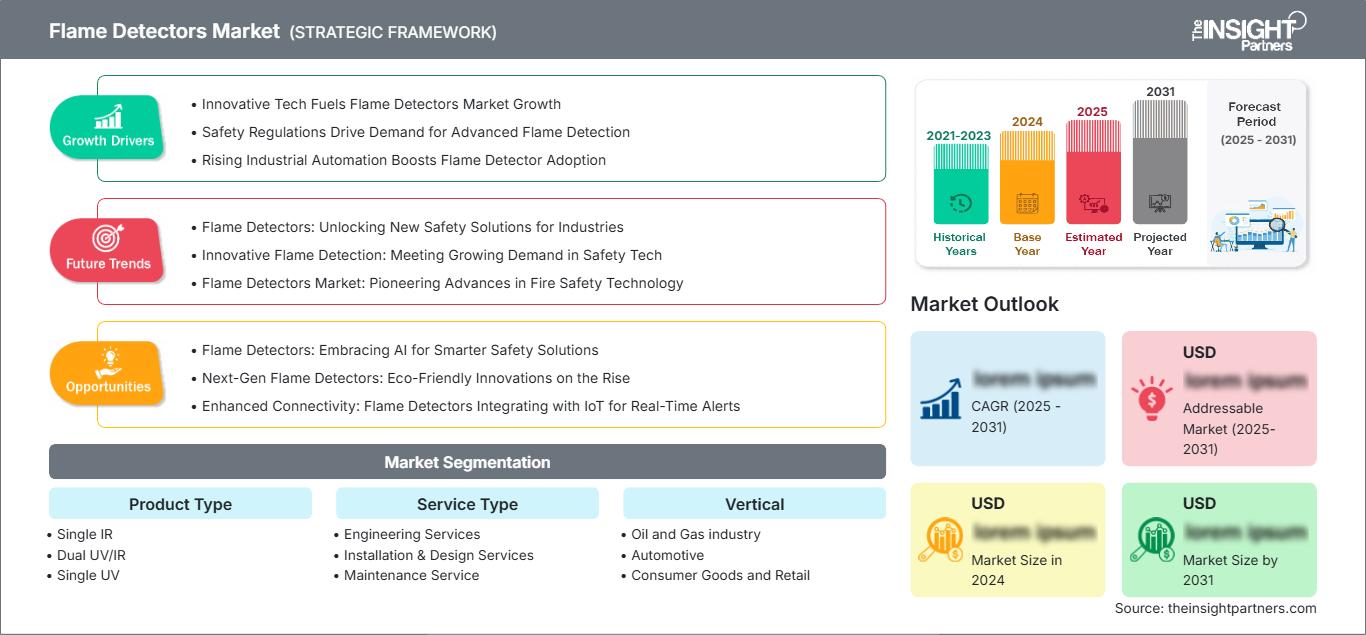
The Flame Detectors Market reached US$ 1.27 Billion in 2025 and is estimated to be US$ 2.11 Billion by 2034, registering a CAGR of 5.79% during 2026-2034. It includes optical-based detectors which recognize flame signatures through the presence of UV, IR, and multi-spectral characteristics of combustion and activate alarm/controls to isolate fuel or suppress the fire in hazardous industrial/commercial/energy and transport applications.
The North America Flame Detectors Market size is forecasted to grow at a CAGR of 5.1-5.8% during 2026-2034, driven by upgrades in refineries, inspections of LNG facilities, protection of battery storage units and due to insurance-mandated upgrades. Demand will also be boosted by NFPA 72 inspection regimen, certification of hazardous areas and procurement preference for less false-alarm devices.
Flame Detectors Market Assessment and Insights
- North America held 34–37% share in 2025 and is growing at a CAGR of 5.1–5.8% during 2026–2034, led by petrochemical replacement demand, LNG terminals, and data-center fire safety upgrades.
- US represented 79–83% of North American revenue in 2025 and is growing at a CAGR of 5.2–5.9% during 2026–2034.
- Europe accounted for 22–25% share in 2025 and is growing at a CAGR of 4.8–5.5% during 2026–2034, led by Germany, the UK, France, Italy, and Spain.
- Asia Pacific held 25–28% share in 2025 and is growing at a CAGR of 6.2–6.9% during 2026–2034, led by China, India, Japan, South Korea, and Australia.
- Largest Segment Triple IR Multi IR held 39–42% market share in 2025 and is growing at a CAGR of 6.0–6.7% during 2026–2034.
- High Growth Segment Inspection and Managed Services represented 17–20% market share in 2025 and is growing at a CAGR of 6.6–7.3% during 2026–2034.
- Key companies analyzed in detail: Honeywell International Inc.; Siemens AG; Johnson Controls plc; Emerson Electric Co.; RTX Corporation; Robert Bosch GmbH; MSA Safety Incorporated; Tyco International Limited; Spectrex Inc.; Micropack Engineering Ltd.
Source: The Insight Partners' analysis based on proprietary research, government publications, company annual reports, investor presentations, industry databases, and expert interviews.
The fire detector market has progressed from simple UV detectors to diagnostics-enabled optical systems comprising triple infrared detection, UV/IR verification, heated windows, event recording, and communication outputs. Industrial processes have started to focus on certifications of electronics, stainless-steel enclosure, hazardous area approval, and factory calibration. The market requirements have also been influenced by system integration solutions involving coordination between flame detectors, gas detectors, emergency shut down, and suppression systems in refineries, terminals, turbine housing, hangars, and production lines.
Investments are being made towards Asia Pacific, Middle East, and North American energy regions where hydrocarbons processing, hydrogen demonstrations, lithium-ion battery energy storage, aircrafts, and automation industry require faster detection with less false alarms. Conformity with NFPA 72, EN 54, IECEx, ATEX, and SIL standards has enabled replacements cycles. Users are increasingly preferring service-enabled products that make proof testing and diagnostics simpler.
Flame Detectors Market Report Scope
| Report Attribute | Details |
|---|---|
| Market size in 2025 | US$ 1.27 Billion |
| Market Size by 2034 | US$ 2.11 Billion |
| Global CAGR (2026 - 2034) | 5.79% |
| Historical Data | 2021-2024 |
| Forecast period | 2026-2034 |
Flame Detectors Market Analysis
Drivers in the market are the requirement for safety in hazard areas, turnarounds at refineries, safety in LNG facilities, turbine housings, and energy storage sites. Supply chain in the market includes optical sensors, electronics, explosion-proof housing, testing labs, engineering firms, system integrators, alarm panels, and services.
The supply side is impacted by component qualification processes, hazardous areas certification, and projects-driven purchasing cycle. In Flame Detectors Market report it was found that multi-wavelength and triple IR types of flame detectors become preferred if there is a possibility of triggering false alarms due to sunlight, welding, hot surfaces, or flaring.
Competition is driven by providers of safety automation products and specialized manufacturers of hazard detection products. Honeywell International Inc., Siemens AG, Johnson Controls plc, Emerson Electric Co., Robert Bosch GmbH, MSA Safety Incorporated, Spectrex Inc., and Micropack Engineering Ltd. compete on approval ratings, detection capability, false alarm elimination capabilities, communication protocols, and service networks.
Trends for investments will include diagnostic systems, automated testing systems, smart commissioning services, and integration with plant control systems. RTX Corporation and Tyco International Limited continue to have relevance due to their legacy fire and security product lines, while Emerson Electric Co. profits from its Det-Tronics and Spectrex technology.
● REPORT CUSTOMIZATION
Tailor This Report To Align With Your Specific Business Requirements
This report can be customized to align precisely with your business objectives, scope, and target markets. Customization options include tailored segmentation, geography, competitive analysis, and strategic insights to support informed decision-making.
Customize This Report →WHAT YOU CAN ADJUST
- ● Segmentations
- ● Geography
- ● Competitive Analysis
- ● Language Preferences
Flame Detectors Market: Strategic Insights
Regional Insights
North America Flame Detectors Market
North America accounted for 34–37% of Flame Detectors Market share in 2025 and is projected to grow at a CAGR of 5.1–5.8% during 2026–2034. Demand is supported by oil and gas process safety, petrochemical modernization, battery-storage installations, and code-based inspection regimes.
The NFPA 72 is still a useful guide for the designing and maintenance of alarms; insurers are also becoming more generous to low false-alarm systems. Honeywell International Inc., Johnson Controls plc, Emerson Electric Co., Siemens AG, MSA Safety Incorporated, and Spectrex Inc. are companies that back the installation of bases in various facilities.
U.S. Flame Detectors Market
In 2025, the U.S. constituted 79%–83% of North America's share and is projected to witness a CAGR of 5.2%–5.9% between 2026 and 2034. There is considerable application demand in applications such as refining, LNG, petrochemicals, aerospace, battery storage, turbine rooms, and critical manufacturing facilities.
Market position will be strengthened by vendors such as Honeywell International Inc., Emerson Electric Co., Johnson Controls plc, Siemens AG, MSA Safety Incorporated, and Spectrex Inc. Purchasers value FM, UL, ATEX, IECEx, and SIL certification along with diagnostics which mitigate the risk of process downtime and facilitate auditing.
Europe Flame Detectors Market
The European region had a market share of 22–25% in 2025, growing at a CAGR of 4.8–5.5% for 2026–2034. The European countries have Germany leading through its processes involving chemical processing, automotive production, and industrial automation. In the UK, the driving factor is offshore energy, aviation, and high-hazard infrastructure.
The demand drivers for France, Italy, and Spain are refineries, logistics, consumer goods production, and transportation services. The EN 54 product category, ATEX standards, and plant maintenance services benefit suppliers having approvals. Key players include Siemens AG, Robert Bosch GmbH, Honeywell International Inc., Johnson Controls plc, and Micropack Engineering Ltd.
APAC Flame Detectors Market
Asia-Pacific is the fastest-growing market between 2025 and 2028 with a market share of 25–28%, and is expected to register growth at a CAGR of 6.2–6.9% from 2026 to 2034. The leading countries include China through chemicals, power, battery production, and automation in industries, whereas India through refining, city gas, and manufacturing safety programs.
Japan and South Korea invest in high-reliability equipment in electronics, shipbuilding, and energy installations, with Australia in mining, LNG, and logistics applications. Increased support for domestic manufacturing plants and strict plant safety regulations contribute to higher adoption of the Market.
Middle East & Africa Flame Detectors Market
MEA is expected to experience growth in the CAGR range of 5.7%-6.4% between 2026-2034. The key driver for MEA is Saudi Arabia by virtue of oil, gas, petrochemical, and large infrastructure projects. The UAE comes second due to aviation, logistics, and sophisticated commercial properties.
The key drivers for South Africa and Rest of MEA include mining, power, ports, and industrial estates. There is an increased use of liquefied natural gas, as well as hydrogen-ready energy solutions. This calls for the need of multi-spectrum detection.
Segmentation Analysis
Product Type
Product Type is projected to grow at a CAGR of 5.7–6.4% during 2026–2034. Flame Detectors Market scope covers Single IR, Dual UV/IR, Single UV, and Triple IR Multi IR devices. Selection depends on fuel type, viewing distance, sunlight exposure, smoke conditions, and certification needs. Triple IR Multi IR leads because it improves hydrocarbon fire detection while reducing nuisance alarms in outdoor process areas.
- Single IR detectors serve boiler fronts, turbine areas, and indoor combustion monitoring where infrared signatures are clear, installation costs matter, and maintenance teams need straightforward testing procedures.
- Dual UV/IR detectors balance fast flame recognition with confirmation logic, making them useful in chemical, aviation, and manufacturing zones where welding, sunlight, or hot equipment can create interference.
- Single UV devices remain relevant for fast-response applications in controlled spaces, especially where hydrocarbon vapor ignition must be detected quickly and optical obstruction is limited.
- Triple IR Multi IR systems dominate high-risk outdoor assets because multiple infrared bands improve discrimination, extend operating range, and reduce false alarms around flares, sunlight, rain, and heated surfaces.
Service Type
Service Type is forecast to grow at a CAGR of 6.0–6.7% during 2026–2034. Engineering, installation, maintenance, inspection, and managed services are becoming more strategic as owners standardize safety documentation, proof-test intervals, detector mapping, and lifecycle replacement. Service intensity rises when plants integrate flame detection with gas monitoring, emergency shutdown, and suppression systems.
- Engineering Services define hazard zones, detector coverage, viewing angles, voting logic, and alarm interfaces, helping owners avoid blind spots and align designs with authority and insurer expectations.
- Installation & Design Services support cable routing, mounting height, environmental protection, commissioning, and control-panel integration, especially in brownfield sites where shutdown windows are short.
- Maintenance Service protects uptime through cleaning, calibration checks, functional testing, firmware review, and replacement planning for detectors exposed to dust, salt, vibration, heat, or process residue.
- Inspection and Managed Services are gaining strategic weight as asset owners outsource compliance records, performance audits, proof-test scheduling, spares planning, and remote diagnostics across multi-site operations.
Vertical
Vertical is expected to grow at a CAGR of 5.8–6.5% during 2026–2034. Oil and gas remains the anchor vertical, while automotive, healthcare, power, manufacturing, logistics, and aerospace adopt certified detection where combustible liquids, gases, battery systems, or enclosed test environments elevate fire risk. Procurement increasingly favors integrated safety architectures rather than standalone devices.
- Oil and Gas industry remains the largest vertical because refineries, LNG plants, pipelines, tank farms, offshore assets, and compressor stations require certified detection for rapid shutdown and suppression.
- Automotive demand is tied to paint shops, battery assembly, engine testing, fuel handling, and hydrogen pilots where optical detection can limit escalation in automated production cells.
- Consumer Goods and Retail uses flame detection in warehouses, packaging operations, distribution hubs, and large retail facilities where combustible inventories and lithium-powered equipment raise protection needs.
- Healthcare adoption focuses on laboratories, oxygen-rich areas, sterilization rooms, backup power systems, and pharmaceutical production zones requiring reliable alarms without unnecessary service disruption.
- Energy and Power applications include gas turbines, coal handling, hydrogen blending, battery storage, substations, and renewable-support infrastructure where fast thermal-event recognition protects critical assets.
- Manufacturing relies on detectors for furnaces, paint lines, chemical handling, robotics, welding-adjacent processes, and material storage where production stoppages and insurance exposure are costly.
- Transportation & Logistics adoption is rising in airports, ports, rail facilities, depots, fleet maintenance, and automated warehouses handling fuels, batteries, chemicals, and high-value cargo.
- Aerospace & Defense requires high-reliability detection for hangars, test cells, fuel farms, propulsion labs, and mission-critical facilities where rapid response and approval documentation are essential.
Opportunity Snapshot
| Vertical | Revenue Contribution | Trend Tag | Adoption Stage |
| Oil and Gas industry | High | LNG Safety | Mature |
| Automotive | Medium | Battery Lines | Scaling |
| Consumer Goods and Retail | Medium | Warehouse Risk | Scaling |
| Healthcare | Low | Lab Safety | Emerging |
| Energy and Power | High | Hydrogen Assets | Scaling |
| Manufacturing | High | Process Lines | Mature |
| Transportation & Logistics | Medium | Port Safety | Scaling |
| Aerospace & Defense | Medium | Hangar Protection | Mature |
Flame Detectors Market Growth Drivers and Impact Analysis
High-hazard energy assets require faster optical detection
Refineries, LNG facilities, tank farms, compressor stations, and turbine packages work under conditions involving flammable substances and pressurized equipment wherein seconds could mean the difference between how dangerous an incident escalates. There is increased use of the Flame Detectors Market because of the advantage of optical sensing, enabling a facility to close down valves, trigger a deluge system, and sound an alarm even before heat and smoke sensors act. The use of energy transition plans by the International Energy Agency has focused the industry more on hydrogen that has a less visible flame and needs proper UV/IR or multispectrum coverage.
Codes, insurers, and audits convert safety intent into purchases
The codes for fire alarms, hazardous-location standards, and insurers' expectations have begun making flame detection no longer optional but a documented necessity. NFPA 72 covers fire alarm systems' design, testing, and maintenance, while EN 54, ATEX, IECEx, FM, UL, and SIL are affecting selection of products in international installations. More and more owners of plants insist on providing evidence of test results, diagnostics, and certification of the detection equipment used in order to protect themselves in case of audit. The positive side for the suppliers is that in such situation they will have to prove not only the efficiency but also reliability and conformity of their solution.
Automation and remote operations raise reliability expectations
There is increased automation and reduced staffing on industrial facilities, along with digital monitoring in particular at offshore rigs, pipeline facilities, battery facilities, warehouses, and utilities. In such conditions, false alarms may interfere with operations, whereas missing alarms would result in huge losses. There is thus increasing demand for self-diagnostic, event logging, infrared-heated, communication-capable sensors, as well as integration into distributed control systems. Operators require management-based inspection schemes that ensure the functionality of their devices without frequent downtimes. There is thus a higher price being paid for reliable products and services ensuring high availability, minimized rounds, and faster reaction to incidents from central control rooms.
Flame Detectors Market Future Trends
AI-assisted optical analytics reduce nuisance alarms
Flame Detectors Market trends point toward AI-assisted optical processing that distinguishes true combustion from welding arcs, sunlight reflections, hot equipment, steam, and routine flare activity. The next product cycle will combine multi-band sensing, video confirmation, and device-health analytics to reduce unnecessary shutdowns without weakening response speed. This shift matters because industrial users increasingly measure detector value by avoided downtime as well as safety performance. Vendors with strong software validation, cybersecurity discipline, and field datasets will be better positioned as networked fire systems become part of broader asset-integrity platforms.
Hydrogen and battery environments reshape detector specifications
Hydrogen production, battery gigafactories, energy-storage arrays, and electrified logistics hubs will push detector specifications beyond traditional hydrocarbon assumptions. Hydrogen flames can be difficult to see, while battery events may begin with gas release, heat, or localized combustion in dense racks. Future procurement will therefore scrutinize spectral sensitivity, response time, field of view, and integration with gas, smoke, and thermal monitoring. Suppliers that can document performance across these emerging hazards will gain credibility with utilities, automakers, data-center operators, and industrial insurers seeking defensible protection strategies.
Flame Detectors Market Opportunities
Managed lifecycle services for multi-site industrial operators
Flame Detectors Market Forecasts support investment in inspection and managed services for refineries, chemical plants, battery factories, ports, and power assets operating across several locations. Owners need standardized detector registers, proof-test records, spare-part planning, and alarm performance reviews that remain consistent despite contractor turnover. Service providers can create recurring revenue by combining site surveys, compliance documentation, remote diagnostics, and replacement roadmaps. The opportunity is strongest where plants already use certified detectors but lack centralized visibility into device health, nuisance alarms, or upcoming obsolescence risks.
Emerging industrial corridors need certified mid-range systems
New manufacturing, logistics, energy, and petrochemical corridors in India, Southeast Asia, the Gulf, Africa, and Latin America create demand for certified devices that balance performance and cost. Many projects need UV/IR or triple IR protection but cannot justify premium configurations across every zone. Vendors can win by offering scalable detector families, local commissioning partners, training, and rapid spare availability. This opportunity rewards companies that translate global certifications into practical project packages for contractors, EPC firms, and plant owners building safety infrastructure from the ground up.
Recent Developments
- July 2026: Emerson announced a new flameproof model for the Rosemount 965 Flame Detector, adding hazardous-location certification for applications where reliable hydrocarbon flame detection is required. The new model combines QuadSense technology, factory-calibrated-for-life operation, broad integration options and rugged enclosure protection to support fire protection strategies matched to application needs.
- November 2025: Ciqurix Ltd has become the first company in the world to achieve certification to LPCB’s new LPS 1976 Video Flame Detection Standard, with its FC-XFP detectors (part of the Ciqurix CORE System) now approved under Certificate No. 1852a and listed on RedBook Live. LPS 1976 is the first research-based benchmark for intelligent video flame detection, confirming the CORE System’s independently verified performance, reliability and false-alarm resilience.
- May 2025: Baker Hughes, an energy technology company, announced Thursday the launch of an advanced flame detection technology, Flame Tracker Increased Low Gain (ILG), designed to enhance flame sensing capabilities on gas turbines. Flame sensors are crucial safety devices in gas turbines that detect the presence of a flame in the combustor section. They provide early warnings if the flame is lost or unstable, triggering a shutdown sequence to prevent turbine damage and minimize hazards, including explosions from unburned fuel buildup. However, the performance of a flame sensor is dependent on its ability to sense light.
Frequently Asked Questions

- Comprehensive Market Sizing and Forecast Analysis
- Detailed Segmentation Analysis
- In-Depth Market Dynamics Assessment
- Regional and Country-Level Insights
- Competitive Landscape and Company Benchmarking
- Strategic Business Intelligence
Recent Reports
Testimonials

The Insight Partners provided valuable market intelligence that supported our global go-to-market strategy. Their team was professional, responsive, and attentive to our feedback, providing thoughtful analysis and helpful methodological clarifications throughout the project.
Junmo Kim Chief Financial Officer (CFO), Enertech Co., Ltd.
The Insight Partners' SCADA System Market report is comprehensive, with valuable insights on current trends and future forecasts. The team was highly professional, responsive, and supportive throughout. We are very satisfied and highly recommend their services.
RAN KEDEM Partner, Reali Technologies LTDs
I requested a report on a very specific software market and the team produced the report in a few days. The information was very relevant and well presented. I then requested some changes and additions to the report. The team was again very responsive and I got the final report in less than a week.
JEAN-HERVE JENN Chairman, Future Analytica
We worked with The Insight Partners for an important market study and forecast. They gave us clear insights into opportunities and risks, which helped shape our plans. Their research was easy to use and based on solid data. It helped us make smart, confident decisions. We highly recommend them.
PIYUSH NAGPAL Sr. Vice President, High Beam Global
The Insight Partners delivered insightful, well-structured market research with strong domain expertise. Their team was professional and responsive throughout. The user-friendly website made accessing industry reports seamless. We highly recommend them for reliable, high-quality research services
YUKIHIKO ADACHI CEO, Deep Blue, LLC.
This is the first time I have purchased a market report from The Insight Partners.While I was unsure at first, I visited their web site and felt more comfortable to take the risk and purchase a market report.I am completely satisfied with the quality of the report and customer service. I had several questions and comments with the initial report, but after a couple of dialogs over email with their analyst I believe I have a report that I can use as input to our strategic planning process.Thank you so much for taking the extra time and making this a positive experience.I will definitely recommend your service to others and you will be my first call when we need further market data.
JOHN SUZUKI President and Chief Executive Officer, Board Director, BK Technologies
I wish to appreciate your support and the professionalism you displayed in the course of attending to my request for information regarding to infectious disease IVD market in Nigeria. I appreciate your patience, your guidance, and the fact that you were willing to offer a discount, which eventually made it possible for us to close a deal. I look forward to engaging The Insight Partners in the future, all thanks to the impression you have created in me as a result of this first encounter.
DR CHIJIOKE ONYIA MANAGING DIRECTOR, PineCrest Healthcare Ltd.Reason to Buy
- Informed Decision-Making
- Understanding Market Dynamics
- Competitive Analysis
- Identifying Emerging Markets
- Customer Insights
- Market Forecasts
- Risk Mitigation
- Boosting Operational Efficiency
- Strategic Planning
- Investment Justification
- Tracking Industry Innovations
- Aligning with Regulatory Trends





 Get Free Sample for