
Flexible Hybrid Electronics (FHE) Market Share, Growth & Demand by 2034
Coverage: By Type (Display, Health Performance Tools, Security Tags, Sensors Componentry); End User (Automotive, Consumer Electronics, Healthcare, Industrial Sector, Military and Defense) , and Geography (North America, Europe, Asia Pacific, and South and Central America)
- Status : Data Released
- Report Code : TIPRE00016972
- Category : Electronics and Semiconductor
- No. of Pages : 150
- Available Report Formats :


- Last update date : September 09, 2026


2025 Market Size
US$ 14,252.33 Mn
Base year value
2034 Forecast
US$ 29,870.06 Mn
Projected by 2034
CAGR 2026-2034
8.57 %
Growth rate
Addressable Market
US$ 197,888.34 Mn
(2026-2034)
The Flexible Hybrid Electronics Market was valued at US$ 14,252.33 Million in 2025 and is projected to reach US$ 29,870.06 Million by 2034, expanding at a CAGR of 8.57% during 2026–2034. Growth is supported by increasing integration of flexible substrates, printed conductors, semiconductor devices, sensors, and embedded processing into lightweight electronic systems. Adoption is broadening across automotive, healthcare, consumer electronics, industrial, and defense applications.
North America remains a significant technology development and commercialization center, with an estimated 7.8–8.8% CAGR during 2026–2034. Demand is supported by defense-funded electronics programs, wearable healthcare technologies, advanced sensing, and domestic manufacturing initiatives. The Flexible Hybrid Electronics Market size is also influenced by investment in additive electronics, heterogeneous integration, flexible sensors, and low-profile systems designed for applications where conventional rigid electronics face form-factor limitations.
Flexible Hybrid Electronics (FHE) Market Assessment and Insights
- North America: North America held approximately 31–33% Flexible Hybrid Electronics Market share in 2025 and is projected to grow at a 7.8–8.8% CAGR between 2026–2034, supported by defense programs, advanced healthcare wearables, electronics manufacturing, and strong R&D infrastructure.
- US: The US represented approximately 82–86% of North American revenue in 2025 and is expected to grow at a 7.9–8.9% CAGR between 2026–2034, led by defense, healthcare, and industrial applications.
- Europe: Europe accounted for approximately 23–25% share in 2025 and is forecast to expand at a 7.4–8.4% CAGR between 2026–2034, with Germany, the UK, France, Italy, and Spain supporting automotive, industrial, and healthcare adoption.
- Asia Pacific: Asia Pacific represented approximately 34–36% share in 2025 and is anticipated to register an 8.8–9.8% CAGR between 2026–2034, led by China, Japan, South Korea, India, and Taiwan through electronics manufacturing and automotive applications.
- Largest Segment: Display represented approximately 38–42% market share in 2025 and is projected to grow at a 7.8–8.6% CAGR during 2026–2034, supported by flexible interfaces and embedded display applications.
- High Growth Segment: Health Performance Tools accounted for approximately 15–19% market share in 2025 and is expected to expand at a 9.8–10.8% CAGR during 2026–2034, driven by wearable and continuous-monitoring applications.
- Key companies analyzed in detail: American Semiconductor, Inc., Brewer Science, Inc., DuPont de Nemours Inc., Epicore Biosystems, Inc., Flex Ltd., General Electric Company, Integrity Industrial Inkjet Integration, Inc., Lockheed Martin Corporation, PARC (Xerox Corporation), and SI2 Technologies.
Source: The Insight Partners' analysis based on proprietary research, government publications, company annual reports, investor presentations, industry databases, and expert interviews.
From experimental flexible circuitry to integrated systems involving thin semiconductors, printing conductors, sensors, antennas, displays, and flexible substrates, the technology base has evolved. The future development will include heterogeneous integration, manufacturing development, additive processes, and testing for reliability. Conformal electronics are thus created for applications on wearable technology, automobiles, industrial machinery, and military systems, along with weight reduction and increased integration flexibility.
Future development will include scalability of manufacturing processes, reliability, intelligence, and regional manufacturing capabilities. Public-private initiatives will further accelerate the maturing of technology, while electrification of automobiles, connected health care, industrial sensing applications, and defense modernization will provide additional application routes. Europe and the Asia Pacific regions will be developing research and manufacturing ecosystems, while North America will continue to leverage government support for commercialization of electronics.
Flexible Hybrid Electronics (FHE) Market Report Scope
| Report Attribute | Details |
|---|---|
| Market size in 2025 | US$ 14,252.33 Million |
| Market Size by 2034 | US$ 29,870.06 Million |
| Global CAGR (2026 - 2034) | 8.57% |
| Historical Data | 2021-2024 |
| Forecast period | 2026-2034 |
Flexible Hybrid Electronics (FHE) Market Analysis
Flexible Hybrid Electronics Market trends are driven by the need for devices which can be integrated in bent surfaces, operate in confined spaces and incorporate sensors along with processing functionalities. Flexible electronics value chain involves semiconductor suppliers, flexible substrate suppliers, conductive material providers, printed electronics providers, assembly providers, system integrators and end users. American Semiconductor, Brewer Science and other technology providers are part of value chain through material, packaging, integration and sensors development.
Market supply factors include substrates quality, conductive inks, semiconductor integration, printing accuracy, assembly yield and reliability requirement. Manufacturing process is still more application oriented as compared to manufacturing of conventional electronics because many systems require customization and integration process for specific systems. Therefore, scaling involves repeatable manufacturing, standardized design approach and qualification processes which are capable to transfer the prototype into commercially viable volume without compromising on flexibility and electrical characteristics.
The Flexible Hybrid Electronics Market report highlights the competitive landscape with regards to materials, manufacturing, system integration and application oriented engineering. Materials and manufacturing capabilities have been provided by DuPont de Nemours Inc., while Flex Ltd. provides manufacturing and integration capabilities. American Semiconductor, Inc. specializes in flexible semiconductors integration, while Brewer Science, Inc. has capabilities in materials and printed sensors technology. Lockheed Martin Corporation and SI2 Technologies provide defense oriented capabilities.
Increasing investments are focused on additive manufacturing, flexible sensing, advanced packaging and scalable manufacturing capabilities. PARC (Xerox Corporation) has capabilities for research in printed and hybrid electronics, while General Electric Company has industrial engineering and advanced manufacturing capabilities. Epicore Biosystems, Inc. specializes in wearable sensing technology, while Integrity Industrial Inkjet Integration, Inc. has specialized printing and integration capabilities. The competitive positioning is dependent on reliability, manufacturability, application engineering and scalability capability.
● REPORT CUSTOMIZATION
Tailor This Report To Align With Your Specific Business Requirements
This report can be customized to align precisely with your business objectives, scope, and target markets. Customization options include tailored segmentation, geography, competitive analysis, and strategic insights to support informed decision-making.
Customize This Report →WHAT YOU CAN ADJUST
- ● Segmentations
- ● Geography
- ● Competitive Analysis
- ● Language Preferences
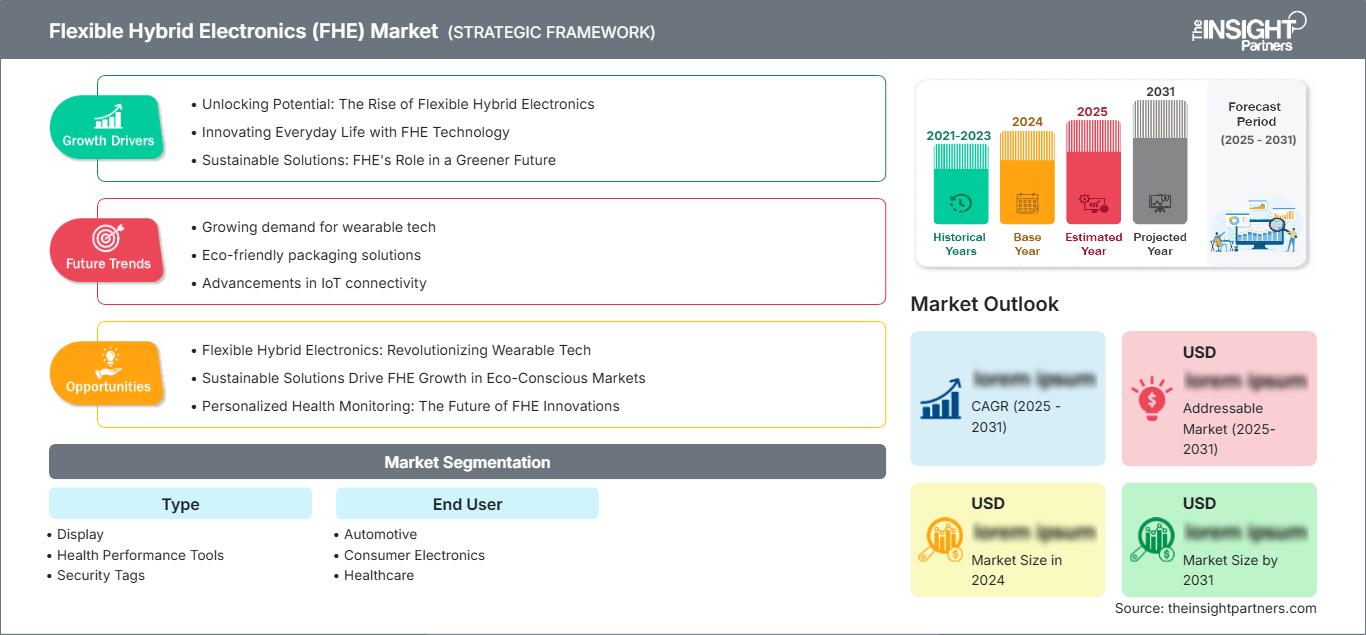
Flexible Hybrid Electronics (FHE) Market: Strategic Insights
Regional Insights
North America Flexible Hybrid Electronics Market
North America accounted for approximately 31–33% Flexible Hybrid Electronics Market in 2025 and is expected to grow at a 7.8–8.8% CAGR through 2034. Advantages for the area include robust defense R&D, healthcare technology innovation, advanced manufacturing, semiconductor capabilities, and existing research institutions. Government initiatives in the United States for flexible and hybrid electronics have led to the establishment of manufacturing capabilities, workforce capabilities, and commercialization pathways. NextFlex reported 219 member organizations and 425 technology projects as of September 2025.
The US is the dominant regional market since customers from defense, aerospace, healthcare, automotive, and industrial sectors are assessing lightweight and conformal electronics for use in wearable soldier systems, flexible sensors, smart labels, medical patches, and embedded monitoring. Advanced manufacturing and healthcare technology form the contribution of Canada. Regional manufacturers are focusing on scalability, qualification, and integration of flexible technologies into semiconductor architectures.
U.S. Flexible Hybrid Electronics Market
The US represented approximately 82–86% of North American Flexible Hybrid Electronics Market revenue in 2025 and is projected to expand at a 7.9–8.9% CAGR through 2034. Government-sponsored R&D and defense upgrades will continue to drive demands, along with expanding applications in healthcare and sensing applications in the industry sector. Companies like American Semiconductor, Inc., Brewer Science, Inc., Lockheed Martin Corporation, SI2 Technologies, and PARC (Xerox Corporation) are all players at different levels in the ecosystem.
Increasing applications in the healthcare sector include continuous monitoring and conformal wearable applications, while the defense sector includes lightweight sensing, communications, and soldier-wearable electronics. Flexible displays, sensing surfaces, and embedded monitoring are some automotive applications. Industrial applications include flexible sensors for those applications where rigid sensors cannot be installed. Public funding, R&D infrastructure, and specific suppliers help maintain US position as the primary development center in North America.
Europe Flexible Hybrid Electronics Market
Europe accounted for approximately 23–25% Flexible Hybrid Electronics Market share in 2025 and is projected to grow at a 7.4–8.4% CAGR through 2034. Germany is a leader in regional adoption due to automotive engineering, industrial automation, materials science, and electronics manufacturing. The UK is another market with strong capabilities in research, while France, Italy, and Spain can offer more options in aerospace, healthcare, automotive, and industrial sectors.
Germany can be considered a leading European Flexible Hybrid Electronics market since automotive engineering and industrial technology firms need lightweight sensing, human interface devices, and embedded electronics. The UK will have aerospace, healthcare, and research programs available, while France has defense and transportation opportunities. Italy and Spain will have development of applications in industrial machinery, automotive parts, medical equipment, and consumer products.
APAC Flexible Hybrid Electronics Market
APAC represented approximately 34–36% share in 2025 and is forecast to expand at an 8.8–9.8% CAGR through 2034. China leads regional demand through electronics manufacturing and automotive production, while Japan and South Korea contribute advanced materials, displays, semiconductors, and industrial technologies.
India is developing opportunities through electronics manufacturing and healthcare digitization, while Australia contributes specialized research and defense applications. Regional growth is supported by manufacturing scale, automotive electrification, consumer electronics, and government-backed electronics initiatives. The concentration of display, semiconductor, flexible-circuit, and contract manufacturing capabilities provides APAC with strong commercialization potential for FHE technologies.
Middle East & Africa Flexible Hybrid Electronics Market
Middle East and Africa represent an emerging opportunity, supported by defense modernization, healthcare digitization, industrial automation, and smart-infrastructure investment. Saudi Arabia and the UAE are leading regional adopters, while South Africa provides an established technology and industrial base. Demand remains smaller than North America, Europe, and APAC but is expanding from specialized applications.
Energy infrastructure creates opportunities for flexible sensing, equipment monitoring, and predictive maintenance, while defense applications can benefit from lightweight conformal electronics. Healthcare programs may support wearable monitoring and flexible diagnostic technologies. The Rest of MEA remains at an earlier adoption stage, with development dependent on local manufacturing capability, technology partnerships, and investment in advanced electronics infrastructure.
Segmentation Analysis
Type
Type segmentation is led by Display, reflecting the suitability of flexible electronics for curved interfaces, lightweight devices, automotive interiors, and emerging wearable platforms. The segment is expected to expand at a 7.8–8.6% CAGR during 2026–2034. Flexible displays also create integration opportunities with sensors, controls, and embedded computing.
- Display: Represents the leading type because flexible interfaces support curved surfaces, lightweight product designs, automotive displays, wearable devices, and compact consumer electronics requiring improved design flexibility.
- Health Performance Tools: Supports wearable monitoring and physiological measurement applications, combining sensors, flexible substrates, and electronic processing. Adoption is increasing as healthcare moves toward continuous and decentralized monitoring.
- Security Tags: Enables flexible identification, authentication, tracking, and condition-monitoring formats. Its strategic value comes from integration into packaging, assets, logistics systems, and security-sensitive products.
- Sensors Componentry: Supports flexible pressure, temperature, strain, biochemical, and environmental sensing. Integration into surfaces and constrained spaces creates opportunities across industrial, healthcare, automotive, and defense environments.
End User
End User demand is projected to increase at a 8.2–9.2% CAGR during 2026–2034, with healthcare, automotive, and defense applications providing important expansion pathways. The Flexible Hybrid Electronics Market scope is broadening as flexible components become more manufacturable and reliable across demanding operating environments.
- Automotive: Uses flexible electronics for displays, sensing, human-machine interfaces, lighting, and interior integration. Lightweight architectures can improve packaging flexibility while supporting increasingly software-defined vehicle designs.
- Consumer Electronics: Represents a major application environment for flexible displays, wearable systems, smart accessories, and compact electronics where form factor and user interaction influence product design.
- Healthcare: Uses conformal sensors, wearable monitoring devices, diagnostic patches, and flexible interfaces. The segment benefits from demand for continuous monitoring and more patient-centric device formats.
- Industrial Sector: Applies flexible sensors and embedded electronics to machinery, equipment surfaces, logistics assets, and industrial monitoring. Adoption is driven by applications where rigid sensors are difficult to position.
- Military and Defense: Uses lightweight, conformal electronics for sensing, communications, identification, wearable systems, and aerospace platforms. Procurement priorities emphasize reliability, weight reduction, survivability, and field performance.
Opportunity Snapshot
| End User | Revenue Contribution (High/Medium/Low) | Trend Tag | Adoption Stage |
|---|---|---|---|
| Automotive | High | Smart Interiors | Scaling |
| Consumer Electronics | High | Flexible Displays | Mature |
| Healthcare | Medium | Wearable Monitoring | Scaling |
| Industrial Sector | Medium | Surface Sensing | Emerging |
| Military and Defense | Medium | Soldier Systems | Scaling |
Flexible Hybrid Electronics (FHE) Market Growth Drivers and Impact Analysis
Demand for Lightweight and Conformal Electronic Systems
Flexible hybrid architectures address a growing engineering requirement: integrating electronic functionality into surfaces and spaces where conventional rigid circuit boards are difficult to deploy. Weight reduction is particularly valuable in aerospace, defense, wearable healthcare, and automotive applications, where every gram can affect system design or user comfort. Conformal sensing also allows electronics to follow curved structures and distributed surfaces, improving measurement coverage. As product designers increasingly prioritize compactness, flexibility, and embedded functionality, FHE provides an alternative integration approach that combines established semiconductor performance with flexible substrates. The resulting market impact extends across components, assembly services, materials, and specialized manufacturing equipment, creating opportunities for suppliers capable of delivering qualified systems at repeatable production volumes.
Expansion of Wearable and Continuous Health Monitoring
Healthcare is creating a distinct pathway for flexible electronics through wearable sensors, skin-conformal patches, and continuous physiological monitoring. Flexible systems can reduce device bulk while improving contact with the body, enabling applications such as sweat analysis, temperature monitoring, hydration assessment, and other physiological measurements. Epicore Biosystems, Inc. illustrates the specialized role of flexible wearable sensing within this ecosystem. Broader healthcare digitization also encourages movement from episodic measurement toward continuous data collection. The market impact includes demand for flexible sensor arrays, thin batteries, low-power processing, wireless connectivity, and biocompatible materials. Commercial success will depend on clinical validation, reliability, regulatory acceptance, data security, and integration with healthcare workflows rather than flexibility alone.
Defense Modernization Supports Advanced Hybrid Electronics Development
Defense organizations are investing in electronics capable of delivering sensing, communication, identification, and monitoring functionality without adding substantial weight or bulk. Flexible hybrid systems can support soldier-worn equipment, conformal antennas, aerospace structures, distributed sensors, and intelligent surfaces. US defense initiatives have provided an important mechanism for advancing manufacturing readiness, reliability, and technology transition. NextFlex reported more than 400 technology projects and a broad industrial and academic membership base, demonstrating the role of collaborative development in building manufacturing capability. Defense procurement can therefore influence commercial maturation by funding challenging applications that require high reliability. Successful technologies may subsequently transition into industrial, automotive, healthcare, and consumer applications as production processes become more scalable and cost-effective.
Flexible Hybrid Electronics (FHE) Market Future Trends
Embedded Intelligence Moves Closer to the Sensor Layer
The Flexible Hybrid Electronics Market trends are moving toward distributed intelligence in which sensing, processing, communication, and power functions are integrated within increasingly compact flexible systems. Instead of transmitting every raw measurement to a central processor, future devices can perform local filtering, classification, and event detection. This approach can reduce communication requirements and improve responsiveness in wearables, industrial monitoring, defense systems, and smart infrastructure. Advances in ultra-thin semiconductor packaging and low-power electronics will support greater computational functionality without eliminating mechanical flexibility. Integration with edge AI could further expand the role of flexible systems from passive sensing components into autonomous electronic nodes. This evolution will increase demand for co-designed hardware, software, packaging, and power-management architectures.
Manufacturing Shifts From Prototyping Toward Repeatable Production
Future commercialization will depend increasingly on converting successful laboratory demonstrations into repeatable manufacturing processes. FHE production requires tighter control over printing accuracy, substrate handling, component placement, bonding, curing, electrical performance, and mechanical reliability. Manufacturers are therefore developing process controls, digital design tools, standardized test methodologies, and automated assembly approaches that can reduce variability. Additive manufacturing may complement conventional semiconductor processes rather than replace them, allowing printed structures and packaged components to coexist within a single system. This hybrid production model can improve design flexibility while retaining established semiconductor performance. As qualification data accumulates, suppliers should be better positioned to address higher-volume applications in automotive, healthcare, industrial sensing, and defense electronics.
Flexible Hybrid Electronics (FHE) Market Opportunities
Commercialization Platforms for High-Value Sensor Applications
The Flexible Hybrid Electronics Market Forecasts create an opportunity for suppliers to prioritize application platforms where the economic value of sensing is high enough to justify specialized manufacturing. Healthcare patches, industrial condition monitoring, defense wearables, and smart asset systems are examples where compact form factors and distributed measurement can provide measurable operational benefits. Companies can reduce commercialization risk by developing modular platforms with reusable sensor, power, communication, and processing architectures rather than designing every product from scratch. Partnerships among materials suppliers, semiconductor companies, system integrators, and end users can accelerate qualification. Investment should focus on applications with clear performance metrics, recurring demand, and manageable regulatory pathways, allowing flexible electronics to transition from demonstration programs into sustainable product categories.
Regional Manufacturing Ecosystems Can Improve Supply Resilience
Regional manufacturing offers an opportunity to reduce dependence on concentrated supply chains for specialized materials, substrates, assembly, and flexible electronic components. Europe, North America, and APAC each possess complementary strengths across research, semiconductor manufacturing, printed electronics, and system integration. Companies can develop regional partnerships for prototyping and production while retaining common design architectures across markets. Such models may also improve responsiveness to automotive, healthcare, defense, and industrial customers that require localized support or compliance. Investment in process qualification, workforce training, reliability testing, and manufacturing automation will be particularly important. A distributed production strategy can strengthen resilience while allowing suppliers to adapt product configurations to regional requirements without rebuilding the entire technology platform.
Recent Developments
- May 2026: SEMI FlexTech launched a new request for proposals focused on advancing flexible hybrid electronics through flexible and moldable electronics, advanced bonding reliability, novel flexible energy storage, and 2D materials. Selected projects can receive US$250,000–US$500,000 in cash awards, with Army Research Laboratory funding matched by participating organizations. SEMI FlexTech 2026 RFP announcement.
- February 2026: Voltera Inc. received the 2026 FLEXI Award for Product Innovation for its NOVA and V-One systems, which support low-cost, low-waste additive prototyping for flexible hybrid electronics. The recognition reflects growing industry emphasis on rapid prototyping and sustainable manufacturing approaches for FHE development.
- March 2025: Brewer Science, Inc. showcased water-quality sensor innovations at NextFlex Innovation Days 2025, including printed sensors designed for real-time contaminant detection. The company highlighted an approximately 1-mm Inflect sensor and discussed flexible hybrid electronics as a pathway toward distributed intelligence and on-site environmental monitoring.
Frequently Asked Questions

- Comprehensive Market Sizing and Forecast Analysis
- Detailed Segmentation Analysis
- In-Depth Market Dynamics Assessment
- Regional and Country-Level Insights
- Competitive Landscape and Company Benchmarking
- Strategic Business Intelligence
Recent Reports
Testimonials

The Insight Partners provided valuable market intelligence that supported our global go-to-market strategy. Their team was professional, responsive, and attentive to our feedback, providing thoughtful analysis and helpful methodological clarifications throughout the project.
Junmo Kim Chief Financial Officer (CFO), Enertech Co., Ltd.
The Insight Partners' SCADA System Market report is comprehensive, with valuable insights on current trends and future forecasts. The team was highly professional, responsive, and supportive throughout. We are very satisfied and highly recommend their services.
RAN KEDEM Partner, Reali Technologies LTDs
I requested a report on a very specific software market and the team produced the report in a few days. The information was very relevant and well presented. I then requested some changes and additions to the report. The team was again very responsive and I got the final report in less than a week.
JEAN-HERVE JENN Chairman, Future Analytica
We worked with The Insight Partners for an important market study and forecast. They gave us clear insights into opportunities and risks, which helped shape our plans. Their research was easy to use and based on solid data. It helped us make smart, confident decisions. We highly recommend them.
PIYUSH NAGPAL Sr. Vice President, High Beam Global
The Insight Partners delivered insightful, well-structured market research with strong domain expertise. Their team was professional and responsive throughout. The user-friendly website made accessing industry reports seamless. We highly recommend them for reliable, high-quality research services
YUKIHIKO ADACHI CEO, Deep Blue, LLC.
This is the first time I have purchased a market report from The Insight Partners.While I was unsure at first, I visited their web site and felt more comfortable to take the risk and purchase a market report.I am completely satisfied with the quality of the report and customer service. I had several questions and comments with the initial report, but after a couple of dialogs over email with their analyst I believe I have a report that I can use as input to our strategic planning process.Thank you so much for taking the extra time and making this a positive experience.I will definitely recommend your service to others and you will be my first call when we need further market data.
JOHN SUZUKI President and Chief Executive Officer, Board Director, BK Technologies
I wish to appreciate your support and the professionalism you displayed in the course of attending to my request for information regarding to infectious disease IVD market in Nigeria. I appreciate your patience, your guidance, and the fact that you were willing to offer a discount, which eventually made it possible for us to close a deal. I look forward to engaging The Insight Partners in the future, all thanks to the impression you have created in me as a result of this first encounter.
DR CHIJIOKE ONYIA MANAGING DIRECTOR, PineCrest Healthcare Ltd.Reason to Buy
- Informed Decision-Making
- Understanding Market Dynamics
- Competitive Analysis
- Identifying Emerging Markets
- Customer Insights
- Market Forecasts
- Risk Mitigation
- Boosting Operational Efficiency
- Strategic Planning
- Investment Justification
- Tracking Industry Innovations
- Aligning with Regulatory Trends





 Get Free Sample for