
Fluorescent Lighting Market Size, Trends & Demand by 2034
Coverage: by Type (Linear Fluorescent Lamps [LFL], Cold Cathode Fluorescent Lamp [CCFL]); Application (Residential, Commercial, Industrial) , and Geography (North America, Europe, Asia Pacific, and South and Central America)
- Status : Data Released
- Report Code : TIPRE00010538
- Category : Electronics and Semiconductor
- No. of Pages : 150
- Available Report Formats :


- Last update date : August 17, 2026


2025 Market Size
US$ 10.53 Bn
Base year value
2034 Forecast
US$ 12.75 Bn
Projected by 2034
CAGR 2026-2034
2.15 %
Growth rate
Addressable Market
US$ 105.56 Bn
(2026-2034)
The Fluorescent Lighting Market was valued at US$ 10.53 Billion in 2025 and is projected to reach US$ 12.75 Billion by 2034, expanding at a CAGR of 2.15% during 2026–2034. The market for demand is driven by existing linear lamp installations, the replacement cycle, and diffuse, economical light needs. The substitution of solid-state light is limited by such factors as specification needs, ballast compatibility, and the economics of purchase.
In North America, the Fluorescent Lighting Market Size is projected to grow at 1.2% to 1.8% annual growth rate as a result of stable demand from the replacement cycle rather than from new installations. High existing stock in offices, educational institutions, warehouses, transportation-related facilities, and municipal installations creates a need for replacements; meanwhile, uniform sockets and budgets for maintenance hinder total substitution. On the other hand, energy efficiency standards and mercury prohibitions speed up targeted substitutions.
Fluorescent Lighting Market Assessment and Insights
- North America: The region represented 27–31% share in 2025 and is projected to grow at a 1.2–1.8% CAGR between 2026–2034, supported by institutional relamping and specialty industrial demand.
- US: The country accounted for 78–82% of North American revenue in 2025 and is expected to record a 1.1–1.7% CAGR during 2026–2034.
- Europe: Europe held 22–26% share in 2025 and is forecast to post a 0.5–1.1% CAGR during 2026–2034, with Germany, the UK, and France leading residual demand.
- Asia Pacific: APAC captured 37–41% share in 2025 and should expand at a 3.0–3.6% CAGR during 2026–2034, led by China, India, Japan, and South Korea.
- Largest Segment: Linear Fluorescent Lamps held a 76–80% market share in 2025 and is projected to register a 1.8–2.4% CAGR during 2026–2034.
- High Growth Segment: Industrial applications represented 28–32% market share in 2025 and are expected to grow at a 2.8–3.4% CAGR during 2026–2034.
- Key companies analyzed in detail: Eastar Lighting, Eaton Corporation plc, Emerson Electric Co., Interlectric Corporation, Lamar Lighting Company, Inc., LDPI, Inc., ams OSRAM AG, Panasonic Holdings Corporation, Schneider Electric SE, and Signify N.V.
Source: The Insight Partners' analysis based on proprietary research, government publications, company annual reports, investor presentations, industry databases, and expert interviews.
There is a transition from comprehensive and mass-production lamp arrays to more focused replacement and specialty ranges. There is an increased rationalization regarding the diameters of tubes, phosphors, electrode assemblies, and ballasts-compatible versions on the part of manufacturers, and there is a more precise management of reduced inventories on the part of distributors. Although the Fluorescent Lighting Market have vast installed base of fixtures, purchasing now emphasizes service continuity, verified lumens and proper disposal. Linear types continue enjoying economies of scale, while cold cathode varieties are used for small displays, instrumentation, signs, and technically challenging assemblies requiring redesign.
Until 2034, there will be targeted investments in developing Asian, Middle Eastern and African markets because the initial cost, labor experience, and availability of replacements will override life cycle cost savings from switching. Legislation will, on one hand, reduce the demand for general purpose lighting and, on the other, favor compliant specialty products. There is a move, thus, away from extensive lamp capacities and towards flexible production cells, low-mercury products, recycling and distributor-supported inventory analytics.
Fluorescent Lighting Market Report Scope
| Report Attribute | Details |
|---|---|
| Market size in 2025 | US$ 10.53 Billion |
| Market Size by 2034 | US$ 12.75 Billion |
| Global CAGR (2026 - 2034) | 2.15% |
| Historical Data | 2021-2024 |
| Forecast period | 2026-2034 |
Fluorescent Lighting Market Analysis
The development process for fluorescent lighting is governed by the economic forces of replacement, durability of fixtures, and continuity of business operations. Managers tend to opt for known luminaires during rewiring, roof repair, systems integration, and in shutdown periods, should the costs associated with replacing the lights immediately become too high. The supply chain starts from the raw materials of glass, phosphors, electrodes, mercury, and ballasts and moves down through OEMs, electrical distributors, installers, facility managers, and licensed recyclers. This industry prefers companies that can offer a consistent line of products in terms of fit, color coordination, start-up, and restocking.
Supply is becoming more diversified since generic production shrinks faster in developed countries compared to emerging nations. The supply of glass and phosphors does not represent a problem, while compliance with mercury standards, risks of breakage, requirements for handling hazardous waste, and reduced volume production make individual units more expensive. Therefore, distributors tend to concentrate on stock management and common linear specifications. An industrial buyer usually maintains dual suppliers due to a situation when absence of a lamp shuts down a production cell, a hazardous area enclosure, inspection point, or transport vehicle.
The Fluorescent Lighting Market Report reveals a fragmented competitive environment featuring diversified electrical conglomerates and niche companies. Eaton Corporation plc, Emerson Electric Co., Schneider Electric SE, and Panasonic Holdings Corporation associate lighting solutions with power generation and distribution, automation and building systems. ams OSRAM AG and Signify N.V. feature strong competence in photonics and lighting, whereas Interlectric Corporation, Lamar Lighting Company, Inc., LDPI, Inc., Eastar Lighting, and others differentiate themselves by way of customization, replacements, and applications.
Funding focuses on portfolio conversion, automated batch manufacturing, compliance logistics, and service-based income. Competitive positioning relies less on commodity capacity expansion and more on securing installed base relations. Those with an auditable recycling channel, cross-referencing, ballasts understanding, and retrofits expertise are able to generate recurring orders by helping clients migrate in stages towards more advanced technologies. Withdrawal policies are just as important since any overzealous rationalization may lead to losing profitable niche customers to local vendors.
● REPORT CUSTOMIZATION
Tailor This Report To Align With Your Specific Business Requirements
This report can be customized to align precisely with your business objectives, scope, and target markets. Customization options include tailored segmentation, geography, competitive analysis, and strategic insights to support informed decision-making.
Customize This Report →WHAT YOU CAN ADJUST
- ● Segmentations
- ● Geography
- ● Competitive Analysis
- ● Language Preferences
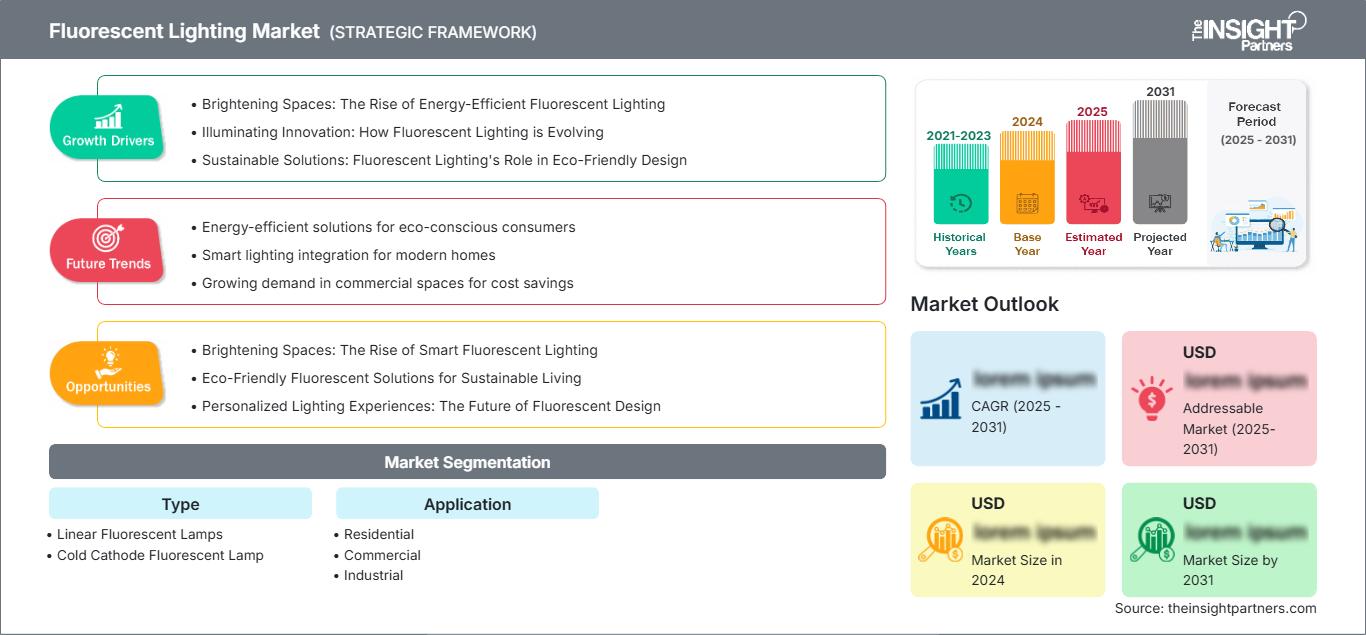
Fluorescent Lighting Market: Strategic Insights
Regional Insights
North America Fluorescent Lighting Market
North America accounted for 27–31% of the Fluorescent Lighting Market revenue in 2025 and will grow at a CAGR of 1.2–1.8% till 2034. The market shares of Fluorescent Lighting depend upon the legacy presence in educational institutions, healthcare centers, offices, warehousing, car parks, and municipal buildings. Relamping takes place if the fixture bodies are fit enough, there is pressure on budget and interruption during relamping will be created due to conversion. The federal testing regulations, utilities’ efficiency program and the state policy on mercury make the procurement process biased toward few number of products and faster plans to do conversion.
The regional supply depends on the electrical wholesalers, maintenance contractors, energy service companies and specialized distributors who have the capability of cross-referencing the discontinued lamp and ballast. The commercial replacement has a declining trend while the requirements for industrial, transportation, laboratories, agriculture and hazardous location continue to remain steady. The service aspect of the business helps in adding value even when the demand is falling.
U.S. Fluorescent Lighting Market
The US constituted 78-82% of North America revenues in 2025 and is projected to register a 1.1-1.7% CAGR through 2026-2034. The demand is driven by schools, hospitals, governmental buildings, federal buildings, warehouses, retail ceilings, and industrial facilities having a pre-existing base of T8 and T5 lamps. Standards set by the Department of Energy still mandate testing and adherence, thus making the ballast selection and performance data a matter of record. The state laws for mercury recycling create an added significance for distributor-managed recycling programs in contract considerations.
The companies offering wide-ranging or selective presence within the electrical distribution, industrial lighting, and retrofit applications are Eaton Corporation plc, Emerson Electric Co., Interlectric Corporation, Lamar Lighting Company, Inc., and LDPI, Inc. Commercial customers frequently use a combination of selective relamping and upgrading controls with fixture-to-fixture conversions to LEDs. Industrial customers tend to be more cautious where certification issues, thermal environment, access for maintenance, need for explosion protection, or validation of the process complicate substitution.
Europe Fluorescent Lighting Market
In Europe, there was 22–26% share in 2025 and it will be growing with slow CAGR of 0.5–1.1% up to 2034. Germany takes lead in the residual demand due to its industrial and technical infrastructure, as well as commercial buildings. Updated mercury regulations ban certain types of lamps as of the end of 2025 or 2026; thus, distributor stock, exceptions, and specialized application of the product become crucial during purchases.
The UK maintains replacement of lamps in public facilities, transportation, retail, and warehouses, however, funding for retrofits is quickening the conversion rate. France unites renovation of tertiary buildings and municipal energy projects. Italy and Spain maintain demand in small commercial buildings; however, purchases are becoming project-driven. For the region, ams OSRAM AG, Signify N.V., Schneider Electric SE, and specialized importers put an emphasis on compliance of their stock, proper disposal, and conversion.
APAC Fluorescent Lighting Market
APAC held 37-41% market share in 2025 and is estimated to gain 3.0-3.6% CAGR till 2034, which is the highest among all regions. China dominated by virtue of its massive manufacturing capabilities and wide installation base, while India provides additional demand due to factories, warehouses, shops, and other infrastructure facilities. Japan and South Korea focus on systematic replacement in special equipment applications; Australia moves faster due to efficiency and waste management initiatives.
Issues such as the growth of industries, urbanization, imbalance in renovations, and manufacturing within the region help sustain the regional market. Efficient lighting that saves energy is favored, but the consumption behavior differs greatly between countries. Firms protect their investments through linear lamps and customizations that save on costs, while distributors address the shortage resulting from importing.
Middle East & Africa Fluorescent Lighting Market
Middle East and Africa is forecast to grow at a 2.2%-2.8% CAGR until 2034. Saudi Arabia will dominate regionally in value because of the presence of industrial plants, public infrastructures, and large real estate portfolios. UAE prefers faster modernization, while South Africa balances replacement demand and power cost. Rest-of-MEA countries still keep their fluorescent solutions, where initial cost and distribution are decisive factors in the total lifecycle.
The reasons for the creation of the segmented market include energy security and infrastructure development, since while the premium solutions use LEDs and control systems, the existing commercial and industrial buildings rely on relamping programs. Such factors as temperature, dust, power variations, and maintainability impact the selection of the lighting fixtures. The strong suppliers, which keep their inventories locally and provide recycling, have the advantage.
Segmentation Analysis
Type
The type segment is projected to record a 1.7–2.3% CAGR during 2026–2034. Fluorescent Lighting Market scope by type reflects two distinct economics: standardized linear lamps depend on replacement scale and distribution breadth, while cold cathode products depend on compact geometry and specialized performance. Portfolio rationalization will favor suppliers that maintain cross-references, compliance documentation, and economical small runs without compromising color, starting, or lifetime consistency.
- Linear Fluorescent Lamps: This format remains the volume foundation in offices, schools, factories, and warehouses, benefiting from standardized fixtures, broad distributor familiarity, and economical replacement across extensive installed systems.
- Cold Cathode Fluorescent Lamp: CCFL products serve compact backlighting, instrumentation, signage, and specialty equipment where uniform light, slim profiles, proven electronics, or redesign costs preserve strategic replacement demand.
Application
The application segment is expected to expand at a 2.0–2.6% CAGR during 2026–2034. Adoption depends on operating hours, fixture condition, ceiling access, power prices, and compliance exposure. Commercial buildings contribute recurring relamping, residential demand is increasingly residual, and industrial users retain fluorescent systems longer when process validation or harsh-environment certifications complicate conversion. Suppliers therefore require differentiated service models rather than a universal replacement proposition.
- Residential: Household demand is mature and declining in many regulated markets, but price-sensitive regions and legacy kitchens, garages, utility rooms, and communal areas sustain limited replacement purchases.
- Commercial: Offices, education, healthcare, retail, and public estates generate dependable maintenance volumes, although portfolio owners increasingly combine bulk relamping with phased controls and retrofit programs.
- Industrial: Factories, warehouses, workshops, and hazardous locations provide the strongest resilience because downtime, certification, environmental conditions, and fixture redesign costs can outweigh immediate efficiency benefits.
Opportunity Snapshot
| Application | Revenue Contribution | Trend Tag | Adoption Stage |
| Residential | Low | Legacy Replacement | Mature |
| Commercial | High | Phased Retrofit | Mature |
| Industrial | High | Certified Continuity | Scaling |
Fluorescent Lighting Market Growth Drivers and Impact Analysis
Installed Fixture Base Extends Replacement Demand
Millions of operational luminaires remain embedded in suspended ceilings, production lines, warehouses, schools, hospitals, and transport assets. Replacing a lamp is often materially simpler than evaluating wiring, emergency circuits, controls, photometrics, ceiling damage, and work disruption. This installed base supports recurring orders even where new construction has moved to LED. The impact is strongest for standardized linear tubes, but it also benefits ballasts, starters, sockets, and maintenance services. Demand is not uniform: facilities with long burning hours convert sooner, while low-use rooms and hard-to-access industrial areas preserve fluorescent equipment longer. Vendors that quantify total intervention cost, rather than lamp price alone, can identify accounts where staged replacement remains operationally rational.
Cost-Sensitive Infrastructure Supports Continued Adoption
In emerging economies, limited capital budgets frequently prioritize immediate illumination needs over lifecycle optimization. Fluorescent systems remain familiar to electricians, broadly available through wholesalers, and compatible with existing fixtures, reducing installation complexity. Public buildings, small retailers, workshops, warehouses, and multifamily common areas may therefore replace failed lamps instead of funding complete retrofits. The market impact is a longer demand tail in India, Southeast Asia, Africa, and parts of the Middle East, especially outside premium urban projects. Currency volatility and imported LED component costs can reinforce this pattern. However, suppliers must balance affordability with tightening mercury rules, product quality, and collection obligations. Local assembly, common specifications, and durable packaging can preserve competitiveness without requiring large greenfield capacity.
Specialty Performance Creates Defensible Niches
Specialty applications often value spectral output, uniformity, compact geometry, low-temperature behavior, hazardous-location approvals, or installed-equipment compatibility more than headline efficacy. Cold cathode lamps, inspection lighting, instrumentation, medical or laboratory equipment, transport systems, and rugged industrial luminaires can require lengthy redesign and validation before adopting alternatives. This creates defensible demand for manufacturers capable of small batches, precise phosphor control, custom dimensions, and documented electrical performance. The commercial effect is favorable mix rather than high volume: specialty products command stronger service content and lower direct substitution risk. Close collaboration with equipment owners and maintenance engineers is essential because an apparently equivalent lamp can alter thermal performance, optics, electromagnetic compatibility, or certification status. Technical support therefore becomes a material purchasing criterion.
Fluorescent Lighting Market Future Trends
Managed Phase-Out Becomes a Service Proposition
Fluorescent Lighting Market trends will increasingly center on managed transition rather than stand-alone lamp sales. Large estate owners need inventories of fixture types, burn hours, emergency dependencies, replacement availability, mercury content, and disposal routes before setting conversion priorities. Distributors and electrical contractors can convert these data into multi-year roadmaps that protect critical stock while avoiding excess inventory. Manufacturers will support the process with cross-reference tools, end-of-life notices, and approved alternatives. The result will be a service-rich channel where revenue comes from audits, scheduled relamping, recycling, and engineered substitution. This trend should reduce surprise shortages and improve supplier visibility into the final demand curve.
Digital Inventory Models Reshape Distribution
As product ranges contract, forecasting errors become more expensive: shortages cause operational disruption, while excess stock risks obsolescence and hazardous-waste cost. Wholesalers will deploy demand sensing, customer asset registers, and automated substitution logic to position the right tubes and ballasts locally. Manufacturers can use sell-through data to schedule smaller production runs and communicate discontinuations earlier. Industrial customers may reserve critical stock through service agreements instead of purchasing opportunistically. Better information will also expose regional specification differences and counterfeit risk. The strategic outcome is a leaner but more transparent supply chain, with availability and traceability becoming differentiators alongside price, lumen output, and rated life.
Fluorescent Lighting Market Opportunities
Industrial Lifecycle Contracts
Suppliers can build recurring revenue by contracting around uptime rather than individual products. A lifecycle agreement can catalogue installed luminaires, reserve critical lamps and ballasts, schedule relamping, verify emergency-lighting interfaces, and manage recycling documentation. The approach is especially relevant in factories, logistics centers, transport facilities, utilities, and hazardous areas where an unplanned outage has disproportionate cost. Providers should prioritize sites with mixed-age assets and limited engineering records, then establish conversion triggers based on failure rates, energy use, regulation, and parts availability. Partnerships among manufacturers, distributors, contractors, and recyclers can create national coverage without heavy fixed investment. Success depends on measurable service levels, transparent stock ownership, and technically credible substitution pathways.
Specialty Lamp Localization
Regional manufacturing or final assembly can address long lead times for specialized tubes, cold cathode products, and certified industrial configurations. Investors should target applications where redesign costs are high, annual volumes are modest but predictable, and customers value rapid technical response. Flexible glass processing, phosphor capability, quality laboratories, and low-volume automation are more important than commodity-scale capacity. Joint ventures with equipment manufacturers can secure baseline demand and access proprietary specifications. Localization also reduces breakage risk and supports compliance with transport and waste rules. The opportunity is strongest in Asia and selected Middle Eastern markets serving local infrastructure, medical equipment, transport, and industrial customers that currently depend on fragmented imports.
Recent Developments
- January 2026: Aalto University has launched a major lighting modernization initiative by replacing conventional fluorescent tube lighting with energy-efficient LED systems across its campus. The project follows the phase-out of fluorescent tube production and aims to improve sustainability, reduce electricity consumption, and lower long-term maintenance costs. The LED upgrade is expected to provide better illumination quality, longer product lifespan, and enhanced environmental performance while supporting the university's commitment to creating a more energy-efficient and future-ready campus infrastructure.
- June 2025: Wurkkos has introduced the HD02 Pro, a new flagship model in its all-in-one tool light series designed for professionals and outdoor users. The product features multiple lighting modes, improved brightness, and enhanced durability to meet diverse work and emergency lighting needs. While not a fluorescent lighting product, the launch highlights ongoing advancements in portable LED lighting technology, reflecting the industry's continued shift toward more efficient, versatile, and long-lasting lighting solutions.
- April 2026: Bright Co., Ltd. has announced the launch of a new range of compact fluorescent LED lamps designed as direct replacements for conventional compact fluorescent lighting. The new products offer improved energy efficiency, longer operational life, and reduced maintenance requirements while delivering reliable illumination for commercial and residential applications. The launch supports the growing transition from fluorescent to LED technology, helping customers reduce energy consumption and comply with evolving environmental and lighting efficiency standards.
Frequently Asked Questions

- Comprehensive Market Sizing and Forecast Analysis
- Detailed Segmentation Analysis
- In-Depth Market Dynamics Assessment
- Regional and Country-Level Insights
- Competitive Landscape and Company Benchmarking
- Strategic Business Intelligence
Recent Reports
Testimonials

The Insight Partners' SCADA System Market report is comprehensive, with valuable insights on current trends and future forecasts. The team was highly professional, responsive, and supportive throughout. We are very satisfied and highly recommend their services.
RAN KEDEM Partner, Reali Technologies LTDs
I requested a report on a very specific software market and the team produced the report in a few days. The information was very relevant and well presented. I then requested some changes and additions to the report. The team was again very responsive and I got the final report in less than a week.
JEAN-HERVE JENN Chairman, Future Analytica
We worked with The Insight Partners for an important market study and forecast. They gave us clear insights into opportunities and risks, which helped shape our plans. Their research was easy to use and based on solid data. It helped us make smart, confident decisions. We highly recommend them.
PIYUSH NAGPAL Sr. Vice President, High Beam Global
The Insight Partners delivered insightful, well-structured market research with strong domain expertise. Their team was professional and responsive throughout. The user-friendly website made accessing industry reports seamless. We highly recommend them for reliable, high-quality research services
YUKIHIKO ADACHI CEO, Deep Blue, LLC.
This is the first time I have purchased a market report from The Insight Partners.While I was unsure at first, I visited their web site and felt more comfortable to take the risk and purchase a market report.I am completely satisfied with the quality of the report and customer service. I had several questions and comments with the initial report, but after a couple of dialogs over email with their analyst I believe I have a report that I can use as input to our strategic planning process.Thank you so much for taking the extra time and making this a positive experience.I will definitely recommend your service to others and you will be my first call when we need further market data.
JOHN SUZUKI President and Chief Executive Officer, Board Director, BK Technologies
I wish to appreciate your support and the professionalism you displayed in the course of attending to my request for information regarding to infectious disease IVD market in Nigeria. I appreciate your patience, your guidance, and the fact that you were willing to offer a discount, which eventually made it possible for us to close a deal. I look forward to engaging The Insight Partners in the future, all thanks to the impression you have created in me as a result of this first encounter.
DR CHIJIOKE ONYIA MANAGING DIRECTOR, PineCrest Healthcare Ltd.Reason to Buy
- Informed Decision-Making
- Understanding Market Dynamics
- Competitive Analysis
- Identifying Emerging Markets
- Customer Insights
- Market Forecasts
- Risk Mitigation
- Boosting Operational Efficiency
- Strategic Planning
- Investment Justification
- Tracking Industry Innovations
- Aligning with Regulatory Trends





 Get Free Sample for