
Gaming Keyboard and Mouse Market Size, Share & Demand by 2034
Coverage: By Product (Keyboard, Mouse); Type (Wired, Wireless); Distribution Channel (Online, Offline); Application (Computer/Laptop, TV, Game Machine, Others), and Geography (North America, Europe, Asia Pacific, and South and Central America)
- Status : Data Released
- Report Code : TIPRE00013795
- Category : Electronics and Semiconductor
- No. of Pages : 150
- Available Report Formats :


- Last update date : August 17, 2026


2025 Market Size
US$ 1.57 Bn
Base year value
2034 Forecast
US$ 2.76 Bn
Projected by 2034
CAGR 2026-2034
6.44 %
Growth rate
Addressable Market
US$ 19.56 Bn
(2026-2034)
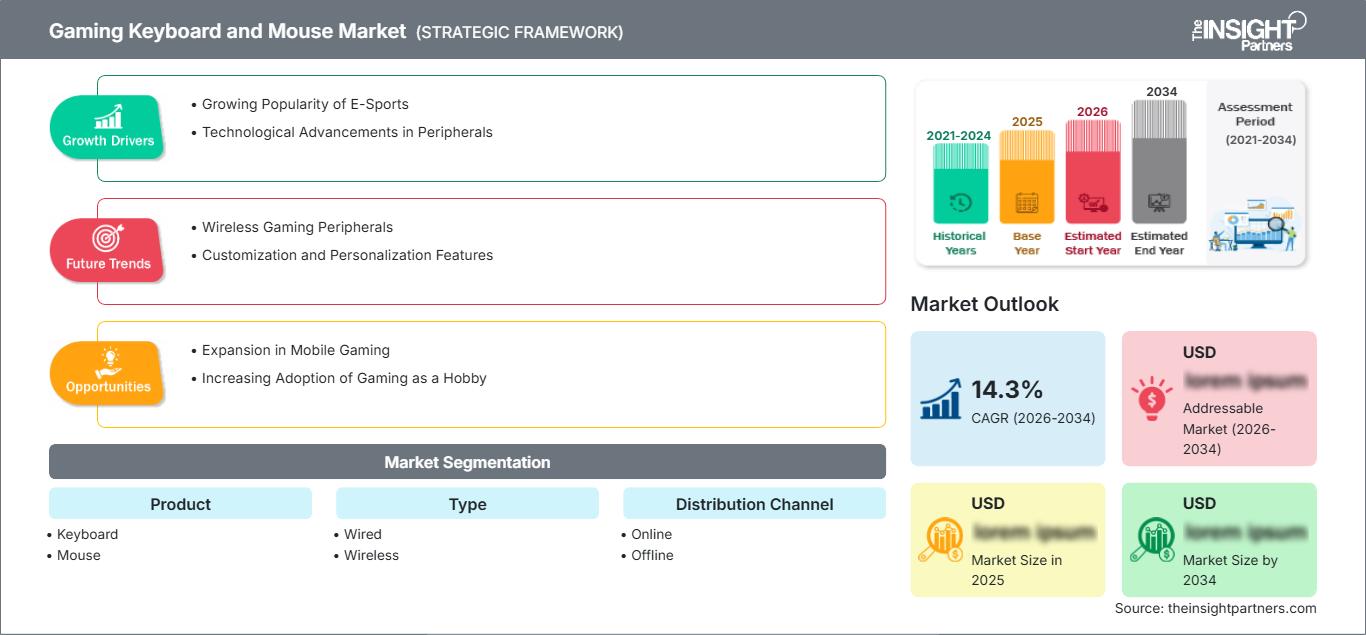
The Gaming Keyboard and Mouse Market was valued at US$ 1.57 Billion in 2025 and is projected to reach US$ 2.76 Billion by 2034, registering a CAGR of 6.44% during 2026–2034. The need for the product is rising due to faster actuation time, tracking accuracy, life span of switches, ergonomics and customization in software by PC gamers. Refreshments of the products now include performance, along with mobility, device connectivity and creation of the products.
In North America, the Gaming Keyboard and Mouse Market size will be rising at a CAGR of 5.8-6.4%, until 2034. The matured market of enthusiasts supports the business with premium cycles, while esports, streaming, and work-play gaming raise the demand for the addressable market. The high density of specialized retail, fast launches of new products and greater receptiveness to low-latency wireless products raises the value, despite less unit growth compared to Asia-Pacific markets.
Gaming Keyboard and Mouse Market Assessment and Insights
- North America: Accounted for an estimated 29–32% share in 2025 and is expected to grow at 5.8–6.4% during 2026–2034, supported by premium PC ownership, esports sponsorship, specialist retail, and frequent enthusiast upgrades.
- US: Represented 82–85% of North American revenue in 2025 and is projected to expand at a 5.9–6.5% CAGR through 2034.
- Europe: Held an estimated 24–27% share in 2025 and should grow at 5.5–6.1%, led by Germany and the UK, with France, Italy, and Spain supporting broader online-channel demand.
- Asia Pacific: Captured an estimated 35–38% share in 2025 and is forecast to rise at 7.1–7.8%, with China, Japan, South Korea, and India underpinning scale, esports activity, and manufacturing depth.
- Largest Segment: Mouse held an estimated 54–58% market share in 2025 and is expected to grow at 6.2–6.8%, reflecting shorter replacement cycles and broad price-point coverage.
- High Growth Segment: Wireless represented an estimated 42–46% market share in 2025 and is forecast to expand at 7.6–8.4%, supported by low-latency radio, lighter designs, and longer battery life.
- Key companies analyzed in detail: A4TECH Co., Ltd., ASUSTeK Computer Inc., Corsair Gaming, Inc., Dell Technologies Inc., HP Development Company, L.P., Logitech International S.A., Rapoo Technology Co., Ltd., Razer Inc., Turtle Beach Corporation, and SteelSeries ApS.
Source: The Insight Partners' analysis based on proprietary research, government publications, company annual reports, investor presentations, industry databases, and expert interviews.
While mechanical switches were the distinguishing factor for enthusiast keyboards, and the evolution of gaming mice has involved moving from sensitivity adjustments towards high-resolution optical sensors, light-weighting, and fast polling, the manufacturing process involves specialized component manufacturers in East Asia producing switches, sensors, controllers, batteries, and plastics. In addition, the firmware and software companions that provide profiles, macros, actuation customization, and coordinated illumination have become tangible elements of product value. With wireless lag reaching parity with wired performance, manufacturers have begun sharing common platforms for their keyboards and mice to simplify development and deepen ecosystem loyalty.
The future holds prospects in terms of further volumes in the regions of India, Southeast Asia, Latin America, and the gaming centers of the Gulf, which will have better broadband connectivity, local tournaments, and online shopping options. The focus of the investment will be on Hall-effect keyboards, energy-saving wireless chipsets, repairable designs, recycling plastics in components, and multilingual software companions. The Right-to-Repair mandates, battery mandates, radio approval mandates, and EPR programs will raise the costs, but will be beneficial to scalable service providers.
Gaming Keyboard and Mouse Market Report Scope
| Report Attribute | Details |
|---|---|
| Market size in 2025 | US$ 1.57 Billion |
| Market Size by 2034 | US$ 2.76 Billion |
| Global CAGR (2026 - 2034) | 6.44% |
| Historical Data | 2021-2024 |
| Forecast period | 2026-2034 |
Gaming Keyboard and Mouse Market Analysis
Drivers for Gaming Keyboard and Mouse success are the presence of many PC gamers and varied requirements. The speed of clicking, accurate tracking, and compactness are the main features needed in tactical games; simulations, strategies, and multiplayer games need more buttons and customization possibilities. The suppliers of components are sensor-makers, switch producers, semiconductor manufacturers, battery makers, cable manufacturers, and molding companies. Assembly and manufacturing of these products are done by contract manufacturers, brand companies, distributors, online retail sites, and specialized retailers.
The risks involved in Asian sourcing are those of high shipping cost, fluctuation of currency rate, component allocation, and tariffs. The brand companies diversify their risks through multiple sourcing, standard platform, and sequential product introduction. High-end products of keyboards and mice have a better margin while low and middle-end products create scale and attract customers.
Gaming Keyboard and Mouse Market report reveals a fractured market environment characterized by high ecosystem competition. Key players such as Logitech International S.A., Razer Inc., Corsair Gaming, Inc., SteelSeries ApS, and ASUSTeK Computer Inc. compete in terms of latency, weight, switches, software, and their involvement in professional esports scene. Dell Technologies Inc. and HP Development Company, L.P. rely on bundled PCs, whereas A4TECH Co., Ltd., Rapoo Technology Co., Ltd., and Turtle Beach Corporation focus on value, channel, and niche strategies.
There is a trend towards investment in reusable wireless architectures, cloud profile synchronization, magnetic actuation, optical switches, and industrial design. In this situation, strategic positioning relies upon ladder portfolios aimed at moving clients from more accessible products to higher-end ecosystems without requiring software changes. Visibility benefits from partnerships with professional teams and franchises, whereas communication and pricing flexibility is ensured by direct-to-consumer channels. Financial responsibility is important due to high rate of innovation and shortening of products' lifespans.
● REPORT CUSTOMIZATION
Tailor This Report To Align With Your Specific Business Requirements
This report can be customized to align precisely with your business objectives, scope, and target markets. Customization options include tailored segmentation, geography, competitive analysis, and strategic insights to support informed decision-making.
Customize This Report →WHAT YOU CAN ADJUST
- ● Segmentations
- ● Geography
- ● Competitive Analysis
- ● Language Preferences
Gaming Keyboard and Mouse Market: Strategic Insights
Regional Insights
North America Gaming Keyboard and Mouse Market
It has contributed 29-32% Gaming Keyboard and Mouse Market share in 2025 and is projected to grow with 5.8-6.4% CAGR over the forecast period of 2026-2034. The reasons behind such high demand are high disposable income, existence of PC gaming communities, college-level esports participation, creators' earnings, and advanced omnichannel shopping. End-users tend to focus on lighter mice, either optical or magnetic switches, small keyboards, and low-latency wireless functionality.
The market maturity stage results in competition based on replacement rate, ecosystem compatibility, and service, rather than first-time buying. The USA accounts for the largest share of revenues generated in the region, while Canada contributes some part of it due to gaming communities and high Internet penetration rates. Mexico makes up a small but increasingly growing market base. Tariffs and exchange rates can influence the price structure, so causing product differentiation.
U.S. Gaming Keyboard and Mouse Market
The U.S. was responsible for about 82-85% of North American income in 2025, with growth forecasted between 5.9% and 6.5% until 2034. High availability of specialist retailers, store presence, delivery speed, and professional gamers' communities contribute to frequent product release cycles. Competitive gamers need high-polling rates, actuation, memory, and ultralight design, whereas regular customers will more likely purchase wireless kits in order to have a clean desk.
Logitech International S.A., Razer Inc., Corsair Gaming, Inc., Dell Technologies Inc., HP Development Company, L.P., SteelSeries ApS, and Turtle Beach Corporation have extensive U.S. distribution networks. There is demand not only for gaming purposes but also for productivity use cases, especially for creative workers, students, and hybrid workers who use the same equipment for everything they do. The importance of seasonal discount programs remains relevant, making the effective management of the channel inventory and software differentiation key elements for keeping prices realized.
Europe Gaming Keyboard and Mouse Market
Europe accounted for about 24–27% in 2025 and is forecast to register a 5.5–6.1% CAGR between 2026 and 2034, led by Germany. German advantages include high PC affinity, specialized retailers, and engineered durability needs. UK enjoys strong esports presence, online buying and creativity, which drives sales of premium mice, tenkeyless keyboards, and wireless components.
France has a huge gaming community and an increasing need for local layout products. While Italy and Spain depend more on promotional activities, with the rise of esport tournaments, streaming and ecommerce, mid-tier products are now available. Requirements for radio components, batteries, chemicals, packaging and responsible e-waste management according to EU laws are considered during the product design process. Products that have good reparability, proper packaging, local firmware and distribution have the best chance of compliance and consumer trust.
APAC Gaming Keyboard and Mouse Market
APAC had a market share of about 35-38% in 2025 and will experience growth by 7.1-7.8% until 2034, with China being the dominant country. China leverages manufacturing, brand, e-commerce, and PC gamers, whereas South Korea's esports community enhances the need for competitive specifications.
Customers in Japan like to have small size and quality equipment; in India, the customer base is growing rapidly through online purchases; and Australians are premium adopters. The ecosystem comprising semiconductors, sensors, switches, and assembly helps speed up product development. Investments in broadband, recognition of e-sports, and digital economy program help in having access to devices despite income diversification.
Middle East & Africa Gaming Keyboard and Mouse Market
The region will grow at a CAGR of 6.4% to 7.2% up to 2034, with the UAE leading. Investment in entertainment and gaming in Saudi Arabia leads to venues, events, and premium setup, whereas UAE benefits from rich consumers, international retail presence, and connectivity.
South Africa drives demand in sub-Saharan countries owing to the presence of PC gamer community and e-commerce. The rest of the MEA is affected by high cost of imports and distribution issues. Data center investments, fiber optics infrastructure, electricity availability, and logistics investments increase digital participation; however, companies need to produce durable products and control their inventory.
Segmentation Analysis
Product
The product segment is projected to grow at 6.1–6.7% during 2026–2034. Gaming Keyboard and Mouse Market scope spans complementary devices with different replacement economics: mice typically turn faster because sensors, switches, weight, and fit influence play directly, whereas keyboards carry higher ticket values and longer ownership periods. Vendors increasingly coordinate styling, wireless receivers, software, and onboard profiles across both categories, raising attachment rates and ecosystem retention.
- Keyboard: Mechanical, optical, and magnetic-switch models address enthusiasts seeking responsive actuation, anti-ghosting, durable keycaps, compact formats, and programmable layers, while membrane products protect accessible price points.
- Mouse: The largest product category benefits from frequent replacement, broad genre-specific designs, lightweight construction, accurate optical sensors, high polling rates, ergonomic variants, and extensive entry-to-premium pricing.
Type
The type segment is expected to expand at 6.3–6.9% during 2026–2034. Wired products retain relevance where affordability, continuous power, and simple tournament deployment matter. Wireless adoption advances faster as proprietary 2.4 GHz links, efficient sensors, lighter batteries, rapid charging, and multi-device support narrow performance differences. Manufacturers balance receiver interoperability and Bluetooth convenience against firmware complexity, radio certification, and battery-service expectations.
- Wired: Wired devices remain strategically important in entry and mid-tier portfolios, esports venues, and institutional setups because they offer predictable latency, no charging requirement, straightforward support, and lower component cost.
- Wireless: Wireless models gain preference among premium gamers and hybrid users seeking cleaner desks, portable setups, multi-device switching, and near-wired responsiveness, making radio efficiency and battery endurance decisive differentiators.
Opportunity Snapshot
| Application | Revenue Contribution | Trend Tag | Adoption Stage |
| Personal Use | High | Desk Ecosystems | Mature |
| Internet Bar | Medium | Fleet Durability | Scaling |
| Professional Gaming | Medium | Rapid Trigger | Scaling |
| Content Creation | Medium | Macro Workflow | Scaling |
Gaming Keyboard and Mouse Market Growth Drivers and Impact Analysis
Competitive Gaming and Creator-Led Upgrade Cycles
Competitive gaming turns keyboards and mice into performance-critical tools rather than generic accessories. Players can perceive improvements in click latency, actuation control, tracking consistency, weight, and grip, encouraging upgrades even when existing devices remain functional. Streaming and video creation amplify this effect because visible desk setups influence audience discovery and purchasing. Team sponsorships, tournament use, and creator reviews shorten the distance between launch and adoption. The commercial impact is strongest in premium mice and compact keyboards, but specification diffusion subsequently lifts mid-tier products. Brands that translate professional features into understandable consumer benefits can widen addressable demand, while those relying only on cosmetic lighting face greater price competition and shorter differentiation windows.
Wireless Performance Reaches Competitive Standards
Advances in proprietary radio protocols, efficient controllers, sensor power management, and battery density have made wireless devices credible for competitive play. This removes a longstanding adoption barrier and supports higher average selling prices through charging systems, dual-mode connectivity, shared receivers, and portable design. The impact extends across both product categories: mice benefit from unrestricted movement, while keyboards gain cleaner setups and easier switching between gaming PCs, laptops, and tablets. Vendors can also use common receivers and software to reinforce ecosystem retention. However, wireless growth raises engineering and compliance requirements involving firmware stability, radio certification, battery longevity, and end-of-life handling. Reliable execution therefore separates durable premium franchises from specification-led products with weak support.
Broader PC Ecosystems Support Peripheral Attachment
PC gaming ecosystems continue to expand through digital distribution, free-to-play titles, creator platforms, and hardware upgrades. Each new or refreshed gaming PC creates an attachment opportunity for a keyboard and mouse, while higher-refresh displays and faster processors make input responsiveness more salient. Valve’s hardware survey consistently shows a diverse installed base rather than a single premium configuration, supporting wide portfolio ladders across affordability and performance. OEM bundles introduce customers to gaming-branded devices, and subsequent replacements move some users toward specialist products. The resulting market impact is resilient rather than purely cyclical: new-system purchases create initial demand, whereas switch wear, grip preferences, software features, and style changes sustain replacement demand between major PC upgrade cycles.
Gaming Keyboard and Mouse Market Future Trends
Magnetic Actuation and Analog Input Move Mainstream
Gaming Keyboard and Mouse Market trends will increasingly center on magnetic Hall-effect switches, adjustable actuation, rapid trigger, and analog input. These features allow users to tune reset points for different games without replacing switches, shifting differentiation from fixed mechanical characteristics toward firmware-defined behavior. As controller costs decline, magnetic technology should spread from flagship keyboards into mid-tier compact formats. Competitive scrutiny will also increase around software reliability, tournament rules, and transparent settings because advanced input behavior can affect perceived fairness. Vendors with intuitive configuration tools, onboard memory, and stable firmware will be better positioned than suppliers that compete only on headline actuation ranges.
Unified Receivers and Cross-Device Profiles
Wireless ecosystems will evolve toward fewer dongles, coordinated power management, and profiles that follow users across desktop PCs, laptops, handhelds, and tablets. Shared receivers can reduce port congestion and packaging, while cloud-synchronized settings simplify device replacement and multi-location play. The commercial opportunity lies in balancing openness with ecosystem retention: consumers value interoperability, but brands seek repeat purchases across keyboards and mice. Security, privacy, and offline functionality will become more important as profiles move between devices. Suppliers that combine low-latency radio, Bluetooth, onboard memory, and transparent update policies can address both competitive gaming and hybrid productivity without forcing users into separate hardware stacks.
Gaming Keyboard and Mouse Market Opportunities
Localized Mid-Tier Portfolios for Emerging PC Markets
Manufacturers can capture growth in India, Southeast Asia, Latin America, and selected Middle Eastern markets through locally calibrated mid-tier portfolios. Action priorities include regional keyboard layouts, lighter packaging, durable cables and switches, marketplace-specific bundles, and service partnerships that reduce buyer risk. Gaming Keyboard and Mouse Market Forecasts support staged investment rather than uniform global launches: brands should test price elasticity, payment options, and creator partnerships city by city. Local assembly or final packaging can improve responsiveness where tariffs justify it, while shared internal platforms protect margins. A disciplined portfolio should preserve competitive specifications, particularly sensor consistency and rollover, instead of using cosmetic differentiation as a substitute for performance.
Repairability and Component-Level Personalization
Repairable and modular designs create an opportunity to extend product life while opening recurring revenue from switches, keycaps, cables, grips, skates, batteries, and replacement receivers. Companies can invest in standardized fasteners, accessible parts, diagnostic software, and clear repair documentation without sacrificing premium positioning. This approach responds to electronic-waste policy, consumer demand for personalization, and the practical wear patterns of heavily used peripherals. Channel partners could offer authorized repair and customization, improving retention beyond warranty periods. The main execution challenge is preserving structural rigidity, water resistance, and weight targets. Vendors that design modularity from the platform stage can manage those trade-offs more effectively than brands retrofitting repair features late.
Recent Developments
- May 2026: GIGABYTE unveiled its latest gaming peripherals, including the AORUS K10 Infinity keyboard and M10 Infinity mouse, at COMPUTEX 2026. The new products are designed to deliver enhanced gaming performance through advanced features, improved responsiveness, and ergonomic designs. The launch reflects the company’s focus on developing high-performance accessories for gamers seeking greater accuracy, speed, and customization. These next-generation keyboard and mouse solutions aim to provide competitive gamers with reliable tools for immersive gaming experiences.
- June 2026: Logitech introduced the G3 Series, a new range of gaming keyboard and mouse products designed to bring premium gaming features at a more accessible price point. The lineup combines responsive controls, modern designs, and dependable performance for PC gamers. By offering advanced technology in an affordable package, Logitech aims to expand access to quality gaming peripherals and support a broader community of casual and competitive players looking for reliable equipment.
- July 2026: Wallhack announced its upcoming CNC aluminium gaming keyboard, featuring a premium metal construction designed for durability, precision, and enhanced gaming performance. Scheduled for launch on July 24, 2026, the keyboard targets enthusiasts seeking high-end build quality and a refined gaming experience. The product highlights the growing demand for specialized gaming peripherals that combine advanced materials, stylish designs, and improved functionality for professional and dedicated gamers.
Frequently Asked Questions

- Comprehensive Market Sizing and Forecast Analysis
- Detailed Segmentation Analysis
- In-Depth Market Dynamics Assessment
- Regional and Country-Level Insights
- Competitive Landscape and Company Benchmarking
- Strategic Business Intelligence
Recent Reports
Testimonials

The Insight Partners' SCADA System Market report is comprehensive, with valuable insights on current trends and future forecasts. The team was highly professional, responsive, and supportive throughout. We are very satisfied and highly recommend their services.
RAN KEDEM Partner, Reali Technologies LTDs
I requested a report on a very specific software market and the team produced the report in a few days. The information was very relevant and well presented. I then requested some changes and additions to the report. The team was again very responsive and I got the final report in less than a week.
JEAN-HERVE JENN Chairman, Future Analytica
We worked with The Insight Partners for an important market study and forecast. They gave us clear insights into opportunities and risks, which helped shape our plans. Their research was easy to use and based on solid data. It helped us make smart, confident decisions. We highly recommend them.
PIYUSH NAGPAL Sr. Vice President, High Beam Global
The Insight Partners delivered insightful, well-structured market research with strong domain expertise. Their team was professional and responsive throughout. The user-friendly website made accessing industry reports seamless. We highly recommend them for reliable, high-quality research services
YUKIHIKO ADACHI CEO, Deep Blue, LLC.
This is the first time I have purchased a market report from The Insight Partners.While I was unsure at first, I visited their web site and felt more comfortable to take the risk and purchase a market report.I am completely satisfied with the quality of the report and customer service. I had several questions and comments with the initial report, but after a couple of dialogs over email with their analyst I believe I have a report that I can use as input to our strategic planning process.Thank you so much for taking the extra time and making this a positive experience.I will definitely recommend your service to others and you will be my first call when we need further market data.
JOHN SUZUKI President and Chief Executive Officer, Board Director, BK Technologies
I wish to appreciate your support and the professionalism you displayed in the course of attending to my request for information regarding to infectious disease IVD market in Nigeria. I appreciate your patience, your guidance, and the fact that you were willing to offer a discount, which eventually made it possible for us to close a deal. I look forward to engaging The Insight Partners in the future, all thanks to the impression you have created in me as a result of this first encounter.
DR CHIJIOKE ONYIA MANAGING DIRECTOR, PineCrest Healthcare Ltd.Reason to Buy
- Informed Decision-Making
- Understanding Market Dynamics
- Competitive Analysis
- Identifying Emerging Markets
- Customer Insights
- Market Forecasts
- Risk Mitigation
- Boosting Operational Efficiency
- Strategic Planning
- Investment Justification
- Tracking Industry Innovations
- Aligning with Regulatory Trends





 Get Free Sample for