
Graphene Nano Platelets (GNPs) Electronics Market Trends, Size & Forecast by 2034
Coverage: By Type (Supercaps Materials, Others); Application (Batteries and Ultracapacitors, Display, Sensors, Electro Mechanical Systems (EMS), Solar Cells, Others), and Geography (North America, Europe, Asia Pacific, and South and Central America)
- Status : Data Released
- Report Code : TIPRE00014360
- Category : Chemicals and Materials
- No. of Pages : 150
- Available Report Formats :


- Last update date : August 07, 2026


2025 Market Size
US$ 1.44 Bn
Base year value
2034 Forecast
US$ 6.8 Bn
Projected by 2034
CAGR 2026-2034
18.84 %
Growth rate
Addressable Market
US$ 33.86 Bn
(2026-2034)
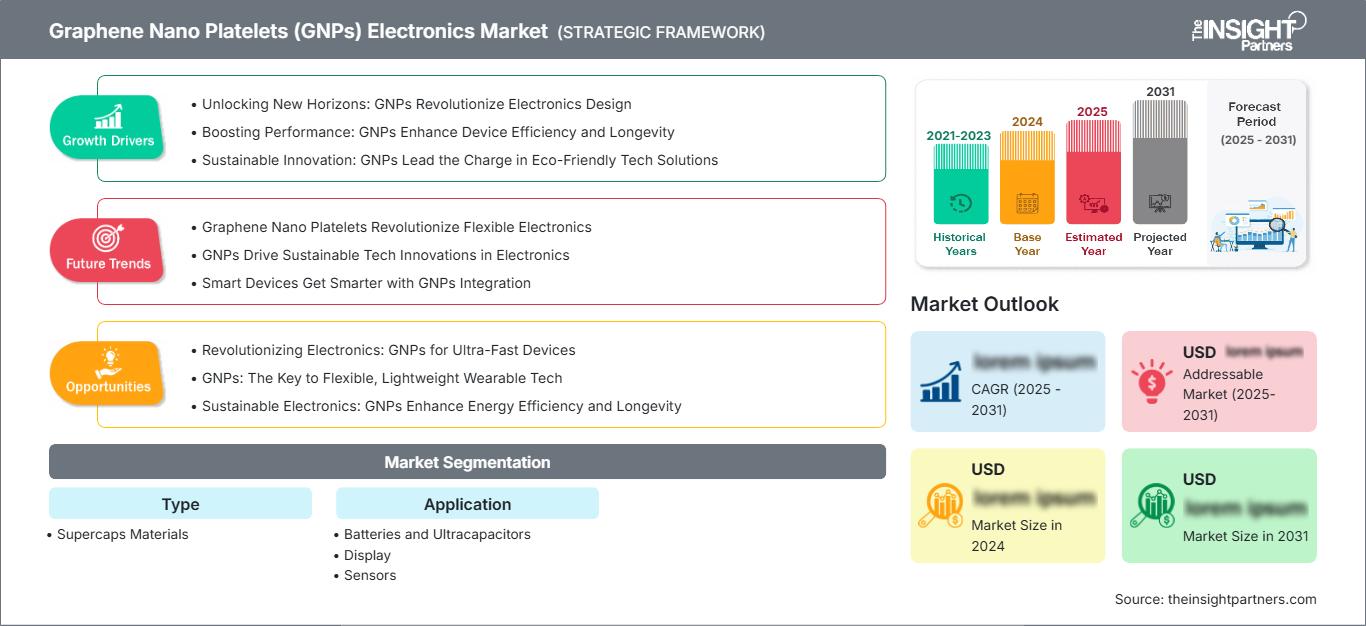
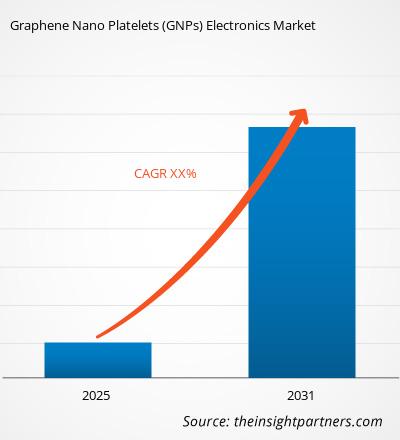
The graphene nano platelets electronics market was valued at US$ 1.44 Billion in 2025 and is projected to reach US$ 6.8 Billion by 2034; it is expected to register a CAGR of 18.84% during 2026–2034. Rising commercialization of graphene-enabled electronic components, increasing investments in advanced materials for energy storage, and expanding adoption of lightweight conductive materials across semiconductor and consumer electronics manufacturing continue to strengthen the long-term outlook for the market.
Throughout North America, graphene electronics have witnessed growing commercialization due to robust research and development efforts in universities, governmental support for advanced manufacturing, and investment in battery technologies by the private sector. The forecasted CAGR of the graphene nano platelets electronics market size in North America between 2026 and 2034 will be 17.5–18.5%. Increased production of electric cars, semiconductor packaging, and sensors is contributing to the growth of demand for graphene nanoplatelet-based electronic materials.
Graphene Nano Platelets (GNPs) Electronics Market Assessment and Insights
- North America: Accounted for 34–36% share in 2025 and is projected to grow at a CAGR of 17.5–18.5% during 2026–2034. Strong investments in semiconductor manufacturing, battery innovation, and advanced materials research continue to support regional leadership.
- US: Represented 79–82% of the North American market in 2025 and is anticipated to expand at a CAGR of 17.8–18.8% during 2026–2034, supported by growing commercialization of graphene-enabled electronics and increasing public-private research funding.
- Europe: Held 27–29% share in 2025 and is forecast to register a CAGR of 17.0–18.0% during 2026–2034. Germany, the UK, France, Italy, and Spain remain leading markets owing to strong electronics manufacturing capabilities and graphene innovation programs.
- Asia Pacific: Captured 29–31% share in 2025 and is expected to witness the fastest regional expansion with a CAGR of 20.0–21.0% during 2026–2034. China, Japan, South Korea, and India continue strengthening investments in advanced electronic materials and battery technologies.
- Largest Segment: Application – Batteries and Ultracapacitors accounted for 41–44% market share in 2025 and is projected to grow at a CAGR of 19.5–20.5% during 2026–2034, driven by increasing deployment of high-performance energy storage systems.
- High Growth Segment: Application – Sensors represented 12–15% market share in 2025 and is expected to record a CAGR of 22.0–23.0% during 2026–2034, supported by rapid expansion of wearable electronics, industrial monitoring, and healthcare diagnostics.
- Key companies analyzed in detail: Graphenea S.A., Graphene Square Inc., Graphene Laboratories Inc., Graphene Frontiers LLC, Grafoid Inc., International Business Machines Corporation (IBM), Samsung Electronics Co., Ltd., Cabot Corporation, NanoXplore Inc., First Graphene Limited.
Source: The Insight Partners' analysis based on proprietary research, government publications, company annual reports, investor presentations, industry databases, and expert interviews.
Breakthroughs in the development of efficient exfoliation processes for scalable manufacture of graphene, advancements in technology for dispersing graphene nanoplatelets and consistent improvement in conductive ink formulation have radically transformed the market in the last decade. The inclusion of graphene nanoplatelets in electronics such as electrodes, flexible substrates, electromagnetic shielding and printed electronics in order to increase electrical conductivity and thermal management, while at the same time lowering down the weight of components has been increasingly adopted by manufacturers.
In the coming years, the development investments will likely spread out to Asia Pacific as well as select European nations that are witnessing support from government policies towards semiconductor manufacturing, battery manufacturing and renewable energy. Stricter laws regarding the environment and encouragement towards using lightweight and energy efficient materials along with joint research activities between universities and electronics manufacturers will aid the commercialization process.
Graphene Nano Platelets (GNPs) Electronics Market Report Scope
| Report Attribute | Details |
|---|---|
| Market size in 2025 | US$ 1.44 Billion |
| Market Size by 2034 | US$ 6.8 Billion |
| Global CAGR (2026 - 2034) | 18.84% |
| Historical Data | 2021-2024 |
| Forecast period | 2026-2034 |
Graphene Nano Platelets (GNPs) Electronics Market Analysis
Electrification of the transport sector, continuous miniaturization of electronics, and increasing requirements for the performance of conductive materials create a promising environment for the growth of the graphene nanoplatelets electronics market. The graphene nanoplatelets have excellent electrical conductivity, thermal conductivity, strength, and chemical stability; thus, their application in batteries, ultracapacitors, sensors, displays, and other advanced microelectronics devices is becoming more and more popular. Due to the continuous support of the governments for the production of semiconductors and localization of the battery supply chain, the demand for advanced conductive nanomaterials will consistently grow.
The value chain is continuously evolving due to closer cooperation of graphene materials suppliers, chemical processors, electronics producers, batteries developers, and research organizations. Improved technologies of raw graphite processing, efficient exfoliation techniques, and quality control systems make graphene production more effective and cheaper. Such changes motivate the wide use of the graphene nanoplatelets not only by traditional electronic devices producers but also by new innovative technology companies producing next-generation electronics.
The competitive differentiation among the various players in the graphene nano plates electronics market analysis is becoming increasingly focused on purity of the materials, layer uniformity, scalability of manufacture, customization for applications, and research collaborations. Graphenea S.A., NanoXplore Inc., First Graphene Limited, Cabot Corporation, and Graphene Square Inc. all continue to grow their portfolios of products that cater for conductive coatings, battery electrodes, and printed electronics. At the same time, Samsung Electronics Co., Ltd. and International Business Machines Corporation are using graphene research for future developments of semiconductors, sensing applications, and flexible electronics through intensive intellectual property development and research collaborations.
Investment strategy is increasingly concentrating on increasing commercial production capacities and consistency in graphene nanoplatelet quality. The companies are investing in pilot production facilities, unique dispersal technologies, and applications development. Government-funded innovation programs for graphene across Europe, North America, and Asia will continue to be of assistance to commercialization, while the growth of collaboration between material suppliers and electronics producers will be an additional factor boosting the development of the market.
● REPORT CUSTOMIZATION
Tailor This Report To Align With Your Specific Business Requirements
This report can be customized to align precisely with your business objectives, scope, and target markets. Customization options include tailored segmentation, geography, competitive analysis, and strategic insights to support informed decision-making.
Customize This Report →WHAT YOU CAN ADJUST
- ● Segmentations
- ● Geography
- ● Competitive Analysis
- ● Language Preferences
Graphene Nano Platelets (GNPs) Electronics Market: Strategic Insights
Regional Insights
North America Graphene Nano Platelets Electronics Market
North America held a graphene nano platelets electronics market share of 34-36% in 2025 and is estimated to grow at a CAGR of 17.5-18.5% from 2026 to 2034. Significant investments in semiconductor production, electric vehicles batteries manufacturing, and advanced material development are the key drivers of the regional growth. The government spending on nanotechnology commercialization together with cooperation among universities, national laboratories, and private businesses have boosted the implementation of graphene nanoplatelets in commercial electronics.
Moreover, the region has a developed ecosystem of electronics including material providers, battery producers, semiconductor firms, and research centers. Growing use of graphene nanoparticles in lithium-ion batteries, electromagnetic interference shieldings, and flexible electronics will contribute to the market growth. Further innovations in printed electronics and sensors are expected to open new prospects for graphene nanoplatelet producers.
U.S. Graphene Nano Platelets Electronics Market
The U.S. represented 79–82% of the North American market in 2025 and is expected to record a CAGR of 17.8–18.8% during 2026–2034. The country remains the regional innovation hub owing to its strong semiconductor industry, leading research institutions, and extensive venture capital investment in advanced materials. Increasing commercialization of graphene-enhanced batteries, sensors, and conductive coatings continues to strengthen domestic demand.
Industry players such as IBM, Cabot Corporation, and Graphene Laboratories Inc., among others, work very closely with academia, start-ups, and electronics manufacturers in order to come up with customized graphene solutions for particular applications. Increase in investment in the production of semiconductors domestically, electric vehicle supply chains, and manufacturing is likely to drive graphene nanoplatelets usage in electronic devices.
Europe Graphene Nano Platelets Electronics Market
Share of Europe stood at 27-29% in 2025, while it is expected to experience growth at a CAGR of 17.0-18.0% over 2026-2034. This region gets support from various policies for advanced materials, collaborative research via graphene innovations initiatives, and electronics manufacturing. Germany continues to be the key contributor because of its automotive electronics, battery technology, and industrial automation segments.
The United Kingdom continues to enhance graphene commercialization via academic research, pilot manufacturing and technology transfer programs focusing on printed electronics, sensors, and energy storage applications. France, Italy and Spain continue to increase their involvement through investment in renewable energy technologies, electronics manufacturing, and nanomaterials research, generating new opportunities for graphene nanoplatelets in a number of industrial applications.
APAC Graphene Nano Platelets Electronics Market
Asia Pacific captured 29–31% of the global market in 2025 and is projected to register the fastest regional expansion with a CAGR of 20.0–21.0% during 2026–2034. China leads regional consumption, followed by Japan, South Korea, India, and Australia, supported by expanding electronics manufacturing and battery production capacities.
Incentives for the manufacturing of semiconductors, EVs, and materials development continue to drive the adoption of graphene nanoplatelets in the region. The increased investment in consumer electronics, energy storage solutions, and flexible electronics is likely to propel the commercialization of graphene nanoplatelets in the Asia Pacific region.
Middle East & Africa Graphene Nano Platelets Electronics Market
The Middle East & Africa market is expected to expand at a CAGR of 16.0–17.0% during 2026–2034. Saudi Arabia and the United Arab Emirates continue investing in advanced manufacturing, clean energy technologies, and research infrastructure to diversify industrial capabilities beyond conventional energy sectors.
South Africa is still an essential contributor owing to its minerals and the rising research activities on carbon materials. The rising infrastructure investments, the use of renewable energy sources, and industrial modernization efforts in the rest of the region will be expected to lead to the gradual rise in the demand for graphene nanoplatelets in electronics.
Segmentation Analysis
Type
The Type segment is projected to expand at a CAGR of 18.5–19.5% during 2026–2034. The graphene nano platelets electronics market scope continues to widen as manufacturers increasingly develop high-performance graphene materials tailored for energy storage, conductive coatings, and flexible electronics. Material optimization, improved dispersion technologies, and scalable production processes are expected to support wider commercial adoption across electronic applications.
- Supercaps Materials – These materials are increasingly utilized in advanced supercapacitors due to their excellent electrical conductivity, high surface area, and long cycle stability. Their ability to improve charging performance and power density supports growing deployment in transportation, industrial equipment, and portable electronic devices.
Application
The Application segment is anticipated to register a CAGR of 19.0–20.0% during 2026–2034. Continuous advancements in electronics miniaturization, energy storage systems, and printed electronics are driving demand across multiple application areas. Manufacturers are focusing on application-specific graphene formulations to improve electrical performance, thermal conductivity, and mechanical reliability.
- Batteries and Ultracapacitors – This represents the largest application owing to increasing demand for high-energy-density batteries, rapid charging capabilities, and longer operational life in electric vehicles, consumer electronics, and grid-scale energy storage systems.
- Display – Graphene nanoplatelets are increasingly incorporated into transparent conductive films, flexible display technologies, and touch-sensitive electronic devices where lightweight structures and high electrical conductivity improve overall product performance.
- Sensors – Rising deployment of wearable electronics, healthcare diagnostics, industrial automation, and environmental monitoring systems continues to strengthen demand for graphene-based sensing materials capable of delivering high sensitivity and rapid response.
- Electro Mechanical Systems – Graphene nanoplatelets improve conductivity, durability, and thermal stability in micro-electromechanical devices used across automotive electronics, industrial automation, aerospace systems, and advanced instrumentation.
- Solar Cells – Increasing research into high-efficiency photovoltaic devices is encouraging the use of graphene nanoplatelets as conductive additives that enhance charge transport, improve durability, and contribute to improved energy conversion efficiency.
Opportunity Snapshot
| Application | Revenue Contribution | Trend Tag | Adoption Stage |
|---|---|---|---|
| Batteries and Ultracapacitors | High | Fast Charging | Mature |
| Display | Medium | Flexible Displays | Scaling |
| Sensors | High | Smart Sensing | Scaling |
| Electro Mechanical Systems | Medium | MEMS Integration | Emerging |
| Solar Cells | Low | High Efficiency | Emerging |
Graphene Nano Platelets (GNPs) Electronics Market Growth Drivers and Impact Analysis
Expanding Adoption of High-Performance Energy Storage Technologies
The rapid expansion of electric vehicles, renewable energy storage systems, and portable electronic devices is significantly increasing demand for graphene nanoplatelets in advanced batteries and ultracapacitors. Compared with conventional conductive additives, graphene nanoplatelets improve electrical conductivity, heat dissipation, and charge transfer while enhancing cycle life and power density. Battery manufacturers are investing in material optimization to support faster charging and higher energy efficiency without substantially increasing component weight. Governments across North America, Europe, and Asia continue introducing policies that encourage battery manufacturing localization and supply chain resilience, further supporting commercial deployment. These developments are creating long-term opportunities for graphene producers to establish strategic partnerships with battery manufacturers, resulting in greater production capacity expansion and accelerated commercialization across multiple energy storage applications.
Growing Semiconductor and Flexible Electronics Manufacturing
Rapid advances in semiconductor fabrication, wearable electronics, printed circuits, and flexible displays are increasing the need for lightweight conductive materials with superior thermal performance. Graphene nanoplatelets enable improved electrical pathways while supporting thinner and more flexible electronic architectures. Electronics manufacturers are integrating graphene-based materials into conductive inks, thermal interface materials, and electromagnetic shielding components to improve device reliability and operational efficiency. Continuous investments in semiconductor manufacturing facilities across the United States, Europe, Japan, South Korea, and China are strengthening demand for advanced nanomaterials capable of supporting next-generation chip packaging technologies. As electronic devices become smaller and more energy efficient, graphene nanoplatelets are expected to play an increasingly important role throughout the electronic materials value chain.
Increasing Public and Private Investment in Advanced Materials Research
Global investment in nanotechnology research continues to accelerate through government funding programs, university collaborations, and corporate innovation initiatives focused on advanced carbon materials. Research organizations are developing scalable production methods that improve graphene quality, reduce manufacturing costs, and enable broader industrial adoption. Electronics companies are increasingly collaborating with graphene producers to accelerate commercialization of products incorporating conductive coatings, sensors, energy storage devices, and microelectronic components. Continued investment in pilot manufacturing facilities and application-specific product development is helping overcome commercialization barriers while improving consistency in material performance. These collaborative innovation ecosystems are expected to strengthen intellectual property development, expand production capabilities, and increase market penetration across emerging electronic applications during the forecast period.
Graphene Nano Platelets (GNPs) Electronics Market Future Trends
Integration of Graphene into Next-Generation Flexible Electronics
The graphene nano platelets electronics market trends increasingly reflect the transition toward lightweight, bendable, and multifunctional electronic devices capable of supporting next-generation consumer and industrial applications. Manufacturers are integrating graphene nanoplatelets into flexible displays, wearable healthcare devices, printed sensors, and transparent conductive films to improve durability without compromising electrical performance. Advances in printable electronics, roll-to-roll manufacturing processes, and flexible substrates are expected to reduce production costs while enabling wider commercialization. Continued research into hybrid graphene materials will further enhance conductivity, thermal stability, and mechanical flexibility, making graphene nanoplatelets a critical material for future electronic product development across several industries.
Development of Multifunctional Conductive Materials
Future product development is expected to focus on multifunctional graphene-based materials capable of simultaneously providing conductivity, thermal management, corrosion resistance, and structural reinforcement. Electronics manufacturers increasingly seek integrated material solutions that reduce component complexity while improving product lifespan and energy efficiency. Research efforts are expanding toward hybrid composites combining graphene nanoplatelets with polymers, ceramics, and metallic materials to achieve application-specific performance characteristics. Commercial adoption of multifunctional conductive materials is anticipated to accelerate across automotive electronics, aerospace systems, telecommunications infrastructure, medical devices, and industrial automation as manufacturers pursue higher performance with reduced material consumption.
Graphene Nano Platelets (GNPs) Electronics Market Opportunities
Commercial Expansion in Advanced Battery Manufacturing
The growing localization of battery manufacturing facilities presents one of the most attractive investment areas for material suppliers. Graphene nano platelets electronics market Forecasts indicate sustained opportunities in lithium-ion batteries, solid-state batteries, and ultracapacitors as manufacturers prioritize higher conductivity, improved charging performance, and longer operational life. Strategic partnerships between graphene producers, battery cell manufacturers, and automotive companies can accelerate commercialization while supporting large-scale production. Investment in application engineering, quality certification, and customized graphene formulations will help suppliers differentiate their offerings and establish long-term supply agreements with global battery manufacturers. Companies capable of delivering consistent material quality at commercial scale are expected to secure significant competitive advantages during the forecast period.
Emerging Opportunities in Smart Sensors and Printed Electronics
Rapid digitalization across healthcare, industrial automation, environmental monitoring, and smart infrastructure is creating strong demand for advanced sensing technologies. Graphene nanoplatelets provide excellent electrical sensitivity, lightweight characteristics, and compatibility with flexible substrates, making them highly suitable for printed electronic sensors and wearable monitoring devices. Increasing investments in Industry 4.0, Internet of Things platforms, and intelligent manufacturing systems are expected to expand commercial opportunities for graphene-enabled sensor technologies. Companies investing in scalable printing technologies, application-specific material formulations, and collaborative product development with electronics manufacturers are well positioned to capitalize on the growing demand for compact, high-performance sensing solutions across global industrial and consumer markets.
Recent Developments
- November 2025: Graphenea Semiconductor, a graphene foundry company and Melexis (Euronext Brussels: MELE), a global supplier of micro-electronic semiconductor solutions, announced a strategic collaboration to accelerate the development and evaluation of Melexis’ integrated GFET-on-CMOS platform for advanced biosensing.
- September 2025: NanoXplore Inc. announced a leadership transition, with founder Soroush Nazarpour stepping down as Chief Executive Officer following the annual general meeting while remaining Vice Chairman and Founder. The company stated that the transition supports continuity as it advances commercialization of graphene materials for transportation, industrial, and energy storage applications.
Frequently Asked Questions

- Comprehensive Market Sizing and Forecast Analysis
- Detailed Segmentation Analysis
- In-Depth Market Dynamics Assessment
- Regional and Country-Level Insights
- Competitive Landscape and Company Benchmarking
- Strategic Business Intelligence
Recent Reports
Testimonials

The Insight Partners' SCADA System Market report is comprehensive, with valuable insights on current trends and future forecasts. The team was highly professional, responsive, and supportive throughout. We are very satisfied and highly recommend their services.
RAN KEDEM Partner, Reali Technologies LTDs
I requested a report on a very specific software market and the team produced the report in a few days. The information was very relevant and well presented. I then requested some changes and additions to the report. The team was again very responsive and I got the final report in less than a week.
JEAN-HERVE JENN Chairman, Future Analytica
We worked with The Insight Partners for an important market study and forecast. They gave us clear insights into opportunities and risks, which helped shape our plans. Their research was easy to use and based on solid data. It helped us make smart, confident decisions. We highly recommend them.
PIYUSH NAGPAL Sr. Vice President, High Beam Global
The Insight Partners delivered insightful, well-structured market research with strong domain expertise. Their team was professional and responsive throughout. The user-friendly website made accessing industry reports seamless. We highly recommend them for reliable, high-quality research services
YUKIHIKO ADACHI CEO, Deep Blue, LLC.
This is the first time I have purchased a market report from The Insight Partners.While I was unsure at first, I visited their web site and felt more comfortable to take the risk and purchase a market report.I am completely satisfied with the quality of the report and customer service. I had several questions and comments with the initial report, but after a couple of dialogs over email with their analyst I believe I have a report that I can use as input to our strategic planning process.Thank you so much for taking the extra time and making this a positive experience.I will definitely recommend your service to others and you will be my first call when we need further market data.
JOHN SUZUKI President and Chief Executive Officer, Board Director, BK Technologies
I wish to appreciate your support and the professionalism you displayed in the course of attending to my request for information regarding to infectious disease IVD market in Nigeria. I appreciate your patience, your guidance, and the fact that you were willing to offer a discount, which eventually made it possible for us to close a deal. I look forward to engaging The Insight Partners in the future, all thanks to the impression you have created in me as a result of this first encounter.
DR CHIJIOKE ONYIA MANAGING DIRECTOR, PineCrest Healthcare Ltd.Reason to Buy
- Informed Decision-Making
- Understanding Market Dynamics
- Competitive Analysis
- Identifying Emerging Markets
- Customer Insights
- Market Forecasts
- Risk Mitigation
- Boosting Operational Efficiency
- Strategic Planning
- Investment Justification
- Tracking Industry Innovations
- Aligning with Regulatory Trends





 Get Free Sample for