
Graphic Tablet Market Demand, Share & Growth by 2034
Coverage: by Type (Passive Tablet, Acoustic tablet, Optical Tablet, Capacitive Tablet, Active Tablet and Electromagnetic Tablet); and Application (Automotive, Telecommunication, Healthcare, Industrial, Consumer Electronics and Others), and Geography (North America, Europe, Asia Pacific, and South and Central America)
- Status : Data Released
- Report Code : TIPTE100000914
- Category : Electronics and Semiconductor
- No. of Pages : 150
- Available Report Formats :


- Last update date : September 16, 2026


2025 Market Size
US$ 727.95 Mn
Base year value
2034 Forecast
US$ 1,930.73 Mn
Projected by 2034
CAGR 2026-2034
11.45 %
Growth rate
Addressable Market
US$ 11,711.77 Mn
(2026-2034)
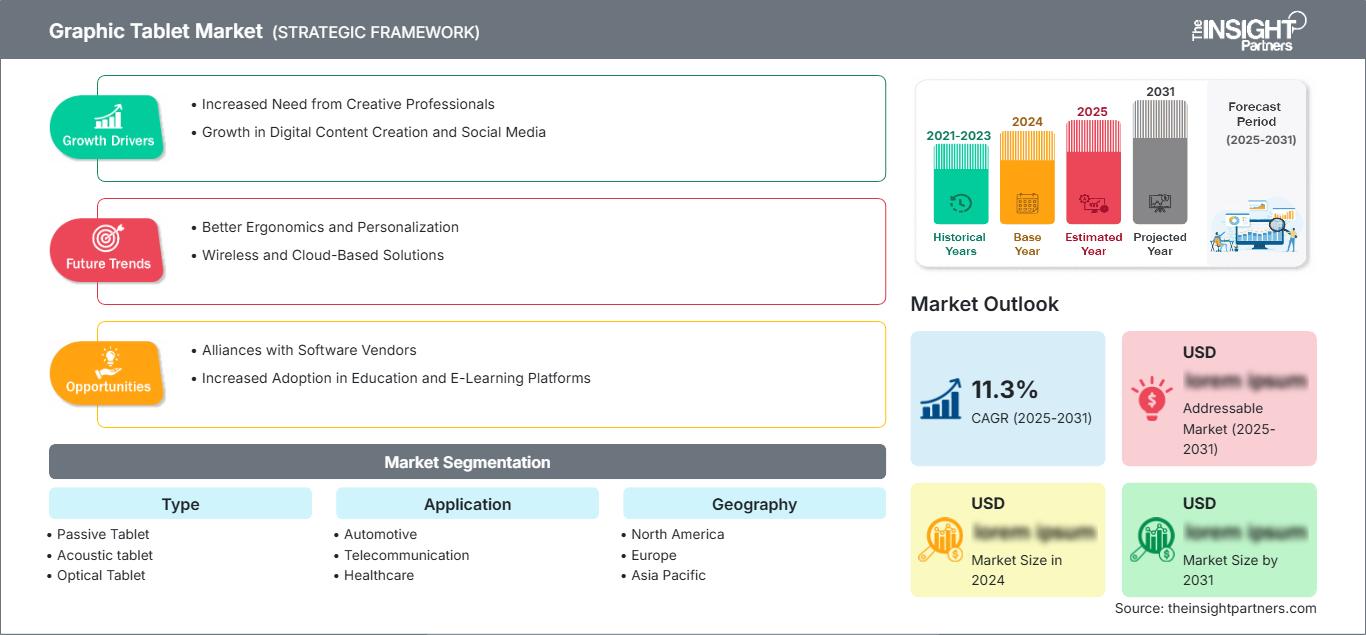
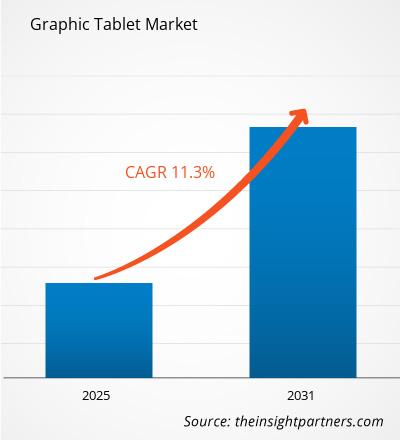
The Graphic Tablet Market was valued at US$ 727.95 Million in 2025 and is projected to reach US$ 1,930.73 Million by 2034, expanding at a CAGR of 11.45% during 2026–2034. The market has seen consistent usage of pressure-sensitive input devices in creative work, industrial processes, medical documentation, automotive design, telecoms, and consumer electronics because of the evolution of pressure sensitivity, wireless capabilities, screen compatibility, ergonomics, and software capabilities.
The North American Graphic Tablet Market Size is forecast to grow at a rate of 9.5–10.5% CAGR up to 2034. The structural growth drivers include the presence of creative software ecosystems, professional designers' jobs, business digitization, and the need for accurate input devices in various industries.
Graphic Tablet Market Assessment and Insights
- North America represents an estimated 25–29% share in 2025 and is projected to grow at a 9.5–10.5% CAGR between 2026–2034, supported by professional creative workflows, enterprise digitization, and established technology adoption.
- US accounts for an estimated 21–24% share in 2025 and is expected to expand at a 9.7–10.7% CAGR during 2026–2034, led by creator applications and engineering-intensive industries.
- Europe holds an estimated 21–25% share in 2025 and is forecast to grow at a 9.8–10.8% CAGR between 2026–2034, with Germany, the UK, France, Italy, and Spain providing diverse industrial and creative demand.
- Asia Pacific commands an estimated 39–43% share in 2025 and is anticipated to register a 12.5–13.5% CAGR during 2026–2034, led by China, Japan, South Korea, and India.
- Largest Segment: Passive Tablet holds an estimated 52–56% market share in 2025 and is projected to grow at a 10.8–11.8% CAGR during 2026–2034.
- High Growth Segment: Healthcare application represents an estimated 8–12% share in 2025 and is projected to expand at a 13.0–14.0% CAGR during 2026–2034.
- Key companies analyzed in detail: Adesso Inc.; KYE Systems Corp.; Shenzhen Huion Animation Technology Co., Ltd.; Xencelabs Technologies Ltd.; Wacom Co., Ltd.; Dell Inc.; Hanvon Ugee Technology Co., Ltd.; XPPEN TECHNOLOGY CO., LTD.; GAOMON Technology Co., Ltd.; Dolphin Computers.
Source: The Insight Partners' analysis based on proprietary research, government publications, company annual reports, investor presentations, industry databases, and expert interviews.
The Graphic Tablet market has moved beyond mere digitization platforms to include precise input systems integrating pressure sensitive pens, programmable features, wireless connections, multitouch features, and display-based systems. Manufacturing focus has been more towards accuracy of sensors, low force required for actuation, thin designs, tough surfaces, and software compatibility. Product differentiation now relies on the entire user experience and not on the size of the tablets anymore, whereas manufacturing continues to be centered on specialized electronics manufacturing chains catering to global and local players.
Future growth in demand is expected to diversify to include developing Asian markets, digitally enabled health care facilities, industrial design hubs, and educational setups. Capital expenditure will move towards portable pen displays, standalone devices, improved stylus, and application-based integration. Increasing regulatory attention towards accessibility, cybersecurity, sustainability of electronic devices, and digital transformation could potentially reward suppliers that are able to prove reliability, interoperability, efficient life cycle management, and support infrastructure.
Graphic Tablet Market Report Scope
| Report Attribute | Details |
|---|---|
| Market size in 2025 | US$ 727.95 Million |
| Market Size by 2034 | US$ 1,930.73 Million |
| Global CAGR (2026 - 2034) | 11.45% |
| Historical Data | 2021-2024 |
| Forecast period | 2026-2034 |
Graphic Tablet Market Analysis
The Graphic Tablet Market growth will be driven by digitization of manual processes of creativity and documentation. There is an increasing need for precise handwriting, drawing, and cursor control among designers, engineers, illustrators, doctors, educators, and technical specialists. Value chain consists of the suppliers of sensors and controllers, stylus technology providers, display producers, original equipment manufacturers, software vendors, distributors, retailers, and integrators for enterprises. Product economics are more determined by components, software compatibility, warranties, and channel strategy rather than hardware only.
Supply chain dynamics are still influenced by electronic components, display panels, pressure sensitive systems, batteries, connection modules, and precision assembly. Vendors have to make a trade-off between affordable mass-market devices and specialized products that need high-end displays and custom-made pens. Scale production is possible thanks to regional manufacturing in Asia Pacific, while channels in North America and Europe put focus on professional specifications, serviceability, and compatibility of applications.
Positioning strategies in the Graphic Tablet Market are varied among established specialty brands, computer vendors, and digitally oriented device makers. The focus for Wacom Co., Ltd. lies in the area of professional creative process flows, whereas the competitors such as Shenzhen Huion Animation Technology Co., Ltd. and XPPEN TECHNOLOGY CO., LTD. offer their products based on comprehensive product offerings and feature-based pricing strategies. Xencelabs Technologies Ltd. caters to the needs of professional creators, whereas Adesso Inc. offers devices for more accessible business and education purposes. The participation of Dell Inc. is based on compatible active input ecosystems and creator oriented computing channels.
Strategic investments have become more and more oriented towards the quality of pens, display technology, portability, compatibility of ecosystems, and software differentiation. Companies such as Hanvon Ugee Technology Co., Ltd., GAOMON Technology Co., Ltd., KYE Systems Corp., and Dolphin Computers serve various price and applications segments, whereas the company Wacom retains its premium positioning strategy.
● REPORT CUSTOMIZATION
Tailor This Report To Align With Your Specific Business Requirements
This report can be customized to align precisely with your business objectives, scope, and target markets. Customization options include tailored segmentation, geography, competitive analysis, and strategic insights to support informed decision-making.
Customize This Report →WHAT YOU CAN ADJUST
- ● Segmentations
- ● Geography
- ● Competitive Analysis
- ● Language Preferences
Graphic Tablet Market: Strategic Insights
Regional Insights
North America Graphic Tablet Market
In 2025, North America held a 25-29% Graphic Tablet Market share of the Graphical Tablets and will witness a growth rate of 9.5-10.5% in the forecast period until 2034. The US represents the main hub of demand and this is backed by the presence of strong creative sectors, engineering, digital education, enterprise annotation, and software segments. Canada represents its share through designers, education, media, and technology-driven customers.
Other factors that drive the demand include the need for replacements to achieve more precision, improved ergonomics, wireless capabilities, and integration with high resolution displays. Adoption in enterprises has begun to move outside creative studios and into the fields of health care, industry documentation, and collaboration. Suppliers who can provide software compatibility and service infrastructure have the potential to gain institutional orders, while pen displays still represent their value.
U.S. Graphic Tablet Market
US represents around 21-24% share in North America and is predicted to expand at a CAGR of 9.7%-10.7% from 2025 to 2034. The penetration of companies is evident in creative software for professionals, engineering design, education, medical documentation, and digital content creation. The range of applications facilitates replacement requirements.
High resolution, customization of shortcuts, pressure sensitivity, wireless capability, and mobility are driving factors for adoption. Professional creators are significant customers, although the demand is expanding due to incorporation of digital record, annotation, collaboration, and visualization of designs. Suppliers include Wacom Co., Ltd., Dell Inc., Adesso Inc., Xencelabs Technologies Ltd., among others.
Europe Graphic Tablet Market
Approximately 21–25% of the global market was dominated by Europe in 2025, which will witness a 9.8–10.8% CAGR during 2026-2034. The lead position is occupied by Germany based on industrial applications; the UK, France, Italy, and Spain add up demand from creative industry, engineering, education, healthcare, and consumers using technology devices.
The UK has well-established media, gaming, advertising, and design sectors, generating demand from professionals for precision engineering. Germany leverages its strength in industrial engineering and automotive designing applications along with technical education needs. Italy, France, and Spain supplement the demand with creative industry applications, architectural and engineering design applications, education and healthcare, and small business digitization needs.
APAC Graphic Tablet Market
APAC accounted for an estimated 39% to 43% share in 2025 and is expected to report a 12.5% to 13.5% CAGR from 2025 to 2034, making it the foremost region. The biggest market is China, owing to its manufacturing capacity and technological eco-systems. Japan and South Korea bring their mature design and electronics demand, while India and Australia provide increasing digitization.
The key drivers of regional demand include industrial digitization, education, games, animation, electronics design, and governmental technology projects. China also brings significant manufacturing capacity for tablets and components. India holds vast potential for long-term growth in terms of digitization and education, while Japan and South Korea continue driving premium demand by means of electronics and design.
Middle East & Africa Graphic Tablet Market
ME&A demand was proportionately lower in 2025 compared to other regions, but the ME&A region is expected to grow at 8.5%-9.5% CAGR through 2034. Adoption in Saudi Arabia and the UAE is driven by infrastructure development, digitalization efforts, and innovation in the creative industry and technologies. South Africa continues to be the key demand hub of Sub-Saharan Africa.
Innovation in Saudi Arabia and the UAE is growing in technology-enabled fields such as design, education, health care, and construction, providing demand for precision input from digital systems. South Africa has demand in education, media, engineering, and professional services. Demand in RoMEA is limited by purchasing power and distribution reach, but can be expanded over time with increased infrastructure and digital efforts.
Segmentation Analysis
Type
Type segmentation distinguishes Passive Tablet, Acoustic tablet, and Optical Tablet according to sensing architecture and input technology. Passive Tablet is estimated to grow at a 10.8–11.8% CAGR during 2026–2034, supported by affordability, established compatibility, and broad adoption across professional and consumer workflows. Technology selection increasingly depends on accuracy, durability, power requirements, and integration needs.
- Passive Tablet remains the principal product category because it combines established electromagnetic sensing with broad software compatibility. Demand is strongest among designers, educators, illustrators, and professional users seeking dependable precision at manageable acquisition costs.
- Acoustic tablet serves specialized applications requiring alternative sensing approaches and can support environments where conventional input architectures are less suitable. Its strategic role depends on application-specific accuracy, integration requirements, and supplier capabilities.
- Optical Tablet addresses specialized precision-input requirements through optical sensing concepts. Adoption is influenced by performance characteristics, system integration, and application economics, with opportunities concentrated in technically demanding workflows.
Application
Application segmentation covers Automotive, Telecommunication, Healthcare, Industrial, and Consumer Electronics. The segment is estimated to grow at a 12.0–13.0% CAGR during 2026–2034 as pen-based interaction expands beyond creative work into technical visualization, documentation, diagnostics, and digitally enabled product development. Application-specific software compatibility remains a major adoption consideration.
- Automotive demand is connected with design visualization, engineering documentation, styling, simulation workflows, and showroom or customer-interface applications. Suppliers benefit when devices integrate smoothly with computer-aided design and visualization environments.
- Telecommunication adoption centers on field documentation, technical workflows, customer interaction, and digital annotation. Portable devices with dependable connectivity can support distributed teams and reduce reliance on paper-based processes.
- Healthcare is increasingly relevant for annotation, clinical documentation, visualization, rehabilitation, and digital workflows. Institutional adoption depends heavily on interoperability, hygiene considerations, usability, data governance, and compatibility with established systems.
- Industrial applications include engineering drawings, quality documentation, maintenance workflows, technical training, and production support. Robust construction and integration with industrial software can materially influence procurement decisions.
- Consumer Electronics represents a broad demand pool spanning creative hobbies, education, personal productivity, gaming, and content creation. Competitive pricing, portability, compatibility, and ease of installation remain decisive purchasing factors.
Opportunity Snapshot
| Application | Revenue Contribution | Trend Tag | Adoption Stage |
|---|---|---|---|
| Automotive | Medium | Design Digitization | Scaling |
| Telecommunication | Medium | Field Annotation | Scaling |
| Healthcare | Medium | Digital Documentation | Emerging |
| Industrial | High | Engineering Input | Scaling |
| Consumer Electronics | High | Creator Devices | Mature |
Graphic Tablet Market Growth Drivers and Impact Analysis
Expansion of Digital Creative and Engineering Workflows
The migration from paper sketches and conventional cursor interfaces toward precision digital workflows is expanding the addressable use base for pen-input hardware. Creative professionals increasingly require pressure-sensitive input for illustration, animation, photo editing, and three-dimensional design, while engineering teams use pen interfaces for markup and visualization. The impact extends beyond replacement sales because professional users often upgrade when improved pressure response, display quality, ergonomics, or connectivity materially improves productivity. In enterprise settings, tablet procurement can also be tied to standardized workstation configurations, training programs, and software licenses. Suppliers that combine hardware with application compatibility can capture greater account value and improve retention. This driver is therefore shifting purchasing criteria from simple input functionality toward workflow efficiency, integration, and total ownership economics across professional environments.
Rising Digital Health and Institutional Documentation Requirements
Digital transformation in healthcare is creating additional pathways for pen-based interaction through clinical annotation, medical visualization, electronic documentation, patient communication, and specialized diagnostic workflows. The World Health Organization reported that 129 countries had established national digital health strategies by 2025, illustrating the institutional scale of digital-health planning. World Health Organization Graphic input devices can complement these systems when handwriting, diagramming, or precise visual annotation remains more efficient than keyboard-only interaction. Market impact is likely to be strongest where tablets integrate securely with existing software, support reliable authentication, and satisfy procurement requirements. Healthcare buyers also evaluate lifecycle management, cleaning procedures, interoperability, accessibility, and data protection. Consequently, vendors able to adapt products for regulated institutional settings can address a higher-value opportunity than suppliers focused exclusively on consumer creative applications.
Advances in Portable, High-Precision Pen Technology
Improvements in stylus sensing, pressure response, display integration, wireless connectivity, battery efficiency, and device thickness are increasing the usefulness of pen-input products across mobile and desktop environments. Modern professional products increasingly support configurable controls and precise tracking, while portable displays reduce dependence on fixed studio workstations. These changes can stimulate replacement demand because users may upgrade for workflow advantages rather than basic functionality alone. The impact is especially relevant for professional creators, educators, field engineers, and digitally enabled businesses requiring mobility. Product differentiation is consequently moving toward complete interaction systems comprising tablet, pen, display, connectivity, and software. Manufacturers that can maintain consistent performance while controlling component costs can improve competitiveness across premium and mid-market tiers, while channel partners gain opportunities to bundle tablets with computers, monitors, software, and accessories.
Graphic Tablet Market Future Trends
Convergence of Standalone Tablets and Professional Pen Displays
The boundary between conventional graphics tablets, pen displays, and standalone creative computers is likely to become less distinct. Future products in the Graphic Tablet Market Trends are expected to combine high-resolution screens, low-latency pen systems, wireless connectivity, local processing, cloud synchronization, and application-aware controls. Such convergence can broaden usage among creators who require mobility without sacrificing professional precision. Manufacturers may increasingly develop modular ecosystems in which one stylus operates across multiple displays and computing environments. Software support will become more important as users expect seamless transitions between desktop and mobile workflows. Device makers can also differentiate through ergonomics, customizable controls, color accuracy, and improved thermal efficiency. Over time, these developments may shift competitive emphasis from isolated hardware specifications toward interoperable product families, recurring software relationships, accessory ecosystems, and workflow continuity across locations.
Application-Specific Input Systems for Enterprise Workflows
Enterprise buyers are likely to seek increasingly specialized pen-input systems rather than generic consumer devices. Automotive studios may prioritize accurate design visualization, hospitals may require secure annotation workflows, and industrial users may value rugged construction and integration with technical software. Telecommunications organizations can use portable input systems for field documentation and customer-facing applications. This specialization should encourage suppliers to develop configurable hardware, software development kits, device-management capabilities, and application partnerships. Procurement decisions may increasingly include cybersecurity, device lifecycle management, accessibility, service-level commitments, and integration testing. As digital transformation becomes more operationally embedded, tablet manufacturers can capture incremental value by supporting vertical-specific deployment rather than competing solely on retail specifications. This trend should also increase the relevance of channel partners and systems integrators in institutional sales.
Graphic Tablet Market Opportunities
Vertical Solutions for Healthcare and Industrial Digitization
Healthcare and industrial organizations offer an opportunity to build application-specific tablet solutions around documented workflows rather than generic creative use. Suppliers can partner with software developers, systems integrators, hospitals, engineering firms, and equipment manufacturers to create validated configurations for annotation, inspection, design review, maintenance, training, and technical documentation. The opportunity is attractive because institutional buyers often evaluate reliability, support, compatibility, security, and lifecycle economics alongside unit price. Vendors can strengthen differentiation through ruggedized designs, antimicrobial surfaces where appropriate, centralized device management, authentication support, and standardized deployment packages. Partnerships can also reduce integration barriers and shorten procurement cycles. The most defensible strategies will focus on measurable workflow improvements and repeatable deployment models, allowing manufacturers to expand from individual device sales toward broader institutional technology programs.
Expansion Across Emerging Digital-Content Ecosystems
Emerging creative economies in Asia, the Middle East, and other digitally expanding markets present opportunities for localized product portfolios and distribution models. Graphic Tablet Market Forecasts should increasingly consider education, gaming, animation, freelance design, online content production, and technology-enabled small businesses alongside traditional professional studios. Manufacturers can address these markets through entry-level products, localized software support, financing options, regional service networks, and partnerships with schools or creator communities. India and Southeast Asian economies are particularly relevant because growing digital-service capabilities can create new user groups beyond established creative centers. Regional manufacturing and logistics advantages can also support competitive pricing. Companies that combine affordable hardware with training, community engagement, and software compatibility may establish durable customer relationships as users progress from entry-level devices toward professional systems.
Recent Developments
- August 2026: XPPen unveiled the Artist Ultra 14, a portable professional drawing display featuring a 2.8K OLED screen, 10-bit color depth, 99% Adobe RGB/sRGB/Display P3 coverage, Delta E < 1 color accuracy, 90Hz refresh rate and X-Touch controls, with an ultra-slim 6mm design weighing 720g.
- August 2025: Wacom and Blender announced a strategic partnership to advance pen and touch experiences for 3D creators across platforms. The collaboration aims to improve the integration of Wacom’s pen and touch technology with Blender’s open-source 3D creation software, supporting more intuitive and efficient workflows for artists and creators.
- May 2026: Asset Value Investors (AVI), Wacom’s largest shareholder on behalf of the portfolios it manages, submitted shareholder proposals seeking the dismissal of two Wacom directors and the appointment of replacements, citing concerns over the company’s governance and capital allocation.
Frequently Asked Questions

- Comprehensive Market Sizing and Forecast Analysis
- Detailed Segmentation Analysis
- In-Depth Market Dynamics Assessment
- Regional and Country-Level Insights
- Competitive Landscape and Company Benchmarking
- Strategic Business Intelligence
Recent Reports
Testimonials

The Insight Partners provided valuable market intelligence that supported our global go-to-market strategy. Their team was professional, responsive, and attentive to our feedback, providing thoughtful analysis and helpful methodological clarifications throughout the project.
Junmo Kim Chief Financial Officer (CFO), Enertech Co., Ltd.
The Insight Partners' SCADA System Market report is comprehensive, with valuable insights on current trends and future forecasts. The team was highly professional, responsive, and supportive throughout. We are very satisfied and highly recommend their services.
RAN KEDEM Partner, Reali Technologies LTDs
I requested a report on a very specific software market and the team produced the report in a few days. The information was very relevant and well presented. I then requested some changes and additions to the report. The team was again very responsive and I got the final report in less than a week.
JEAN-HERVE JENN Chairman, Future Analytica
We worked with The Insight Partners for an important market study and forecast. They gave us clear insights into opportunities and risks, which helped shape our plans. Their research was easy to use and based on solid data. It helped us make smart, confident decisions. We highly recommend them.
PIYUSH NAGPAL Sr. Vice President, High Beam Global
The Insight Partners delivered insightful, well-structured market research with strong domain expertise. Their team was professional and responsive throughout. The user-friendly website made accessing industry reports seamless. We highly recommend them for reliable, high-quality research services
YUKIHIKO ADACHI CEO, Deep Blue, LLC.
This is the first time I have purchased a market report from The Insight Partners.While I was unsure at first, I visited their web site and felt more comfortable to take the risk and purchase a market report.I am completely satisfied with the quality of the report and customer service. I had several questions and comments with the initial report, but after a couple of dialogs over email with their analyst I believe I have a report that I can use as input to our strategic planning process.Thank you so much for taking the extra time and making this a positive experience.I will definitely recommend your service to others and you will be my first call when we need further market data.
JOHN SUZUKI President and Chief Executive Officer, Board Director, BK Technologies
I wish to appreciate your support and the professionalism you displayed in the course of attending to my request for information regarding to infectious disease IVD market in Nigeria. I appreciate your patience, your guidance, and the fact that you were willing to offer a discount, which eventually made it possible for us to close a deal. I look forward to engaging The Insight Partners in the future, all thanks to the impression you have created in me as a result of this first encounter.
DR CHIJIOKE ONYIA MANAGING DIRECTOR, PineCrest Healthcare Ltd.Reason to Buy
- Informed Decision-Making
- Understanding Market Dynamics
- Competitive Analysis
- Identifying Emerging Markets
- Customer Insights
- Market Forecasts
- Risk Mitigation
- Boosting Operational Efficiency
- Strategic Planning
- Investment Justification
- Tracking Industry Innovations
- Aligning with Regulatory Trends





 Get Free Sample for