
Grow Light Market Trends, Size & Forecast by 2034
Coverage: By Technology (High Intensity Discharge (HID) Lights, Light Emitting Diodes (LEDs), Fluorescent Lights, Light Emitting Plasma Grow lights (LEPs), and Induction Lights); Installation (New and Retrofit); and Application (Indoor Farming, Vertical Farming, Commercial Green Houses, and Rooftop Farming), and Geography (North America, Europe, Asia Pacific, and South and Central America)
- Status : Data Released
- Report Code : TIPTE100001176
- Category : Electronics and Semiconductor
- No. of Pages : 150
- Available Report Formats :


- Last update date : August 17, 2026


2025 Market Size
US$ 6.90 Bn
Base year value
2034 Forecast
US$ 25.70 Bn
Projected by 2034
CAGR 2026-2034
15.73 %
Growth rate
Addressable Market
US$ 138.29 Bn
(2026-2034)
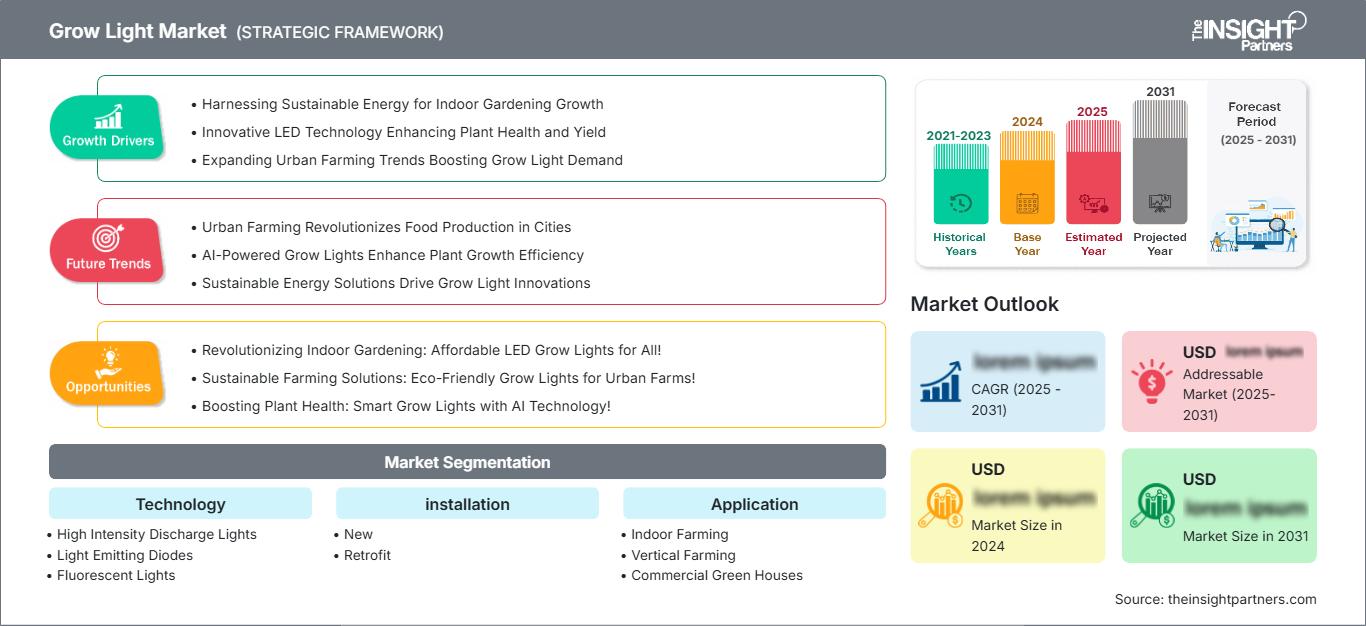
The Grow Light Market was valued at US$ 6.90 Billion in 2025 and is projected to reach US$ 25.70 Billion by 2034, registering a compound annual growth rate (CAGR) of 15.73% from 2026 to 2034. The market comprises artificial light systems that help plants carry out photosynthesis where there is not enough natural light in those areas such as indoor farms, vertical farms, and commercial greenhouses. Urbanization trends, scarcity of land and increasing use of controlled environment agriculture techniques are some of the factors leading to growth in this market.
North America constitutes a significant part of the revenue earned by the Grow Light Market size, with the region being projected to contribute 28–32% to the worldwide revenues in 2025. The North American market is projected to witness growth at a CAGR of 14.5–15.5% over the period 2025 to 2034 due to the high level of use of agricultural technology, well-established greenhouse system, and investment in vertical farming projects.
Grow Light Market Assessment and Insights
- North America – Estimated to hold approximately 28–32% share of the global Market in 2025, supported by advanced CEA infrastructure and strong technology adoption. The region is projected to grow at a CAGR of 14.5–15.5% from 2026 to 2034.
- US – The United States accounts for approximately 70–74% of North America's Market revenues in 2025. The market is anticipated to expand at a CAGR of 14–16% through 2034, underpinned by commercial greenhouse expansion and vertical farming investments.
- Europe – Europe represents an estimated 31–35% share of the global market in 2025, with Germany, the UK, and the Netherlands as leading national markets. The regional market is projected to grow at a CAGR of 13.5–15.5% from 2026 to 2034.
- Asia Pacific – Asia Pacific is estimated to account for approximately 24–28% of global Market revenues in 2025. The region is expected to register the fastest growth at a CAGR of 16–18% through 2034, led by China, Japan, and India.
- Largest Segment – Light Emitting Diodes (LED) represent the largest technology segment, accounting for an estimated 55–60% of global market share in 2025, with a projected CAGR of 17–19% from 2026 to 2034.
- High Growth Segment – Vertical farming applications are the fastest-growing segment, with an estimated market share of 18–22% in 2025 and a projected CAGR of 19–21% from 2026 to 2034.
- Key companies analyzed in detail – Osram Licht AG, General Electric Company, Iwasaki Electric Co., Ltd., LumiGrow, Inc., Gavita Holland B.V., Sunlight Supply, Inc., Heliospectra AB, Royal Philips, Illumitex Inc., Transcend Lighting Inc.
Source: The Insight Partners' analysis based on proprietary research, government publications, company annual reports, investor presentations, industry databases, and expert interviews.
In terms of technology used by the Grow Light Market, there is a notable shift from high intensity discharge and fluorescent grow lights to more efficient energy-efficient LED grow lights with precise spectrum control and low operating cost. Developments in full spectrum lighting, tunable spectra, and sensing technologies have allowed growers to maximize the efficiency of photosynthesis for different crops at different growth stages. Competitiveness of the market participants is increasingly determined by the development of software products for adjusting light in real time, scheduling, and integration into larger greenhouse management systems.
Moving forward, there are prospects for growth in the Grow Light Market owing to the increase in the rate of investments from emerging economies toward food security through indoor farming and vertical agriculture. Government policies aimed at promoting sustainable agriculture, along with the drop in prices of LEDs and improved energy efficiency, are anticipated to lead to increased penetration across commercial as well as residential sectors. The regulations for urban farming and controlled environment agriculture in regions that are characterized by land shortages and climate instability are set to provide further impetus to the market.
Grow Light Market Report Scope
| Report Attribute | Details |
|---|---|
| Market size in 2025 | US$ 6.90 Billion |
| Market Size by 2034 | US$ 25.70 Billion |
| Global CAGR (2026 - 2034) | 15.73% |
| Historical Data | 2021-2024 |
| Forecast period | 2026-2034 |
Grow Light Market Analysis
Grow Light Market is mainly fueled by the rising need for indoor and vertical farming technology due to urbanization and limited availability of agricultural land. As per estimates from Food and Agriculture Organization, more than 68 percent of the global population will live in urban areas by the year 2050, making it imperative for agricultural innovations to meet the demands for food. Indoor farms allow year round growth of crops in a controlled environment where the source of light for photosynthesis is provided by grow lights, irrespective of the change in seasons and weather. E-commerce and grocery deliveries have further increased the demand for locally grown vegetables and fruits, which have become essential for vertical farms and commercial greenhouses that need efficient lighting technologies. Growth in the cannabis market in North America and Europe is creating a large demand for grow lights.
In terms of supply-side dynamics, the Grow Light Market Report comprises a highly competitive environment with lighting conglomerates and providers of technology specifically tailored to horticulture. Some of the leading firms such as Osram Licht AG, Royal Philips, General Electric, and Gavita Holland B.V. are consolidating their market power through constant innovation related to the design of chips, spectral tuning, and system integration. These five producers of grow lights account for about 55–60% of total world market share. Competitiveness is gradually becoming a function of software development and service delivery because firms offer unique lighting management systems, mobile applications, and API platforms that are easy to integrate with existing farm management systems. In terms of investment dynamics, there has been an increase in vertical integration whereby a number of companies have been developing controlled environment agriculture solutions which include lighting, climate control, irrigation, and crop monitoring technologies. Strategic alliances with ag-tech startups, institutions of research, and farming operators are some of the major success factors in the rapidly changing market.
● REPORT CUSTOMIZATION
Tailor This Report To Align With Your Specific Business Requirements
This report can be customized to align precisely with your business objectives, scope, and target markets. Customization options include tailored segmentation, geography, competitive analysis, and strategic insights to support informed decision-making.
Customize This Report →WHAT YOU CAN ADJUST
- ● Segmentations
- ● Geography
- ● Competitive Analysis
- ● Language Preferences
Grow Light Market: Strategic Insights
Regional Insights
North America Grow Light Market
The Grow Light Market in North America was valued at 28-32% of the total global market value in 2025, owing to the development of the advanced agricultural technology environment along with the adoption of controlled environment agriculture practices in the region. The regional market is expected to register a CAGR of 14.5-15.5% during 2026-2034. Growing demand from commercial greenhouse operators, along with the rise in vertical farming facility expansions within the urban locations, has been a key contributor to the growth of the market. In North America, the US leads the market, while California, Arizona, and the Northeast Corridor have emerged as key regions for investing in indoor agriculture projects. Canada's market is boosted by government initiatives towards sustainable agriculture, along with the legalization of the cannabis industry within the country.
U.S. Grow Light Market
The United States is the dominant player in the North American Grow Light Market Share, capturing about 70-74% of the revenue generated in the region in 2025. The growth of the U.S. market is forecast to rise at a CAGR of 14-16% between 2026 and 2034. Applications range from commercial greenhouse farming to vertical farming and cultivation of cannabis. Leading companies such as General Electric, Osram, and Gavita have managed to get a good foothold in the market owing to their wide reach as well as technological partnerships. Opportunities in this market include the growing adoption of lighting management systems based on artificial intelligence technology and working in collaboration with the precision agriculture platform. The rising preference among consumers for local as well as organic produce is promoting investments in urban farms.
Europe Grow Light Market
Europe accounted for an estimated 31–35% of the global market share for Grow Lights in 2025. Moreover, the market is forecasted to grow at a CAGR of 13.5–15.5% between 2026 to 2034. The Netherlands dominates Europe's grow light market owing to their superior greenhouse horticulture business and exports fresh products from here. Germany is next in line owing to their extensive investment in urban farming and vertical agriculture projects. UK's market is fuelled by the rising popularity of fresh produce and sustainable farming methods by consumers as well as government measures. There is increasing adoption in French and Italian markets owing to Mediterranean greenhouses in operation there. In addition, Spain's market is fuelled owing to their large-scale horticulture export business. Energy efficient policies and reduced carbon emission policies are pushing the adoption of LED lights instead of conventional lights in the region.
APAC Grow Light Market
It is projected that the Asia Pacific will occupy around 24-28% of the global market for grow light in 2025 and is anticipated to witness the fastest rate of regional growth with a CAGR of 16-18% between 2026 and 2034. China continues to be the leader of this market due to government initiatives which focus on vertical farming and urban agriculture in order to ensure food security in the densely populated urban areas. Japan and South Korea participate in this market through the adoption of advanced technology in commercial greenhouses and research laboratories. India emerges as a highly promising market thanks to urbanization, increase in disposable incomes and government initiatives for sustainable agriculture.
Middle East & Africa Grow Light Market
Middle East and Africa constitutes the small yet fast-growing share of the global Grow Light Market, exhibiting a projected CAGR of 15-17% during the period 2026-2034. The leading countries include Saudi Arabia and the UAE, due to the considerable investment made in the projects related to food security, desert farming and vertical farming that uses grow light in totality to grow crops. The market in South Africa is fueled by the developed horticulture industry and the rise in the adoption of controlled environment agriculture systems in order to export products. The remaining countries of the region, such as Egypt and Kenya, are adopting the technology gradually due to increasing awareness in agriculture technology.
Segmentation Analysis
Technology
The Grow Light Market is segmented by technology into High Intensity Discharge Lights, Light Emitting Diodes, Fluorescent Lights, Light Emitting Plasma Grow lights, and Induction Lights. Light Emitting Diodes (LED) dominate the market with an estimated 55–60% share in 2025, driven by their superior energy efficiency, long operational life, and spectral tunability. The LED segment is projected to grow at a CAGR of 17–19% from 2026 to 2034. HID lights maintain a significant presence in traditional greenhouse operations, while fluorescent and plasma technologies serve niche applications in research and small-scale cultivation.
- High Intensity Discharge Lights – HID lights, including metal halide and high-pressure sodium varieties, have been widely used in commercial greenhouse operations. They offer high light output at lower initial costs but face increasing competition from more energy-efficient LED alternatives.
- Light Emitting Diodes – LEDs represent the dominant and fastest-growing technology segment, offering superior energy efficiency, customizable spectrums, and extended operational life. They are increasingly adopted across all application areas from commercial greenhouses to vertical farms.
- Fluorescent Lights – Fluorescent grow lights are primarily used in research settings, seedling propagation, and small-scale cultivation. They offer lower initial costs but are gradually being displaced by more efficient LED solutions in commercial applications.
- Light Emitting Plasma Grow lights – Plasma grow lights provide full-spectrum illumination with high efficacy and long lamp life. They are used in specialized applications such as research facilities and high-value crop cultivation where spectral quality is critical.
- Induction Lights – Induction grow lights offer long operational life and good color rendering but have limited market penetration due to higher costs and competition from LEDs. They are primarily used in niche horticulture applications.
Installation
The market is segmented by installation into New and Retrofit. New installations represent the larger segment, driven by the construction of new indoor farming facilities, commercial greenhouses, and vertical farming operations worldwide. Retrofit installations are gaining traction as existing greenhouse operators upgrade from traditional lighting systems to energy-efficient LED solutions.
- New – New installation encompasses grow lighting systems deployed in newly constructed indoor farming facilities, commercial greenhouses, and vertical farms. This segment benefits from greenfield projects and expanding controlled environment agriculture capacity.
- Retrofit – Retrofit installation involves upgrading existing lighting systems in operational greenhouses and cultivation facilities. This segment is driven by energy cost savings and the transition from HID to LED technologies.
Application
The Grow Light Market serves multiple applications including Indoor Farming, Vertical Farming, Commercial Greenhouses, and Rooftop Farming. Commercial greenhouses constitute the largest application segment, accounting for an estimated 40–44% of market revenues in 2025. Vertical farming represents the fastest-growing application, driven by urban agriculture initiatives and space-efficient cultivation methods.
- Indoor Farming – Indoor farming applications encompass controlled environment agriculture in warehouses, shipping containers, and dedicated indoor facilities. This segment benefits from year-round production capabilities and protection from external climate variability.
- Vertical Farming – Vertical farming involves stacked cultivation systems in urban environments, maximizing production per square foot. This high-growth segment is driven by urbanization, food security concerns, and technological advancements in lighting and automation.
- Commercial Greenhouses – Commercial greenhouses represent the largest application segment, utilizing grow lights to supplement natural daylight and extend production seasons. This segment benefits from established infrastructure and成熟的 horticulture practices.
- Rooftop Farming – Rooftop farming involves crop cultivation on building rooftops in urban areas. This emerging segment is driven by local food movements, sustainability initiatives, and efficient use of underutilized urban spaces.
Opportunity Snapshot
| Application | Revenue Contribution | Trend Tag | Adoption Stage |
|---|---|---|---|
| Commercial Greenhouses | High | Season Extension | Mature |
| Indoor Farming | High | CEA Expansion | Scaling |
| Vertical Farming | Medium | Urban Agriculture | Emerging |
| Rooftop Farming | Low | Urban Greening | Emerging |
Grow Light Market Growth Drivers and Impact Analysis
Rising Demand for Indoor and Vertical Farming Solutions
Rapid urbanization and the limited availability of arable land are driving the global shift toward indoor and vertical farming, creating substantial demand for artificial lighting solutions. Urban populations are projected to reach 68% of the global total by 2050, necessitating innovative approaches to food production that minimize transportation costs and environmental impact. Indoor farming facilities rely entirely on grow lights for photosynthesis, enabling year-round crop production in controlled environments regardless of external climate conditions. The ability to produce fresh produce locally in urban centers reduces supply chain vulnerabilities and carbon emissions, making indoor agriculture an increasingly attractive solution for food security. Major retail chains and food service providers are investing in vertical farming projects to secure consistent, high-quality produce supplies, further amplifying demand for advanced grow lighting systems.
Advancements in LED Technology and Energy Efficiency
Continuous improvements in LED technology have transformed the grow lighting landscape, offering unprecedented energy efficiency, spectral precision, and operational cost savings. Modern LED grow lights consume up to 50-60% less energy than traditional HID systems while delivering comparable or superior photosynthetic photon flux density. The ability to customize light spectrums for specific crop types and growth stages has enabled growers to optimize yields, enhance nutritional content, and reduce flowering times. Declining LED component costs and improving manufacturing efficiencies have made these solutions increasingly accessible to commercial growers and hobbyists alike. Energy efficiency regulations and sustainability commitments are accelerating the transition from conventional lighting to LED solutions across all application segments.
Government Support for Sustainable Agriculture and Food Security
Governments worldwide are implementing policies and funding programs to promote sustainable agriculture, urban farming, and controlled environment production. Initiatives include subsidies for greenhouse modernization, grants for vertical farming projects, and research funding for horticulture lighting technologies. In Asia Pacific, government programs targeting food security and agricultural modernization are driving significant investments in indoor farming infrastructure. European Union agricultural policies increasingly emphasize sustainable production methods, creating favorable conditions for energy-efficient grow lighting adoption. These policy tailwinds are reducing barriers to entry for commercial growers and accelerating the deployment of advanced lighting solutions across both developed and emerging markets.
Grow Light Market Future Trends
Integration of AI and IoT in Grow Lighting Systems
Grow Light Market Trends are evolving from standalone illumination devices into intelligent platforms integrated with artificial intelligence and Internet of Things technologies. Future systems will leverage AI algorithms to analyze plant growth patterns, environmental conditions, and energy consumption data, automatically adjusting light spectrums, intensity, and duration for optimal results. IoT connectivity enables remote monitoring, real-time adjustments, and integration with broader farm management systems including climate control, irrigation, and nutrient delivery. This trend is transforming grow lighting from a cost center into a strategic asset that delivers measurable improvements in crop quality, yield consistency, and resource efficiency. Machine learning capabilities will enable predictive optimization, reducing energy waste and improving operational outcomes.
Expansion of Vertical Farming and Urban Agriculture Projects
The proliferation of vertical farming projects in urban centers worldwide is creating new opportunities for specialized grow lighting solutions. Major cities are increasingly adopting vertical farming as a strategy for local food production, job creation, and reduced food miles. These facilities require advanced lighting systems optimized for multi-tier cultivation, with considerations for heat management, uniform light distribution, and energy efficiency. The trend toward modular, scalable vertical farming systems is driving demand for standardized lighting solutions that can be easily deployed across different facility configurations. As vertical farming economics improve through technological advancements and economies of scale, this application segment is expected to capture an increasing share of the overall grow lighting market.
Grow Light Market Opportunities
Expansion into Emerging Markets with Growing Food Security Needs
Emerging economies across Asia Pacific, Latin America, and Africa present significant growth opportunities for grow lighting vendors as these regions invest in food security and agricultural modernization. Countries such as India, Indonesia, Brazil, and Nigeria are witnessing rapid urbanization and shrinking agricultural land, driving interest in indoor farming and controlled environment agriculture solutions. Government initiatives promoting sustainable agriculture and urban food production are creating favorable conditions for Grow Light Market Forecast. Vendors that develop cost-optimized lighting solutions tailored to local crop types, climate conditions, and power infrastructure are well-positioned to capture market share in these high-growth regions. Partnerships with local agricultural technology companies, research institutions, and government agencies will be critical for successful market penetration.
Development of Specialized Lighting Solutions for Niche Crops
Beyond traditional leafy greens and herbs, there is growing demand for specialized grow lighting solutions optimized for high-value crops including strawberries, tomatoes, medicinal plants, and ornamental flowers. Each crop type has unique light spectrum requirements for optimal growth, flowering, and yield characteristics. The expanding legal cannabis industry in North America and Europe represents a significant opportunity for specialized flowering and cannabinoid production lighting. Vendors that develop crop-specific lighting recipes, integrated with environmental controls and cultivation protocols, can differentiate themselves in an increasingly competitive market. Research collaborations with agricultural universities and commercial growers will enable the development of validated lighting solutions that deliver measurable improvements in crop quality and production efficiency.
Recent Developments
- November 2025: Soltech Solutions LLC — unveiled the Aura Ambient Grow Lamp, the first grow lamp designed as home décor that combines warm ambient lighting with full-spectrum plant growth technology. Designed by Italian designer Matteo Ragni, the lamp features dimmable 3000K illumination, high color rendering, and a decorative wood base, enabling indoor plant care without compromising interior aesthetics.
- March 2026: JumpLights — launched the Vert Series LED fixtures designed for multi-tier flowering rooms and vegetative cultivation. The new lineup includes the Vert 420, Vert 830, and Vert Pro 900 models, delivering high light output, optimized spectrums, UV and Far Red control options, and improved canopy penetration for commercial indoor growers. The fixtures are engineered for reliable, large-scale horticultural operations and are assembled and tested in the United States.
- June 2023: MechaTronix — launched the CoolStack LED grow light designed specifically for high-wire greenhouse crops such as tomatoes and cucumbers. The fixture combines passive cooling, high light output, and energy-efficient performance to improve crop productivity while lowering greenhouse operating costs.
- October 2023: LED iBond International A/S — launched its second-generation HORTISABER LED grow lights for industrial greenhouses. The new toplighting system delivers improved light uniformity, customized light spectra, and up to 40% lower energy consumption, helping commercial growers increase yields while reducing operating costs.
Frequently Asked Questions

- Comprehensive Market Sizing and Forecast Analysis
- Detailed Segmentation Analysis
- In-Depth Market Dynamics Assessment
- Regional and Country-Level Insights
- Competitive Landscape and Company Benchmarking
- Strategic Business Intelligence
Recent Reports
Testimonials

The Insight Partners provided valuable market intelligence that supported our global go-to-market strategy. Their team was professional, responsive, and attentive to our feedback, providing thoughtful analysis and helpful methodological clarifications throughout the project.
Junmo Kim Chief Financial Officer (CFO), Enertech Co., Ltd.
The Insight Partners' SCADA System Market report is comprehensive, with valuable insights on current trends and future forecasts. The team was highly professional, responsive, and supportive throughout. We are very satisfied and highly recommend their services.
RAN KEDEM Partner, Reali Technologies LTDs
I requested a report on a very specific software market and the team produced the report in a few days. The information was very relevant and well presented. I then requested some changes and additions to the report. The team was again very responsive and I got the final report in less than a week.
JEAN-HERVE JENN Chairman, Future Analytica
We worked with The Insight Partners for an important market study and forecast. They gave us clear insights into opportunities and risks, which helped shape our plans. Their research was easy to use and based on solid data. It helped us make smart, confident decisions. We highly recommend them.
PIYUSH NAGPAL Sr. Vice President, High Beam Global
The Insight Partners delivered insightful, well-structured market research with strong domain expertise. Their team was professional and responsive throughout. The user-friendly website made accessing industry reports seamless. We highly recommend them for reliable, high-quality research services
YUKIHIKO ADACHI CEO, Deep Blue, LLC.
This is the first time I have purchased a market report from The Insight Partners.While I was unsure at first, I visited their web site and felt more comfortable to take the risk and purchase a market report.I am completely satisfied with the quality of the report and customer service. I had several questions and comments with the initial report, but after a couple of dialogs over email with their analyst I believe I have a report that I can use as input to our strategic planning process.Thank you so much for taking the extra time and making this a positive experience.I will definitely recommend your service to others and you will be my first call when we need further market data.
JOHN SUZUKI President and Chief Executive Officer, Board Director, BK Technologies
I wish to appreciate your support and the professionalism you displayed in the course of attending to my request for information regarding to infectious disease IVD market in Nigeria. I appreciate your patience, your guidance, and the fact that you were willing to offer a discount, which eventually made it possible for us to close a deal. I look forward to engaging The Insight Partners in the future, all thanks to the impression you have created in me as a result of this first encounter.
DR CHIJIOKE ONYIA MANAGING DIRECTOR, PineCrest Healthcare Ltd.Reason to Buy
- Informed Decision-Making
- Understanding Market Dynamics
- Competitive Analysis
- Identifying Emerging Markets
- Customer Insights
- Market Forecasts
- Risk Mitigation
- Boosting Operational Efficiency
- Strategic Planning
- Investment Justification
- Tracking Industry Innovations
- Aligning with Regulatory Trends





 Get Free Sample for