
Handheld Computers Market Share, Demand & Growth by 2034
Coverage: by Component (Hardware and Software); Application (Industrial, Manufacturing, Government, Retail, Other) , and Geography (North America, Europe, Asia Pacific, and South and Central America)
- Status : Data Released
- Report Code : TIPRE00008269
- Category : Electronics and Semiconductor
- No. of Pages : 150
- Available Report Formats :


- Last update date : September 10, 2026


2025 Market Size
US$ 10.01 Bn
Base year value
2034 Forecast
US$ 20.15 Bn
Projected by 2034
CAGR 2026-2034
8.08 %
Growth rate
Addressable Market
US$ 135.55 Bn
(2026-2034)
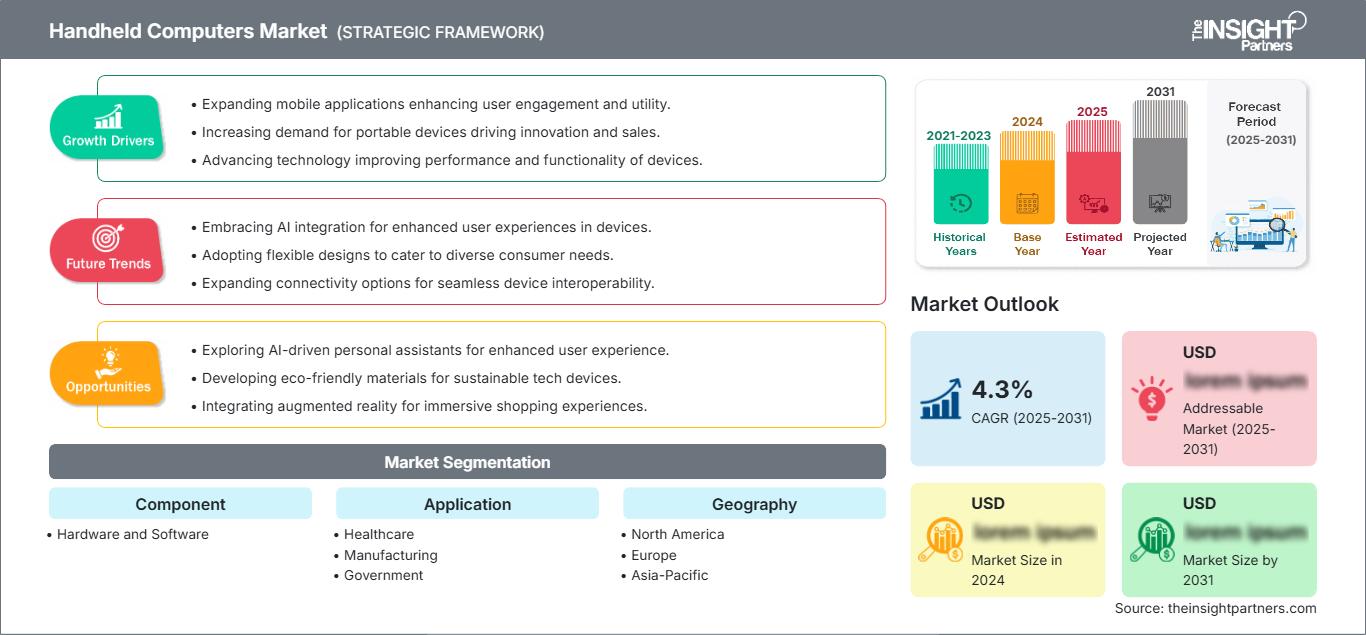
Handheld Computer Market was valued at US$ 10.01 Billion in 2025 and is projected to reach US$ 20.15 Billion by 2034, expanding at a CAGR of 8.08% during 2026–2034. Demand is driven by digitization of the mobile workforce, connectivity of the field operations, warehouse automation, healthcare mobility, retail execution, and industrial data capture where hardware and software are now developed as platform solutions providing real-time visibility into operations.
North America is still strategically important as a region with the estimated 8.0–9.0% CAGR until 2034. The Handheld Computer Market size is driven by the need to replace the aging enterprise equipment, growing adoption of 5G/Wi-Fi 6/7 connectivity, and ongoing investment in mobile processes in logistics, healthcare, manufacturing, public safety, and retail operations.
Handheld Computers Market Assessment and Insights
- North America held a 27–31% share in 2025 and is projected to grow at a CAGR of 8.0–9.0% between 2026–2034, supported by mature enterprise mobility, device-refresh cycles, logistics digitization, and connected frontline operations.
- US represented a 20–24% share in 2025 and is expected to expand at a CAGR of 8.2–9.2% between 2026–2034, driven by warehouse modernization, healthcare mobility, and retail automation.
- Europe accounted for a 20–24% share in 2025 and is forecast to grow at a CAGR of 7.4–8.4% during 2026–2034, led by Germany, the UK, France, Italy, and Spain, where industrial digitization supports enterprise mobility.
- Asia Pacific represented a 36–40% share in 2025 and is anticipated to expand at a CAGR of 9.5–10.5% between 2026–2034, led by China, Japan, South Korea, India, and Australia through manufacturing, logistics, and public-sector digitization.
- Largest Segment: Hardware held a 65–69% market share in 2025 and is projected to grow at a CAGR of 7.4–8.4% during 2026–2034, reflecting device-intensive deployments.
- High Growth Segment: Healthcare represented a 15–19% market share in 2025 and is estimated to grow at a CAGR of 10.0–11.0% during 2026–2034, supported by mobile clinical workflows.
- Key companies analyzed in detail: ADLINK Technology Inc.; AML; Handheld Group; Hewlett-Packard Development Company, L.P.; Honeywell International Inc.; Juniper Systems; Prodigy Electronics; Schmidt and Co., (Hong Kong) Limited; Trimble Inc.; Zebra Technologies Corporation.
Source: The Insight Partners' analysis based on proprietary research, government publications, company annual reports, investor presentations, industry databases, and expert interviews.
The Handheld Computer Market has evolved from primitive portable terminals to rugged computing solutions with features like barcode scanning, RFID, high-speed wireless communication, camera, biometrics, and advanced processing capabilities. The factors now influencing production decisions include environmental toughness, longer software life, secure OS, battery life, and maintainability during the lifetime of the solution. Product designs are becoming more task-specific, as opposed to generic computing, and allowing differentiated product designs for warehouses, hospitals, factories, retail outlets, and field applications.
Future growth prospects will see industrial automation, digitization of healthcare, government transformation, and connected logistics in emerging countries contribute to future growth. Investments are becoming more towards edge computing, artificial intelligence, private wireless infrastructure, device management, and application integration. Cybersecurity, workplace safety, electronic documentation, and data management will be key regulatory drivers in the purchase decision of handheld computers.
Handheld Computers Market Report Scope
| Report Attribute | Details |
|---|---|
| Market size in 2025 | US$ 10.01 Billion |
| Market Size by 2034 | US$ 20.15 Billion |
| Global CAGR (2026 - 2034) | 8.08% |
| Historical Data | 2021-2024 |
| Forecast period | 2026-2034 |
Handheld Computers Market Analysis
Market development for Handheld Computers is highly correlated with the digitization of front line work, where workers need real-time access to inventory data, patient data, production data, asset information, or customer information. The supply chain includes processors, displays, scanning technology, RFID, batteries, operating systems, device management, application providers, distributors, and systems integrators. Strong demand exists when there is an opportunity to eliminate paper or fixed terminal transactions to increase efficiency.
Supply-side factors increasingly tip the scales in favor of companies that can provide a combination of rugged hardware along with quality software services. Hardware companies need to have control over availability of semiconductors, display components, scanner technology, battery cells, connectivity components, and enclosure materials. Additionally, corporate customers factor in lifetime costs since field devices need accessories, maintenance, security patches, replacement batteries, and application support.
Competitive Handheld Computer Market Report points out the domination of specialist enterprise-mobility suppliers along with diversified computing and positioning technology companies. Among the companies with broad portfolios covering the areas of retail, manufacturing, healthcare, transportations and logistics are Zebra Technologies Corporation and Honeywell International Inc. Trimble Inc. focuses on field data capturing and positioning intensive processes, while Handheld Group and Juniper Systems concentrate on rugged computing. Also included in the list are companies such as ADLINK Technology Inc., AML, Prodigy Electronics, Schmidt and Co., (Hong Kong) Limited and Hewlett-Packard Development Company, L.P.
Increasing investments are made in the technologies for AI-powered processing, secured Android OS, enhanced scanning and private 5G and software for device management. Suppliers are enhancing their strategic positioning by means of vertical applications and partner ecosystems. Honeywell concentrates on integrated mobile workflows, Zebra Technologies combines mobility with scanning, RFID, software and analytics, while Trimble aligns handheld computing with geospatial workflows. This positioning strategy helps customers consider platforms, lifecycles and integration instead of devices only.
● REPORT CUSTOMIZATION
Tailor This Report To Align With Your Specific Business Requirements
This report can be customized to align precisely with your business objectives, scope, and target markets. Customization options include tailored segmentation, geography, competitive analysis, and strategic insights to support informed decision-making.
Customize This Report →WHAT YOU CAN ADJUST
- ● Segmentations
- ● Geography
- ● Competitive Analysis
- ● Language Preferences
Handheld Computers Market: Strategic Insights
Regional Insights
North America Handheld Computer Market
North America occupied a Handheld Computer Market share of 27-31% in 2025 and expected to grow at a CAGR of 8.0-9.0% till 2034. US is considered the major region, with Canada contributing to the market through logistics, natural resources, health care, retailing, and public sector applications. The mature enterprise mobility infrastructure ensures the fast adoption of connected handheld devices.
Upgrade from aging Android and Windows devices is a critical purchase driver, especially in case of lack of security support. The need for warehouse automation, parcel handling, digitization in health care, and retail inventory visibility drives the adoption of bar code, RFID, imaging, and voice-based devices. Private wireless and edge applications may improve the effectiveness of devices by providing real-time data at operational points.
U.S. Handheld Computer Market
The US made up 20% to 24% of North America in 2025 and is forecast to grow at a CAGR of 8.2% to 9.2% until 2034. In the US, there is extensive enterprise adoption in warehousing, healthcare, retail, manufacturing facilities, utility services, public safety, and transportation. Zebra Technologies Corporation, Honeywell International Inc., Hewlett-Packard Development Company, L.P. and other vendors have a large channel and customer base.
Trends for applications include real-time inventory, mobile point of sale, clinical communications, field services, warehousing picking, asset management, and workforce management. There is also high demand in the US for 5G, Wi-Fi 6/7, RFID and artificial intelligence-powered edge computing technology. When buying devices, security updates and lifecycle management are becoming important factors due to fleet size.
Europe Handheld Computer Market
Europe represented 20–24% market share in 2025 and is expected to exhibit a compound annual growth rate of 7.4–8.4% over 2026–2034, with Germany as the top country. Industry automation, warehouse management, digitization of the healthcare sector, retail implementation, and concerns about data security drive enterprise mobility in Europe.
The UK uses an approach where logistics, retail, healthcare, and public sector is integrated with state-of-the-art digital technology. Industrial and automotive industries in Germany need durable devices for production process, inspections, inventories and maintenance. Additional applications come from modern retail, manufacturing, transportation, healthcare, and field services in France, Italy, and Spain. Security, lifecycle, environment and interoperability factors gain importance among European customers.
APAC Handheld Computer Market
APAC captured between 36% and 40% in 2025 and is projected to grow with a CAGR of 9.5% to 10.5% until 2034. The biggest market is represented by China, which has manufacturing, logistics, retail, and government digitization. In addition, there is the contribution of Japan and South Korea because of the development of industrial automation. India and Australia contribute because of logistics, healthcare, utilities, and field services.
The factors contributing to the growth in APAC are industrial modernization and government digitalization. Manufacturing and logistics in China, growing digitalization and retail in India, precise manufacturing and connectivity in Japan and South Korea, and robust field computing in Australia characterize the region.
Middle East & Africa Handheld Computer Market
Middle East & Africa is expected to grow at a CAGR of 6.8–7.8% through 2034, with Saudi Arabia and the UAE leading regional adoption. Large infrastructure projects, logistics modernization, retail expansion, healthcare investment, and public-sector digitization are creating demand for connected frontline computing.
South Africa continues to be a significant Sub-Saharan market via mining, retail, logistics, healthcare, and government verticals. Adoption in RoMEA will be growing from a lower base due to limitations with infrastructure and procurement environments. Energy upgrades, port development, airports, warehouses, and smart city technologies create further scenarios for rugged mobile devices and field activities.
Segmentation Analysis
Component
Component comprises Hardware and Software. Hardware is estimated to grow at a CAGR of 7.4–8.4% during 2026–2034, remaining the larger component because every deployment requires physical computing, connectivity, scanning, display, and power infrastructure. Software adoption is expanding as enterprises demand centralized management, analytics, security controls, workflow orchestration, and application integration.
- Hardware remains the dominant component because rugged enclosures, processors, displays, batteries, scanners, cameras, RFID modules, and wireless interfaces directly determine device suitability. Replacement programs and expanding frontline deployments sustain hardware procurement.
- Software is increasingly strategic as organizations seek centralized configuration, application deployment, security monitoring, analytics, and fleet management. Cloud-connected management platforms can reduce administrative effort while improving visibility across distributed enterprise-device populations.
Application
Application includes Healthcare, Manufacturing, Government, Retail, and Others. Application demand is estimated to grow at a CAGR of 8.8–9.8% during 2026–2034 as organizations extend mobile computing into clinical, industrial, public-service, and customer-facing workflows. Vertical requirements increasingly determine device configuration, connectivity, scanning capabilities, durability, and software integration.
- Healthcare is becoming strategically important as clinicians and support teams require immediate access to records, medication information, patient identification, communications, and workflow applications within care environments.
- Manufacturing demand centers on production tracking, quality inspection, warehouse movement, maintenance, work instructions, and material handling. Ruggedness, scanning accuracy, connectivity, and integration with manufacturing systems influence deployment decisions.
- Government applications include public safety, inspections, field administration, infrastructure management, and secure data collection. Long service lifecycles and compliance requirements make device security and centralized fleet management particularly important.
- Retail adoption focuses on inventory accuracy, mobile checkout, price verification, order fulfillment, customer assistance, and workforce communication. Devices increasingly connect store operations with centralized inventory and fulfillment platforms.
- Others covers logistics, transportation, utilities, construction, energy, and professional field services where mobile data capture improves asset visibility, dispatch coordination, inspection, and documentation.
Opportunity Snapshot
| Application | Revenue Contribution | Trend Tag | Adoption Stage |
|---|---|---|---|
| Healthcare | Medium | Clinical Mobility | Scaling |
| Manufacturing | High | Shopfloor Data | Mature |
| Government | Medium | Field Digitization | Scaling |
| Retail | High | Mobile Checkout | Mature |
| Others | Medium | Asset Tracking | Scaling |
Handheld Computers Market Growth Drivers and Impact Analysis
Acceleration of Warehouse and Supply Chain Digitization
The use of real-time identification, picking, receiving, replenishing, shipment confirmation, and asset tracking has become common practice in warehouses. With the handheld computer, workers have instant access to the inventory system along with a tool that scans barcodes, wireless functionality, and application software in one single unit. This is crucial due to the potential for mistakes related to the identification or location of the goods to affect subsequent processes within the warehouse. The baggage tracking model by IATA highlights how traceability is the focus of the logistics process, which, according to data from the industry, has caused 33.4 million lost bags in 2024 and losses amounting to $5 billion per year. While an airport baggage operation is a unique case, the concept of visibility is equally valid in the warehousing process.
Expansion of Digital Healthcare Workflows
Healthcare organizations are increasing reliance on digital records, connected communication, patient identification, medication management, and mobile clinical workflows. The World Health Organization reported in 2025 that 129 countries had established national digital health strategies, while 130 Member States had conducted digital health maturity assessments. These developments create a stronger institutional foundation for mobile computing deployments. Handheld devices can provide clinicians and support workers with immediate access to information while supporting barcode scanning, secure messaging, documentation, and asset tracking. Adoption depends on hygiene, durability, battery Handheld Computer Market, authentication, software interoperability, and long-term security support. The market impact extends beyond hospitals because clinics, laboratories, emergency services, pharmacies, and community-care organizations also require mobile information access. Suppliers that tailor configurations to healthcare workflows can address requirements that general-purpose smartphones may not consistently satisfy.
Growth of Connected Frontline Workforces
Organizations are expanding digital tools beyond offices into factories, stores, transportation hubs, construction sites, utilities, and field-service environments. Handheld computers can connect employees with enterprise applications without requiring access to fixed workstations, improving responsiveness where tasks occur away from desks. Newer devices increasingly integrate 5G, Wi-Fi 6/7, high-performance processors, cameras, RFID, advanced scanning, and AI capabilities. This convergence allows one device to support multiple operational functions, including communication, identification, documentation, navigation, inspection, and payment. The resulting market impact is strongest where labor productivity depends on reducing travel to fixed terminals or eliminating paper-based processes. Enterprises also benefit from centralized device management, which can standardize applications and security policies across large fleets. As distributed workforces become more connected, mobile computing increasingly becomes an operational infrastructure layer rather than a standalone hardware purchase.
Handheld Computers Market Future Trends
AI-Enabled Edge Intelligence for Frontline Devices
The Handheld Computer Market trends are likely to move toward embedded artificial intelligence that processes selected information directly on devices. Future handhelds may use local AI for barcode recognition, image classification, voice interaction, predictive maintenance prompts, document extraction, and workflow assistance without continuously sending sensitive information to remote servers. This approach can reduce latency and improve resilience when connectivity is intermittent. Device manufacturers are therefore likely to increase investment in neural-processing capabilities, optimized operating systems, and application programming interfaces that allow developers to deploy compact AI models. Enterprise buyers may prioritize measurable use cases such as faster inspections, automated quality checks, improved search, and hands-free assistance. Security controls will remain essential because edge intelligence increases the volume of locally processed operational data. The strongest products will combine AI acceleration with manageable deployment and transparent lifecycle support.
Convergence of Mobility, RFID, and Real-Time Location
Handheld devices are likely to evolve into more comprehensive operational interfaces connecting barcode scanning, RFID, positioning, sensing, communication, and workflow software. Instead of using separate terminals for identification, communication, inventory, and asset tracking, organizations may consolidate functions within a common device architecture. This convergence can simplify workforce training and reduce equipment complexity while providing richer operational context. Retail workers could combine inventory verification with customer assistance, manufacturers could pair production instructions with asset identification, and field technicians could connect inspection records with precise location information. Future systems will also increasingly integrate cloud analytics and device-management platforms, enabling organizations to monitor usage and optimize deployments. Product design will consequently focus on modular accessories, adaptable scanning capabilities, stronger wireless performance, and battery architectures capable of supporting more intensive workloads throughout long frontline shifts.
Handheld Computers Market Opportunities
Verticalized Solutions for Healthcare and Public Services
Healthcare and government represent attractive investment areas because their workflows involve distributed personnel, sensitive information, and strong requirements for reliable mobile access. Suppliers can develop dedicated configurations combining secure operating systems, biometric authentication, barcode scanning, high-quality cameras, disinfectant-resistant materials, and centralized device management. In healthcare, devices can support patient identification, medication verification, clinical communication, and documentation. Government deployments can address inspections, emergency response, infrastructure management, and secure field administration. The opportunity is not limited to hardware because application integration, device lifecycle services, training, and support can create additional value. Vendors should prioritize partnerships with specialized software providers and systems integrators to shorten deployment cycles. Handheld Computer Market Forecasts should therefore incorporate vertical solutions as a pathway to higher-value institutional contracts and stronger customer retention.
Expansion in Emerging Manufacturing and Logistics Hubs
Emerging manufacturing and logistics centers provide opportunities for vendors to establish regional channels before mobile-device fleets become deeply standardized. India, Southeast Asia, the Middle East, and selected Latin American economies are expanding organized logistics, industrial automation, modern retail, and infrastructure investment. Suppliers can target these markets with scalable device portfolios ranging from entry-level scanners to premium rugged computers supporting RFID, 5G, and advanced imaging. Local service partnerships can address concerns surrounding repair turnaround, replacement batteries, accessories, and software support. Financing and fleet-management models may also reduce acquisition barriers for mid-sized enterprises. Companies should prioritize industries with repetitive data-capture requirements because measurable productivity improvements can accelerate adoption. Regional localization, application compatibility, language support, and distributor training will be important for converting pilot projects into broader enterprise deployments.
Recent Developments
- May 2026: Intel introduced its Arc G-Series processors, a new family of chips purpose-built for next-generation handheld gaming PCs, combining Intel Xe3 graphics, ray tracing, XeSS 3, optimized power management and Windows 11 Xbox Mode to deliver high-performance, portable gaming with improved battery life. Handhelds from OEM partners including Acer, MSI and OneXPlayer were scheduled to begin rolling out from June 2026, with broader availability throughout the year.
- June 2026: Intel and MSI detailed how they co-engineered the MSI Claw 8 EX AI+, the world’s first handheld gaming PC powered by Intel Arc G3 Extreme. The two companies spent more than two years refining the device across three generations, focusing on a smaller and lighter design, improved power efficiency and thermal management, and software optimizations for longer battery life and smoother gaming. The collaboration also incorporated Microsoft’s Xbox Mode on Windows 11 to create a more seamless handheld gaming experience.
- April 2026: Intel was expected to expand its push into PC gaming handhelds at Computex 2026 by unveiling its custom Arc G3 and Arc G3 Extreme processors, based on its Panther Lake architecture. MSI and OneXPlayer were expected to be among the first manufacturers to adopt the chips, as Intel sought to challenge AMD’s dominance in the handheld gaming market; however, memory shortages were expected to affect pricing and availability.
Frequently Asked Questions

- Comprehensive Market Sizing and Forecast Analysis
- Detailed Segmentation Analysis
- In-Depth Market Dynamics Assessment
- Regional and Country-Level Insights
- Competitive Landscape and Company Benchmarking
- Strategic Business Intelligence
Recent Reports
Testimonials

The Insight Partners provided valuable market intelligence that supported our global go-to-market strategy. Their team was professional, responsive, and attentive to our feedback, providing thoughtful analysis and helpful methodological clarifications throughout the project.
Junmo Kim Chief Financial Officer (CFO), Enertech Co., Ltd.
The Insight Partners' SCADA System Market report is comprehensive, with valuable insights on current trends and future forecasts. The team was highly professional, responsive, and supportive throughout. We are very satisfied and highly recommend their services.
RAN KEDEM Partner, Reali Technologies LTDs
I requested a report on a very specific software market and the team produced the report in a few days. The information was very relevant and well presented. I then requested some changes and additions to the report. The team was again very responsive and I got the final report in less than a week.
JEAN-HERVE JENN Chairman, Future Analytica
We worked with The Insight Partners for an important market study and forecast. They gave us clear insights into opportunities and risks, which helped shape our plans. Their research was easy to use and based on solid data. It helped us make smart, confident decisions. We highly recommend them.
PIYUSH NAGPAL Sr. Vice President, High Beam Global
The Insight Partners delivered insightful, well-structured market research with strong domain expertise. Their team was professional and responsive throughout. The user-friendly website made accessing industry reports seamless. We highly recommend them for reliable, high-quality research services
YUKIHIKO ADACHI CEO, Deep Blue, LLC.
This is the first time I have purchased a market report from The Insight Partners.While I was unsure at first, I visited their web site and felt more comfortable to take the risk and purchase a market report.I am completely satisfied with the quality of the report and customer service. I had several questions and comments with the initial report, but after a couple of dialogs over email with their analyst I believe I have a report that I can use as input to our strategic planning process.Thank you so much for taking the extra time and making this a positive experience.I will definitely recommend your service to others and you will be my first call when we need further market data.
JOHN SUZUKI President and Chief Executive Officer, Board Director, BK Technologies
I wish to appreciate your support and the professionalism you displayed in the course of attending to my request for information regarding to infectious disease IVD market in Nigeria. I appreciate your patience, your guidance, and the fact that you were willing to offer a discount, which eventually made it possible for us to close a deal. I look forward to engaging The Insight Partners in the future, all thanks to the impression you have created in me as a result of this first encounter.
DR CHIJIOKE ONYIA MANAGING DIRECTOR, PineCrest Healthcare Ltd.Reason to Buy
- Informed Decision-Making
- Understanding Market Dynamics
- Competitive Analysis
- Identifying Emerging Markets
- Customer Insights
- Market Forecasts
- Risk Mitigation
- Boosting Operational Efficiency
- Strategic Planning
- Investment Justification
- Tracking Industry Innovations
- Aligning with Regulatory Trends





 Get Free Sample for