
Handheld Iris Scanner Market Growth, Share & Trends by 2034
Coverage: By Type (Optical Iris Scanner, Electric Iris Scanner); Application (Commercial, Industrial, Government) , and Geography (North America, Europe, Asia Pacific, and South and Central America)
- Status : Data Released
- Report Code : TIPRE00020270
- Category : Electronics and Semiconductor
- No. of Pages : 150
- Available Report Formats :


- Last update date : September 10, 2026


2025 Market Size
US$ 1.38 Bn
Base year value
2034 Forecast
US$ 4.42 Bn
Projected by 2034
CAGR 2026-2034
13.83 %
Growth rate
Addressable Market
US$ 25.09 Bn
(2026-2034)
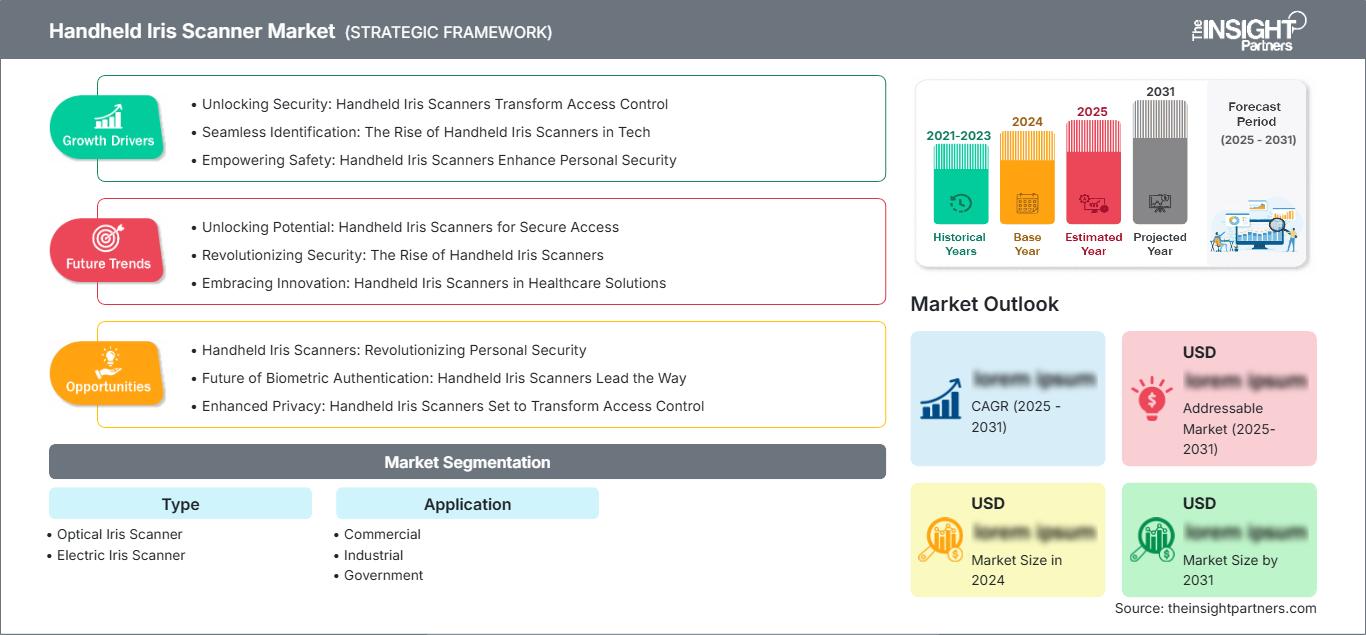
The Handheld Iris Scanner Market was valued at US$ 1.38 Billion in 2025 and is projected to reach US$ 4.42 Billion by 2034, expanding at a CAGR of 13.83% during 2026–2034. Greater incorporation of portable biometrics identification for border security, national identity initiatives, law enforcement, authentication and authorization, and industrial access control is creating greater demand for iris capture devices that can operate successfully in non-enrollment locations.
North America is expected to see strong growth in the coming years, based on the upgrading of the nation's border security and greater usage of multi-modal biometrics for identity verification purposes. CAGR is projected to be between 12.6% and 13.6% for North America Handheld Iris Scanner Market in the years from 2026 to 2034.
Handheld Iris Scanner Market Assessment and Insights
- North America: North America is projected to hold a 25–29% share in 2025 and expand at a CAGR of 12.6–13.6% during 2026–2034, supported by border security, law enforcement, and enterprise identity modernization.
- US: The US represents approximately 83–87% of North American demand in 2025 and is expected to grow at a CAGR of 12.8–13.8%, supported by federal and commercial deployments.
- Europe: Europe is estimated to account for 21–25% of 2025 demand and expand at 11.8–12.8% CAGR, with Germany, the UK, France, and Italy supporting adoption across government and enterprise identity applications.
- Asia Pacific: Asia Pacific is estimated to represent 34–38% of 2025 demand and grow at 14.5–15.5% CAGR, led by China, India, Japan, and South Korea through national identity and security deployments.
- Largest Segment: Government is assessed as the largest application, representing a 34–38% market share in 2025 and expanding at 13.0–14.0% CAGR during 2026–2034.
- High Growth Segment: Industrial is the high-growth application segment, accounting for 21–25% of 2025 demand and expanding at 14.5–15.5% CAGR through 2034.
- Key companies analyzed in detail: Thales Group, RIS S.A, HID Global Corporation, Iris ID, Inc., M2SYS Technology, Pivot International, BioID Technologies Limited, BioEnable Technologies Pvt. Ltd., CMITech, IRITECH, INC.
Source: The Insight Partners' analysis based on proprietary research, government publications, company annual reports, investor presentations, industry databases, and expert interviews.
Handheld Iris Scanners will be shifting towards the deployment of mobile identity verification solutions that integrate iris recognition capabilities along with fingerprinting and facial recognition systems for capturing biometric data and performing local matching functions. Existing systems are increasingly focusing on portability, automatic capture capability, offline use, rugged design, and conformance to standards. For instance, HID has launched its portable iris systems that are targeted at identity verification in commercial and civil governmental sectors, and SEEK Avenger that includes both iris and fingerprint capture capability in challenging outdoor settings.
Future investments will focus on multi-modal devices, embedded processing capabilities, enhanced live detection technology and identity platforms that are interoperable in nature. The case of India is significant in terms of regulatory impact and market ecosystem influence, as UIDAI mandates that biometric devices should be registered within the Aadhaar authentication ecosystem where device level protections are meant to ensure biometric integrity.
Handheld Iris Scanner Market Report Scope
| Report Attribute | Details |
|---|---|
| Market size in 2025 | US$ 1.38 Billion |
| Market Size by 2034 | US$ 4.42 Billion |
| Global CAGR (2026 - 2034) | 13.83% |
| Historical Data | 2021-2024 |
| Forecast period | 2026-2034 |
Handheld Iris Scanner Market Analysis
Increase in demand is proportionate to expansion of identification verification process from enrollment centers. Government agencies require mobile devices for border crossings, on-site enrollments, law enforcement, military applications, social service verification purposes, and emergencies. Firms have considered iris scanning for security when passwords, cards, or fingerprints fail to provide adequate security. Growth in Handheld Iris Scanner Market will not only be dependent on government purchase but also on security improvement by enterprises.
Infrstructure involves infrared illumination, imaging sensor, optical unit, embedded processor, biometric algorithm, secure storage, software development kit, identity database, and system integrator. Developers should find a compromise between capturing distance, robustness, imaging performance, computational performance, and energy efficiency. The BioEnable company's product line exemplifies the integrated solution, which includes iris scanners based on standard biometric technologies and platform, like MOSIP.
More emphasis in the Handheld Iris Scanner Market Report is placed on full workflow solutions rather than just scanning equipment for competitive positioning. Thales Group and HID Global Corporation are involved in larger-scale identity and security eco-systems, whereas Iris ID, Inc. offers strong specialization in terms of iris recognition technology. The company's iCAM R100 solution provides for portable enrollment, national identification, public safety, and entitlement use cases and shows that compact capturing devices can be integrated into the identity management workflow.
The focus of investments is moving towards multimodal authentication, edge processing, and field-ready solutions. RIS S.A, M2SYS Technology, Pivot International, BioID Technologies Limited, BioEnable Technologies Pvt. Ltd., CMITech, and IRITECH, INC. differentiate themselves based on biometrics algorithms, hardware development, software development, and special-purpose implementations.
● REPORT CUSTOMIZATION
Tailor This Report To Align With Your Specific Business Requirements
This report can be customized to align precisely with your business objectives, scope, and target markets. Customization options include tailored segmentation, geography, competitive analysis, and strategic insights to support informed decision-making.
Customize This Report →WHAT YOU CAN ADJUST
- ● Segmentations
- ● Geography
- ● Competitive Analysis
- ● Language Preferences
Handheld Iris Scanner Market: Strategic Insights
Regional Insights
North America Handheld Iris Scanner Market
It is estimated that North America represents 25-29% of global 2025 demand and will grow at 12.6-13.6% CAGR until 2034. The US continues to be the key market due to border management, defense, law enforcement, and enterprise identity programs. Portable biometrics systems allow verifying identity in remote areas without infrastructure for verification purposes. Ruggedness, offline capability, speed, and multimodal reading of credentials become important criteria in procurement processes.
Canada participates with immigration, public sector identity solutions, security needs, and technology-intensive enterprise environments. The regional ecosystem enjoys developed software and cybersecurity solutions and system integration expertise. More and more buyers require compliant image capture, secure data processing, and interoperability with existing identity management systems databases. The combination of government procurement, enterprise authentication requirements, and security modernization will support above-average growth rate without dependence on one segment.
U.S. Handheld Iris Scanner Market
The US is the leading country representing 83-87% of North American Handheld Iris Scanner Market Share in 2025, with a projected CAGR of 12.8-13.8% through 2034. Demand in the market is focused in border security, defense, law enforcement, government enrollment, and high-security commercial sectors. The use of portable devices is highly recommended in field identification due to the ability to capture iris images with fingerprints, facial imagery, and credentials.
HID Global Corporation has a visible presence in the market through its portable iris and multimodal devices, which include devices used in military, border security, and law enforcement environments. Commercial applications are increasing in secure access, workforce identification, and high-assurance authentication. It is worth mentioning that the US market focuses greatly on cybersecurity, data governance, interoperability, and device certification. Thus, suppliers should consider differentiation through complete identity workflows and not just imaging devices.
Europe Handheld Iris Scanner Market
Europe is projected to be responsible for 21–25% of worldwide 2025 demand, experiencing 11.8-12.8% CAGR through 2034. The largest markets are Germany, the UK, France, Italy, and Spain. Europe uses biometrics for border management, government identity programs, enterprise security, and regulated environments. Increased demand for secure biometric processing and privacy protection is driven by the need for compliance with data protection standards.
The UK presents promising potential for demand for applications in border control, law enforcement, and government identity workflows where the use of mobile equipment can facilitate verification. Germany is an attractive market because of security needs in industry and governmental organizations' modernization needs. France offers a market combining government, aerospace, and defense-related applications. Italy and Spain offer a combination of applications for public administration, transportation, and enterprise security.
APAC Handheld Iris Scanner Market
APAC is estimated to account for 34–38% of 2025 demand and to grow at a 14.5-15.5% CAGR during 2034 and beyond. It will be the largest region in terms of growth. Contributions come from China and India, along with the Japanese and Korean technologies. India is boosted by the availability of biometrics infrastructures and registered devices.
The contributions of China come from security needs and identity verification services, while its huge digital infrastructure is a plus factor. The importance of electronics and enterprise security comes from Japan and South Korea, along with government and border security needs of Australia. Industrial investment and national identity updates in the region should sustain the market, and China will be the leader of the region.
Middle East & Africa Handheld Iris Scanner Market
Middle East and Africa require less demand but driven by border management, national identity, airport security, defense, and critical infrastructure modernization. Leading markets include Saudi Arabia and the UAE, whereas South Africa requires demand from governments, financial services, mining, and enterprise security. The Middle East and Africa market is forecasted to grow at 11.0% -12.0% CAGR till 2034.
UAE emerges as the key adoption hub due to its superior digital government infrastructure and investments in identity management systems. Saudi Arabia's infrastructure modernization and security modernization provide another source of demand. Remaining MEA region relies mainly on government-driven initiatives and system integrators. Portable devices become popular due to distributed enrollment and field verification minimizing the dependency on fixed sites.
Segmentation Analysis
Type
Type segmentation reflects the underlying capture architecture and determines image quality, portability, power requirements, environmental tolerance, and system cost. The segment is projected to expand at 13.2–14.2% CAGR during 2026–2034 as buyers increasingly favor compact scanners with automated capture and secure processing.
- Optical Iris Scanner: Optical Iris Scanner devices remain strategically important because controlled infrared illumination and optical imaging can deliver consistent iris images. Demand centers on government enrollment, security, and applications requiring dependable capture quality.
- Electric Iris Scanner: Electric Iris Scanner architectures emphasize compact electronics, integrated sensing, and portable implementation. Their importance increases where lightweight field equipment, embedded processing, and rapid deployment are prioritized by system integrators.
Application
Application segmentation defines procurement priorities across public and private environments. Government remains the largest application because identity programs, border control, and law enforcement require high-assurance verification. The segment is projected to grow at 13.4–14.4% CAGR during 2026–2034, while industrial deployments are expected to expand rapidly as biometric access becomes integrated with distributed operational security.
- Commercial: Commercial deployments include enterprise access, workforce authentication, banking, and secure facilities. Adoption is driven by contactless verification, identity assurance, and integration with broader access-management platforms.
- Industrial: Industrial deployments address controlled facilities, critical infrastructure, manufacturing environments, and workforce management. Demand emphasizes rugged equipment, rapid authentication, offline capability, and integration with operational security systems.
- Government: Government remains the principal application because national identity, border management, law enforcement, military, and public-benefit programs require portable identity verification across distributed locations.
Opportunity Snapshot
| Application | Revenue Contribution | Trend Tag | Adoption Stage |
| Commercial | Medium | Secure Access | Scaling |
| Industrial | Medium | Field Authentication | Emerging |
| Government | High | Border Identity | Mature |
Handheld Iris Scanner Market Growth Drivers and Impact Analysis
Expansion of mobile identity verification programs
Government identity programs increasingly require biometric verification beyond permanent enrollment centers. Portable iris scanners allow authorized personnel to conduct enrollment or authentication at border posts, remote communities, temporary facilities, field operations, and public-service locations. This expands the addressable deployment environment while reducing dependence on fixed infrastructure. The commercial impact is strongest for suppliers offering secure local processing, battery-efficient operation, and interoperability with identity platforms. Device procurement can also generate recurring demand for replacement units, software updates, calibration, and support services. As biometric programs mature, agencies are likely to prioritize devices capable of combining multiple modalities, reducing the need to carry separate equipment. This favors vendors with integrated hardware and software portfolios and increases the importance of certification, data integrity, and lifecycle management.
Growing preference for contactless biometric authentication
Contactless authentication is gaining strategic importance because iris recognition can verify identity without physical contact between the user and sensor. This characteristic is valuable in high-throughput environments where hygiene, user convenience, and rapid processing matter. The impact extends beyond public-sector applications into enterprise access, healthcare environments, financial services, and controlled industrial facilities. Handheld form factors make contactless verification available in locations where permanent access terminals are impractical. Suppliers can differentiate through capture distance, automatic acquisition, anti-spoofing, and performance under variable lighting. The commercial opportunity is therefore linked to the complete user experience rather than optical specifications alone. Organizations evaluating biometric upgrades increasingly consider throughput, operator training, integration effort, and privacy controls alongside recognition accuracy and device durability.
Integration of multimodal biometric capabilities
Multimodal biometrics is changing procurement because organizations increasingly seek multiple identity signals within one field device. Combining iris, fingerprint, facial, and credential information can improve decision-making when one modality is temporarily difficult to capture. HID's SEEK Avenger illustrates this direction by integrating iris and fingerprint capture with facial imaging and credential-reading capabilities for demanding operational environments. The market impact is significant because multimodal devices can replace several specialized units while reducing operator workload and equipment logistics. Suppliers capable of providing common software development kits, secure interfaces, and unified identity workflows can gain an advantage. This trend also raises the value of local processing and configurable software because agencies may need different combinations of biometric modalities across missions.
Handheld Iris Scanner Market Future Trends
Edge-based biometric processing will become more capable
Future devices are likely to shift more biometric processing from centralized infrastructure toward the scanner itself. Embedded processors can perform image quality assessment, segmentation, template generation, matching, and basic liveness analysis locally, reducing network dependence. This architecture can improve response times and support operations in disconnected environments. As processor efficiency improves, suppliers can add sophisticated algorithms without substantially increasing device size. Secure enclaves and hardware-backed encryption should also become more common as organizations seek to minimize exposure of raw biometric information. The resulting devices will behave less like peripheral cameras and more like autonomous identity platforms. This transition will create differentiation around processing performance, cybersecurity architecture, software update mechanisms, and the ability to operate securely when connectivity to central databases is intermittent.
Rugged multimodal devices will broaden field deployment
A second trend is the development of rugged devices that combine several biometric and credential functions in a single portable platform. Future products are likely to include stronger environmental protection, improved displays, longer battery life, wireless connectivity, secure storage, and configurable capture modules. Such architectures can support military, border, law-enforcement, humanitarian, and industrial missions without requiring operators to carry multiple devices. The value proposition will increasingly depend on mission flexibility rather than iris capture alone. Suppliers may therefore offer modular hardware with interchangeable components and software profiles designed for different operational requirements. Integration with mobile identity applications should also improve, allowing field devices to synchronize verified records when connectivity returns. These capabilities can make portable biometrics practical in more geographically distributed and operationally challenging environments.
Handheld Iris Scanner Market Opportunities
Portable identity platforms for emerging national programs
National identity modernization creates opportunities for suppliers that can provide certified scanners, software development kits, secure enrollment workflows, and local support. Emerging programs often require equipment capable of operating across urban and remote locations, making portability particularly valuable. Vendors can improve commercial positioning by developing reference architectures that connect scanners with identity databases, enrollment applications, and credential issuance systems. The Handheld Iris Scanner Market Forecasts should therefore be assessed alongside government digitization budgets, identity-program coverage, and certification requirements rather than scanner demand alone. Partnerships with local integrators can reduce procurement barriers and provide after-sales support. India demonstrates how registered-device frameworks and biometric standards can shape product eligibility, creating opportunities for suppliers that build compliance and interoperability into the product lifecycle.
Enterprise biometric access can create recurring replacement demand
Enterprise security presents an opportunity beyond large government procurements because organizations periodically upgrade access systems, workforce authentication platforms, and high-security facilities. Portable iris devices can support enrollment, temporary access provisioning, remote verification, and contingency authentication, giving enterprises reasons to maintain mobile units even when fixed terminals remain dominant. The opportunity is strongest in financial institutions, critical infrastructure, data centers, research facilities, and industrial campuses where identity assurance is more important than low-cost access. Suppliers can pursue recurring revenue through device management, software licensing, maintenance, calibration, and security updates. A Handheld Iris Scanner Market Report can help decision-makers compare device architectures, application priorities, regional procurement conditions, and vendor capabilities before committing to a deployment model.
Recent Developments
- August 2026: U.S. Customs and Border Protection is preparing to procure 267 biometric devices, including 51 fixed palm scanners, 46 mobile palm scanners, and 170 dual iris and facial cameras, with an estimated procurement value of US$1 million to US$2 million.
- May 2026: U.S. Immigration and Customs Enforcement purchased iris-scanning equipment and related technology tools as part of its expansion of biometric identification capabilities.
- July 2025: Topcon Healthcare, Inc. acquired Intelligent Retinal Imaging Systems (IRIS), strengthening its AI-assisted retinal screening and connected-care capabilities. The transaction integrates IRIS's cloud-based screening platform with Topcon's connected-care ecosystem and expands retinal imaging applications in primary care.
Frequently Asked Questions

- Comprehensive Market Sizing and Forecast Analysis
- Detailed Segmentation Analysis
- In-Depth Market Dynamics Assessment
- Regional and Country-Level Insights
- Competitive Landscape and Company Benchmarking
- Strategic Business Intelligence
Recent Reports
Testimonials

The Insight Partners provided valuable market intelligence that supported our global go-to-market strategy. Their team was professional, responsive, and attentive to our feedback, providing thoughtful analysis and helpful methodological clarifications throughout the project.
Junmo Kim Chief Financial Officer (CFO), Enertech Co., Ltd.
The Insight Partners' SCADA System Market report is comprehensive, with valuable insights on current trends and future forecasts. The team was highly professional, responsive, and supportive throughout. We are very satisfied and highly recommend their services.
RAN KEDEM Partner, Reali Technologies LTDs
I requested a report on a very specific software market and the team produced the report in a few days. The information was very relevant and well presented. I then requested some changes and additions to the report. The team was again very responsive and I got the final report in less than a week.
JEAN-HERVE JENN Chairman, Future Analytica
We worked with The Insight Partners for an important market study and forecast. They gave us clear insights into opportunities and risks, which helped shape our plans. Their research was easy to use and based on solid data. It helped us make smart, confident decisions. We highly recommend them.
PIYUSH NAGPAL Sr. Vice President, High Beam Global
The Insight Partners delivered insightful, well-structured market research with strong domain expertise. Their team was professional and responsive throughout. The user-friendly website made accessing industry reports seamless. We highly recommend them for reliable, high-quality research services
YUKIHIKO ADACHI CEO, Deep Blue, LLC.
This is the first time I have purchased a market report from The Insight Partners.While I was unsure at first, I visited their web site and felt more comfortable to take the risk and purchase a market report.I am completely satisfied with the quality of the report and customer service. I had several questions and comments with the initial report, but after a couple of dialogs over email with their analyst I believe I have a report that I can use as input to our strategic planning process.Thank you so much for taking the extra time and making this a positive experience.I will definitely recommend your service to others and you will be my first call when we need further market data.
JOHN SUZUKI President and Chief Executive Officer, Board Director, BK Technologies
I wish to appreciate your support and the professionalism you displayed in the course of attending to my request for information regarding to infectious disease IVD market in Nigeria. I appreciate your patience, your guidance, and the fact that you were willing to offer a discount, which eventually made it possible for us to close a deal. I look forward to engaging The Insight Partners in the future, all thanks to the impression you have created in me as a result of this first encounter.
DR CHIJIOKE ONYIA MANAGING DIRECTOR, PineCrest Healthcare Ltd.Reason to Buy
- Informed Decision-Making
- Understanding Market Dynamics
- Competitive Analysis
- Identifying Emerging Markets
- Customer Insights
- Market Forecasts
- Risk Mitigation
- Boosting Operational Efficiency
- Strategic Planning
- Investment Justification
- Tracking Industry Innovations
- Aligning with Regulatory Trends





 Get Free Sample for