
High Density Interconnect Market Trends, Demand & Growth by 2034
Coverage: by Product (4 6 Layers HDI, 8 10 Layers HDI 10 an Layers HDI); End user (Consumer Electronics, Automotive, Medical, Telecommunications, Others) , and Geography (North America, Europe, Asia Pacific, and South and Central America)
- Status : Data Released
- Report Code : TIPRE00003707
- Category : Electronics and Semiconductor
- No. of Pages : 150
- Available Report Formats :


- Last update date : August 25, 2026


2025 Market Size
US$ 19.89 Bn
Base year value
2034 Forecast
US$ 42.27 Bn
Projected by 2034
CAGR 2026-2034
8.74 %
Growth rate
Addressable Market
US$ 278.57 Bn
(2026-2034)
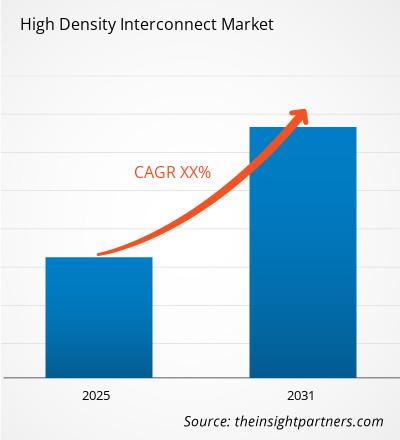
The High Density Interconnect market size was estimated at US$ 19.89 billion in 2025 and is forecasted to reach US$ 42.27 billion by 2034, with a CAGR of 8.74% from 2026–2034. The growth is driven by the growing need for circuit density, miniaturization of electronic components, data transfer speed, and the rising adoption of printed circuit boards in consumer electronics, automobiles, healthcare, and telecommunications.
In North America, the High Density Interconnect Market share is estimated to grow at a CAGR of 10.5–11.5% from 2026–2034. It is underpinned by strong domestic electronics manufacturing, localization of supply chain due to defense purposes, spending on data centers, vehicle electrification, and the increasing requirement of high reliability interconnects in computing and communication equipment.
High Density Interconnect Market Assessment and Insights
- North America: North America represents an estimated 18–22% share in 2025 and is projected to grow at a 10.5–11.5% CAGR between 2026–2034, supported by electronics reshoring, automotive electronics, aerospace, defense, and high-performance computing demand.
- US: The US accounts for approximately 78–82% of North America's 2025 market and is expected to expand at a 10.8–11.8% CAGR during 2026–2034, led by advanced computing, defense, telecom, and medical electronics.
- Europe: Europe holds an estimated 20–24% share in 2025 and is projected to grow at a 8.0–9.0% CAGR through 2034, with Germany, the UK, France, Italy, and Spain supported by automotive electronics, industrial automation, medical technology, and telecommunications.
- Asia Pacific: Asia Pacific represents approximately 44–48% of 2025 demand and is expected to expand at a 8.5–9.5% CAGR through 2034, with China, Japan, South Korea, and India benefiting from dense electronics manufacturing ecosystems.
- Largest Segment: 4 6 Layers HDI is the largest product segment, with an estimated 45–50% market share in 2025 and an 8.1–8.6% CAGR during 2026–2034.
- High Growth Segment: Automotive is the high-growth end-user segment, representing approximately 18–22% share in 2025 and projected to register a 10.0–10.8% CAGR during 2026–2034.
- Key companies analyzed in detail: CMK Corporation, Compeq Manufacturing Co., Ltd., Fujitsu Interconnect Technologies Limited, Meiko Electronics Co., Ltd., NCAB Group AB, Samsung Electro-Mechanics Co., Ltd., Sierra Circuits, Inc., TTM Technologies, Inc., Unimicron Technology Corp., and Zhen Ding Technology Holding Limited.
Source: The Insight Partners' analysis based on proprietary research, government publications, company annual reports, investor presentations, industry databases, and expert interviews.
This industry has moved from traditional multilayer construction methods to new methods involving microvias and sequential build-ups for more circuit density within the reduced area of the board. With the growing use of fine line routing, laser drilling, vias in pads, and advanced material types, new economics of the production process emerge, with increasing concern for yield, thermal considerations, signal integrity, and layer stacking complexity.
The High Density Interconnect Market forecast indicates that in the coming years, growth is anticipated to spread to non-traditional regions of electronics manufacturing due to investments in India, Southeast Asia, Eastern Europe, and parts of the Middle East. Increased regulatory focus on supply chain sustainability, automotive electrification, and secure communication will contribute to localization trends. On the other hand, stricter qualification standards in the medical, automotive, aerospace, and telecommunication sectors will motivate companies to make investments in process control and testing.
High Density Interconnect Market Report Scope
| Report Attribute | Details |
|---|---|
| Market size in 2025 | US$ 19.89 Billion |
| Market Size by 2034 | US$ 42.27 Billion |
| Global CAGR (2026 - 2034) | 8.74% |
| Historical Data | 2021-2024 |
| Forecast period | 2026-2034 |
High Density Interconnect Market Analysis
High Density Interconnect market growth is driven by the requirement to route higher signal counts within reduced electronic assemblies. More stringent design specifications include thin boards, short routes, controlled impedance, and thermal management capabilities. The supply chain includes copper foils, laminates, resins, drilling tools, imaging machines, plating solutions, manufacturing, testing, and electronics assembly. Thus, supply is contingent upon the ability to provide not only the materials but also the process know-how.
Manufacturing facilities are located primarily in the Asia Pacific region. At the same time, customers from North America and Europe increasingly prefer to use local or nearby supplies. Thus, a dual supply approach combining high volume production in Asia and additional manufacturing capacity in regions of strategic importance is emerging. In addition, long certification periods typical for automotive and medical markets also favor existing suppliers.
The competitive environment consists of major global players in the PCB industry along with regional specialists characterized by their specialization in the number of layers, automotive certification, rapid-turn manufacturing, or advanced interconnection design. Both CMK Corporation and Meiko Electronics Co., Ltd. offer advanced automotive and HDI services, while Compeq Manufacturing Co., Ltd., Unimicron Technology Corp., and Zhen Ding Technology Holding Limited operate in various Asian electronics environments.
Investments are now being made into technologies allowing for manufacturing of high layer counts, advanced drilling, automation, and diversification geographically. In particular, TTM Technologies, Inc. focuses on ultra-HDI manufacturing in the US, while NCAB Group AB expands its regional customer base. Samsung Electro-Mechanics Co., Ltd. is specialized in advanced substrate and interconnection technology, while Sierra Circuits, Inc. provides engineering-intensive services.
● REPORT CUSTOMIZATION
Tailor This Report To Align With Your Specific Business Requirements
This report can be customized to align precisely with your business objectives, scope, and target markets. Customization options include tailored segmentation, geography, competitive analysis, and strategic insights to support informed decision-making.
Customize This Report →WHAT YOU CAN ADJUST
- ● Segmentations
- ● Geography
- ● Competitive Analysis
- ● Language Preferences
High Density Interconnect Market: Strategic Insights

Regional Insights
North America High Density Interconnect Market
North America is forecast to account for 18% to 22% of global demand in 2025, driven by High Density Interconnect Market expansion with a 10.5% to 11.5% CAGR until 2034. Factors such as localization of electronic devices, government military spending, semiconductor manufacturing, electric vehicles, and data center infrastructure expansion are propelling growth in North America.
There are several sectors in Canada that help drive demand such as the aerospace industry, medical electronics, industrial automation, and telecommunications. Mexico is benefited from the presence of electronics manufacturing and auto manufacturing integration with the US. Reliability, dimensional control, and shorter value chains have become the new focus areas for the demand in the region.
U.S. High Density Interconnect Market Market
The United States comprises about 78%-82% of North America's 2025 market, and the High Density Interconnect Market will experience a compound annual growth rate (CAGR) of 10.8%-11.8% until 2034. Demand will remain limited to defense electronics, high-performance computing, telecommunications, automotive systems, and medical equipment. Efforts to manufacture domestically have led to an increased interest in developing HDI and lowering dependence on foreign supply chains.
Demands in the applications sector are becoming increasingly rigorous owing to the increasing demand for increased circuit density and electrical performance from AI servers, networking systems, radar systems, and connected vehicles. TTM Technologies Inc has expanded its capacity to manufacture ultra-HDI in Syracuse. Sierra Circuits Inc caters to highly engineered projects, which factor into the selection of the supplier.
Europe High Density Interconnect Market Market
The Europe region has an approximate share of 20–24% in 2025 and is expected to grow at a 8.0–9.0% CAGR over 2034. Germany retains the leadership driven by automotive electronics, automation and advanced manufacturing, industrial controls. UK continues to drive demand in aerospace, defense, telecommunications, and medical applications whereas France is driven by aerospace, automotive and public infrastructure electronics.
The German market is aided by the presence of a well-established automotive supply chain with growing usage of electronic control systems. The UK market has a diversified higher level of reliability requirements in aerospace, defense and communications. France, Italy, and Spain are contributing with automotive manufacturing, automation systems, medical systems, renewable energy systems, and telecommunications infrastructures.
APAC High Density Interconnect Market Market
The APAC region represents around 44-48% of demand in 2025 and is projected to expand at a CAGR of 8.5-9.5% until 2034. Leading country in the region is China, driven by significant electronics manufacturing capacity, automotive manufacturing, telecommunication equipment and domestic PCB manufacturing. Japan and South Korea offer well-developed automotive, consumer electronic and semiconductor ecosystems.
India has become an emerging location for manufacturing diversification, and Australia is relatively smaller but offers advantages through communications, defense, medical and industrial electronics. Policies to support electronics manufacturing, semiconductor ecosystems and localisation of the supply chain have been reinforced. Having component manufacturers, PCB manufacturers, assembly houses and OEMs in the region gives APAC region a significant cost and scale benefit.
Middle East & Africa High Density Interconnect Market Market
Middle East and Africa demand is smaller than the major manufacturing regions but is expected to expand at a 6.5–7.5% CAGR through 2034. Saudi Arabia and the UAE lead regional adoption through digital infrastructure, telecommunications, defense modernization, smart-city programs, and industrial diversification. South Africa contributes through automotive, medical, mining, industrial, and communications applications.
The Rest of MEA market is supported by investments in data connectivity, energy infrastructure, industrial automation, and electronics-enabled public services. Regional PCB production remains comparatively limited, increasing dependence on imports and regional distribution networks. Infrastructure localization and technology-intensive projects can gradually improve demand for higher-density boards, particularly where equipment requires compact designs and greater processing capability.
Segmentation Analysis
Product
Product configuration determines routing density, manufacturing complexity, reliability requirements, and final board economics. High Density Interconnect Market adoption remains strongest in mid-layer configurations because they balance performance and fabrication cost, while higher layer counts gain importance in advanced computing, telecommunications, automotive electronics, and specialized equipment. The Product segment is projected to expand at an 8.3–8.9% CAGR during 2026–2034.
- 4 6 Layers HDI: This configuration maintains the broadest adoption because it balances density, manufacturing yield, thermal performance, and cost. Demand is concentrated in smartphones, portable electronics, automotive modules, and mainstream connected devices.
- 8 10 Layers HDI: Higher routing density supports advanced computing, telecommunications, automotive control systems, and sophisticated medical electronics. Strategic importance increases where component miniaturization requires additional signal, power, and grounding layers.
- 10 an Layers HDI: Very high layer counts address demanding signal-density and performance requirements in premium electronics, advanced computing, communications, and specialized equipment. Adoption depends strongly on manufacturing capability and process yield.
End user
End-user requirements are increasingly differentiated by reliability, miniaturization, signal integrity, thermal constraints, and regulatory qualification. High Density Interconnect Market demand from automotive applications is expected to outpace traditional consumer electronics because electrification and connected vehicle architectures increase electronic content per vehicle. The End user segment is projected to register an 8.9–9.6% CAGR during 2026–2034.
- Consumer Electronics: Smartphones, tablets, wearables, and portable computing remain major users because compact designs require dense routing. Replacement cycles and continuing device integration sustain high-volume demand.
- Automotive: Electrification, advanced driver assistance, connected-car systems, and increasingly software-defined architectures raise PCB content and reliability requirements, making automotive a strategically important growth market.
- Medical: Diagnostic systems, monitoring devices, imaging equipment, and compact therapeutic technologies require dependable interconnects with controlled performance, supporting steady adoption of advanced PCB configurations.
- Telecommunications: 5G infrastructure, networking equipment, optical systems, and edge computing require dense signal routing and high-speed performance, sustaining demand for increasingly sophisticated interconnect architectures.
Opportunity Snapshot
| End Users | Revenue Contribution (High/Medium/Low) | Trend Tag | Adoption Stage |
|---|---|---|---|
| Consumer Electronics | High | Device Miniaturization | Mature |
| Automotive | Medium | EV Electronics | Scaling |
| Medical | Medium | Digital Diagnostics | Scaling |
| Telecommunications | High | 5G Networking | Mature |
High Density Interconnect Market Growth Drivers and Impact Analysis
Miniaturization and higher electronic functionality
Electronic products increasingly combine processors, sensors, connectivity modules, memory, and power-management functions within smaller physical envelopes. This raises routing density and reduces the feasibility of conventional board architectures. High Density Interconnect Market suppliers benefit because microvias and sequential build-up structures enable designers to create compact assemblies while preserving signal integrity. The commercial impact extends beyond smartphones into wearables, medical equipment, automotive modules, and advanced networking hardware. Product designers can reduce board footprint or accommodate additional functionality without proportionally increasing package dimensions. This shift also encourages suppliers to improve laser-drilling accuracy, copper plating uniformity, inspection systems, and material handling. As design complexity rises, qualification and yield become stronger competitive differentiators, favoring manufacturers with mature process controls and engineering capabilities.
Vehicle electrification and electronic content expansion
Automotive electronics are moving from discrete control functions toward highly integrated architectures supporting electrification, connectivity, advanced driver assistance, and software-defined vehicle platforms. The resulting increase in sensors, processors, communication modules, power-management systems, and displays expands demand for reliable high-density interconnects. The IEA reported that global electric car sales exceeded 20 million units in 2025, with electric vehicles representing roughly one-quarter of new car sales. This transition increases the addressable role of sophisticated PCBs in battery-management systems, domain controllers, infotainment, cameras, and connectivity modules. Suppliers able to meet automotive qualification, thermal, vibration, and lifecycle requirements can capture higher-value programs. The impact is particularly significant for manufacturers expanding from consumer electronics into automotive production.
5G, AI computing, and high-speed data transmission
The expansion of high-speed networks and AI-oriented computing is increasing requirements for signal integrity, power delivery, thermal management, and interconnect density. GSMA Intelligence forecasts 5.6 billion 5G connections by 2030, with 65% using standalone 5G networks, highlighting continued infrastructure evolution. AI servers and networking equipment similarly require increasingly sophisticated board architectures to accommodate high-speed interfaces and greater power density. These requirements favor suppliers with advanced materials, controlled-impedance fabrication, fine-line capability, and reliable via structures. The market impact extends across data centers, telecommunications, optical networking, and edge computing. Investment therefore increasingly targets higher-value interconnect technologies rather than simple capacity additions, supporting stronger utilization of advanced manufacturing assets.
High Density Interconnect Market Future Trends
AI-driven ultra-HDI architecture
Market trends are increasingly influenced by AI servers, accelerators, optical modules, and high-bandwidth networking platforms that require tighter routing and improved power-delivery performance. Future designs are likely to use more advanced sequential build-up structures, finer geometries, improved copper technologies, and increasingly sophisticated thermal-management approaches. Manufacturers will focus on reducing signal loss while controlling warpage and reliability risks as layer counts and interconnect density rise. Automation and process analytics are expected to become more important because yield losses become increasingly expensive at advanced technology levels. The trend also favors closer collaboration between PCB fabricators, substrate suppliers, semiconductor companies, and system designers. Over time, capacity investment should increasingly prioritize technological capability and qualification depth rather than only board volume.
Localized and resilient PCB production networks
Future High Density Interconnect Market trends will include greater geographic diversification of manufacturing as electronics companies seek resilience against logistics disruptions, trade restrictions, and concentration risks. Asia Pacific will remain central to high-volume production, but North America, India, Southeast Asia, and parts of Europe are positioned to attract incremental capacity. Buyers are likely to use dual sourcing more extensively for strategically important boards while retaining established Asian suppliers for scale. Regional manufacturing incentives may support investments in advanced fabrication, testing, materials, and assembly ecosystems. Qualification requirements will limit the speed at which supply chains can shift, creating opportunities for suppliers that establish local engineering and quality capabilities alongside production capacity. Sustainability requirements will further encourage shorter logistics routes and more efficient manufacturing processes.
High Density Interconnect Market Opportunities
India and Southeast Asia capacity diversification
High Density Interconnect Market report indicates that opportunities are emerging as electronics manufacturers diversify production beyond established Northeast Asian clusters. India offers a growing electronics manufacturing base, expanding automotive production, and policy support for domestic component ecosystems, while Southeast Asia provides established assembly networks and proximity to major electronics customers. Suppliers can target these markets through phased investments combining local engineering, prototyping, and selected production capabilities. Strategic partnerships with EMS providers and OEMs can reduce qualification barriers and improve capacity utilization. Vietnam, in particular, is becoming relevant for PCB manufacturers seeking proximity to electronics assembly operations. A successful expansion strategy should prioritize automotive, telecommunications, consumer electronics, and computing programs where volume growth can support investments in higher-density manufacturing.
High-reliability medical and industrial electronics
Medical and industrial electronics provide an opportunity to diversify beyond high-volume consumer applications. WHO's updated medical-device policy framework emphasizes digital health, sustainability, regulatory systems, and technology management, reinforcing the need for reliable electronic components in healthcare equipment. Suppliers can capture this opportunity by developing traceable manufacturing processes, tighter inspection regimes, and documentation systems suitable for regulated applications. Industrial automation, diagnostic equipment, monitoring systems, and laboratory platforms can similarly require compact and reliable interconnects without the extreme volume concentration of smartphones. The strategic opportunity lies in combining engineering support with qualification expertise, enabling suppliers to participate earlier in product development. This approach can improve customer retention and reduce exposure to commodity-oriented pricing pressure.
Recent Developments
- August 2025: Polymatech Electronics commissioned a €100 million PCB manufacturing facility in Estonia, expanding its European production capabilities for high-end electronics. The approximately 10,000-square-foot cleanroom is equipped to produce up to 50,000 square meters of multilayer High-Density Interconnect (HDI) PCBs annually, including advanced HDI, high-speed, high-frequency, and up-to-48-layer configurations. The facility targets premium mobile devices, telecommunications, aerospace, defense, automotive electronics, semiconductor manufacturing, industrial electronics, and security applications, strengthening Polymatech’s HDI PCB manufacturing presence in Europe.
- June 2026: Aptiv’s Winchester Interconnect launched its VITA 67.2 RF connector product line, enabling up to eight high-frequency RF signal channels within a single standard Open VPX backplane slot for high-density aerospace and defense systems. The connectors feature SMPM contacts, blind-mate engagement, built-in contact float, and a compact VPX-compatible footprint, supporting frequencies from DC to 26.5 GHz with options up to 40 GHz. The solution is designed to reduce external coaxial cabling while increasing RF channel density in electronic warfare, signals intelligence, radar, avionics, and C4ISR platforms, supporting the growing demand for compact, high-performance interconnect architectures.
- August 2025: Starteam Global launched a new High-Density Interconnect (HDI) production line at its Jiangyou facility, expanding its manufacturing capabilities for advanced HDI printed circuit boards. The investment strengthens the company’s ability to serve demand for high-density, miniaturized, and high-performance PCB solutions used in advanced electronics, supporting increased production capacity and the development of next-generation interconnect technologies.
Frequently Asked Questions

- Comprehensive Market Sizing and Forecast Analysis
- Detailed Segmentation Analysis
- In-Depth Market Dynamics Assessment
- Regional and Country-Level Insights
- Competitive Landscape and Company Benchmarking
- Strategic Business Intelligence
Recent Reports
Testimonials

The Insight Partners provided valuable market intelligence that supported our global go-to-market strategy. Their team was professional, responsive, and attentive to our feedback, providing thoughtful analysis and helpful methodological clarifications throughout the project.
Junmo Kim Chief Financial Officer (CFO), Enertech Co., Ltd.
The Insight Partners' SCADA System Market report is comprehensive, with valuable insights on current trends and future forecasts. The team was highly professional, responsive, and supportive throughout. We are very satisfied and highly recommend their services.
RAN KEDEM Partner, Reali Technologies LTDs
I requested a report on a very specific software market and the team produced the report in a few days. The information was very relevant and well presented. I then requested some changes and additions to the report. The team was again very responsive and I got the final report in less than a week.
JEAN-HERVE JENN Chairman, Future Analytica
We worked with The Insight Partners for an important market study and forecast. They gave us clear insights into opportunities and risks, which helped shape our plans. Their research was easy to use and based on solid data. It helped us make smart, confident decisions. We highly recommend them.
PIYUSH NAGPAL Sr. Vice President, High Beam Global
The Insight Partners delivered insightful, well-structured market research with strong domain expertise. Their team was professional and responsive throughout. The user-friendly website made accessing industry reports seamless. We highly recommend them for reliable, high-quality research services
YUKIHIKO ADACHI CEO, Deep Blue, LLC.
This is the first time I have purchased a market report from The Insight Partners.While I was unsure at first, I visited their web site and felt more comfortable to take the risk and purchase a market report.I am completely satisfied with the quality of the report and customer service. I had several questions and comments with the initial report, but after a couple of dialogs over email with their analyst I believe I have a report that I can use as input to our strategic planning process.Thank you so much for taking the extra time and making this a positive experience.I will definitely recommend your service to others and you will be my first call when we need further market data.
JOHN SUZUKI President and Chief Executive Officer, Board Director, BK Technologies
I wish to appreciate your support and the professionalism you displayed in the course of attending to my request for information regarding to infectious disease IVD market in Nigeria. I appreciate your patience, your guidance, and the fact that you were willing to offer a discount, which eventually made it possible for us to close a deal. I look forward to engaging The Insight Partners in the future, all thanks to the impression you have created in me as a result of this first encounter.
DR CHIJIOKE ONYIA MANAGING DIRECTOR, PineCrest Healthcare Ltd.Reason to Buy
- Informed Decision-Making
- Understanding Market Dynamics
- Competitive Analysis
- Identifying Emerging Markets
- Customer Insights
- Market Forecasts
- Risk Mitigation
- Boosting Operational Efficiency
- Strategic Planning
- Investment Justification
- Tracking Industry Innovations
- Aligning with Regulatory Trends





 Get Free Sample for