
High Dynamic Range (HDR) Display Market Growth, Trends & Demand by 2034
Coverage: by Product (Display Device, Capturing Display); Application (Entertainment, Consumer Eectronics, Security and Surveillance, Others) , and Geography (North America, Europe, Asia Pacific, and South and Central America)
- Status : Data Released
- Report Code : TIPRE00005429
- Category : Electronics and Semiconductor
- No. of Pages : 150
- Available Report Formats :


- Last update date : August 19, 2026


2025 Market Size
US$ 25.27 Bn
Base year value
2034 Forecast
US$ 56. Bn
Projected by 2034
CAGR 2026-2034
10.46 %
Growth rate
Addressable Market
US$ 386.46 Bn
(2026-2034)
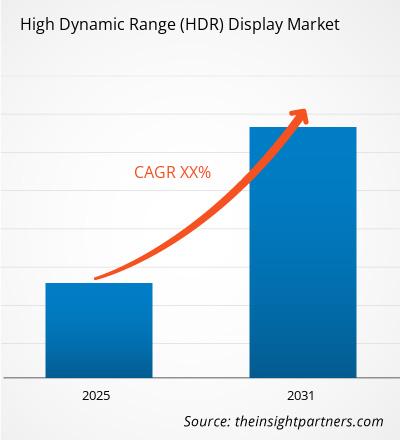
The global High Dynamic Range Display Market was valued at US$ 25.27 Billion in 2025 and is projected to reach US$ 56.0 Billion by 2034, registering a compound annual growth rate (CAGR) of 10.46% from 2026 to 2034. The market consists of display devices as well as display capture solutions which help create better visual quality in terms of increased brightness, contrast, and color accuracy. Such technologies are currently used widely in entertainment, consumer electronics, and security.
North America is one of the key regions in the High Dynamic Range Display Market Size and is expected to generate around 32-36% of all revenues in 2025 with a 9-11% CAGR throughout the forecast period. Such market performance in the region is largely caused by high levels of consumer spending on premium electronics, active development of streaming content, and fast adoption of display technologies. Increasing demand for gaming monitors and home theaters with high dynamic range further contribute to the market growth in North America.
High Dynamic Range (HDR) Display Market Assessment and Insights
- North America: North America held a significant share of approximately 32-36% in 2025 and is projected to grow at a CAGR of 9-11% during 2026-2034. The region benefits from high consumer disposable income, strong streaming platform presence, and early adoption of premium OLED and Mini-LED display technologies.
- US: The United States accounted for approximately 85-90% of the North American Market in 2025 and is expected to grow at a CAGR of 10-12% through 2034. Strong retail infrastructure, high internet penetration, and premium consumer electronics preferences drive US market growth.
- Europe: Europe represented approximately 22-26% of the global Market in 2025, with a projected CAGR of 8-10% during 2026-2034. Leading countries include Germany, the United Kingdom, and France, where high-quality visual standards and strong broadcast infrastructure sustain steady demand.
- Asia Pacific: Asia Pacific accounted for approximately 38-42% of the global Market in 2025 and is projected to grow at a CAGR of 11-13% during 2026-2034. China, Japan, South Korea, India, and Australia are key contributors, driven by manufacturing capabilities, rising consumer electronics demand, and increasing smartphone penetration.
- Largest Segment: The Display Device segment held the largest market share of approximately 55-60% in 2025 and is projected to grow at a CAGR of 9-11% during 2026-2034. Televisions dominate this category, driven by widespread adoption of HDR10, HDR10+, and Dolby Vision standards across consumer entertainment platforms.
- High Growth Segment: The Capturing Display segment is the fastest-growing product category, with a projected CAGR of 12-14% during 2026-2034. Growing demand for HDR-capable cameras, smartphones, and professional imaging equipment drives this segment's accelerated growth trajectory.
- Key companies analyzed in detail: Apple, Inc., Canon, Inc., Casio Computer Co., Ltd., LG Display Co., Ltd., Nikon Corporation, Olympus Corporation, OmniVision Technologies, Inc., Photonfocus, Pyxalis, Samsung Electronics Co., Ltd.
Source: The Insight Partners' analysis based on proprietary research, government publications, company annual reports, investor presentations, industry databases, and expert interviews.
The High Dynamic Range Display Market has witnessed tremendous changes, from an attribute used as a premium feature to one which is now expected even in mass products for televisions, monitors, smartphones, and professional content-creation panels. This change has been fueled by technological improvements in OLED displays, QD-OLED, and Mini-LED backlighting systems that have resulted in sustainable peak brightness going above 1,000 nits, and in the latest screens even beyond 4,000 nits. Manufacturing trends have seen a change with more activities moving towards Asia Pacific with electronics supply chain already in place and manufacturing facilities providing affordable solutions, while Western markets have been focused on premium products with unique features like advanced display technology, AI image processing, and ecosystem solutions.
Investment into research and development of the High Dynamic Range Display Market continues to grow, with major players spending significant sums of money on Micro LED technology, QD-OLED, and advanced local dimming technologies. Growing use of AI-based image processing, growth in HDR content libraries available on all major streaming services, and increased adoption of HDR in gaming and professional environment widen the market potential even more.
High Dynamic Range (HDR) Display Market Report Scope
| Report Attribute | Details |
|---|---|
| Market size in 2025 | US$ 25.27 Billion |
| Market Size by 2034 | US$ 56. Billion |
| Global CAGR (2026 - 2034) | 10.46% |
| Historical Data | 2021-2024 |
| Forecast period | 2026-2034 |
High Dynamic Range (HDR) Display Market Analysis
Drivers for the HDR Display Market include several demand factors that work together to define the market's growth trajectory. With many HDR-mastered pieces of content becoming available via streaming channels, there has been increased consumer demand for displays that will produce the highest level of visual performance possible. The streaming services offer most of their content in one of the three HDR formats: HDR10, HDR10+ and Dolby Vision, with live sports, games and even user-generated videos not far behind. As a result of the availability of the aforementioned content ecosystem, there has been increased consumer demand for upgraded displays that can support viewing the content. The supply chain for HDR displays includes a complicated ecosystem of panel manufacturers, semiconductor companies, software providers, and distributors, with the manufacturing of key components taking place in Asia Pacific and system integration in North America, Europe and Japan. There has been increased use of vertically integrated supply chain networks by manufacturers to help maintain quality and cost-effectiveness of production.
High Dynamic Range Display Market Report competitive dynamics consist of both traditional display manufacturers and consumer electronics companies. Samsung Electronics Co., Ltd. stays ahead thanks to its QD-OLED and Micro RGB display technologies and presents at CES 2026 130 inches Micro RGB TV with Micro RGB HDR Pro AI Color Processing Technology. LG Display Co., Ltd. is an aggressive player with Tandem WOLED technology and 4,500 nits peak brightness and world's record low 0.3% reflectance rate. Apple, Inc. stands out with its Studio Display XDR with 27-inch 5K Retina XDR display with mini-LED backlight and 2000 nits peak HDR brightness. Sony Corporation is one of the most serious competitors with BRAVIA Professional Display lineup including 16 4K HDR models in various price segments. Investment tendencies include increased attention to image processing powered by AI, local dimming innovations and connection of the display with gaming and professional content creation workflow. Strategic positioning is becoming more focused on ecosystem connection where HDR display can be easily connected with streaming services, game consoles and professional content creation solutions.
● REPORT CUSTOMIZATION
Tailor This Report To Align With Your Specific Business Requirements
This report can be customized to align precisely with your business objectives, scope, and target markets. Customization options include tailored segmentation, geography, competitive analysis, and strategic insights to support informed decision-making.
Customize This Report →WHAT YOU CAN ADJUST
- ● Segmentations
- ● Geography
- ● Competitive Analysis
- ● Language Preferences
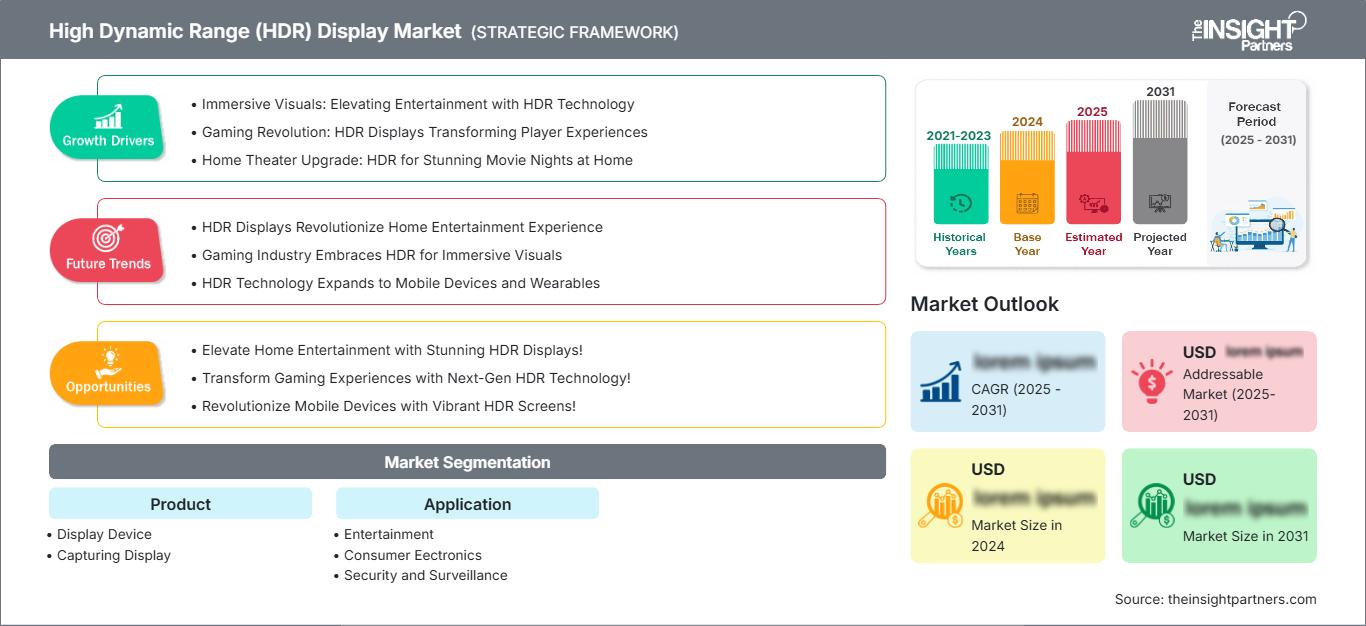
High Dynamic Range (HDR) Display Market: Strategic Insights
Regional Insights
North America High Dynamic Range Display Market
The North American market is regarded as an advanced one for HDR displays, contributing around 32-36% to the overall global revenue in 2025 with a CAGR of 9-11% in 2026-2034. The key reasons behind the market leadership are high levels of disposable income of consumers, well-developed systems of streaming content as well as early adoption of premium displays. The US plays the key role here as a major driver of growth due to consumers' desire to pay for immersive visual experience for both entertainment and games in home settings. The market benefits from well-developed industry of content creation; Hollywood studios and streaming platforms promote their demand for mastering and professional monitoring HDR displays. Canada acts as a complement of the market due to similar consumer behavior and demand. North America boasts a high concentration of global companies, such as Samsung, LG Display, Apple, and Sony, holding a considerable market share.
U.S. High Dynamic Range Display Market
North America holds a dominant position in the High Dynamic Range Display Market Share within the region, contributing approximately 85-90% of the total revenue of the region in 2025 with a forecasted CAGR of 10-12% between 2026 and 2034. The US market has an advantage because of its sizable consumer base with technologically savvy consumers, strong retail and e-commerce distribution channels, and the location of major corporate headquarters. The consumers in the US market have preferences for HDR-enabled televisions for home theater setup, high refresh rate gaming monitors, and high-end smartphones with superior displays. There has been considerable use of OLED and Mini-LED panels owing to low pricing and increased availability of HDR content. There is also a substantial contribution in the form of corporate and professional applications including creation of content and medical imaging. The US market is also a major market for product testing of global launches.
Europe High Dynamic Range Display Market
Europe held about 22-26% of the global market in 2025 with an expected CAGR of 8-10% for 2026-2034. Germany ranks first in Europe due to its engineering expertise, good visual standards and high expenses for premium electronics products. The second is the United Kingdom with a sophisticated retail market and widespread use of UHD broadcasting and streaming technologies. France, Italy and Spain significantly contribute to the region through its media and entertainment sectors and increased popularity of premium displays. European consumers are highly sophisticated people who are concerned about the quality of the picture, design, and energy consumption. The legal environment of the EU impacts both product development and distribution channels. Samsung, LG Display, and Sony have strong regional positions, whereas local specialists compete in niches such as professional broadcast monitors and home theaters.
APAC High Dynamic Range Display Market
Asia Pacific was the leading regional market in terms of revenue generation for HDR Displays in 2025, contributing around 38-42%, with CAGR of 11-13% from 2026-2034. The region is led by China owing to its status as the largest manufacturing hub for display panels as well as its rapidly developing consumer base on account of increasing disposable incomes and urbanization along with presence of many consumer electronics firms in the country. The contribution of Japan and South Korea is noteworthy due to its high display manufacturing capacity and adoption rate of premium display technologies. The growing middle class in countries such as India and Australia as well as increased use of smartphones in these regions make them emerging regions of growth. The region has favorable industrial policies for the manufacture of displays along with strong logistics support and initiatives by the government for digitalization.
Middle East & Africa High Dynamic Range Display Market
The Middle East & Africa region is expected to be a smaller yet growing market of HDR displays with a CAGR of 9-11% between 2026 and 2034. Saudi Arabia and the UAE stand out as the two countries generating regional demand due to high disposable income levels, the expansion of retail infrastructures, and consumer desire for premium consumer electronics products. South Africa is the key country on the Sub-Saharan Africa market, driven by the existence of a relatively developed retail sector and growing demand for advanced display technologies. Infrastructure development projects in the region have generated demand for commercial display installations in the hospitality, entertainment, and corporate segments. Rest of MEA is a category of varied markets at different stages of adoption where the presence of smartphones and digital content consumption drive the use of display technologies.
Segmentation Analysis
Product
The Product segment of the High Dynamic Range Display Market encompasses display devices and capturing displays, each serving distinct roles in the HDR ecosystem. This segment is projected to grow at a CAGR of approximately 9-12% from 2026 to 2034, driven by continuous innovation across both product categories and expanding use cases beyond traditional entertainment.
- Display Device: Display devices dominate the product category, including televisions, monitors, laptops, smartphones, tablets, and projectors equipped with HDR technology. HDR-enabled televisions represent the largest sub-segment, anchored by widespread adoption of HDR10, HDR10+, and Dolby Vision standards. Demand is driven by consumer preference for immersive viewing experiences across entertainment, gaming, and professional applications.
- Capturing Display: Capturing displays encompass HDR-capable cameras, camcorders, and imaging devices used in professional content creation, photography, and videography. The segment is growing rapidly as content creators and broadcasters adopt HDR mastering workflows. Professional-grade HDR monitors and reference displays serve the needs of filmmakers, colorists, and post-production facilities.
Application
The Application segment categorizes HDR display adoption across entertainment, consumer electronics, and security and surveillance applications. This segment is projected to grow at a CAGR of approximately 10-12% from 2026 to 2034, with entertainment maintaining the largest share.
- Entertainment: Entertainment represents the largest application segment, encompassing home theater systems, gaming, streaming media consumption, and professional content creation. Growing availability of HDR-mastered movies, TV shows, and games drives sustained demand for HDR-capable displays.
- Consumer Electronics: Consumer electronics applications include smartphones, tablets, laptops, and monitors for everyday use. HDR has become a standard feature in premium consumer devices, driven by consumer expectations for superior visual quality in portable and desktop form factors.
- Security and Surveillance: Security and surveillance applications utilize HDR displays for enhanced image clarity in monitoring and forensic analysis. High dynamic range capabilities improve visibility in challenging lighting conditions, supporting law enforcement and critical infrastructure protection.
Opportunity Snapshot
| Application Segment | Revenue Contribution | Trend Tag | Adoption Stage |
| Entertainment | High | Immersive Visuals | Mature |
| Consumer Electronics | High | Mobile HDR | Scaling |
| Security and Surveillance | Medium | Enhanced Imaging | Emerging |
High Dynamic Range (HDR) Display Market Growth Drivers and Impact Analysis
Expansion of HDR Content Across Streaming Platforms
The proliferation of HDR-mastered content across streaming platforms has fundamentally reshaped consumer expectations for visual quality, driving demand for HDR-capable displays. Streaming services including Netflix, Disney+, and Amazon Prime are investing heavily in HDR content production, with the majority of flagship titles now distributed in HDR10, HDR10+, or Dolby Vision formats. Live sports, gaming, and user-generated video are following the same trajectory, creating a comprehensive HDR content ecosystem that spans multiple genres and platforms. This content availability has incentivized consumers to upgrade their displays, expanding the addressable market beyond early adopters to mainstream audiences. The growing HDR content library also drives demand for professional capturing displays used in content production, creating a virtuous cycle of content creation and consumption that sustains market growth.
Technological Advancements in Display Panel Technologies
Technological advancements in OLED, QD-OLED, and Mini-LED backlight systems have significantly enhanced HDR display capabilities while reducing manufacturing costs. Panel manufacturers have pushed sustained peak brightness past 1,000 nits and, in the newest Micro RGB and RGB Mini-LED panels, well beyond 4,000 nits. These advancements enable superior contrast ratios, wider color volumes, and more precise local dimming, delivering the visual fidelity required for HDR content. The combination of denser local-dimming zones, wider color volume, and falling per-unit panel costs is compressing the price premium that once limited HDR to flagship devices, accelerating unit penetration across every product category. Manufacturers are now shipping HDR as a default feature even in mid-range tiers, broadening the addressable base far beyond the early premium niche.
Rising Consumer Demand for Immersive Gaming Experiences
The gaming industry has emerged as a significant growth driver for the High Dynamic Range Display Market, as gamers increasingly demand HDR-capable displays for immersive gameplay experiences. Modern gaming consoles and PCs support HDR output, enabling enhanced visual fidelity with improved contrast, brightness, and color accuracy. The growing popularity of competitive gaming and esports has driven demand for high-refresh-rate HDR monitors that combine superior image quality with responsive performance. Game developers are increasingly optimizing titles for HDR, creating content that leverages the full capabilities of advanced display technologies. This trend has expanded the market beyond traditional home theater applications, with gaming driving adoption across monitors, televisions, and portable devices. The convergence of gaming with streaming and content creation further amplifies demand for HDR displays across multiple use cases.
High Dynamic Range (HDR) Display Market Future Trends
AI-Powered Image Processing and Content Optimization
Artificial intelligence is increasingly central to delivering optimized HDR viewing experiences through real-time image enhancement, dynamic contrast adjustment, and intelligent upscaling. AI-driven image processing enables displays to analyze content characteristics and ambient lighting conditions, automatically adjusting parameters to deliver optimal visual quality. This trend extends to content creation, where AI tools assist in HDR mastering and color grading workflows. The integration of machine learning enables continuous improvement in image quality algorithms, creating increasingly refined visual experiences that enhance user satisfaction. As AI capabilities advance, HDR displays are evolving from passive playback devices into intelligent platforms that proactively optimize visual output for specific content types and viewing environments.
Emergence of Advanced HDR Formats and Standards
The development of advanced HDR formats and standards represents a transformative High Dynamic Range Display Market trend, with new technologies including HDR10+ Advanced and Dolby Vision 2 competing as open and licensed formats. These emerging standards offer enhanced capabilities including dynamic metadata, improved color volume, and compatibility with next-generation display technologies. The introduction of these formats is driving a new wave of innovation in display hardware and content production, creating opportunities for product differentiation and premium positioning. The battle for HDR supremacy is expected to intensify as new standards launch, with manufacturers and content providers aligning with specific formats. This competitive dynamic is accelerating technological advancement and expanding consumer choice, ultimately benefiting market growth.
High Dynamic Range (HDR) Display Market Opportunities
Integration with Augmented and Virtual Reality Applications
The integration of HDR display technology with augmented reality and virtual reality applications represents a significant growth opportunity for market participants. AR and VR systems require high-brightness, high-contrast displays to deliver immersive experiences that convincingly blend digital and physical environments. HDR capabilities enhance the realism and visual impact of AR/VR content, enabling more compelling applications across gaming, training, education, and enterprise collaboration. This opportunity extends to head-mounted displays and spatial computing platforms that require advanced panel technologies. Manufacturers can leverage their HDR display expertise to capture emerging AR/VR markets, creating new revenue streams and expanding their addressable markets. The High Dynamic Range Display Market Forecasts indicate strong potential in immersive applications as the AR/VR ecosystem matures.
Expansion into Automotive Display Applications
The adoption of HDR displays in automotive applications represents an emerging opportunity as vehicle manufacturers enhance in-vehicle infotainment and instrument cluster experiences. Modern vehicles increasingly feature large, high-resolution displays for navigation, entertainment, and vehicle information. HDR capabilities improve visibility in varying lighting conditions and enhance the visual quality of content consumed in vehicles. This opportunity is particularly relevant for electric vehicle manufacturers seeking to differentiate through premium cabin experiences. Partnerships between display manufacturers and automotive OEMs can accelerate adoption by integrating HDR displays into next-generation vehicle platforms. The integration of HDR with advanced driver assistance systems and autonomous vehicle interfaces further expands the opportunity.
Recent Developments
- August 2026: Samsung Electronics — the company became the first TV manufacturer to launch HDR10+ Advanced commercially, bringing the new HDR standard to its 2026 TV lineup and Prime Video. The technology adds enhanced brightness, intelligent motion smoothing, local tone mapping, and scene-based optimization to improve picture quality.
- August 2026: Hisense — the company became the first TV manufacturer to roll out Dolby Vision 2 on select 2026 televisions, including its UX, UR9, UR8, and U7 series. The update introduces improved scene-by-scene image processing, an adjustable HDR intensity control, and advanced features such as Authentic Motion and Light Sense 2 on compatible models.
- February 2025: Sharp Business Systems (India) — the company acquired NEC India's Display Business, expanding its portfolio of professional display solutions across markets including retail, education, healthcare, aviation, manufacturing, and smart cities. The acquisition strengthens Sharp's presence in India's growing visual-solutions market.
Frequently Asked Questions

- Comprehensive Market Sizing and Forecast Analysis
- Detailed Segmentation Analysis
- In-Depth Market Dynamics Assessment
- Regional and Country-Level Insights
- Competitive Landscape and Company Benchmarking
- Strategic Business Intelligence
Recent Reports
Testimonials

The Insight Partners' SCADA System Market report is comprehensive, with valuable insights on current trends and future forecasts. The team was highly professional, responsive, and supportive throughout. We are very satisfied and highly recommend their services.
RAN KEDEM Partner, Reali Technologies LTDs
I requested a report on a very specific software market and the team produced the report in a few days. The information was very relevant and well presented. I then requested some changes and additions to the report. The team was again very responsive and I got the final report in less than a week.
JEAN-HERVE JENN Chairman, Future Analytica
We worked with The Insight Partners for an important market study and forecast. They gave us clear insights into opportunities and risks, which helped shape our plans. Their research was easy to use and based on solid data. It helped us make smart, confident decisions. We highly recommend them.
PIYUSH NAGPAL Sr. Vice President, High Beam Global
The Insight Partners delivered insightful, well-structured market research with strong domain expertise. Their team was professional and responsive throughout. The user-friendly website made accessing industry reports seamless. We highly recommend them for reliable, high-quality research services
YUKIHIKO ADACHI CEO, Deep Blue, LLC.
This is the first time I have purchased a market report from The Insight Partners.While I was unsure at first, I visited their web site and felt more comfortable to take the risk and purchase a market report.I am completely satisfied with the quality of the report and customer service. I had several questions and comments with the initial report, but after a couple of dialogs over email with their analyst I believe I have a report that I can use as input to our strategic planning process.Thank you so much for taking the extra time and making this a positive experience.I will definitely recommend your service to others and you will be my first call when we need further market data.
JOHN SUZUKI President and Chief Executive Officer, Board Director, BK Technologies
I wish to appreciate your support and the professionalism you displayed in the course of attending to my request for information regarding to infectious disease IVD market in Nigeria. I appreciate your patience, your guidance, and the fact that you were willing to offer a discount, which eventually made it possible for us to close a deal. I look forward to engaging The Insight Partners in the future, all thanks to the impression you have created in me as a result of this first encounter.
DR CHIJIOKE ONYIA MANAGING DIRECTOR, PineCrest Healthcare Ltd.Reason to Buy
- Informed Decision-Making
- Understanding Market Dynamics
- Competitive Analysis
- Identifying Emerging Markets
- Customer Insights
- Market Forecasts
- Risk Mitigation
- Boosting Operational Efficiency
- Strategic Planning
- Investment Justification
- Tracking Industry Innovations
- Aligning with Regulatory Trends





 Get Free Sample for