
Home Beer Brewing Machine Market Share, Demand & Growth by 2034
Coverage: by Product Type (Mini Brewer, Full-size Brewer); Mechanism (Automatic, Manual) , and Geography (North America, Europe, Asia Pacific, and South and Central America)
- Status : Data Released
- Report Code : TIPRE00011131
- Category : Electronics and Semiconductor
- No. of Pages : 150
- Available Report Formats :


- Last update date : September 17, 2026


2025 Market Size
US$ 1.28 Bn
Base year value
2034 Forecast
US$ 3.47 Bn
Projected by 2034
CAGR 2026-2034
11.72 %
Growth rate
Addressable Market
US$ 20.88 Bn
(2026-2034)
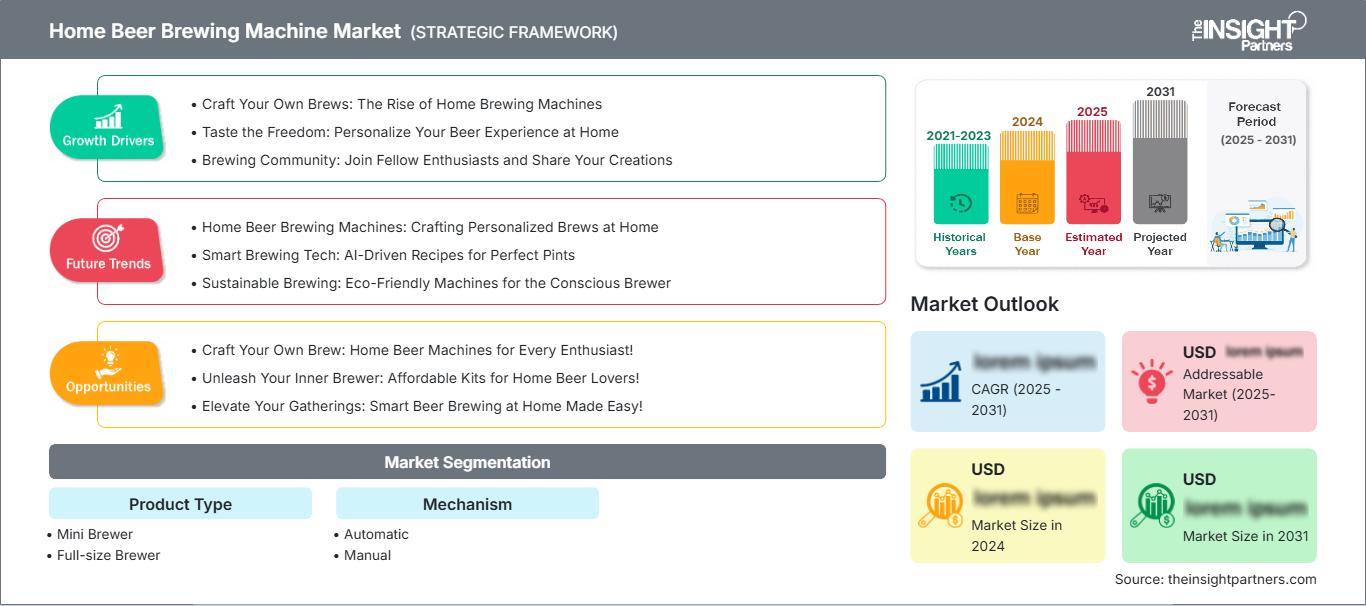
The Home Beer Brewing Machine Market was valued at US$ 1.28 Billion in 2025 and is projected to reach US$ 3.47 Billion by 2034, expanding at a CAGR of 11.72% during 2026–2034. The growth is driven by increasing consumer interest in personalized drinks, small-scale brewing equipment, automation, and the convenience of brewing at home. New product innovations are characterized by the integration of fermentation control, temperature control, interface design, and easy ingredient management.
North America continues to be a structurally appealing region driven by the existing home brewing culture, high penetration rate of connected cooking appliances, and the presence of craft beer culture. The outlook for the North American Home Beer Brewing Machine Market Size depicts a CAGR of 10.8 – 11.8 percent through 2034.
Home Beer Brewing Machine Market Assessment and Insights
- North America: North America accounted for an estimated 34–38% share in 2025 and is expected to grow at a 10.8–11.8% CAGR between 2026–2034, supported by mature home-brewing culture and strong premium appliance adoption.
- US: The US represented approximately 80–84% of North America's 2025 market and is projected to grow at a 10.7–11.7% CAGR between 2026–2034, led by craft-beer experimentation and connected appliances.
- Europe: Europe held an estimated 28–32% share in 2025 and is expected to expand at a 10.9–11.9% CAGR between 2026–2034, with Germany, the UK, France, Italy, and Spain providing established brewing cultures.
- Asia Pacific: Asia Pacific represented approximately 22–26% share in 2025 and is forecast to register a 12.4–13.4% CAGR between 2026–2034, with China, Japan, South Korea, India, and Australia supporting adoption.
- Largest Segment: Mini Brewer represented approximately 55–59% market share in 2025 and is expected to grow at a 10.8–11.8% CAGR from 2026–2034, benefiting from compact residential designs.
- High Growth Segment: Automatic is estimated at 58–62% market share in 2025 and is projected to expand at a 12.1–13.1% CAGR from 2026–2034, driven by convenience and process consistency.
- Key companies analyzed in detail: ABE Equipment, AIBrew Corp., BrewArt, Home Brew West, Jinan Zhuoda Machinery Equipment Co., Ltd., LG Electronics Inc., MiniBrew B.V., PicoBrew Inc., SPEIDEL TANK UND BEHÄLTERBAU GmbH, WilliamsWarn NZ Ltd.
Source: The Insight Partners' analysis based on proprietary research, government publications, company annual reports, investor presentations, industry databases, and expert interviews.
The Home Beer Brewing Machine Market has moved from equipment which needed quite a bit of expertise on the part of the brewer to integrated domestic systems capable of automation of temperature control, fermentation, carbonation, and monitoring. Smaller formats, recipes, applications, and prepackaged ingredients are making the process more streamlined. The manufacturing process is changing in favor of modular systems through which manufacturers can generate profits not only from hardware but also from software, accessories, consumables, and services.
Positive trends are becoming clearer in urban markets where limited cooking spaces favor smaller machines and more streamlined brewing processes. Energy usage, ease of cleaning, noise levels, and storage space needs are also being considered. Regulations in regard to producing alcohol become essential because household brewing rules vary significantly across countries.
Home Beer Brewing Machine Market Report Scope
| Report Attribute | Details |
|---|---|
| Market size in 2025 | US$ 1.28 Billion |
| Market Size by 2034 | US$ 3.47 Billion |
| Global CAGR (2026 - 2034) | 11.72% |
| Historical Data | 2021-2024 |
| Forecast period | 2026-2034 |
Home Beer Brewing Machine Market Analysis
DConsumer demand is being driven by consumers who want more control over the beverage type, ingredients, freshness, and experiments with the brewing process. The growth path of the Home Beer Brewing Machine Market is driven by the increasing trend of interest in craft beverages and technology-driven kitchen appliances. Supply chain conditions have become favorable for the companies that are able to fit heating, cooling, fermenting, monitoring, and dispensing processes in small machines.
Availability of components, food-grade materials, temperature control technology, software development, and after-sales support affect the economics of the product. Modular approach in design allows changing capacity and brewing preferences of the machine without increasing engineering complexity. The Home Beer Brewing Machine Market report consists of machine makers, ingredient makers, recipe designers, sellers, digital platforms, maintenance providers, and logistic partners. Ingredient replenishment creates an opportunity that is not only limited to the sale of appliances.
Competitive forces exist between brewers’ equipment specialists and consumer electronics specialists. The former has the appliance technology and smart home solution, whereas the latter highlights its brew ecosystem comprising hardware, ingredients, software, and dispensing. While MiniBrew B.V. focuses on automation and connectivity features, AIBrew Corp. aims at intelligent brewing solutions. Supplier competitors include ABE Equipment and SPEIDEL TANK UND BEHÄLTERBAU GmbH offering brewing equipment experience.
Key investment focus will be on automation, interface design, recipe ecosystems, miniaturization, and recurring products. Additional competitive offerings of PicoBrew Inc., Home Brew West, WilliamsWarn NZ Ltd, and Jinan Zhuoda Machinery Equipment Co., Ltd. should be also noted here. Accordingly, strategic focus will shift towards differentiation through user experience, reliability, ecosystems, and local distribution.
● REPORT CUSTOMIZATION
Tailor This Report To Align With Your Specific Business Requirements
This report can be customized to align precisely with your business objectives, scope, and target markets. Customization options include tailored segmentation, geography, competitive analysis, and strategic insights to support informed decision-making.
Customize This Report →WHAT YOU CAN ADJUST
- ● Segmentations
- ● Geography
- ● Competitive Analysis
- ● Language Preferences
Home Beer Brewing Machine Market: Strategic Insights
Regional Insights
North America Home Beer Brewing Machine Market
North America is estimated to make up 34-38% of Home Beer Brewing Machine Market Share in 2025, emerging as the biggest regional market segment. The region will grow at the rate of 10.8-11.8% CAGR between 2024 and 2034. The US represents the bulk of demand in the region, whereas Canada offers a smaller yet developed consumer base. High involvement of craft beers, specialty retailers, homebrewers, and strong penetration of eCommerce help generate demand for both discovery and replacement.
Adoption is becoming increasingly linked to convenience, reliability, and customization rather than basic brewing functionality. Customers become interested in machines that cut down on preparation processes but allow for recipe customization at the same time. Smart monitoring capabilities, automatic fermentation control, and compact design can help expand the target customer base. Moreover, manufacturers enjoy developed channels of distribution for kitchen appliances and accessories ecosystems, meaning that North American demand will focus on premium automated equipment, even though traditional equipment remains relevant among advanced hobbyists.
U.S. Home Beer Brewing Machine Market
It is estimated that the United States would capture 80–84% of North American market by 2025, which is predicted to experience CAGR of 10.7–11.7% up to 2034. It is characterized by an established culture of craft beer consumption, high awareness levels of home brewing as well as advanced connectivity of home appliances. The demand is dominated by hobbyists, technologically advanced consumers, and individuals looking for personalized drinking experience without using professional equipment.
There is competition between specialist brewers and popular brands of home appliances. Automation becomes increasingly important in cases when customers emphasize repeatability and less human intervention in the process, whereas non-automated brewing devices remain attractive for experienced home brewers, as they can enjoy the experimental aspect. Internet resources are essential in selling home brewing equipment, ingredients, additional tools, and learning materials. The system featuring apps for monitoring the process, guided brewing, automated fermentation, and dispensing could receive extra attention from customers.
Europe Home Beer Brewing Machine Market
Europe is expected to have a 28–32% share in 2025 and should experience growth in the range of 10.9–11.9% CAGR up until 2034. Germany holds the largest market share due to a long history of brewing traditions, followed by the UK, France, Italy, and Spain. Europe is the combination of brewing preferences and rising interest in residential equipment.
The UK is a developed market of enthusiasts who enjoy craft beer culture and need equipment that allows for recipes control and repeatability. Germany enjoys great brewing tradition along with technically-minded customers, making it a suitable market for systems aimed at precision. France, Italy, and Spain also provide room for development because craft beverages, premium home entertaining, and specialized brewing experiences are becoming increasingly popular. Moreover, European consumers pay growing attention to durability, ease of cleaning, energy efficiency, and rational usage of resources. All of the above allows for a gradual switch to compact automation equipment, while manual equipment continues to be demanded by professionals.
APAC Home Beer Brewing Machine Market
APAC is estimated to represent 22–26% of global revenue in 2025 and is expected to register the fastest regional growth at a 12.4–13.4% CAGR through 2034. China leads the regional opportunity, followed by Japan, South Korea, India, and Australia. Urbanization, rising disposable incomes, premium beverage interest, and connected-appliance adoption support expansion.
It can be said that China gains the advantage of production facilities and consumer interest in premium beverages. Japan and South Korea are technologically advanced consumer markets, whereas India and Australia have emerging prospects associated with premiumization and home entertainment. Online shopping is facilitating increased availability in key markets, especially in compact machines. Localization of the product, multi-language application, energy savings, and space-saving design will continue to be relevant.
Middle East & Africa Home Beer Brewing Machine Market
Despite being a smaller regional opportunity, Middle East & Africa demand is driven by high-end hospitality, tourism, expatriate population, and beverage equipment channels. Saudi Arabia & the UAE are the key commercial opportunities within the region, whereas South Africa is an opportunity with a more mature brewing environment. The regional market is projected to grow at 9.2–10.2% CAGR until 2034.
Regulatory differences have a significant impact on addressable demand across various countries, especially in the case of domestic alcohol brewing. The UAE has a high-end appliance market, along with strong hospitality demand, whereas South Africa has a mature brewing industry. Saudi Arabia & other Gulf countries are more selective markets owing to local regulations. Distribution, compliance, after-sales support, and marketing strategy become key drivers of regional growth. Companies with flexible market entry strategy can capitalize on hospitality and specialist channels in the presence of household limitations.
Segmentation Analysis
Product Type
Product Type segment in the Home Beer Brewing Machine Market remains a fundamental determinant of consumer adoption because household space, brewing frequency, batch requirements, and technical experience influence purchasing decisions. The segment is expected to expand at a 11.1–12.1% CAGR from 2026–2034. Mini brewers retain the largest position because they fit urban kitchens and reduce upfront complexity, while full-size systems attract serious hobbyists seeking larger batches and broader process control.
- Mini Brewer: Mini brewers hold the leading position because compact dimensions, simplified operation, and lower space requirements suit first-time users and urban households. Their strategic importance is reinforced by e-commerce accessibility and growing interest in convenient craft experiences.
- Full-size Brewer: Full-size brewers address experienced users who prioritize larger batches, greater recipe flexibility, and deeper process control. Demand is supported by hobbyist communities and consumers seeking equipment closer to traditional brewing workflows.
Mechanism
Mechanism segment in the Home Beer Brewing Machine Market directly affects ease of use, control, cleaning requirements, and perceived brewing consistency. The segment is projected to grow at a 11.4–12.4% CAGR from 2026–2034. Automatic systems are expected to maintain the stronger position as consumers prioritize convenience, while manual systems remain relevant among experienced users seeking hands-on experimentation and process flexibility.
- Automatic: Automatic machines simplify brewing through integrated process control, temperature management, monitoring, and guided programs. Their strategic importance is increasing as manufacturers target consumers with limited brewing experience and seek differentiated connected-appliance experiences.
- Manual: Manual machines appeal to experienced hobbyists who value direct process intervention, recipe experimentation, and traditional brewing methods. They remain strategically relevant where consumers prioritize control over convenience and accept greater preparation and monitoring requirements.
Opportunity Snapshot
| Product Type | Revenue Contribution | Trend Tag | Adoption Stage |
| Mini Brewer | High | Compact Brewing | Scaling |
| Full-size Brewer | Medium | Batch Customization | Mature |
Home Beer Brewing Machine Market Growth Drivers and Impact Analysis
Expansion of At-Home Craft Beverage Experiences
Rising consumer interest in customizing their food and drink experience is expanding the pool of customers seeking equipment for home brewing. Rather than using pre-made beer styles and flavors, consumers show a desire to experiment with different types of brews, ingredients, levels of alcohol content, and even bitterness. Such preferences lead to a demand for equipment capable of offering customization but removing some of the complexity of traditional brewing process. The benefits of this behavior manifest themselves not only in terms of the growth of the home brewing market itself but also in the expansion of markets of equipment, ingredients, recipe kits, and digital services related to home brewing.
Automation Reducing Brewing Complexity
Automation is transforming the economics of homebrewing by cutting down the time and knowledge necessary to perform various production stages. Automation in brewing, such as integrated heating, temperature control, fermentation management, and recipes, may decrease the variation of the process and make brewing easier for those who do not have expertise in it. It expands the potential client base and makes the development of software, sensors, connectivity, and interfaces crucial. For the producer, automation means possibilities to introduce unique algorithms, programs, and services into their product to distinguish it. This issue is especially important for high-end appliances since people are able to compare brewing equipment with all the other connected kitchen equipment by its convenience and functions.
Growth of Compact Connected Kitchen Appliances
Residential space constraints are increasing the relevance of compact appliances that combine multiple functions without requiring dedicated brewing rooms or large storage areas. Smaller households and urban consumers can favor machines that integrate brewing, fermentation, cooling, and dispensing within a manageable footprint. Connectivity further strengthens this proposition by allowing users to monitor brewing cycles and receive status notifications without continuous physical supervision. The commercial effect is a broader addressable market for manufacturers capable of miniaturizing thermal, mechanical, and electronic components while maintaining food safety and brewing performance. Compact connected designs can also improve e-commerce suitability because simplified installation and lower spatial requirements reduce purchase barriers. Consequently, product development is increasingly focused on modular architecture, intuitive maintenance, efficient energy use, and seamless integration with digital household environments.
Home Beer Brewing Machine Market Future Trends
Connected Recipe Ecosystems and Personalized Brewing Profiles
The Home Beer Brewing Machine Market trends are moving toward connected recipe ecosystems that transform machines from standalone appliances into personalized brewing platforms. Future products are likely to use cloud-based profiles, adaptive recipe recommendations, ingredient tracking, and performance feedback to improve repeatability across batches. Artificial intelligence can support recipe adjustment by learning consumer preferences for bitterness, aroma, alcohol content, and fermentation characteristics. Manufacturers may increasingly combine equipment sales with recipe libraries, ingredient replenishment, community features, and software subscriptions. This model could improve customer retention while generating recurring revenue beyond the initial hardware purchase. Interoperability with smartphones and broader smart-home platforms is also likely to become more important as consumers expect connected appliances to share notifications, usage data, and maintenance information through unified digital interfaces.
Low-Intervention Brewing and Resource Efficiency
Future product development is likely to emphasize lower intervention, easier cleaning, reduced water consumption, and improved energy efficiency. Brewing machines can incorporate more efficient heating and cooling cycles, optimized fermentation control, automated cleaning prompts, and reusable components to reduce operating complexity. Manufacturers may also redesign ingredient packaging to minimize waste while preserving shelf stability and dosing accuracy. Resource efficiency can become a stronger purchasing criterion as consumers compare connected brewing appliances with broader sustainability expectations for household electronics. In parallel, compact equipment architectures can reduce material requirements and transportation footprints when designed for modular repair or component replacement. These developments should encourage manufacturers to measure lifecycle performance rather than focusing only on brewing output. Product differentiation will increasingly depend on the combined value of convenience, durability, efficiency, and responsible consumption.
Home Beer Brewing Machine Market Opportunities
Expansion of Consumables and Subscription-Based Ecosystems
The strongest commercial opportunity in the segment in the Home Beer Brewing Machine Market Forecast beyond hardware lies in recurring consumables and digital services. Manufacturers can develop ingredient subscriptions covering malt, hops, yeast, flavoring components, and recipe-specific brewing inputs, allowing customers to receive standardized quantities matched to compatible machines. Subscription models can improve production planning while increasing customer lifetime value and reducing dependence on one-time appliance sales. Digital recipe libraries, premium brewing programs, personalized recommendations, and remote technical support can complement these offerings. The model is particularly relevant for automatic machines because standardized ingredients can simplify programming and improve consistency. Companies can also create partnerships with breweries and ingredient specialists to introduce limited-edition recipes or regional styles. Such ecosystems can strengthen differentiation, create recurring revenue streams, and increase switching costs without requiring major changes to core appliance hardware.
Localized Product Platforms for Emerging Consumer Markets
Emerging markets offer an opportunity for manufacturers to adapt compact brewing systems to local household environments, consumer preferences, and regulatory conditions. Asia Pacific is particularly attractive because urban consumers are increasingly familiar with smart appliances, online retail, and premium beverage experiences. Localized platforms can incorporate smaller batch capacities, multilingual interfaces, region-specific recipes, energy-efficient operating modes, and locally sourced ingredients. Manufacturers can also use digital commerce to test demand before committing to extensive physical distribution networks. Partnerships with specialty retailers, hospitality businesses, brewing communities, and ingredient suppliers can provide additional routes to market. Regulatory screening should remain central because household alcohol-production rules differ significantly between countries. Companies that combine localized product design with compliance-oriented commercialization can reduce market-entry risks while building scalable platforms across diverse consumer environments.
Recent Developments
- February 2025: MiniBrew B.V. announced a strategic shift toward a subscription-led business model, stating that the company would reduce reliance on hardware sales while strengthening the digital and service ecosystem around its brewing platform. The company also outlined plans to improve platform sustainability and explore a standalone server solution for greater customer independence.
- March 2025: The Coopers USA, Inc. updated the BrewArt US website terms governing its BeerDroid, BrewArt App, brewing products, and associated services. The update reflects continued operation of the connected brewing ecosystem, including app-based brewing control, digital services, and product support.
- May 2025: LG Electronics India Ltd. commenced construction of its third Indian manufacturing facility at Sri City, Andhra Pradesh. Although the project is broader than brewing appliances, the investment expands LG’s regional manufacturing footprint and supports the company’s wider consumer-electronics production capabilities in India.
Frequently Asked Questions

- Comprehensive Market Sizing and Forecast Analysis
- Detailed Segmentation Analysis
- In-Depth Market Dynamics Assessment
- Regional and Country-Level Insights
- Competitive Landscape and Company Benchmarking
- Strategic Business Intelligence
Recent Reports
Testimonials

The Insight Partners' SCADA System Market report is comprehensive, with valuable insights on current trends and future forecasts. The team was highly professional, responsive, and supportive throughout. We are very satisfied and highly recommend their services.
RAN KEDEM Partner, Reali Technologies LTDs
I requested a report on a very specific software market and the team produced the report in a few days. The information was very relevant and well presented. I then requested some changes and additions to the report. The team was again very responsive and I got the final report in less than a week.
JEAN-HERVE JENN Chairman, Future Analytica
We worked with The Insight Partners for an important market study and forecast. They gave us clear insights into opportunities and risks, which helped shape our plans. Their research was easy to use and based on solid data. It helped us make smart, confident decisions. We highly recommend them.
PIYUSH NAGPAL Sr. Vice President, High Beam Global
The Insight Partners delivered insightful, well-structured market research with strong domain expertise. Their team was professional and responsive throughout. The user-friendly website made accessing industry reports seamless. We highly recommend them for reliable, high-quality research services
YUKIHIKO ADACHI CEO, Deep Blue, LLC.
This is the first time I have purchased a market report from The Insight Partners.While I was unsure at first, I visited their web site and felt more comfortable to take the risk and purchase a market report.I am completely satisfied with the quality of the report and customer service. I had several questions and comments with the initial report, but after a couple of dialogs over email with their analyst I believe I have a report that I can use as input to our strategic planning process.Thank you so much for taking the extra time and making this a positive experience.I will definitely recommend your service to others and you will be my first call when we need further market data.
JOHN SUZUKI President and Chief Executive Officer, Board Director, BK Technologies
I wish to appreciate your support and the professionalism you displayed in the course of attending to my request for information regarding to infectious disease IVD market in Nigeria. I appreciate your patience, your guidance, and the fact that you were willing to offer a discount, which eventually made it possible for us to close a deal. I look forward to engaging The Insight Partners in the future, all thanks to the impression you have created in me as a result of this first encounter.
DR CHIJIOKE ONYIA MANAGING DIRECTOR, PineCrest Healthcare Ltd.Reason to Buy
- Informed Decision-Making
- Understanding Market Dynamics
- Competitive Analysis
- Identifying Emerging Markets
- Customer Insights
- Market Forecasts
- Risk Mitigation
- Boosting Operational Efficiency
- Strategic Planning
- Investment Justification
- Tracking Industry Innovations
- Aligning with Regulatory Trends





 Get Free Sample for