
Home electronic locks Market Size, Trends & Growth by 2034
Coverage: By Product Type (Strikes, Deadbolts and Latches, Lever Locks, Others); Connectivity (Bluetooth, Wi-Fi, NFC, Others); Authentication Method (Biometrics, Keypad, RFID, Others), and Geography (North America, Europe, Asia Pacific, and South and Central America)
- Status : Data Released
- Report Code : TIPRE00018608
- Category : Electronics and Semiconductor
- No. of Pages : 150
- Available Report Formats :


- Last update date : September 17, 2026


2025 Market Size
US$ 5.21 Bn
Base year value
2034 Forecast
US$ 14.77 Bn
Projected by 2034
CAGR 2026-2034
12.27 %
Growth rate
Addressable Market
US$ 87.42 Bn
(2026-2034)
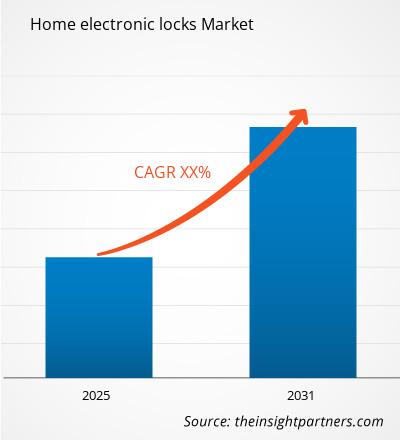
The Home Electronic Locks Market is positioned at the intersection of residential security, connected-home automation, and digital access management. The market is valued at US$ 5.21 Billion in 2025 and is projected to reach US$ 14.77 Billion by 2034, registering a CAGR of 12.27% during 2026–2034. Expansion is supported by increasing acceptance of keyless entry, connected devices, remote access, and digitally managed household security.
Across North America, adoption is supported by mature smart-home ecosystems, high smartphone penetration, residential renovation activity, and strong consumer familiarity with connected security products. The regional Home Electronic Locks Market outlook indicates a modeled CAGR of 11.5–13.5% during 2026–2034. Demand is particularly supported by retrofit-friendly electronic locks, interoperability with home platforms, and increasing preference for remotely monitored entry.
Home electronic locks Market Assessment and Insights
- North America: North America is expected to maintain a leading position, with a modeled 2025 share of 38–42% and CAGR of 11.5–13.5% between 2026–2034, supported by established smart-home infrastructure and retrofit demand.
- US: The US represents the dominant North American market, accounting for 78–82% of regional revenue in 2025 and expanding at a modeled 11.5–13.5% CAGR during 2026–2034.
- Europe: Europe is estimated at 22–26% share in 2025 and a 10.5–12.5% CAGR, led by Germany, the UK, France, Italy, and Spain, where residential modernization and connected-access adoption are strengthening.
- Asia Pacific: Asia Pacific is estimated at 25–29% share in 2025 and the highest regional CAGR of 13.5–15.5%, with China, Japan, South Korea, and India leading adoption through urbanization and smart-home development.
- Largest Segment: Deadbolts and Latches represent an estimated 42–46% market share in 2025, with a modeled 11.5–13.5% CAGR through 2034, reflecting residential security priorities.
- High Growth Segment: Biometrics holds an estimated 24–28% share in 2025 and is modeled to expand at 14.0–16.0% CAGR, supported by stronger identity-based authentication.
- Key companies analyzed in detail: Allegion plc, August Home, Be-Tech Security Systems Ltd., Godrej & Boyce Manufacturing Company Limited, Guangzhou Lightsources Electronics Technology Limited (LILIWISE), Honeywell International Inc., HUNE Lock, Postscape LLC (Smart Lock Scout), Samsung SDS Co., Ltd., Spectrum Brands Holdings, Inc. (Kwikset).
Source: The Insight Partners' analysis based on proprietary research, government publications, company annual reports, investor presentations, industry databases, and expert interviews.
The industry has shifted its direction from individual electronic lock systems to more complex access platforms that include mobile credentialing, wireless connectivity, biometric verification, and cloud management systems. Design improvements are focused on improving energy efficiency, tampering prevention capabilities, ease of integration, and installation for retrofit purposes. In addition, the makers of electronic locks are now focusing on mechanical robustness, cybersecurity architecture, and interoperability as opposed to just offering keyless systems.
Expansion in the future will largely be dependent on digitally sophisticated Asian cities, housing renovation projects, and premium housing developments. It is expected that investments will focus on multi-factor authentication, robust offline capability, and connectivity. Moreover, regulation with respect to cybersecurity, consumer protection, and interoperability may drive architectural decisions. Property developers and security integrators will increasingly consider electronic locks within connected buildings specification frameworks.
Home electronic locks Market Report Scope
| Report Attribute | Details |
|---|---|
| Market size in 2025 | US$ 5.21 Billion |
| Market Size by 2034 | US$ 14.77 Billion |
| Global CAGR (2026 - 2034) | 12.27% |
| Historical Data | 2021-2024 |
| Forecast period | 2026-2034 |
Home electronic locks Market Analysis
The demand trend will be further driven by the larger transition to integrated living systems where access control becomes part of cameras, alarms, lighting, and voice-controlled systems. Accordingly, the future growth rate for Home Electronic Locks Market is reliant on both lock replacement trends and growth in home ecosystem solutions. Value chain participants include lock makers, electronic components makers, authenticators, software makers, distributors, installers, and platform makers.
The supply side is impacted by semiconductors, wireless connectivity, sensors, motors, batteries, metals, and security software. Firms that are vertically integrated in terms of product design can minimize integration problems, while contract manufacturing continues to play an important role for lower-cost products. Product design needs to take into account the interplay between connectivity features and battery life since the latter could be affected negatively when using continuous Wi-Fi connectivity as opposed to Bluetooth-based local connectivity.
Competitive positioning in the Home Electronic Locks Market is increasingly incorporating mechanical lock expertise with software and connected device know-how. Allegion plc leverages its home access segment, while August Home leverages its brand identity for the connected home segment. Spectrum Brands Holdings, Inc. (Kwikset) stresses on home hardware and electronic access segment, while Samsung SDS Co., Ltd. focuses on digital security and connected devices segment. Honeywell International Inc. uses access technologies in larger building security ecosystems.
Investment is increasingly going into interoperability, digital credentials, cybersecurity, and applications-level services. Be-Tech Security Systems Ltd., Godrej & Boyce Manufacturing Company Limited, HUNE Lock, and Guangzhou Lightsources Electronics Technology Limited (LILIWISE) cater to differentiated regional and product needs. Postscape LLC (Smart Lock Scout) focuses on specialized smart locks segment. For all the competitors, product range, ease of installation, distribution network, software reliability, and post-sales support are increasingly becoming critical along with security.
● REPORT CUSTOMIZATION
Tailor This Report To Align With Your Specific Business Requirements
This report can be customized to align precisely with your business objectives, scope, and target markets. Customization options include tailored segmentation, geography, competitive analysis, and strategic insights to support informed decision-making.
Customize This Report →WHAT YOU CAN ADJUST
- ● Segmentations
- ● Geography
- ● Competitive Analysis
- ● Language Preferences
Home electronic locks Market: Strategic Insights
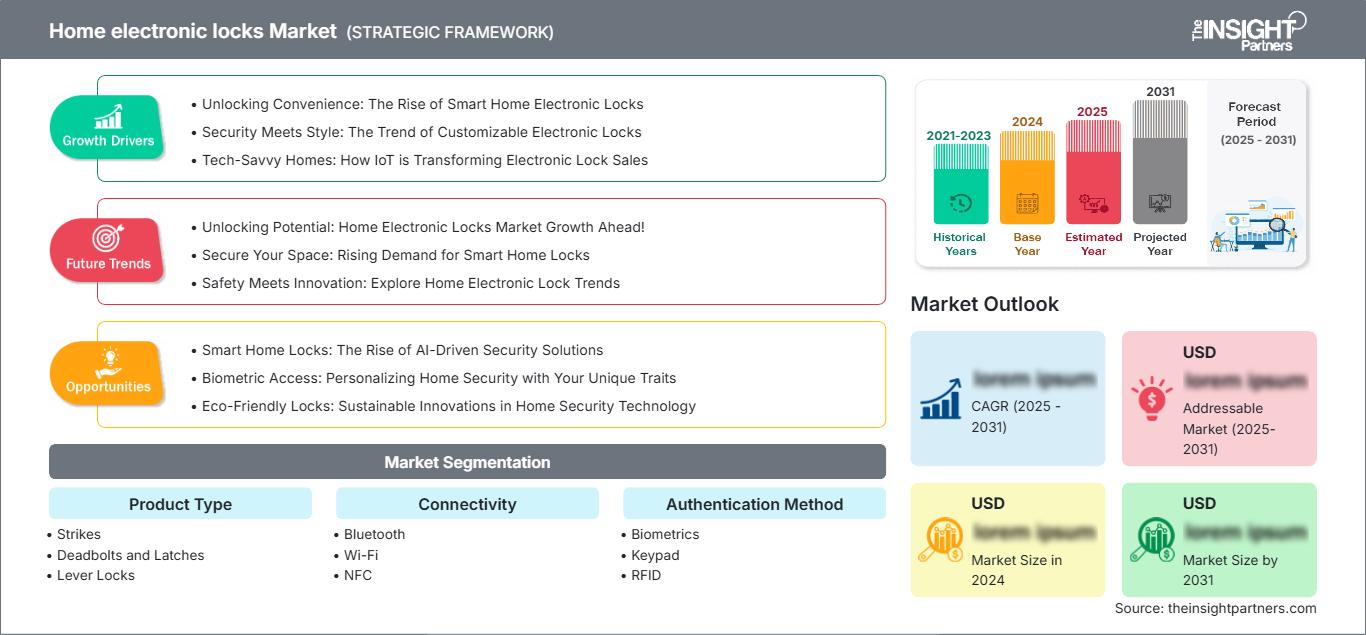
Regional Insights
North America Home Electronic Locks Market
North America will be estimated at 38-42% Home Electronic Locks Market share for 2025 and a 11.5-13.5% CAGR until 2034. This region has several factors that play a role in its favor – the development of connected-home environments, extensive usage of smartphones, proven residential remodeling methods and consumer knowledge of remote access capabilities.
The USA accounts for 78-82% of the revenue in North America, while Canada is responsible for the rest. The demand in the region is driven by residential security, access control of rental property, home deliveries and integration with other automation systems. The two technologies (Bluetooth and Wi-Fi) address different needs, the first technology allows energy savings by using local access, while the second one enables remote monitoring. Well-established hardware manufacturers and technology-focused companies provide a competitive environment for this region.
U.S. Home Electronic Locks Market
The United States makes up 78-82% of North America revenues in 2025 and is forecasted to grow by 11.5-13.5% CAGR until 2034. The growth drivers include the use of connected homes, home remodeling, smart security installations, and available channels for sales and installations. The companies including Allegion plc, August Home, Honeywell International Inc., and Spectrum Brands Holdings, Inc. (Kwikset) are among the competitors.
Residential applications continue to play an integral part, especially the retrofits where the residents require keyless entry without much modification of the doors. The other purchasing considerations include control through smartphones, keypad operation, temporary access, and the integration of cameras and alarms. In addition, the industry has benefited from property management applications that make credential issuance remotely easier. In product differentiation, the focus is now on battery life, application, mechanical integration, and security of data.
Europe Home Electronic Locks Market
Europe contributes to 22-26% of the world’s revenue in 2025 and is forecasted to grow at a CAGR of 10.5-12.5% until 2034, driven by Germany. The UK, Germany, France, Italy, and Spain will be the primary areas of demand driven by modernization of residences, security consciousness, and adoption of connected buildings.
The UK has a high retrofit profile and consumers as well as tenants become more inclined to consider electronic access systems because of convenience, property management, and secured entry. German markets emphasize high importance of quality engineering, privacy, physical security, and compatibility with the existing building structure. France is influenced by modernization of apartments and the adoption of smart homes, while Italy and Spain provide opportunities owing to renovation, hospitality-related residences, and digitally enabled property management.
Europe has been affected by privacy and cybersecurity concerns and therefore, protection of credentials and secure application design will become differentiation factors. Germany stays the top country and UK becomes a market with high commercial and residential technology adoption. It helps manufacturers to increase acceptance of their products in various housing structures and national environments.
APAC Home Electronic Locks Market
The APAC model is based on an estimated 25-29% Home Electronic Locks Market share in 2025, and the region's highest CAGR of 13.5-15.5% from 2024 to 2034. China takes the lead followed by Japan, South Korea, India, and Australia. Electronic access implementation is growing due to increased urbanization, smartphone ownership, construction of apartments, and the development of smart home ecosystems.
China has the advantage of local electronics production and connectivity of devices, Japan focuses on convenience and accessibility, South Korea relies on highly developed digital infrastructure and high smart home adoption, India is helped by housing developments in cities and increasing consumer interest in security systems, and Australia has the developed market of premium homes.
Middle East & Africa Home Electronic Locks Market
Middle East and Africa constitutes a relatively minor opportunity but is expected to grow at a rate of 10.0–12.0% CAGR until 2034. The largest demands within the region are in Saudi Arabia, UAE, and South Africa, whereas the rest of MEA is relatively fragmented. New residential constructions, hotels, and modernization of security services are key to connected access.
Urban development and construction of digital buildings in Saudi Arabia and UAE contribute significantly to the market. South Africa has an already existing market focused on security needs, while other MEA countries represent selective opportunities related to hotels, premium residences, and business facilities. Energy savings, remote monitoring, and building infrastructure may facilitate the implementation of connected access solutions.
Segmentation Analysis
Product Type
The Product Type segment is expected to expand at a modeled 11.5–13.5% CAGR during 2026–2034. Mechanical form factors remain important because consumers generally require electronic functionality without compromising established door compatibility. The Home Electronic Locks scope therefore spans products that preserve familiar installation geometries while adding digital credentials, connectivity, and automated locking functions.
- Strikes: Electric strikes support controlled entry configurations where the locking mechanism interacts with an existing door frame. Their strategic relevance is strongest where retrofit requirements favor modifications to the frame rather than complete lock replacement.
- Deadbolts and Latches: Deadbolts and latches remain the principal residential format because they combine familiar mechanical security with electronic control, supporting retrofit installations, keypad entry, mobile credentials, and automated locking.
- Lever Locks: Lever locks address homes requiring integrated handle and locking functionality. Their design flexibility supports contemporary residential interiors and accessibility-oriented installations where ease of operation is an important purchasing consideration.
Connectivity
The Connectivity segment in the Home Electronic Locks Market is modeled to grow at 12.0–14.0% CAGR from 2026–2034 as consumers increasingly expect locks to communicate with smartphones and connected-home platforms. Bluetooth, Wi-Fi, and NFC address different balances between battery consumption, range, setup complexity, and remote accessibility, making connectivity selection an important product-design decision.
- Bluetooth: Bluetooth supports low-power local communication and convenient smartphone proximity access. Its battery efficiency and direct-device functionality make it particularly relevant for retrofit residential locks where dependable local unlocking is prioritized.
- Wi-Fi: Wi-Fi enables remote access, notifications, cloud connectivity, and integration with broader home networks. It is strategically important for users requiring control while away from the property and for connected property-management applications.
- NFC: NFC provides short-range credential exchange and supports compatible smartphones or access devices. Its strategic value lies in quick authentication and low-interaction entry scenarios where secure proximity-based access is preferred.
Authentication Method
The Authentication Method segment in the Home Electronic Locks Market is projected to register a modeled 13.0–15.0% CAGR during 2026–2034. The Home Electronic Locks analysis indicates that authentication is becoming a core differentiator as users compare convenience with security. Multi-modal products can accommodate different household preferences while providing fallback access when a smartphone or biometric reader is unavailable.
- Biometrics: Biometric authentication supports identity-based access using physiological characteristics, reducing dependence on physical keys or shared codes. Its strategic importance is rising in premium residential products where convenience and personalized access are valued.
- Keypad: Keypads provide familiar PIN-based entry and allow temporary or recurring credentials without requiring smartphones. They remain important for households, rental properties, and service access where controlled code sharing simplifies administration.
- RFID: RFID enables contactless credential use through cards, tags, or compatible devices. It is particularly relevant where multiple authorized users require controlled access without distributing physical keys or depending on individual smartphones.
Opportunity Snapshot
| End Users | Revenue Contribution (High/Medium/Low) | Trend Tag | Adoption Stage |
|---|---|---|---|
| Residential homeowners | High | Mobile Entry | Scaling |
| Rental properties | Medium | Remote Access | Scaling |
| Smart-home integrators | Medium | Platform Sync | Scaling |
| Property managers | Medium | Digital Credentials | Scaling |
| Premium housing developers | Medium | Biometric Entry | Emerging |
Home electronic locks Market Growth Drivers and Impact Analysis
Connected-home platform integration expands the addressable use case
Locks are increasingly used as elements in connected home systems instead of simple security devices. Interaction with cameras, alarms, lighting, voice assistants, and applications provides an incentive for the use of electronic locks beyond their direct security function. The consequences cover the entire value chain because lock manufacturers will have to develop software interfaces and interoperability in addition to hardware quality. Ecosystem compatibility may even affect the choice of channels because installers and smart home integration experts tend to suggest products that can be integrated into the system. As a consequence, manufacturers see a motivation for spending money on developing and testing applications instead of spending them only on manufacturing hardware.
Residential renovation creates a large retrofit pathway
Renovation provides an important route for electronic-lock adoption because homeowners can add digital access without constructing entirely new properties. Retrofit-friendly deadbolts, latches, and lever configurations reduce installation complexity and make the technology relevant to existing housing stock. The commercial impact is significant for manufacturers and distributors because retrofit products can be sold through retail, e-commerce, locksmith, and professional installation channels. Consumers also receive a tangible convenience benefit from keyless entry, temporary credentials, and automated locking. Product developers consequently prioritize compatibility with common door configurations, battery accessibility, mechanical overrides, and straightforward setup. As renovation spending increasingly incorporates security and automation features, electronic locks can compete for budgets previously allocated to conventional hardware, particularly in premium and technology-oriented households.
Digital credential management improves property access efficiency
Digital credentials create measurable operational advantages for landlords, property managers, homeowners, and service providers by reducing dependence on physical key distribution. Access can be assigned, modified, or revoked without replacing a cylinder, while event histories can improve accountability. These capabilities are particularly useful for rental homes, vacation properties, domestic services, and maintenance visits where access requirements change frequently. The impact encourages manufacturers to develop software functions alongside locking hardware, including scheduling, user permissions, notifications, and remote administration. It also creates opportunities for recurring software services and professional management tools. As property ownership becomes more distributed and short-term occupancy patterns increase, electronic access can reduce administrative friction while maintaining stronger visibility over who enters a property and when.
Home electronic locks Market Future Trends
Interoperable smart-home access will become a design priority
Future products are likely to place greater emphasis on interoperability across smart-home platforms, mobile ecosystems, and connected security devices. Rather than treating connectivity as a single protocol decision, manufacturers will increasingly design flexible architectures that can support multiple communication pathways and authentication options. Matter-oriented ecosystems and standardized application interfaces may reduce platform fragmentation, although implementation quality will remain decisive. Battery management will also become more sophisticated as locks combine local radios, sensors, biometric readers, and remote services. Vendors are likely to differentiate through seamless credential portability, dependable offline operation, and clearer privacy controls. The resulting product category should increasingly resemble an access-management endpoint within the home network, connecting physical security with digital identity while maintaining mechanical fallback capabilities for resilience during connectivity or power interruptions.
Biometric and multi-factor authentication will move toward mainstream tiers
Biometric capabilities are likely to migrate from premium products toward broader residential price categories as sensor costs, processing capabilities, and component integration improve. Future locks may combine fingerprint recognition with keypad, smartphone, NFC, or mechanical credentials, allowing users to select the most appropriate method for each situation. Multi-factor authentication could become more relevant for high-value residences and properties requiring stronger access assurance. Manufacturers will need to address false acceptance, false rejection, sensor durability, and privacy expectations while keeping installation and operation simple. Greater on-device processing may also reduce the need to transmit sensitive authentication information to remote services. This Home Electronic Locks Market Trends can expand the addressable customer base by making identity-based entry practical for ordinary households rather than limiting it to luxury homes and specialized security applications.
Home electronic locks Market Opportunities
Retrofit ecosystems can unlock underserved residential housing stock
Manufacturers can target the large installed base of conventional residential doors by developing modular locks that fit common mechanical configurations without extensive alteration. Investment should prioritize installation guides, compatibility databases, universal mounting components, and partnerships with locksmiths and home-improvement retailers. Products designed around replaceable batteries, emergency mechanical access, and simple smartphone onboarding can reduce perceived switching barriers. The opportunity is particularly relevant in markets where new construction is slower than housing renovation. A broader retrofit ecosystem can also create complementary revenue from accessories, hubs, replacement modules, and professional installation. Companies that simplify the transition from mechanical to electronic access may capture customers who are interested in smart security but remain reluctant to undertake complicated door modifications or depend entirely on cloud-based functionality.
Property-management solutions can broaden recurring revenue opportunities
Property managers represent an attractive opportunity because electronic credentials can be administered across multiple residences while reducing physical-key logistics. Suppliers can develop centralized dashboards, temporary-access workflows, audit records, and integration interfaces for property-management systems. The Home Electronic Locks Market Forecasts should therefore consider not only hardware replacement but also the expansion of digitally managed properties and service-based access models. Investment opportunities extend to hospitality, vacation rentals, student housing, and multi-family developments where occupancy changes frequently. Vendors with reliable APIs, strong authentication controls, and responsive support can differentiate beyond lock hardware. Partnerships with property technology providers may accelerate deployment by embedding access control within existing operational workflows, making electronic locks a recurring infrastructure component rather than a one-time consumer hardware purchase.
Recent Developments
- July 2026: Hafele has recently introduced the Vega Digital Lock, an all-in-one smart locking solution designed for modern homes and commercial spaces. The lock combines intelligent technology, multiple access options and a sleek black-glass-inspired design for contemporary interiors.
- March 2026: Samsung Electronics Co., Ltd. announced the launch of Digital Home Key, a new feature within Samsung Wallet built on Aliro, a standardized smart lock access protocol that enables Samsung Galaxy users to unlock compatible smart door locks using their smartphone. Beginning in March, this new feature expands Samsung Wallet’s digital key capabilities to the home, offering a secure and convenient way for users to unlock the door.
- February 2026: Nuki introduces the fifth generation of its electronic door lock, now available in the variant Swiss round cylinder. Europe’s market leader for keyless access solutions combines compact design, exceptional speed, highest security standards, and improved compatibility for Swiss doors.
Frequently Asked Questions

- Comprehensive Market Sizing and Forecast Analysis
- Detailed Segmentation Analysis
- In-Depth Market Dynamics Assessment
- Regional and Country-Level Insights
- Competitive Landscape and Company Benchmarking
- Strategic Business Intelligence
Recent Reports
Testimonials

The Insight Partners provided valuable market intelligence that supported our global go-to-market strategy. Their team was professional, responsive, and attentive to our feedback, providing thoughtful analysis and helpful methodological clarifications throughout the project.
Junmo Kim Chief Financial Officer (CFO), Enertech Co., Ltd.
The Insight Partners' SCADA System Market report is comprehensive, with valuable insights on current trends and future forecasts. The team was highly professional, responsive, and supportive throughout. We are very satisfied and highly recommend their services.
RAN KEDEM Partner, Reali Technologies LTDs
I requested a report on a very specific software market and the team produced the report in a few days. The information was very relevant and well presented. I then requested some changes and additions to the report. The team was again very responsive and I got the final report in less than a week.
JEAN-HERVE JENN Chairman, Future Analytica
We worked with The Insight Partners for an important market study and forecast. They gave us clear insights into opportunities and risks, which helped shape our plans. Their research was easy to use and based on solid data. It helped us make smart, confident decisions. We highly recommend them.
PIYUSH NAGPAL Sr. Vice President, High Beam Global
The Insight Partners delivered insightful, well-structured market research with strong domain expertise. Their team was professional and responsive throughout. The user-friendly website made accessing industry reports seamless. We highly recommend them for reliable, high-quality research services
YUKIHIKO ADACHI CEO, Deep Blue, LLC.
This is the first time I have purchased a market report from The Insight Partners.While I was unsure at first, I visited their web site and felt more comfortable to take the risk and purchase a market report.I am completely satisfied with the quality of the report and customer service. I had several questions and comments with the initial report, but after a couple of dialogs over email with their analyst I believe I have a report that I can use as input to our strategic planning process.Thank you so much for taking the extra time and making this a positive experience.I will definitely recommend your service to others and you will be my first call when we need further market data.
JOHN SUZUKI President and Chief Executive Officer, Board Director, BK Technologies
I wish to appreciate your support and the professionalism you displayed in the course of attending to my request for information regarding to infectious disease IVD market in Nigeria. I appreciate your patience, your guidance, and the fact that you were willing to offer a discount, which eventually made it possible for us to close a deal. I look forward to engaging The Insight Partners in the future, all thanks to the impression you have created in me as a result of this first encounter.
DR CHIJIOKE ONYIA MANAGING DIRECTOR, PineCrest Healthcare Ltd.Reason to Buy
- Informed Decision-Making
- Understanding Market Dynamics
- Competitive Analysis
- Identifying Emerging Markets
- Customer Insights
- Market Forecasts
- Risk Mitigation
- Boosting Operational Efficiency
- Strategic Planning
- Investment Justification
- Tracking Industry Innovations
- Aligning with Regulatory Trends





 Get Free Sample for