
Human-Centric Lighting Market Growth, Trends & Forecast by 2034
Coverage: by Application (Wholesale and Retail, Enterprises and Data Centres, Educational Institutions, Residential, Healthcare, Industrial, Hospitality); Installation Type (New Installations, Retrofit Installations, ); Offering (Hardware, Software Components, Services) , and Geography (North America, Europe, Asia Pacific, and South and Central America)
- Status : Data Released
- Report Code : TIPRE00004804
- Category : Electronics and Semiconductor
- No. of Pages : 150
- Available Report Formats :


- Last update date : September 15, 2026


2025 Market Size
US$ 3.5 Bn
Base year value
2034 Forecast
US$ 22.74 Bn
Projected by 2034
CAGR 2026-2034
23.11 %
Growth rate
Addressable Market
US$ 102.47 Bn
(2026-2034)
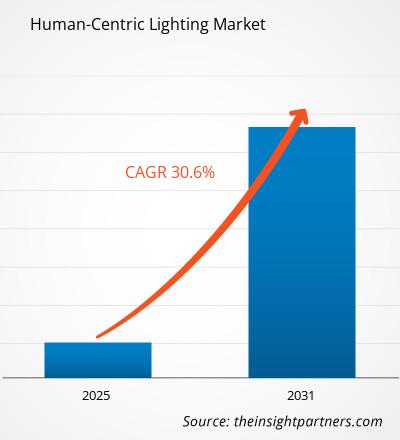
The global Human-Centric Lighting market was valued at US$ 3.5 billion in 2025 and is expected to reach US$ 22.74 billion by 2034; it is estimated to record a CAGR of 23.11% during 2026-2034.
Human-Centric Lighting Market Assessment and Insights
- North America: North America represented 26–28% share in 2025 and is expected to grow at a 20–22% CAGR during 2026–2034, supported by smart-building adoption, healthcare modernization, and established lighting controls infrastructure.
- US: The US represented approximately 7–8% of global demand in 2025 and is projected to grow at a 20–22% CAGR during 2026–2034, supported by commercial modernization and connected lighting adoption.
- Europe: Europe represented 37–39% share in 2025 and is forecast to grow at a 20–22% CAGR during 2026–2034, with Germany, the UK, France, Italy, and Spain supporting adoption through building efficiency and modernization initiatives.
- Asia Pacific: Asia Pacific represented 19–21% share in 2025 and is projected to register a 22–24% CAGR during 2026–2034, with China, Japan, South Korea, India, and Australia supporting connected-lighting deployment.
- Largest Segment: Hardware is the largest component, with a 68–72% market share in 2025 and an estimated 22–26% CAGR during 2026–2034.
- High Growth Segment: Services represent approximately 16–18% of 2025 revenue and are projected to grow at a 22–24% CAGR during 2026–2034, reflecting rising commissioning and optimization requirements.
- Key companies analyzed in detail: Acuity Brands Lighting, Inc.; Glamox AS; Halla, a. s.; Helvar; Hubbell Incorporated; Legrand North America, LLC; OSRAM Opto Semiconductors GmbH; Signify Holding; Wipro Enterprise Pvt Ltd; Zumtobel Group AG.
Source: The Insight Partners' analysis based on proprietary research, government publications, company annual reports, investor presentations, industry databases, and expert interviews.
Technology development will transition the Human-Centric Lighting Market away from traditional lighting toward programmable systems which involve the use of tunable LEDs, sensors, digital drivers, control and software. The trend toward manufacturing in the form of integrated systems is growing, making it easier to install them and adjust both light intensity and color temperature. As a result, control electronics and software play an increasing part while hardware remains the main source of income.
Future demand will be seen not only in North America, but also in Asia Pacific, institutions, healthcare complexes, hotels, and premium residences. More capital will be invested into developing retrofit-friendly systems that will allow for integrating lighting into overall building management system. Energy efficiency and modernization regulations also provide the market with one more tailwind.
Human-Centric Lighting Market Report Scope
| Report Attribute | Details |
|---|---|
| Market size in 2025 | US$ 3.5 Billion |
| Market Size by 2034 | US$ 22.74 Billion |
| Global CAGR (2026 - 2034) | 23.11% |
| Historical Data | 2021-2024 |
| Forecast period | 2026-2034 |
Human-Centric Lighting Market Analysis
Demand for lighting is becoming more influenced by the building owners who desire to integrate energy efficiency and occupant adaptability in lighting systems. The growth of the Human-Centric Lighting Market will benefit from the ecosystem created by LED producers, luminaires, semiconductor producers, sensors, controls providers, software providers, designers, contractors, distributors, and facility managers. Hardware becomes important, but digital control and services become more critical as systems become increasingly configurable.
In the entire value chain, suppliers need to synchronize optical components, LED engines, drivers, sensors, communication modules, software, and installation know-how. Retrofit applications generate increased demand as existing buildings can implement tunable solutions without undergoing rebuilding process. This makes phase-by-phase implementation possible and minimizes disruption of operations, while new construction provides an opportunity to integrate lighting into HVAC, shading, occupancy, and building management systems during the design process.
According to Human-Centric Lighting Market Report, competitiveness is driven not only by portfolio approach but also by integration of it. Acuity Brands Lighting, Inc., Signify Holding, Zumtobel Group AG, Glamox AS, Hubbell Incorporated, and Legrand North America, LLC operate in adjacent spheres of luminaires, controls, systems and solutions. Helvar enhances the control sphere whereas Wipro Enterprise Pvt Ltd is regionally relevant in India.
Positioning is additionally influenced by specialized products for healthcare institutions. Halla, a. s., OSRAM Opto Semiconductors GmbH, and some technology-driven suppliers bring value through competences in ecosystems of products and components. Increasingly, competitiveness is based on interoperability, commissioning, retrofitting capability, application engineering, life cycle services and connectivity with digital building initiatives.
● REPORT CUSTOMIZATION
Tailor This Report To Align With Your Specific Business Requirements
This report can be customized to align precisely with your business objectives, scope, and target markets. Customization options include tailored segmentation, geography, competitive analysis, and strategic insights to support informed decision-making.
Customize This Report →WHAT YOU CAN ADJUST
- ● Segmentations
- ● Geography
- ● Competitive Analysis
- ● Language Preferences
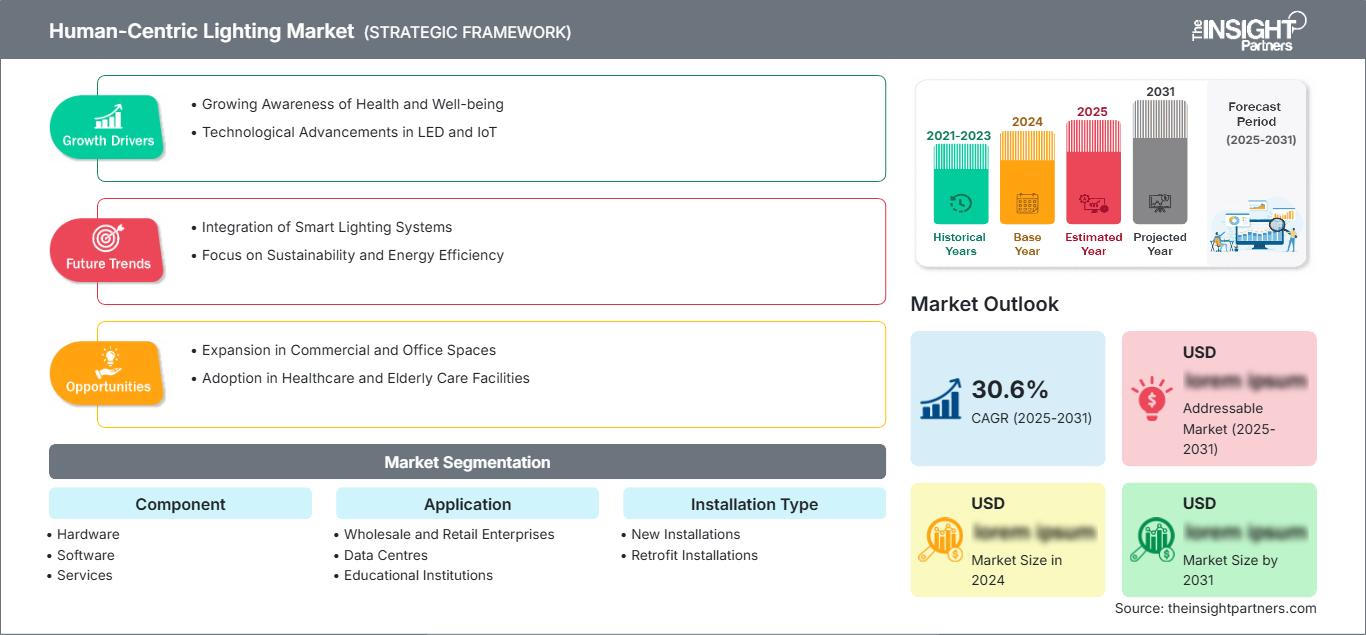
Human-Centric Lighting Market: Strategic Insights
Regional Insights
North America Human-Centric Lighting Market
North America contributed 26–28% of the total market size in 2025 and is expected to have a 20–22% CAGR in 2026–2034. The region boasts advanced commercial infrastructure, widespread LED use, advanced controls technology, and ongoing building renovations. Healthcare facilities, education facilities, office buildings, retail buildings, and hospitality venues will continue to represent key application areas as they allow for integrating lighting systems with energy management and occupancy sensing as well as digital controls of facilities.
The Human-Centric Lighting Market Share in North America receives support from high demand in the United States, Canada, and Mexico. Increasingly, buyers prefer tunable lighting products, connected controls, centralized setup, and commissioning tailored for specific applications. North American competition includes both manufacturers and controls providers and allows for creating an ecosystem able to facilitate large multi-site and healthcare/education projects.
U.S. Human-Centric Lighting Market
In 2025, the US accounted for about 7–8% of the worldwide market value and about 27–30% of the North American demand. Growth is forecasted at a 20–22% CAGR between 2026 and 2034. Diverse sources of demand include commercial buildings, healthcare facilities, educational institutions, hospitality buildings, and upscale residential buildings. The connected lighting systems are becoming an integral part of building automation strategy.
Participants of the market include Acuity Brands Lighting, Inc., Hubbell Incorporated, and Legrand North America, LLC, in addition to foreign companies. Retrofit projects are the preferred applications due to their ability to preserve existing infrastructure while updating the luminaire and controls. New construction plays an important role as it allows integration of lighting control system with the HVAC, daylighting, occupancy, and other building management functions.
Europe Human-Centric Lighting Market
The market share for Europe in 2025 was 37-39%, while its growth is projected at a CAGR of 20-22% during 2026 and 2034. Germany is one of the key countries in the region, while other prospects for growth are offered by the UK, France, Italy, and Spain.
In the UK, the development is being driven by commercial renovation and sustainable construction programs. In Germany, there are strong industrial facilities along with building engineering standards. The contributions from France, Italy, and Spain come from health care, hospitality, residential renovation, and commercial renovation. Local players such as Glamox AS, Helvar, and Zumtobel Group AG enhance the competitive landscape, and Signify Holding aids European market reach.
APAC Human-Centric Lighting Market
APAC represented 19–21% of the global market in 2025 and is expected to record a 22–24% CAGR during 2026–2034. China, Japan, South Korea, India, and Australia are major markets. China provides the largest regional opportunity, while India is expanding through commercial infrastructure, healthcare, education, and urban development.
Industries' development, smart building initiatives, and high-quality construction contribute to the need for the product throughout the area. The focus of policies towards energy-efficient buildings and interconnectivity makes the case of tunable LED products more valid. India has experienced 21.1% CAGR in recent assessments based on a 2025 outlook for the region.
Middle East & Africa Human-Centric Lighting Market
MEA is expected to see growth at a 20-21% CAGR in 2026-2034. Both Saudi Arabia and UAE dominate in terms of regional market adoption in large commercial, hospitality, healthcare, and mixed-use projects. South Africa offers another institutional market, and the Rest of MEA represents project-oriented market dynamics.
Energy management is particularly important in Gulf countries owing to the need for energy-efficient cooling systems for buildings. Smart city initiatives, tourism infrastructure development, hospital renovation, and upscale projects represent potential projects. Saudi Arabia is one of the leading countries in terms of high-growth dynamics, while the UAE represents important commercial and hospitality projects.
Segmentation Analysis
Component
The Human-Centric Lighting Market scope by component comprises Hardware, Software, and Services. The component category is projected to grow at a 22–26% CAGR during 2026–2034. Hardware remains the principal revenue contributor because every deployment requires physical lighting and control infrastructure, while software and services gain importance as installations become more connected and configurable.
- Hardware: Hardware remains the principal procurement category because luminaires, drivers, sensors, and related equipment form the physical foundation of every deployment. Its position is reinforced by replacement cycles and new construction.
- Software: Software supports scheduling, scene management, color-temperature adjustment, analytics, remote configuration, and centralized control. Its strategic role increases as organizations manage larger connected lighting portfolios.
- Services: Services cover design, integration, commissioning, installation support, maintenance, and optimization. Their importance rises with system complexity and creates recurring engagement opportunities after the initial equipment sale.
Application
Application demand is projected to expand at a 24–28% CAGR during 2026–2034. Adoption differs according to building function, operating schedules, occupant requirements, and investment priorities. Healthcare and education provide strong institutional use cases, while retail, hospitality, residential, and data-center environments increasingly value controllability, differentiated experiences, and operational efficiency.
- Wholesale and Retail Enterprises: Retail environments can use dynamic lighting for merchandising, navigation, ambience, and energy management. Centralized controls also help multi-site operators standardize lighting behavior across geographically distributed properties.
- Data Centres: Data centers require reliable illumination across equipment areas, maintenance spaces, circulation zones, and employee environments. Occupancy-based controls can reduce unnecessary operation while preserving visibility for critical activities.
- Educational Institutions: Schools and universities can deploy tunable systems across classrooms, libraries, laboratories, and common areas. Integration with daylight and occupancy sensing supports flexible schedules and varied educational environments.
- Residential: Residential adoption is moving toward connected luminaires offering adjustable intensity, color temperature, schedules, and application-based control. Premium housing increasingly integrates lighting with wider home-automation and wellness systems.
- Healthcare: Healthcare facilities require lighting that balances patient comfort, clinical visibility, staff requirements, and operating schedules. Renovation projects create opportunities for tunable, programmable, and application-specific systems.
- Hospitality: Hotels and resorts can use programmable scenes across guestrooms, lobbies, restaurants, spas, and event spaces. Lighting becomes part of the guest experience while centralized control supports operating consistency.
Installation Type
Installation Type is projected to grow at a 20–24% CAGR during 2026–2034. New Installations and Retrofit Installations serve different procurement needs. New projects provide maximum design flexibility, whereas retrofit projects create opportunities to modernize operating facilities without requiring complete reconstruction. Retrofit activity is supported by the large installed base of conventional and early-generation LED systems.
- New Installations: New installations allow luminaires, sensors, controls, wiring, and building-management interfaces to be planned as one architecture. This supports optimized placement, interoperability, commissioning, and application-specific performance.
- Retrofit Installations: Retrofit installations allow owners to modernize lighting progressively while retaining usable infrastructure. Their strategic importance comes from reduced disruption, phased capital allocation, and the replacement of aging equipment.
Opportunity Snapshot
| Application | Revenue Contribution | Trend Tag | Adoption Stage |
| Wholesale and Retail Enterprises | High | Dynamic Merchandising | Scaling |
| Data Centres | Medium | Occupancy Control | Scaling |
| Educational Institutions | High | Tunable Classrooms | Scaling |
| Residential | Medium | Circadian Automation | Scaling |
| Healthcare | High | Patient Comfort | Scaling |
| Hospitality | Medium | Adaptive Ambience | Scaling |
| Others | Low | Smart Spaces | Emerging |
Human-Centric Lighting Market Growth Drivers and Impact Analysis
Integration with Connected Building Platforms
Integration with connected building platforms is increasing the strategic value of intelligent lighting. Luminaires, sensors, and controllers can exchange information with occupancy, HVAC, security, and energy-management systems, allowing facility operators to coordinate multiple building functions. This expands the addressable value beyond illumination and encourages procurement teams to evaluate communication protocols, software compatibility, cybersecurity, commissioning, and upgradeability. For manufacturers, interoperability can increase specification opportunities because lighting becomes part of a broader digital infrastructure purchase. For building owners, centralized control can simplify portfolio management and improve operational visibility. The practical impact is a shift toward connected architectures in which fixture performance remains important, but the ability to integrate, configure, monitor, and maintain the system becomes a major purchasing criterion.
Rising Focus on Occupant Wellness and Lighting Quality
Occupant wellness is changing how organizations evaluate indoor lighting. Tunable systems can modify intensity and color temperature according to schedules, room functions, daylight availability, and user requirements. Healthcare, education, offices, and hospitality are particularly relevant because occupants spend extended periods in these environments. The resulting market impact is a broader specification framework that considers visual comfort, glare, adaptability, and user experience alongside energy efficiency and maintenance. Manufacturers are responding with products capable of programmable scenes and simplified controls, while designers increasingly consider lighting as one element of the indoor environmental experience. Buyers are also becoming more attentive to commissioning and application engineering because poorly configured systems may fail to deliver the intended experience. This creates stronger differentiation for suppliers combining equipment with technical expertise.
Expansion of LED Modernization and Retrofit Programs
Retrofit modernization is creating a practical pathway for broader adoption because existing facilities can replace aging luminaires while adding sensors, controls, and tunable functionality. Projects can be incorporated into wider energy-efficiency programs, reducing the incremental investment required for advanced lighting capabilities. This approach is particularly relevant for commercial portfolios, educational campuses, healthcare facilities, and hospitality properties with long operating schedules. Suppliers can strengthen their position by offering products compatible with existing ceilings, electrical layouts, and control architectures. Contractors and distributors also gain opportunities through surveying, installation, commissioning, and maintenance services. The market impact extends beyond fixture sales because modernization projects require project management and lifecycle support. As owners increasingly phase capital expenditure, scalable retrofit architectures can help vendors build longer customer relationships while reducing the operational disruption associated with full-building upgrades.
Human-Centric Lighting Market Future Trends
AI-Assisted Adaptive Lighting
The Human-Centric Lighting Market trends are likely to move toward AI-assisted systems capable of interpreting occupancy, daylight, schedules, room usage, and operating patterns. Instead of relying entirely on fixed scenes, future platforms may continuously recommend or adjust lighting settings within user-defined boundaries. This can reduce configuration effort and improve consistency across large building portfolios. AI can also support anomaly detection, predictive maintenance, and commissioning assistance by identifying unusual operating behavior or sensor conditions. As lighting systems become more software-defined, vendors may introduce recurring models based on analytics, optimization, and remote management. The transition will favor suppliers that combine reliable sensing, interoperable controls, secure software, and practical interfaces. Adoption will depend on demonstrating operational value rather than simply adding artificial intelligence, making measurable performance and straightforward facility management important determinants of commercial success.
Standardized Multi-Site Lighting Architectures
Multi-site organizations are likely to prioritize standardized architectures that can be deployed consistently across offices, stores, healthcare properties, campuses, and hospitality portfolios. Interoperability will become more important as buyers seek flexibility to integrate products from multiple suppliers without replacing entire control infrastructures. Common communication protocols, modular drivers, centralized configuration, and cloud-enabled management can reduce deployment complexity and simplify training. Standardization can also improve procurement, maintenance, commissioning, and data management because facility teams can apply common operating principles across locations. Suppliers that support open architectures while retaining differentiated application capabilities may gain an advantage with enterprise buyers. Over time, portfolio-level scalability could become a stronger purchasing criterion than individual fixture specifications, particularly for organizations seeking consistent lighting experiences and predictable lifecycle management across geographically distributed properties.
Human-Centric Lighting Market Opportunities
Healthcare Renovation and Senior Living
Healthcare renovation provides an attractive investment opportunity because hospitals, clinics, rehabilitation centers, and senior-living facilities require lighting that serves patients, caregivers, and visitors simultaneously. Projects can combine ambient, examination, reading, nighttime, and tunable lighting functions with occupancy sensing and centralized management. The opportunity is strengthened when lighting is included within broader facility modernization budgets rather than treated as an isolated wellness purchase. Suppliers with healthcare-specific engineering, installation expertise, and compliance knowledge can differentiate themselves from general-purpose providers. Senior living is also relevant because operators seek environments that support comfort, navigation, safety, and resident experience. The Human-Centric Lighting Market Forecasts indicate that application diversification will be important for suppliers seeking durable growth, particularly where products can be adapted to patient rooms, recovery areas, common spaces, and long-term-care environments.
Smart Hospitality and Premium Residential Projects
Hospitality and premium residential projects offer opportunities to connect programmable lighting with broader automation and experience platforms. Hotels can deploy differentiated lighting scenes across guestrooms, restaurants, lobbies, wellness areas, and event spaces, while premium residences can integrate lighting with climate, security, entertainment, and application-based controls. The investment case improves when lighting becomes part of the property's design identity rather than a commodity electrical purchase. Vendors can pursue partnerships with architects, interior designers, developers, automation integrators, and hospitality technology providers. Regional opportunities are supported by tourism infrastructure, mixed-use developments, and premium housing programs. Modular architectures can help suppliers serve multiple project tiers, while software updates, commissioning, maintenance, and optimization create opportunities for recurring revenue after installation. This combination of design differentiation and lifecycle services can improve project economics.
Recent Developments
- March 2026: Signify (Euronext: LIGHT), the world leader in lighting, today introduced four additions to its Interact platform at Light + Building in Frankfurt. These new solutions can help businesses and municipalities make buildings smarter and cities more responsive and sustainable, driven by data.
- February 2025: ABB is launching the new System Access Point 3.0 Wireless at Light + Building 2026, extending ABB-free@home® Wireless with greater scale, secure remote access, and broader smart home integration. The solution is designed to help installers deliver reliable in-home control and scale projects easily as needs grow.
- June 2024: Signify (Euronext: LIGHT), the world leader in lighting, today announced the launch of NatureConnect; an industry-first revolutionary product, designed to enhance well-being by bringing the benefits of natural light indoors. Inspired by biophilic design principles, NatureConnect mimics the natural rhythm of sunlight, promoting a healthier circadian rhythm, improved mood, enhanced focus, and better sleep quality.
Frequently Asked Questions

- Comprehensive Market Sizing and Forecast Analysis
- Detailed Segmentation Analysis
- In-Depth Market Dynamics Assessment
- Regional and Country-Level Insights
- Competitive Landscape and Company Benchmarking
- Strategic Business Intelligence
Recent Reports
Testimonials

The Insight Partners' SCADA System Market report is comprehensive, with valuable insights on current trends and future forecasts. The team was highly professional, responsive, and supportive throughout. We are very satisfied and highly recommend their services.
RAN KEDEM Partner, Reali Technologies LTDs
I requested a report on a very specific software market and the team produced the report in a few days. The information was very relevant and well presented. I then requested some changes and additions to the report. The team was again very responsive and I got the final report in less than a week.
JEAN-HERVE JENN Chairman, Future Analytica
We worked with The Insight Partners for an important market study and forecast. They gave us clear insights into opportunities and risks, which helped shape our plans. Their research was easy to use and based on solid data. It helped us make smart, confident decisions. We highly recommend them.
PIYUSH NAGPAL Sr. Vice President, High Beam Global
The Insight Partners delivered insightful, well-structured market research with strong domain expertise. Their team was professional and responsive throughout. The user-friendly website made accessing industry reports seamless. We highly recommend them for reliable, high-quality research services
YUKIHIKO ADACHI CEO, Deep Blue, LLC.
This is the first time I have purchased a market report from The Insight Partners.While I was unsure at first, I visited their web site and felt more comfortable to take the risk and purchase a market report.I am completely satisfied with the quality of the report and customer service. I had several questions and comments with the initial report, but after a couple of dialogs over email with their analyst I believe I have a report that I can use as input to our strategic planning process.Thank you so much for taking the extra time and making this a positive experience.I will definitely recommend your service to others and you will be my first call when we need further market data.
JOHN SUZUKI President and Chief Executive Officer, Board Director, BK Technologies
I wish to appreciate your support and the professionalism you displayed in the course of attending to my request for information regarding to infectious disease IVD market in Nigeria. I appreciate your patience, your guidance, and the fact that you were willing to offer a discount, which eventually made it possible for us to close a deal. I look forward to engaging The Insight Partners in the future, all thanks to the impression you have created in me as a result of this first encounter.
DR CHIJIOKE ONYIA MANAGING DIRECTOR, PineCrest Healthcare Ltd.Reason to Buy
- Informed Decision-Making
- Understanding Market Dynamics
- Competitive Analysis
- Identifying Emerging Markets
- Customer Insights
- Market Forecasts
- Risk Mitigation
- Boosting Operational Efficiency
- Strategic Planning
- Investment Justification
- Tracking Industry Innovations
- Aligning with Regulatory Trends





 Get Free Sample for