
Hyperscale Computing Market Trends, Demand & Growth by 2034
Hyperscale Computing Market Size and Forecasts (2021 - 2034), Global and Regional Share, Trends, and Growth Opportunity Analysis Report Coverage : By Offering (Solutions and Services), Application (Cloud Computing, Big Data, IoT), Vertical (Manufacturing, Government & Defense, BFSI, IT & Telecom, Retail & Consumer Goods)
- Status : Data Released
- Report Code : TIPRE00039465
- Category : Technology, Media and Telecommunications
- No. of Pages : 150
- Available Report Formats :


- Last update date : August 06, 2026


2025 Market Size
US$ 77.29 Bn
Base year value
2034 Forecast
US$ 524.49 Bn
Projected by 2034
CAGR 2026-2034
23.71 %
Growth rate
Addressable Market
US$ 2,333.51 Bn
(2026-2034)
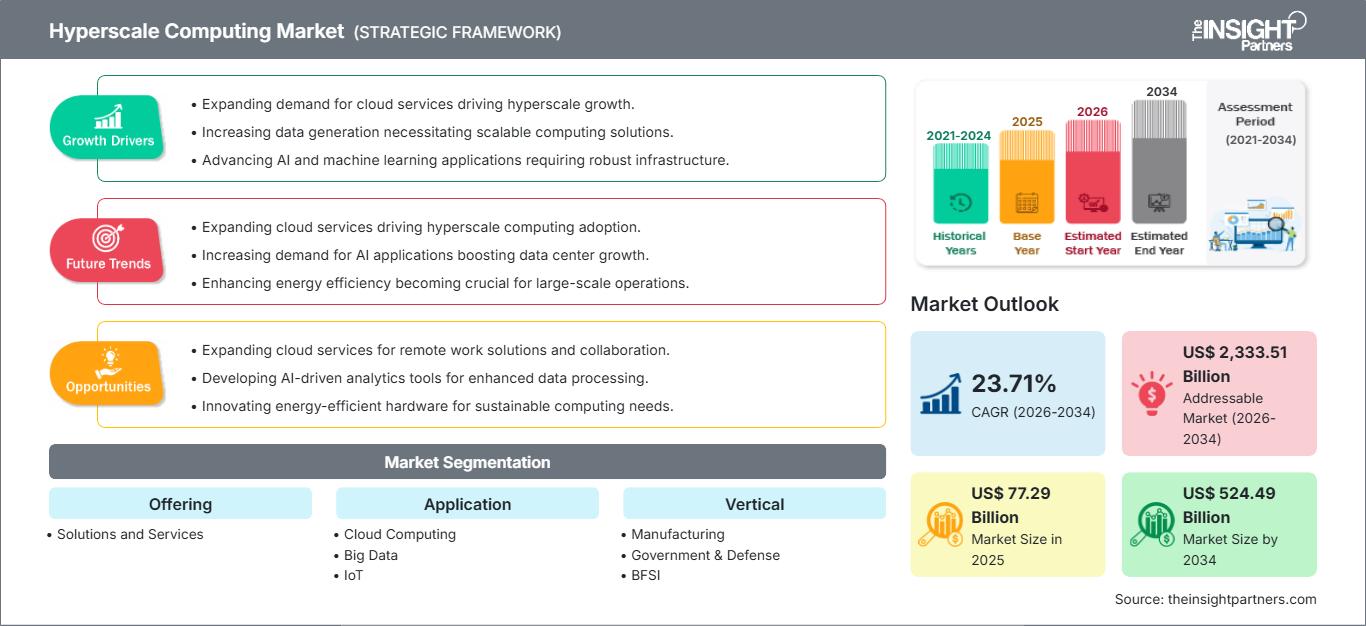
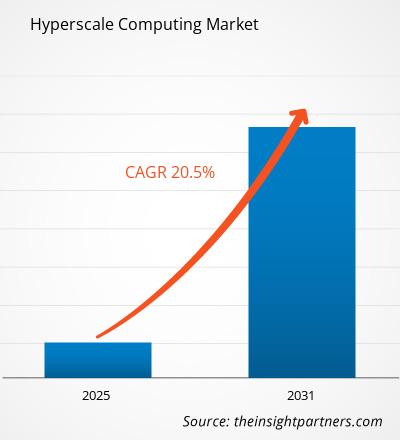
The hyperscale computing market was valued at US$ 77.29 Billion in 2025 and is projected to reach US$ 524.49 Billion by 2034, registering a CAGR of 23.71% during 2026–2034. Growth is being driven by increasing deployment of artificial intelligence workloads, rapid cloud adoption, rising enterprise data generation, and expansion of large-scale digital infrastructure. Organizations across industries are investing in high-performance computing environments capable of supporting complex analytical, storage, and networking requirements while ensuring scalability and operational efficiency.
North America remains the most mature regional ecosystem for large-scale digital infrastructure development. The hyperscale computing market size across the region continues to benefit from strong cloud penetration, ongoing investment in AI-enabled data centers, and significant spending by hyperscale cloud providers. Regional expansion is expected to remain within a 21–24% CAGR range through 2034, supported by advanced connectivity, semiconductor innovation, and enterprise modernization programs across public and private sectors.
Hyperscale Computing Market Assessment and Insights
- North America: Accounted for 36–40% share in 2025 and is expected to grow at a 21–24% CAGR during 2026–2034. Growth is supported by extensive cloud infrastructure deployment, AI-related investments, and strong enterprise technology spending across major industries.
- US: Represented 78–82% of North American revenue in 2025 and is projected to expand at a 22–25% CAGR during 2026–2034. The presence of leading cloud providers and substantial AI infrastructure investments continue to reinforce market leadership.
- Europe: Held 24–28% share in 2025 and is anticipated to advance at a 20–23% CAGR during 2026–2034. Germany, the United Kingdom, and France remain key markets due to digital sovereignty initiatives and rising cloud adoption.
- Asia Pacific: Captured 28–32% share in 2025 and is forecast to register a 25–28% CAGR during 2026–2034. China, India, Japan, and South Korea are leading investment activity in large-scale digital infrastructure.
- Largest Segment: Cloud Computing accounted for a 46–50% market share in 2025 and is projected to expand at a 22–25% CAGR during 2026–2034, supported by enterprise migration toward scalable and flexible cloud environments.
- High Growth Segment: IoT represented 20–24% of market revenue in 2025 and is expected to grow at a 27–30% CAGR during 2026–2034, driven by rapid adoption of connected devices and industrial automation technologies.
- Key companies analyzed in detail: Amazon Web Services, Inc.; Google LLC; Microsoft Corporation; IBM Corporation; Oracle Corporation; Hewlett Packard Enterprise Company; Alibaba Cloud; Tencent Cloud; Salesforce, Inc.; Huawei Technologies Co., Ltd.; Viavi Solutions Inc.
Source: The Insight Partners' analysis based on proprietary research, government publications, company annual reports, investor presentations, industry databases, and expert interviews.
The modern hyperscale ecosystem has evolved significantly as organizations increasingly shift mission-critical workloads toward cloud-native and distributed computing architectures. Improvements in processor performance, networking technologies, virtualization platforms, and software-defined infrastructure have enabled hyperscale facilities to support increasingly sophisticated enterprise applications. Growing requirements for artificial intelligence training, machine learning deployment, real-time analytics, and business intelligence are further transforming infrastructure strategies. Data center operators now prioritize scalability, automation, energy optimization, and workload orchestration to maintain efficiency while managing expanding computational demands across global digital ecosystems, driving sustained growth in the Hyperscale Computing Market.
Market outlook is extremely positive since both the government and companies are still focusing on digital transformation programs. New markets are increasingly focused on cloud computing infrastructure, intelligent manufacturing, and artificial intelligence innovation frameworks. Regulations supporting data localization, cybersecurity, and sovereign clouds will spur further capacity building. Increasing investments in facilities powered by renewable energy, better cooling techniques, and networking infrastructures are set to influence future capacity expansions.
Hyperscale Computing Market Report Scope
| Report Attribute | Details |
|---|---|
| Market size in 2025 | US$ 77.29 Billion |
| Market Size by 2034 | US$ 524.49 Billion |
| Global CAGR (2026 - 2034) | 23.71% |
| Historical Data | 2021-2024 |
| Forecast period | 2026-2034 |
Hyperscale Computing Market Analysis
The hyperscale computing market growth trajectory is strongly influenced by the accelerating digitalization of business operations across industries. Organizations increasingly depend on large-scale computing environments to process vast volumes of structured and unstructured data while supporting AI-driven decision-making. Demand is expanding across cloud service providers, financial institutions, government agencies, healthcare organizations, retail enterprises, and telecommunications companies. These end users require high-performance infrastructure capable of ensuring reliability, scalability, security, and rapid deployment of digital services.
Moreover, there is a high level of interconnectivity in the value chain, which consists of semiconductor makers, networking equipment companies, infrastructure developers, software vendors, cloud providers, and systems integration services providers. There are improvements made in GPUs, high bandwidth networking, liquid cooling, and intelligent resource management services, which are making operations more efficient. With the growing complexity of tasks, the focus of operators is on integrated infrastructure ecosystems.
The hyperscale computing market analysis demonstrates a competitive landscape characterized by continuous infrastructure expansion and technology innovation. Leading providers such as Amazon Web Services, Inc., Microsoft Corporation, Google LLC, Oracle Corporation, and Alibaba Cloud are focusing on AI-optimized facilities, custom silicon development, and enhanced networking architectures. Market participants increasingly compete on infrastructure scale, geographic presence, service breadth, and workload performance capabilities.
Meanwhile, IBM Corporation, Hewlett Packard Enterprise Company, Salesforce, Inc., Tencent Cloud, Huawei Technologies Co., Ltd., and Viavi Solutions Inc. are strengthening their market positions through hybrid cloud offerings, performance monitoring solutions, enterprise integration capabilities, and advanced infrastructure management services in the Hyperscale Computing Market. Strategic partnerships, acquisitions, research investments, and regional expansion initiatives continue shaping competition. As enterprises seek resilient and flexible computing environments, providers capable of delivering efficient, scalable, and sustainable solutions are expected to gain significant advantages throughout the forecast period.
● REPORT CUSTOMIZATION
Tailor This Report To Align With Your Specific Business Requirements
This report can be customized to align precisely with your business objectives, scope, and target markets. Customization options include tailored segmentation, geography, competitive analysis, and strategic insights to support informed decision-making.
Customize This Report →WHAT YOU CAN ADJUST
- ● Segmentations
- ● Geography
- ● Competitive Analysis
- ● Language Preferences
Hyperscale Computing Market: Strategic Insights
Regional Insights
North America hyperscale computing market
North America accounted for approximately 36–40% of global market revenue in 2025 and is projected to register a 21–24% CAGR through 2034. The region benefits from mature cloud ecosystems, advanced telecommunications networks, extensive data center infrastructure, and a strong concentration of technology companies. Continuous deployment of AI-enabled infrastructure and increasing demand for cloud-based services across enterprises are supporting sustained revenue growth. Government agencies and large organizations are also investing heavily in digital modernization initiatives that require scalable computing environments capable of supporting complex data processing requirements.
The region's hyperscale computing market share continues to lead globally due to the presence of major hyperscale operators and extensive investment activity. Data center developers are expanding capacity across established and emerging markets to accommodate growing workload intensity. Widespread adoption of machine learning, generative AI applications, and advanced analytics solutions is creating additional demand for infrastructure expansion. Furthermore, renewable energy adoption, enhanced cybersecurity frameworks, and infrastructure resilience strategies are supporting long-term market development while maintaining operational efficiency.
U.S. hyperscale computing market
The United States represented approximately 78–82% of North American revenue in 2025 and is expected to grow at a 22–25% CAGR during the forecast period. Enterprise infrastructure investments, cloud-first approach, and artificial intelligence (AI) investments continue to fuel infrastructure deployments. Major facilities located in the major technology centers serve as homes for diverse applications, such as cloud computing, predictive analytics, automation systems, and digital business services.
In this regard, the country enjoys widespread distribution of infrastructure provided by Amazon Web Services, Inc., Microsoft Corporation, Google LLC, Oracle Corporation, IBM Corporation, and many other infrastructure providers. Continuous need for AI training clusters, advanced networking, and high-performance computing capacities creates additional opportunities for investments. The growth of semiconductor manufacturing capacities, digital infrastructure upgrades, and intelligent applications adoption is likely to increase national market leadership up to 2034.
Europe hyperscale computing market
Europe accounted for approximately 24–28% of global revenue in 2025 and is expected to register a 20–23% CAGR through 2034. Regional growth is supported by sovereign cloud initiatives, increasing enterprise cloud migration, and rising investment in AI-ready infrastructure. The European Union's emphasis on data governance, cybersecurity, and digital autonomy has encouraged governments and enterprises to expand domestic computing capabilities. Germany remains the largest national market owing to strong industrial digitization, manufacturing automation, and advanced engineering ecosystems.
Investment in the infrastructure of the United Kingdom will keep on going owing to the well-developed financial services sector in the country and its heavy reliance on cloud-based solutions. Capacity creation for the infrastructure will be stimulated by the needs of companies from the banking, healthcare, telecommunications, and e-commerce industries.
Germany will benefit from a large-scale application of the concepts of Industry 4.0 that involve extensive computing and performance analytics. France, Italy, and Spain will become new market players with regard to investment in the development of their infrastructures because of digital transformation initiatives, public cloud projects, and smart city initiatives.
APAC hyperscale computing market
Asia Pacific captured approximately 28–32% of global revenue in 2025 and is projected to grow at a 25–28% CAGR through 2034. The region represents the fastest-growing major market due to rapid digitalization, expanding internet penetration, and strong government support for cloud computing and artificial intelligence initiatives.
China remains the leading contributor, while India, Japan, South Korea, and Australia are accelerating investments in data centers and advanced computing infrastructure. Government-backed innovation programs, expanding enterprise cloud adoption, and increasing use of AI-enabled applications continue to create favorable growth conditions across regional markets.
Middle East & Africa hyperscale computing market
The Middle East & Africa market is expected to expand at a 22–25% CAGR during 2026–2034. Infrastructure deployment is being aided by digital transformation efforts, national cloud projects, and increased use of technologies within enterprises in the region.
The two dominant countries in terms of hyperscale investments include Saudi Arabia and the United Arab Emirates. Both countries are making investments in smart city projects, artificial intelligence, and digital economy projects. South Africa continues to be an important market in the region, while infrastructure investments are driving market growth.
Segmentation Analysis
Offering
The Offering segment is expected to grow at a 23–26% CAGR during 2026–2034 within the Hyperscale Computing Market. Organizations increasingly seek comprehensive infrastructure solutions and managed services capable of supporting high-volume workloads. Growing complexity in cloud, AI, and analytics environments is driving demand for integrated offerings that improve scalability, reliability, and operational efficiency. Service capabilities are becoming increasingly important as enterprises require support for deployment, optimization, migration, and infrastructure management activities.
- Solutions – Solutions represent the foundation of hyperscale infrastructure deployments by enabling computing, networking, storage management, automation, and workload orchestration across large-scale digital environments.
- Services – Services support infrastructure planning, implementation, migration, performance optimization, monitoring, and lifecycle management, helping organizations maximize operational efficiency and infrastructure utilization.
Application
The Application segment is forecast to expand at a 24–27% CAGR during 2026–2034 in the Hyperscale Computing Market. Increasing enterprise dependence on cloud-native architectures, advanced analytics, and connected ecosystems is driving sustained demand across application categories. Organizations require scalable computing resources to process growing data volumes while supporting intelligent decision-making and digital innovation initiatives.
- Cloud Computing – The largest application segment, supporting enterprise transformation, software delivery, scalable infrastructure consumption, and flexible resource allocation across diverse business environments.
- Big Data – A critical application area enabling advanced analytics, predictive modeling, business intelligence, and large-scale data management for improved operational and strategic decision-making.
- IoT – A rapidly growing category driven by connected devices, industrial automation systems, smart infrastructure, and real-time monitoring applications that generate high volumes of continuous data.
Vertical
The Vertical segment is expected to register a 22–25% CAGR during 2026–2034 in the Hyperscale Computing Market. Industry-specific adoption is being fueled by increasing requirements for automation, digital services, advanced analytics, and secure computing infrastructure. Demand varies according to regulatory requirements, data intensity, and operational complexity across sectors, driving the need for scalable and high-performance hyperscale computing environments.
- Manufacturing – Utilizes hyperscale infrastructure for predictive maintenance, digital twin technologies, automated production systems, and supply chain optimization.
- Government & Defense – Relies on large-scale computing resources for cybersecurity, intelligence analysis, digital public services, and mission-critical operational workloads.
- BFSI – Deploys advanced infrastructure for transaction processing, fraud detection, compliance management, customer analytics, and digital banking operations.
- IT & Telecom – Represents a major user group requiring scalable infrastructure to support network operations, cloud services, and digital platform delivery.
- Retail & Consumer Goods – Uses large-scale computing for customer analytics, inventory optimization, personalization engines, and omnichannel commerce strategies.
Opportunity Snapshot
| Application | Revenue Contribution | Trend Tag | Adoption Stage |
| Cloud Computing | High | AI Cloud | Mature |
| Big Data | High | Predictive Analytics | Scaling |
| IoT | Medium | Edge Intelligence | Emerging |
Hyperscale Computing Market Growth Drivers and Impact Analysis
Expanding Artificial Intelligence Infrastructure Requirements
The implementation of artificial intelligence is driving new levels of requirements for computing infrastructure. The training of the latest AI models, their implementation and execution involve substantial computational power, efficient networking, and storage scalability. Tech vendors keep pouring money into the development of infrastructure optimized for AI tasks, advanced processors and cooling systems that can handle more complicated workloads. Companies deploy the use of generative AI, predictive analytics tools, automation platforms and smart applications that rely on scalable computing infrastructure. The increasing prevalence of AI across organizations is pushing the view of hyperscale infrastructure from an enabling technology to a strategic capability, opening new opportunities for all parties involved.
Growing Enterprise Dependence on Cloud-Native Operations
Most organizations within almost all industries are moving their business-critical applications into cloud infrastructures. This has increased the need for infrastructure that can accommodate varying workload demands and guarantee performance, reliability, and cybersecurity. Companies need infrastructure that can facilitate a hybrid and multi-cloud environment, as well as fast deployment of applications and digital services. Cloud-native infrastructure provides flexibility and scalability benefits that other types of infrastructure may not be able to offer. With more companies becoming efficient, cost-effective, and pursuing digital transformations, investments in cloud infrastructures have significantly increased, presenting a lot of growth potential for technology providers.
Rapid Growth in Enterprise and Consumer Data Volumes
As more connected devices, digital platforms, enterprise apps, and cloud services are deployed, an enormous amount of data needs constant processing and storage. The increased reliance on analytics-based decision-making processes by businesses adds more pressure on infrastructure vendors to provide scalable computing solutions. The need for real-time processing in manufacturing, healthcare, retail, and telecommunication industries is creating even more demand for advanced infrastructure solutions. Organizations need to have robust infrastructures that can not only process a variety of tasks but also scale for future needs.
Hyperscale Computing Market Future Trends
AI-Native Infrastructure Design Becomes Standard
Future infrastructure development is expected to focus increasingly on AI-native architectures built specifically for accelerated computing environments. Operators are likely to deploy advanced cooling systems, intelligent workload balancing technologies, and specialized processors designed for high-performance applications. The hyperscale computing market trends indicate growing adoption of automation platforms capable of optimizing resource allocation and reducing operational complexity. Investments in intelligent infrastructure are expected to improve efficiency while enabling support for larger and more computationally intensive workloads. Organizations that adopt AI-focused infrastructure models may achieve meaningful advantages in performance, scalability, and cost management.
Regional Cloud Ecosystems Gain Strategic Importance
Data sovereignty and digital independence are becoming more important for both national governments and businesses. More investments in the regional infrastructure are expected as the need for better control over data governance and compliance issues increases. Such developments can result in the building of facilities near consumers and can foster local innovation ecosystems. The development of regional clouds is likely to boost the growth of data centers, edge computing infrastructure, and other networking solutions.
Hyperscale Computing Market Opportunities
Infrastructure Expansion Across Emerging Digital Economies
Emerging markets present compelling opportunities for infrastructure developers, technology vendors, and cloud service providers. Digital transformation initiatives, expanding connectivity networks, and increasing enterprise technology adoption are creating strong demand for scalable computing resources. The hyperscale computing market Forecasts suggest substantial investment potential across the Asia Pacific, the Middle East, and selected African economies where digital infrastructure gaps remain. Organizations capable of delivering efficient, cost-effective, and sustainable infrastructure solutions are well-positioned to capitalize on increasing demand while supporting the development of modern digital ecosystems.
Sustainable High-Density Data Center Development
The increased focus on sustainability targets is leading to the emergence of opportunities for organizations that are capable of providing hyperscale infrastructure solutions that are energy-efficient. More and more emphasis is being laid upon advanced cooling solutions, the incorporation of renewable energy, and intelligent resource management systems. The companies that are able to provide such infrastructure solutions are sought by enterprises and government organizations that are looking for digital expansion. Such organizations could benefit from a low-carbon operation model and energy management solutions.
Frequently Asked Questions

- Comprehensive Market Sizing and Forecast Analysis
- Detailed Segmentation Analysis
- In-Depth Market Dynamics Assessment
- Regional and Country-Level Insights
- Competitive Landscape and Company Benchmarking
- Strategic Business Intelligence
Recent Reports
Testimonials

The Insight Partners' SCADA System Market report is comprehensive, with valuable insights on current trends and future forecasts. The team was highly professional, responsive, and supportive throughout. We are very satisfied and highly recommend their services.
RAN KEDEM Partner, Reali Technologies LTDs
I requested a report on a very specific software market and the team produced the report in a few days. The information was very relevant and well presented. I then requested some changes and additions to the report. The team was again very responsive and I got the final report in less than a week.
JEAN-HERVE JENN Chairman, Future Analytica
We worked with The Insight Partners for an important market study and forecast. They gave us clear insights into opportunities and risks, which helped shape our plans. Their research was easy to use and based on solid data. It helped us make smart, confident decisions. We highly recommend them.
PIYUSH NAGPAL Sr. Vice President, High Beam Global
The Insight Partners delivered insightful, well-structured market research with strong domain expertise. Their team was professional and responsive throughout. The user-friendly website made accessing industry reports seamless. We highly recommend them for reliable, high-quality research services
YUKIHIKO ADACHI CEO, Deep Blue, LLC.
This is the first time I have purchased a market report from The Insight Partners.While I was unsure at first, I visited their web site and felt more comfortable to take the risk and purchase a market report.I am completely satisfied with the quality of the report and customer service. I had several questions and comments with the initial report, but after a couple of dialogs over email with their analyst I believe I have a report that I can use as input to our strategic planning process.Thank you so much for taking the extra time and making this a positive experience.I will definitely recommend your service to others and you will be my first call when we need further market data.
JOHN SUZUKI President and Chief Executive Officer, Board Director, BK Technologies
I wish to appreciate your support and the professionalism you displayed in the course of attending to my request for information regarding to infectious disease IVD market in Nigeria. I appreciate your patience, your guidance, and the fact that you were willing to offer a discount, which eventually made it possible for us to close a deal. I look forward to engaging The Insight Partners in the future, all thanks to the impression you have created in me as a result of this first encounter.
DR CHIJIOKE ONYIA MANAGING DIRECTOR, PineCrest Healthcare Ltd.Reason to Buy
- Informed Decision-Making
- Understanding Market Dynamics
- Competitive Analysis
- Identifying Emerging Markets
- Customer Insights
- Market Forecasts
- Risk Mitigation
- Boosting Operational Efficiency
- Strategic Planning
- Investment Justification
- Tracking Industry Innovations
- Aligning with Regulatory Trends





 Get Free Sample for