
Incident Response System Market Trends, Demand & Growth by 2034
Coverage: by System (Back-up & Disaster Recovery, Geospatial Technologies, Threat Management System and Surveillance Systems); and Application (Banking, Financial Services & Insurance, Retail, Government Agencies & Public Sector, Telecommunication & Information Technology, Healthcare and Others), and Geography (North America, Europe, Asia Pacific, and South and Central America)
- Status : Data Released
- Report Code : TIPTE100000732
- Category : Electronics and Semiconductor
- No. of Pages : 150
- Available Report Formats :


- Last update date : October 16, 2026


2025 Market Size
US$ 31.43 Bn
Base year value
2034 Forecast
US$ 177.28 Bn
Projected by 2034
CAGR 2026-2034
21.19 %
Growth rate
Addressable Market
US$ 833.88 Bn
(2026-2034)
The Incident Response System Market is valued at US$ 31.43 Billion in 2025 and is projected to reach US$ 177.28 Billion by 2034, registering a 21.19% CAGR during 2026–2034. Expansion is now influenced by cyber attack risks, cloud adoption, connection of infrastructure, compliance, ransomware attack risk, and need for integrated detection, response, recovery, and continuity management capability.
North America will be one of the main markets for expansion, with the Incident Response System Market Size based on the availability of established cybersecurity framework, high cloud adoption, critical infrastructure protection needs, and increased adoption of automated response. The region’s expansion rate is projected to grow at 20.0-21.5% CAGR between 2026 and 2034.
Incident Response System Market Assessment and Insights
- North America: The region is estimated to hold a 32–35% share in 2025 and expand at a 20.0–21.5% CAGR between 2026–2034, supported by cybersecurity modernization, critical infrastructure protection, cloud workloads, and automated incident response.
- US: The US represents approximately 84–87% of North American revenue in 2025 and is projected to grow at a 20.2–21.7% CAGR during 2026–2034, supported by federal and enterprise cybersecurity spending.
- Europe: Europe accounts for approximately 24–27% share in 2025 and is expected to grow at a 19.0–20.5% CAGR during 2026–2034, led by Germany, the UK, France, Italy, and Spain through regulatory compliance and digital resilience initiatives.
- Asia Pacific: Asia Pacific represents approximately 25–28% share in 2025 and is anticipated to register a 23.0–24.8% CAGR during 2026–2034, led by China, Japan, South Korea, India, and Australia as digital infrastructure expands.
- Largest Segment: Threat Management System holds approximately 35–39% market share in 2025 and is expected to grow at a 21.5–22.8% CAGR during 2026–2034, reflecting increasing detection and response requirements.
- High Growth Segment: Government Agencies & Public Sector represents approximately 15–19% market share in 2025 and is projected to grow at a 22.5–24.0% CAGR during 2026–2034, driven by national cyber resilience programs.
- Key companies analyzed in detail: Hexadite, Acronis International GmbH, Honeywell International Inc., FireEye, NetApp, Veritas Technologies LLC, Asigra Inc., Rockwell Collins, Cisco Systems, Inc., and DFLabs S.p.A.
Source: The Insight Partners' analysis based on proprietary research, government publications, company annual reports, investor presentations, industry databases, and expert interviews.
This market has moved from being a market based on stand-alone security products to one in which platforms are being built by integrating backup, disaster recovery, threat intelligence, geospatial capability, surveillance, and automatic remediation. There has been a trend towards moving away from hardware-based security infrastructure to cloud native architectures, and the use of artificial intelligence for prioritizing alerts and conducting investigations. There have also been changes in the production process as vendors are bundling their software, management services, orchestration, and recovery solutions into resilience solutions.
Future prospects for this market will become brighter with the development of digital economies in which there are parallel growth of cloud migrations and connected infrastructure. Banks, health care organizations, telecommunication firms, and government organizations will be under pressure to establish more detailed incident response procedures as they are now faced with tougher regulations. Regulatory reforms, cyber insurance demands, and corporate risk management should drive investments in this market.
Incident Response System Market Report Scope
| Report Attribute | Details |
|---|---|
| Market size in 2025 | US$ 31.43 Billion |
| Market Size by 2034 | US$ 177.28 Billion |
| Global CAGR (2026 - 2034) | 21.19% |
| Historical Data | 2021-2024 |
| Forecast period | 2026-2034 |
Incident Response System Market Analysis
Growth of the Incident Response System Market is being driven by the rising number of digitally connected assets and the growing impact of service disruption. The market environment comprises security software vendors, data protection companies, cloud infrastructure providers, telecoms, managed security services providers, systems integrators, and governmental organizations. Customers become more interested in unified processes that speed up investigation and minimize operational disruption during the course of the event.
The demand for incident response systems is being further stimulated by ransomware, supply chain attacks, identity-based attacks, and vulnerabilities of distributed systems. The value chain encompasses all aspects from telemetry and threat intelligence through containment and forensic investigation, backup testing, restoring and remediation of the incident aftermath. Integration of security operations and disaster recovery is gaining increased relevance since organizations tend to measure their resilience by their ability to restore services rather than to detect attacks.
From the study of the Incident Response System Market Report, there is a competitive landscape of established infrastructure vendors and niche cybersecurity vendors. Cisco Systems, Inc. leverages extensive network visibility and operations security features, but Acronis International GmbH offers cyber protection and backup and recovery features. Honeywell International Inc. has a strong focus on operational technology environments. NetApp and Veritas Technologies LLC offer crucial capabilities of data protection and recovery for resilient approaches.
The strategic position is becoming more and more dependent on the following factors: interoperability, automation, threat intelligence, recovery assurance, and industry expertise. FireEye has established threat investigation capabilities, but DFLabs S.p.A. specializes in orchestration and response processes. Asigra Inc. concentrates on data protection capabilities, but Rockwell Collins can leverage the legacy of aerospace and defense. Hexadite, which was acquired by Microsoft, is an example of consolidation of automated investigation capabilities in the market.
● REPORT CUSTOMIZATION
Tailor This Report To Align With Your Specific Business Requirements
This report can be customized to align precisely with your business objectives, scope, and target markets. Customization options include tailored segmentation, geography, competitive analysis, and strategic insights to support informed decision-making.
Customize This Report →WHAT YOU CAN ADJUST
- ● Segmentations
- ● Geography
- ● Competitive Analysis
- ● Language Preferences
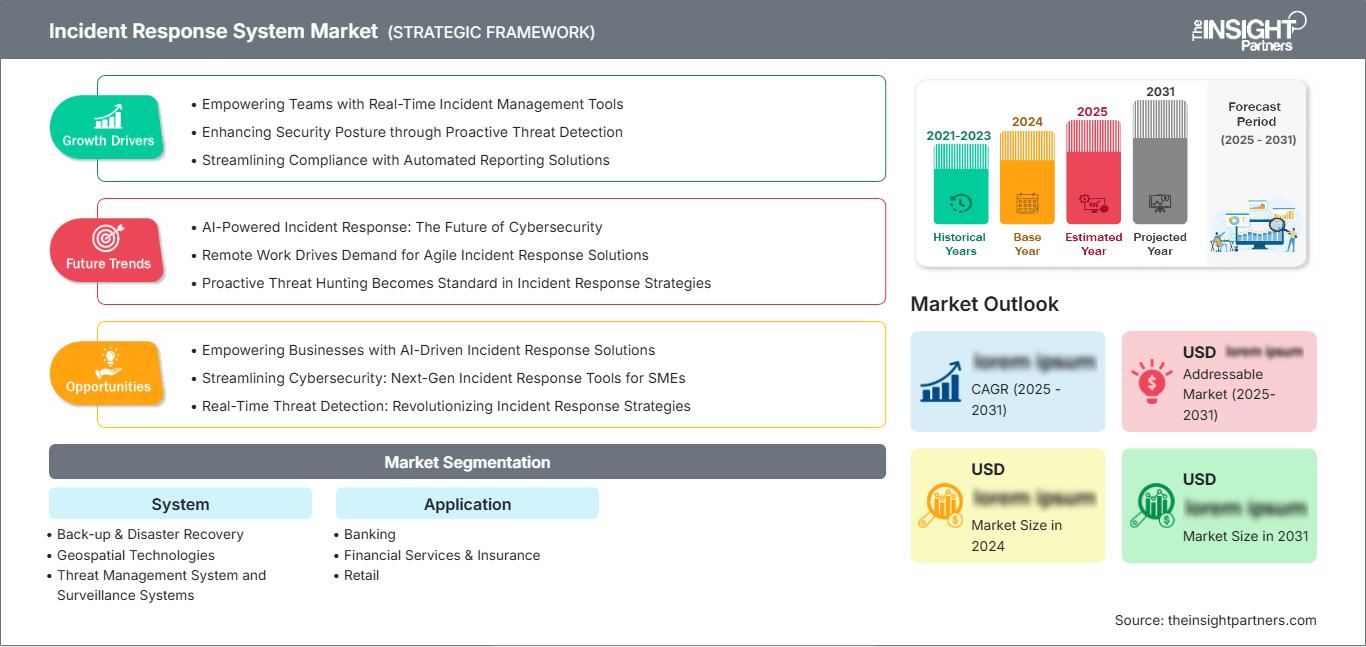
Incident Response System Market: Strategic Insights
Regional Insights
North America Incident Response System Market
The Incident Response System Market Share of North America in 2025 is around 32-35%, while it is expected to grow at 20.0-21.5% CAGR during 2026-2034. The USA dominates the regional market due to the advanced cybersecurity measures, cloud computing, financial services, healthcare, military, and protection of critical infrastructure. Canada drives demand from government, telecom, energy, and finance sectors.
Automation, centralized visibility, recovery management, and testing of readiness are becoming key concerns for enterprise customers. Federal cybersecurity programs and better control of boards of directors are making organizations to introduce their procedures of responding to incidents. Technology companies and cybersecurity companies are competing on the regional market through integrations, managed services, threat intelligence, and recovery services. This leads to the development of resilience architectures in the region.
U.S. Incident Response System Market
United States accounts for 84–87% of North American revenue by 2025 and will register a CAGR of 20.2–21.7% from 2026 through 2034. Governments agencies, financial institutions, hospitals, tech companies, utility companies, and large retailers make up the main users. Established vendors like Cisco Systems, Inc., Honeywell International Inc., and Acronis International GmbH have substantial application exposure.
Application adoption is increasingly being driven by security orchestration, ransomware recovery, cloud-based incident response, and automated investigation. The need for enhanced documentation, rapid escalation, and successful testing of recovery measures is crucial for government agencies and regulated sectors. Companies are also merging incident response and security information and event management, endpoint security, back-up, and identity management. This merging of different functions is increasing the need for platforms that can manage different security solutions without having to perform manual work during serious incidents.
Europe Incident Response System Market
Europe holds about 24 to 27% market share in 2025 and is expected to expand at a CAGR of 19.0 to 20.5% between 2026 to 2034, with Germany as one of the key markets. The finance industry, manufacturing, governmental agencies, telecom and healthcare sectors are key areas of deployment for improved digital operational resilience.
The UK remains a robust market in terms of demand for finance services, governmental agencies, defense and technological companies due to advanced security operations that lead to orchestration and managed response. Germany enjoys an advantage of industrial cybersecurity needs and advanced manufacturing operations. France has demand in governmental agencies, aerospace, banking and telecoms. Italy and Spain have growing demand for digital transformation, modernization of governmental agencies and critical infrastructure protection.
APAC Incident Response System Market
The APAC region accounts for around 25-28% of the share in 2025, and it is estimated to grow with a CAGR of 23.0-24.8% during 2026-2034, with China being the major driver of regional demand. Japan, South Korea, India, and Australia will fuel the growth through financial services, manufacturing, telecommunications, government, and cloud infrastructure.
The extensive digital infrastructure and investments in cybersecurity by enterprises will favor the Chinese market. The Japanese and South Korean markets will be fueled by their technological adoption and large industrial ecosystems. In India, there is development of cybersecurity along with digital and cloud public infrastructure. The Australian market will be driven by its regulated sectors and critical infrastructures.
Middle East & Africa Incident Response System Market
Middle East & Africa region is expected to grow at a CAGR of 18.0–19.5% from 2026–2034, with the leadership of Saudi Arabia and UAE. Digitization by the government, smart cities initiatives, banking, telecommunications, energy infrastructure, and cybersecurity by the country are driving adoption.
South Africa continues to be an important market for banking, mining, telecommunications, and security needs of the government sector, while Rest of MEA is offering new opportunities. The need for energy infrastructure demands special continuity and quick containment. Large-scale infrastructural modernization is motivating central surveillance, threat management, disaster recovery, and geographical resilience.
Segmentation Analysis
System
System is forecast to grow at a 21.0–22.2% CAGR during 2026–2034. Enterprises increasingly require coordinated capabilities spanning backup, threat management, geospatial awareness, and surveillance. The Incident Response System Market scope is consequently expanding toward integrated resilience architectures rather than standalone response applications.
- Back-up & Disaster Recovery supports operational continuity by protecting critical workloads and enabling restoration after ransomware, infrastructure failure, accidental deletion, or destructive incidents. Integration with response workflows is becoming strategically important.
- Geospatial Technologies help organizations visualize incidents, affected assets, geographic dependencies, and response priorities. Demand is particularly relevant for government, emergency management, utilities, transportation, and distributed infrastructure.
- Threat Management System provides detection, investigation, prioritization, and containment capabilities. It remains central to security operations because organizations need faster correlation of alerts across endpoints, networks, applications, and cloud environments.
- Surveillance Systems support physical and digital situational awareness through cameras, sensors, monitoring infrastructure, and analytics. Integration with security operations can improve coordinated responses to incidents affecting facilities and critical assets.
Application
Application is projected to expand at a 21.3–22.5% CAGR during 2026–2034. Adoption differs according to regulatory exposure, digital dependency, infrastructure criticality, and incident consequences. Financial institutions and government organizations typically require mature response governance, while healthcare and telecommunications increasingly prioritize continuous availability.
- Banking, Financial Services & Insurance require rapid containment, fraud investigation, data protection, and regulatory reporting because operational disruption can directly affect customers, transactions, and financial integrity.
- Retail is adopting response capabilities to protect payment environments, customer information, digital commerce platforms, supply chains, and increasingly distributed store infrastructure.
- Government Agencies & Public Sector prioritize national resilience, sensitive information protection, continuity of essential services, and coordinated response across geographically distributed departments and critical infrastructure.
- Telecommunication & Information Technology depend on continuous network and application availability, making automated detection, traffic analysis, vulnerability response, and recovery orchestration strategically important.
- Healthcare requires rapid response while preserving clinical availability, patient information, medical-device connectivity, and operational continuity across hospitals, laboratories, and distributed care environments.
Opportunity Snapshot
| Application | Revenue Contribution (High/Medium/Low) | Trend Tag (MAX 2 words) | Adoption Stage (Emerging/Scaling/Mature) |
|---|---|---|---|
| Banking, Financial Services & Insurance | High | Fraud Response | Mature |
| Retail | Medium | Commerce Security | Scaling |
| Government Agencies & Public Sector | High | National Resilience | Scaling |
| Telecommunication & Information Technology | High | Cloud Response | Mature |
| Healthcare | Medium | Clinical Continuity | Scaling |
Incident Response System Market Growth Drivers and Impact Analysis
Ransomware Raises the Value of Integrated Recovery
The economics of ransomware attacks in the enterprise environment are being transformed since detection alone cannot provide assurance of business continuity. Companies need solutions for immutable backup, isolated recovery environment, secure recovery, and tested playbooks. There is a need for integration of security operations with data protection and disaster recovery. The economic implications of this trend have been particularly evident in the case of financial institutions, healthcare providers, government organizations, and tech companies, where the cost of extended downtime can be disastrous for business operations. Companies will be able to offer their solutions beyond just alerting to include recovery processes, verification, and forensics. Additionally, clients are measuring response solutions based on recovery outcomes as opposed to the number of alerts handled.
Cloud Expansion Increases Incident Visibility Requirements
Hybrid and multicloud environments create fragmented telemetry across applications, identities, endpoints, infrastructure, and third-party services. Security teams consequently need centralized visibility and orchestration capable of correlating events across environments. Cloud expansion increases the number of assets requiring monitoring while also creating new identity, configuration, and access risks. The resulting market impact favors systems that can ingest diverse telemetry and coordinate response actions through application programming interfaces. Enterprises increasingly expect response platforms to connect with cloud-native security tools rather than operate as isolated consoles. This creates opportunities for vendors offering broad integration ecosystems and automated workflows. Managed security providers can also benefit because many organizations lack the internal expertise required to monitor complex environments continuously. As cloud workloads become more operationally critical, incident response is moving closer to core infrastructure management.
Regulatory Pressure Strengthens Formal Response Planning
Regulatory requirements are encouraging organizations to document, test, and demonstrate their ability to manage technology incidents. Financial institutions, healthcare providers, telecommunications operators, and public-sector organizations face increasing expectations around notification, resilience, third-party risk, and operational continuity. Regulations do not simply increase cybersecurity spending; they change purchasing criteria by making auditability and evidence generation more important. Incident response systems can support this requirement by recording investigation steps, escalation decisions, containment actions, recovery activities, and post-incident reviews. The commercial effect is greater demand for centralized case management, workflow automation, reporting, and policy enforcement. Vendors serving regulated industries can therefore differentiate through compliance templates and industry-specific workflows. Organizations are also more likely to invest in recurring exercises and readiness assessments, creating opportunities for managed response services alongside technology platforms.
Incident Response System Market Future Trends
AI-Driven Investigation and Response Orchestration
Artificial intelligence is expected to transform response workflows by helping security teams summarize alerts, correlate indicators, identify attack paths, recommend containment actions, and prioritize cases according to business impact. Future systems will increasingly use AI agents to coordinate repetitive investigation tasks while retaining human approval for consequential actions. This approach can reduce analyst workload and accelerate response across large environments containing thousands of assets. The most valuable implementations will likely combine AI with high-quality telemetry, organization-specific context, and established playbooks rather than operate as generic assistants. Vendors may also introduce autonomous testing capabilities that simulate attacks and assess whether response workflows perform as designed. Over time, AI could become a control layer connecting detection, investigation, remediation, recovery, and reporting. This evolution will increase the importance of explainability, governance, audit trails, and safeguards around automated actions.
Convergence of Cybersecurity and Operational Resilience
Future platforms in the Incident Response System Market Trends are likely to connect cybersecurity incident response more closely with business continuity, disaster recovery, physical security, and operational resilience. Organizations increasingly recognize that a cyber incident can simultaneously affect applications, facilities, supply chains, communications, and customer services. Consequently, response planning will move beyond technical containment toward coordinated business recovery. Systems may incorporate asset criticality, geographic information, dependency mapping, recovery priorities, and executive communication into unified workflows. This convergence will create opportunities for vendors capable of integrating previously separate technologies. Backup platforms may add stronger security orchestration, while security platforms may incorporate recovery validation and continuity management. The result should be broader resilience dashboards that help organizations understand operational exposure before an incident occurs and coordinate cross-functional actions when disruption begins.
Incident Response System Market Opportunities
Integrated Platforms for Regulated Industries
Regulated organizations represent an attractive investment opportunity because they require stronger documentation, repeatable procedures, and demonstrable resilience. Vendors can develop industry-specific platforms for banking, healthcare, telecommunications, and government that incorporate predefined workflows, reporting structures, evidence retention, and recovery priorities. The Incident Response System Market Forecasts support a favorable environment for solutions that reduce the complexity of compliance while improving operational readiness. Investment should focus on modular architectures that connect existing security tools rather than forcing customers to replace mature infrastructure. Vendors can also establish partnerships with systems integrators and managed service providers to accelerate deployment. Specialized templates for financial fraud, healthcare disruption, cloud compromise, and public-sector incidents can shorten implementation cycles. Long-term opportunities should favor platforms that combine technical response with governance, risk documentation, and measurable recovery outcomes.
Managed Response and Resilience Services
Organizations facing cybersecurity skills shortages may increasingly outsource monitoring, investigation, containment, and recovery coordination. Managed response providers can build recurring revenue models by combining security operations, threat intelligence, recovery testing, and incident readiness assessments. This opportunity is particularly relevant for mid-sized organizations that cannot maintain specialized response teams around the clock. Providers can differentiate through industry expertise, response-time commitments, regional support, and integration with customer infrastructure. Investment in automation can improve service economics by reducing repetitive analyst work while preserving human oversight for complex incidents. Partnerships with cloud providers, backup vendors, telecommunications companies, and technology integrators can expand distribution. The strongest services are likely to combine continuous monitoring with periodic exercises, ensuring customers are not simply reacting to incidents but continuously improving preparedness and recovery capabilities.
Recent Developments
- June 2026: VelocityEHS®, the global leader in EHS & Sustainability software solutions, announced the launch of QR Codes for Incident Management, a powerful new feature designed to eliminate friction in safety reporting and help organizations surface incidents and near misses faster, see risk more clearly, and act with greater speed and confidence. By enabling instant, mobile access to reporting tools through a simple QR code scan, the solution removes traditional barriers that often prevent timely and accurate incident reporting.
- September 2025: At GSX 2025 in New Orleans, Sept. 29 - Oct. 1, Motorola Solutions (NYSE: MSI) is showcasing new AI-assisted incident response solutions across on-premise, cloud-based and other third-party security deployments that ease the burden on security operators managing hundreds of cameras, doors, sensors and more.
- June 2025: AlertMedia, the world’s leading provider of risk intelligence and critical event management solutions, announced the launch of Incident Response, a powerful addition to its AI-enabled platform designed to help organizations mitigate risks and resolve incidents faster.
Frequently Asked Questions

- Comprehensive Market Sizing and Forecast Analysis
- Detailed Segmentation Analysis
- In-Depth Market Dynamics Assessment
- Regional and Country-Level Insights
- Competitive Landscape and Company Benchmarking
- Strategic Business Intelligence
Recent Reports
Testimonials

The Insight Partners provided valuable market intelligence that supported our global go-to-market strategy. Their team was professional, responsive, and attentive to our feedback, providing thoughtful analysis and helpful methodological clarifications throughout the project.
Junmo Kim Chief Financial Officer (CFO), Enertech Co., Ltd.
The Insight Partners' SCADA System Market report is comprehensive, with valuable insights on current trends and future forecasts. The team was highly professional, responsive, and supportive throughout. We are very satisfied and highly recommend their services.
RAN KEDEM Partner, Reali Technologies LTDs
I requested a report on a very specific software market and the team produced the report in a few days. The information was very relevant and well presented. I then requested some changes and additions to the report. The team was again very responsive and I got the final report in less than a week.
JEAN-HERVE JENN Chairman, Future Analytica
We worked with The Insight Partners for an important market study and forecast. They gave us clear insights into opportunities and risks, which helped shape our plans. Their research was easy to use and based on solid data. It helped us make smart, confident decisions. We highly recommend them.
PIYUSH NAGPAL Sr. Vice President, High Beam Global
The Insight Partners delivered insightful, well-structured market research with strong domain expertise. Their team was professional and responsive throughout. The user-friendly website made accessing industry reports seamless. We highly recommend them for reliable, high-quality research services
YUKIHIKO ADACHI CEO, Deep Blue, LLC.
This is the first time I have purchased a market report from The Insight Partners.While I was unsure at first, I visited their web site and felt more comfortable to take the risk and purchase a market report.I am completely satisfied with the quality of the report and customer service. I had several questions and comments with the initial report, but after a couple of dialogs over email with their analyst I believe I have a report that I can use as input to our strategic planning process.Thank you so much for taking the extra time and making this a positive experience.I will definitely recommend your service to others and you will be my first call when we need further market data.
JOHN SUZUKI President and Chief Executive Officer, Board Director, BK Technologies
I wish to appreciate your support and the professionalism you displayed in the course of attending to my request for information regarding to infectious disease IVD market in Nigeria. I appreciate your patience, your guidance, and the fact that you were willing to offer a discount, which eventually made it possible for us to close a deal. I look forward to engaging The Insight Partners in the future, all thanks to the impression you have created in me as a result of this first encounter.
DR CHIJIOKE ONYIA MANAGING DIRECTOR, PineCrest Healthcare Ltd.Reason to Buy
- Informed Decision-Making
- Understanding Market Dynamics
- Competitive Analysis
- Identifying Emerging Markets
- Customer Insights
- Market Forecasts
- Risk Mitigation
- Boosting Operational Efficiency
- Strategic Planning
- Investment Justification
- Tracking Industry Innovations
- Aligning with Regulatory Trends





 Get Free Sample for