
Indoor Antennas Market Size, Trends & Growth by 2034
Coverage: By Type (Amplified HDTV Antenna, Nonamplified HDTV Antenna, Budget HDTV Antenna); Application (Domestic, Commercial) , and Geography (North America, Europe, Asia Pacific, and South and Central America)
- Status : Data Released
- Report Code : TIPRE00022726
- Category : Electronics and Semiconductor
- No. of Pages : 150
- Available Report Formats :


- Last update date : September 18, 2026


2025 Market Size
US$ 1.31 Bn
Base year value
2034 Forecast
US$ 2.37 Bn
Projected by 2034
CAGR 2026-2034
6.81 %
Growth rate
Addressable Market
US$ 16.63 Bn
(2026-2034)
The Indoor Antennas market was valued at US$ 1.31 billion in 2025 and is expected to reach US$ 2.37 billion by 2034; it is estimated to record a CAGR of 6.81% during 2026-2034.
Indoor Antennas Market Assessment and Insights
- North America: Accounted for 34–37% Indoor Antennas Market share in 2025 and is expected to expand at a 7.1–7.8% CAGR between 2026–2034, supported by cord-cutting, mature retail channels, and broad digital-broadcast availability.
- US: Represented 82–86% of North American revenue in 2025, with a projected 7.2–7.9% CAGR between 2026–2034 as hybrid streaming and broadcast viewing expands.
- Europe: Held 25–28% share in 2025 and is forecast to grow at 6.6–7.3% between 2026–2034, led by the UK and Germany, followed by France, Italy, and Spain.
- Asia Pacific: Captured 23–26% share in 2025 and is expected to record an 8.4–9.2% CAGR between 2026–2034, with China, Japan, South Korea, India, and Australia shaping demand.
- Largest Segment: Domestic applications held 76–80% market share in 2025 and are projected to expand at a 7.4–8.0% CAGR between 2026–2034.
- High Growth Segment: Amplified HDTV antennas represented 48–52% market share in 2025 and are forecast to grow at an 8.3–9.0% CAGR between 2026–2034.
- Key companies analyzed in detail: General Electric Company, Mohu, Inc., Winegard Company, VOXX Accessories Corp., Ematic, Antennas Direct, Inc., RadioShack Online OpCo, LLC, Koninklijke Philips N.V., Iskra, d.o.o., and ANTOP Antenna Inc.
Source: The Insight Partners' analysis based on proprietary research, government publications, company annual reports, investor presentations, industry databases, and expert interviews.
Evolution of technology has seen development of indoor reception devices move away from telescopic rods into the adoption of small panels, loops and amplification. The product designs incorporate capabilities in both UHF and High VHF bands and incorporation of LTE and 5G filters. Production is still relatively electronics-free yet quality-focused as coaxial cables, connectors, amplifiers' components and conductive films are what define functionality. Thus, the market of Indoor Antennas becomes one of the places where proven performance, proper installation instructions, and realistic range claims are rewarded.
Future trends in the Indoor Antennas Market will include growth in demand in urban environments undergoing transition from pay TV services to digital terrestrial television and increase of smart TV penetration rate. Regulatory measures on improvement of broadcast services could extend the addressable base. Retailers will give preference to devices with lower returns ratio and more clear guidance on installation. Investments would be directed at adaptive gain, signal indicator, recyclable casing and local channel selection software. Brazil, India, South East Asia and some Middle Eastern countries provide long-term growth opportunity.
Indoor Antennas Market Report Scope
| Report Attribute | Details |
|---|---|
| Market size in 2025 | US$ 1.31 Billion |
| Market Size by 2034 | US$ 2.37 Billion |
| Global CAGR (2026 - 2034) | 6.81% |
| Historical Data | 2021-2024 |
| Forecast period | 2026-2034 |
Indoor Antennas Market Analysis
Indoor Antennas Market growth is driven by the growing divergence in the costs of subscription television and consumers' willingness to pay for local news, sports, weather, and emergency channels. As of July 2025, the percentage of households that have only broadcast television in the U.S. stands at 16.3%, up from 13.3% a year before.
This ecosystem consists of broadcasters, antenna designers, component makers, original equipment manufacturers, retailers, installers, and TV set owners. The supply side remains relatively scalable, although it is highly sensitive to factors such as conductor quality, amplifier noise, cable loss, and package performance claims. Multi-channel distribution helps increase the scope of reach, while transmitter location and setup help decrease return rates.
Indoor Antennas Market forecast suggests a fragmented scenario, with the battle going on between renowned electronics companies and specialized antenna companies along with online providers who offer value to customers. The companies such as General Electric Company, Koninklijke Philips N.V. and VOXX Accessories Corp. derive advantage out of their brand recognition whereas the rest of the companies compete on the grounds of reception engineering expertise and specialization in this area.
The strategic investment in the Indoor Antennas Market is moving away from simple range extension to a more sophisticated approach of controlled amplification, mobile mounting support, signal strength measurement and packages that explain about the UHF/VHF compatibility. The value-focused providers include Ematic and RadioShack Online OpCo, LLC whereas the established specialists ensure that they retain their position by way of testing of products, training of technical people and availability in different forms.
● REPORT CUSTOMIZATION
Tailor This Report To Align With Your Specific Business Requirements
This report can be customized to align precisely with your business objectives, scope, and target markets. Customization options include tailored segmentation, geography, competitive analysis, and strategic insights to support informed decision-making.
Customize This Report →WHAT YOU CAN ADJUST
- ● Segmentations
- ● Geography
- ● Competitive Analysis
- ● Language Preferences
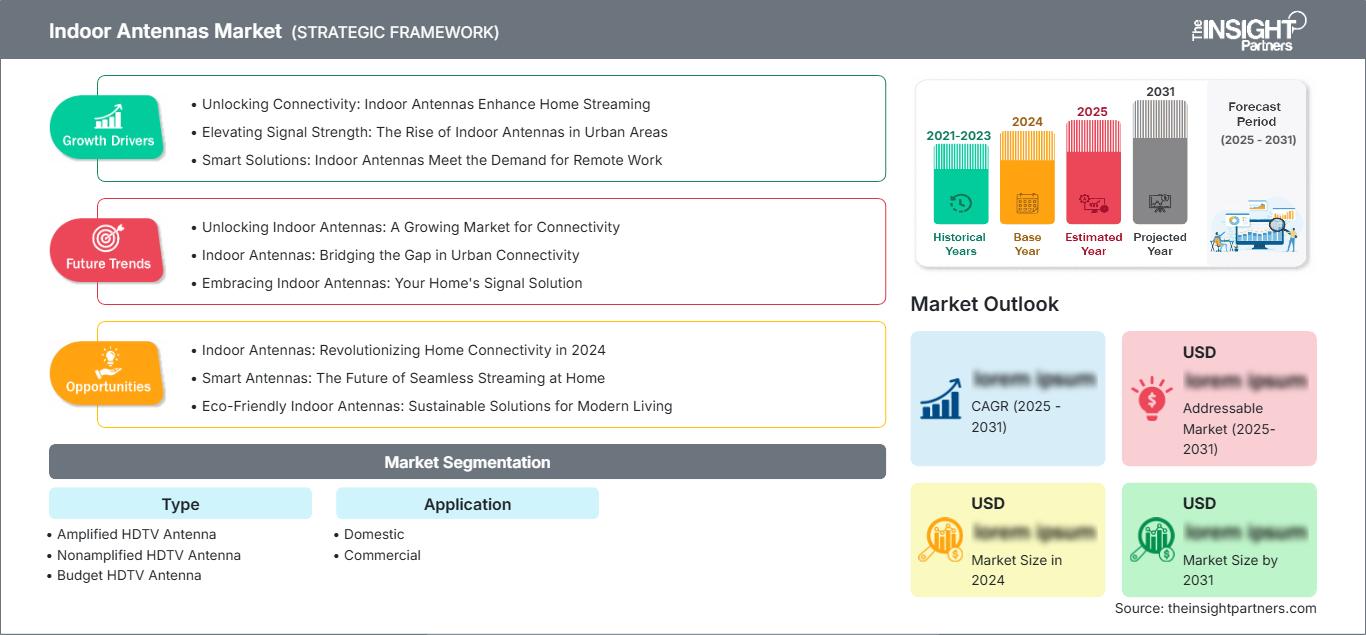
Indoor Antennas Market: Strategic Insights
Regional Insights
North America Indoor Antennas Market
North America held 34–37% of global revenue in 2025 and is projected to advance at a 7.1–7.8% CAGR through 2034. Market Share in Indoor Antennas is driven by mature awareness among consumers, extensive terrestrial broadcastings, large ownership of televisions, and great availability at electronics stores, mass merchandisers, and the internet. Already 76% of households in the United States receive NEXTGEN TV broadcasting, thus putting greater emphasis on reception compatible products.
Market growth in the regions is fueled by the demand for cable replacement and preference among consumers for pairing streaming subscriptions with free-to-air channels. Amplified flat panels have good performance in suburban and fringe reception zones, whereas non-amplified ones work well closer to urban transmission sites. Contribution comes from Canada in its metropolitan routes and remote areas where reception could supplement broadband.
U.S. Indoor Antennas Market
The U.S. accounted for 82–86% of North American revenue in 2025 and is forecast to expand at a 7.2–7.9% CAGR. Broadcast-only households represented 16.3% of television homes in July 2025, up from 13.3% in July 2024, although the classification methodology changed in 2024. This expanding audience directly supports indoor antenna replacement, multi-room installation, and first-time purchases among households reducing traditional pay-TV expenditure.
Uses are mostly domestic, yet hospitality rooms, offices, waiting areas, education centers, and recreational vehicles generate commercial needs. Winegard Company, Antennas Direct, Inc., Mohu, Inc., General Electric Company, and VOXX Accessories Corp. possess recognizable product lines and sales. The consumer’s purchasing decision hinges more on proximity to the tower, material of walls, VHF, bypassing of amplifier, and cable length. Extensive implementation of ATSC 3.0 technology improves consumer knowledge; however, antenna efficiency is determined by radio frequencies and not picture resolution labeling.
Europe Indoor Antennas Market
Europe represented 25–28% of revenue in 2025 and is expected to grow at a 6.6–7.3% CAGR through 2034. The UK takes leadership in regional demand thanks to wide free-to-air viewing and traditional terrestrial television watching. Compact antennas are good for renting homes and secondary television sets, and requirements call for products capable of working with both UHF and relevant VHF signals. Retailers focus on the unobtrusive design, reliable compatibility, and easy scanning of channels.
Germany comes next with dense population of apartments in cities, high purchasing power for consumer electronics, and good terrestrial reception in cities. Iskra, d.o.o., and European distributors help ensure specialist availability. German opportunity lies in high quality amplified antennas with good interference rejection since reinforced walls, indoor electronics, and complex shape of transmitters may degrade cheaper devices.
The other demand level comes from France, Italy, and Spain. This is because France is favored by good digital terrestrial broadcast services, Italy enjoys free-to-air consumption, and Spain has urban multi-dwelling units. The country growth still depends on household development, secondary television, tourist facilities, and not using pay-TV. Localization of products, right connectors, multilingual set-up instructions, and correct gain requirements are important for managing return rates.
APAC Indoor Antennas Market
Asia Pacific captured 23–26% of revenue in 2025 and is forecast to register an 8.4–9.2% CAGR through 2034, the fastest regional pace. China leads through manufacturing scale and e-commerce reach, while Japan and South Korea support premium compact products. South Korea’s ATSC 3.0 services reach more than 80% of the population.
India offers longer-term upside as direct-to-mobile and broadcast modernization are evaluated, while Australia sustains demand through established free-to-air television. Industrial advantages include dense component supply chains, conductive-material expertise, and low-cost assembly. Policy-led digital transitions, smart-TV penetration, and urban apartment growth favor amplified, easy-install designs across the Indoor Antennas Market.
Middle East & Africa Indoor Antennas Market
Middle East and Africa is projected to expand at a 6.5–7.2% CAGR through 2034. South Africa leads because of its comparatively developed retail base and terrestrial television ecosystem. Saudi Arabia and the UAE provide selective commercial demand from hospitality, serviced accommodation, staff housing, and secondary-screen installations.
Across the rest of MEA, addressability depends on digital terrestrial coverage, affordability, electricity reliability, and local channel availability. Indoor products avoid rooftop installation cost, but concrete construction and transmitter distance can constrain reception. Distributors that bundle placement guidance, durable cabling, and controllable amplification are better positioned than sellers relying on unverified distance claims.
Segmentation Analysis
Type
Type is projected to expand at a 7.5–8.1% CAGR during 2026–2034. The Indoor Antennas Market scope covers amplified, nonamplified, and budget HDTV designs, each serving different signal conditions and price points. Purchase decisions depend on tower proximity, building attenuation, room placement, channel bands, and interference. Manufacturers increasingly provide amplifier bypass, longer coaxial leads, low-noise circuitry, and clearer positioning instructions to improve usable reception and reduce avoidable returns.
- Amplified HDTV Antenna: Leads demand where buildings, distance, or split signals weaken reception. Switchable gain, low-noise amplification, and cellular filtering make this category strategically important for suburban and difficult indoor environments.
- Nonamplified HDTV Antenna: Serves households near transmitters where excess gain can overload tuners. Its simple architecture, lower price, passive operation, and minimal failure risk support stable urban replacement demand.
- Budget HDTV Antenna: Targets first-time buyers, secondary televisions, dormitories, and highly price-sensitive markets. Competitive success depends on honest specifications, acceptable cable quality, easy setup, and low return incidence.
Application
Application is expected to record a 7.3–7.9% CAGR during 2026–2034. Domestic installations represent the core volume base, while commercial use is fragmented across hospitality, offices, recreation, education, and public-facing premises. Adoption is strongest where local programming and emergency information are valued without recurring service fees. Commercial buyers emphasize repeatable installation, durable connectors, procurement consistency, and support documentation, whereas households prioritize aesthetics, channel availability, and easy repositioning.
- Domestic: Dominates unit demand through primary televisions, bedrooms, rental homes, apartments, and cord-cutting households. Multi-set ownership and inexpensive access to local programming support recurring replacement and expansion purchases.
- Commercial: Covers hotels, offices, waiting rooms, educational sites, recreational vehicles, and small venues. Procurement favors dependable reception, standardized setup, durable cabling, and low lifetime service requirements.
Opportunity Snapshot
| Application | Revenue Contribution | Trend Tag | Adoption Stage |
| Domestic | High | Hybrid Viewing | Mature |
| Commercial | Medium | Hospitality Retrofit | Scaling |
Indoor Antennas Market Growth Drivers and Impact Analysis
Cord-Cutting and Hybrid Television Economics
Households increasingly combine one or two streaming subscriptions with free local broadcasting rather than maintaining a full cable or satellite package. This behavior creates a practical role for indoor antennas as low-cost access points for news, weather, sports, and emergency information. U.S. broadcast-only penetration rose to 16.3% in July 2025 from 13.3% in July 2024, demonstrating renewed engagement with over-the-air reception. The impact extends beyond first purchases, because households often add antennas to bedrooms, kitchens, rental properties, and secondary televisions. Manufacturers benefit when they explain channel availability and placement, while retailers gain from offering tiered good-better-best assortments matched to distance and building conditions.
Expansion of Advanced Digital Broadcasting
Broadcast modernization supports product replacement by improving awareness of terrestrial television and increasing the value of compatible reception equipment. ATSC 3.0 services reach more than 76% of U.S. households, and South Korean coverage exceeds 80% of the population. The standard enables improved video, audio, accessibility, emergency alerts, and interactive capabilities, although the antenna itself remains a radio-frequency device rather than a resolution generator. Consumers upgrading televisions or receivers frequently reassess reception hardware, favoring UHF/VHF support and stable indoor performance. Suppliers can capture this cycle with accurate compatibility language, amplifier bypass, and channel-rescan instructions. Regulatory efforts that reduce transition friction can broaden confidence and sustain retail visibility.
Improved Amplification and Interference Control
Urban electronics density and modern building materials create difficult reception conditions, increasing demand for technically differentiated products. Low-noise amplifiers can compensate for cable and splitter losses, while LTE and 5G filters help suppress nearby cellular interference. The strongest designs allow amplification to be switched off because excessive gain can overload a television tuner near a transmitter. This flexibility expands a single model’s addressable geography and reduces returns. Signal-strength indicators, longer coaxial cables, and placement applications further improve installation outcomes. The market impact is a gradual shift toward higher-value amplified models, particularly in suburban homes, apartments with limited window access, hospitality rooms, and locations where users cannot install outdoor hardware.
Indoor Antennas Market Future Trends
Adaptive Indoor Reception Systems
Indoor Antennas Market trends will be shifting towards adaptive reception rather than fixed gain. Future designs will involve the use of adaptable amplifiers together with signal quality feedback and assisted positioning using either mobile apps or televisions. Algorithms can help users to compare locations, detect overcrowded signals, and differentiate between reception issues and lack of channel availability. Manufacturers will be able to incorporate removable cable assemblies, power injection modules, and automatic amplifier by-pass to reach more homes with fewer SKUs. This development will increase consumers' trust and reduce number of return sales allowing them to charge a higher price based on performance of installation rather than advertised coverage distance.
Sustainable, Design-Led Product Platforms
The future of indoor antennas involves better incorporation into the contemporary room as people refuse to have visible hardware that is close to the television hanging on the wall. Conductive films, fabric finishes, colors that reverse, small stands, and painting surfaces will make it possible to put the device anywhere without compromising the performance. Sustainability will also be taken into account when choosing the product in terms of less plastic, recyclable paper wrapping, interchangeable coax cables, and energy-saving amplifiers. Expectations in Europe will speed up this process, but it is possible to implement these standards worldwide for all brands and private labels. This brings commercial value in terms of longevity and less returns because of damage.
Indoor Antennas Market Opportunities
Localized Kits for Emerging Digital-Terrestrial Markets
Manufacturers can build market-entry programs around countries upgrading terrestrial television or expanding consumer-electronics access. The opportunity requires more than exporting a universal antenna. Investors should fund local frequency validation, connector selection, multilingual setup material, channel-availability education, and distribution partnerships with television retailers. Brazil’s adoption of technologies derived from ATSC 3.0 and India’s exploration of direct-to-mobile broadcasting illustrate how policy change can stimulate reception awareness. Affordable amplified models with durable cables can serve apartment-dense cities, while passive designs suit strong-signal areas. A phased strategy using pilot retailers, return-rate monitoring, and installer feedback limits risk before national expansion and helps distinguish validated performance from marketplace exaggeration.
Commercial Retrofit and Multi-Room Packages
Hospitality groups, student housing operators, recreational-vehicle dealers, offices, and public venues offer a scalable opportunity for standardized reception packages. Suppliers should provide site-survey guidance, cable-length options, mounting accessories, channel maps, and centralized procurement support. Commercial buyers value predictable installation and low maintenance more than consumer-facing range language. Multi-room kits can combine antennas, splitters, amplifiers, and replacement cables while preserving flexibility for properties with different transmitter geometry. Partnerships with television installers and facility-management distributors can shorten sales cycles and improve after-sales support. The best targets are properties seeking local news and emergency channels without adding recurring service costs to every screen or room.
Recent Developments
- June 2025: Ericsson has announced a major expansion of its antenna manufacturing and engineering capabilities in India, unveiling its first antenna model manufactured in the country for global export. The move strengthens India’s role as a strategic hub for Ericsson’s innovation, production and global supply operations. The newly introduced antenna was unveiled at an event attended by India’s Union Minister for Communications and Development of Northeastern Region, Jyotiraditya M. Scindia. The product was scheduled for commercial release in June 2025, with international shipments expected to begin in July.
- February 2026: AntennaWare has announced a new range of BodyWave antennas designed to address wireless connectivity challenges in applications where devices operate close to the human body or metal surfaces. The company unveiled the new products at Embedded World, expanding its portfolio beyond existing DECT, Bluetooth and UWB solutions.
- March 2026: Adant Technologies has introduced a new smart antenna solution designed to improve the performance of Wi-Fi routers, gateways and mesh nodes without adding significant hardware cost compared with conventional passive antenna systems. The new technology dynamically changes the antenna radiation pattern to select the most effective configuration for each wireless connection.
Frequently Asked Questions

- Comprehensive Market Sizing and Forecast Analysis
- Detailed Segmentation Analysis
- In-Depth Market Dynamics Assessment
- Regional and Country-Level Insights
- Competitive Landscape and Company Benchmarking
- Strategic Business Intelligence
Recent Reports
Testimonials

The Insight Partners provided valuable market intelligence that supported our global go-to-market strategy. Their team was professional, responsive, and attentive to our feedback, providing thoughtful analysis and helpful methodological clarifications throughout the project.
Junmo Kim Chief Financial Officer (CFO), Enertech Co., Ltd.
The Insight Partners' SCADA System Market report is comprehensive, with valuable insights on current trends and future forecasts. The team was highly professional, responsive, and supportive throughout. We are very satisfied and highly recommend their services.
RAN KEDEM Partner, Reali Technologies LTDs
I requested a report on a very specific software market and the team produced the report in a few days. The information was very relevant and well presented. I then requested some changes and additions to the report. The team was again very responsive and I got the final report in less than a week.
JEAN-HERVE JENN Chairman, Future Analytica
We worked with The Insight Partners for an important market study and forecast. They gave us clear insights into opportunities and risks, which helped shape our plans. Their research was easy to use and based on solid data. It helped us make smart, confident decisions. We highly recommend them.
PIYUSH NAGPAL Sr. Vice President, High Beam Global
The Insight Partners delivered insightful, well-structured market research with strong domain expertise. Their team was professional and responsive throughout. The user-friendly website made accessing industry reports seamless. We highly recommend them for reliable, high-quality research services
YUKIHIKO ADACHI CEO, Deep Blue, LLC.
This is the first time I have purchased a market report from The Insight Partners.While I was unsure at first, I visited their web site and felt more comfortable to take the risk and purchase a market report.I am completely satisfied with the quality of the report and customer service. I had several questions and comments with the initial report, but after a couple of dialogs over email with their analyst I believe I have a report that I can use as input to our strategic planning process.Thank you so much for taking the extra time and making this a positive experience.I will definitely recommend your service to others and you will be my first call when we need further market data.
JOHN SUZUKI President and Chief Executive Officer, Board Director, BK Technologies
I wish to appreciate your support and the professionalism you displayed in the course of attending to my request for information regarding to infectious disease IVD market in Nigeria. I appreciate your patience, your guidance, and the fact that you were willing to offer a discount, which eventually made it possible for us to close a deal. I look forward to engaging The Insight Partners in the future, all thanks to the impression you have created in me as a result of this first encounter.
DR CHIJIOKE ONYIA MANAGING DIRECTOR, PineCrest Healthcare Ltd.Reason to Buy
- Informed Decision-Making
- Understanding Market Dynamics
- Competitive Analysis
- Identifying Emerging Markets
- Customer Insights
- Market Forecasts
- Risk Mitigation
- Boosting Operational Efficiency
- Strategic Planning
- Investment Justification
- Tracking Industry Innovations
- Aligning with Regulatory Trends





 Get Free Sample for