
GPS Antenna Market Growth Analysis by Size and Share: 2034
Coverage: By Type (Internal, External); Application (Aviation Industry, Automotive, Transportation, Healthcare) , and Geography (North America, Europe, Asia Pacific, and South and Central America)
- Status : Data Released
- Report Code : TIPRE00023063
- Category : Electronics and Semiconductor
- No. of Pages : 150
- Available Report Formats :


- Last update date : August 19, 2026


2025 Market Size
US$ 2.91 Bn
Base year value
2034 Forecast
US$ 5.24 Bn
Projected by 2034
CAGR 2026-2034
6.68 %
Growth rate
Addressable Market
US$ 36.69 Bn
(2026-2034)
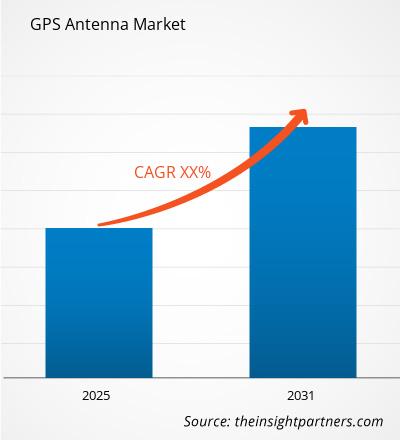
The GPS Antenna market was valued at US$ 2.91 Billion in 2025 and is projected to reach US$ 5.24 Billion by 2034, registering a CAGR of 6.68% from 2026 to 2034. Such a growth trend highlights the increased importance of precision positioning solutions within multiple industries. Drivers of the industry include the growing use of autonomous systems, increasing demand for location-based services, and the growing incorporation of GNSS into consumer and industrial equipment.
North America captured the GPS Antenna market size in 2025, with expectations of sustaining a CAGR of around 5.5–6.5% over the forecast period. North American dominance is attributed to the early adoption of advanced navigation solutions in the automotive and aviation industries, heavy defense spending on positioning systems, and the availability of major technology providers in the region. Growth in autonomous vehicles and precision farming is contributing to market growth in the region.
GPS Antenna Market Assessment and Insights
- North America: Estimated to hold approximately 30–34% share in 2025, growing at a CAGR of 5.5–6.5% from 2026 to 2034. Growth is driven by the high concentration of technology enterprises and robust defense sector investments.
- United States: Representing nearly 85–90% of the North American market in 2025, expanding at a CAGR of 5.0–6.0%. The market is supported by substantial investments in autonomous vehicle testing and smart infrastructure projects.
- Europe: Accounting for approximately 24–28% of the global market in 2025, with a CAGR of 5.5–6.5%. Leading countries include the United Kingdom, Germany, and France, driven by automotive excellence and precision agriculture adoption.
- Asia Pacific: Representing roughly 26–30% of the global market in 2025, growing at the highest CAGR of 7.5–8.5%. Key contributors include China, Japan, India, and South Korea, fueled by rapid industrialization and smart city initiatives.
- Largest Segment: Type segment dominates with a market share of approximately 55–60% in 2025, growing at a CAGR of 6.0–7.0%. This is driven by the extensive deployment of external antennas in automotive and aviation applications requiring superior signal reception.
- High Growth Segment: Application segment projected to expand at a CAGR of 7.0–8.0%, driven by the rising adoption of GPS antenna solutions in transportation and healthcare for asset tracking and patient monitoring applications.
- Key companies analyzed in detail: Harxon Corporation, Hemisphere GNSS, Javad GNSS, Inc., Leica Geosystems, NavCom Technology, Inc., NovAtel, Inc., Orolia, Sokkia, Tallysman, Topcon Positioning Systems, Inc.
Source: The Insight Partners' analysis based on proprietary research, government publications, company annual reports, investor presentations, industry databases, and expert interviews.
The GPS Antenna market is experiencing a shift away from conventional stand-alone positioning systems toward multi-constellation GNSS solutions, which provide improved accuracy and reliability. Market dynamics are changing as manufacturers broaden their product lines to address the needs of different end-users, ranging from high-accuracy surveying to autonomous navigation and IoT-based asset tracking applications. With continued improvements in antenna technology in terms of smaller size, multi-band capability, and anti-jamming features, GPS antennas are becoming feasible even under more challenging conditions, such as dense urban canyons and indoors.
It is anticipated that the GPS Antennas market would register steady growth in the upcoming years due to the heavy investment by the developing countries in their digital infrastructure and smart cities. The positive regulatory scenario that promotes the usage of ADAS as well as the increasing requirement for accurate positioning in agriculture and construction would definitely be among the driving forces of the market.
GPS Antenna Market Report Scope
| Report Attribute | Details |
|---|---|
| Market size in 2025 | US$ 2.91 Billion |
| Market Size by 2034 | US$ 5.24 Billion |
| Global CAGR (2026 - 2034) | 6.68% |
| Historical Data | 2021-2024 |
| Forecast period | 2026-2034 |
GPS Antenna Market Analysis
The key driver of demand in the GPS Antennas industry is the massive rise in demand for location-based services along with the requirement for accurate positioning technology in autonomous technologies. In an era where the likes of the automotive, aerospace, and agricultural sectors are rapidly adopting automation and analytics-based processes, the demand for highly accurate positioning systems is rising. The growth in GPS antenna market has been made possible due to technological improvements in multi-frequency and multi-satellite reception which provide highly accurate positioning in the range of centimeters for applications like autonomous vehicle navigation and precision farming.
The competitive structure of the market is marked by the involvement of GNSS technology solution providers and positioning equipment suppliers. Leading companies like NovAtel, Inc., Leica Geosystems, and Topcon Positioning Systems, Inc. are engaged in innovation and partnering activities to reinforce their market standing. The GPS Antenna market report demonstrates the emergence of trend related to provision of the turnkey solution, consisting of an antenna, receiver and processing software designed specifically for particular application. Also, there is a tendency to increase the amount of mergers and acquisitions in the market performed by the major companies in order to broaden their product portfolio and geographic expansion.
● REPORT CUSTOMIZATION
Tailor This Report To Align With Your Specific Business Requirements
This report can be customized to align precisely with your business objectives, scope, and target markets. Customization options include tailored segmentation, geography, competitive analysis, and strategic insights to support informed decision-making.
Customize This Report →WHAT YOU CAN ADJUST
- ● Segmentations
- ● Geography
- ● Competitive Analysis
- ● Language Preferences
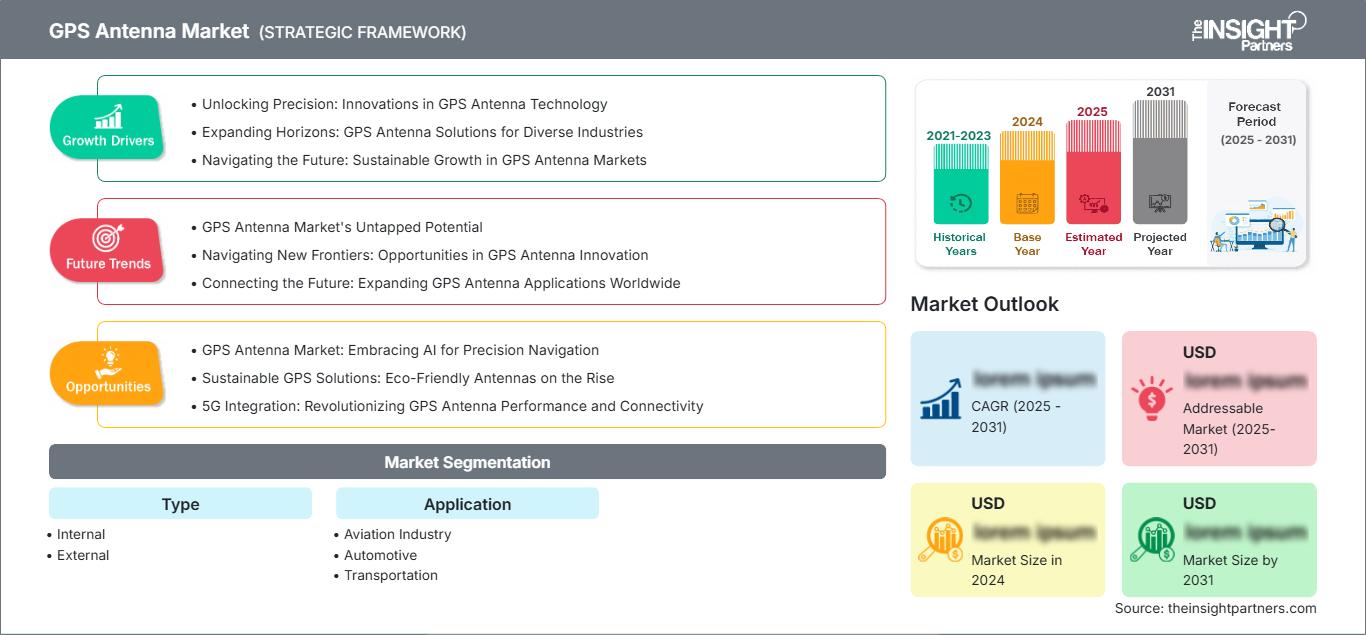
GPS Antenna Market: Strategic Insights
Regional Insights
North America GPS Antenna Market
North America is a developed but developing market of GPS Antennas, accounting for a sizeable market share of around 30–34% of the total worldwide revenue in 2025. Growth of this region depends on early adaptation of new technologies related to positioning in areas such as autonomous vehicle production, precision farming, and military applications. Factors driving growth are significant government funding for GPS upgrades and development of GNSS augmentation systems, presence of key players in innovative technologies, as well as a well-developed ecosystem for testing autonomous vehicles. The market of GPS Antennas in North America is experiencing growth due to rising usage of smart infrastructure and IoT devices that need accurate location information. CAGR for this region in 2026–2034 is expected to be between 5.5% and 6.5%.
U.S. GPS Antenna Market
US leads in terms of the maximum market share of the North America market, occupying approximately 85-90% market share in 2025 with a CAGR of 5.0-6.0%. This market leadership is attributed to the availability of a number of GNSS solution providers, investments done by the defense industry on positioning solutions, and the strong autonomous vehicles industry. There is an extensive application of GPS antennas in the transportation and agriculture industry, where precise positioning is important in increasing the efficiency in the process. Some of the key players like NavCom Technology, Inc. and NovAtel, Inc. are working hard towards increasing their market share through strategic collaborations with system integrators and OEMs.
Europe GPS Antenna Market
Europe holds around 24-28% of the worldwide market share for GPS Antennas with a CAGR of 5.5-6.5%. UK and Germany have emerged as the key players in the region, supported by their robust automotive production industry and adoption of autonomous driving technology. France, Italy, and Spain are other major contributors, backed by governmental programs focusing on the development of digital agriculture and smart cities. Growth in this region is also being boosted due to the Galileo Satellite Navigation system of the European Union, which is helping increase the usage of multi-GNSS antenna systems.
APAC GPS Antenna Market
The Asia Pacific region is the most rapidly developing market for GPS antennas, accounting for around 26–30% in 2025, with a solid CAGR of 7.5–8.5%. China and Japan are the two dominating nations, owing to substantial investments in large-scale government-sponsored infrastructural projects and fast industrial sectors digitization. The growth rates of India and South Korea are also high, as a result of growing investments in smart city projects and the development of autonomous cars. Policies for the promotion of local manufacturing of GNSS components and technologies and technological independence are boosting the adoption of GPS antennas in APAC as well.
Middle East & Africa GPS Antenna Market
The Middle East and Africa market is an emerging market for GPS Antennas with Saudi Arabia and UAE being the main adopters due to heavy investment in smart cities and digital infrastructure development. This market has a CAGR of about 6.0-8.0% driven by the requirement for accurate positioning in the energy industry, infrastructure development, and defense modernization projects. South Africa also has emerged as one of the main markets with increased demands in the mining and agriculture industries for accurate positioning solutions.
Segmentation Analysis
Type
The Type segment is a cornerstone of the GPS Antenna market, encompassing internal and external antenna configurations. This segment is projected to grow at a CAGR of 6.0–7.0% from 2026 to 2034, driven by the expanding range of applications requiring different form factors and performance characteristics. Market dynamics are shaped by continuous innovations in antenna design aimed at enhancing signal reception, reducing size, and improving integration capabilities. The segment's growth is further propelled by the rising demand for external antennas in high-precision applications and internal antennas in consumer electronics and IoT devices.
- Internal: These antennas are embedded within devices, offering space-saving advantages and aesthetic integration. The growing trend of compact device design in consumer electronics, wearables, and IoT applications is driving demand for internal GPS antennas with improved sensitivity and multi-band reception capabilities.
- External: External GPS antennas are designed for applications requiring superior signal reception and accuracy, such as automotive navigation, surveying, and aviation. Their strategic importance is growing with the increasing deployment of autonomous systems and high-precision positioning solutions that demand robust signal reception even in challenging environments.
Application
The Application segment is a key driver of the GPS Antenna market, growing at a CAGR of 7.0–8.0% from 2026 to 2034. This growth is underpinned by the increasing need for precise positioning and navigation across diverse end-user sectors. The adoption of advanced GPS antennas in autonomous vehicles and transportation is accelerating, driven by the need for reliable and accurate positioning data for safe navigation. The aviation industry is also a significant contributor, utilizing high-precision antennas for both commercial and defense applications.
- Aviation Industry: Relies on GPS antennas for navigation, surveillance, and communication systems in both commercial and military aircraft. The increasing adoption of satellite-based augmentation systems and the modernization of air traffic management are driving demand for high-reliability aviation-grade antennas.
- Automotive: Utilizes GPS antennas for navigation, connected car services, and advanced driver-assistance systems. The growing trend of autonomous vehicle development and the integration of connected car features are fueling demand for robust, high-performance automotive GPS antennas.
- Transportation: Employs GPS antennas for fleet management, asset tracking, logistics optimization, and public transportation systems. The need for real-time location data to improve operational efficiency and safety is a significant driver for this sub-segment.
- Healthcare: Uses GPS antennas for patient monitoring, asset tracking, and emergency response systems. The growing adoption of telehealth and remote patient monitoring solutions is increasing the demand for reliable GPS antennas in healthcare applications.
Opportunity Snapshot
| Application | Revenue Contribution | Trend Tag | Adoption Stage |
|---|---|---|---|
| Aviation Industry | High | Autonomous Flight | Scaling |
| Automotive | High | ADAS Integration | Scaling |
| Transportation | Medium | Fleet Tracking | Mature |
| Healthcare | Medium | Remote Monitoring | Emerging |
GPS Antenna Market Growth Drivers and Impact Analysis
Rapid Expansion of Autonomous Vehicle Development
The exponential growth in autonomous vehicle testing and deployment is a primary driver for the market. Autonomous systems require centimeter-level positioning accuracy, which can only be achieved through high-performance multi-constellation GPS antennas capable of receiving signals from GPS, GLONASS, Galileo, and BeiDou. The impact is most pronounced in the automotive and transportation sectors, where reliable positioning is critical for safe navigation and operation. This driver is expected to significantly boost demand for high-precision external antennas with anti-jamming and multi-band capabilities.
Increasing Adoption of Precision Agriculture
The growing adoption of precision agriculture techniques is fueling the demand for GPS Antennas. Farmers are increasingly using GPS-guided systems for automated steering, variable rate application, and field mapping to optimize yields and reduce input costs. This driver is particularly influential in North America and Europe, where large-scale commercial farming operations are embracing precision agriculture technologies. The trend towards sustainable farming practices and the need to maximize productivity are expected to accelerate the adoption of GPS antennas in the agricultural sector.
Rising Demand for Location-Based Services and IoT
The proliferation of location-based services and IoT devices is creating significant demand for GPS Antennas. From wearable devices and smartphones to industrial IoT sensors, the need for accurate location data is expanding across both consumer and enterprise applications. This driver is impacting a wide range of sectors, including healthcare, logistics, and retail, where location tracking and asset management are becoming increasingly critical. The trend towards connected everything is expected to sustain demand for both internal and external GPS antennas.
GPS Antenna Market Future Trends
Integration of Multi-Constellation and Multi-Frequency Capabilities
The GPS Antenna market trends indicate a significant shift towards multi-constellation and multi-frequency antennas capable of receiving signals from GPS, GLONASS, Galileo, and BeiDou. This integration enables enhanced positioning accuracy, reliability, and robustness, particularly in challenging environments such as dense urban areas and indoor settings. The trend is expected to accelerate as more countries launch their own GNSS systems and as user demand for superior positioning performance grows.
Adoption of Anti-Jamming and Anti-Spoofing Technologies
An emerging trend is the increasing adoption of anti-jamming and anti-spoofing technologies in GPS Antennas. As GPS signals become more critical for safety-critical applications like autonomous driving and aviation, the need for resilient positioning solutions is growing. Advanced GPS antennas are being developed with built-in interference mitigation capabilities to ensure uninterrupted service in the presence of intentional or unintentional interference.
GPS Antenna Market Opportunities
Expansion in Emerging IoT and Wearable Device Markets
There is a significant opportunity in the GPS Antenna Market Forecast to penetrate the rapidly expanding IoT and wearable device markets with compact, low-power GPS antennas. As the number of connected devices continues to grow, the demand for small-form-factor internal antennas with adequate performance is increasing. This opportunity is particularly relevant in the healthcare, logistics, and consumer electronics sectors, where space constraints and power consumption are critical considerations. The GPS Antenna forecasts indicate significant growth potential in this segment.
Developing High-Precision Solutions for Emerging Applications
Tailoring high-precision GPS antenna solutions to meet the unique requirements of emerging applications such as drone delivery, autonomous robotics, and smart city infrastructure presents a substantial growth opportunity. Developing solutions with enhanced accuracy, robustness, and integration capabilities can create a competitive edge for manufacturers. This focused approach allows vendors to address specific pain points, fostering deeper market penetration in high-value applications. GPS Antenna opportunities are particularly strong in the Asia Pacific region where infrastructure investments are accelerating.
Recent Developments
- November 2025: Panorama Antennas and Panasonic Connect announced a strategic partnership to integrate Panorama’s high-performance antenna technology into Panasonic’s TOUGHBOOK® rugged computing portfolio for mission-critical mobile operations. The integrated 5G Sharkee® antenna platform combines 2x2 MiMo 4G/5G, Wi-Fi 6, and high-precision GNSS/GPS capabilities in a single ruggedized unit, supporting reliable connectivity for public safety, utilities, and field-service professionals.
- March 2025: Quectel expanded its GNSS antenna portfolio with high-precision and customizable antenna solutions designed to provide greater flexibility for IoT developers and positioning applications. The portfolio expansion complements Quectel’s GNSS modules and supports high-precision positioning requirements across connected devices and industrial applications. By broadening its range of GNSS antenna solutions, Quectel strengthens its position in the GPS/GNSS antenna market and supports the increasing adoption of high-accuracy positioning technologies across IoT, navigation, transportation, and other location-based applications.
- January 2025: Taoglas introduced a new family of active, multi-band GNSS antennas under its Levity Series, including the AHP24510 supporting L1/L2/L-Band and the AHP54510 supporting L1/L5/L-Band. The directional patch antennas are optimized for GPS, Galileo, GLONASS, and BeiDou satellite constellations and support high-precision GNSS correction services through L-Band capability. The multi-band architecture enables faster and more accurate signal acquisition, improved positioning performance, reduced satellite blind spots, and lower energy consumption.
Frequently Asked Questions

- Comprehensive Market Sizing and Forecast Analysis
- Detailed Segmentation Analysis
- In-Depth Market Dynamics Assessment
- Regional and Country-Level Insights
- Competitive Landscape and Company Benchmarking
- Strategic Business Intelligence
Recent Reports
Testimonials

The Insight Partners' SCADA System Market report is comprehensive, with valuable insights on current trends and future forecasts. The team was highly professional, responsive, and supportive throughout. We are very satisfied and highly recommend their services.
RAN KEDEM Partner, Reali Technologies LTDs
I requested a report on a very specific software market and the team produced the report in a few days. The information was very relevant and well presented. I then requested some changes and additions to the report. The team was again very responsive and I got the final report in less than a week.
JEAN-HERVE JENN Chairman, Future Analytica
We worked with The Insight Partners for an important market study and forecast. They gave us clear insights into opportunities and risks, which helped shape our plans. Their research was easy to use and based on solid data. It helped us make smart, confident decisions. We highly recommend them.
PIYUSH NAGPAL Sr. Vice President, High Beam Global
The Insight Partners delivered insightful, well-structured market research with strong domain expertise. Their team was professional and responsive throughout. The user-friendly website made accessing industry reports seamless. We highly recommend them for reliable, high-quality research services
YUKIHIKO ADACHI CEO, Deep Blue, LLC.
This is the first time I have purchased a market report from The Insight Partners.While I was unsure at first, I visited their web site and felt more comfortable to take the risk and purchase a market report.I am completely satisfied with the quality of the report and customer service. I had several questions and comments with the initial report, but after a couple of dialogs over email with their analyst I believe I have a report that I can use as input to our strategic planning process.Thank you so much for taking the extra time and making this a positive experience.I will definitely recommend your service to others and you will be my first call when we need further market data.
JOHN SUZUKI President and Chief Executive Officer, Board Director, BK Technologies
I wish to appreciate your support and the professionalism you displayed in the course of attending to my request for information regarding to infectious disease IVD market in Nigeria. I appreciate your patience, your guidance, and the fact that you were willing to offer a discount, which eventually made it possible for us to close a deal. I look forward to engaging The Insight Partners in the future, all thanks to the impression you have created in me as a result of this first encounter.
DR CHIJIOKE ONYIA MANAGING DIRECTOR, PineCrest Healthcare Ltd.Reason to Buy
- Informed Decision-Making
- Understanding Market Dynamics
- Competitive Analysis
- Identifying Emerging Markets
- Customer Insights
- Market Forecasts
- Risk Mitigation
- Boosting Operational Efficiency
- Strategic Planning
- Investment Justification
- Tracking Industry Innovations
- Aligning with Regulatory Trends





 Get Free Sample for