
Indoor Ceiling Antenna Market Trends, Demand & Growth by 2034
Coverage: by Product Type (Shortwave, Mediumwave, Longwave); Application (Emit Signal, Reception Signal) , and Geography (North America, Europe, Asia Pacific, and South and Central America)
- Status : Data Released
- Report Code : TIPRE00003873
- Category : Electronics and Semiconductor
- No. of Pages : 150
- Available Report Formats :


- Last update date : September 18, 2026


2025 Market Size
US$ 101.66 Mn
Base year value
2034 Forecast
US$ 125.05 Mn
Projected by 2034
CAGR 2026-2034
2.62 %
Growth rate
Addressable Market
US$ 1,043.57 Mn
(2026-2034)
The indoor ceiling antenna market was valued at US$ 101.66 Million in 2025 and is projected to reach US$ 125.05 Million by 2034, registering a CAGR of 2.62% during 2026–2034. Demand is supported by the continuing need for reliable indoor radio-frequency coverage across commercial buildings, transportation facilities, public venues, industrial premises, and communication environments where architectural structures can weaken or distort wireless signals.
North America is expected to remain a comparatively mature demand center, with an estimated 2.7–3.1% CAGR during 2026–2034. Continued deployment of in-building wireless infrastructure and expansion of private cellular networks are key structural drivers. The Indoor Ceiling Antenna Market size is also influenced by modernization of enterprise connectivity, public-safety communications, and multi-band indoor coverage requirements.
Indoor Ceiling Antenna Market Assessment and Insights
- North America: North America represented a 36–40% Indoor Ceiling Antenna Market share in 2025 and is projected to grow at a 2.7–3.1% CAGR between 2026–2034, supported by mature in-building wireless infrastructure and enterprise connectivity upgrades.
- US: The US accounted for 82–86% of North American demand in 2025 and is expected to expand at a 2.7–3.1% CAGR during 2026–2034, supported by private networks and public-safety coverage.
- Europe: Europe held a 25–29% share in 2025 and is forecast to grow at a 2.4–2.9% CAGR, with Germany, the UK, France, Italy, and Spain supporting indoor connectivity modernization.
- Asia Pacific: Asia Pacific represented a 23–27% share in 2025 and is expected to register a 3.0–3.5% CAGR through 2034, led by China, Japan, South Korea, India, and Australia.
- Largest Segment: Emit Signal held a 54–58% market share in 2025 and is projected to grow at a 2.8–3.3% CAGR during 2026–2034 as coverage systems expand.
- High Growth Segment: Reception Signal represented a 42–46% market share in 2025 and is expected to grow at a 2.9–3.4% CAGR, supported by higher indoor data requirements.
- Key companies analyzed in detail: Amphenol Antenna Solutions, Cellcom, Infineon Technologies AG, Laird Connectivity, Murata Manufacturing Co., Ltd., Skyworks Solutions, Inc., Sinclair Technologies, TDK Corporation, Qorvo, Inc., Vanchip Technologies Co., Ltd.
Source: The Insight Partners' analysis based on proprietary research, government publications, company annual reports, investor presentations, industry databases, and expert interviews.
The evolution of Indoor Ceiling Antenna Market has involved the shift from basic single-frequency systems to compact multi-frequency and low profile distributed systems. The ceiling-mounted antenna systems are now being developed keeping in mind the building aesthetics, cable installation, radiation pattern, passive intermodulation characteristics and multi-wireless technology compatibility.
Moving forward, the demand in the Indoor Ceiling Antenna Market is likely to emerge from buildings that need connectivity both from the public and private networks. New opportunities will arise from the smart factory, hospital, airport, hotel, education campus and large commercial buildings. Investments made in 5G, private cellular network, Wi-Fi convergence and neutral host solutions will drive the incremental demand for antennas, while standardization and spectrum diversification will favor multi-band systems.
Indoor Ceiling Antenna Market Report Scope
| Report Attribute | Details |
|---|---|
| Market size in 2025 | US$ 101.66 Million |
| Market Size by 2034 | US$ 125.05 Million |
| Global CAGR (2026 - 2034) | 2.62% |
| Historical Data | 2021-2024 |
| Forecast period | 2026-2034 |
Indoor Ceiling Antenna Market Analysis
The development of Indoor Ceiling Antenna Market is driven by the growing use of indoor wireless networks where walls, floors, metallic infrastructure, low-emissivity glass, and high building densities negatively impact radio signal propagation. The value chain includes companies specializing in the design and manufacture of antennas, RF component manufacturers, providers of cables and connectors, DAS installers, mobile network operators, private network operators, architects, and building owners. Increasingly, the purchasing criteria include coverage homogeneity, ease of installation, frequency range, and compatibility with existing infrastructure.
The supply environment depends on RF component availability, precision engineering, plastic materials, metals, coaxial assembly, connectors, and testing. Multi-frequency products may reduce installation time, but good impedance matching and isolation between different frequency bands are important. Companies should be able to deal with passive intermodulation, gain, radiation characteristics, power capabilities, and mechanical installation issues. It creates a chance for those who can provide antenna assemblies, not just individual components.
The indoor ceiling antenna market analysis suggests that the competition includes traditional RF component suppliers and specialist antenna suppliers. Amphenol Antenna Solutions offers in-building antenna systems, including ceiling-mounted models that are suitable for iDAS deployments. Murata Manufacturing Co., Ltd. and TDK Corporation offer advanced RF and electronic component expertise, while Skyworks Solutions, Inc., Qorvo, Inc., Infineon Technologies AG, and Vanchip Technologies Co., Ltd. engage via RF semiconductors and connectivity technologies.
Specialization becomes especially important in cases when custom frequency bands or complex buildings are involved. Laird Connectivity and Sinclair Technologies supply specialist solutions for wireless infrastructure, while Cellcom supplies expertise in antennas and connectivity. Future investments focus on compact multi-band solutions, RF performance improvement, ease of installation, and integration into future cellular and private network architectures.
● REPORT CUSTOMIZATION
Tailor This Report To Align With Your Specific Business Requirements
This report can be customized to align precisely with your business objectives, scope, and target markets. Customization options include tailored segmentation, geography, competitive analysis, and strategic insights to support informed decision-making.
Customize This Report →WHAT YOU CAN ADJUST
- ● Segmentations
- ● Geography
- ● Competitive Analysis
- ● Language Preferences
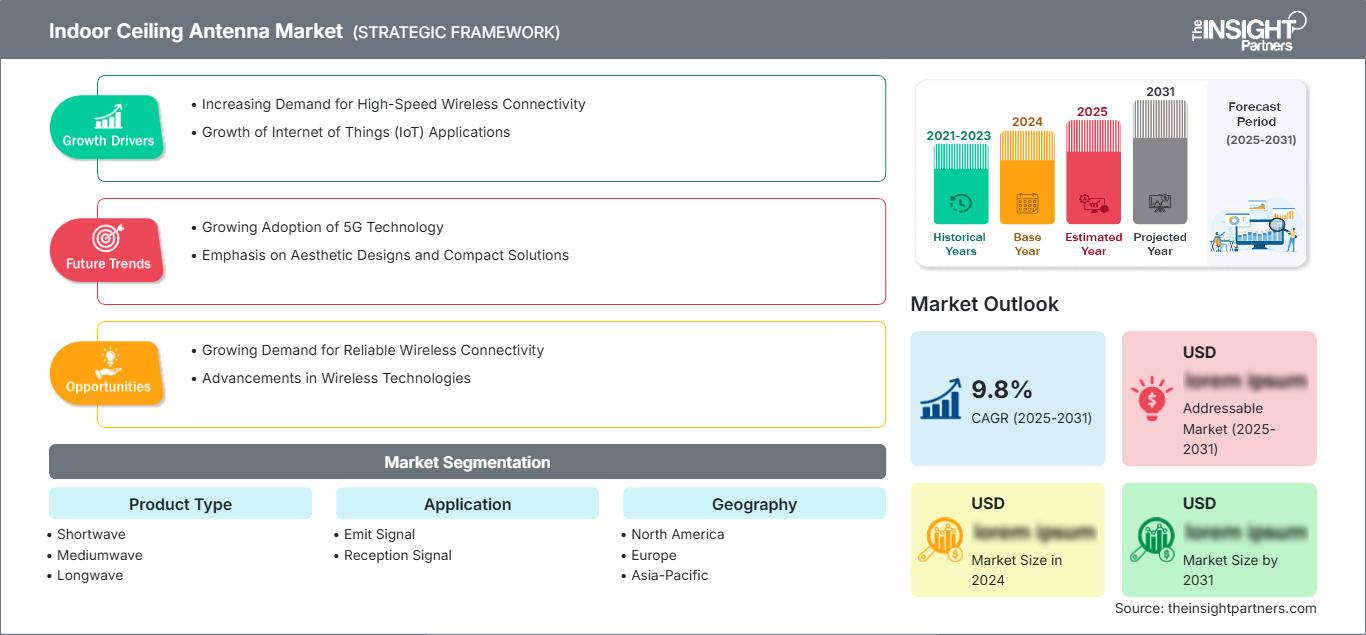
Indoor Ceiling Antenna Market: Strategic Insights
Regional Insights
North America Indoor Ceiling Antenna Market
North America accounted for a 36–40% share in 2025 and is projected to expand at a 2.7–3.1% CAGR through 2034. The area has existing cellular network infrastructure, mature enterprise wireless deployment, high public safety needs, and an installed base of commercial buildings. The United States is still the main market, but Canada also helps through connectivity for transport, commercial buildings, institutions, and industry. The demand is now related to multi-band network modernization rather than simply antenna upgrades.
The emergence of private cellular networks has increased the need for indoor coverage since enterprises require connectivity within manufacturing plants, logistics centers, campuses, and critical infrastructure. Research by the GSMA has highlighted the importance of private cellular networks as a model for enterprise connectivity, and Release 16 of 3GPP has defined non-public network functionalities. Such trends help promote antenna solutions that can cover various spectrum bands.
U.S. Indoor Ceiling Antenna Market
The US represented 82–86% of North American demand in 2025 and is expected to grow at a 2.7–3.1% CAGR during 2026–2034. Commercial office spaces, airports, hospitals, hotels, sports stadia, warehouses, and industrial parks continue to be vital application areas. Vendors with wide range of RF solutions can cater to both traditional distributed antenna systems as well as new private network implementations. The industry features rigorous performance specifications and relatively developed buying processes.
The applications are moving towards multi-band operation, neutral-host networks, 5G private networks, and public safety communications. For instance, Amphenol Antenna Solutions provides ultra-low profile indoor antennas capable of multiple MIMO combinations, showing how applications are moving towards small-sized products which will suit modern interiors. There is also a high contribution of operators, integrators, and enterprises in the US market, thus requiring multi-carrier antennas.
Europe Indoor Ceiling Antenna Market
Europe held a 25–29% share in 2025 and is forecast to grow at a 2.4–2.9% CAGR. Germany is the leading country, followed by the UK, France, Italy, and Spain. Market share of Indoor Ceiling Antenna market in the region is driven by enterprise wireless infrastructure, urban high-rise buildings, transportation infrastructure, and ongoing deployment of next-generation cellular technology.
UK gains from mobile and enterprise digitization, Germany from industrial infrastructure, transport and manufacturing industries, France from hospitality, healthcare, and commercial buildings. Italy and Spain bring in tourism, transportation, retail and large venues. In Europe in general, the presence of neutral host and private network solutions may eliminate the necessity of installing additional coverage systems, thus increasing demand for multi-band antennas with known RF behavior.
APAC Indoor Ceiling Antenna Market
APAC represented a 23–27% share in 2025 and is expected to register a 3.0–3.5% CAGR, making it the fastest-growing major region. China leads demand, followed by Japan, South Korea, India, and Australia. Manufacturing, commercial construction, transportation, smart-building programs, and private-network development support regional adoption.
China benefits from large-scale connectivity investment, while Japan and South Korea emphasize advanced wireless infrastructure. India is expanding enterprise digitization and private 5G adoption, while Australia supports demand across commercial and public infrastructure. GSMA has highlighted private-network development as an important component of enterprise digital transformation in Asia Pacific, reinforcing the need for dependable indoor radio coverage.
Middle East & Africa Indoor Ceiling Antenna Market
Middle East and Africa demand is projected to grow at a 2.5–3.0% CAGR through 2034, with the UAE and Saudi Arabia leading regional investment. South Africa remains the principal African market, while Rest of MEA demand is supported by commercial construction, hospitality, transportation, and enterprise digitization. Indoor coverage is increasingly incorporated into new building and infrastructure planning.
High-density venues and large commercial developments create requirements for dependable indoor connectivity, particularly where thick construction materials and extensive floor areas reduce signal penetration. Saudi Arabia and the UAE benefit from large infrastructure programs, while South Africa supports demand through business, healthcare, education, and transportation facilities. Regional adoption should remain linked to telecom investment, smart-building projects, and the expansion of enterprise wireless applications.
Segmentation Analysis
Product Type
Product Type is projected to grow at a 2.5–3.0% CAGR during 2026–2034. Demand differs according to operating frequency, propagation characteristics, coverage objectives, and system architecture. Product selection increasingly considers multi-band compatibility, installation constraints, radiation performance, and integration with distributed antenna systems. The segmentation remains relevant where indoor networks must balance coverage quality with architectural and deployment requirements.
- Shortwave: Shortwave products serve specialized lower-frequency communication requirements where propagation characteristics and building penetration are important. Their strategic relevance is concentrated in applications requiring dependable low-frequency indoor signal transmission or reception.
- Mediumwave: Mediumwave antennas support applications requiring balanced coverage and established radio-frequency operation. Demand depends on institutional, transportation, commercial, and specialized communication environments where frequency-specific performance remains important.
- Longwave: Longwave products address specialized low-frequency communication requirements and can benefit from applications where propagation through structures and dependable reception characteristics outweigh the need for compact high-frequency designs.
Application
Application is expected to expand at a 2.8–3.3% CAGR from 2026 to 2034. Indoor networks increasingly require both dependable transmission and reception, with system architecture determining the relative importance of each function. Antenna specifications therefore reflect coverage geometry, frequency selection, power handling, receiver sensitivity, and the desired balance between network capacity and installation complexity.
- Emit Signal: Emit Signal represents the principal application position because distributed systems require controlled transmission from RF sources to defined indoor coverage areas. Demand is linked to carrier, private-network, and enterprise deployments.
- Reception Signal: Reception Signal supports reliable collection of wireless signals within buildings where attenuation can reduce service quality. Its strategic importance is increasing as connected devices, mobility, and data-intensive indoor applications expand.
Opportunity Snapshot
| Application | Revenue Contribution | Trend Tag | Adoption Stage |
|---|---|---|---|
| Emit Signal | High | Multi-Band DAS | Mature |
| Reception Signal | High | Indoor Coverage | Scaling |
Indoor Ceiling Antenna Market Growth Drivers and Impact Analysis
Expansion of private cellular networks inside enterprises
Private cellular networks are increasing the number of enterprise environments where purpose-designed indoor radio coverage becomes necessary. Manufacturing factories, warehouses, airports, utility plants, and large campuses need reliable connectivity for mobile employees, sensors, autonomous vehicles, and operational systems. A survey conducted in 2025 by the industry indicated that there were 1,846 mobile network customers in 80 countries with 359 customers being from the manufacturing sector. This implies that there is potential in the design of ceiling antennas that incorporate private spectrum, neutral host infrastructure, and operation along with public cellular networks. 3image.png3GPP The effect on the market is not confined only to new buildings but existing ones may also need their antennas upgraded with the installation of a private network.
Increasing demand for reliable indoor mobile connectivity
There is an increasing need for wireless communication within buildings to ensure seamless communication, security, automation, digital services, and improved efficiency of employees. Structures made up of concrete, metal partitions, coated glass, elevators, and substructures have potential to cause dead zones that outdoor macro-cellular networks fail to address reliably. Indoor antenna solutions offer a controlled manner of deploying the radio frequencies within challenging indoor environments. Such a situation creates recurring demand in offices, hospitals, hotels, transport terminals, shopping centers, and recreational facilities. Increased demands for constant wireless communication regardless of technology and providers are only making such demands much higher. Manufacturers of antennas are increasingly competing on the basis of multi-band capability, aesthetic value, compatibility with MIMO, and ease of deployment.
Growth of multi-band and converged wireless infrastructure
Network operators and enterprises increasingly seek infrastructure capable of supporting multiple frequency bands rather than separate antenna systems for each technology. Convergence can lower cabling complexity, reduce ceiling penetrations, simplify maintenance, and improve the flexibility of future network upgrades. Amphenol’s in-building portfolio illustrates this direction through low-profile ceiling antennas available in 4x4 MIMO, 2x2 MIMO, and SISO configurations. The commercial effect is a shift toward higher-value antenna assemblies with broader frequency coverage and more demanding RF engineering. Suppliers able to maintain isolation, radiation consistency, passive intermodulation performance, and mechanical compactness across multiple bands can gain an advantage in complex building projects where installation costs and visual considerations materially affect purchasing decisions.
Indoor Ceiling Antenna Market Future Trends
Multi-band antennas will become central to converged indoor networks
The indoor ceiling antenna market trends are likely to center on antenna platforms supporting several cellular and enterprise wireless bands within compact ceiling-mounted designs. Future products should increasingly accommodate combinations of legacy cellular frequencies, 5G mid-band spectrum, public-safety requirements, and selected enterprise wireless technologies. This approach can reduce antenna density while supporting phased network upgrades. MIMO configurations will also become more important as operators seek better capacity and spatial performance indoors. Product development is likely to emphasize lower profiles, improved isolation, higher power handling, and easier commissioning. Manufacturers may increasingly provide configurable antenna families that allow integrators to select radiation patterns and frequency combinations for specific building layouts. The resulting procurement model should favor adaptable platforms over narrowly specified single-band products.
Indoor connectivity will converge with private-network architectures
Future deployments should increasingly treat antennas as components of broader enterprise connectivity architectures rather than isolated RF endpoints. Private 5G, neutral-host systems, edge computing, IoT, and industrial automation will create demand for coordinated radio coverage across operational and administrative spaces. Standardized private-network architectures can simplify the integration of radio access equipment, core functions, and enterprise applications, but antenna design will remain critical to achieving consistent coverage. GSMA research highlights multiple deployment models, including standalone, hybrid, and public-network-integrated private networks, indicating that indoor infrastructure must support different architectural choices. GSMA Suppliers are therefore likely to emphasize interoperability, configurable frequency support, installation flexibility, and lifecycle upgrade paths as customers move toward converged wireless environments.
Indoor Ceiling Antenna Market Opportunities
Retrofit programs for commercial and institutional buildings
The indoor ceiling antenna market forecasts indicate a sustained opportunity in retrofit projects where existing buildings require better wireless coverage without major structural changes. Offices, hospitals, hotels, universities, shopping centers, and transportation facilities can benefit from antenna upgrades that improve coverage while preserving existing cable routes and ceiling layouts. Suppliers can develop low-profile products designed for rapid replacement, multi-band operation, and compatibility with existing distributed antenna equipment. Integrators can also package antenna upgrades with testing, commissioning, and RF optimization services. Retrofit-focused strategies can be particularly attractive where building owners want to support new cellular bands without installing entirely separate antenna networks. Vendors that simplify installation and minimize visible equipment can strengthen their position in renovation and modernization projects.
Private 5G and neutral-host infrastructure partnerships
Investment opportunities are expanding around partnerships connecting antenna manufacturers with system integrators, mobile operators, private-network providers, and building technology companies. New enterprise deployments increasingly require coordinated decisions covering spectrum, radio equipment, antenna placement, cabling, network management, and application integration. Suppliers can capture value by developing antenna platforms prequalified for private 5G and neutral-host architectures, reducing engineering time for integrators. Opportunities are particularly relevant in factories, airports, logistics campuses, hospitals, and large commercial properties. The strongest positioning may come from companies that combine RF design with application-specific engineering and deployment support. Such partnerships can also improve access to projects where antenna specifications are determined early during building-network design rather than purchased as independent components.
Recent Developments
- February 2026: SureCall highlighted its SC-528W Ultra-Wideband Indoor Ultra-Thin Omni Antenna, a low-profile ceiling-mounted antenna designed to improve in-building cellular connectivity across 2G, 3G, 4G and 5G networks. The 360° omni-directional antenna supports 617–2700 MHz frequencies, offers up to 6 dBi gain and provides two mounting options for different ceiling types, making it suitable for discreet deployment in offices and other indoor environments.
- March 2026: Quectel expanded its small cell antenna portfolio with five new products launched at MWC Barcelona, adding greater flexibility in form factors, mounting options and performance for 5G and other wireless deployments. The range includes the YECJ095JPAM 5G ceiling-mount omnidirectional antenna for wide-area indoor coverage, the YEMG496KPAM 4×4 MIMO directional antenna for high-capacity applications, and the YEMG492WPAM stadium antenna designed to support reliable connectivity and high data throughput for thousands of simultaneous users.
- April 2026: Southwest Antennas joined the HEICO Corporation family as part of HEICO’s Electronic Technologies Group, with HEICO acquiring a majority ownership stake while CEO Ben Culver retained a minority interest and continued to lead the company. The partnership gives Southwest Antennas additional resources, operational support and strategic opportunities to expand its rugged RF and microwave antenna solutions for military, public safety and unmanned systems applications.
Frequently Asked Questions

- Comprehensive Market Sizing and Forecast Analysis
- Detailed Segmentation Analysis
- In-Depth Market Dynamics Assessment
- Regional and Country-Level Insights
- Competitive Landscape and Company Benchmarking
- Strategic Business Intelligence
Recent Reports
Testimonials

The Insight Partners' SCADA System Market report is comprehensive, with valuable insights on current trends and future forecasts. The team was highly professional, responsive, and supportive throughout. We are very satisfied and highly recommend their services.
RAN KEDEM Partner, Reali Technologies LTDs
I requested a report on a very specific software market and the team produced the report in a few days. The information was very relevant and well presented. I then requested some changes and additions to the report. The team was again very responsive and I got the final report in less than a week.
JEAN-HERVE JENN Chairman, Future Analytica
We worked with The Insight Partners for an important market study and forecast. They gave us clear insights into opportunities and risks, which helped shape our plans. Their research was easy to use and based on solid data. It helped us make smart, confident decisions. We highly recommend them.
PIYUSH NAGPAL Sr. Vice President, High Beam Global
The Insight Partners delivered insightful, well-structured market research with strong domain expertise. Their team was professional and responsive throughout. The user-friendly website made accessing industry reports seamless. We highly recommend them for reliable, high-quality research services
YUKIHIKO ADACHI CEO, Deep Blue, LLC.
This is the first time I have purchased a market report from The Insight Partners.While I was unsure at first, I visited their web site and felt more comfortable to take the risk and purchase a market report.I am completely satisfied with the quality of the report and customer service. I had several questions and comments with the initial report, but after a couple of dialogs over email with their analyst I believe I have a report that I can use as input to our strategic planning process.Thank you so much for taking the extra time and making this a positive experience.I will definitely recommend your service to others and you will be my first call when we need further market data.
JOHN SUZUKI President and Chief Executive Officer, Board Director, BK Technologies
I wish to appreciate your support and the professionalism you displayed in the course of attending to my request for information regarding to infectious disease IVD market in Nigeria. I appreciate your patience, your guidance, and the fact that you were willing to offer a discount, which eventually made it possible for us to close a deal. I look forward to engaging The Insight Partners in the future, all thanks to the impression you have created in me as a result of this first encounter.
DR CHIJIOKE ONYIA MANAGING DIRECTOR, PineCrest Healthcare Ltd.Reason to Buy
- Informed Decision-Making
- Understanding Market Dynamics
- Competitive Analysis
- Identifying Emerging Markets
- Customer Insights
- Market Forecasts
- Risk Mitigation
- Boosting Operational Efficiency
- Strategic Planning
- Investment Justification
- Tracking Industry Innovations
- Aligning with Regulatory Trends





 Get Free Sample for