
Indoor Flooring Market Growth, Trends & Forecast 2034
Coverage: By Type (Ceramic Tiles, Carpet, Vinyl Linoleum & Rubber, Wood & Laminate, and Others) and End user (Residential and Non-Residential)
- Status : Data Released
- Report Code : TIPRE00018576
- Category : Manufacturing and Construction
- No. of Pages : 150
- Available Report Formats :


- Last update date : August 28, 2026


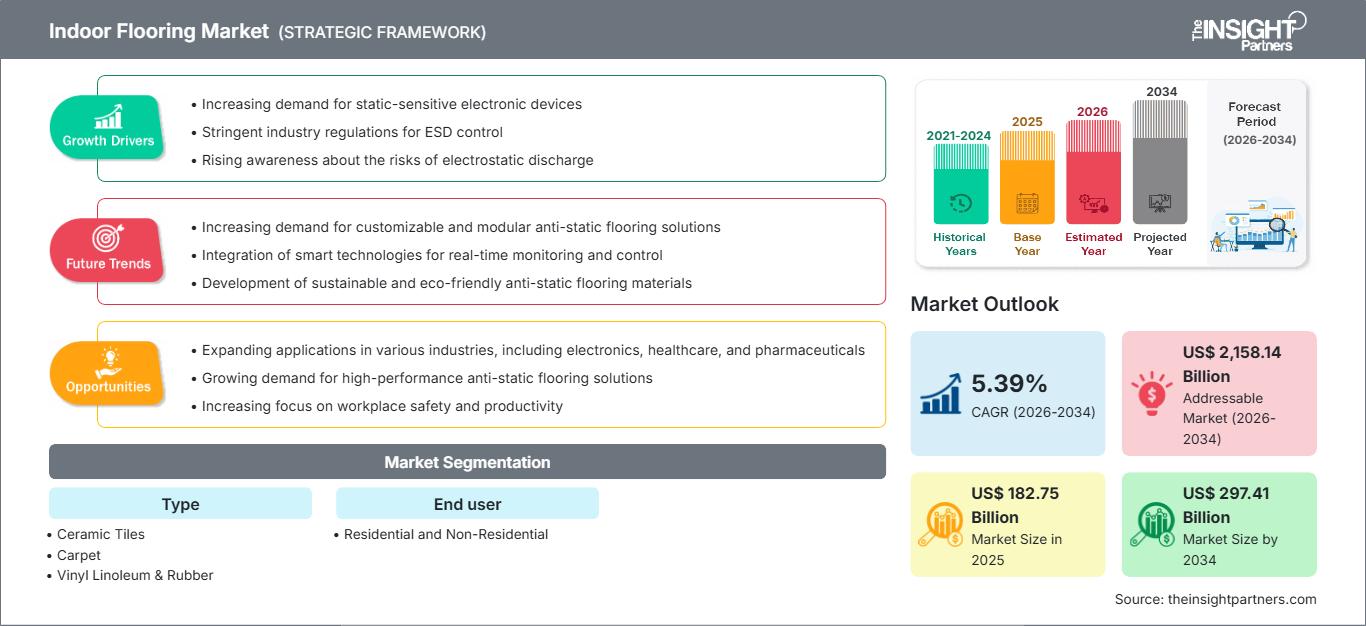
2025 Market Size
US$ 182.75 Bn
Base year value
2034 Forecast
US$ 297.41 Bn
Projected by 2034
CAGR 2026-2034
5.39 %
Growth rate
Addressable Market
US$ 2,158.14 Bn
(2026-2034)
The indoor flooring market was valued at US$ 182.75 Billion in 2025 and is projected to reach US$ 297.41 Billion by 2034, expanding at a CAGR of 3.55% during 2026–2034. Demand spans ceramic tiles, carpet, vinyl linoleum and rubber, and wood and laminate products serving residential and non-residential settings, with replacement cycles, specification requirements, and construction activity shaping purchasing decisions across the value chain.
Across North America, the indoor flooring market size is expected to advance at a modeled 3.0–3.4% CAGR through 2034. An aging building stock supports renovation-led replacement, while healthcare, education, and workplace upgrades favor durable, low-emission surfaces. Near-term residential demand remains rate-sensitive, but local manufacturing, broad distribution, and rising interest in waterproof resilient products provide structural support for specification and retail channels.
Indoor Flooring Market Assessment and Insights
- North America: Represented 27–29% share in 2025 and is modeled to grow at 3.0–3.4% CAGR during 2026–2034, supported by replacement demand, institutional refurbishment, domestic capacity, and resilient-flooring adoption.
- US: Accounted for 84–87% of North American demand in 2025 and is modeled at 3.0–3.4% CAGR through 2034 as renovation offsets housing-cycle weakness.
- Europe: Held 24–26% share in 2025 and is modeled at 2.7–3.1% CAGR during 2026–2034. Germany leads, while the UK, France, Italy, and Spain sustain renovation demand.
- Asia Pacific: Captured 35–38% share in 2025 and is modeled at 4.1–4.6% CAGR during 2026–2034, led by China and supported by India, Japan, South Korea, and Australia.
- Largest Segment: Ceramic Tiles held 37–40% market share in 2025 and is modeled at 3.0–3.4% CAGR during 2026–2034, reflecting durability and broad residential use.
- High Growth Segment: Vinyl Linoleum & Rubber held 23–26% market share in 2025 and is modeled at 4.4–4.9% CAGR during 2026–2034 as modular resilient formats scale.
- Key companies analyzed in detail: Forbo Holding Ltd., Tarkett S.A., Beaulieu International Group N.V., Ecore International, Inc., Interface, Inc., TOLI Corporation, Mohawk Industries, Inc., Gerflor SAS, Altro Limited, and Polyflor Ltd.
Source: The Insight Partners' analysis based on proprietary research, government publications, company annual reports, investor presentations, industry databases, and expert interviews.
Engineering materials has moved interior surfaces from being predominantly decorative coatings to performative systems that combine water resistance, dimensional stability, sound management, and reduced carbon content. Print technology has increased the accuracy of wood and stone reproduction, while click-to-lock systems and module design help decrease installation time. Manufacturers must now reconcile international sourcing of resins, fibers, wood, and minerals with localized finishing and distribution. Capacity rationalization is key since soft residential applications tend to underutilize facilities whereas commercial orders have smaller run lengths and require verified emissions and product certifications for specific applications.
Demand through 2034 will diversify within India, Southeast Asia, the Gulf states, and select African cities as home deliveries and institutional builds increase. Capital investment will focus on durable flooring, decorative automation, recycling systems, and regional distribution centers. Building decarbonization regulations and public procurement policies reward products with environmental statements, low volatile-organic-compounds emissions, and end-of-life take-back. Manufacturers can capitalize on these requirements by streamlining specification and install information.
Indoor Flooring Market Report Scope
| Report Attribute | Details |
|---|---|
| Market size in 2025 | US$ 182.75 Billion |
| Market Size by 2034 | US$ 297.41 Billion |
| Global CAGR (2026 - 2034) | 5.39% |
| Historical Data | 2021-2024 |
| Forecast period | 2026-2034 |
Indoor Flooring Market Analysis
Market expansion for interior flooring is contingent upon the repeat nature of the business, completion of urban construction, and renovations in hospitals, educational institutions, hospitality, retail stores, and offices. Flooring choices are being guided by factors such as the total cost to install, time off due to renovation, maintenance costs, anti-slip properties, sound absorption, and emission controls more than just the initial price point.
There is variability in upstream exposure for each type of product; ceramics use clays, feldspar, energy and firing of the kilns, resilient products use polymers, fillers, plasticizers, and backing systems, carpets use yarns and backing systems, wood and laminate use foresting raw materials, panels, coatings, and transportation. Distributors, dealers, architects, installers, and facility managers affect the conversion process.
Market analysis of the indoor flooring suggests a fragmented competition featuring globally scaled players and categories specialists. While Mohawk Industries, Inc. operates across ceramic, carpet, resilient, laminate, and wood categories, Tarkett S.A. and Gerflor SAS focus on commercial resilient systems. Interface, Inc. and Forbo Holding Ltd. stand out due to their unique product features such as modular design and carbon reductions and proven circularity.
Capital deployment is going into automation, recycling feedstock, captured carbon materials, digital visualization, and distribution efficiencies. Beaulieu International Group N.V., TOLI Corporation, Ecore International, Inc., Altro Limited, and Polyflor Ltd. create a competitive advantage through the application knowledge in healthcare, transport, education, sports, and safety flooring. Competitive advantage becomes more dependent on combining extensive portfolios with environmental data, local inventory, installer networks, and strict pricing policies.
● REPORT CUSTOMIZATION
Tailor This Report To Align With Your Specific Business Requirements
This report can be customized to align precisely with your business objectives, scope, and target markets. Customization options include tailored segmentation, geography, competitive analysis, and strategic insights to support informed decision-making.
Customize This Report →WHAT YOU CAN ADJUST
- ● Segmentations
- ● Geography
- ● Competitive Analysis
- ● Language Preferences
Indoor Flooring Market: Strategic Insights
Regional Insights
North America indoor flooring market
North America represented 27–29% of global demand in 2025 and is modeled to expand at 3.0–3.4% CAGR during 2026–2034. Indoor flooring market share has an extensive installed base, well established replacement channels, and relatively high per-project spend. Higher borrowing rates limit remodeling projects but aging properties, insurance fixes, and apartment turnover provide sustained demand. Waterproof vinyl, laminate, and engineered wood win when time, maintenance certainty, and realism are valued by the installer and consumer.
Commercial demand is more consistent for healthcare facilities, educational institutions, data centers, hotels, and office renovations. Requests for Environmental Product Declarations, reduced emissions, acoustics, and take-back are increasing in specifications. Regional manufacturing minimizes the risk from freight costs but finished goods and raw material imports still face tariff risks. Big box stores drive residential selections while architects, dealers, and specialty contractors drive non-residential conversions. Suppliers with regional inventory, consistent color lines, and fast sampling capabilities will succeed under tight project schedules.
U.S. Indoor Flooring Market
The U.S. accounted for 84–87% of North American demand in 2025 and is modeled at 3.0–3.4% CAGR through 2034. This industry has significant size as it involves a wide range of housing, retail, healthcare, education, hospitality, and corporate properties. Transactions for existing homes and the affordability of mortgage have significant impact on residential replacement in this market segment. Public and institutional projects will have more visibility, especially for rubber, sheet vinyl, carpet tile, and safety surfaces which will require infection control, acoustic or slip performance properties.
Mohawk Industries, Inc., Interface, Inc., Ecore International, Inc., Tarkett S.A., and Forbo Holding Ltd. have substantial presence in the commercial, manufacturing, or distribution channels. Category adoption varies based on the applications: luxury vinyl tile and waterproof laminate cater to multifamily and renovation requirements; modular carpet caters to office and education requirements; and ceramics are vital in kitchens, bathrooms, and hospitality. Local production and regional warehousing help in reducing the lead time but imports will increase procurement risks.
Europe Indoor Flooring Market
Europe held 24–26% share in 2025 and is modeled at 2.7–3.1% CAGR during 2026–2034. Germany dominates based on its construction sector, technical standards, and renovation projects. The UK focuses on renovations, rental, healthcare, education, and office refurbishment, which favors carpet tile, safety flooring, and resilient sheet. The energy efficiency programs of Germany along with preference of durable and well-documented materials favor laminate, wood, linoleum, and commercial resilient. However, the lack of building permits hampers the volume in the short term.
France blends public renovations with hospitality and multifamily market trends, promoting low emission and design driven resilient surface products. The cluster of ceramic manufacturing in Italy promotes product innovation, exportability, and high end tiles. In Spain, hospitality renovation and residential improvements favor ceramic and laminate. Circular procurement, environmental declaration and renovation policies help to create differentiation while high energy, labor and compliance costs burden small companies and drive automation, portfolio simplification and recycling alliances across the region.
APAC Indoor Flooring Market
Asia Pacific captured 35–38% indoor flooring market share in 2025 and is modeled at 4.1–4.6% CAGR during 2026–2034, making it the leading region. Manufacturing along with renovation and commercial demands characterize China, whereas the urban housing and institutional building in India widen the customer base. Quality, small spaces, and low emission material are preferred in Japan and South Korea, whereas Australia prefers top-notch renovation and commercial specifications.
The industrial policy emphasizes local production capacity, automation, and better materials. The ceramic material is still fundamental, but resilient planks, laminate, and specialized commercial materials become more popular.
Middle East & Africa Indoor Flooring Market
Middle East and Africa demand is modeled at 4.0–4.5% CAGR during 2026–2034. Saudi Arabia leads through tourism, housing, healthcare, and large mixed-use projects, while the UAE sustains hospitality and premium commercial refurbishment. South Africa anchors the sub-Saharan formal market, and the rest of MEA remains project-led, with uneven distribution depth.
Energy-intensive ceramic production benefits from regional fuel access but remains exposed to kiln efficiency and freight economics. Imported resilient, carpet, and wood products compete on lead time, certification, and installer availability.
Segmentation Analysis
Type
Type is modeled at 3.4–3.8% CAGR during 2026–2034. The indoor flooring market scope spans mineral, textile, resilient, and wood-based systems with distinct installation, durability, maintenance, and design economics. Ceramic retains scale, while resilient formats gain from modularity and waterproof performance. Carpet remains relevant where comfort and acoustics matter, and wood and laminate serve customers seeking natural aesthetics at differentiated price points.
- Ceramic Tiles: The largest category serves kitchens, bathrooms, hospitality, retail, and public spaces. Durability, water resistance, design printing, and established installer networks preserve strategic importance.
- Carpet: Demand concentrates in bedrooms, offices, education, and hospitality where softness, acoustics, and modular replacement matter. Recycled yarn and low-carbon backing improve specification relevance.
- Vinyl Linoleum & Rubber: The fastest-growing category benefits from resilient performance, cleanability, adhesive-free options, and rapid installation across healthcare, schools, multifamily housing, retail, and workplaces.
- Wood & Laminate: Natural visuals and renovation appeal support demand. Waterproof cores, improved wear layers, responsible forestry, and click-lock installation broaden adoption beyond traditional living areas.
End user
End user demand is modeled at 3.3–3.7% CAGR during 2026–2034. Residential purchasing follows housing completions, turnover, repair, and discretionary remodeling, while non-residential specifications follow project pipelines and lifecycle requirements. Residential channels prioritize appearance, water resistance, price, and do-it-yourself compatibility. Non-residential buyers emphasize compliance, downtime, acoustics, cleaning, wear performance, warranty administration, and consistent availability across multi-site portfolios.
- Residential: Replacement and remodeling dominate mature economies, while new housing contributes more in urbanizing markets. Retail display, digital visualization, installer access, and financing influence conversion.
- Non-Residential: Healthcare, education, hospitality, office, retail, and public projects create specification-led demand. Lifecycle cost, safety, acoustics, hygiene, environmental documentation, and phased installation determine product choice.
Opportunity Snapshot
| End user | Revenue Contribution | Trend Tag | Adoption Stage |
| Residential | High | Waterproof Renovation | Mature |
| Non-Residential | High | Circular Specification | Scaling |
Indoor Flooring Market Growth Drivers and Impact Analysis
Renovation-Led Replacement Across Aging Buildings
The rate at which flooring wears out exceeds that of building structures, resulting in a recurring need for replacements irrespective of any reduction in new builds. Old houses, schools, hospitals, hotels, shops, and offices have the need for flooring solutions to combat issues such as water damage, accessibility, sound control, sanitation, and aesthetics. In renovation situations, there is a preference for flooring that requires minimal disruption and downtime during installation, especially click-lock resilient planks, carpet tile, loose lay sheets, and floating laminate. Besides the increase in the quantity of floorings required, there are opportunities for suppliers to capitalize on the need for accessories, sub-floor preparation systems, moisture protection, and installer training.
Performance Specifications Reshape Product Mix
Flooring products in the indoor flooring market are being increasingly scrutinized as systems that play a role in impacting safety, indoor air quality, maintenance costs, acoustics, and operability. Healthcare organizations require flooring with weldable and cleanable surfaces, whereas educational institutions emphasize acoustics and reparability. Hospitality facilities are looking for consistent design and stain-resistant flooring. Businesses want modular and low-carbon flooring. Residential customers are interested in water-resistant and scratch-resistant flooring. This changes the focus to wear layers, backings, acoustical underlays, emission-free adhesives, and proven slip-resistant properties. Floorings that provide evidence of performance can defend their pricing and get specified more. Otherwise, they would be in danger of commoditization and pricing erosion. The resulting impact of this trend is an increased variety of product lines, stronger sales force, and collaboration between all stakeholders.
Urban Housing and Institutional Construction Expand Demand
The increase in urban population as well as the process of housing, healthcare, education, retail, and hospitality sectors becoming formalized will increase the demand in the indoor flooring market. Most importantly, the impact would be the largest in the Asia Pacific as well as certain Middle Eastern regions where the development is based on cost, speed of development, climatic conditions, and maintainability. Ceramic products can use their strengths in heat resistance and moisture resistance, while resilient and laminate products would benefit due to fast fit-out and interior consistency. Such large developments generate follow-up demand in the form of replacement cycles. This market can be accessed through product localization, education of contractors, spec sheets, and local stocks.
Indoor Flooring Market Future Trends
Carbon-Storing and Circular Material Platforms
The indoor flooring market trends will focus more on carbon reduction which is substantiated as compared to the sustainability concept. Manufacturers will be experimenting with biobased binders, carbon captured fillers, backing from recycling, energy for production from renewable sources, and systems which will help recover installed products. There will be a better standardization of environmental declarations at the product level as procurement personnel will ask for cradle-to-gate information and recycled content. Design will evolve with separable layers, standardized material flows, and adhesives that help in recovering materials. In commercial purchases, companies should give marks not only on cost and aesthetics but also on collection and recycling abilities of the supplier.
Digitally Enabled Selection and Installation
Digitization in the indoor flooring market would link together inspiration, specification, ordering, and installation more effectively. Visualizing rooms would cut down on the uncertainty of homeowners, while building information modeling and digitized samples would enable architects to assess the performance and environmental characteristics earlier. Pattern optimization would prevent wastage due to cutting, and connected measurement tools would enhance the estimation process. These interfaces should be linked by manufacturers to inventory availability, accessory compatibility, and installation scheduling, not treated as standalone marketing efforts. The business advantage would lie in faster selection processes, fewer substitution requests, and more complete orders. Information from search and specification behavior could be used for assortment planning and regional inventory management while ensuring consumer privacy.
Indoor Flooring Market Opportunities
Localized Resilient-Flooring Capacity in Growth Markets
The indoor flooring market forecast supports select investments in the processes of compounding, calendaring, coating and finishing of resilient floors closer to the areas of demand in India, South East Asia, Gulf and some African countries. Regional production will provide benefits of shorter lead time, reduced freight costs, adjustment of design according to local taste, and easier access to public/developer projects that favor local production. Investors should focus on modular machinery, good laboratory facilities and technical services rather than economies of scale only. Collaboration with local distributors/installers is crucial since it reduces risks for entering the market. Flexibility of raw materials is necessary due to changing prices for polymers, fillers and backings.
Service-Led Commercial Replacement Programs
Manufacturers and distributors in the indoor flooring market can convert episodic commercial sales into recurring programs by combining floor-condition audits, phased replacement plans, standardized palettes, local inventory, installation coordination, and take-back services. Multi-site healthcare, education, hospitality, retail, and corporate customers value predictable downtime and consistent appearance across locations. Contract structures can bundle products, accessories, maintenance guidance, and recovery obligations while preserving competition at renewal. The opportunity requires digital asset records, trained installers, and clear performance metrics. Suppliers should begin with categories suited to selective replacement, such as carpet tile, rubber tile, and modular resilient flooring. Successful programs improve demand visibility, customer retention, and material recovery while reducing emergency procurement.
Recent Developments
- June 2026: Interface, Inc. released its 2025 Impact Report, reporting a 4% year-over-year reduction in the footprint of its total product portfolio, deployment of captured carbon in carpet-tile manufacturing, and more than 450 carbon-negative flooring options depending on location. The update links product development with supplier assessment, renewable energy, recycled content, and operational execution.
- April 2026: Tarkett S.A. published its 2025 Sustainability Statement, reporting that recycled materials reached 20% of raw materials, renewable sources supplied 43% of energy consumption, and the ReStart take-back program operated in 29 countries. The company also reported 160,000 tons of recycled materials used during 2025, supporting broader circular-flooring specifications.
- September 2025: Forbo Holding Ltd. expanded its Evolve+ low-embodied-carbon carpet-tile family with Tessera Tranquillity. The collection uses regenerated polyamide yarn, contains 76% recycled content by weight, and carries a third-party-verified cradle-to-gate footprint of 1.66 kg CO2 equivalent per square meter without offsets, targeting office and education projects.
Frequently Asked Questions

- Comprehensive Market Sizing and Forecast Analysis
- Detailed Segmentation Analysis
- In-Depth Market Dynamics Assessment
- Regional and Country-Level Insights
- Competitive Landscape and Company Benchmarking
- Strategic Business Intelligence
Recent Reports
Testimonials

The Insight Partners provided valuable market intelligence that supported our global go-to-market strategy. Their team was professional, responsive, and attentive to our feedback, providing thoughtful analysis and helpful methodological clarifications throughout the project.
Junmo Kim Chief Financial Officer (CFO), Enertech Co., Ltd.
The Insight Partners' SCADA System Market report is comprehensive, with valuable insights on current trends and future forecasts. The team was highly professional, responsive, and supportive throughout. We are very satisfied and highly recommend their services.
RAN KEDEM Partner, Reali Technologies LTDs
I requested a report on a very specific software market and the team produced the report in a few days. The information was very relevant and well presented. I then requested some changes and additions to the report. The team was again very responsive and I got the final report in less than a week.
JEAN-HERVE JENN Chairman, Future Analytica
We worked with The Insight Partners for an important market study and forecast. They gave us clear insights into opportunities and risks, which helped shape our plans. Their research was easy to use and based on solid data. It helped us make smart, confident decisions. We highly recommend them.
PIYUSH NAGPAL Sr. Vice President, High Beam Global
The Insight Partners delivered insightful, well-structured market research with strong domain expertise. Their team was professional and responsive throughout. The user-friendly website made accessing industry reports seamless. We highly recommend them for reliable, high-quality research services
YUKIHIKO ADACHI CEO, Deep Blue, LLC.
This is the first time I have purchased a market report from The Insight Partners.While I was unsure at first, I visited their web site and felt more comfortable to take the risk and purchase a market report.I am completely satisfied with the quality of the report and customer service. I had several questions and comments with the initial report, but after a couple of dialogs over email with their analyst I believe I have a report that I can use as input to our strategic planning process.Thank you so much for taking the extra time and making this a positive experience.I will definitely recommend your service to others and you will be my first call when we need further market data.
JOHN SUZUKI President and Chief Executive Officer, Board Director, BK Technologies
I wish to appreciate your support and the professionalism you displayed in the course of attending to my request for information regarding to infectious disease IVD market in Nigeria. I appreciate your patience, your guidance, and the fact that you were willing to offer a discount, which eventually made it possible for us to close a deal. I look forward to engaging The Insight Partners in the future, all thanks to the impression you have created in me as a result of this first encounter.
DR CHIJIOKE ONYIA MANAGING DIRECTOR, PineCrest Healthcare Ltd.Reason to Buy
- Informed Decision-Making
- Understanding Market Dynamics
- Competitive Analysis
- Identifying Emerging Markets
- Customer Insights
- Market Forecasts
- Risk Mitigation
- Boosting Operational Efficiency
- Strategic Planning
- Investment Justification
- Tracking Industry Innovations
- Aligning with Regulatory Trends






 Get Free Sample for