
Industrial and Bar-b-que Charcoal Market Drivers, Trends, and Forecast by 2034
Coverage: By Type (Lump Charcoal, Japanese Charcoal, Charcoal Briquette, Extruded Charcoal, Charcoal Briquette, Sugar Charcoal); Application (Industrial, Bar-b-que) , and Geography (North America, Europe, Asia Pacific, and South and Central America)
- Status : Data Released
- Report Code : TIPRE00021626
- Category : Chemicals and Materials
- No. of Pages : 150
- Available Report Formats :


- Last update date : September 02, 2026


2025 Market Size
US$ 4.8 Bn
Base year value
2034 Forecast
US$ 7.03 Bn
Projected by 2034
CAGR 2026-2034
4.31 %
Growth rate
Addressable Market
US$ 53.66 Bn
(2026-2034)
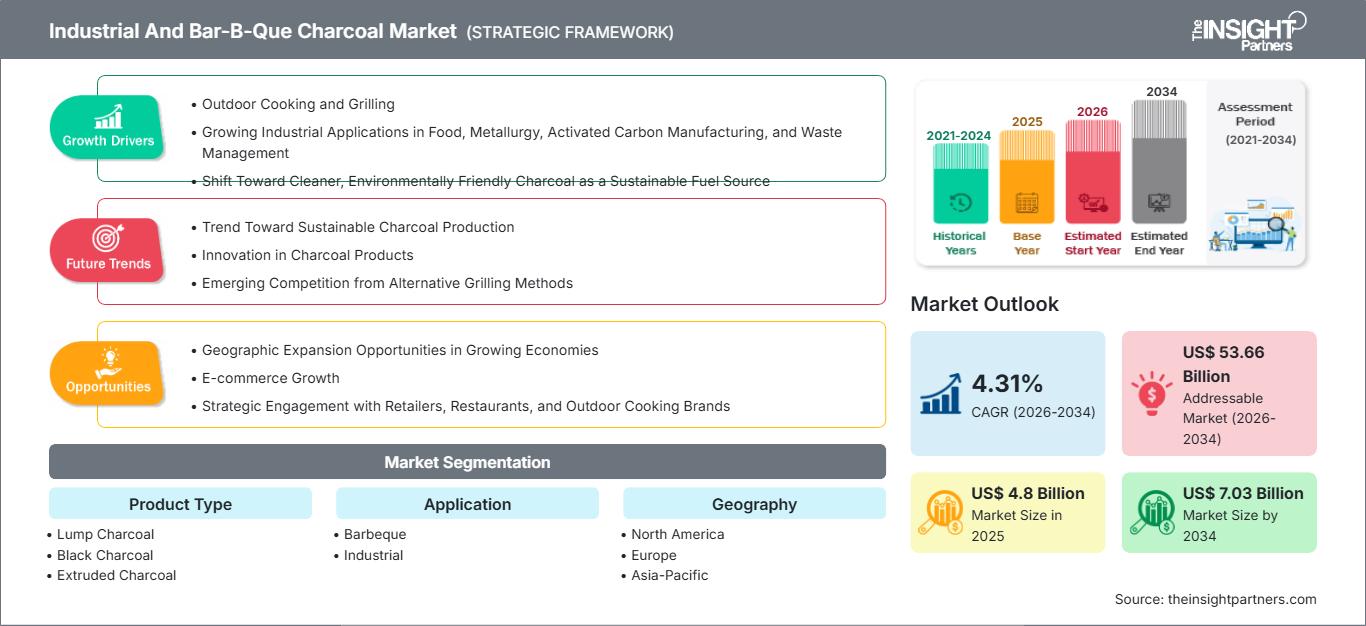
The industrial and barbecue charcoal market is projected to grow from US$ 4.8 Billion in 2025 to US$ 7.03 Billion by 2034, registering a CAGR of 4.31% during 2026–2034. Market expansion is supported by sustained demand from outdoor cooking, foodservice, metallurgical processes, and other heat-intensive applications. Product innovation, improvements in carbonization efficiency, and increasing interest in traceable and responsibly sourced biomass are also reshaping production and distribution strategies.
In North America, the industrial and barbecue charcoal market size is supported by an established outdoor grilling culture and a broad retail network serving households, restaurants, and commercial users. The regional market is expected to expand at an estimated CAGR of 3.8–4.4% during 2026–2034. Premium hardwood products, convenience-oriented packaging, and demand for consistent-burning fuel are strengthening product differentiation, while industrial users continue to prioritize predictable calorific performance and dependable supply.
Industrial and Bar-b-que Charcoal Market Assessment and Insights
- North America: North America accounted for an estimated 32–36% Industrial and Barbecue Charcoal Market share in 2025, supported by strong household grilling participation, developed retail distribution, and established branded suppliers. The regional market is projected to grow at a CAGR of 3.8–4.4% between 2026–2034 as premium and convenience-oriented products gain traction.
- US: The US represented approximately 78–82% of the North American market in 2025. Demand is supported by backyard cooking, foodservice consumption, and industrial applications, with growth estimated at 3.7–4.3% during 2026–2034.
- Europe: Europe held an estimated 24–28% share in 2025 and is projected to expand at a CAGR of 3.6–4.2% between 2026–2034. Germany, the UK, France, Italy, and Spain remain important consumption centers, supported by retail grilling demand and industrial carbon applications.
- Asia Pacific: Asia Pacific accounted for approximately 27–31% of the market in 2025 and is expected to record a CAGR of 4.8–5.5% during 2026–2034. China, India, Japan, South Korea, and Australia support demand through industrial activity, food preparation, and expanding organized retail channels.
- Largest Segment: Barbeque represented an estimated 54–58% market share in 2025. Its broad consumer base and established distribution channels are expected to support a CAGR of 4.0–4.6% through 2034.
- High Growth Segment: Industrial applications accounted for approximately 42–46% in 2025 and are expected to expand at a CAGR of 4.7–5.4% during 2026–2034, supported by metallurgical and specialized processing requirements.
- Key companies analyzed in detail: Maurobera S.A.S., Blackwood Charcoal Company, Duraflame, Inc., BRICAPAR S.A.S., Saint Louis Charcoal Company, Royal Oak Enterprises, LLC, Timber Charcoal Company, Mesjaya Abadi Sdn. Bhd., Parker Charcoal Company, Kingsford Products Company.
Source: The Insight Partners' analysis based on proprietary research, government publications, company annual reports, investor presentations, industry databases, and expert interviews.
Product manufacturing has evolved from being fragmented and localized towards more efficient distribution networks which incorporate branded consumer products with industrial-quality material. Innovations in kilns and process gases utilization, along with better moisture management, will help in producing better quality products. However, the market is still vulnerable to changes in supply of hardwoods, forest management policies, logistics and seasonality of demand. Therefore, in the industrial and barbecue charcoal market, it is supply chain management that counts rather than increasing production volumes.
In terms of future development, the growing consumer bases in Asia Pacific, Middle East and selected African markets are likely to be sources of investments in processing and distribution infrastructure. Regulatory emphasis on sourcing of sustainable biomass and prohibition of illegal deforestation will possibly be an advantage for those manufacturers who can produce branded products with the help of certified or documented feedstock, high-quality carbonization and good quality control.
Industrial and Bar-b-que Charcoal Market Report Scope
| Report Attribute | Details |
|---|---|
| Market size in 2025 | US$ 4.8 Billion |
| Market Size by 2034 | US$ 7.03 Billion |
| Global CAGR (2026 - 2034) | 4.31% |
| Historical Data | 2021-2024 |
| Forecast period | 2026-2034 |
Industrial and Bar-b-que Charcoal Market Analysis
The demand for industrial and barbecue charcoal market is driven by two types of consumerism systems: non-centralized purchase from individual households and foodservice consumers, and specified type of industrial demand. Development of the market is underpinned by outdoor cooking, grilling in restaurants, metallurgy, chemical industry, and specialty filtration purposes. The chain of supply starts with wood/biomass acquisition, then follows carbonization, screening, grading, packaging, transport, and delivery of the product. The supply situation is determined by the availability of raw materials, kiln performance, conversion rate, and compliance with forestry and environmental standards.
For individual consumers, there is demand for consistent ignition, heat retention, minimal smoke emission, and convenience of packaging. In case of industrial demand, fixed carbon, ash percentage, particle size, moisture, and calorific qualities are important. Due to this diversity of demands, there are good incentives for the producers to maintain a wide range of product grades. Import/export of the product is relevant due to the localization of production and consumption sites.
The Industrial and Barbecue Charcoal Market report shows that the competitive structure comprises consumer-oriented multinational brands, regional players, and many local producers. Duraflame, Inc. and Kingsford Products Company have the advantage of consumer channels, whereas Royal Oak Enterprises, LLC and Saint Louis Charcoal Company have strengths in branded charcoal products. Maurobera S.A.S., BRICAPAR S.A.S., Blackwood Charcoal Company, Timber Charcoal Company, Mesjaya Abadi Sdn. Bhd., Parker Charcoal Company and other specialists compete by having the source connections and product reliability.
In investment terms, focus moves to production efficiency, packaging technology, feedstock supply chain management, and distribution capacity. The market analysis for industrial and barbecue charcoal reveals that the strategic positioning is not anymore so much dependent on the production capacity only. Differentiated products and retailers' relationship, as well as traceability, are needed. Vertical coordination with forestry producers and biomass producers may help to stabilize the feedstock supply chain, while investments in more modern kilns may increase the yield rate and lower the emissions rate.
● REPORT CUSTOMIZATION
Tailor This Report To Align With Your Specific Business Requirements
This report can be customized to align precisely with your business objectives, scope, and target markets. Customization options include tailored segmentation, geography, competitive analysis, and strategic insights to support informed decision-making.
Customize This Report →WHAT YOU CAN ADJUST
- ● Segmentations
- ● Geography
- ● Competitive Analysis
- ● Language Preferences
Industrial and Bar-b-que Charcoal Market: Strategic Insights
Regional Insights
North America Industrial and Barbecue Charcoal Market
North America accounted for an estimated 32–36% of the industrial and barbecue charcoal market in 2025 and is projected to grow at a CAGR of 3.8–4.4% through 2034. The region benefits from deeply established grilling traditions, extensive home-improvement and mass-retail distribution, and significant demand from restaurants and catering operations. Branded products command particular importance because consumers increasingly compare ignition performance, burn duration, smoke generation, and packaging convenience when selecting charcoal products.
The structural demand is boosted by the seasonality of the outdoors, by the consumption pattern of the suburbs, and through multi-channel retail. The producers also cater to the needs of industrial consumers who need carbon-based substances with specific physical characteristics. The resiliency of the supply chain becomes critical owing to the impacts of weather-related incidents, cost of transportation, and the availability of hardwood. The result is that the North American industry of charcoal for industrial and barbecue purposes increasingly favors companies with reliable sourcing, efficient production, quality assurance, and well-established distribution networks.
U.S. Industrial and Barbecue Charcoal Market
The US represented approximately 78–82% of North American demand in 2025 and is expected to record a CAGR of 3.7–4.3% during 2026–2034. Its scale reflects high household participation in grilling, strong foodservice demand, and extensive nationwide distribution. Major branded suppliers maintain broad retail presence, while regional producers compete through hardwood varieties, premium lump formats, and locally sourced product positioning.
Product application trends are expanding product ranges beyond their traditional backyard use. Restaurants look for uniform heat patterns, whereas industrial consumers analyze fixed carbon, ash, moisture, and particle content. Established companies like Kingsford Products Company and Royal Oak Enterprises, LLC have an advantage because of the established brand recognition and distribution systems. Thus, the US market is typified by mature penetration levels, while there are still opportunities for premiumization, sustainable sourcing, e-commerce fulfillment, and specialized cooking products.
Europe Industrial and Barbecue Charcoal Market
Europe accounted for approximately 24–28% of the industrial and barbecue charcoal market in 2025 and is projected to grow at a CAGR of 3.6–4.2% through 2034. Demand is influenced by seasonal grilling, cross-border trade, industrial carbon requirements, and increasingly stringent expectations regarding biomass sourcing. Germany remains a leading market because of its large consumer base, established barbecue culture, and central position within regional distribution networks.
The UK has high demand via household barbecuing, garden-based retailing, and premium product lines. Germany has advantages due to organized retail distribution and imports from proven producers. France, Italy, and Spain provide contributions through outdoor eating venues, hospitality services, domestic consumption, and industrial applications. Southern European countries also have the advantage of long outdoor cooking periods, but there can be variations depending on tourism and weather conditions.
Producers and importers in Europe are being forced to show more transparency in regard to supply origin. It presents an opportunity for those suppliers who can demonstrate uniformity in specifications and more stringent sourcing policies. Industrial and barbecuing charcoal market will continue to have an aged structure, and leading countries will emphasize quality, logistics, and stability of supplies more than volume.
APAC Industrial and Barbecue Charcoal Market
Asia Pacific held an estimated 27–31% share in 2025 and is expected to grow at a CAGR of 4.8–5.5% through 2034. China is the leading regional market because of its extensive industrial base and large biomass-processing ecosystem. India contributes through commercial cooking, industrial consumption, and expanding organized distribution, while Japan and South Korea support premium and specification-driven demand.
Australia remains important for outdoor cooking consumption and organized retail. Industrialization, urban foodservice expansion, and policy attention toward efficient biomass utilization are supporting regional development. The industrial and barbecue charcoal market also benefits from proximity to major producing countries, although sustainability requirements and trade controls increasingly influence sourcing decisions.
Middle East & Africa Industrial and Barbecue Charcoal Market
The Middle East & Africa is expected to expand at a CAGR of 4.5–5.2% during 2026–2034. Saudi Arabia and the UAE support demand through hospitality, foodservice, tourism, and expanding urban consumption. Infrastructure development and energy-intensive industrial activity also create opportunities for specialized carbon products, although demand patterns differ substantially across individual countries.
South Africa remains a significant regional industrial economy and consumer market, while the Rest of MEA includes important biomass-producing and export-oriented locations. Investment in processing efficiency, logistics, and sustainable feedstock management could strengthen regional participation. Energy availability, infrastructure quality, and forestry regulation will remain important determinants of long-term competitiveness.

Segmentation Analysis
Product Type
Product Type demand is expected to expand at a CAGR of 4.2–4.8% during 2026–2034 as users increasingly select charcoal according to heat performance, ignition behavior, ash generation, and application requirements. The industrial and barbecue charcoal market scope within this segment ranges from traditional hardwood formats to engineered products designed for more consistent shape and combustion. Producers are differentiating portfolios to address premium cooking, household convenience, and specification-based industrial demand.
- Lump Charcoal: Lump charcoal remains strategically important for premium grilling and foodservice applications because consumers associate natural wood origin and high-temperature performance with product quality, supporting continued differentiation through hardwood species and origin.
- Black Charcoal: Black charcoal serves traditional cooking and selected industrial requirements where predictable carbonization characteristics are valued. Its market position depends on regional production practices, feedstock availability, and established distribution relationships.
- Extruded Charcoal: Extruded charcoal offers greater uniformity in shape and handling, making it relevant for organized retail, commercial cooking, and industrial applications requiring more consistent combustion characteristics and easier packaging.
- Sugar Charcoal: Sugar charcoal occupies a specialized position associated with controlled carbonization and premium applications. Its strategic importance lies in serving niche users requiring specific purity, combustion, or traditional material characteristics.
Application
Application demand is expected to increase at a CAGR of 4.3–5.0% between 2026–2034, reflecting the coexistence of mature consumer consumption and expanding industrial requirements. The industrial and barbecue charcoal market scope is shaped by different purchasing criteria across applications, with barbeque users prioritizing convenience and sensory performance, while industrial buyers emphasize carbon quality, consistency, supply security, and technical specifications.
- Barbeque: Barbeque is the largest application, supported by household grilling, restaurants, outdoor recreation, and extensive retail availability. Premium hardwood formats and convenience-oriented packaging are strengthening product differentiation and repeat purchasing.
- Industrial: Industrial applications are strategically important because procurement emphasizes technical specifications and supply reliability. Metallurgical processes and specialized manufacturing uses can support demand for consistent grades with controlled moisture, ash, and carbon characteristics.
Opportunity Snapshot
| Application | Revenue Contribution | Trend Tag | Adoption Stage |
|---|---|---|---|
| Barbeque | High | Premium Grilling | Mature |
| Industrial | High | Carbon Processing | Scaling |
Industrial and Bar-b-que Charcoal Market Growth Drivers and Impact Analysis
Expansion of Outdoor Cooking and Foodservice Consumption
Outdoor cooking continues to be a reliable source of steady consumption, as charcoal is highly connected with cooking procedures which involve direct heating, smoke qualities, and heat resistance. The purchases by households are driven by seasonal recreational activities, while for restaurants and catering establishments, there is a need for quality goods which will work during multiple rounds of cooking. Manufacturers respond by developing premium quality hardwoods, bigger packaging sizes, and convenient goods. This trend directly affects producers, since the differentiation is now being done not based on availability but on the burning qualities and consumer experience. Producers who have distribution connections may gain an advantage due to repetitive purchases, while small producers may take a competitive edge with local wood types, premium goods, and special restaurant-oriented products.
Rising Need for Consistent Carbon Materials in Industrial Processes
Industrial consumers generate a need for products of charcoals with specific qualities like carbon percentage, particle size, moisture, and ash content. Metallurgy, specialized processes, and certain filtering and chemical applications are not always able to utilize varying qualities without hampering process efficiencies. As industries attempt to gain more control over their input materials, there are strong incentives for producers to enhance their sorting and grading. It could result in increased obstacles for producers who depend solely on unstandardized production procedures. Improved carbonization plants will be able to tap into more lucrative avenues through standardized production practices. The market implications of such a trend extend throughout the entire chain of activities due to the nature of industrial purchases requiring more extended commitments and logistical capabilities.
Greater Focus on Feedstock Traceability and Production Efficiency
Biomass sourcing has become important with regards to forest management regulations, consumer concerns and risk assessment of biomass suppliers. The need is for producers to understand where the biomass comes from and how to cut waste and increase efficiency. With the introduction of new kilns, it would be possible to have greater process control than is currently achieved by less-controlled conventional processes. This impacts competitive advantage since documentation of the biomass source might facilitate the access to organized retail consumers and industrial buyers that require procurement. In addition, this will encourage investments in the use of residues and alternative biomass sources if it is technically possible. Companies that are able to secure their feedstock sources and produce effectively will be able to reduce risks associated with material volatility.
Industrial and Bar-b-que Charcoal Market Future Trends
Premiumization Through Specialized Grilling Formats
The industrial and barbecue charcoal market trends increasingly point toward premiumization as consumers seek products associated with specific hardwood species, longer burn duration, lower ash, and distinctive cooking characteristics. Producers are likely to expand differentiated formats rather than compete solely through standard commodity products. Packaging will increasingly communicate origin, intended cooking use, and performance attributes. Retailers may allocate more space to premium and specialty offerings where margins justify assortment expansion. This trend could support smaller specialist producers with distinctive feedstock access, while larger companies may use brand strength to extend into higher-value formats. Over time, premiumization is expected to encourage greater product segmentation across household, enthusiast, restaurant, and professional cooking applications.
Modernization of Carbonization and Quality-Control Systems
Future investment is expected to focus increasingly on controlled carbonization systems that improve product uniformity and resource efficiency. Producers will seek technologies capable of managing temperature, residence time, emissions, and feedstock variability more effectively. Better process data can also support consistent industrial specifications and reduce product losses caused by under- or over-carbonization. Modernization may encourage consolidation because capital-intensive facilities can operate at larger scale and support broader distribution networks. At the same time, smaller processors may adopt modular equipment to improve quality without completely replacing existing infrastructure. These developments could gradually shift competition toward operational efficiency, traceability, repeatable specifications, and the ability to supply multiple grades from a flexible production platform.
Industrial and Bar-b-que Charcoal Market Opportunities
Investment in Traceable Export-Oriented Supply Chains
Investment opportunities are emerging for processors and distributors capable of linking biomass-rich producing areas with regulated consumer markets. Industrial and barbecue charcoal market Forecasts indicate that supply security and documented sourcing can become increasingly important differentiators as retailers and industrial buyers strengthen procurement requirements. Investors can support integrated systems covering feedstock collection, carbonization, grading, packaging, and export logistics. Such models may reduce handling losses and improve quality consistency while creating greater visibility across the supply chain. Opportunities are particularly relevant where biomass residues are available but processing remains fragmented. Strategic partnerships with forestry operators, agricultural processors, and logistics providers can strengthen feedstock access and reduce dependence on spot-market purchasing over time.
Development of Application-Specific Industrial Grades
Application-specific grades represent an opportunity to move beyond undifferentiated bulk sales. Producers can develop products with controlled particle size, moisture, ash, and carbon characteristics for metallurgical and specialized processing requirements. Investment in laboratory testing, quality systems, and customer qualification can support higher-value positioning and longer-term supply relationships. Companies entering this area should focus on applications where consistent performance provides measurable operational benefits to buyers. Collaboration with industrial customers can help define acceptable specifications before large-scale capacity is committed. The opportunity is especially relevant for producers with modernized kilns because better process control can improve repeatability. Successful execution may diversify revenue away from seasonal consumer demand and strengthen year-round capacity utilization.
Recent Developments
- February 2026: Birla Carbon announced a new production line at its carbon black facility in Trecate, Italy. This dedicated line will serve the purpose of finishing and packing of Continua Sustainable Carbonaceous Material (SCM), an industry-leading circular material derived from end-of-life tires.
- January 2026: Weber released its annual new product lineup, covering multiple categories including smart charcoal grills, smart gas grills, and wireless temperature probes. This marks the comprehensive formation of the smart BBQ ecosystem. By integrating smartphone applications with hardware devices, smart grilling is simplifying complex outdoor cooking into a precise and controllable operational experience.
Frequently Asked Questions

- Comprehensive Market Sizing and Forecast Analysis
- Detailed Segmentation Analysis
- In-Depth Market Dynamics Assessment
- Regional and Country-Level Insights
- Competitive Landscape and Company Benchmarking
- Strategic Business Intelligence
Recent Reports
Testimonials

The Insight Partners provided valuable market intelligence that supported our global go-to-market strategy. Their team was professional, responsive, and attentive to our feedback, providing thoughtful analysis and helpful methodological clarifications throughout the project.
Junmo Kim Chief Financial Officer (CFO), Enertech Co., Ltd.
The Insight Partners' SCADA System Market report is comprehensive, with valuable insights on current trends and future forecasts. The team was highly professional, responsive, and supportive throughout. We are very satisfied and highly recommend their services.
RAN KEDEM Partner, Reali Technologies LTDs
I requested a report on a very specific software market and the team produced the report in a few days. The information was very relevant and well presented. I then requested some changes and additions to the report. The team was again very responsive and I got the final report in less than a week.
JEAN-HERVE JENN Chairman, Future Analytica
We worked with The Insight Partners for an important market study and forecast. They gave us clear insights into opportunities and risks, which helped shape our plans. Their research was easy to use and based on solid data. It helped us make smart, confident decisions. We highly recommend them.
PIYUSH NAGPAL Sr. Vice President, High Beam Global
The Insight Partners delivered insightful, well-structured market research with strong domain expertise. Their team was professional and responsive throughout. The user-friendly website made accessing industry reports seamless. We highly recommend them for reliable, high-quality research services
YUKIHIKO ADACHI CEO, Deep Blue, LLC.
This is the first time I have purchased a market report from The Insight Partners.While I was unsure at first, I visited their web site and felt more comfortable to take the risk and purchase a market report.I am completely satisfied with the quality of the report and customer service. I had several questions and comments with the initial report, but after a couple of dialogs over email with their analyst I believe I have a report that I can use as input to our strategic planning process.Thank you so much for taking the extra time and making this a positive experience.I will definitely recommend your service to others and you will be my first call when we need further market data.
JOHN SUZUKI President and Chief Executive Officer, Board Director, BK Technologies
I wish to appreciate your support and the professionalism you displayed in the course of attending to my request for information regarding to infectious disease IVD market in Nigeria. I appreciate your patience, your guidance, and the fact that you were willing to offer a discount, which eventually made it possible for us to close a deal. I look forward to engaging The Insight Partners in the future, all thanks to the impression you have created in me as a result of this first encounter.
DR CHIJIOKE ONYIA MANAGING DIRECTOR, PineCrest Healthcare Ltd.Reason to Buy
- Informed Decision-Making
- Understanding Market Dynamics
- Competitive Analysis
- Identifying Emerging Markets
- Customer Insights
- Market Forecasts
- Risk Mitigation
- Boosting Operational Efficiency
- Strategic Planning
- Investment Justification
- Tracking Industry Innovations
- Aligning with Regulatory Trends





 Get Free Sample for