
Industrial Display Market Size, Share & Trends by 2034
Coverage: by Type (Rugged Displays, Open Frame Monitors, Panel Mount Monitors, Marine Displays, Others); Technology (LCD, LED, OLED, Others); End User (Manufacturing, Energy and Power, Oil and Gas, Metals and Mining, Others), and Geography (North America, Europe, Asia Pacific, and South and Central America)
- Status : Data Released
- Report Code : TIPRE00003280
- Category : Electronics and Semiconductor
- No. of Pages : 150
- Available Report Formats :


- Last update date : September 21, 2026


2025 Market Size
US$ 9.89 Bn
Base year value
2034 Forecast
US$ 19.78 Bn
Projected by 2034
CAGR 2026-2034
8.01 %
Growth rate
Addressable Market
US$ 133.45 Bn
(2026-2034)
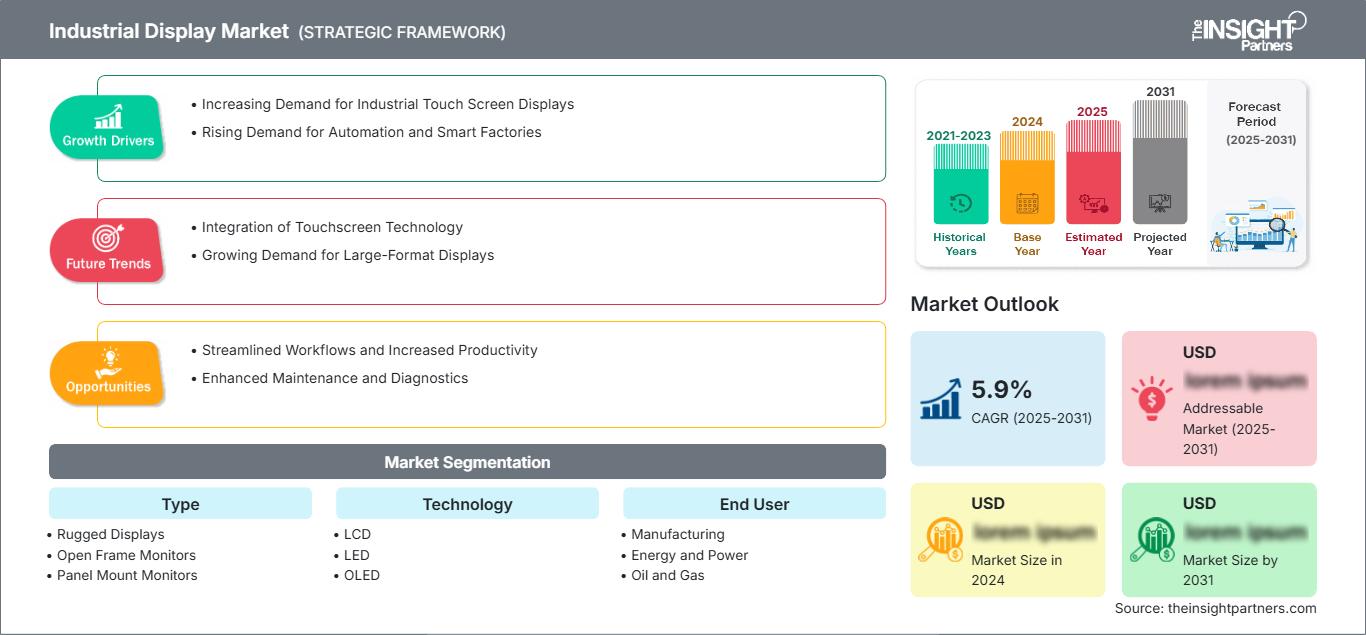
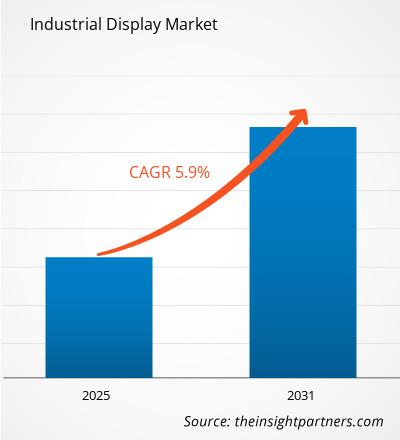
The Industrial Display Market was valued at US$ 9.89 Billion in 2025 and is projected to reach US$ 19.78 Billion by 2034, expanding at a CAGR of 8.01% during 2026–2034. Demand is strengthening as factories, utilities, extractive operations, and marine environments replace conventional operator panels with rugged, networked visualization systems that support reliable control, continuous monitoring, and faster operational decisions under demanding conditions.
North American demand is expected to advance at a 7.2–7.8% CAGR, supported by automation retrofits, reshoring-linked factory investment, and stringent reliability requirements in energy and process industries. The Industrial Display Market size in the region also benefits from an established control-system ecosystem, broad adoption of connected human-machine interfaces, and replacement cycles favoring sunlight-readable, washdown-resistant, and long-life monitors.
Industrial Display Market Assessment and Insights
- North America: Accounted for 35–38% Industrial Display Market share in 2025 and is projected to grow at a 7.2–7.8% CAGR between 2026–2034, supported by automation retrofits, energy infrastructure modernization, and stringent uptime requirements.
- US: Represented 78–82% of North American revenue in 2025 and is expected to expand at a 7.3–7.9% CAGR through 2034.
- Europe: Held 25–28% share in 2025 and is forecast to rise at a 7.0–7.6% CAGR, led by Germany, the UK, France, Italy, and Spain.
- Asia Pacific: Captured 30–33% share in 2025 and should record an 8.8–9.5% CAGR, with China, Japan, South Korea, and India leading industrial deployments.
- Largest Segment: Rugged displays held 40–43% market share in 2025 and are anticipated to grow at a 7.6–8.2% CAGR during 2026–2034.
- High Growth Segment: OLED represented 10–13% market share in 2025 and is projected to expand at a 10.0–10.8% CAGR during 2026–2034.
- Key companies analyzed in detail: Advantech Co., Ltd.; AUO Corporation; Innolux Corporation; Japan Display Inc.; LG Display Co., Ltd.; Panasonic Holdings Corporation; Planar Systems, Inc.; Rockwell Automation, Inc.; Samsung Electronics Co., Ltd.; Siemens AG.
Source: The Insight Partners' analysis based on proprietary research, government publications, company annual reports, investor presentations, industry databases, and expert interviews.
Industrial visualization is moving from individual, button-operated user stations towards integrated touch displays that can offer data related to machinery, quality, safety, and energy in one view. LCD continues to be a workhorse in production, but high-brightness LED backlighting, optical bonding, projected capacitive touch display technology, and edge processing contribute to improving visibility and responsiveness. Manufacturers are increasingly offering packages of panels, housings, control hardware, and lifecycle services, because customers prefer certified packages of components that save engineering time and are resistant to vibration, dust, humidity, chemical exposure, and temperature variations.
Up until 2034, investments need to move beyond well-known applications such as automotive and electronics manufacturing facilities into battery manufacturing, water management, renewable energy generation units, harbors, and mining operations. Incentives to localize production and increase resilience will lead to increased local manufacturing and dual sourcing of supplies. On the other hand, the growing cybersecurity requirements, functional safety standards, and energy efficiency regulations will reward suppliers that provide long-term availability of components, reliable connectivity, serviceability, and operation.
Industrial Display Market Report Scope
| Report Attribute | Details |
|---|---|
| Market size in 2025 | US$ 9.89 Billion |
| Market Size by 2034 | US$ 19.78 Billion |
| Global CAGR (2026 - 2034) | 8.01% |
| Historical Data | 2021-2024 |
| Forecast period | 2026-2034 |
Industrial Display Market Analysis
Industrial Display Market growth is driven by the requirement to convert growing data from machines into information for operators. Displays are used in control cabinets, production cells, inspection stations, and central locations, whereas utilities and extractive industries require remote visibility, alarming, and sealed environments. Thus, the demand goes through panel makers, touch-sensor makers, embedded computer suppliers, enclosure makers, automation integrators, distributors, and maintenance suppliers.
Supply considerations are still affected by availability of panels, controller approval, backlight lifetime, and part obsolescence. Industrial customers give priority to product availability rather than consumer refresh rate, which becomes critical for multiyear support and compatibility. Optical bonding, antiglare surface treatment, gloved touch screens, and front IP ratings define product differentiation, while configurable platforms allow suppliers to address low volume applications without compromising on manufacturing economics.
Industrial Display Market Analysis shows that the competitive landscape includes players such as panel suppliers, automation companies, and visualization specialists. Players such as AUO Corporation, Innolux Corporation, Japan Display Inc., LG Display Co., Ltd., and Samsung Electronics Co., Ltd. impact innovation and panel sizes, whereas Advantech Co., Ltd., Rockwell Automation, Inc., and Siemens AG impact their competitors through industrial computing and automation integration.
Investment is shifting towards edge-AI user interface, high-brightness outdoor displays, low-power consumption architecture, and modular product families. Panasonic Holdings Corporation and Planar Systems, Inc. continue to benefit from visualization and specialized display capabilities. Positioning within the industrial display market will depend more and more on industry specialization, certification portfolio, channel coverage, time-to-market, and capability for hardware and device management integration. Collaboration between display, computing and automation companies can lead to faster qualification and application scope extension.
● REPORT CUSTOMIZATION
Tailor This Report To Align With Your Specific Business Requirements
This report can be customized to align precisely with your business objectives, scope, and target markets. Customization options include tailored segmentation, geography, competitive analysis, and strategic insights to support informed decision-making.
Customize This Report →WHAT YOU CAN ADJUST
- ● Segmentations
- ● Geography
- ● Competitive Analysis
- ● Language Preferences
Industrial Display Market: Strategic Insights
Regional Insights
North America Industrial Display Market
The region held 35–38% of global revenue in 2025 and is projected to expand at a 7.2–7.8% CAGR through 2034. Industrial Display Market share is supported by a large installed base of automated equipment, strong spending on semiconductor, battery, aerospace, food, and pharmaceutical capacity, and rigorous requirements for safe, continuously available operator interfaces.
Need is shifting toward wider temperature range monitoring, stainless-steel washdown-capable sensors, and display systems that interface with edge computing and secure industrial networking. The value-added services of Canada lie in energy, mining, utilities, and advanced manufacturing sectors, whereas Mexico gains advantage through electronics and automotive nearshoring. Suppliers in the region compete by offering lifecycle support, protocol compatibility, local engineering, and fast response services.
U.S. Industrial Display Market
The U.S. represented 78–82% of North American revenue in 2025 and is expected to post a 7.3–7.9% CAGR. Applications such as semiconductor fabrication, electric car manufacturing, battery manufacture, warehouse automation, military and defense manufacture, and advanced power infrastructure are the main applications that drive demand for panel PCs, rugged monitors, and large-format visualization in control rooms.
The companies Advantech Co., Ltd., Rockwell Automation, Inc., Planar Systems, Inc., and Siemens AG have excellent commercial or distribution channel coverage to facilitate specification and installation of the products. Applications are now moving towards multi-touch HMIs, remote diagnostic and maintenance, predictive maintenance screens, and consolidation of alarms into one screen. The customers now require the cybersecurity information, fast domestic support, sunlight readable capability, and wash down, vibration-resistant operation.
Europe Industrial Display Market
Europe accounted for 25–28% share in 2025 and should grow at a 7.0–7.6% CAGR. Germany shines in machinery, auto, chemicals, and automation. Existing industrial facilities ensure the continuous installation needs of interoperable screens, as requirements to reduce energy consumption support lower power consumption and increased component durability. In the UK, the fields of aerospace, process manufacturing, utilities, and marine installations prevail, hence requiring robust and marine-certified products.
France is a blend of aerospace, transport, energy, and food processing needs, and Italy offers the applications of machines, packaging, and special equipment. Spain represents automotive, renewable and infrastructure industries. European buyers pay particular attention to CE certification, reparability, security, and the lifetime of their purchases. Those who can offer regional customization and certifications have good chances to win, as old brownfield plants upgrade legacy controls with new data infrastructures.
APAC Industrial Display Market
Asia Pacific captured 30–33% share in 2025 and is forecast to expand at an 8.8–9.5% CAGR, the fastest regional pace. China leads through manufacturing scale, automation investment, electronics production, and infrastructure modernization, while Japan and South Korea contribute robotics, advanced panels, automotive systems, and semiconductor capacity.
India is scaling electronics, renewables, and industrial corridors, and Australia supports mining, ports, and energy applications. Government manufacturing programs, supply-chain localization, and smart-factory adoption reinforce demand for rugged, connected, cost-efficient displays.
Middle East & Africa Industrial Display Market
Middle East and Africa demand is projected to rise at a 7.4–8.1% CAGR. Saudi Arabia leads through industrial diversification, mining, utilities, and large infrastructure programs, while the UAE emphasizes logistics, ports, energy, and advanced buildings. Harsh ambient conditions favor high-brightness, sealed, and wide-temperature displays.
South Africa contributes mining, power, and process-industry replacements. Across the Rest of MEA, water, transport, and energy projects create selective opportunities, although procurement cycles, service coverage, and import dependence shape adoption timing.
Segmentation Analysis
Type
Type is projected to expand at a 7.7–8.3% CAGR during 2026–2034. The Industrial Display Market scope spans standardized monitors and application-specific assemblies engineered for ingress protection, brightness, mounting, thermal performance, and long service life. Rugged and panel-mount products anchor factory demand, while open-frame configurations support equipment manufacturers requiring flexible integration. Marine displays address navigation and deck environments where corrosion resistance and daylight visibility are essential.
- Rugged Displays: Lead adoption in harsh factories, field equipment, defense-adjacent systems, mining, and transport, where resistance to shock, vibration, moisture, dust, and temperature extremes protects operational continuity.
- Open Frame Monitors: Serve OEM machinery, kiosks, charging equipment, and embedded stations by offering flexible mounting, compact integration, configurable touch options, and lower redesign effort across equipment generations.
- Panel Mount Monitors: Remain central to control cabinets and machine interfaces because front-panel sealing, standardized cutouts, straightforward maintenance, and integration with industrial PCs suit brownfield and new-build automation.
- Marine Displays: Address bridges, engine rooms, offshore platforms, and deck systems with sunlight readability, dimming control, corrosion protection, stable performance, and certifications aligned with safety-critical maritime operations.
Technology
Technology revenue is expected to grow at a 8.0–8.6% CAGR through 2034. LCD retains broad adoption because of mature supply, familiar integration, and balanced cost-performance, while LED developments improve luminance, energy efficiency, contrast, and service life. OLED gains in premium applications needing thin form factors, wide viewing angles, and rapid response. Selection remains application-led, with burn-in risk, temperature tolerance, brightness, repairability, and lifecycle availability shaping qualification.
- LCD: Maintains the broadest installed base across machine control and process monitoring, supported by mature components, multiple sizes, industrial temperature options, established touch integration, and predictable qualification pathways.
- LED: Gains strategic importance in high-brightness monitors, large control-room surfaces, outdoor equipment, and efficient backlighting, where improved luminance, visibility, durability, and lower power use strengthen lifecycle economics.
- OLED: Expands in premium, compact, mobile, and visually demanding interfaces, offering high contrast and viewing performance while suppliers address brightness longevity, image retention, ruggedization, and qualification challenges.
End User
End-user demand is forecast to rise at a 8.1–8.7% CAGR during 2026–2034. Manufacturing represents the largest opportunity because displays connect operators with increasingly automated equipment and production analytics. Energy, oil and gas, metals, and mining prioritize reliability, remote supervision, and safe alarm visualization across dispersed or hazardous assets. Procurement decisions reflect environmental certification, interoperability, local service, cybersecurity, and the cost of downtime rather than display price alone.
- Manufacturing: Generates the largest recurring demand through machine HMI, production dashboards, inspection, robotics, and digital work instructions, with retrofit compatibility and long availability central to procurement decisions.
- Energy and Power: Uses industrial displays for substations, renewable assets, generation control, and grid operations, emphasizing continuous visibility, secure connectivity, alarm prioritization, wide-temperature operation, and remote maintenance support.
- Oil and Gas: Requires certified, rugged visualization for drilling, processing, pipelines, terminals, and control rooms, where hazardous-area suitability, glove operation, sunlight readability, and reliability reduce operational and safety risks.
- Metals and Mining: Prioritizes vibration resistance, sealed construction, high brightness, and dependable touch performance for mobile equipment, mills, processing plants, and remote operations exposed to dust and severe conditions.
Opportunity Snapshot
| End User | Revenue Contribution | Trend Tag | Adoption Stage |
| Manufacturing | High | Smart HMI | Mature |
| Energy and Power | High | Grid Visibility | Scaling |
| Oil and Gas | Medium | Hazard Displays | Mature |
| Metals and Mining | Medium | Remote Operations | Scaling |
| Others | Low | Vertical Expansion | Emerging |
Industrial Display Market Growth Drivers and Impact Analysis
Automation Converts Displays into Operational Decision Points
Continuous flow production lines provide real-time information on efficiency, quality, energy usage, maintenance, and safety. The value of screens showing prioritized information increases because the information comes from continuous flow production lines. Modern HMIs allow for reduced steps in navigation, integration of machine view with analytics, and standardization of procedures for multiple shifts. Consequently, the need for replacement is not limited to new greenfield facilities since existing push button stations cannot display information regarding complex process state efficiently. This effect is especially powerful in expensive downtime operations since fast fault detection and guidance during fault elimination can be enough to pay extra for durable devices. Suppliers benefit from combination of screens with edge computing, secure networking, and device management software, while system integrators earn from engineering and maintenance services.
Harsh-Environment Reliability Protects Lifecycle Economics
An industrial buyer judges display systems based on their total cost of ownership rather than the upfront cost of the panels. Factors like dust, vibration, moisture, chemical substances, sunlight, electromagnetic interference, and temperature variation may reduce the life of consumer display products and cause disruptions that incur huge costs to repair. For this reason, features like sealing, optical bonding, industrial backlights, toughened glass, conformal coating, and wide temperature range electronics play an important role in buying decisions. Besides, ruggedized systems help buyers in safety and maintenance planning as certified systems are likely to experience fewer unexpected faults and replacement parts. Commercial implications go far beyond to include mines, offshore sites, power plants, food processing plants, ports, and outdoors, among others, whereby delayed accessibility increases maintenance costs.
Infrastructure Modernization Expands Nonfactory Applications
The investments made in electricity grids, renewable energy sources, water supply systems, transportation hubs, charging stations, and logistics solutions are making the demand for industrial automation grow beyond the boundaries of factories. This requires on-site visualization systems for installation, alarm handling, maintenance, and backup control purposes, despite the possibility of central monitoring provided by cloud solutions. Brightness, anti-reflection displays, heat resistance, and tamper-proof touch displays are well-suited for deployment in outdoor or semi-outdoor conditions. The decentralized structure of this infrastructure will increase the number of sites that require regular replacements and maintenance, while standardization of the displays will allow the same interface to be used at different sites. Market aspects become especially relevant for quickly growing industrial countries, where new infrastructure can have connected displays from the very beginning.
Industrial Display Market Future Trends
Edge AI Reshapes the Operator Interface
Industrial Display Market trends will shift towards edge AI at the visualization level. Instead of showing static process values, displays will tend to highlight anomalies, summarize the status of machines, and instruct technicians on what action to take. Inference based on the edge AI will enable responsive behavior even when the connection is unreliable as well as protect against the leak of confidential information. The solution should strike a balance between enhanced software functionality and determinism, cybersecurity, and alerts that are easy to understand so that operators have control. Touchless technologies such as camera, voice, and gestures may be combined with touch input depending on their reliability and safety.
Low-Power and Serviceable Design Becomes a Procurement Criterion
Energy use, repairability, and lifecycle transparency will become more visible in industrial display selection. Buyers operating hundreds of always-on screens will compare backlight efficiency, automatic brightness control, standby behavior, component replacement, and expected service life. Modular electronics and standardized mechanical interfaces can reduce waste when controllers or panels require renewal. Product environmental documentation will also influence tenders as industrial companies extend sustainability requirements into equipment supply chains. This trend favors architectures that deliver high luminance without excessive heat, because lower thermal stress extends component life and simplifies enclosure design. Vendors able to quantify energy savings and provide refurbishment pathways can convert sustainability objectives into measurable operating benefits.
Industrial Display Market Opportunities
Build Retrofit Kits for Brownfield Automation
A large opportunity lies in engineered retrofit packages that replace obsolete screens without redesigning entire control systems. Industrial Display Market Forecasts support investment in drop-in mechanical formats, legacy video and serial interfaces, protocol gateways, and configurable touch behavior. Vendors can partner with system integrators to map installed equipment, prequalify replacements, and maintain application images. Commercial models may combine hardware, migration engineering, spares, and multiyear support, improving revenue visibility. Target sectors include packaging, food processing, metals, water, and discrete manufacturing, where equipment remains productive long after original displays become unavailable. Clear compatibility documentation and regional repair capability can reduce customer risk and accelerate standardized fleet upgrades.
Localize Platforms for Emerging Industrial Corridors
New manufacturing and infrastructure corridors across Asia, the Middle East, and selected African markets create opportunities for localized assembly, channel development, and application engineering. Investors should prioritize configurable platforms that share electronics while accommodating regional certifications, languages, power conditions, brightness needs, and mounting practices. Partnerships with machine builders, panel shops, and automation distributors can provide specification access before projects reach procurement. Local spare inventories and technician training are equally important because service responsiveness shapes trust in mission-critical hardware. Rather than competing only on price, suppliers can differentiate through deployment templates for solar assets, water plants, warehouses, mining operations, and battery factories, creating repeatable solutions with defensible service revenue.
Recent Developments
- May 2026: LEDsynergy has announced a strategic manufacturing partnership with LEDX Technology in India, marking a significant change in how the company produces its standard LED display range. Under the agreement, standard products will be manufactured in India, while LEDsynergy will continue designing and building custom and specialist displays in the UK.
- June 2026: ViewSonic showcased its latest Direct View LED (dvLED) display solutions at InfoComm 2026, highlighting technologies designed to make large-format LED displays easier to deploy, manage and scale across commercial and professional AV environments. The company's portfolio includes solutions based on MicroLED in Package (MIP) technology, mobile LED displays and pre-configured all-in-one systems. ViewSonic says these products are designed to simplify installation while providing high-quality visuals for applications ranging from meeting spaces and events to large venues and other high-traffic environments.
- August 2026: LG Display has introduced FLiPP (FMM-Less innovative Pixel Patterning), a new OLED manufacturing technology designed to overcome several limitations associated with the conventional Fine Metal Mask (FMM) process. The company describes FLiPP as a next-generation OLED patterning method that can enable brighter, longer-lasting and more energy-efficient displays while providing greater flexibility in panel production.
Frequently Asked Questions

- Comprehensive Market Sizing and Forecast Analysis
- Detailed Segmentation Analysis
- In-Depth Market Dynamics Assessment
- Regional and Country-Level Insights
- Competitive Landscape and Company Benchmarking
- Strategic Business Intelligence
Recent Reports
Testimonials

The Insight Partners provided valuable market intelligence that supported our global go-to-market strategy. Their team was professional, responsive, and attentive to our feedback, providing thoughtful analysis and helpful methodological clarifications throughout the project.
Junmo Kim Chief Financial Officer (CFO), Enertech Co., Ltd.
The Insight Partners' SCADA System Market report is comprehensive, with valuable insights on current trends and future forecasts. The team was highly professional, responsive, and supportive throughout. We are very satisfied and highly recommend their services.
RAN KEDEM Partner, Reali Technologies LTDs
I requested a report on a very specific software market and the team produced the report in a few days. The information was very relevant and well presented. I then requested some changes and additions to the report. The team was again very responsive and I got the final report in less than a week.
JEAN-HERVE JENN Chairman, Future Analytica
We worked with The Insight Partners for an important market study and forecast. They gave us clear insights into opportunities and risks, which helped shape our plans. Their research was easy to use and based on solid data. It helped us make smart, confident decisions. We highly recommend them.
PIYUSH NAGPAL Sr. Vice President, High Beam Global
The Insight Partners delivered insightful, well-structured market research with strong domain expertise. Their team was professional and responsive throughout. The user-friendly website made accessing industry reports seamless. We highly recommend them for reliable, high-quality research services
YUKIHIKO ADACHI CEO, Deep Blue, LLC.
This is the first time I have purchased a market report from The Insight Partners.While I was unsure at first, I visited their web site and felt more comfortable to take the risk and purchase a market report.I am completely satisfied with the quality of the report and customer service. I had several questions and comments with the initial report, but after a couple of dialogs over email with their analyst I believe I have a report that I can use as input to our strategic planning process.Thank you so much for taking the extra time and making this a positive experience.I will definitely recommend your service to others and you will be my first call when we need further market data.
JOHN SUZUKI President and Chief Executive Officer, Board Director, BK Technologies
I wish to appreciate your support and the professionalism you displayed in the course of attending to my request for information regarding to infectious disease IVD market in Nigeria. I appreciate your patience, your guidance, and the fact that you were willing to offer a discount, which eventually made it possible for us to close a deal. I look forward to engaging The Insight Partners in the future, all thanks to the impression you have created in me as a result of this first encounter.
DR CHIJIOKE ONYIA MANAGING DIRECTOR, PineCrest Healthcare Ltd.Reason to Buy
- Informed Decision-Making
- Understanding Market Dynamics
- Competitive Analysis
- Identifying Emerging Markets
- Customer Insights
- Market Forecasts
- Risk Mitigation
- Boosting Operational Efficiency
- Strategic Planning
- Investment Justification
- Tracking Industry Innovations
- Aligning with Regulatory Trends





 Get Free Sample for