
Industrial Ethernet Switch Market Growth, Size & Forecast by 2034
Coverage: by Type (Managed, Unmanaged); Enterprise Size (Small Scale Enterprise, Medium Scale Enterprise, Large Scale Enterprise); Industry Vertical (Electric and Power, Manufacturing, Aerospace and Defense, Oil and Gas, Automotive and Transportation, Others) , and Geography (North America, Europe, Asia Pacific, and South and Central America)
- Status : Data Released
- Report Code : TIPRE00031433
- Category : Electronics and Semiconductor
- No. of Pages : 150
- Available Report Formats :


- Last update date : September 18, 2026


2025 Market Size
US$ 3.64 Bn
Base year value
2034 Forecast
US$ 6.61 Bn
Projected by 2034
CAGR 2026-2034
6.84 %
Growth rate
Addressable Market
US$ 46.27 Bn
(2026-2034)
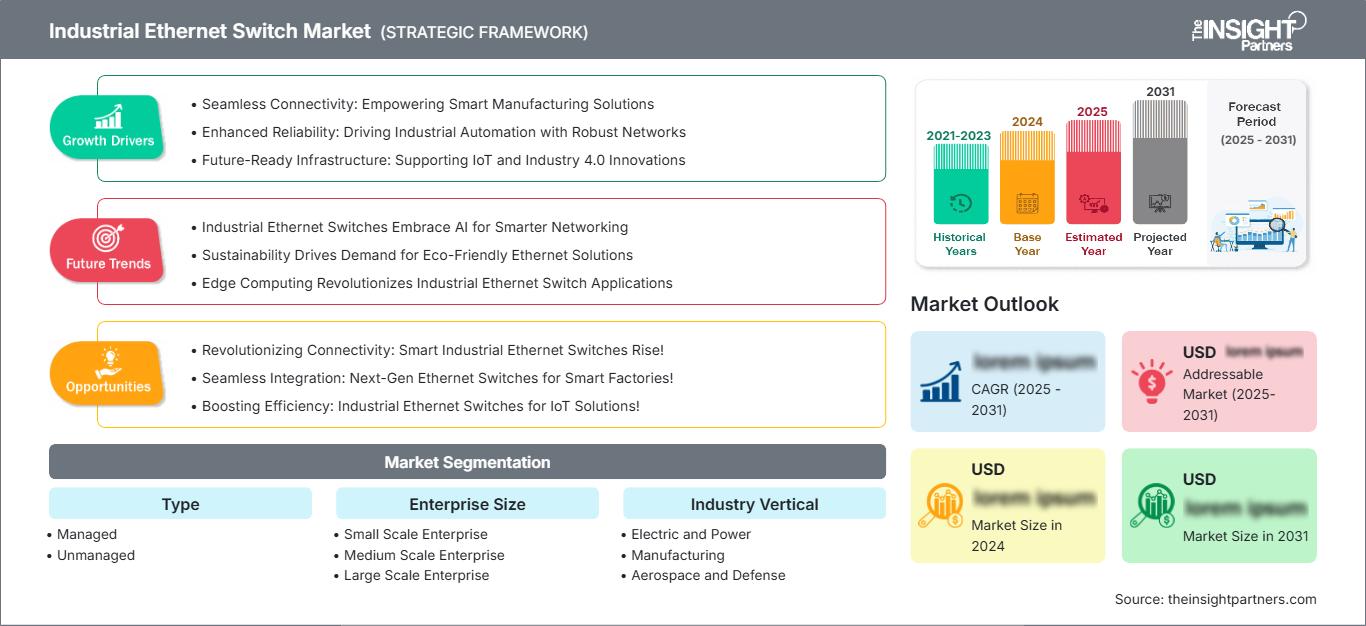
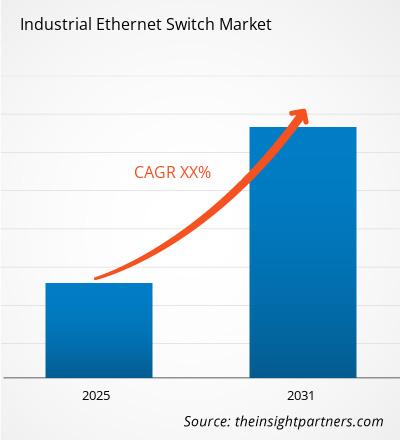
The Industrial Ethernet Switch Market size was valued at US$ 3.64 Billion in 2025 and is projected to reach US$ 6.61 Billion by 2034, expanding at a CAGR of 6.84% during 2026–2034. Demand is shaped by industrial automation, connected production assets, resilient operational networks, and migration toward higher-bandwidth Ethernet architectures. These factors are broadening deployment across factories, utilities, transport, and process facilities.
North America is positioned for steady expansion, and the Industrial Ethernet Switch Market size is supported by factory modernization, semiconductor and automotive investment, and energy infrastructure upgrades. The regional outlook also benefits from cybersecurity requirements for operational technology, increasing use of managed switching, and integration of industrial networks with edge computing and private wireless systems. Brownfield replacement remains relevant.
Industrial Ethernet Switch Market Assessment and Insights
- North America: The region is expected to hold a 31–33% Industrial Ethernet Switch Market share in 2025 and expand at a 6.4–7.1% CAGR during 2026–2034, supported by automation and energy modernization.
- US: The US is expected to represent 72–76% of North America’s 2025 revenue and grow at a 6.5–7.2% CAGR during 2026–2034 as factories and utilities modernize.
- Europe: Europe is estimated at a 27–29% share in 2025 and a 6.1–6.8% CAGR through 2034, led by Germany, the UK, France, Italy, and Spain.
- Asia Pacific: Asia Pacific is estimated at a 35–37% share in 2025 and a 7.6–8.4% CAGR through 2034, led by China, Japan, South Korea, and India.
- Largest Segment: Managed switches are estimated at a 66–70% market share in 2025 and a 9.8–10.6% CAGR during 2026–2034.
- High Growth Segment: Electric and Power is estimated at an 18–22% 2025 share and an 8.1–8.8% CAGR during 2026–2034.
- Key companies analyzed in detail: ALE International SAS, Beckhoff Automation GmbH & Co. KG, Cisco Systems, Inc., Hewlett Packard Enterprise Development LP, International Business Machines Corporation, Juniper Networks, Inc., Moxa Inc., Perle Systems Limited, Rockwell Automation, Inc., Siemens AG, Belden Inc.
Source: The Insight Partners' analysis based on proprietary research, government publications, company annual reports, investor presentations, industry databases, and expert interviews.
Industrial networks have gone from simple machine interconnectivity to managed resilient networking, providing services like traffic determinism, diagnosis, redundancy, and cybersecurity measures. Production sites now involve not only controllers and sensors but also machine vision, robotics, and edge computing devices, increasing the demands on the system’s bandwidth and availability. Managed switching has therefore become increasingly important, along with hardened components due to temperature, vibration, and electromagnetic compatibility requirements. This trend is most prominent in automobile, electronics, and energy factories where network availability determines process speed and machinery coordination.
In the forecast period, the technology will be more widely deployed in newly built industrial clusters and related infrastructure. New investment in semiconductor manufacture, electric cars, renewables, logistic centers, and industrial automation is expected to generate more use cases. Critical infrastructures’ resilience and industrial cybersecurity concerns will also make it easier for solutions offering network segmentation, monitoring, secure management, and lifecycle update to win.
Industrial Ethernet Switch Market Report Scope
| Report Attribute | Details |
|---|---|
| Market size in 2025 | US$ 3.64 Billion |
| Market Size by 2034 | US$ 6.61 Billion |
| Global CAGR (2026 - 2034) | 6.84% |
| Historical Data | 2021-2024 |
| Forecast period | 2026-2034 |
Industrial Ethernet Switch Market Analysis
The use of automation in industries will continue to increase connections, which will drive the growth of the Industrial Ethernet Switch Market in production units, substations, warehouses, transportation facilities, and process units. The switches are in an environment that consists of controllers, sensors, industrial PCs, fiber optics, cybersecurity systems, integrators, and network management software. Demand for the switches is higher in areas where the lack of production and safety are associated with a shutdown.
Supply factors include semiconductor supply, rugged component qualification, connectors, optical transceivers, and regional certifications. Companies offer products on the basis of their temperature range, redundancy, port density, software integration, and life cycle. Customers are now considering total cost of ownership since they will be able to lower maintenance activities and minimize disruptions in their operations through network monitoring and remote diagnostics.
Positioning is based on automation knowledge, network competence, which makes Industrial Ethernet Switch Market analysis valuable for portfolio breadth, installed base relationships, and security integration. Siemens AG and Rockwell Automation, Inc. combine switching product portfolio with automation environment, whereas Cisco Systems, Inc., Hewlett Packard Enterprise Development LP, and Juniper Networks, Inc. offer broader network architecture to industrial application. Portfolio breadth and channels will be considered during vendor selection, where customers are looking for some standardization for various factories and geographic locations.
Moxa Inc., Beckhoff Automation GmbH & Co. KG, Belden Inc., ALE International SAS, Perle Systems Limited, and International Business Machines Corporation differentiate themselves by offering some industrial connectivity, robust hardware, software, integration, or networking skills. Increasing investment is made in managed platforms, edge-capable architecture, increased speed uplinks, and secure operations. Strategic alliances and modular families will facilitate migration process and staged deployment. It will be beneficial for those companies which can combine hardware with software, services, and integration abilities.
● REPORT CUSTOMIZATION
Tailor This Report To Align With Your Specific Business Requirements
This report can be customized to align precisely with your business objectives, scope, and target markets. Customization options include tailored segmentation, geography, competitive analysis, and strategic insights to support informed decision-making.
Customize This Report →WHAT YOU CAN ADJUST
- ● Segmentations
- ● Geography
- ● Competitive Analysis
- ● Language Preferences
Industrial Ethernet Switch Market: Strategic Insights
Regional Insights
North America Industrial Ethernet Switch Market
North America is estimated to account for a 31–33% Industrial Ethernet Switch Market share in 2025 and grow at a 6.4–7.1% CAGR through 2034. The USA sustains demand through sophisticated manufacturing, auto manufacturing, aerospace, expansion of the semiconductor manufacturing facility, and upgrading utilities. Canada contributes energy-related, mining, transportation, and process industry projects. The role of industrial policy and private investments allows modernizing existing plant facilities and communications infrastructure. Such projects enhance demand for hardened, standards-based connectivity at critical industrial and infrastructure locations.
The managed switches become more relevant due to segmentation, diagnostics, redundancy, and secure remote access needs. Digitization of factories increases bandwidth demand for machine vision, analytics, and robotics, whereas brownfield projects increase replacement demand in the absence of visibility, robustness, and sustainability of existing infrastructure. Integrators are still important since many projects involve both networking and control modernization and cybersecurity considerations. Such procurement logic sustains recurrent replacement cycles and increases demand for software-based network management functionalities.
U.S. Industrial Ethernet Switch Market
The US represents 72–76% of North America’s 2025 market and is expected to expand at a 6.5–7.2% CAGR through 2034. Automotive, aerospace, semiconductor, energy, logistics, and discrete manufacturing programs contribute towards demand, while industrial investments contribute to local production capabilities and automation upgrades. Programs for public infrastructure contribute towards modernizing utilities, transport, and industries that need reliable communication in operations. Secure remote administration and upgrade path capabilities are becoming more important for industrial clients that want to be assured of secure use of their long-lived assets and networks around the world.
Cisco Systems, Inc., Rockwell Automation, Inc., Siemens AG, and Hewlett Packard Enterprise Development LP provide solutions for factory automation, utilities, transportation, and processes. The decision makers link their purchasing decisions with OT security, edge computing, and lifecycle management needs, which contribute to growth in the demand for interoperable platforms in multi-generational industrial settings. The applications need resilience, remote diagnostics, secure segmentation, and interoperation with existing automation solutions.
Europe Industrial Ethernet Switch Market
Europe is estimated to represent a 27–29% share in 2025 and grow at a 6.1–6.8% CAGR through 2034. Germany is the market leader, backed by automated manufacturing, industrial machinery, automotive manufacturing, and smart factories. The UK, France, Italy, and Spain provide further demand in energy, aerospace, transport, automotive, machinery, and logistics. Procurement stresses security concerns and equipment lifespan. Buyers evaluate security and lifecycle management side-by-side with compatibility. Procurement favors those pieces of equipment which have both industrial certifications and managed and compatible networking and lifecycle management capabilities.
Germany keeps the strongest automation environment in the region, the UK focuses on industrial digitalization and energy infrastructure, France leverages aerospace and energy-related assets, Italy machinery and automotive manufacturing, and Spain transport, utilities, and industrial upgrading. Security demands in the EU drive networking that needs to be managed, monitored, and supported throughout the lifecycle, whereas industrial enterprises look for interoperability of operational technology and enterprise information systems in their phased upgrading programs.
APAC Industrial Ethernet Switch Market
APAC is estimated at a 35–37% share in 2025 and is expected to grow at a 7.6–8.4% CAGR through 2034, making it the leading regional market. China is ahead, followed by Japan, South Korea, India, and Australia, due to the size of manufacturing driving adoption. Growth in electronics, automotive, machinery, and energy creates a wide installed base of equipment which drives greenfield and brownfield upgrades of industrial networking. Local manufacturing ecosystem enhances channel presence with capable system integrators and equipment manufacturers.
Factory automation, electronics manufacturing, automotive manufacturing, renewables and transport modernization drive adoption. Industrial policy initiatives in China and India promote manufacturing and digital infrastructures, whereas Japan and South Korea have highly developed automation ecosystems. The need for durable managed switches, bandwidth and edge computing architectures will be in demand. Australia drives through mining, utilities, and remote infrastructure where durability and environmental resistance are key purchase criteria. These needs increase the scope from large factories to distributed infrastructures and industrial facilities.
Middle East & Africa Industrial Ethernet Switch Market
Middle East and Africa is expected to expand at a 6.8–7.6% CAGR through 2034. Saudi Arabia and the UAE lead through energy diversification, industrial development, ports, utilities, and smart infrastructure, while South Africa contributes through mining, power, manufacturing, and transport applications. Large project environments often require rugged equipment, redundancy, and long lifecycle support because operating conditions can be demanding and geographically dispersed. Project procurement can favor suppliers with local support, certification knowledge, and engineering partnerships.
Oil and gas modernization remains important because networks must operate reliably in harsh and remote environments. Infrastructure programs broaden demand into renewable energy, water, logistics, and transportation. The UAE is the leading country in infrastructure adoption, while Saudi Arabia provides project-led demand through industrial and energy investments. Regional buyers increasingly evaluate remote monitoring, secure access, and integration with operations centers. Such requirements create opportunities for vendors combining rugged hardware with centralized diagnostics and lifecycle management.
Segmentation Analysis
Type
Type adoption is increasingly shaped by the balance between network simplicity and operational visibility. Managed switches are favored where segmentation, redundancy, diagnostics, and cybersecurity matter, while unmanaged devices remain relevant for compact machine-level connections. This defines the Industrial Ethernet Switch Market scope across brownfield and greenfield deployments. The Type segment is expected to expand at a 7.5–8.2% CAGR during 2026–2034 as both architectures coexist.
- Managed: Managed switches occupy the strategic core of complex industrial networks, providing configuration, monitoring, redundancy, and segmentation capabilities required for larger automation systems and cybersecurity-conscious operations.
- Unmanaged: Unmanaged switches remain relevant for straightforward machine connections where low configuration effort, compact installation, and predictable connectivity outweigh advanced monitoring requirements.
Enterprise Size
Enterprise Size reflects differing investment capacity, network complexity, and digital maturity. Large organizations generally deploy standardized architectures across multiple plants, while smaller businesses often prioritize simple, scalable connectivity. The Enterprise Size segment is expected to grow at a 6.5–7.2% CAGR during 2026–2034 as industrial digitization reaches a broader customer base.
- Small Scale Enterprise: Small-scale enterprises favor compact, cost-controlled deployments that connect essential machines without extensive network administration, supporting practical first-stage automation upgrades.
- Medium Scale Enterprise: Medium-scale enterprises increasingly require managed connectivity as production footprints expand, supporting centralized monitoring, segmentation, redundancy, and industrial software integration.
- Large Scale Enterprise: Large-scale enterprises prioritize standardized architectures, higher port density, centralized management, cybersecurity controls, and lifecycle consistency across multi-site operational technology.
Industry Vertical
Industry Vertical demand is shaped by application criticality, environmental conditions, compliance requirements, and the degree of automation. Electric and Power is expected to expand at an 8.1–8.8% CAGR during 2026–2034, while manufacturing remains a major deployment base for connected production systems.
- Electric and Power: Utilities require deterministic, resilient communications for substations, protection systems, distributed assets, and grid automation, making industrial switching strategically important as networks become more digitally coordinated.
- Manufacturing: Manufacturing remains a core demand center because robotics, machine vision, controllers, and production analytics require reliable low-latency connectivity across increasingly connected factory environments.
- Aerospace and Defense: Aerospace and defense applications emphasize secure, rugged, and highly reliable communications, with stringent environmental and operational requirements shaping procurement and qualification decisions.
- Oil and Gas: Oil and gas operators prioritize rugged networking, redundancy, remote diagnostics, and hazardous-area suitability across upstream, midstream, and downstream facilities where communications support safety and continuity.
- Automotive and Transportation: Automotive and transportation projects increasingly connect automated production, rail, traffic, fleet, and charging infrastructure, creating demand for resilient switching across distributed operational environments.
Opportunity Snapshot
| Industry Vertical | Revenue Contribution | Trend Tag | Adoption Stage |
| Electric and Power | High | Grid Digital | Scaling |
| Manufacturing | High | Smart Factory | Mature |
| Aerospace and Defense | Medium | Secure OT | Scaling |
| Oil and Gas | Medium | Remote Ops | Scaling |
| Automotive and Transportation | High | Connected Mobility | Scaling |
Industrial Ethernet Switch Market Growth Drivers and Impact Analysis
Expansion of connected industrial automation
Industrial automation is increasing connected endpoints across factories, utilities, warehouses, and transport facilities. Robots, sensors, controllers, machine vision, and edge computers generate traffic requiring dependable switching and sophisticated management. Brownfield facilities must often retrofit communication layers without interrupting production, favoring compact rugged switches, fiber uplinks, redundancy, and managed architectures. As plants move toward continuous data collection and distributed control, network reliability becomes linked to asset utilization and maintenance performance. Suppliers supporting mixed protocols, extended temperature ranges, and long product lifecycles are better positioned where equipment replacement cycles span many years. Integrators increasingly specify networking alongside automation equipment, strengthening demand for interoperable products and services.
Rising operational technology cybersecurity requirements
Cybersecurity is becoming a purchasing criterion for industrial networking equipment rather than a separate software consideration. Segmentation, access control, logging, secure configuration, and visibility are increasingly expected as operational technology connects with enterprise and cloud environments. Regulatory initiatives reinforce critical-infrastructure resilience and supplier accountability. Managed switches gain relevance because they can enforce network policies closer to connected assets. Impact includes replacement of legacy equipment, greater centralized management, and closer automation-cybersecurity collaboration. Suppliers combining switching with secure management, diagnostics, and lifecycle updates can address broader modernization budgets while buyers reduce exposure from flat networks and unsupported legacy devices. This also increases the strategic value of long-term firmware support.
Growth of digital power and distributed infrastructure
Power networks, transportation systems, industrial campuses, and distributed infrastructure are becoming more digitally coordinated, creating additional locations requiring industrial-grade switching. Substations, renewable generation sites, battery facilities, charging infrastructure, rail systems, and remote process assets increasingly depend on communications for monitoring and control. These deployments often require extended temperature operation, redundancy, precise timing, electromagnetic resilience, and long service life. The impact favors specialized platforms where outages can interrupt essential services. Infrastructure investment also creates opportunities for fiber architectures and higher-speed aggregation as data volumes rise. Suppliers with certifications and application-specific designs can benefit where procurement prioritizes reliability and interoperability over lowest upfront cost. Integrator relationships can strengthen specification influence.
Industrial Ethernet Switch Market Future Trends
Convergence of wired Ethernet, TSN, and private wireless
Industrial Ethernet Switch Market trends are likely to reshape industrial connectivity as conventional Ethernet switching, Time-Sensitive Networking, and private wireless become complementary architectures. Operators will seek common visibility across fixed machines, mobile equipment, autonomous systems, and edge applications. This convergence should increase demand for switches supporting deterministic traffic, synchronization, policy-based segmentation, and software-defined orchestration. Private 5G can extend connectivity where cabling is difficult, while industrial Ethernet remains central to fixed control infrastructure. Competition will increasingly center on interoperability, lifecycle software, and management capabilities. Customers may evaluate complete connectivity architectures, encouraging partnerships among automation suppliers, networking specialists, wireless providers, and cybersecurity vendors. Such convergence can also support flexible production layouts.
AI-enabled diagnostics and predictive network management
Artificial intelligence is expected to move from production analytics into industrial communication management. Network platforms can use telemetry, event histories, topology information, and device health data to identify abnormal traffic, predict failures, and recommend corrective actions. Operators gain value by reducing unplanned outages and specialist intervention across distributed plants. Switches with richer telemetry and programmable interfaces will become useful data sources for observability systems. The trend also supports remote operations because centralized teams can monitor assets previously requiring on-site inspection. AI-assisted diagnostics may shift procurement toward measurable availability, faster troubleshooting, and operational technology integration. Vendors able to expose reliable network data through standardized interfaces can improve interoperability and automate portions of network maintenance workflows.
Industrial Ethernet Switch Market Opportunities
Brownfield modernization through modular network upgrades
Brownfield plants offer an opportunity because Industrial Ethernet Switch Market Forecasts should prioritize facilities that cannot justify complete control-system replacement but still need improved connectivity, cybersecurity, and visibility. Modular switching platforms can support staged migration by adding managed functions, fiber links, redundancy, or higher-speed uplinks while preserving compatible field equipment. Investment strategies should prioritize sites with recurring downtime, limited diagnostics, aging switches, or expanding machine populations. Suppliers can work with system integrators to develop migration paths that minimize production disruption and demonstrate measurable operational benefits. The opportunity is relevant where installed assets remain productive for long periods. Backward-compatible product road maps can reduce technical and financial risks and encourage phased capital allocation.
Grid and infrastructure digitization projects
Digitalization of electricity networks, transportation corridors, water infrastructure, and industrial utilities creates opportunities for application-specific switching solutions. Investors and suppliers can target projects requiring rugged hardware, redundant communication paths, secure remote management, and long lifecycle support. Grid modernization is especially relevant because distributed generation, storage, automation, and monitoring increase communication requirements across substations and field assets. Similar needs arise in rail and intelligent transportation deployments, where communications must remain dependable under vibration, temperature variation, and distributed conditions. Participants can strengthen positions through certified product families, local service capabilities, and engineering partnerships. Procurement often emphasizes compliance and continuity, creating room for differentiated solutions based on reliability and lifecycle economics. Local support can improve project execution.
Recent Developments
- August 2026: Moxa Inc., a leader in industrial communications and networking, is presenting its solutions for AI-powered onboard applications along with train-to-ground (T2G) and trackside communication at InnoTrans 2026. These solutions enable rail operators and train manufacturers to modernize their communication infrastructure and strengthen cybersecurity for building sustainable and secure data-driven operations. In line with the motto “Forging Mobility Ahead—En route to smarter, safer transportation”, Moxa will showcase its latest edge computers for condition-based monitoring (CBM) and CCTV surveillance, its sustainable Ethernet switches, and demos of onboard AI applications in Hall 4.1, Booth 550.
- April 2026: Belden Inc. (NYSE: BDC), a leading global supplier of complete connection solutions, today announced the launch of its Hirschmann GREYHOUND2000 Standard Switch. Building on Belden’s visionary leadership in the industrial automation space, GREYHOUND2000 sets new standards for 19-inch Ethernet switches. This next-generation switch delivers very high fiber port density and configurable port modules that adapt to various connectivity scenarios.
- February 2026: AMG Systems of the United Kingdom and the USA has announced the latest product release with the extended range of Industrial Managed Switches. The AMG570 Series Industrial Ethernet Switches, now featuring up to 24-ports, provide next-generation connectivity for critical networks that require reliability, security, and long-term durability. Engineered for harsh environments and designed for high-bandwidth applications, the AMG570 is the ideal solution for industrial networking, IP surveillance, intelligent transportation systems, and critical infrastructure.
Frequently Asked Questions

- Comprehensive Market Sizing and Forecast Analysis
- Detailed Segmentation Analysis
- In-Depth Market Dynamics Assessment
- Regional and Country-Level Insights
- Competitive Landscape and Company Benchmarking
- Strategic Business Intelligence
Recent Reports
Testimonials

The Insight Partners' SCADA System Market report is comprehensive, with valuable insights on current trends and future forecasts. The team was highly professional, responsive, and supportive throughout. We are very satisfied and highly recommend their services.
RAN KEDEM Partner, Reali Technologies LTDs
I requested a report on a very specific software market and the team produced the report in a few days. The information was very relevant and well presented. I then requested some changes and additions to the report. The team was again very responsive and I got the final report in less than a week.
JEAN-HERVE JENN Chairman, Future Analytica
We worked with The Insight Partners for an important market study and forecast. They gave us clear insights into opportunities and risks, which helped shape our plans. Their research was easy to use and based on solid data. It helped us make smart, confident decisions. We highly recommend them.
PIYUSH NAGPAL Sr. Vice President, High Beam Global
The Insight Partners delivered insightful, well-structured market research with strong domain expertise. Their team was professional and responsive throughout. The user-friendly website made accessing industry reports seamless. We highly recommend them for reliable, high-quality research services
YUKIHIKO ADACHI CEO, Deep Blue, LLC.
This is the first time I have purchased a market report from The Insight Partners.While I was unsure at first, I visited their web site and felt more comfortable to take the risk and purchase a market report.I am completely satisfied with the quality of the report and customer service. I had several questions and comments with the initial report, but after a couple of dialogs over email with their analyst I believe I have a report that I can use as input to our strategic planning process.Thank you so much for taking the extra time and making this a positive experience.I will definitely recommend your service to others and you will be my first call when we need further market data.
JOHN SUZUKI President and Chief Executive Officer, Board Director, BK Technologies
I wish to appreciate your support and the professionalism you displayed in the course of attending to my request for information regarding to infectious disease IVD market in Nigeria. I appreciate your patience, your guidance, and the fact that you were willing to offer a discount, which eventually made it possible for us to close a deal. I look forward to engaging The Insight Partners in the future, all thanks to the impression you have created in me as a result of this first encounter.
DR CHIJIOKE ONYIA MANAGING DIRECTOR, PineCrest Healthcare Ltd.Reason to Buy
- Informed Decision-Making
- Understanding Market Dynamics
- Competitive Analysis
- Identifying Emerging Markets
- Customer Insights
- Market Forecasts
- Risk Mitigation
- Boosting Operational Efficiency
- Strategic Planning
- Investment Justification
- Tracking Industry Innovations
- Aligning with Regulatory Trends





 Get Free Sample for