
Industrial Salt Market Trends, Size & Forecast by 2034
Industrial Salt Market Size and Forecasts (2021 - 2034), Global and Regional Share, Trends, and Growth Opportunity Analysis Report Coverage : by Source (Rock Salt and Natural Brine); Manufacturing Process (Conventional Mining, Vacuum Evaporation, Solar Evaporation); Application (Chemical Processing, De-Icing, Water Treatment, Oil and Gas); and Geography (North America, Europe, Asia Pacific, and South and Central America)
- Status : Data Released
- Report Code : TIPRE00040386
- Category : Chemicals and Materials
- No. of Pages : 150
- Available Report Formats :


- Last update date : August 28, 2026


2025 Market Size
US$ 15.72 Bn
Base year value
2034 Forecast
US$ 20.00 Bn
Projected by 2034
CAGR 2026-2034
2.71 %
Growth rate
Addressable Market
US$ 162.10 Bn
(2026-2034)
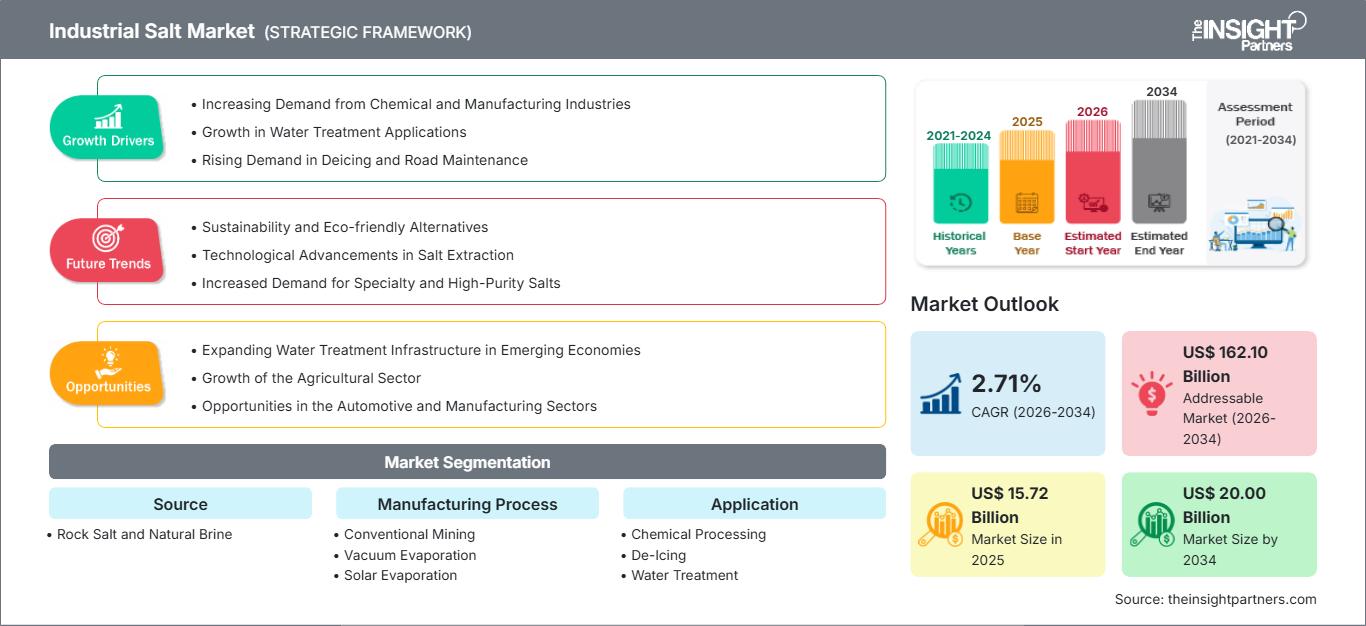
The industrial salt market was valued at US$ 15.72 Billion in 2025 and is projected to reach US$ 20.00 Billion by 2034, registering a CAGR of 2.71% during 2026–2034. Market expansion is supported by salt consumption across chemical processing, de-icing, water treatment, and oil and gas operations, while production remains dependent on geographically distributed rock salt deposits, natural brine resources, and energy-intensive evaporation technologies.
In North America, the industrial salt market size is supported by established chlor-alkali capacity, recurring winter road-maintenance requirements, and large-scale water-treatment infrastructure. The regional market is expected to expand at an estimated CAGR of 2.4–3.0% during 2026–2034, with demand resilience strengthened by the essential nature of sodium chloride in municipal services and industrial chemical value chains.
Industrial Salt Market Assessment and Insights
- North America: North America accounted for an estimated 27–31% share in 2025 and is expected to grow at a CAGR of 2.4–3.0% between 2026–2034. Chlor-alkali production, municipal water treatment, and structurally recurring winter de-icing requirements support a stable regional consumption base.
- US: The U.S. represented approximately 78–84% of North American demand in 2025 and is projected to expand at a CAGR of 2.3–2.9% during 2026–2034, supported by extensive chemical manufacturing and transportation infrastructure.
- Europe: Europe held an estimated 24–28% share in 2025 and is expected to record a CAGR of 1.9–2.5% between 2026–2034. Germany, the UK, France, Italy, and Spain remain important markets due to chemical production and winter-maintenance requirements.
- Asia Pacific: Asia Pacific accounted for approximately 34–38% share in 2025 and is forecast to expand at a CAGR of 3.1–3.8% during 2026–2034. China, India, Japan, South Korea, and Australia support demand through chemicals, water infrastructure, and industrial processing.
- Largest Segment: Chemical Processing held an estimated 39–44% market share in 2025 and is projected to grow at a CAGR of 2.8–3.4% during 2026–2034, reflecting its role in chlorine and caustic soda production.
- High Growth Segment: Water Treatment accounted for approximately 12–16% market share in 2025 and is expected to register a CAGR of 3.6–4.3% during 2026–2034, supported by expanding treatment and desalination infrastructure.
- Key companies analyzed in detail: K+S Aktiengesellschaft, Cargill, Incorporated, Compass Minerals International, Inc., China National Salt Industry Co., Ltd., Tata Chemicals Limited, Mitsui & Co., Ltd., Rio Tinto plc, Compagnie des Salins du Midi et Salines de l'Est SAS, Dominion Salt Limited, Exportadora de Sal, S.A. de C.V.
Source: The Insight Partners' analysis based on proprietary research, government publications, company annual reports, investor presentations, industry databases, and expert interviews.
Production within the industrial salt market has evolved from a predominantly extraction-oriented business toward a more application-specific supply system shaped by purity requirements, logistics efficiency, and process technology. Conventional underground mining remains important for large rock-salt reserves, while vacuum evaporation supports high-purity grades used by chemical and specialized industrial customers. Solar evaporation will continue to hold economic value in appropriate climates, especially where land and brine factors will minimize energy needs. Suppliers are focusing on product differentiation through granulation, quality, moisture control, packaging, and dependable regional delivery logistics.
In the future, growth in demand is bound to be more geographically diverse with the spread of industrialization, construction of water infrastructures, and additional chemical production capacities in developing nations. Future investments will also be influenced by brine source development, improved energy efficiency in the evaporation processes, and local supply chains. Environmental considerations concerning mining, water management, and waste disposal are prompting more control. These trends will favor selective capacity upgrades and make low-cost sources and proximity to large consumption industries strategically important.
Industrial Salt Market Report Scope
| Report Attribute | Details |
|---|---|
| Market size in 2025 | US$ 15.72 Billion |
| Market Size by 2034 | US$ 20.00 Billion |
| Global CAGR (2026 - 2034) | 2.71% |
| Historical Data | 2021-2024 |
| Forecast period | 2026-2034 |
Industrial Salt Market Analysis
Demand for the industrial salt market is fundamentally linked to the chlor-alkali value chain, where sodium chloride is converted into chlorine, caustic soda, and hydrogen. The market growth outlook is therefore influenced by downstream consumption in construction materials, pulp and paper, water treatment, alumina processing, and numerous chemical intermediates. De-icing provides an additional volume outlet in colder climates, although annual consumption can fluctuate with winter severity and public-sector procurement requirements.
The value chain starts with the extraction or the brine mining process, followed by crushing, screening, purification, evaporating, storage, transport, and distribution. Economic issues vary depending on the source of the salt. Rock salt companies enjoy advantages in their ample supplies and existing mines, while vacuum salt production is more energy-dependent. Solar salt production is viable where favorable evaporation conditions exist.
From a competitive perspective, the industrial salt market analysis shows that resource ownership, geographic reach, product quality, logistics infrastructure, and downstream integration remain the principal differentiators. K+S Aktiengesellschaft and Compass Minerals International, Inc. maintain strong positions in mined salt and specialty applications, while Cargill, Incorporated serves diverse industrial and de-icing customers through broad production and distribution capabilities. China National Salt Industry Co., Ltd. benefits from its position within China's extensive domestic salt industry.
Strategic positioning is also affected by the availability of market specialization and export facilities. The involvement of Tata Chemicals Limited is through its operations involving salt and chemicals, and Mitsui & Co., Ltd., in the form of international trade and logistics capabilities. Rio Tinto plc adds mining experience, and Compagnie des Salins du Midi et Salines de l'Est SAS, Dominion Salt Limited, and Exportadora de Sal, S.A. de C.V. provide crucial regional supply bases. Investment trends are oriented towards capacity optimization, product specification, and transportation rather than globalization.
● REPORT CUSTOMIZATION
Tailor This Report To Align With Your Specific Business Requirements
This report can be customized to align precisely with your business objectives, scope, and target markets. Customization options include tailored segmentation, geography, competitive analysis, and strategic insights to support informed decision-making.
Customize This Report →WHAT YOU CAN ADJUST
- ● Segmentations
- ● Geography
- ● Competitive Analysis
- ● Language Preferences
Industrial Salt Market: Strategic Insights
Regional Insights
North America Industrial Salt Market
North America represented an estimated 27–31% of the industrial salt market share in 2025 and is projected to expand at a CAGR of 2.4–3.0% during 2026–2034. This area is endowed with extensive subterranean and solution-mining supplies along with consistent requirements from chemical processing, water purification, and road de-icing applications. Chlor-alkali plants have provided producers with a sizeable, fairly stable industrial consumer base while transport departments establish seasonal buying patterns for road de-icing purposes.
Factors impacting the economics of production include mine efficiencies, transportation capabilities through railways and maritime transport, energy supplies, and closeness to consumer markets. The United States accounts for most of the regional demand, whereas Canada provides substantial rock salt reserves and consumption for de-icing applications. Investment in infrastructure and water purification may bring some positive impacts, while warm winters may limit de-icing applications. Producers are increasingly balancing their seasonal and chemical/industrial-grade products.
U.S. Industrial Salt Market
The U.S. accounted for approximately 78–84% of North American industrial salt demand in 2025 and is expected to grow at a CAGR of 2.3–2.9% through 2034. Chlor-alkali plants of large capacities, water treatment facilities of municipalities, food and industrial processing units, and large highways contribute to maintaining a wide clientele. Compass Minerals International, Inc. and Cargill, Incorporated are some of the existing companies operating in the major domestic applications.
There is a growing preference in application trends towards reliable supply agreements, consistent specifications, and regional inventories. The chemical industry is by far the largest end user of sodium bicarbonate, while its usage for water softening purposes continues to make steady demands in municipalities and industrial units. The winter season is a key factor impacting short-term demand for ice melting. Future investments in industrial facilities are likely to help increase its production, but cost considerations are important.
Europe Industrial Salt Market
Europe held an estimated 24–28% share of the industrial salt market in 2025 and is projected to grow at a CAGR of 1.9–2.5% during 2026–2034. Germany is the dominant regional market owing to its chemical manufacturing industries and established sources of underground salts. The United Kingdom continues to remain significant owing to winter maintenance, chemical application, and supply systems. Examples of diverse production within the region include K+S Aktiengesellschaft and Compagnie des Salins du Midi et Salines de l'Est SAS.
The German industrial manufacturing system provides constant demand for high-purity and bulk salts, while France has an advantage in having established production of solar and evaporated salts. Italy and Spain have an added advantage from their chemical manufacturing industries, water purification and coastally located salts. The regulatory environment related to energy consumption, emissions, mining, and water regulation is forcing modernization within the region. Industrial expansion is moderate and steady, while established downstream demand guarantees the significance of the region in the future.
APAC Industrial Salt Market
Asia Pacific accounted for approximately 34–38% of the industrial salt market in 2025 and is expected to expand at a CAGR of 3.1–3.8% during 2026–2034. China leads regional consumption through its extensive chemical sector, while India benefits from large solar-salt production and expanding industrial activity. Japan and South Korea require a reliable high-purity supply, whereas Australia provides significant resource availability and export potential.
Policy support for water infrastructure, manufacturing, and industrial development is strengthening demand across the region. China National Salt Industry Co., Ltd. remains a prominent domestic participant. Growth is expected to be supported primarily by chemicals and water treatment rather than weather-dependent de-icing, creating a comparatively diversified long-term demand profile.
Middle East & Africa Industrial Salt Market
The Middle East and Africa industrial salt market is expected to grow at a CAGR of 3.2–3.9% during 2026–2034. Saudi Arabia and the UAE are significant demand centers due to their need for chemical inputs related to desalination processes, water treatment, petrochemical production, and industrial diversification. Additionally, the availability of energy resources and the proximity to the coast create favorable conditions for salt processing in some Middle East countries.
South Africa still is an important industrial center on the African continent, whereas the Rest of MEA represents a long-term growth market in relation to mining, water infrastructure, and urbanization. The growth of desalination and energy projects will lead to the growth in demand for water treatment and industrial chemicals.
Segmentation Analysis
Source
The source segment of the industrial salt market is projected to expand at a CAGR of 2.7–3.3% during 2026–2034. Resource characteristics strongly influence production economics, product purity, transportation requirements, and suitability for downstream applications. Rock deposits support large-scale bulk production, while natural brine enables solution mining and evaporation routes. Geographic availability of reserves and access to energy, water, and logistics infrastructure will continue to determine regional supply competitiveness.
- Rock Salt: Rock salt remains strategically important for bulk chemical processing and de-icing applications. Large underground deposits support high-volume extraction, while established mining infrastructure and rail connections can provide a reliable supply to regional industrial customers.
- Natural Brine: Natural brine supports solution mining and evaporation-based production, particularly where purity requirements are high. Its strategic value lies in flexible processing, potential resource efficiency, and suitability for chemical and specialized industrial applications.
Manufacturing Process
Manufacturing processes are expected to record a CAGR of 2.6–3.2% during 2026–2034 as producers balance energy consumption, resource availability, product specifications, and operating costs. Conventional mining remains efficient for accessible deposits, whereas vacuum evaporation supports highly refined products. Solar evaporation retains importance in favorable climates because lower energy intensity can improve production economics, although output remains dependent on weather conditions and evaporation cycles.
- Conventional Mining: Conventional mining serves high-volume markets where underground deposits are commercially accessible. The process remains important for supplying bulk grades to chemical processors and transportation agencies requiring dependable, large-scale deliveries.
- Vacuum Evaporation: Vacuum evaporation is strategically important for applications requiring controlled purity and consistent particle characteristics. Producers use this route to serve chemical, treatment, and specialized industrial customers where product quality can justify higher processing costs.
- Solar Evaporation: Solar evaporation remains valuable in regions with high temperatures, suitable land, and accessible brine. Its comparatively low energy requirements strengthen competitiveness, although production planning must accommodate climatic conditions and longer evaporation cycles.
Application
Application demand is forecast to grow at a CAGR of 2.9–3.5% during 2026–2034. Chemical Processing is the largest application, while Water Treatment represents the highest-growth segment. This industrial salt market scope reflects the material's importance as both a chemical feedstock and a functional industrial input. Demand patterns vary substantially by geography because chemical capacity, climate, municipal infrastructure, and energy-sector activity determine the relative importance of individual applications.
- Chemical Processing: Chemical Processing is the largest application, accounting for an estimated 39–44% share in 2025. Sodium chloride remains essential to chlor-alkali production and numerous downstream chemical value chains, supporting comparatively stable baseline demand.
- De-Icing: De-Icing demand is concentrated in colder regions and depends on winter severity, road networks, and public procurement. Strategic stockpiling and distribution capacity are therefore important competitive factors for suppliers serving transportation agencies.
- Water Treatment: Water Treatment accounted for approximately 12–16% share in 2025 and is the highest-growth application. Municipal treatment expansion, water softening, industrial reuse, and desalination-related chemical requirements support a CAGR of 3.6–4.3%.
- Oil and Gas: Oil and Gas applications include drilling, completion, processing, and associated industrial operations. Demand is linked to upstream activity, regional energy investment, and the technical requirements of salt-based fluids and processing systems.
Opportunity Snapshot
| Application | Revenue Contribution | Trend Tag | Adoption Stage |
| Chemical Processing | High | Chlor-Alkali | Mature |
| De-Icing | High | Winter Resilience | Mature |
| Water Treatment | Medium | Water Reuse | Scaling |
| Oil and Gas | Low | Brine Fluids | Scaling |
Industrial Salt Market Growth Drivers and Impact Analysis
Expansion of Chlor-Alkali and Downstream Chemical Production
Chemical manufacturing continues to be the most strategically significant demand factor as sodium chloride is an important raw material for chlor-alkali industry production. Chlorine and caustic soda products are then used in PVC, alumina extraction, paper and pulp, water purification, soaps, detergents, and many other manufacturing industries. With the development of downstream manufacturing capacity, salt manufacturers gain benefits from periodic bulk consumption and long-term supply arrangements. It is especially significant in those areas where integrated chemical complexes are being built close to ports, sources of energy or local minerals. Integration in production may decrease transportation intensity and ensure supply security. This factor is favorable for producers who are able to provide constant high purity and large volumes of salt products.
Growing Investment in Water Treatment and Desalination Infrastructure
Water security concerns and infrastructure investment are increasing the strategic importance of salt across municipal and industrial treatment systems. Sodium chloride is used in regeneration, softening, ion exchange, and selected treatment processes, while broader desalination ecosystems strengthen demand for chemicals and industrial inputs. Urban population growth and industrial water reuse are creating recurring requirements that are less dependent on seasonal conditions than de-icing. The industrial salt market benefits when treatment facilities prioritize reliable material availability and specification consistency. This driver is particularly relevant in water-stressed economies across the Asia Pacific and the Middle East. Suppliers with proximity to treatment infrastructure can reduce freight costs and improve responsiveness, creating opportunities for regional production, distribution hubs, and application-specific product grades.
Recurring Winter Road Maintenance and Transportation Safety Needs
De-icing is a significant factor in the volume of demand in locations that experience extended periods of freezing weather. Agencies involved in transportation use salt to ensure the availability of the roads and decrease the weather risks to their passengers; therefore, they face great demands for seasonal procurement. The demand can vary greatly depending on the amount of precipitation, the weather patterns, the stock of the company and the previous pre-season purchases. However, the constant need for infrastructure maintenance results in a continuous baseline demand. The manufacturers have the opportunity to take advantage of geographically convenient mines, warehouses and distribution centers to deliver the product quickly in times of harsh weather conditions.
Industrial Salt Market Future Trends
Energy-Efficient Production and Process Modernization
Energy efficiency will become increasingly important as producers modernize evaporation, purification, pumping, and material-handling systems. The industrial salt market trends increasingly favor lower energy intensity because electricity and thermal requirements can materially affect the economics of vacuum-evaporated grades. Companies are expected to invest in process automation, heat recovery, improved brine management, and equipment reliability. Solar evaporation will remain attractive where climate conditions permit, while mined-salt producers will focus on productivity and recovery improvements. Digital monitoring may further improve inventory planning and maintenance. Over time, modernization will support more consistent product specifications, reduced operating variability, and stronger resilience against energy-price volatility and regulatory requirements.
Greater Emphasis on Regional Supply Security and Logistics
Suppliers' ability to guarantee a stable supply will gain more significance in terms of purchasing as chemical industries, cities, and industries work on decreasing their risks associated with transportation disruptions. In the future, the following factors are likely to be crucial: access to resources, storage capabilities, railway links, port facilities, and geographic location. It is possible that the producers will start keeping dispersed inventories to cater to the seasonality of de-icing needs and the continuous demand for chemicals. Although foreign trade will continue to be crucial for those regions that do not have sufficient resources or are situated near the coast, the cost of transportation will negatively affect the competitiveness of distant bulk deliveries.
Industrial Salt Market Opportunities
High-Purity Grades for Expanding Industrial Applications
Investment in high-purity salt production offers an opportunity to capture applications where product consistency and contamination control are more important than bulk volume alone. Vacuum evaporation, advanced purification, and controlled packaging can support differentiated supply to chemical processors, treatment operators, and specialized industrial users. Industrial salt market Forecasts indicate that emerging water infrastructure and manufacturing investment can gradually increase demand for application-specific grades. Producers should evaluate regional gaps between available resource quality and customer specifications before committing capital. Partnerships with downstream users can improve product design and contract visibility. This opportunity is strongest where industrial customers currently depend on imported refined grades or where domestic resource development can replace costly long-distance supply.
Integrated Salt Supply Near Water and Energy Infrastructure
The creation of integrated supply models in the proximity of desalination, petrochemical, and energy complexes represents an alternative route for investments. The presence of coastal brine deposits, utilities, and a port will allow efficient production and distribution at the sites of high local demand. The possibilities of integrating resource extraction, processing, storage, and transport can be evaluated, and thus, handling will be simplified. Particularly favorable environments from the standpoint of infrastructure include Saudi Arabia and the UAE, although some African countries can become relevant due to the combined mining and water investments. Modernizing existing facilities will also help increase productivity and uniformity of the output.
Recent Developments
- August 2026: Compass Minerals highlighted clear financial progress alongside stubborn operational hurdles. Strong momentum in Plant Nutrition and firmer salt pricing are lifting profitability and guidance, yet mining inefficiencies, higher logistics costs, and softer highway volumes are tempering the near‑term cash story and execution narrative.
- June 2026: Compass Minerals International Inc. upgraded to 'B+' from 'B' on debt paydown, and improved leverage.
Frequently Asked Questions

- Comprehensive Market Sizing and Forecast Analysis
- Detailed Segmentation Analysis
- In-Depth Market Dynamics Assessment
- Regional and Country-Level Insights
- Competitive Landscape and Company Benchmarking
- Strategic Business Intelligence
Recent Reports
Testimonials

The Insight Partners provided valuable market intelligence that supported our global go-to-market strategy. Their team was professional, responsive, and attentive to our feedback, providing thoughtful analysis and helpful methodological clarifications throughout the project.
Junmo Kim Chief Financial Officer (CFO), Enertech Co., Ltd.
The Insight Partners' SCADA System Market report is comprehensive, with valuable insights on current trends and future forecasts. The team was highly professional, responsive, and supportive throughout. We are very satisfied and highly recommend their services.
RAN KEDEM Partner, Reali Technologies LTDs
I requested a report on a very specific software market and the team produced the report in a few days. The information was very relevant and well presented. I then requested some changes and additions to the report. The team was again very responsive and I got the final report in less than a week.
JEAN-HERVE JENN Chairman, Future Analytica
We worked with The Insight Partners for an important market study and forecast. They gave us clear insights into opportunities and risks, which helped shape our plans. Their research was easy to use and based on solid data. It helped us make smart, confident decisions. We highly recommend them.
PIYUSH NAGPAL Sr. Vice President, High Beam Global
The Insight Partners delivered insightful, well-structured market research with strong domain expertise. Their team was professional and responsive throughout. The user-friendly website made accessing industry reports seamless. We highly recommend them for reliable, high-quality research services
YUKIHIKO ADACHI CEO, Deep Blue, LLC.
This is the first time I have purchased a market report from The Insight Partners.While I was unsure at first, I visited their web site and felt more comfortable to take the risk and purchase a market report.I am completely satisfied with the quality of the report and customer service. I had several questions and comments with the initial report, but after a couple of dialogs over email with their analyst I believe I have a report that I can use as input to our strategic planning process.Thank you so much for taking the extra time and making this a positive experience.I will definitely recommend your service to others and you will be my first call when we need further market data.
JOHN SUZUKI President and Chief Executive Officer, Board Director, BK Technologies
I wish to appreciate your support and the professionalism you displayed in the course of attending to my request for information regarding to infectious disease IVD market in Nigeria. I appreciate your patience, your guidance, and the fact that you were willing to offer a discount, which eventually made it possible for us to close a deal. I look forward to engaging The Insight Partners in the future, all thanks to the impression you have created in me as a result of this first encounter.
DR CHIJIOKE ONYIA MANAGING DIRECTOR, PineCrest Healthcare Ltd.Reason to Buy
- Informed Decision-Making
- Understanding Market Dynamics
- Competitive Analysis
- Identifying Emerging Markets
- Customer Insights
- Market Forecasts
- Risk Mitigation
- Boosting Operational Efficiency
- Strategic Planning
- Investment Justification
- Tracking Industry Innovations
- Aligning with Regulatory Trends





 Get Free Sample for