
Industrial USB Connectors Market Trends, Demand & Growth by 2034
Coverage: by Type (USB Type A, USB Type B, USB Type C); Application (Industrial Automation, Automotive, Others) , and Geography (North America, Europe, Asia Pacific, and South and Central America)
- Status : Data Released
- Report Code : TIPRE00010547
- Category : Electronics and Semiconductor
- No. of Pages : 150
- Available Report Formats :


- Last update date : September 21, 2026


2025 Market Size
US$ 3.72 Bn
Base year value
2034 Forecast
US$ 5.49 Bn
Projected by 2034
CAGR 2026-2034
4.42 %
Growth rate
Addressable Market
US$ 41.82 Bn
(2026-2034)
The Industrial USB Connectors Market was valued at US$ 3.72 Billion in 2025 and is projected to reach US$ 5.49 Billion by 2034, expanding at a CAGR of 4.42% during 2026–2034. The market reflects sustained demand for standardized data and power interfaces across connected industrial equipment, while connector designs increasingly emphasize mechanical retention, environmental protection, signal integrity, compact form factors, and compatibility with higher-speed USB standards.
North America is a mature demand center where the Industrial USB Connectors Market size is supported by factory automation upgrades, industrial computing deployments, and automotive electronics modernization. Regional growth is expected at 4.0–4.5% during 2026–2034, with buyers prioritizing rugged interfaces, locking mechanisms, environmental protection, and dependable supply for long-life equipment.
Industrial USB Connectors Market Assessment and Insights
- North America accounts for 28–32% share in 2025 and is expected to grow at a CAGR of 4.0–4.5% during 2026–2034, supported by automation modernization, industrial computing, and automotive electronics.
- US represents 72–76% of North America's 2025 demand and is projected to expand at a CAGR of 4.1–4.6%, supported by factory automation, automotive electronics, and industrial equipment replacement.
- Europe holds 24–28% share in 2025 and is expected to register a CAGR of 3.8–4.3%, led by Germany, the UK, France, Italy, and Spain through automotive and automation demand.
- Asia Pacific represents 34–38% share in 2025 and is projected to grow at a CAGR of 5.0–5.5%, led by China, Japan, South Korea, India, and Australia.
- Largest Segment is USB Type A, representing 45–49% market share in 2025 and growing at a CAGR of 3.2–3.7%, reflecting the installed industrial equipment base.
- High Growth Segment is USB Type C, representing 18–22% market share in 2025 and expanding at a CAGR of 7.0–7.6%, driven by compact designs and higher data and power requirements.
- Key companies analyzed in detail: Amphenol Corporation, Bulgin Limited, EDAC Inc., Hirose Electric Co., Ltd., Kycon, Inc., Molex, LLC, Newnex Technology Corp., Parallax Inc., SAMTEC, Inc., TE Connectivity Ltd., and OMRON Corporation.
Source: The Insight Partners' analysis based on proprietary research, government publications, company annual reports, investor presentations, industry databases, and expert interviews.
Industrial USB Connectors Market has matured from simple peripherals to rugged and high speed connectivity. There are trends towards locking, shielding, panel mounting, sealing, and reinforced housing in industrial connectivity products. The company provides industrial USB connectivity with locking and sealed designs and its latest Type C range serves high speed data transfer and industrial automation. Manufacturing priorities have shifted from standardized connector design to precise contact, impedance control, and durability.
In the forecast period, adoption will increase as manufacturers standardize interfaces for machines, vehicles, industrial PCs, sensors, and diagnostic devices. Investments will be made in Type C connectivity, waterproof assembly, small mounting designs, and improved signal quality. There will be growth opportunities in Asia Pacific region because of increasing electronics and automotive manufacturing whereas North America and Europe customers value reliability and lifecycle support.
Industrial USB Connectors Market Report Scope
| Report Attribute | Details |
|---|---|
| Market size in 2025 | US$ 3.72 Billion |
| Market Size by 2034 | US$ 5.49 Billion |
| Global CAGR (2026 - 2034) | 4.42% |
| Historical Data | 2021-2024 |
| Forecast period | 2026-2034 |
Industrial USB Connectors Market Analysis
Demand is fueled by the growing population of programmable automation equipment, industrial PCs, HMI units, machine vision, diagnostics equipment, and networked controllers. Growth of the Industrial USB Connectors Market is thus driven by the modernization of factories and demand for standardized interfaces for communication and servicing. The market environment includes suppliers of connectors, cables, printed circuit boards, automation original equipment manufacturers, distributors, system integrators, and industrial equipment manufacturers.
Suppliers of Industrial USB Connectors are influenced by factors including precision stamping, plating, molding, shielding, assembling, and environmental testing. Increasing differentiation of suppliers is achieved through features such as locking, ingress protection, wide operating temperatures, vibration resistance, and high cycle count capability. Industrial USB Connectors are applied in factory automation, PLCs, industrial PCs, control cabinets, robotics, printers, and diagnostic equipment.
Competitive positioning is varied, and includes players such as large interconnect manufacturers and niche players. The Industrial USB Connectors Market report shows that Amphenol Corporation, Molex, LLC, Hirose Electric Co., Ltd., TE Connectivity Ltd., SAMTEC, Inc. and Bulgin Limited position themselves based on their portfolio depth, engineering services, customization options, and regional presence. Other key companies include EDAC Inc., Kycon, Inc., Newnex Technology Corp., Parallax Inc., and OMRON Corporation, which cater to specific applications and offer alternatives.
Investments will now focus on high-speed interfaces, auto connectivity, industrial automation, and miniaturized assemblies. Of special importance is type C connectors since one interface may be used for data, power delivery, and protocols. Positioning is more and more based on ruggedness, signal integrity, environmental protection, lifecycle management, and the capability of qualifying the product at OEMs globally.
● REPORT CUSTOMIZATION
Tailor This Report To Align With Your Specific Business Requirements
This report can be customized to align precisely with your business objectives, scope, and target markets. Customization options include tailored segmentation, geography, competitive analysis, and strategic insights to support informed decision-making.
Customize This Report →WHAT YOU CAN ADJUST
- ● Segmentations
- ● Geography
- ● Competitive Analysis
- ● Language Preferences
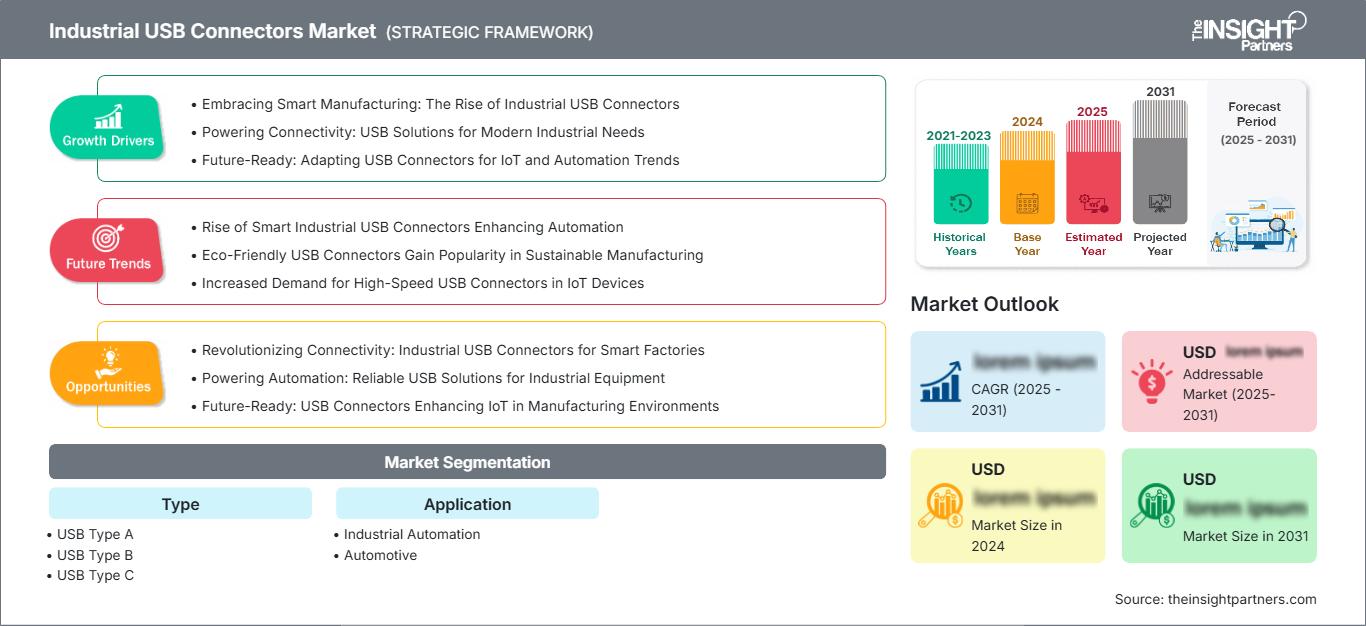
Industrial USB Connectors Market: Strategic Insights
Regional Insights
North America Industrial USB Connectors Market
North America makes up 28-32% of Industrial USB Connectors Market Share by 2025 and is expected to post a CAGR of 4.0-4.5% until 2034. US will drive the regional demand, fueled by industrial automation, factory upgrading, industrial computing, robotics, and automotive electronics. Canada will contribute from automation, energy machinery, and industrial machinery segments.
Demand will be driven by proven engineering ecosystems as well as wide availability of components. Market share of Industrial USB Connectors in North America will be driven by the need of customers for locking mechanisms, shielding, environmental protection, and availability over the life cycle as connected production equipment becomes more decentralized.
U.S. Industrial USB Connectors Market
The United States accounts for 72%-76% of North America’s 2025 market and is estimated to grow at a CAGR of 4.1%-4.6% up to 2034. Industrial automation, automotive electronics, industrial computers, robots, and diagnostic systems represent significant demand bases. The country provides substantial engineering and distribution capabilities for connectors.
TE Connectivity Ltd., Amphenol Corporation, Molex, LLC, SAMTEC, Inc., and others offer wide availability of connectors in industrial applications. Type A continues to be relevant for existing devices, whereas Type C gains popularity among new computers, automotive, and miniature industrial automation systems. Requirements related to retention, shielding, environmental protection, and cycling have become more prevalent among buyers.
Europe Industrial USB Connectors Market
Europe holds a market share of 24-28% in 2025 and is expected to grow at a CAGR of 3.8-4.3% till 2034. Germany holds regional market leadership due to its demand driven by automotive manufacturing, automation industry, machine tools, and factory automation. United Kingdom, France, Italy, and Spain hold their shares through manufacturing, transport, electronics, and industrial machinery.
United Kingdom holds its regional market leadership through engineering & modernization of equipment and industrial automation for rugged panel mounted interface applications. Germany continues to lead the regional market due to its dense automotive and automation industries. France, Italy, and Spain hold their regional market shares through machinery, automotive manufacturing, electronics, energy, and industrial control, with growing reliability focus.
APAC Industrial USB Connectors Market
APAC accounts for 34-38% of world demand by 2025 and is expected to witness a CAGR of 5.0-5.5%. China remains a front runner in this category, followed by Japan, South Korea, India, and Australia. Manufacturing, automobile, automation, and industrial digitization drives regional demand.
Manufacturing volumes in China drive connector demand, whereas Japan and South Korea have a focus on electronics and automobile segments. India has been growing in significance due to electronics and automobile manufacturing activities, while Australia has contributions from industrial machinery and resource sectors.
Middle East & Africa Industrial USB Connectors Market
The Middle East & Africa market is forecast to see growth at a CAGR of 4.2-4.7% until 2034. The Middle East & Africa region is led by Saudi Arabia, followed by UAE and South Africa, with RoMEA contributing from infrastructure development, industrial projects, and equipment upgradation.
Factors driving the use of connectors include energy infrastructure development, logistics, diversification of the manufacturing sector, and investments in smart facilities. Saudi Arabia and UAE are working on automation and development of their digital infrastructure, whereas South Africa continues to show demand from its mining and manufacturing industries.
Segmentation Analysis
Type
The Type segment comprises USB Type A, USB Type B, and USB Type C. Industrial USB Connectors Market scope is shaped by the installed base of legacy interfaces and the migration toward compact, higher-speed designs. USB Type A remains strongly embedded in existing industrial equipment, Type B serves established device-side applications, and Type C is gaining adoption for newer computing and automotive architectures. The segment is expected to expand at a CAGR of 4.3–4.8% during 2026–2034.
- USB Type A remains strategically important for industrial PCs, HMIs, controllers, test equipment, and service systems where compatibility and established tooling influence purchasing decisions.
- USB Type B maintains demand in industrial printers, measurement equipment, programming interfaces, and device-side applications where stable, familiar connections remain valuable.
- USB Type C is increasingly selected for compact industrial computers, automotive electronics, portable diagnostics, and next-generation control platforms requiring reversible connectivity and higher data and power capabilities.
Application
The Application segment in the Industrial USB Connectors Market covers Industrial Automation and Automotive. Industrial automation remains the principal demand center because USB interfaces connect controllers, HMIs, industrial PCs, diagnostic equipment, and peripherals. Automotive demand is gaining strategic importance as vehicles incorporate more displays, infotainment systems, diagnostics, and connected electronics. The application segment is projected to grow at a CAGR of 4.8–5.3% during 2026–2034.
- Industrial Automation represents the core application base, spanning PLC-related equipment, HMIs, robotics, machine vision, industrial PCs, control cabinets, and diagnostic tools requiring reliable service connectivity.
- Automotive is increasingly important as vehicle electronics adopt compact, high-speed interfaces for infotainment, passenger connectivity, diagnostics, rear-seat systems, and emerging electric and software-defined vehicle architectures.
Opportunity Snapshot
| Application | Revenue Contribution (High/Medium/Low) | Trend Tag (MAX 2 words) | Adoption Stage (Emerging/Scaling/Mature) |
| Industrial Automation | High | Factory Connectivity | Mature |
| Automotive | Medium | Vehicle USB-C | Scaling |
Industrial USB Connectors Market Growth Drivers and Impact Analysis
Expansion of Connected Factory Automation Architectures
Connected production equipment is increasing the number of physical interfaces required for commissioning, diagnostics, firmware updates, peripheral communication, and service operations. Industrial PCs, HMIs, robotics, machine-vision platforms, and programmable controllers increasingly operate as interconnected nodes rather than isolated machines. This creates recurring demand for connectors that maintain communication under vibration, dust, repeated mating, and electromagnetic interference. Locking and sealed designs can reduce accidental disconnection and maintenance interruptions. The market impact is a shift in purchasing criteria from low component cost toward total equipment reliability, field serviceability, and compatibility with installed architectures. Suppliers that combine standardized USB interfaces with industrial retention and environmental protection can therefore capture design opportunities in machinery and automation equipment.
Migration Toward Higher-Speed and Multifunctional Interfaces
Industrial equipment is generating greater volumes of data through cameras, sensors, displays, storage devices, and edge-computing platforms. This increases the value of interfaces capable of combining data transmission, power delivery, and compact mechanical integration. USB Type C is suited to this transition because its reversible architecture can support multiple USB generations and high-speed communication. TE Connectivity Ltd. states that its Type C portfolio supports USB4 up to 40Gbps, while industrial variants can include waterproof and enhanced-retention options. As equipment designers consolidate ports and reduce enclosure space, Type C adoption should increase connector value and encourage suppliers to develop rugged, high-cycle, high-integrity variants for industrial applications.
Increasing Automotive Electronics Content
Automotive platforms are incorporating more displays, infotainment functions, passenger connectivity, diagnostic systems, and electronic control capabilities. These architectures create opportunities for USB interfaces that combine compact packaging with high data rates and reliable mechanical performance. The transition toward electric and software-defined vehicles further increases electronic content and creates demand for standardized interfaces during development, servicing, and passenger use. Hirose Electric Co., Ltd. has highlighted automotive USB Type C adoption through its AU1 series, demonstrating the movement toward standardized vehicle connectivity. This trend can broaden the addressable application base for specialized connectors while raising requirements for vibration resistance, environmental durability, manufacturing consistency, and platform-level qualification.
Industrial USB Connectors Market Future Trends
Rising Adoption of Rugged USB Type C Architectures
Industrial USB Connectors Market trends increasingly point toward USB Type C architectures that combine compact reversible form factors with industrial-grade retention and environmental protection. Consumer-style receptacles can be inadequate where vibration, moisture, dust, repeated service access, or mechanical shock is present. Manufacturers are therefore likely to expand sealed, panel-mounted, locking, and reinforced Type C configurations. The transition should encourage greater interface standardization across industrial computing and automotive platforms while reducing dependence on proprietary connections. Suppliers that combine high-speed electrical performance with durable mechanical architectures will be positioned to capture new equipment designs as engineers prioritize interface consolidation, higher bandwidth, and long-term serviceability.
Increasing Integration of Data, Power, and Service Connectivity
Future connector platforms will increasingly be evaluated as multifunctional interfaces rather than simple data-transfer components. USB Type C can support data, power, and alternate-mode functions through a compact interface, allowing equipment designers to simplify port architecture. This direction is relevant to industrial handhelds, edge computers, diagnostic tools, operator terminals, and compact controllers. As equipment becomes more modular, manufacturers can use standardized interfaces for commissioning, maintenance, peripherals, and temporary instrumentation. Connector suppliers will therefore have opportunities to develop assemblies with controlled impedance, stronger board retention, thermal robustness, and environmental sealing. The resulting product architecture should support higher equipment density while reducing the number of physical interface formats used across product families.
Industrial USB Connectors Market Opportunities
Localized Production and Distribution in Asia Pacific
Industrial USB Connectors Market Forecasts indicate an attractive opportunity for localized production and distribution because connector demand is closely linked to Asia Pacific's electronics, automotive, machinery, and automation manufacturing base. China remains the largest production center, while India is expanding electronics manufacturing and vehicle production. Japan and South Korea provide mature engineering ecosystems supporting higher-value connector applications. Suppliers can strengthen regional competitiveness through localized molding, stamping, assembly, testing, and distribution while maintaining global qualification standards. Regional manufacturing can reduce logistics exposure and shorten replenishment cycles for OEM customers. The opportunity is strongest for suppliers offering Type C, ruggedized Type A, and application-specific assemblies that combine standardized interfaces with environmental protection.
Application-Specific Connector Platforms for Harsh Environments
A second opportunity lies in developing connector families tailored to demanding environments rather than competing solely on standardized USB interfaces. Mining, energy, outdoor automation, machine vision, marine equipment, and field diagnostics can require sealing, vibration resistance, corrosion protection, secure mating, and controlled cable routing. Rugged USB portfolios demonstrate how conventional functionality can be adapted for harsh conditions through sealed and panel-mount architectures. Similar solutions can be extended to Type C, where higher bandwidth and compact packaging create a pathway into newer industrial equipment. Investment in modular housings, overmolded cable assemblies, locking mechanisms, and environmental validation can create higher-value products and improve differentiation against commodity connector suppliers.
Recent Developments
- March 2026: Hirose's AU1 Series has become the industry's first connector to be adopted as the in‑vehicle USB Type‑C solution by a major global EV manufacturer. Building on this adoption, Hirose Electric will collaborate closely with the OEM to advance the standardization of automotive USB Type‑C, helping to set new benchmarks for next‑generation vehicle design.
- April 2025: ATTEND, a leading provider of advanced connectivity solutions, proudly introduces its expanded Waterproof USB & USB-C Connector Series, designed to meet the rigorous demands of harsh outdoor and industrial environments. The series encompasses USB Type-C, USB 2.0 Type-A, Mini USB, Micro USB, and introduces the cutting-edge USB Type-C Screw Lock Waterproof Connectors and USB4 Gen3 Waterproof Type-C Connectors. Engineered with IP67 or IP68 protection ratings, these connectors ensure exceptional resistance to water, dust, corrosion, and shock,-delivering reliable data and power transmission under extreme conditions.
- April 2025: Amphenol Socapex introduces its new USB3 Type A to Type C Adapter, designed to seamlessly integrate modern USB Type C technology into legacy USB Type A systems. Engineered for maximum durability, this adapter is ideal for demanding military, industrial, and harsh environment applications. The USB3 Type A to Type C Adapter is built to withstand the toughest conditions while ensuring high-speed data transfer and secure connections. With a Tri Start Thread coupling mechanism (MIL-DTL-38999 Series III type), IP68-rated environmental sealing, and enhanced EMI protection, this adapter ensures mission-critical reliability in C5ISR systems, battlefield communications, ground vehicles, and naval operations.
Frequently Asked Questions

- Comprehensive Market Sizing and Forecast Analysis
- Detailed Segmentation Analysis
- In-Depth Market Dynamics Assessment
- Regional and Country-Level Insights
- Competitive Landscape and Company Benchmarking
- Strategic Business Intelligence
Recent Reports
Testimonials

The Insight Partners' SCADA System Market report is comprehensive, with valuable insights on current trends and future forecasts. The team was highly professional, responsive, and supportive throughout. We are very satisfied and highly recommend their services.
RAN KEDEM Partner, Reali Technologies LTDs
I requested a report on a very specific software market and the team produced the report in a few days. The information was very relevant and well presented. I then requested some changes and additions to the report. The team was again very responsive and I got the final report in less than a week.
JEAN-HERVE JENN Chairman, Future Analytica
We worked with The Insight Partners for an important market study and forecast. They gave us clear insights into opportunities and risks, which helped shape our plans. Their research was easy to use and based on solid data. It helped us make smart, confident decisions. We highly recommend them.
PIYUSH NAGPAL Sr. Vice President, High Beam Global
The Insight Partners delivered insightful, well-structured market research with strong domain expertise. Their team was professional and responsive throughout. The user-friendly website made accessing industry reports seamless. We highly recommend them for reliable, high-quality research services
YUKIHIKO ADACHI CEO, Deep Blue, LLC.
This is the first time I have purchased a market report from The Insight Partners.While I was unsure at first, I visited their web site and felt more comfortable to take the risk and purchase a market report.I am completely satisfied with the quality of the report and customer service. I had several questions and comments with the initial report, but after a couple of dialogs over email with their analyst I believe I have a report that I can use as input to our strategic planning process.Thank you so much for taking the extra time and making this a positive experience.I will definitely recommend your service to others and you will be my first call when we need further market data.
JOHN SUZUKI President and Chief Executive Officer, Board Director, BK Technologies
I wish to appreciate your support and the professionalism you displayed in the course of attending to my request for information regarding to infectious disease IVD market in Nigeria. I appreciate your patience, your guidance, and the fact that you were willing to offer a discount, which eventually made it possible for us to close a deal. I look forward to engaging The Insight Partners in the future, all thanks to the impression you have created in me as a result of this first encounter.
DR CHIJIOKE ONYIA MANAGING DIRECTOR, PineCrest Healthcare Ltd.Reason to Buy
- Informed Decision-Making
- Understanding Market Dynamics
- Competitive Analysis
- Identifying Emerging Markets
- Customer Insights
- Market Forecasts
- Risk Mitigation
- Boosting Operational Efficiency
- Strategic Planning
- Investment Justification
- Tracking Industry Innovations
- Aligning with Regulatory Trends





 Get Free Sample for