
Industrial Vacuum Cleaners Market Size, Trends & Growth by 2034
Coverage: By Type ( Dry and Wet & Dry ); Power Source ( Electric and Pneumatic ); Industry ( Food & Beverages, Pharmaceuticals, Metal Working, Building & Construction, Others ), and Geography (North America, Europe, Asia Pacific, and South and Central America)
- Status : Data Released
- Report Code : TIPRE00003233
- Category : Electronics and Semiconductor
- No. of Pages : 150
- Available Report Formats :


- Last update date : September 21, 2026


2025 Market Size
US$ 1.41 Bn
Base year value
2034 Forecast
US$ 3.19 Bn
Projected by 2034
CAGR 2026-2034
9.53 %
Growth rate
Addressable Market
US$ 20.56 Bn
(2026-2034)
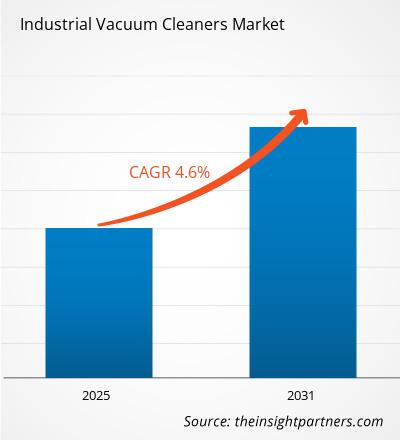
The Industrial Vacuum Cleaners Market was valued at US$ 1.41 Billion in 2025 and is projected to reach US$ 3.19 Billion by 2034, expanding at a CAGR of 9.53% during 2026–2034. This is based on the continuous effort to control contamination, combustible dust, process recovery, and effective housekeeping in industries including food and beverages, pharmaceuticals, metal working, building and construction, and others.
The market size of Industrial Vacuum Cleaners in North America is predicted to expand with a projected CAGR of 8.8%-9.4% up to 2034. Compliance of combustible dust, plant modernization, and increased manufacturing investments through reshoring drive purchases of certified electric and pneumatic systems. Buyers favor HEPA filtration, conductive accessories, silent motors, and selective collection systems which prevent cross-contamination.
Industrial Vacuum Cleaners Market Assessment and Insights
- North America: Held 30–33% share in 2025 and is modeled to grow at 8.8–9.4% CAGR during 2026–2034, supported by combustible-dust controls, plant modernization, and broad uptake of certified filtration equipment.
- US: Represented 79–83% of North American revenue in 2025 and is modeled at 8.9–9.5% CAGR through 2034, reflecting food, pharmaceutical, and metalworking upgrades.
- Europe: Accounted for 27–30% share in 2025 and is modeled at 8.3–8.9% CAGR during 2026–2034, led by Germany, the UK, France, Italy, and Spain.
- Asia Pacific: Captured 29–32% share in 2025 and is modeled at 10.5–11.3% CAGR during 2026–2034, with China, Japan, South Korea, India, and Australia driving industrial demand.
- Largest Segment: Dry systems held 57–61% market share in 2025 and are modeled to expand at 8.7–9.3% CAGR through 2034 across routine particulate collection.
- High Growth Segment: Pharmaceuticals held 12–15% market share in 2025 and are modeled at 11.1–11.9% CAGR through 2034, driven by containment and validated cleaning.
- Key companies analyzed in detail: American Vacuum Company, Comac S.p.A., Diversey Holdings, Ltd., Eureka Forbes Limited, EXAIR LLC, Alfred Kärcher SE & Co. KG, Nederman Holding AB, Numatic International Ltd., Suiden Co., Ltd., and Tennant Company.
Source: The Insight Partners' analysis based on proprietary research, government publications, company annual reports, investor presentations, industry databases, and expert interviews.
The evolution of industrial vacuuming from simple mobile extraction into systems that are designed for particular dust types, liquids, swarf, powders, and dangerous locations has occurred. The industry currently incorporates multi-stage filtration systems, automatic filter cleaning, conductive hoses, stainless-steel receivers, and continuous duty side channel blowers. Modular technology is required in production since customers require interchangeable heads, separators, and disposals. All the above factors put the Industrial Vacuum Cleaners Market in the context of other initiatives aimed at protecting workers, recycling, contamination control, and increased uptime.
In terms of future, more investment will be made in manufacturing sites across Asian corridors, North America’s reshoring operations, and upgraded facilities in Europe dust risk management. Pharmaceutical production capacities, batteries materials, additive manufacturing, and advanced food processing present challenging requirements for industrial vacuum cleaners. Regulation, insurance requirements, and corporate hygiene standards increase replacement activities. Companies that can prove the filtration efficiency, build equipment for dangerous locations, and offer local servicing will be well positioned.
Industrial Vacuum Cleaners Market Report Scope
| Report Attribute | Details |
|---|---|
| Market size in 2025 | US$ 1.41 Billion |
| Market Size by 2034 | US$ 3.19 Billion |
| Global CAGR (2026 - 2034) | 9.53% |
| Historical Data | 2021-2024 |
| Forecast period | 2026-2034 |
Industrial Vacuum Cleaners Market Analysis
The industrial vacuum cleaners market growth is fueled by more stringent housekeeping requirements, increased automation levels, and the need for combustible and respirable dust awareness. Users align their equipment specifications with regard to air volume, vacuum degree, filtration rating, grounding, and collection efficiency in relation to the nature of the material.
The supply environment is advantageous to producers who have flexibility in design and filter replacement capability. Stainless steel construction, conductive properties of components, electrical certification of equipment components, and efficient motor contribute to cost and delivery considerations. The end users tend to favor equipment that reduces changeover time, segregates recyclable liquids or metal swarf, and integrates into production process without dust generation.
Industrial Vacuum Cleaners market report shows competition between the suppliers of general cleaning equipment and application-specific equipment. The companies such as Alfred Kärcher SE & Co. KG, Tennant Company, Diversey Holdings, Ltd., and Comac S.p.A. enjoy the advantage of broad distribution channels, while American Vacuum Company, EXAIR LLC, Nederman Holding AB, Numatic International Ltd., Suiden Co., Ltd., and Eureka Forbes Limited compete through specialization, geography, or product range.
This investment shall be placed into automated systems of filter cleaning, energy-efficient electric motors, remote monitoring system, and dust removal systems. The positioning of the company should be done based on hazardous location approval, sanitation engineering, pneumatic systems, and lifecycle services. Manufacturers who test applications and provide accessories for source capture will have larger profit margins compared to manufacturers who only compete through suction capabilities.
● REPORT CUSTOMIZATION
Tailor This Report To Align With Your Specific Business Requirements
This report can be customized to align precisely with your business objectives, scope, and target markets. Customization options include tailored segmentation, geography, competitive analysis, and strategic insights to support informed decision-making.
Customize This Report →WHAT YOU CAN ADJUST
- ● Segmentations
- ● Geography
- ● Competitive Analysis
- ● Language Preferences
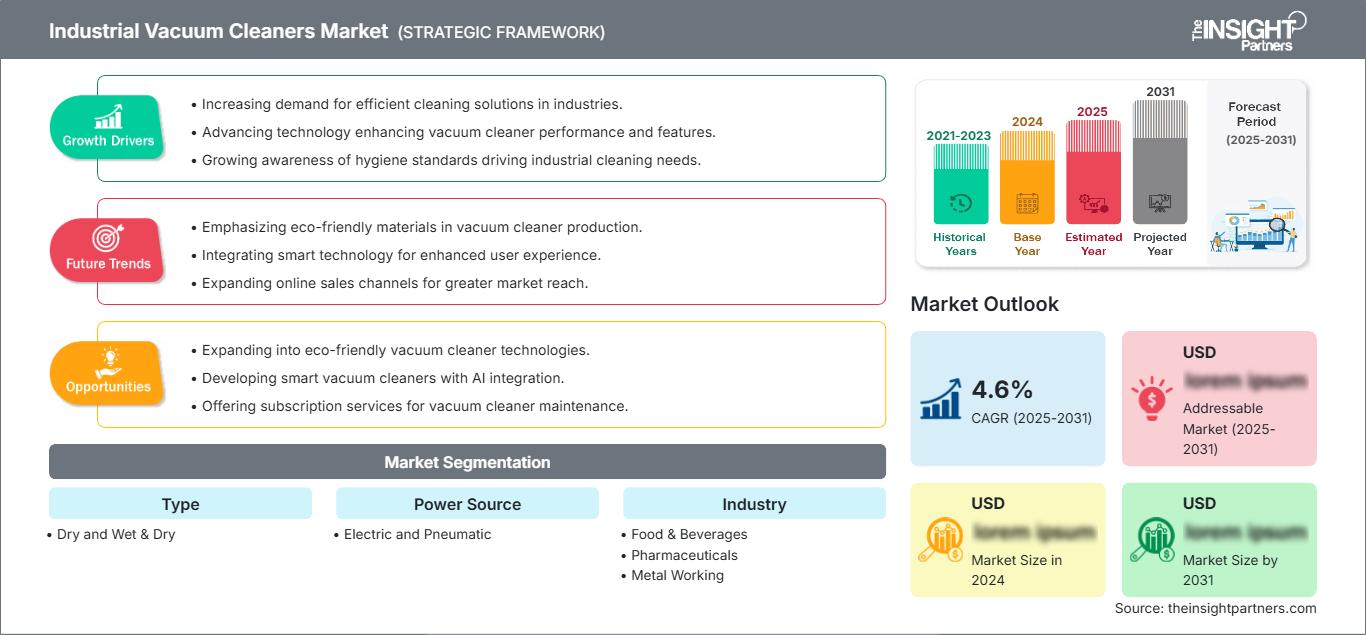
Industrial Vacuum Cleaners Market: Strategic Insights
Regional Insights
North America Industrial Vacuum Cleaners Market
The North American region commanded a 30–33% Industrial Vacuum Cleaners Market share in 2025 and is anticipated to grow at a 8.8–9.4% CAGR between 2026 and 2034. A substantial presence of food processing plants, pharmaceutical plants, metal working shops, warehouses, and construction contractors drives replacement applications. The OSHA regulations related to housekeeping, ventilation, grain handling, and hazardous locations promote dust control systematization, and NFPA 660 standardizes the approach to combustible dust issues.
For their regional customers, who consider spark, voltage, or any risk posed by the rotation of motor as dangers, the most preferable option is HEPA-fitted electrical cleaning systems for manufacturing activities and pneumatic vacuum cleaners. However, the brownfield sites utilize continuous duty industrial cleaners, pre-separators, and conductive tool kits. The extensive dealer and equipment rental channels have increased the availability of equipment among small customers, while reshoring, battery plants, and semiconductors increase demand for fine particulate matter cleaning.
U.S. Industrial Vacuum Cleaners Market
In the U.S., North American market revenue share was estimated to be 79-83%, and its growth rate forecasted at 8.9-9.5% CAGR up to 2034. A range of markets is present in food processing, pharmaceuticals, fabrication, aerospace, warehousing and construction. Combustible dust of flour, sugar, wood, plastic, and metal is to be processed with special equipment, which makes customers buy grounded systems, sealed filters, and hazardous location systems instead of conventional shop vacuums.
American Vacuum Company, EXAIR LLC, Tennant Company, Alfred Kärcher SE & Co. KG, Nederman Holding AB, and Numatic International Ltd. have a direct or channel distribution. The number of applications is growing in specificity: continuous duty central systems operate on production lines, wet/dry systems collect coolants and swarf, and portable HEPA systems are used in controlled environments. Purchase decisions take into account filter availability, noise level, ergonomic design, waste removal system, and compatibility with the dust type.
Europe Industrial Vacuum Cleaners Market
Europe holds a modeled share of 27-30% in 2025 and is projected to achieve CAGR of 8.3-8.9% during 2025-2034. Germany is the leader due to machinery, automotive, chemicals, food and metalworking segments, where ATEX-compliant equipment and proper maintenance enable high-end models. The UK is powered by food processing, pharmaceuticals, construction, aerospace, and recycling, and contractors require mobile HEPA units and manufacturers prefer hazardous dust models.
France relies on pharmaceuticals, food processing, transport equipment, and renovation of construction; Italy is characterized by machinery and industrial cleaning equipment segment. Spain supplies automotive, food, ceramic and infrastructure applications. In all these regions, energy-efficiency, noise reduction, ergonomic waste handling and product durability impact purchasing. European producers provide both ATEX and dust classes of their products, highlighting the region's competence in producing engineering systems for dangerous or contamination-sensitive environments.
Regulatory compliance and distribution network maturity ensure demand for the whole life cycle, which includes filters, hoses, separators, and service. Lower energy consumption and dust-free disposal systems dominate replacement cycles.
APAC Industrial Vacuum Cleaners Market
Asia Pacific captured the simulated 29-32% market share in 2025 and is estimated to grow at 10.5-11.3% CAGR between 2026-2034. China is a leader owing to large-scale production facilities, batteries, metals, chemicals, and food processing. Demand from Japan and South Korea is associated with value-added electronics, automotive industry, and precision manufacturing.
The pharmaceutical, construction, food products, cement, and metals production expansion in India will boost the market, while Australia is expected to provide growth via mining and materials processing demands. Upgrades of industrial equipment, export quality products, and setting up factories will drive growth, but price sensitivity will require tiering and local assembling of machines.
Middle East & Africa Industrial Vacuum Cleaners Market
The territory is forecasted to grow at a 9.0% to 9.8% CAGR rate until 2034. The growth is fueled by Saudi Arabia through petrochemicals, mining, food processing, and construction projects. The United Arab Emirates benefits from logistics, metals processing, aviation maintenance, and infrastructure construction needs requiring reliable mobile units.
The country of South Africa requires mining, manufacturing, food processing, and construction, while the Rest of MEA is project oriented. Energy and infrastructure development result in the requirement of washing and dust control and high-pressure pneumatic equipment. Purchasing is dependent on distribution capability and spare parts availability as well as operator training.
Segmentation Analysis
Type
Type demand is modeled at 9.0–9.6% CAGR during 2026–2034 as facilities match collection systems to particulate, liquid, and mixed-waste profiles. The Industrial Vacuum Cleaners Market scope spans routine dry housekeeping, process-integrated extraction, spill recovery, and chip-and-coolant separation. Selection increasingly reflects filtration class, container design, disposal method, corrosion resistance, mobility, and duty cycle rather than nominal motor power alone.
- Dry: Dry units hold the leading position because dust, powders, granules, and machining debris occur across most factories; advanced filters and automatic cleaning strengthen continuous operation.
- Wet & Dry: Wet and dry systems address spills, sludge, coolants, chips, and mixed waste, making them strategically important for maintenance teams seeking versatile equipment and faster recovery.
Power Source
Power-source revenue is modeled to rise at 9.2–9.8% CAGR through 2034. Electric machines dominate general factory use through broad availability, efficient motors, and flexible capacities, while pneumatic equipment remains important where compressed air is established or electrical ignition concerns constrain deployment. Operating cost, mobility, noise, maintenance, hazardous-area suitability, and continuous-duty requirements guide procurement.
- Electric: Electric systems lead routine and continuous-duty applications because they offer wide capacity choices, lower compressed-air dependence, and compatibility with automated filter cleaning and monitoring.
- Pneumatic: Pneumatic vacuums serve hazardous, wet, remote, or maintenance-intensive settings where simple ejector designs, limited moving parts, and existing compressed-air networks support reliable operation.
Industry
Industry demand is modeled at 9.5–10.1% CAGR during 2026–2034, reflecting distinct contamination, recovery, and safety priorities. Food and beverages emphasize hygienic materials and combustible powders; pharmaceuticals require containment and validated cleaning; metal working prioritizes swarf and coolant recovery; building and construction needs portable fine-dust control. Configurability enables suppliers to serve these varied operating environments efficiently.
- Food & Beverages: Hygienic construction, flour and sugar dust control, allergen separation, and frequent washdowns sustain demand for stainless-steel, conductive, and easy-disposal configurations.
- Pharmaceuticals: Pharmaceutical users prioritize sealed HEPA filtration, powder containment, cleanability, and documentation, making the segment strategically important for premium equipment and specialized accessories.
- Metal Working: Metalworking facilities need rugged systems for chips, fines, grinding dust, oils, and coolants, with separation and material recovery improving housekeeping and operating economics.
- Building & Construction: Contractors value portable machines for concrete, silica-bearing dust, renovation debris, and wet pickup, with durability, transportability, and filter-cleaning performance shaping purchase decisions.
Opportunity Snapshot
| Industry Vertical | Revenue Contribution | Trend Tag | Adoption Stage |
| Food & Beverages | High | Hygienic Capture | Mature |
| Pharmaceuticals | Medium | Powder Containment | Scaling |
| Metal Working | High | Coolant Recovery | Mature |
| Building & Construction | Medium | Silica Control | Scaling |
| Others | Medium | Flexible Extraction | Emerging |
Industrial Vacuum Cleaners Market Growth Drivers and Impact Analysis
Combustible-Dust and Exposure-Control Compliance
Combustible and respirable dust turns industrial housekeeping into a risk-control function rather than a cosmetic task. U.S. OSHA standards address ventilation, hazardous locations, grain handling, walking-working surfaces, and hazard communication, while NFPA 660 consolidates multiple combustible-dust standards under one framework. The commercial impact extends beyond machine purchases because users must evaluate grounding, ignition sources, filters, hoses, collection vessels, and disposal methods. Food, wood, plastics, chemicals, pharmaceuticals, and metalworking facilities therefore favor purpose-selected equipment over general shop vacuums. Suppliers with documented hazardous-location configurations, conductive accessories, sealed filtration, and application support gain stronger positions. Compliance-driven replacement remains resilient because inadequate collection can expose operators to enforcement, insurance, quality, and business-continuity consequences.
Automation and Higher Production Throughput
Faster production lines, robotic cells, additive manufacturing, and continuous processing generate concentrated waste streams that manual sweeping cannot manage efficiently. Industrial vacuums increasingly connect to tools, hoppers, mixers, packaging lines, and machining centers to capture material near its source. Higher throughput raises the value of continuous-duty blowers, automatic filter cleaning, larger collection capacity, and quick-change disposal. The market impact is visible in equipment specifications: buyers evaluate sustained airflow under filter loading, duty cycle, noise, hose routing, and separation efficiency rather than peak suction alone. Systems that recover metal chips, coolants, powders, or saleable material also create an operating-cost case. This links vacuum investment to productivity, quality, and resource recovery, supporting purchases even without a direct regulatory trigger.
Hygiene and Cross-Contamination Prevention
Food and pharmaceutical producers require cleaning methods that remove fine residues without redistributing them through compressed-air blowdown or dry sweeping. Dedicated equipment by allergen, zone, product, or potency level helps reduce cross-contamination, while stainless-steel contact surfaces, smooth containers, sealed transfer, and validated filters simplify sanitation. Real-world impact appears in procurement of color-coded accessories, antistatic hoses, dust-free bagging, wet and dry capability, and units designed for frequent cleaning. The Industrial Vacuum Cleaners Market benefits because hygiene programs involve multiple machines across receiving, blending, processing, packaging, and maintenance areas. Suppliers that combine cleanable construction with documentation and reliable consumables can secure recurring filter and accessory revenue. The driver is strongest where contamination events can trigger rejected batches, recalls, extended downtime, or regulatory investigation.
Industrial Vacuum Cleaners Market Future Trends
Connected Filtration and Predictive Maintenance
Industrial Vacuum Cleaners Market trends will increasingly center on connected filtration rather than standalone suction performance. Differential-pressure sensing, filter-status alerts, runtime data, and motor-condition indicators can help maintenance teams schedule service before airflow deteriorates. Fleet dashboards may support utilization tracking across large plants or contractor inventories, while automatic cleaning systems preserve performance during long shifts. Adoption will depend on rugged electronics, simple interfaces, and secure data handling because buyers will resist connectivity that adds complexity without measurable benefit. Suppliers that translate machine data into filter-life planning, energy management, and downtime avoidance can create recurring service value while improving the total cost of ownership.
Application-Specific Modular Platforms
Future product architectures will use common chassis, blowers, and controls with configurable filters, separators, containers, discharge systems, and power heads. This modular approach can shorten lead times while addressing liquids, powders, swarf, hazardous dust, cleanrooms, and high-temperature material. Customers will benefit from upgrade paths that add HEPA stages, conductive kits, automatic cleaning, or larger collection capacity as processes change. Manufacturers can simplify parts and training without forcing users into generic designs. The trend also supports local assembly near fast-growing industrial clusters, where distributors can configure machines for regional voltage, compressed-air availability, dust classification, and service expectations.
Industrial Vacuum Cleaners Market Opportunities
Localized Hazardous-Dust Solutions in Emerging Manufacturing Hubs
Industrial Vacuum Cleaners Market Forecasts indicate an actionable opportunity for suppliers to expand engineering, demonstration, and service capacity near Asian, Middle Eastern, and African industrial clusters. Many facilities understand dust risk but lack support for material testing, equipment selection, grounding, filter choice, and disposal design. Vendors can invest in application centers, distributor certification, rental fleets, and multilingual training for food, metals, chemicals, and construction users. Local stocking of filters, hoses, and components reduces downtime and improves buyer confidence. Partnerships with safety consultants and integrators can embed vacuum selection within broader dust-control programs. Companies combining global product standards with region-specific pricing, voltage, compressed-air, and service models can build durable installed bases.
Premium Containment for Pharmaceuticals and Battery Materials
Pharmaceutical powders and battery materials create high-value applications where ordinary collection equipment is insufficient. Investors can target sealed HEPA systems, conductive designs, safe-change filters, inerting-compatible configurations, and dust-free discharge for potent compounds or reactive particles. Pilot programs with drug manufacturers, battery plants, and engineering contractors can establish cleaning protocols before broader rollout. Opportunity also exists in dedicated accessories, validation documentation, operator training, and preventive service contracts. Suppliers should develop modular platforms that separate clean and dirty sides, minimize operator contact, and support material recovery where feasible. Success will depend on application expertise and disciplined qualification, because the cost of contamination or ignition greatly exceeds equipment price.
Recent Developments
- February 2026: Xerowaste Solutions has announced the launch of a new range of battery-powered industrial vacuum cleaners, led by the Comzu F3313, a high-performance cordless model designed for demanding industrial cleaning applications. The Comzu F3313 is powered by a lithium iron phosphate (LiFePO4) battery, which the company says provides enhanced safety, longer service life and greater operating time compared with conventional battery technologies. The vacuum is manufactured by Netherlands-based Verhagen Leiden, a company with more than six decades of manufacturing experience.
- August 2026: SharkNinja has introduced Shark AquaReach, a new wet-and-dry cleaning system designed to tackle messes not only on floors but also on hard-to-reach surfaces throughout the home. The company describes it as the industry's first vacuum-and-mop system featuring an integrated extendable wand for cleaning areas such as baseboards, windowsills, cabinet fronts and other hard surfaces.
- November 2025: Nilfisk has launched the VP25, an industrial-grade robotic vacuum designed to automate routine cleaning in high-traffic professional environments such as offices, hotels and retail spaces. The new machine is part of Nilfisk’s expanding portfolio of autonomous cleaning solutions and is designed to help businesses improve productivity while addressing workforce challenges.
Frequently Asked Questions

- Comprehensive Market Sizing and Forecast Analysis
- Detailed Segmentation Analysis
- In-Depth Market Dynamics Assessment
- Regional and Country-Level Insights
- Competitive Landscape and Company Benchmarking
- Strategic Business Intelligence
Recent Reports
Testimonials

The Insight Partners provided valuable market intelligence that supported our global go-to-market strategy. Their team was professional, responsive, and attentive to our feedback, providing thoughtful analysis and helpful methodological clarifications throughout the project.
Junmo Kim Chief Financial Officer (CFO), Enertech Co., Ltd.
The Insight Partners' SCADA System Market report is comprehensive, with valuable insights on current trends and future forecasts. The team was highly professional, responsive, and supportive throughout. We are very satisfied and highly recommend their services.
RAN KEDEM Partner, Reali Technologies LTDs
I requested a report on a very specific software market and the team produced the report in a few days. The information was very relevant and well presented. I then requested some changes and additions to the report. The team was again very responsive and I got the final report in less than a week.
JEAN-HERVE JENN Chairman, Future Analytica
We worked with The Insight Partners for an important market study and forecast. They gave us clear insights into opportunities and risks, which helped shape our plans. Their research was easy to use and based on solid data. It helped us make smart, confident decisions. We highly recommend them.
PIYUSH NAGPAL Sr. Vice President, High Beam Global
The Insight Partners delivered insightful, well-structured market research with strong domain expertise. Their team was professional and responsive throughout. The user-friendly website made accessing industry reports seamless. We highly recommend them for reliable, high-quality research services
YUKIHIKO ADACHI CEO, Deep Blue, LLC.
This is the first time I have purchased a market report from The Insight Partners.While I was unsure at first, I visited their web site and felt more comfortable to take the risk and purchase a market report.I am completely satisfied with the quality of the report and customer service. I had several questions and comments with the initial report, but after a couple of dialogs over email with their analyst I believe I have a report that I can use as input to our strategic planning process.Thank you so much for taking the extra time and making this a positive experience.I will definitely recommend your service to others and you will be my first call when we need further market data.
JOHN SUZUKI President and Chief Executive Officer, Board Director, BK Technologies
I wish to appreciate your support and the professionalism you displayed in the course of attending to my request for information regarding to infectious disease IVD market in Nigeria. I appreciate your patience, your guidance, and the fact that you were willing to offer a discount, which eventually made it possible for us to close a deal. I look forward to engaging The Insight Partners in the future, all thanks to the impression you have created in me as a result of this first encounter.
DR CHIJIOKE ONYIA MANAGING DIRECTOR, PineCrest Healthcare Ltd.Reason to Buy
- Informed Decision-Making
- Understanding Market Dynamics
- Competitive Analysis
- Identifying Emerging Markets
- Customer Insights
- Market Forecasts
- Risk Mitigation
- Boosting Operational Efficiency
- Strategic Planning
- Investment Justification
- Tracking Industry Innovations
- Aligning with Regulatory Trends





 Get Free Sample for