
Industrial Wireless Control Switches Market Share, Growth & Demand by 2034
Coverage: By Product Type (Wireless Limit Switches, Wireless Pushbutton Switches); Application (Power Industry, Oil and gas, Factory Automation, Construction Engineering, Others) , and Geography (North America, Europe, Asia Pacific, and South and Central America)
- Status : Data Released
- Report Code : TIPRE00020419
- Category : Electronics and Semiconductor
- No. of Pages : 150
- Available Report Formats :


- Last update date : September 18, 2026


2025 Market Size
US$ 220.75 Mn
Base year value
2034 Forecast
US$ 329.14 Mn
Projected by 2034
CAGR 2026-2034
4.54 %
Growth rate
Addressable Market
US$ 2,496.93 Mn
(2026-2034)
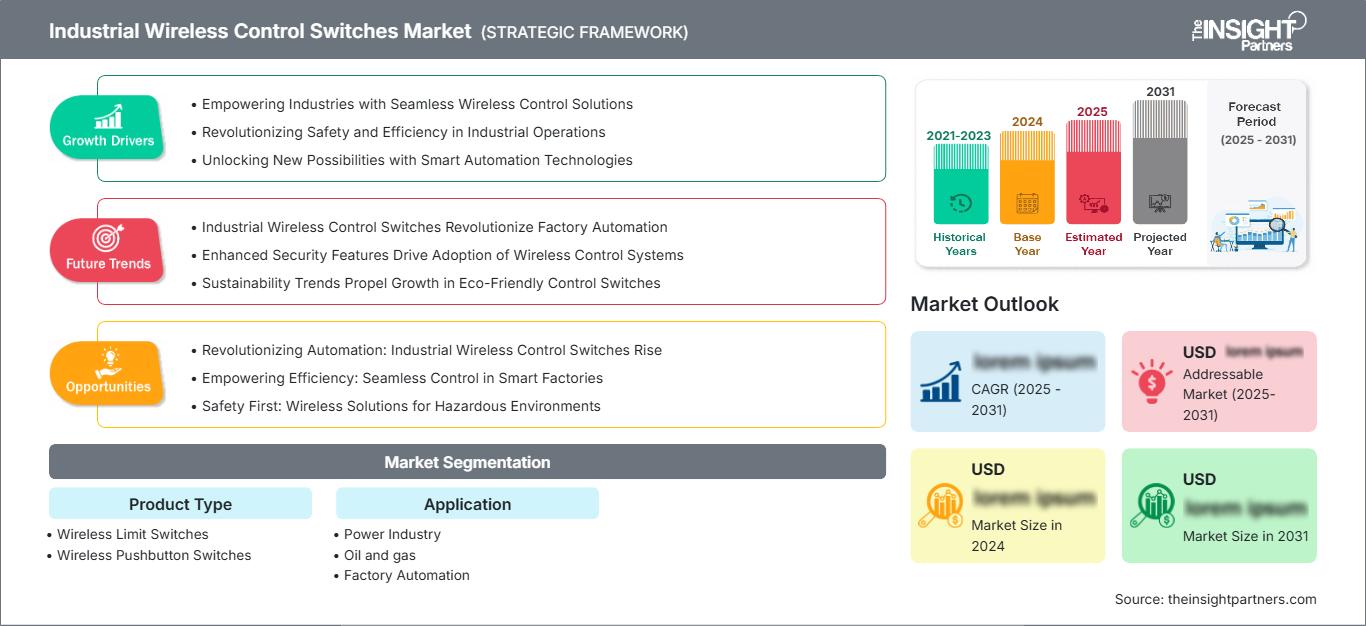
The Industrial Wireless Control Switches Market is positioned for steady expansion as manufacturers replace wired control points with flexible wireless architectures. The market is expected to increase from US$ 220.75 Million in 2025 to US$ 329.14 Million by 2034, representing a CAGR of 4.54% during 2026–2034. Adoption is supported by factory modernization, reduced cabling requirements, mobile equipment integration, and increasing demand for remotely operated industrial control functions.
North America remains an important deployment center, with the Industrial Wireless Control Switches Market size supported by established automation infrastructure, brownfield modernization, and increasing adoption of wireless industrial communication. Regional growth is expected at 4.8–5.3% CAGR between 2026 and 2034, driven by manufacturing automation, oil and gas monitoring, construction equipment digitization, and demand for flexible machine interfaces.
Industrial Wireless Control Switches Market Assessment and Insights
- North America: North America is projected to account for 28–32% share in 2025 and expand at a 4.8–5.3% CAGR between 2026–2034, supported by factory automation investment, brownfield upgrades, and wireless control deployment across energy and construction environments.
- US: The US represents approximately 70–74% of North America's 2025 share and is expected to grow at 4.9–5.4% CAGR between 2026–2034, supported by industrial modernization and remote equipment control.
- Europe: Europe is estimated at 25–29% share in 2025, growing at 4.4–4.9% CAGR between 2026–2034, with Germany, the UK, France, and Italy benefiting from automation modernization and industrial connectivity initiatives.
- Asia Pacific: Asia Pacific is estimated to hold 31–35% share in 2025 and grow at 5.0–5.6% CAGR between 2026–2034, led by China, Japan, South Korea, and India as manufacturing automation expands.
- Largest Segment: Wireless Limit Switches are estimated at 58–62% market share in 2025, with 4.2–4.7% CAGR during 2026–2034, reflecting broad machine-positioning applications.
- High Growth Segment: Factory Automation is estimated at 31–35% market share in 2025, with 5.2–5.8% CAGR during 2026–2034, supported by smart manufacturing adoption.
- Key companies analyzed in detail: Banner Engineering Corp, EPG Companies Inc, Georg Schlegel GmbH and Co. KG, Honeywell International Inc, Humanistic Robotics Inc, Kar-Tech Inc, OMRON Corp, Schneider Electric, steute Technologies GmbH and Co. KG, ZF Friedrichshafen.
Source: The Insight Partners' analysis based on proprietary research, government publications, company annual reports, investor presentations, industry databases, and expert interviews.
With regard to the industrial control architecture, there is a gradual shift from hardwiring towards wireless connectivity systems that can be realigned, scaled, and combined with mobile machinery. Development in low-power radio chips, industrial gateways, robust housing units, and battery management technology allows for increased installation flexibility. More and more manufacturers offer their switches in combination with sensors, indicators, and remote I/O, thus creating an interrelated system of control appropriate for equipment in which wiring would either be too expensive or disruptive to install.
During the forecast period, investment is expected to spread beyond discrete manufacturing to include construction machinery, power generation infrastructure, and oil and gas facilities. The advantage of wireless control architecture is decreased installation difficulty in case when equipment changes location often or is subject to mechanical stress. Safety regulations focusing on work environment and operation reliability are likely to foster demand.
Industrial Wireless Control Switches Market Report Scope
| Report Attribute | Details |
|---|---|
| Market size in 2025 | US$ 220.75 Million |
| Market Size by 2034 | US$ 329.14 Million |
| Global CAGR (2026 - 2034) | 4.54% |
| Historical Data | 2021-2024 |
| Forecast period | 2026-2034 |
Industrial Wireless Control Switches Market Analysis
The Industrial Wireless Control Switches Market is growing increasingly affected by manufacturers' demand for fast installation times, ease of reprogramming machinery, and reduced cost throughout their life cycles. Industrial wireless control switches are capable of connecting operators, machines, gateways, and automation systems without having to run a special cable for each control. The suppliers usually manufacture industrial wireless control switches from components such as devices, radio modules, antennas, power supplies, gateways, software, and integration.
In addition, demand will also depend on the economics of brownfield upgrade projects, whereby replacing cables would take up more time and labor. On the supply side, wireless switch technology is based on factors such as radio reliability, coverage area, enclosure quality, battery life, security issues, and the compatibility of wireless switches with control systems.
Positioning within competitive environments is becoming more and more dependent on the ability to integrate hardware into automation ecosystems. According to the analysis of the Industrial Wireless Control Switches Market Report, diversified automation companies are able to use their already established connections with machine makers and facility managers, whereas specialized companies have to compete using application-specific wireless solutions. Banner Engineering Corp. offers diversified industrial wireless products, while Honeywell International Inc. and Schneider Electric are capable of incorporating wireless functionalities into their automation solutions.
Specialized companies such as EPG Companies Inc., Georg Schlegel GmbH and Co. KG, Humanistic Robotics Inc., Kar-Tech Inc., and steute Technologies GmbH and Co. KG focus on specific needs for switching, operator interface, and mobile equipment. OMRON Corp and ZF Friedrichshafen provide additional features for industrial automation and vehicle solutions. Current investments are increasingly focused on interoperability, energy efficiency of communication, ruggedization, and software-based monitoring.
● REPORT CUSTOMIZATION
Tailor This Report To Align With Your Specific Business Requirements
This report can be customized to align precisely with your business objectives, scope, and target markets. Customization options include tailored segmentation, geography, competitive analysis, and strategic insights to support informed decision-making.
Customize This Report →WHAT YOU CAN ADJUST
- ● Segmentations
- ● Geography
- ● Competitive Analysis
- ● Language Preferences
Industrial Wireless Control Switches Market: Strategic Insights
Regional Insights
North America Industrial Wireless Control Switches Market
It is estimated that North America holds a market share of 28–32%, along with a compound annual growth rate (CAGR) of 4.8–5.3% during 2026–2034. North America offers several advantages like industrial automation development, brownfield sites, and increasing demand for remote machinery operations. The US is the primary contributor to the market in North America, whereas Canada is promoting wireless control switch adoption through modernization in energy, mining, logistics, and process industries. Wireless control switches are useful when machinery is moving and production site changes frequently.
Another contributing factor to the North America Industrial Wireless Control Switches Market Share is the need for remote control and monitoring in oil and gas sites. One of the main applications of industrial wireless control switches is factory automation due to its capability of reducing wiring requirements near conveyors, workstations, and machinery. Construction applications offer another opportunity for the market owing to the use of wireless control switches in cranes and lifting equipment.
U.S. Industrial Wireless Control Switches Market
The US accounts for 70–74% of North America's total 2025 share and grows at 4.9–5.4% CAGR in the period of 2026–2034. The demand occurs in manufacturing, energy, logistics, and construction industries. Increasingly, major industrial companies are preferring flexible control systems for plants being automated since the cost of wiring would add up considerably to downtime and engineering expenses. Wireless push buttons and limit switches are used in machine control, operator signaling, and remote status control.
In addition, the US Industrial Wireless Control Switches Market receives help from the existing distribution channels of automation vendors as well as an extensive base of programmable controllers, industrial gateways, and connected devices. There are such major automation vendors like Banner Engineering Corp, Honeywell International Inc, etc., with necessary product range or distribution channels. The use of wireless control switches is found in factories, oilfield equipment, construction equipment, and mobile machinery.
Europe Industrial Wireless Control Switches Market
Europe is estimated to hold 25–29% share in 2025, with growth of 4.4–4.9% CAGR during 2026–2034. Germany is the leading regional market because of its advanced manufacturing base, machine-building ecosystem, and industrial automation intensity. The UK and France provide additional demand through process industries, infrastructure modernization, and industrial digitalization programs.
Germany is one of the main adopters due to increasing integration of connected machine interfaces within the automated manufacturing environment. There are prospects for the UK in terms of energy sector, logistics, and advanced manufacturing. France will benefit from modernization of the industry and infrastructure development. Italy and Spain offer further demand due to manufacturing of machines, automobile manufacturing, food processing, and construction industry. Wireless control adoption in Europe takes into account industrial safety, interoperability, energy efficiency, and cost aspects.
APAC Industrial Wireless Control Switches Market
Asia Pacific is expected to hold a market share of 31–35% in 2025, registering a CAGR of 5.0–5.6% for the period 2026–2034. China dominates demand from the region, followed by Japan, South Korea, India, and Australia. Rising levels of factory automation, manufacturing of electronic components, automobiles, and infrastructure development will fuel demand for wireless control technologies.
The Asia Pacific region’s Industrial Wireless Control Switches Market will be driven by the rise of intelligent manufacturing practices and use of connected production equipment. The industrial automation market is robust in China and Japan, India is building up its manufacturing base and digital infrastructure, while South Korea is adding value through electronics and automotive sectors.
Middle East & Africa Industrial Wireless Control Switches Market
Demand in Middle East and Africa comes from energy infrastructure, industrial diversification, and construction. Leading adopters in this region include Saudi Arabia, followed by the UAE and South Africa. The forecasted growth rate is anticipated to be between 5.0% and 5.6% CAGR for 2026-2034, based on investments into automation, distributed systems, and remote equipment management.
Industrial diversification and infrastructure development in Saudi Arabia and the UAE create great opportunities, whereas mining and manufacturing in South Africa contribute to the demand. Rest of MEA applications include oil & gas, utilities, construction, and remote assets. Remote asset control helps to eliminate cabling needs for large sites and geographically dispersed operations.
Segmentation Analysis
Product Type
Product Type is expected to expand at 4.4–4.9% CAGR during 2026–2034, reflecting continued replacement of wired control points in mobile and fixed industrial equipment. Product selection depends on switching frequency, operating environment, communication distance, power availability, safety requirements, and integration with existing industrial networks. Wireless limit switches remain central to machine-position detection, while pushbutton switches support operator commands.
- Wireless Limit Switches: Wireless Limit Switches hold the leading position because they provide remote position detection for conveyors, machinery, gates, and material-handling systems. Demand is strongest where cable routing is difficult or equipment frequently changes configuration.
- Wireless Pushbutton Switches: Wireless Pushbutton Switches address operator command and signaling requirements across workstations, mobile equipment, and remote machinery. Their flexibility supports call-for-action functions, emergency-related signaling architectures, and decentralized machine interaction.
Application
Application is projected to grow at 4.8–5.3% CAGR during 2026–2034, supported by the expansion of connected equipment and decentralized control. The Industrial Wireless Control Switches Market scope is broadening as users deploy wireless controls across factory floors, energy assets, construction machinery, and oil and gas facilities where fixed cabling creates installation constraints.
- Power Industry: The Power Industry uses wireless control interfaces for distributed equipment, maintenance workflows, and remote operational environments. Adoption is supported by the need to minimize wiring complexity around substations, generation assets, and auxiliary equipment.
- Oil and gas: Oil and gas facilities require robust communication and control across hazardous, remote, and geographically distributed environments. Wireless architectures can simplify deployment around tanks, pipelines, loading areas, and mobile maintenance equipment.
- Factory Automation: Factory Automation represents the fastest-growing application, supported by smart manufacturing, flexible production cells, mobile equipment, and rapid line reconfiguration. Wireless switches complement sensors, PLCs, gateways, and industrial software platforms.
- Construction Engineering: Construction Engineering uses wireless switches where equipment mobility, temporary layouts, and difficult cable routing increase installation complexity. Crane systems, lifting equipment, material handling, and site machinery provide relevant deployment opportunities.
Opportunity Snapshot
| Application | Revenue Contribution | Trend Tag | Adoption Stage |
|---|---|---|---|
| Power Industry | Medium | Remote Control | Scaling |
| Oil and gas | High | Asset Monitoring | Mature |
| Factory Automation | High | Smart Factory | Scaling |
| Construction Engineering | Medium | Mobile Equipment | Emerging |
Industrial Wireless Control Switches Market Growth Drivers and Impact Analysis
Expansion of Flexible Factory Automation Architectures
Manufacturers are increasingly redesigning production environments around modular equipment, mobile workstations, and flexible production cells. This shift increases the value of wireless switches because control points can be positioned without extending dedicated signal cables across every machine section. The impact is strongest in facilities where production layouts change frequently or where automated equipment must be moved during maintenance. Wireless pushbuttons can support operator interaction, while limit switches provide position feedback for machine states. As industrial automation becomes more distributed, suppliers that combine switching hardware with gateways and remote I/O can capture additional system value. This driver is expected to support steady replacement demand across automotive, electronics, logistics, and general manufacturing applications.
Reduced Installation Complexity in Brownfield Industrial Facilities
Brownfield facilities often contain legacy wiring, constrained cable trays, limited access points, and equipment installed over multiple production generations. Wireless control devices offer an alternative when extending wired infrastructure would require shutdowns, structural changes, or substantial engineering labor. The economic impact extends beyond hardware because reduced installation time can lower commissioning expenses and shorten production interruptions. Industrial operators can selectively introduce wireless devices around difficult-to-access assets while retaining wired control for critical functions. This hybrid approach allows modernization without requiring complete control-system replacement. As factories, energy facilities, and processing plants prioritize incremental digitalization, wireless switching becomes a practical tool for targeted upgrades rather than a wholesale replacement technology.
Growing Deployment of Connected Mobile and Remote Equipment
Mobile industrial equipment creates a structural requirement for flexible communication because physical cables can restrict movement, increase wear, or create maintenance challenges. Wireless switches address this constraint across construction machinery, conveyors, lifting equipment, warehouse systems, and remote industrial assets. Their value increases when machines operate across changing work zones or when control points must remain accessible while equipment moves. Integration with gateways and industrial controllers enables switching information to become part of broader operational workflows. The resulting market impact is visible in applications where mobility and rapid deployment outweigh the advantages of conventional wiring. Demand should therefore remain resilient in construction, logistics, material handling, and remote energy applications.
Industrial Wireless Control Switches Market Future Trends
Convergence of Wireless Switching With Edge-Based Industrial Intelligence
Future Industrial Wireless Control Switches Market trends will increasingly connect switching devices with edge controllers capable of local processing, diagnostics, and event classification. Rather than transmitting only binary commands, connected devices can provide richer operational information through gateways and industrial software. Edge processing can identify abnormal switching patterns, battery degradation, communication interruptions, or equipment-state changes before information reaches centralized systems. This architecture may improve response times in distributed facilities and reduce unnecessary network traffic. Suppliers are likely to integrate wireless switches with condition monitoring, asset identification, and operator interfaces. Over time, purchasing decisions could shift from standalone switching hardware toward interoperable device ecosystems that provide measurable operational intelligence while retaining simple installation and maintenance characteristics.
Greater Adoption of Energy-Efficient and Self-Powered Devices
Energy efficiency will become a stronger product-development priority as industrial operators deploy larger numbers of wireless control points. Low-power radios, optimized transmission cycles, improved batteries, energy harvesting, and sleep-mode architectures can reduce maintenance requirements and extend device operating life. Self-powered switching concepts may become particularly relevant for equipment where battery replacement is difficult or where electrical connections are impractical. Product designers are also likely to improve diagnostics so users can monitor battery status and communication health remotely. These improvements could expand deployment into temporary construction environments, remote energy installations, and difficult-to-access industrial areas. As device reliability improves, wireless switching can move from selective retrofit applications toward broader standardized control architectures.
Industrial Wireless Control Switches Market Opportunities
Expansion Across Remote Energy and Infrastructure Assets
Energy infrastructure offers an attractive opportunity for suppliers because many assets are geographically distributed and difficult to connect economically with conventional wiring. Operators can evaluate wireless switches for remote pumping systems, auxiliary equipment, substations, storage facilities, and maintenance operations where localized control is required. Investment strategies should prioritize rugged devices, secure communication, long battery life, and compatibility with existing supervisory systems. Suppliers with experience in energy environments can differentiate through environmental ratings and integration capabilities rather than basic switching functions alone. Industrial Wireless Control Switches Market Forecasts should therefore consider the increasing convergence of remote monitoring, distributed automation, and infrastructure modernization. Partnerships with system integrators could accelerate adoption by reducing engineering barriers for end users.
Integration With Construction and Mobile Equipment Platforms
Construction equipment manufacturers and contractors increasingly require control systems that accommodate mobile machinery, changing work zones, and temporary installations. Wireless switches can support operator commands and machine-state functions without extensive cabling across moving equipment. Commercial opportunities include cranes, lifting systems, concrete equipment, conveyors, mobile platforms, and specialized construction machinery. Suppliers can pursue growth by developing ruggedized products with high resistance to vibration, dust, moisture, and temperature variation. Integration with machine controllers and telematics platforms can further increase value by connecting physical control events with equipment diagnostics. Strategic partnerships with equipment manufacturers and specialized automation integrators may provide scalable routes into this market while allowing customization for different machine architectures and regional safety requirements.
Recent Developments
- August 2026: Banner Engineering Corp continued expanding its industrial wireless portfolio, with its current product releases showing ongoing development across industrial wireless, connectivity, remote I/O, and control technologies. Its Direct Select wireless operator interface supports two-way communication and machine-mounted operation, reinforcing the company's focus on flexible industrial control architectures.
- July 2025: Honeywell International Inc announced plans to evaluate strategic alternatives for its Productivity Solutions and Services and Warehouse and Workflow Solutions businesses as part of its portfolio simplification. The company stated that the planned restructuring would sharpen its focus on automation, including process and industrial automation capabilities, ahead of its planned 2026 separation.
- May 2025: Schneider Electric launched its Open Automation Movement in India, emphasizing open, software-defined, vendor-agnostic industrial automation and interoperability. The initiative targets greater flexibility and scalability in industrial systems, supporting broader integration between automation hardware, software, and connected control architectures.
Frequently Asked Questions

- Comprehensive Market Sizing and Forecast Analysis
- Detailed Segmentation Analysis
- In-Depth Market Dynamics Assessment
- Regional and Country-Level Insights
- Competitive Landscape and Company Benchmarking
- Strategic Business Intelligence
Recent Reports
Testimonials

The Insight Partners provided valuable market intelligence that supported our global go-to-market strategy. Their team was professional, responsive, and attentive to our feedback, providing thoughtful analysis and helpful methodological clarifications throughout the project.
Junmo Kim Chief Financial Officer (CFO), Enertech Co., Ltd.
The Insight Partners' SCADA System Market report is comprehensive, with valuable insights on current trends and future forecasts. The team was highly professional, responsive, and supportive throughout. We are very satisfied and highly recommend their services.
RAN KEDEM Partner, Reali Technologies LTDs
I requested a report on a very specific software market and the team produced the report in a few days. The information was very relevant and well presented. I then requested some changes and additions to the report. The team was again very responsive and I got the final report in less than a week.
JEAN-HERVE JENN Chairman, Future Analytica
We worked with The Insight Partners for an important market study and forecast. They gave us clear insights into opportunities and risks, which helped shape our plans. Their research was easy to use and based on solid data. It helped us make smart, confident decisions. We highly recommend them.
PIYUSH NAGPAL Sr. Vice President, High Beam Global
The Insight Partners delivered insightful, well-structured market research with strong domain expertise. Their team was professional and responsive throughout. The user-friendly website made accessing industry reports seamless. We highly recommend them for reliable, high-quality research services
YUKIHIKO ADACHI CEO, Deep Blue, LLC.
This is the first time I have purchased a market report from The Insight Partners.While I was unsure at first, I visited their web site and felt more comfortable to take the risk and purchase a market report.I am completely satisfied with the quality of the report and customer service. I had several questions and comments with the initial report, but after a couple of dialogs over email with their analyst I believe I have a report that I can use as input to our strategic planning process.Thank you so much for taking the extra time and making this a positive experience.I will definitely recommend your service to others and you will be my first call when we need further market data.
JOHN SUZUKI President and Chief Executive Officer, Board Director, BK Technologies
I wish to appreciate your support and the professionalism you displayed in the course of attending to my request for information regarding to infectious disease IVD market in Nigeria. I appreciate your patience, your guidance, and the fact that you were willing to offer a discount, which eventually made it possible for us to close a deal. I look forward to engaging The Insight Partners in the future, all thanks to the impression you have created in me as a result of this first encounter.
DR CHIJIOKE ONYIA MANAGING DIRECTOR, PineCrest Healthcare Ltd.Reason to Buy
- Informed Decision-Making
- Understanding Market Dynamics
- Competitive Analysis
- Identifying Emerging Markets
- Customer Insights
- Market Forecasts
- Risk Mitigation
- Boosting Operational Efficiency
- Strategic Planning
- Investment Justification
- Tracking Industry Innovations
- Aligning with Regulatory Trends





 Get Free Sample for