
True Wireless Stereo Market Size, Trends & Demand by 2034
True Wireless Stereo Market Size and Forecasts (2021 - 2034), Global and Regional Share, Trends, and Growth Opportunity Analysis Report Coverage : By Price (Below US$100, US$100-US$200, Above US$200); Application (Listening to music, Making calls, Gaming)
- Status : Data Released
- Report Code : TIPRE00039660
- Category : Electronics and Semiconductor
- No. of Pages : 150
- Available Report Formats :


- Last update date : October 30, 2026


2025 Market Size
US$ 53.39 Bn
Base year value
2034 Forecast
US$ 127.82 Bn
Projected by 2034
CAGR 2026-2034
10.19 %
Growth rate
Addressable Market
US$ 805.30 Bn
(2026-2034)
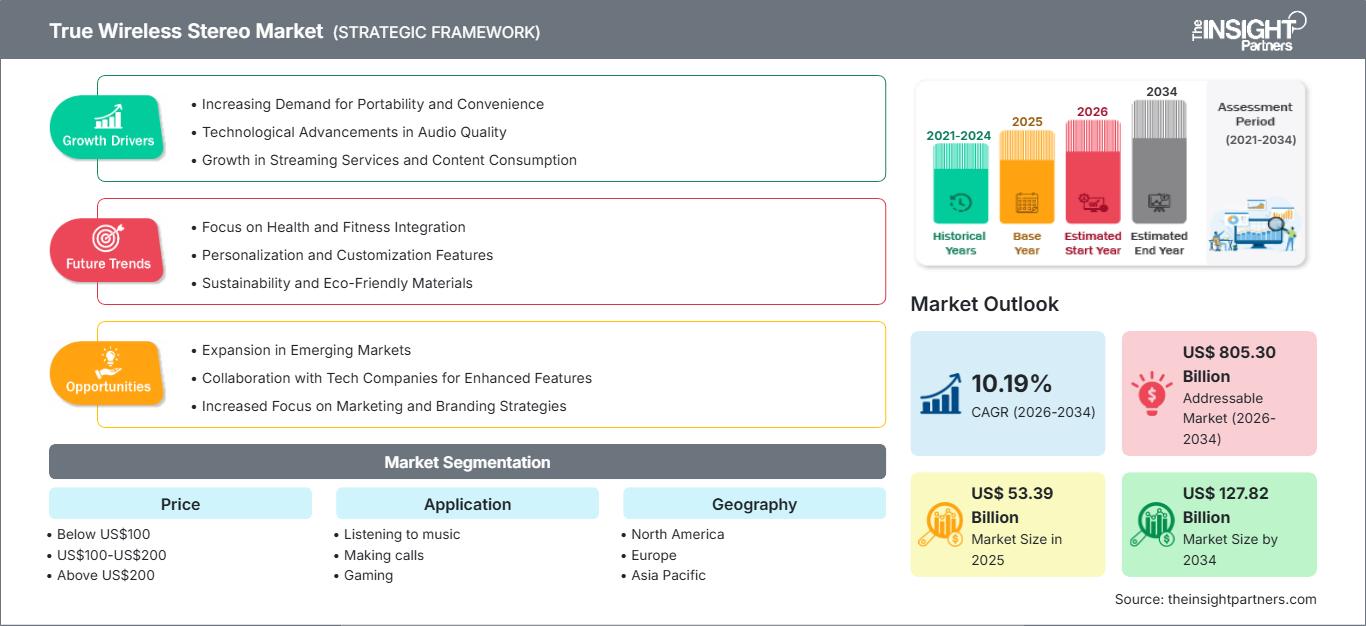
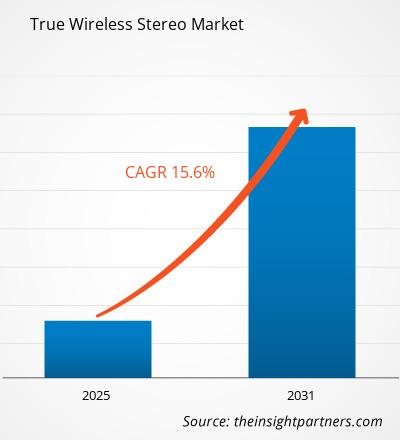
The True Wireless Stereo Market is expanding as wireless earbuds become an increasingly integrated part of mobile, computing, entertainment, and connected-device ecosystems. The market is valued at US$ 53.39 Billion in 2025 and is projected to reach US$ 127.82 Billion by 2034, representing a CAGR of 10.19% from 2026 to 2034. The market covers TWS products differentiated by price and used primarily for music listening, calling, and gaming, with competition increasingly centered on audio quality, comfort, connectivity, ANC, battery performance, and intelligent features.
Increasing device penetration, replacement demand, premiumization, and broader adoption across emerging economies are supporting the True Wireless Stereo Market size outlook in North America. The region is modeled to expand at ~9% CAGR through 2034, supported by high smartphone and connected-device penetration and replacement of earlier-generation wireless earbuds. Premium audio features, ecosystem integration, and growing interest in AI-enabled hearing experiences are strengthening value creation beyond basic wireless connectivity.
True Wireless Stereo Market Assessment and Insights
Regional Outlook
- North America: ~29% of the global market in 2025 | ~9% CAGR through 2034. Market position: North America is a major premium TWS market, supported by established smartphone ecosystems, high replacement demand, strong consumer adoption of ANC-enabled products, and substantial spending on premium audio devices.
- US: ~78% of North American market revenue in 2025 | ~9% CAGR through 2034. Market position: The US represents the principal country market within North America, with strong ecosystem-driven demand, premium earbud adoption, replacement purchases, and broad use across music, communications, fitness, and entertainment.
- Europe: ~23% of the global market in 2025 | ~10% CAGR through 2034. Market position: Europe combines mature consumer electronics adoption with strong premium audio demand. Germany is the leading country in Europe, while the UK, France, Italy, and Spain support broad consumer and entertainment applications.
- Asia Pacific: ~40% of the global market in 2025 | ~12% CAGR through 2034. Market position: Asia Pacific is the largest and fastest-growing regional market, supported by manufacturing scale, expanding smartphone ecosystems, aggressive price competition, and rapid adoption across China, India, South Korea, and Southeast Asia.
Segment Outlook
- Listening to music: ~58% Share in 2025 | ~10% CAGR through 2034. Market position: Listening to music leads because TWS products remain primarily audio-consumption devices. Streaming services, improved codecs, ANC, spatial audio, personalization, and longer battery life reinforce recurring consumer demand.
- Gaming: ~17% Share in 2025 | ~14% CAGR through 2034. Market position: Gaming is the high-growth application as lower latency, spatial audio, microphones, cross-device connectivity, and gaming-specific modes make TWS products increasingly suitable for mobile, PC, and console-oriented users.
Competitive Coverage
Apple Inc., Samsung Electronics Co., Ltd., Xiaomi Corporation, Sony Group Corporation, boAt Lifestyle, Huawei Technologies Co., Ltd., Shure Incorporated, Sennheiser electronic GmbH & Co. KG, Bose Corporation, Nothing Technology Limited
Methodology
The Insight Partners follows Data Collection & Secondary Research, Primary Research, Data Analysis, and Data Triangulation & Final Review to validate market estimates and insights.
Source: The Insight Partners' analysis based on proprietary research, government publications, company annual reports, investor presentations, industry databases, and expert interviews.
True Wireless Stereo (TWS) devices have come a long way, from simple wireless audio products to advanced hearables that incorporate noise cancellation, adaptability, spatial audio, virtual assistants, health sensors, advanced microphones, and even wireless technologies. The True Wireless Stereo Market scope of production itself has expanded significantly, particularly in Asia, thus enabling manufacturers to create increasingly sophisticated devices at lower costs, where premium players stand out through compatibility with the ecosystem and proprietary audio technologies. In other words, future competition in TWS devices will not be limited to wireless technologies but will focus on feature sets, comfort, acoustics, and software integration.
The future will be defined by entry into new markets, replacement cycles, luxury pricing, and tighter integration with smartphones, computers, tablets, cars, and wearables. Asia-Pacific will continue to drive the volumes, while North America and Europe will maintain their premium revenues. Product innovation will focus on open ear technology, AI interaction, better translation, low latency gaming, and improved calling. Overall, this will expand the application for True Wireless Stereo Market beyond audio accessories to intelligent personal audio interfaces.
True Wireless Stereo Market Report Scope
| Report Attribute | Details |
|---|---|
| Market size in 2025 | US$ 53.39 Billion |
| Market Size by 2034 | US$ 127.82 Billion |
| Global CAGR (2026 - 2034) | 10.19% |
| Historical Data | 2021-2024 |
| Forecast period | 2026-2034 |
True Wireless Stereo Market Analysis
The demand is driven by the upgrade cycle of smartphones, consumption of streaming media, remote/hybrid communications, exercise workouts, gaming, and replacement of wired or legacy wireless headphones. The growth mechanism of the True Wireless Stereo Market relies on the combination of units as well as average revenue per unit due to consumer upgrading to ANC, spatial audio, enhanced microphones, and smart features. The ecosystem includes providers of chipsets, acoustic components, batteries, sensors, original design manufacturers, branded devices, retail distributors, telecom, and digital marketplaces.
The competition is very high because production takes place in Asian electronics ecosystems, and the brands have significant market shares in the premium segment. According to Omdia, in Q1 2025, global TWS shipments reached 78 million units and experienced an increase of 18% compared to the previous year. The leading companies in the segment were Apple, Xiaomi, Samsung, Huawei, and boAt.
As per the True Wireless Stereo Market Report, the competitors include ecosystem leaders and specialized audio brands. Apple has an advantage because of hardware-software integration, Samsung connects its earbuds with Galaxy ecosystems, while Xiaomi provides powerful gadgets at affordable costs. Sony, Bose, Shure, and Sennheiser focus on audio quality and premium features, and boAt prioritizes affordability in mass market. In addition, Huawei and Nothing have ecosystem and design differences that put more pressure on existing suppliers and make them provide more innovative features rather than new hardware versions.
Computational audio, interaction based on artificial intelligence, low-latency connectivity, open-ear form factor, sensing for health, and personalization are areas of investment. As Omdia stated in its data on 2025, Xiaomi rapidly expands in emerging markets, whereas Apple keeps its strong positions globally.
● REPORT CUSTOMIZATION
Tailor This Report To Align With Your Specific Business Requirements
This report can be customized to align precisely with your business objectives, scope, and target markets. Customization options include tailored segmentation, geography, competitive analysis, and strategic insights to support informed decision-making.
Customize This Report →WHAT YOU CAN ADJUST
- ● Segmentations
- ● Geography
- ● Competitive Analysis
- ● Language Preferences
True Wireless Stereo Market: Strategic Insights
Regional Insights
North America True Wireless Stereo Market
The North America was ~29% of the total global True Wireless Stereo Market Share in 2025 and is forecasted to grow at ~9% CAGR from 2026-2034. The North American market has an established installed base of wireless earbuds, hence further growth in the region will be largely driven by replacement, premiumization, and added functionalities, rather than pure adoption. High smartphone ownership, along with consumer familiarity with wireless accessories, fuels continuous demand in the region.
The United States is the key market within this region, whereas Canada adds another layer of demand through consumer electronics, telecommunications, and entertainment segments. Premium ANC, spatial audio, better call quality, and product capabilities based on the respective ecosystem are key drivers of purchase. In addition, Apple has a dominant position in the North American market, with Samsung, Sony, Bose, and other premium players competing in their own price segments.
U.S. True Wireless Stereo Market
The US accounted for ~78% of North American market revenue in 2025 and is modeled to expand at a ~9% CAGR through 2034. Demand is supported by established smartphone ecosystems, frequent replacement of personal electronics, premium audio consumption, and widespread use of earbuds for commuting, work, fitness, entertainment, and communications. Omdia reported that Apple held more than half of the North American TWS market in Q1 2025.
Companies such as Apple, Samsung, Sony, Bose, Shure, and Sennheiser play in both the high-end and niche market segments, whereas companies providing less expensive products fight for volume. There is growth in gaming and calling, as users demand low latency, better microphone, and smooth transition between phones, computers, and tablets. This makes the US an essential region for both premium and early adoption of functionalities in hearables.
Europe True Wireless Stereo Market
Europe accounted for ~23% of the global True Wireless Stereo Market in 2025 and is forecast to register a ~10% CAGR through 2034. Germany is the leading country in Europe, supported by strong consumer electronics adoption, premium automotive and technology ecosystems, and established demand for branded audio equipment. The UK contributes through digital entertainment, music consumption, gaming, and premium consumer electronics, while France provides demand through consumer technology and lifestyle-oriented audio products.
Both Italy and Spain provide additional opportunities through tourism, mobile entertainment, consumer electronics, and rising wireless device ownership. European buyers are now assessing earbuds by considering such attributes as sound quality, comfort, battery life, sustainability, and intelligence of the product. In this regard, high-end manufacturers are competing in acoustics and durability, whereas mass-market producers are employing price-performance strategies to increase adoption.
In addition, the European region provides an excellent ground for testing privacy-focused AI features, sustainable product design, and product longevity. The need for replacement is still relevant because old models of wireless earbuds are replaced with new ones that include ANC, connectivity, better microphones, and improved software. As a result, a well-balanced market structure emerges, combining mature demand, replacement, and adoption.
APAC True Wireless Stereo Market
APAC held ~40% of the global market in 2025 and is expected to grow at a ~12% CAGR through 2034, making it the fastest-growing regional market. China is the leading country in Asia Pacific, supported by large electronics manufacturing capacity, domestic smartphone ecosystems, extensive retail channels, and strong price competition. South Korea and Japan contribute through advanced consumer electronics and premium audio technologies.
India is an important expansion market as affordable TWS products broaden consumer access, while Australia provides a mature application environment. Vendors increasingly use localized pricing and distribution to penetrate emerging markets. Omdia has identified China as the world's largest TWS market and reported strong shipment momentum from Xiaomi and Huawei across emerging markets.
Middle East & Africa True Wireless Stereo Market
Middle East and Africa is an emerging regional opportunity and is modeled to grow at a ~11% CAGR through 2034. The UAE is the leading country in the Middle East and Africa market based on its concentrated premium consumer electronics, tourism, retail, and digital entertainment ecosystem. Saudi Arabia is developing additional demand through consumer technology and entertainment investment, while South Africa represents an important African electronics market.
Regional growth is supported by smartphone adoption, e-commerce expansion, younger consumer demographics, and broader availability of branded wireless audio. Price sensitivity remains important, particularly outside premium urban markets, making affordable TWS products an important volume driver. At the premium end, ANC, battery life, durability, and ecosystem compatibility can support higher-value purchases.
Segmentation Analysis
Price
Price is a major competitive determinant because the category spans entry-level products and premium audiophile-oriented earbuds. The True Wireless Stereo Market scope increasingly extends across feature-rich affordable products and premium models offering ANC, spatial audio, advanced microphones, health functions, and proprietary ecosystem integration. Price segmentation therefore shapes both volume penetration and revenue concentration.
- Below US$100 represents the broadest accessibility tier and supports high-volume adoption, particularly in emerging markets. Vendors compete through battery life, ANC, audio codecs, water resistance, and design while maintaining cost discipline. This tier is central to expanding the installed user base.
- US$100-US$200 provides a balance between premium functionality and broader affordability. Products in this tier increasingly incorporate advanced ANC, spatial audio, better microphones, multipoint connectivity, and stronger acoustic performance, making it strategically important for feature-led replacement demand.
- Above US$200 is concentrated around premium brands and ecosystem-linked products. Consumers in this tier prioritize acoustic quality, materials, ANC performance, software integration, durability, and differentiated features. The segment is important for maintaining revenue value as unit competition intensifies.
Application
Application determines how TWS products are incorporated into daily digital activities. Listening to music remains the largest application, but calling and gaming are becoming increasingly important as microphones, connectivity, spatial audio, and latency performance improve. The True Wireless Stereo Market analysis indicates that vendors can expand addressable demand by optimizing products for distinct use cases rather than treating earbuds as generic audio accessories.
- Listening to music remains the core application because TWS earbuds provide convenient access to streaming services, personal media libraries, podcasts, and other audio content. Improvements in ANC, spatial audio, codec support, and personalization continue to strengthen this use case.
- Making calls is gaining importance as users increasingly rely on earbuds for mobile, workplace, and online communication. Improved microphone arrays, beamforming, wind-noise reduction, and voice processing can differentiate products where call clarity is a primary purchase consideration.
- Gaming represents the fastest-growing application opportunity as gamers demand low latency, positional audio, clear voice communication, and stable wireless connections. Mobile gaming is particularly relevant because TWS devices provide portability while increasingly supporting dedicated low-latency modes and spatial sound.
Opportunity Snapshot
| Application | Revenue Contribution | Trend Tag | Adoption Stage |
|---|---|---|---|
| Listening to music | High | Spatial Audio | Mature |
| Making calls | Medium | Voice Clarity | Scaling |
| Gaming | Medium | Low Latency | Scaling |
True Wireless Stereo Market Growth Drivers and Impact Analysis
Premium Audio Features Accelerate Replacement Demand
The introduction of advanced features is changing the replacement cycle for TWS products. Consumers who already own wireless earbuds have greater incentives to upgrade when new models deliver materially better ANC, spatial audio, battery performance, call quality, or device integration. This supports revenue expansion even in mature markets where first-time adoption is slowing. Premiumization also allows manufacturers to offset intense competition in entry-level products by increasing functionality in higher-value tiers. The impact extends across the ecosystem because advanced features require improved microphones, processors, sensors, acoustic components, batteries, and software. Vendors therefore have opportunities to increase value per device through integrated hardware and software improvements rather than relying solely on shipment growth.
Smartphone Ecosystems Strengthen Earbud Attachment
TWS earbuds increasingly function as extensions of smartphone ecosystems rather than independent audio accessories. Fast pairing, device switching, spatial audio, voice assistants, translation, personalized sound, and cross-device controls can create meaningful advantages when earbuds are integrated with a manufacturer's broader hardware and software portfolio. Apple, Samsung, Xiaomi, and Huawei illustrate this ecosystem-oriented competitive model, while specialist audio companies compete through sound quality and cross-platform compatibility. The impact is significant because ecosystem integration can improve retention and encourage consumers to purchase compatible accessories when upgrading smartphones. It also raises competitive barriers for vendors that lack software capabilities, making partnerships with operating-system, chipset, AI, and application providers increasingly relevant.
Emerging-Market Price Optimization Expands User Penetration
Growth in True Wireless Stereo Market is being supported by broader availability of affordable TWS products that incorporate features previously associated with premium devices. Vendors are increasingly combining low-cost manufacturing with ANC, long battery life, gaming modes, and improved microphones, reducing the performance gap between entry and premium categories. This strategy expands the addressable consumer base while intensifying competition on price-performance metrics. Xiaomi and Huawei have demonstrated the importance of expansion across emerging markets, while brands such as boAt have established strong positions through localized pricing and distribution. For manufacturers, the market impact is a trade-off between volume growth and average selling price, making supply-chain efficiency, channel control, and component cost management increasingly important.
True Wireless Stereo Market Future Trends
AI-Enabled Hearables Move Beyond Conventional Audio
The True Wireless Stereo Market trends are increasingly centered on transforming earbuds into intelligent interfaces for voice interaction, translation, contextual information, and personalized audio. Future products can combine microphones, onboard processing, smartphone AI capabilities, and environmental sensing to provide functions that extend beyond playback and calls. Real-time translation, voice-note capture, adaptive sound profiles, and context-aware assistants are examples of how the product category can become more closely connected with digital services. This evolution could shift competitive differentiation toward software capabilities and data processing in addition to acoustic performance. Vendors with strong mobile ecosystems may have an advantage in deploying these features, while specialist brands can differentiate through partnerships and platform-neutral implementations.
Open-Ear and Alternative Form Factors Broaden the Category
Open-ear products are becoming an increasingly relevant part of the broader wireless audio landscape because they address comfort and environmental-awareness requirements that conventional in-ear designs cannot always satisfy. Omdia reported that open wireless stereo shipments reached more than 10 million units in Q3 2025, while conventional TWS shipments declined during the quarter, indicating increasing consumer interest in alternative form factors. Through 2034, manufacturers are likely to experiment with ear-hook, clip-on, open-ear, and other designs that balance audio performance with situational awareness. This can broaden applications in fitness, commuting, office use, and outdoor activities while creating new opportunities for brands to differentiate on comfort and use-case specialization.
True Wireless Stereo Market Opportunities
Gaming-Optimized Earbuds and Low-Latency Ecosystems
Gaming provides a differentiated opportunity because users evaluate TWS products through latency, positional audio, microphone quality, battery endurance, and stable connectivity rather than conventional music criteria alone. Manufacturers can create gaming-specific products with dedicated low-latency modes, spatial sound profiles, customizable controls, and software integration across mobile and PC platforms. The opportunity extends beyond earbuds to companion applications and gaming ecosystems, where firmware updates and audio profiles can generate ongoing engagement. Vendors can also target esports, mobile gaming, and cloud gaming audiences with different performance configurations. As gaming becomes increasingly cross-platform, products capable of maintaining consistent performance across devices can address a broader audience without relying exclusively on smartphone ecosystem lock-in.
Health, Accessibility, and Personalized Audio Services
The True Wireless Stereo Market Forecasts increasingly includes opportunities connected to hearing personalization, accessibility, wellness, and contextual audio. Earbuds already contain microphones, processors, batteries, and sensors that can support more sophisticated software functions. Future products can use these components to tailor sound profiles, improve speech clarity, support hearing-related functions, and adapt playback to environmental conditions. Commercial opportunity can therefore extend beyond hardware into applications, subscriptions, service partnerships, and device ecosystems. Vendors that combine personalized audio with privacy-conscious data handling can differentiate products while creating recurring engagement. The opportunity is particularly relevant to premium segments where consumers may accept higher prices for tangible improvements in comfort, listening quality, and individualized experiences.
Recent Developments
- September 2026: Apple Inc. introduced AirPods 5 with an open-ear design, active noise cancellation, Adaptive EQ, hands-free Siri AI access, and Live Translation. The company positioned the product as a lower-priced entry point for advanced AirPods capabilities, expanding ANC and intelligent functions across its earbud portfolio. The product became available in stores on September 18, 2026.
- February 2026: Samsung Electronics Co., Ltd. introduced the Galaxy Buds4 and Galaxy Buds4 Pro, adding enhanced ANC, Adaptive EQ, computationally designed fit, and deeper AI integration. The Buds4 Pro also introduced a wider woofer, reinforcing Samsung's strategy of combining premium sound performance with Galaxy ecosystem functionality.
- September 2025: OPPO Electronics Corp. launched the Enco Buds3 Pro for sale, targeting value-conscious consumers with long battery life, dual-device pairing, IP55 water resistance, and features aimed at music, multitasking, and gaming. The product entered the Indian market at an accessible price point, illustrating continued feature expansion in lower-price TWS tiers.
Frequently Asked Questions

- Comprehensive Market Sizing and Forecast Analysis
- Detailed Segmentation Analysis
- In-Depth Market Dynamics Assessment
- Regional and Country-Level Insights
- Competitive Landscape and Company Benchmarking
- Strategic Business Intelligence
Recent Reports
Testimonials

The Insight Partners provided valuable market intelligence that supported our global go-to-market strategy. Their team was professional, responsive, and attentive to our feedback, providing thoughtful analysis and helpful methodological clarifications throughout the project.
Junmo Kim Chief Financial Officer (CFO), Enertech Co., Ltd.
The Insight Partners' SCADA System Market report is comprehensive, with valuable insights on current trends and future forecasts. The team was highly professional, responsive, and supportive throughout. We are very satisfied and highly recommend their services.
RAN KEDEM Partner, Reali Technologies LTDs
I requested a report on a very specific software market and the team produced the report in a few days. The information was very relevant and well presented. I then requested some changes and additions to the report. The team was again very responsive and I got the final report in less than a week.
JEAN-HERVE JENN Chairman, Future Analytica
We worked with The Insight Partners for an important market study and forecast. They gave us clear insights into opportunities and risks, which helped shape our plans. Their research was easy to use and based on solid data. It helped us make smart, confident decisions. We highly recommend them.
PIYUSH NAGPAL Sr. Vice President, High Beam Global
The Insight Partners delivered insightful, well-structured market research with strong domain expertise. Their team was professional and responsive throughout. The user-friendly website made accessing industry reports seamless. We highly recommend them for reliable, high-quality research services
YUKIHIKO ADACHI CEO, Deep Blue, LLC.
This is the first time I have purchased a market report from The Insight Partners.While I was unsure at first, I visited their web site and felt more comfortable to take the risk and purchase a market report.I am completely satisfied with the quality of the report and customer service. I had several questions and comments with the initial report, but after a couple of dialogs over email with their analyst I believe I have a report that I can use as input to our strategic planning process.Thank you so much for taking the extra time and making this a positive experience.I will definitely recommend your service to others and you will be my first call when we need further market data.
JOHN SUZUKI President and Chief Executive Officer, Board Director, BK Technologies
I wish to appreciate your support and the professionalism you displayed in the course of attending to my request for information regarding to infectious disease IVD market in Nigeria. I appreciate your patience, your guidance, and the fact that you were willing to offer a discount, which eventually made it possible for us to close a deal. I look forward to engaging The Insight Partners in the future, all thanks to the impression you have created in me as a result of this first encounter.
DR CHIJIOKE ONYIA MANAGING DIRECTOR, PineCrest Healthcare Ltd.Reason to Buy
- Informed Decision-Making
- Understanding Market Dynamics
- Competitive Analysis
- Identifying Emerging Markets
- Customer Insights
- Market Forecasts
- Risk Mitigation
- Boosting Operational Efficiency
- Strategic Planning
- Investment Justification
- Tracking Industry Innovations
- Aligning with Regulatory Trends





 Get Free Sample for