
4G Wireless Infrastructure Market Size, Trends & Growth by 2034
Coverage: By Type (Communication Towers, Transmitting antenna, Receiving antenna, Decoder); Application (Military Use, Civil Use) , and Geography (North America, Europe, Asia Pacific, and South and Central America)
- Status : Data Released
- Report Code : TIPRE00023123
- Category : Electronics and Semiconductor
- No. of Pages : 150
- Available Report Formats :


- Last update date : July 13, 2026


2025 Market Size
US$ 52.69 Bn
Base year value
2034 Forecast
US$ 75.73 Bn
Projected by 2034
CAGR 2026-2034
4.11 %
Growth rate
Addressable Market
US$ 583.15 Bn
(2026-2034)
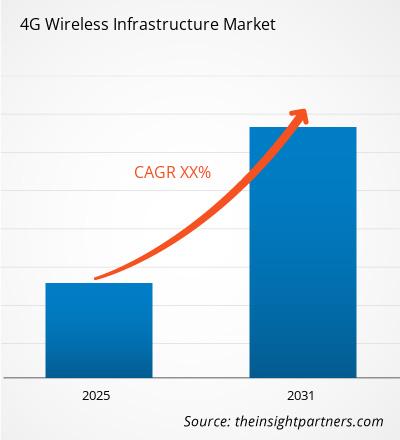
The 4G Wireless Infrastructure market was valued at US$ 52.69 billion in 2025 and is expected to reach US$ 75.73 billion by 2034; it is estimated to record a CAGR of 4.11% during 2026-2034.
4G Wireless Infrastructure Market Assessment and Insights
- North America: The region accounted for 25%–29% share in 2025 and is growing at a 4.1%–4.7% CAGR between 2026–2034, driven by rural broadband, private LTE utilities, emergency communications, and tower modernization.
- US: The U.S. represented 78%–84% of North American 4G Wireless Infrastructure Market in 2025 and is growing at a 4.2%–4.8% CAGR between 2026–2034, supported by public safety, utility, defense, and enterprise LTE demand.
- Europe: Europe held 22%–27% share in 2025 and is growing at a 3.8%–4.4% CAGR between 2026–2034, led by Germany, the UK, France, Italy, and Spain.
- Asia Pacific: Asia Pacific held 34%–39% share in 2025 and is growing at a 4.8%–5.5% CAGR between 2026–2034, led by China, India, Japan, South Korea, and Australia.
- Largest Segment: Communication Towers held 41%–46% market share in 2025 and is growing at a 4.2%–4.8% CAGR between 2026–2034 as operators reinforce coverage, resilience, and site sharing.
- High Growth Segment: Civil Use held 68%–73% of the 4G Wireless Infrastructure market share in 2025 and is growing at a 4.7%–5.3% CAGR between 2026–2034 due to broadband, transport, enterprise, and public services.
- Key companies analyzed in detail: Telefonaktiebolaget LM Ericsson, Nokia Corporation, Cisco Systems, Inc., Huawei Technologies Co., Ltd., ZTE Corporation, Juniper Networks, Inc., CommScope Holding Company, Inc., HUBER+SUHNER AG, Corning Incorporated, NEC Corporation.
Source: The Insight Partners' analysis based on proprietary research, government publications, company annual reports, investor presentations, industry databases, and expert interviews.
The 4G Wireless Infrastructure Market has shifted from its intense efforts on a national LTE roll out to a lifecycle stage that is focused on modernization, capacity addition, and efficiency. Data provided by the Ericsson Mobility Report states that LTE subscriptions stayed at 4.66 billion for 2025, whereas the ITU estimated that LTE/WiMAX penetration into the population was 92.7%. Thus, 4G technology offers the most extensive high-speed mobile network. Production trends are geared towards radio efficiency, replacement of antennas, tower sharing, and interoperable hardware for future 5G migration.
Demand for the future will include coverage holes in developing countries, private LTE in utilities and military services, and government initiatives that stress resilient connectivity. In terms of opportunities, 4G Wireless Infrastructure stands the best chance in those regions where operators need robust broadband connections over large geographic expanses, such as APAC, MEA, and rural North America. Challenges include regulatory issues associated with spectrum repacking, infrastructure sharing, and broadband mapping programs.
4G Wireless Infrastructure Market Report Scope
| Report Attribute | Details |
|---|---|
| Market size in 2025 | US$ 52.69 Billion |
| Market Size by 2034 | US$ 75.73 Billion |
| Global CAGR (2026 - 2034) | 4.11% |
| Historical Data | 2021-2024 |
| Forecast period | 2026-2034 |
4G Wireless Infrastructure Market Analysis
The demand will be driven by mobile broadband, enterprise mobility, public safety, and machine communication. The 4G Wireless Infrastructure Market will be favored by the fact that the cost of LTE continues to remain low in case of the provision of services in a wide area in which investments have been made for 5G in high-density areas. The value chain consists of tower companies, antenna producers, radio access equipment, packet core, fiber backhaul, and chips.
The dynamics of supply are changing from simple equipment volume to upgrade economics, interconnectivity, and energy efficiency. The communication tower is the physical structure; the antenna transmits and receives signals, and the decoder aids in efficient data processing. According to the 4G Wireless Infrastructure analysis, purchasing decisions are being made based on life cycle costs, efficiency of spectrum, energy consumption at sites, and integration into LTE/5G architecture.
The competitive landscape is concentrated around end-to-end RAN suppliers, IP networking vendors, passive infrastructure specialists, and optical connectivity providers. Telefonaktiebolaget LM Ericsson, Nokia Corporation, Huawei Technologies Co., Ltd., ZTE Corporation, Cisco Systems, Inc., Juniper Networks, Inc., CommScope Holding Company, Inc., HUBER+SUHNER AG, Corning Incorporated, and NEC Corporation compete through reliability, security, cost efficiency, and upgrade paths.
Investment trends indicate that rural connectivity, private LTE, public safety communications, rail/road corridors, and utility grids will be preferred by investors. Vendors are preparing for software-defined networking, assisted AI, low-power radio sites, smaller antennas, and robust backhaul services. From the 4G Wireless Infrastructure Trends, it is evident that buyers favor deployment experience, cybersecurity management, and vendor support over technology refresh cycles.
● REPORT CUSTOMIZATION
Tailor This Report To Align With Your Specific Business Requirements
This report can be customized to align precisely with your business objectives, scope, and target markets. Customization options include tailored segmentation, geography, competitive analysis, and strategic insights to support informed decision-making.
Customize This Report →WHAT YOU CAN ADJUST
- ● Segmentations
- ● Geography
- ● Competitive Analysis
- ● Language Preferences
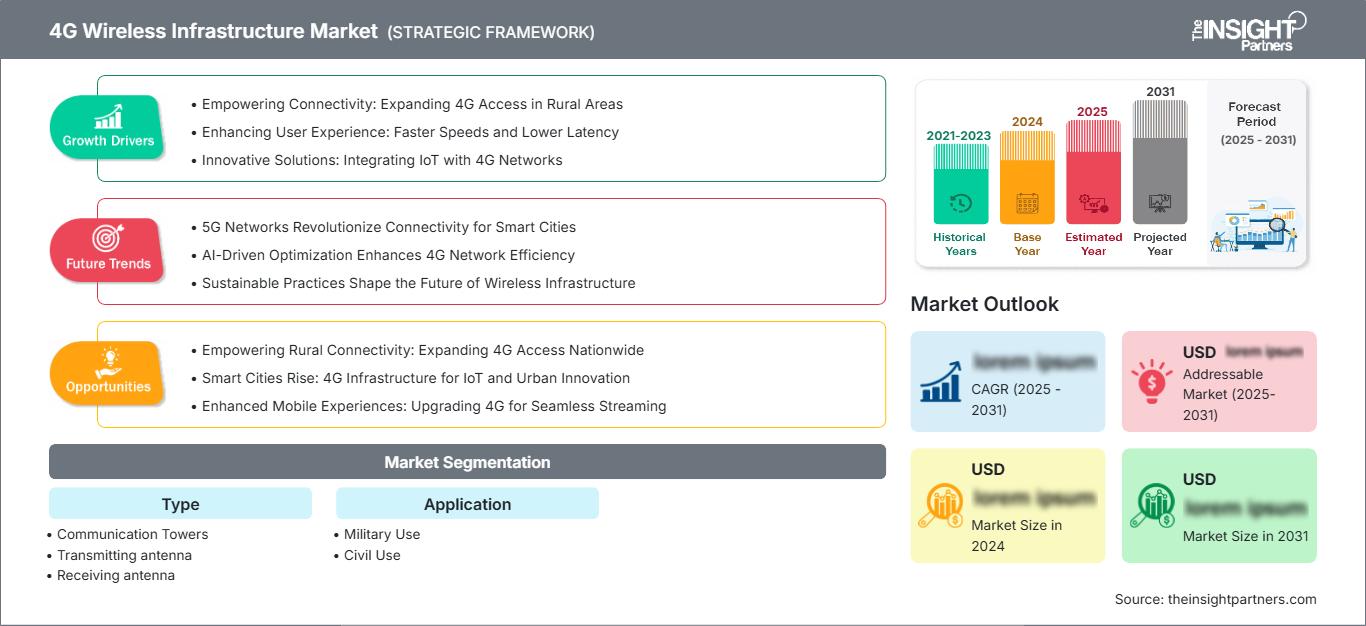
4G Wireless Infrastructure Market: Strategic Insights
Regional Insights
North America 4G Wireless Infrastructure
North America held 25%–29% share in 2025 and is growing at a 4.1%–4.7% CAGR between 2026–2034. The 4G Wireless Infrastructure Market benefits from rural broadband support, FirstNet-style public safety requirements, private LTE for utilities, and continued LTE densification in suburban, logistics, and transport corridors.
Improvements are being made to towers, antennas, and core components in order to maintain coverage while rolling out 5G selectively. Mobile broadband coverage maps from FCC further substantiate the necessity for precise coverage determination, and there is also demand for civil use as well as utility private LTE initiatives. Civil Use leads regional demand, while military and emergency applications support secure, resilient communications, reflecting evolving 4G Wireless Infrastructure Market Trends.
U.S. 4G Wireless Infrastructure Market
The U.S. represented 78%–84% of North America in 2025 and is growing at a 4.2%–4.8% CAGR between 2026–2034. Demand is supported by emergency response networks, utility grid modernization, defense communications, industrial campuses, logistics corridors, and coverage obligations in underserved locations.
Company presence is strong across RAN, IP networking, antennas, optical fiber, and network management. Telefonaktiebolaget LM Ericsson, Nokia Corporation, Cisco Systems, Inc., Juniper Networks, Inc., CommScope Holding Company, Inc., and Corning Incorporated support different layers of the ecosystem. Civil applications dominate, while military use emphasizes hardened field connectivity and secure operations.
Europe 4G Wireless Infrastructure Market
Europe held 22%–27% share in 2025 and is growing at a 3.8%–4.4% CAGR between 2026–2034. Germany is the leading country because manufacturing density, automotive supply chains, logistics hubs, and industrial campus networks create persistent demand for reliable LTE coverage and private network readiness.
Emergency services modernization, rail connectivity, rural commitment, and defense communication benefit the United Kingdom. Germany’s economic development relies on factory automation, port activities, automobile clustering, and enterprise mobility. Tower enhancements along with receiver antennas improve capacity in dense urban areas and industrial sectors within developed infrastructures.
Demand is created by France, Italy, and Spain through civil protection, network upgrade, tourist mobile traffic, connectivity, and energy. France focuses on its own coverage and resilience, Italy promotes enterprise mobility and densification in cities, whereas Spain takes advantage of transport corridors, rural broadband and shared infrastructures, resulting in an increased 4G Wireless Infrastructure Market Size in the future.
APAC 4G Wireless Infrastructure Market
Asia Pacific held 34%–39% share in 2025 and is growing at a 4.8%–5.5% CAGR between 2026–2034. China is the leading country, supported by subscriber scale, industrial digitization, smart infrastructure, and large tower upgrade cycles.
China, Japan, and South Korea use LTE for mobility, IoT, logistics, and backup connectivity. Japan and South Korea emphasize indoor reliability and enterprise-grade performance, while China’s domestic manufacturing base supports antennas, radio systems, and transmission equipment for large-scale modernization.
India and Australia add growth through rural broadband, mining, defense, disaster response, transport, and public network expansion. Policy drivers include digital inclusion, smart cities, local electronics manufacturing, and industrial modernization, keeping the 4G Wireless Infrastructure growth outlook favorable where LTE delivers immediate coverage economics.
Middle East & Africa 4G Wireless Infrastructure Market
Middle East & Africa is growing at a 5.2%–5.9% CAGR between 2026–2034. Saudi Arabia is the leading country, supported by national digital transformation, oil and gas connectivity, logistics expansion, and infrastructure programs requiring dependable wide-area LTE coverage.
Saudi Arabia and the UAE use LTE infrastructure for energy facilities, ports, airports, smart districts, and field operations. Communication towers remain central because desert geography, industrial zones, and remote assets require resilient coverage with predictable operating costs.
South Africa and the rest of MEA show demand from mining, utilities, rural broadband, public safety, and transport corridors. Growth depends on tower sharing, spectrum availability, affordable devices, and financing models that improve coverage without excessive capital burden.
Segmentation Analysis
Type
The Type segment is growing at a 4.3%–4.9% CAGR between 2026–2034. Demand is strongest for equipment that extends LTE coverage, improves signal reliability, and lowers operating cost. Communication towers lead because they host radio systems across urban, rural, industrial, and defense sites, while antennas and decoders support performance optimization in mature networks.
- Communication Towers: Communication Towers form the structural base of LTE coverage, enabling macro-site reach, rural expansion, capacity layering, and resilient connectivity for civil networks, industrial zones, utilities, and defense installations.
- Transmitting antenna: Transmitting antenna systems support signal propagation, coverage shaping, and capacity optimization, making them essential for operators improving LTE performance in dense cities, transport routes, campuses, and remote areas.
- Receiving antenna: Receiving antenna components strengthen signal capture, reduce service gaps, and improve connection stability, especially where terrain, indoor penetration, mobility, or high user density challenges network consistency.
- Decoder: Decoder equipment processes network signals and supports efficient communication flow, helping infrastructure providers maintain service quality, device compatibility, and reliable data transmission across mature LTE environments.
Application
The Application segment is growing at a 4.6%–5.2% CAGR between 2026–2034. Civil Use dominates because consumer broadband, enterprise mobility, public safety, and transport systems require broad LTE coverage. Military Use remains strategically important, with procurement focused on resilient communications, secure field operations, and dependable connectivity in challenging environments.
- Military Use: Military Use depends on resilient LTE infrastructure for base communications, field connectivity, logistics coordination, surveillance support, and secure operational mobility where dependable coverage is more important than peak speed.
- Civil Use: Civil Use leads adoption through consumer broadband, enterprise mobility, public safety, transport connectivity, smart city services, rural broadband, and industrial applications requiring broad, stable LTE access.
Opportunity Snapshot
| Application | Revenue Contribution | Trend Tag | Adoption Stage |
| Military Use | Medium | Secure Mobility | Scaling |
| Civil Use | High | Broadband Access | Mature |
4G Wireless Infrastructure Market Growth Drivers and Impact Analysis
Sustained LTE Coverage Needs Across Civil and Public Networks
A core driver is the continuing requirement for dependable LTE coverage across civil networks, emergency services, transportation corridors, and rural locations. ITU reported 92.7% global LTE or WiMAX population coverage in 2025, indicating that 4G remains the most widely available high-speed mobile layer. Operators still rely on towers, transmitting antennas, receiving antennas, and decoders to maintain voice, broadband, alerts, and enterprise mobility. The market impact is a steady modernization cycle focused on coverage infill, tower reinforcement, antenna refreshes, and power optimization rather than one-time nationwide rollout spending, supporting continued 4G Wireless Infrastructure Market Growth.
Private LTE Adoption for Industrial and Mission-Critical Sites
Demand for the 4G Wireless Infrastructure Market is being boosted by Private LTE, as utility companies, industrial estates, ports, logistics companies, and defense services require covered, reliable, and resilient connections. The February 2025 deal between Ericsson and the Lower Colorado River Authority on private LTE for certain parts of 68 Texas counties is one example. The impact is rising spending on antennas, local cores, ruggedized equipment, and managed network services for sites where Wi-Fi or public-only connectivity cannot meet operational requirements, strengthening vendors' 4G Wireless Infrastructure Market Share.
Semiconductor and Packaging Advances Improving Network Economics
Energy efficiency is emerging as an area of procurement in efforts to decrease the operating costs of mature LTE networks. Sites for radio access use electricity all the time, and any change to increase cooling efficiency, enhance the performance of the antennas, and minimize the number of visits to the site will be beneficial to lifecycle management. Ericsson's mobility report indicates that mobile network traffic was at 203 EB per month by 2025, thus proving the necessity to manage higher data traffic effectively. The practical implications include higher need for smaller radio access units, effective packet core, optical backhaul, and smart operation management software.
4G Wireless Infrastructure Market Future Trends
LTE and 5G Coexistence Creating Longer Infrastructure Lifecycles
A major future trend would be coexistence between LTE and 5G. According to Ericsson, LTE subscriptions reached 4.66 billion in 2025 while 5G subscriptions have been growing very rapidly, forming a network layer rather than replacing the other. The operators would use 4G for coverage, voice continuation, low cost devices, and enterprise mobility, while 5G would cater to areas that require high capacity. This trend would secure the demand for towers, antennas, decoders, and managed evolution, but will shift vendor value towards interoperability, energy efficiency, and security.
AI-Assisted Network Planning and Energy Optimization
AI-enhanced planning and energy management will come to play an increasing role in LTE network deployments. 4G networks have already matured and have accumulated experience with respect to such operational factors as congestion, interruptions, hand-offs, energy consumption, and aging of equipment. AI technologies may assist operators in focusing on antenna adjustments, tower servicing, coverage gap filling, and energy-saving options, regardless of the need to conduct field surveys. The commercial benefit is lower operating expense, improved service quality, and more disciplined capital allocation across networks supporting both 4G and 5G, helping leading suppliers strengthen their 4G Wireless Infrastructure Market Share.
4G Wireless Infrastructure Market Opportunities
Rural Broadband and Coverage Extension Programs
Rural broadband remains a strong opportunity because 4G infrastructure offers a proven route to extend connectivity where fiber deployment is slow, expensive, or geographically difficult. The broadband mapping process from the FCC is still ongoing, highlighting areas that need more attention with regards to coverage and hence providing a basis for future investments in mobile and fixed wireless. It is possible to improve coverage in villages, roads, farms, remote industries, and emergency situations using communication towers, high gain antennas, and receiving equipment. The key emphasis by manufacturers needs to be on shared towers, energy saving equipment, low maintenance and collaborations, supporting sustained 4G Wireless Infrastructure Market Size expansion.
Mission-Critical LTE for Defense, Utilities, and Emergency Services
A mission-critical LTE system presents a business opportunity in the defense, utilities, civil security, transport, and energy sectors. They need to have a high degree of mobility, priority of services, coverage, and connectivity even during emergency situations. The military and civil protection systems tend to need specialized or hardening infrastructure like the towers, antennas, local processing, and secure network management. Investment will need to be made on systems which include cybersecurity, interoperability, ruggedness, and maintenance, according to the 4G Wireless Infrastructure Market Forecast for the long run. Those companies which offer wireless infrastructure plus cloud-based management and processing systems will do well in the procurement cycle.
Recent Developments
- February, 2026: Parallel Wireless launched GreenRAN™ Synergy™, a RAN-sharing platform that enables multiple mobile network operators to share radio access network infrastructure while maintaining spectrum independence and service performance. The platform’s first commercial deployment in the UK supports shared 4G and 5G services under the Neutral Host Outdoor framework, helping operators reduce capital expenditures, improve total cost of ownership, accelerate network expansion, and advance sustainability goals through more efficient infrastructure utilization.
- June, 2026: Lantronix and Cherry & White introduced a Rapid Wi-Fi Platform designed to deliver enterprise-grade connectivity to critical infrastructure environments within minutes. Combining Lantronix’s ruggedized NTC-552 industrial 5G gateway with Cherry & White’s Rapid Wi-Fi technology, the solution provides high-speed, secure connectivity for utilities, emergency response teams, defense installations, and remote industrial operations, supporting private 5G deployments and accelerating digital transformation in challenging field environments.
- June, 2026: Ericsson announced that its Ericsson Private 5G solution is now available for Verizon Business private wireless deployments outside the United States. The expansion enables multinational enterprises to extend secure, low-latency, and high-performance private 5G networks across international operations, supporting advanced use cases such as industrial automation, AI-driven analytics, IoT connectivity, and smart manufacturing while simplifying global private network deployment.
Frequently Asked Questions

- Comprehensive Market Sizing and Forecast Analysis
- Detailed Segmentation Analysis
- In-Depth Market Dynamics Assessment
- Regional and Country-Level Insights
- Competitive Landscape and Company Benchmarking
- Strategic Business Intelligence
Recent Reports
Testimonials

The Insight Partners' SCADA System Market report is comprehensive, with valuable insights on current trends and future forecasts. The team was highly professional, responsive, and supportive throughout. We are very satisfied and highly recommend their services.
RAN KEDEM Partner, Reali Technologies LTDs
I requested a report on a very specific software market and the team produced the report in a few days. The information was very relevant and well presented. I then requested some changes and additions to the report. The team was again very responsive and I got the final report in less than a week.
JEAN-HERVE JENN Chairman, Future Analytica
We worked with The Insight Partners for an important market study and forecast. They gave us clear insights into opportunities and risks, which helped shape our plans. Their research was easy to use and based on solid data. It helped us make smart, confident decisions. We highly recommend them.
PIYUSH NAGPAL Sr. Vice President, High Beam Global
The Insight Partners delivered insightful, well-structured market research with strong domain expertise. Their team was professional and responsive throughout. The user-friendly website made accessing industry reports seamless. We highly recommend them for reliable, high-quality research services
YUKIHIKO ADACHI CEO, Deep Blue, LLC.
This is the first time I have purchased a market report from The Insight Partners.While I was unsure at first, I visited their web site and felt more comfortable to take the risk and purchase a market report.I am completely satisfied with the quality of the report and customer service. I had several questions and comments with the initial report, but after a couple of dialogs over email with their analyst I believe I have a report that I can use as input to our strategic planning process.Thank you so much for taking the extra time and making this a positive experience.I will definitely recommend your service to others and you will be my first call when we need further market data.
JOHN SUZUKI President and Chief Executive Officer, Board Director, BK Technologies
I wish to appreciate your support and the professionalism you displayed in the course of attending to my request for information regarding to infectious disease IVD market in Nigeria. I appreciate your patience, your guidance, and the fact that you were willing to offer a discount, which eventually made it possible for us to close a deal. I look forward to engaging The Insight Partners in the future, all thanks to the impression you have created in me as a result of this first encounter.
DR CHIJIOKE ONYIA MANAGING DIRECTOR, PineCrest Healthcare Ltd.Reason to Buy
- Informed Decision-Making
- Understanding Market Dynamics
- Competitive Analysis
- Identifying Emerging Markets
- Customer Insights
- Market Forecasts
- Risk Mitigation
- Boosting Operational Efficiency
- Strategic Planning
- Investment Justification
- Tracking Industry Innovations
- Aligning with Regulatory Trends





 Get Free Sample for