
Industry Control and Factory Automation Market Size, Growth & Demand by 2034
Coverage: by Component (Industrial Robots, Machine Vision, Control Valves, Field Instruments, Human-Machine Interface, Industrial PC, Sensors, Industrial 3D printing); Application (Power, Automotive, Printing and packaging, Oil and Gas, Pharmaceuticals, Textile, Chemical, Plastics, Food processing, Original Equipment Manufacturers ) , and Geography (North America, Europe, Asia Pacific, and South and Central America)
- Status : Data Released
- Report Code : TIPRE00004806
- Category : Electronics and Semiconductor
- No. of Pages : 150
- Available Report Formats :


- Last update date : September 21, 2026


2025 Market Size
US$ 180.72 Bn
Base year value
2034 Forecast
US$ 337.8 Bn
Projected by 2034
CAGR 2026-2034
7.2 %
Growth rate
Addressable Market
US$ 2,339.90 Bn
(2026-2034)
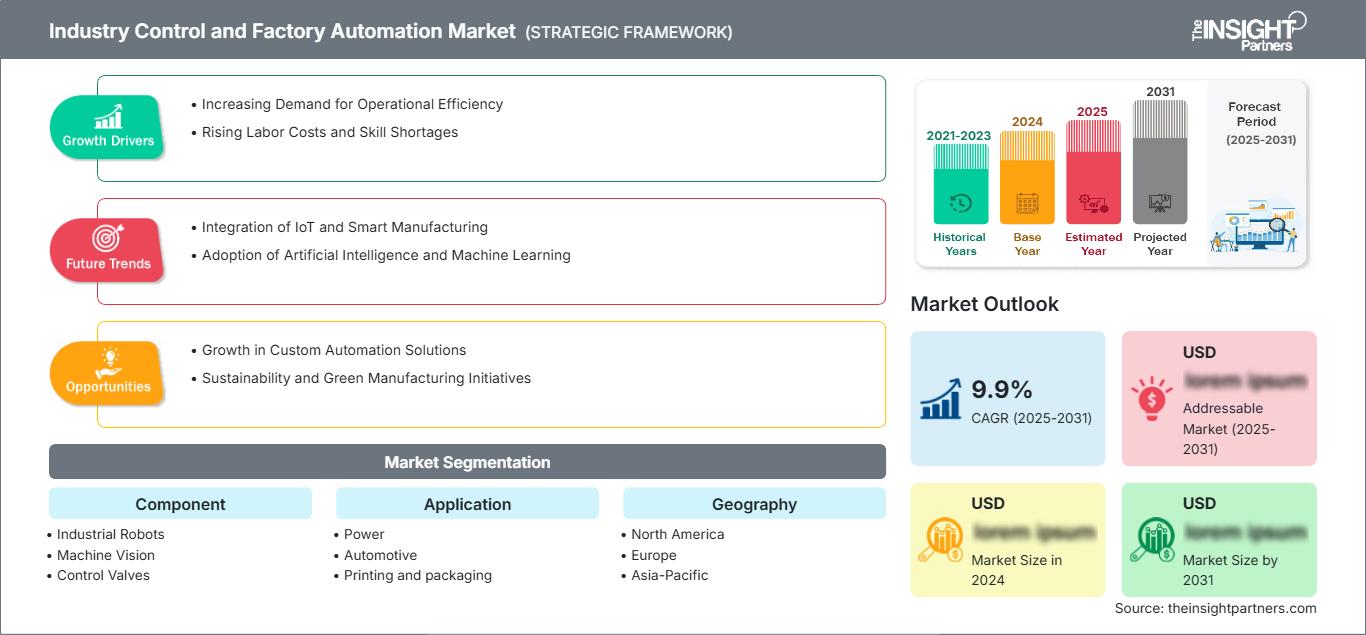
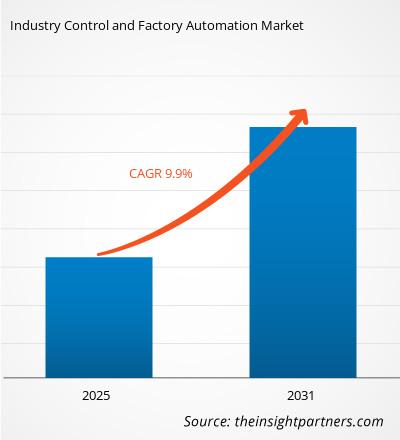
The global Industry Control and Factory Automation market was valued at US$ 180.72 billion in 2025 and is expected to reach US$ 337.8 billion by 2034; it is estimated to record a CAGR of 7.2% during 2026-2034.
Industry Control and Factory Automation Market Assessment and Insights
- North America: North America is estimated to account for a 28–32% share in 2025, supported by manufacturing modernization and intelligent automation investment, with a 7.8–8.7% CAGR between 2026–2034.
- US: The US represents 79–84% of North American revenue in 2025 and is expected to expand at a 7.9–8.8% CAGR between 2026–2034.
- Europe: Germany, the UK, France, Italy, and Spain contribute to a 23–27% share in 2025, with industrial digitization supporting a 7.0–7.9% CAGR between 2026–2034.
- Asia Pacific: China, Japan, South Korea, and India support a 35–39% share in 2025, while factory investment and electronics production underpin a 9.0–9.9% CAGR between 2026–2034.
- Largest Segment: Industrial Robots represent an estimated 22–26% market share in 2025, supported by automated production requirements, with a 9.1–10.0% CAGR during 2026–2034.
- High Growth Segment: Industrial 3D printing represents an estimated 5–8% market share in 2025 and is projected to grow at a 13.0–14.2% CAGR through 2034.
- Key companies analyzed in detail: AMETEK, Inc.; Bosch Rexroth AG; General Electric Company; Honeywell International Inc.; Mitsubishi Corporation; OMRON Corporation; Rockwell Automation, Inc.; Schneider Electric SE; Siemens AG; Yokogawa Electric Corporation.
Source: The Insight Partners' analysis based on proprietary research, government publications, company annual reports, investor presentations, industry databases, and expert interviews.
Control of the Industry and Factory Automation The market for factory automation is growing through developments from stand-alone machine control into connected production systems that involve robotics, sensing, vision, edge computing, analysis, and software-based control. Manufacturers are starting to use automation equipment along with digital twins and predictive functions to increase throughput, quality, efficiency, and productivity. Dynamics in the industry are moving towards the use of modular systems that can be phased in and operate alongside existing equipment.
Expansion in the future will be driven by investments in automation in Asia Pacific, reshoring in North America, and the upgrade of manufacturing capabilities in Europe. There is a growing need for cyber security, efficiency improvements, and the shortage of workers, all of which are motivating investments in automation beyond simple labor replacement. Standards and regulations in the industrial world are increasing the importance of secure connectivity, functional safety, machine interoperability, and lifecycle management for vendors.
Industry Control and Factory Automation Market Report Scope
| Report Attribute | Details |
|---|---|
| Market size in 2025 | US$ 180.72 Billion |
| Market Size by 2034 | US$ 337.8 Billion |
| Global CAGR (2026 - 2034) | 7.2% |
| Historical Data | 2021-2024 |
| Forecast period | 2026-2034 |
Industry Control and Factory Automation Market Analysis
Factors affecting demand include manufacturer desire for efficiency, quality, flexibility, and minimum unplanned downtime. Growth of Industry Control and Factory Automation Market involves robotics, machine vision, industrial sensing, control technology, and connected production software. Participants in the ecosystem include component makers, automation companies, system integrators, machine builders, software suppliers, distributors, and customers. Factors affecting supply include semiconductors, motion-control components, sensors, industrial networking devices, and engineering skills.
According to Industry Control and Factory Automation Market report, there is competition among wide-range automation products and unique technology solutions. Siemens AG, Schneider Electric SE, Rockwell Automation, Inc., and Honeywell International Inc. have control, software, instrumentation, and digital solutions while OMRON Corporation concentrates on sensing, robotics, machine vision, and factory automation technologies. Bosch Rexroth AG has motion and control technologies whereas Yokogawa Electric Corporation concentrates on process automation and instrumentation.
AMETEK, Inc. will be a participant via its technologies of measurement and industry, while General Electric Company is capable in both industrial systems and digital. On the part of Mitsubishi Corporation, it will contribute through the industrial eco-system as well as the company’s business connections, and strategic competition is now revolving around the platform, not the device itself.
● REPORT CUSTOMIZATION
Tailor This Report To Align With Your Specific Business Requirements
This report can be customized to align precisely with your business objectives, scope, and target markets. Customization options include tailored segmentation, geography, competitive analysis, and strategic insights to support informed decision-making.
Customize This Report →WHAT YOU CAN ADJUST
- ● Segmentations
- ● Geography
- ● Competitive Analysis
- ● Language Preferences
Industry Control and Factory Automation Market: Strategic Insights
Regional Insights
North America Industry Control and Factory Automation Market
North America is estimated to represent 28–32% of 2025 revenue and is projected to expand at a 7.8–8.7% CAGR through 2034. The US dominates regional activity, supported by automotive, aerospace, semiconductor, energy, pharmaceuticals, and advanced manufacturing investment. Reshoring programs and labor availability constraints are encouraging manufacturers to increase robotics, machine vision, industrial computing, and connected control deployments.
Canada’s role comes through energy, mining, food processing, and manufacturing. For Mexico, there will be benefits from the investment in terms of automotive and electronics supply chain. The consumer today wants interoperability, cybersecurity, predictive maintenance, and flexible automation that can respond to the production variation. There is now an increase in investment in industrial automation, from one machine to entire factory architectures.
U.S. Industry Control and Factory Automation Market
The US constitutes 79-84% of North American revenues in 2025 and is forecasted to register a 7.9-8.8% CAGR over 2034. Manufacturing modernization, semiconductor investments, aerospace manufacturing, automotive localization, and energy infrastructure all contribute to automation needs. Robotic assembly, machine vision, industrial analytics, process control, and automated inspection are some applications covered by an increasing number of automation providers.
Rockwell Automation, Inc., Honeywell International Inc., General Electric Company, AMETEK, Inc., and other traditional vendors have solid relationships within the industrial sector. Siemens AG, Schneider Electric SE, OMRON Corporation, and Bosch Rexroth AG also satisfy US demands for automation through their automation, motion, sensing, software, and control offerings. The purchase process puts more emphasis on lifecycle support, cybersecurity, interoperability, and productivity.
Europe Industry Control and Factory Automation Market
Europe is expected to have a 23-27% market share in 2025 and to grow at a 7.0-7.9% CAGR during 2025-2034. Germany is the most prominent in the region due to automotive, machinery, chemicals, and manufacturing. UK, France, Italy, and Spain add their share via aerospace, pharmaceuticals, food processing, energy, and industrial development.
UK focuses on increasing industrial productivity, advanced manufacturing, and digitalization, where automation can increase efficiency in labor-intensive and high value-added production processes. Germany stays ahead due to its broad machinery and automotive industry as well as industrial engineering sector. There are prospects for France in aerospace, pharmaceuticals, and energy sectors. Italy and Spain can benefit from machinery, food processing, automotive, packaging, and renewable energy investments.
APAC Industry Control and Factory Automation Market
The APAC region is expected to represent 35-39% of revenue in 2025 and register CAGR of 9.0-9.9% between 2025 and 2034. The top markets are, respectively, China, Japan, South Korea, India, and Australia. The APAC region is characterized by the availability of manufacturing scale, electronics production, automotive investments, and governmental efforts on digitalization.
The Chinese market is notable for substantial robotic and factory investments, Japanese one – for automation expertise, and the South Korean market – for electronics and semiconductors production. The Indian market is developing its industrial capacities and digital manufacturing, and the Australian one – mining, energy, and process industries opportunities.
Middle East & Africa Industry Control and Factory Automation Market
Middle East and Africa is projected to expand at a 7.1–8.0% CAGR through 2034, led by Saudi Arabia and the UAE. Energy diversification, petrochemical projects, utilities, infrastructure, and industrial development programs are increasing demand for control, instrumentation, and automated operations.
South Africa contributes through mining, manufacturing, and energy, while the rest of MEA remains driven by large industrial and infrastructure projects. Saudi Arabia leads regional opportunities because of industrial diversification and energy investment. The UAE benefits from smart infrastructure and advanced industrial facilities requiring connected automation and process-control technologies.
Segmentation Analysis
Component
Component is projected to expand at a 8.4–9.3% CAGR during 2026–2034. Industrial robots and machine vision are gaining importance as factories pursue flexible automation, while sensors, industrial PCs, HMIs, control valves, and field instruments remain essential to connected operations. Industrial 3D printing is developing rapidly in applications requiring customized tooling, components, and production flexibility.
- Industrial Robots: Industrial robots remain strategically important for repetitive, hazardous, and precision-intensive tasks, with automotive, electronics, metalworking, and packaging applications supporting broad deployment across automated production environments.
- Machine Vision: Machine vision supports automated inspection, measurement, identification, and quality control, allowing manufacturers to increase consistency while reducing dependence on manual inspection processes.
- Control Valves: Control valves remain fundamental to process industries because accurate flow, pressure, and temperature regulation directly affects safety, product quality, and energy efficiency.
- Field Instruments: Field instruments capture process variables and provide measurement inputs for control systems, remaining essential across oil and gas, chemicals, pharmaceuticals, and power facilities.
- Human-Machine Interface: HMIs provide operators with visualization, alarms, diagnostics, and control access, increasingly incorporating touch interfaces, remote monitoring, and data-rich visualization.
- Industrial PC: Industrial PCs provide computing infrastructure for machine control, visualization, edge analytics, and industrial software, with ruggedization supporting demanding factory environments.
- Sensors: Sensors form the data foundation for automation by capturing position, temperature, pressure, motion, presence, and other operating conditions throughout production systems.
- Industrial 3D printing: Industrial 3D printing enables customized tooling, rapid prototyping, lightweight components, and localized production, creating opportunities where conventional manufacturing has longer lead times.
Application
Application segment in the Industry Control and Factory Automation Market is forecast to grow at a 7.8–8.7% CAGR during 2026–2034. Automotive and power applications provide substantial demand because they combine high production volumes with stringent requirements for reliability and process control. Pharmaceuticals, chemicals, oil and gas, food processing, textiles, plastics, and packaging add diverse automation requirements, while OEMs influence technology selection through machine design.
- Power: Power facilities use automation for generation, transmission, distribution, monitoring, and asset management, emphasizing reliability, protection, and continuous process visibility.
- Automotive: Automotive production requires robotics, machine vision, motion control, inspection, and flexible manufacturing systems across assembly, welding, painting, and material handling.
- Printing and packaging: Printing and packaging operations prioritize high-speed motion, inspection, synchronization, and rapid changeovers, creating demand for integrated automation platforms.
- Oil and Gas: Oil and gas facilities require instrumentation, control systems, valves, safety systems, and remote monitoring across upstream, midstream, and downstream operations.
- Pharmaceuticals: Pharmaceutical manufacturing emphasizes process consistency, traceability, validation, cleanroom compatibility, and controlled production, supporting advanced automation and data-management systems.
- Textile: Textile manufacturers use automation for material handling, spinning, weaving, inspection, and production monitoring, with productivity and quality remaining central adoption factors.
- Chemical: Chemical plants depend on precise process measurement and control to manage temperature, pressure, flow, composition, safety, and energy consumption.
- Plastics: Plastics processing uses automation for molding, extrusion, material handling, quality inspection, and process optimization, supporting consistent production and reduced waste.
- Food processing: Food processing requires hygienic automation, inspection, packaging, traceability, and temperature control, creating demand for reliable integrated production systems.
- Original Equipment Manufacturers: OEMs integrate automation components into machines and production systems, influencing downstream adoption through standardized control architectures, motion systems, sensing, and software.
Opportunity Snapshot
| Application | Revenue Contribution (High/Medium/Low) | Trend Tag (MAX 2 words) | Adoption Stage (Emerging/Scaling/Mature) |
| Power | High | Grid Automation | Mature |
| Automotive | High | Robotic Assembly | Mature |
| Printing and packaging | Medium | Vision Inspection | Scaling |
| Oil and Gas | High | Process Control | Mature |
| Pharmaceuticals | Medium | Validated Automation | Scaling |
| Textile | Medium | Smart Looms | Scaling |
| Chemical | High | Process Optimization | Mature |
| Plastics | Medium | Automated Molding | Scaling |
| Food processing | High | Hygienic Robotics | Scaling |
| Original Equipment Manufacturers | High | Machine Integration | Scaling |
Industry Control and Factory Automation Market Growth Drivers and Impact Analysis
Labor constraints are accelerating industrial automation investment
Manufacturers are increasingly investing in automation where skilled-worker shortages, rising labor costs, and production variability constrain capacity. Robotics, machine vision, industrial PCs, and intelligent sensing can automate repetitive operations while allowing personnel to focus on higher-value tasks. The impact extends beyond labor substitution because automated systems can maintain consistent cycle times and quality across multiple shifts. Automotive, electronics, pharmaceuticals, food processing, and logistics are particularly suited to this transition. OEMs also benefit because standardized automation platforms can shorten machine development and simplify service. As manufacturers compare automation projects, return-on-investment calculations increasingly include productivity, quality, safety, energy consumption, and uptime. This broader economic case can support adoption even when initial capital expenditure remains substantial.
Industrial AI is converting machine data into operational decisions
Factories generate large quantities of data from sensors, controllers, vision systems, robots, and production equipment, but value depends on converting those signals into timely operational decisions. Industrial AI can support anomaly detection, predictive maintenance, quality inspection, process optimization, and engineering assistance. The market impact is increasing demand for edge computing, industrial PCs, connected sensors, and software capable of integrating operational data. AI also changes the role of automation hardware because control systems increasingly need computing capacity for analytics alongside deterministic control. Vendors are therefore combining automation platforms with data infrastructure and AI capabilities. Customers can benefit from reduced downtime and faster troubleshooting, while suppliers gain opportunities to expand from hardware sales into software, services, analytics, and lifecycle contracts.
Energy efficiency is becoming an automation investment criterion
Energy-intensive industries are placing greater emphasis on monitoring and controlling electricity, steam, compressed air, heat, and process energy. Automation systems can expose consumption patterns and coordinate equipment operation to reduce avoidable losses. Sensors, field instruments, variable-speed systems, control software, and analytics therefore increasingly contribute to sustainability initiatives as well as production management. The market impact is strongest in chemicals, metals, food processing, pharmaceuticals, oil and gas, and large manufacturing facilities where energy costs materially affect operating margins. Automation suppliers can strengthen project economics by connecting energy measurements with production data, allowing operators to evaluate efficiency at the machine, line, and plant levels. This approach expands automation investment beyond throughput and quality into measurable resource optimization.
Industry Control and Factory Automation Market Future Trends
Software-defined automation will reshape industrial system architecture
Industry Control and Factory Automation Market trends are increasingly moving toward software-defined architectures that separate automation functions from rigid hardware dependencies. Future systems are likely to use modular software, virtualized engineering environments, standardized interfaces, and more flexible computing infrastructure. This approach can simplify upgrades and allow manufacturers to introduce new analytics or control functions without replacing complete automation platforms. It may also encourage greater interoperability between suppliers and reduce dependence on proprietary architectures. Industrial customers could increasingly evaluate automation systems according to software portability, engineering productivity, cybersecurity, and lifecycle flexibility rather than hardware specifications alone. Vendors that support open development environments and modular deployment models may therefore gain an advantage as manufacturers modernize brownfield facilities while attempting to minimize production disruption.
Digital twins will become more operational and continuously connected
Digital twins are expected to evolve from engineering and simulation tools into continuously updated representations of operating assets and production systems. Future deployments may combine real-time sensor data, process models, maintenance records, production schedules, and AI-generated recommendations. This can support virtual commissioning, process optimization, predictive maintenance, and scenario analysis before physical changes are introduced. Greater integration with automation platforms will allow digital models to influence operational decisions rather than remaining separate engineering resources. Adoption should be strongest among complex manufacturers where downtime, commissioning delays, or process instability have significant financial consequences. As digital twins mature, interoperability between engineering, control, manufacturing execution, and enterprise systems will become increasingly important for delivering useful plant-wide models.
Industry Control and Factory Automation Market Opportunities
Modernization of brownfield industrial facilities
Industry Control and Factory Automation Market Forecasts indicate substantial opportunity in upgrading existing plants rather than relying solely on greenfield facilities. Brownfield manufacturers can improve productivity through targeted replacement of controllers, HMIs, sensors, drives, machine vision, industrial PCs, and networking systems while retaining valuable production assets. Suppliers can develop migration packages that preserve existing processes while introducing modern monitoring, cybersecurity, analytics, and remote-service capabilities. Financing and subscription models may further reduce barriers where customers are reluctant to undertake large capital projects. The strongest opportunities are likely to occur in older manufacturing clusters across North America, Europe, and Asia where installed equipment remains productive but lacks modern connectivity. System integrators can become important channels for delivering phased modernization.
Integrated automation for emerging manufacturing economies
Manufacturing expansion in India, Southeast Asia, the Middle East, and selected Latin American economies creates opportunities for automation suppliers to establish localized engineering, service, and training capabilities. New factories can adopt connected automation architectures from inception, avoiding some legacy constraints associated with older production sites. Suppliers can target automotive, electronics, food processing, pharmaceuticals, packaging, and energy projects where standardized automation platforms provide repeatable deployment models. Local partnerships can improve project execution by combining global technology with regional engineering expertise. Investment strategies should prioritize ecosystems rather than individual products, including distributors, machine builders, integrators, training centers, and software partners. This approach can support recurring service revenue while increasing the installed base of automation technologies across rapidly industrializing markets.
Recent Developments
- August 2026: Solen Software Group announced the acquisition of SHEA Global, an ERP consulting and implementation firm specializing in Syspro. The deal, which closed in May 2026, expands smrtr’s capabilities in ERP, manufacturing, distribution, and business-process automation.
- June 2026: Accenture agreed to acquire Industries eXcellence Group (IndX), a division of Engineering Group and long-standing Siemens Digital Industries partner. The acquisition strengthens Accenture’s software, data, and AI capabilities for modernizing manufacturing, product development, production, and supply-chain operations.
- July 2026: Control Engineering reported 20 automation-sector transactions in its July 2026 summary, spanning flow control, motion control, robotics, and related automation technologies. The activity highlights continued consolidation across industrial automation and control markets.
Frequently Asked Questions

- Comprehensive Market Sizing and Forecast Analysis
- Detailed Segmentation Analysis
- In-Depth Market Dynamics Assessment
- Regional and Country-Level Insights
- Competitive Landscape and Company Benchmarking
- Strategic Business Intelligence
Recent Reports
Testimonials

The Insight Partners' SCADA System Market report is comprehensive, with valuable insights on current trends and future forecasts. The team was highly professional, responsive, and supportive throughout. We are very satisfied and highly recommend their services.
RAN KEDEM Partner, Reali Technologies LTDs
I requested a report on a very specific software market and the team produced the report in a few days. The information was very relevant and well presented. I then requested some changes and additions to the report. The team was again very responsive and I got the final report in less than a week.
JEAN-HERVE JENN Chairman, Future Analytica
We worked with The Insight Partners for an important market study and forecast. They gave us clear insights into opportunities and risks, which helped shape our plans. Their research was easy to use and based on solid data. It helped us make smart, confident decisions. We highly recommend them.
PIYUSH NAGPAL Sr. Vice President, High Beam Global
The Insight Partners delivered insightful, well-structured market research with strong domain expertise. Their team was professional and responsive throughout. The user-friendly website made accessing industry reports seamless. We highly recommend them for reliable, high-quality research services
YUKIHIKO ADACHI CEO, Deep Blue, LLC.
This is the first time I have purchased a market report from The Insight Partners.While I was unsure at first, I visited their web site and felt more comfortable to take the risk and purchase a market report.I am completely satisfied with the quality of the report and customer service. I had several questions and comments with the initial report, but after a couple of dialogs over email with their analyst I believe I have a report that I can use as input to our strategic planning process.Thank you so much for taking the extra time and making this a positive experience.I will definitely recommend your service to others and you will be my first call when we need further market data.
JOHN SUZUKI President and Chief Executive Officer, Board Director, BK Technologies
I wish to appreciate your support and the professionalism you displayed in the course of attending to my request for information regarding to infectious disease IVD market in Nigeria. I appreciate your patience, your guidance, and the fact that you were willing to offer a discount, which eventually made it possible for us to close a deal. I look forward to engaging The Insight Partners in the future, all thanks to the impression you have created in me as a result of this first encounter.
DR CHIJIOKE ONYIA MANAGING DIRECTOR, PineCrest Healthcare Ltd.Reason to Buy
- Informed Decision-Making
- Understanding Market Dynamics
- Competitive Analysis
- Identifying Emerging Markets
- Customer Insights
- Market Forecasts
- Risk Mitigation
- Boosting Operational Efficiency
- Strategic Planning
- Investment Justification
- Tracking Industry Innovations
- Aligning with Regulatory Trends





 Get Free Sample for